
- Buying a skills platform without fixing your job architecture first is the single most common and costly mistake in skills-based organization rollouts.
- A skills taxonomy is not a product feature. It is a governance decision that requires cross-functional ownership, version control, and a refresh cycle.
- Manager behavior is the implementation variable that most skills transformation plans ignore and the one that determines whether the whole initiative succeeds or fails.
- Skills-based talent management only works when skills data connects across hiring, internal mobility, performance, and learning. A siloed skills inventory is just an expensive spreadsheet.
- The business case must be tied to a specific problem: reducing time-to-fill, cutting attrition, improving internal mobility rates, or closing a capability gap. “We want to be skills-based” is not a business case.
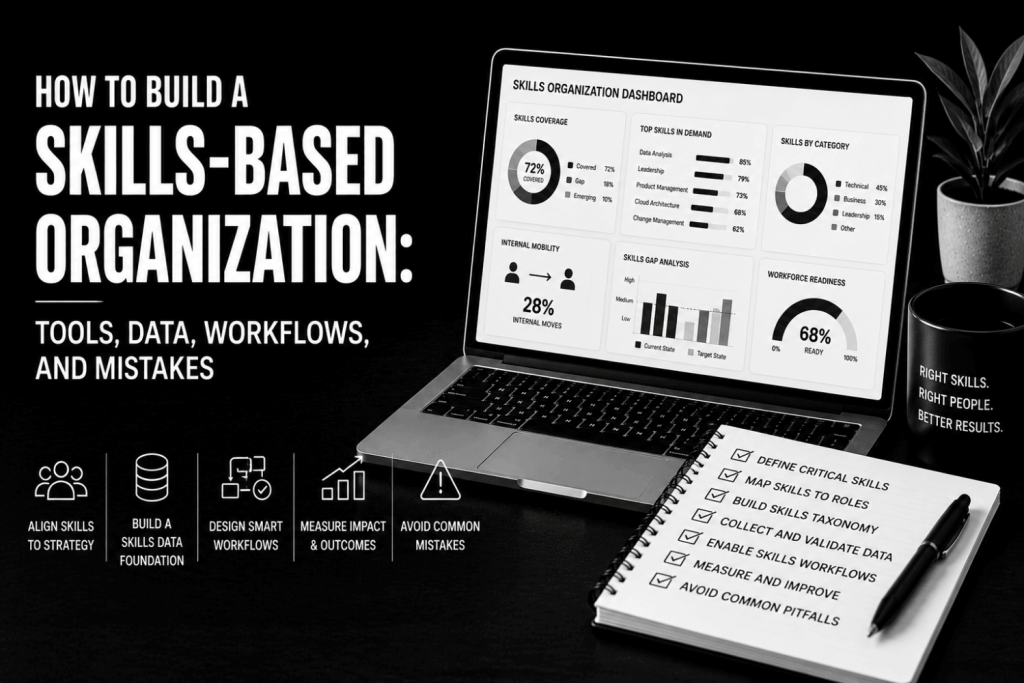
If you are trying to figure out how to build a skills-based organization, the honest answer is: it starts with data architecture and governance, not software. Building a skills-based organization means redesigning how your company identifies, develops, and deploys talent around verified skills rather than job titles or credentials. It requires a validated skills taxonomy, clean job architecture, skills data governance, workflows that surface skills at the point of decision, manager training, and software that connects these layers. Software alone does not produce a skills-based organization. The data model, governance, and behavior change do.
Why Most Companies Buy Software First and Fail
The pitch from skills platform vendors is compelling. They show you a demo where every employee has a rich, up-to-date skills profile, managers make staffing decisions in seconds, and internal mobility metrics improve within a quarter. Then you buy the platform and spend six months arguing about whether “project management” is one skill or twelve.
The underlying problem is that skills-based transformation is a data and governance problem dressed in a technology interface. The software cannot populate itself. It cannot decide whether your taxonomy should reflect current roles, future roles, or both. It cannot tell your managers to start looking at skill profiles instead of job history when filling an internal opening. Those decisions belong to people, not products.
Talent intelligence platforms like Eightfold, Gloat, and Beamery all offer skills inference and ontology features. They are genuinely useful once your foundation is in place. Without that foundation, they produce skills profiles that nobody trusts, adoption that stalls at early users, and eventually a shelfware problem that is expensive and embarrassing to explain to the board.
What Does “Skills-Based Organization” Actually Mean?
A skills-based organization structures work, hiring, compensation, and development around demonstrated or validated skills rather than around job titles, years of experience, or educational credentials. The logic is straightforward: a job title tells you what someone was called at a previous employer. A verified skill tells you what they can actually do.
In practice, this affects six major HR processes:
- Hiring: Job postings are written around skills, not degree requirements. Candidate evaluation weighs demonstrated capability over credential proxies.
- Internal mobility: Open roles are matched to employees based on adjacent skills, not tenure or title history.
- Workforce planning: Future headcount decisions are driven by skill gaps against a strategic capability model, not by replacing headcount one-for-one.
- Learning and development: Development investment is targeted at specific skill gaps, not generic training programs.
- Performance management: Employees are evaluated partly on skill growth, not just output or behavior.
- Compensation: Pay ranges consider market value of skills, not just job level or tenure.
Most companies start with one or two of these and try to connect the others over time. That sequencing is fine, but the connections matter. Skills data that lives only in your learning platform and never reaches your ATS or succession planning process is not skills-based talent management. It is a feature in a tool nobody outside of L&D looks at.
What Is a Skills Taxonomy and Why Does It Break Everything?
A skills taxonomy is a structured, hierarchical vocabulary of skills that your organization uses consistently across HR processes. A skills ontology extends this by mapping relationships between skills: which skills are adjacent, which are prerequisites for others, which cluster together into capability domains.
The distinction matters because an ontology is what makes AI-driven skills inference and internal mobility matching work. Without relationship mapping, a system cannot suggest that someone with Python and data modeling experience is a candidate for a data engineering role when they have never held that title.
Building your own taxonomy from scratch is almost always a mistake. The maintenance burden is brutal, and internal taxonomies tend to reflect your current org structure rather than the external labor market. Most organizations are better off starting with a licensed or open framework and customizing it. Options include the Lightcast (formerly Emsi Burning Glass) skills library, the O*NET occupational database, or the skills ontologies embedded in platforms like Eightfold, Beamery, or Workday Skills Cloud. Each has different depth, update frequency, and licensing considerations.
The governance question most organizations skip: who owns the taxonomy? Someone has to approve new skills, deprecate obsolete ones, and run a quarterly or annual refresh cycle. Without a named owner and a documented process, your taxonomy calcifies within eighteen months and starts reflecting the org chart of two years ago.
How to Audit Your Job Architecture Before Touching a Skills Platform
Job architecture is the prerequisite most implementation projects skip because it is unglamorous and politically complicated. It means having clean, consistent job families, levels, and role definitions across your organization before you try to map skills to them.
If your HRIS has forty-seven variations of “Senior Software Engineer” in the job title field because every hiring manager wrote their own, your skills mapping exercise will inherit that chaos. Skills platforms do not fix messy job data. They amplify it.
The audit has four steps:
- Pull every active job title from your HRIS and count the variants. Anything above three or four variants per job family is a signal your architecture needs work.
- Map existing roles to a standardized job family and level framework. This is the heavy lift, and it typically takes eight to sixteen weeks depending on org size.
- Define the five to ten skills that genuinely differentiate performance at each level within each job family. Do this with input from high performers and their managers, not from job description templates.
- Validate the resulting framework against the external labor market using a tool like Lightcast or your skills platform’s market data feed. Internal-only skill definitions drift from market reality fast.
Companies running Workday, SAP SuccessFactors, or Oracle HCM often discover their job architecture work is tied to their HCM configuration. If you are planning an HRIS change alongside a skills transformation, sequence the job architecture decisions before the system configuration, not after.
What Does Skills-Based Workforce Planning Actually Require?
Skills-based workforce planning replaces headcount-centric planning with capability-centric planning. Instead of asking “how many people do we need in product management next year,” you ask “what product management skills do we need, at what level, and how many people currently have them versus how many we will need.”
This sounds straightforward. Executing it requires three things most HR teams do not have simultaneously: a validated skills inventory for current employees, a strategic capability model tied to business goals, and a gap analysis methodology that finance and business leaders will accept.
The AI people analytics platforms that support skills-based workforce planning, including platforms like Visier, Orgvue, and One Model, are designed to model these gaps at scale. They work best when the skills data feeding them is clean and consistent. If your skills inventory is self-reported and unvalidated, your workforce plan is built on surveyed opinions, not verified capability.
Validation is the missing step in most skills inventory projects. Employees self-reporting skills through a LinkedIn-style profile is a starting point, not an endpoint. Validation methods include manager confirmation, skills assessments, project history analysis, and AI inference from work artifacts. Each has a different cost and accuracy profile. Self-report is cheapest and least reliable. Assessment-based validation is most reliable and most expensive to run at scale.
Which Workflows Actually Change in a Skills-Based Organization?
The organizational design question behind every skills transformation is this: at which decision points do people currently look at job title and tenure, and what would they need to see instead to look at skills? That list is the workflow change map.
Hiring
Skills-based hiring starts at the job requisition. Hiring managers need to write role requirements in terms of demonstrated skills, not years of experience or degree requirements. Most of them have never done this, and most ATS configurations do not make it easy. The workflow change requires requisition templates, manager training, and often an ATS configuration project.
Skills-based screening then means evaluating candidates on assessed skill evidence rather than resume proxies. Tools like skills assessments, structured work samples, or AI-driven skills inference from resumes can help. The skills-based hiring assessment category has expanded significantly, with vendors like Vervoe, Codility, Karat, and HackerRank all offering role-specific assessed screening.
Internal Mobility
Internal mobility is where skills-based logic pays off fastest and where resistance is highest. The barrier is manager behavior: most managers prefer to hire externally because they can write a precise spec. Matching an internal candidate based on adjacent skills requires more judgment and more willingness to invest in a development gap.
The workflow change is: when a role opens, the internal candidate pool is surfaced by skills match before external sourcing begins. AI internal mobility platforms like Gloat, Fuel50, and Eightfold do this matching automatically. But the process change , the expectation that managers actually interview the surfaced internal candidates rather than archiving the notification , has to be enforced through policy and manager accountability, not through the software alone.
Performance and Development
Performance management in a skills-based organization includes a skills growth component. That means defining target skill levels for each role, measuring current versus target, and connecting the gap to a development plan. Most performance management platforms support this, but few organizations have done the upstream work of defining target skill levels clearly enough for the feature to be useful.
Why Manager Adoption Is the Variable Nobody Plans For
Implementation plans for skills-based organizations almost always show a technology adoption curve, a communications plan, and a launch date. They rarely show a manager behavior change plan, which is strange because manager behavior is what determines whether skills data gets used or ignored.
Managers are the gatekeepers of internal mobility, development investment, and performance assessment. If a manager does not trust the skills profiles in the platform, does not know how to interpret a skills match score, or is incentivized to hoard their best people rather than develop them for other roles, the skills-based model collapses at the team level regardless of how good the software is.
The behavior changes you need from managers are specific:
- Look at skills profiles before conducting a requisition intake meeting.
- Interview at least one internal skills-matched candidate before external sourcing when one exists.
- Include a skills development conversation in quarterly check-ins.
- Rate skills on the defined proficiency scale, not with freeform comments.
Each of these requires a workflow prompt, a training touchpoint, and a consequence structure. “We want managers to be development-focused” is a value. “Managers who have three or more internal mobility moves from their team in a year are recognized in the annual people leadership review” is a mechanism. One produces compliance in a kickoff meeting. The other produces behavior change.
What Technology Do You Actually Need, and When?
The technology stack for a skills-based organization is not a single platform. It is a set of integrated capabilities, and the right sequence depends on where you are starting and what problem you are solving first.
| Capability Layer | What It Does | Representative Tools | When to Buy |
|---|---|---|---|
| Skills Taxonomy and Ontology | Defines and maintains the vocabulary of skills across the organization | Lightcast, Workday Skills Cloud, Eightfold ontology | Before any other layer. Everything else depends on it. |
| Skills Inventory and Inference | Captures, validates, and infers employee skill profiles | Eightfold, Beamery, Gloat, Workday HCM | After taxonomy is stable and job architecture is clean. |
| Workforce Planning | Models skill gaps at the team, function, and org level against strategic plans | Orgvue, Visier, One Model, Workday Adaptive | After inventory is populated and validated at meaningful coverage. |
| Internal Mobility Matching | Surfaces internal candidates for open roles and project staffing based on skills | Gloat, Fuel50, Eightfold, Phenom | After inventory exists. Most platforms recommend coverage above 70% of employees before matching quality becomes reliable , verify this threshold with your specific vendor during evaluation. |
| Skills-Based Hiring (External) | Assesses and screens candidates on verified skills rather than credentials | Vervoe, Codility, Karat, HackerRank, Pymetrics | Can start in parallel with internal work. Does not require internal inventory. |
| Learning Recommendation | Recommends learning content based on skill gaps | Degreed, 360Learning, Cornerstone, LinkedIn Learning | After skill gap data is defined and validated. Otherwise recommendations are generic. |
If you are running an enterprise HCM like Workday or SAP SuccessFactors, both have native skills cloud features worth evaluating before buying a point solution. The Workday AI, SAP Joule, and Oracle AI capabilities differ significantly in their skills graph maturity and integration depth. That comparison is worth running before you commit to a separate specialist platform, because integration costs and data duplication will matter more than feature differences in the long run.
What Are the Most Common Mistakes in a Skills-Based Organization Rollout?
The failures in this space follow consistent patterns. Understanding them before you start is more valuable than any vendor demo.
Starting with a skills self-assessment exercise with no validation plan
Self-reported skills profiles are a starting point. They are not a foundation for workforce planning decisions or performance calibration. Organizations that launch a “skills profile completion” campaign without a validation layer end up with data that overstates capability at senior levels and understates it in technical roles where people tend to be conservative self-assessors. The fix is building validation into the process design from day one, not retrofitting it after adoption stalls.
Building a skills taxonomy in isolation from the business
When HR builds the taxonomy without meaningful input from business leaders, engineering managers, and the functions that actually define what good looks like, you end up with a vocabulary that HR understands and nobody else uses. The taxonomy validation process should involve the people who will consume the data, not just the people who will maintain it.
Treating skills-based organization as an L&D initiative
Skills transformation programs that live inside L&D departments rarely scale. They produce a learning platform with skills tagging and a development plan template. They do not produce changes to how people are hired, how internal mobility decisions are made, or how workforce planning happens. Skills-based talent management requires joint ownership between talent acquisition, HRBP, compensation, and L&D, with a CHRO-level mandate that forces the functions to share data.
Underestimating the integration work
Skills data that lives in one system and cannot be read by others is an expensive island. The most common failure mode is a talent marketplace that has skills data but cannot push it to the ATS, cannot read from the performance platform, and cannot connect to the LMS. Evaluating the API and data integration capabilities of any skills platform before purchasing is as important as evaluating the feature set. The HR software buying checklist questions on data portability and integration architecture are directly relevant here.
Launching org-wide before proving value in one function
A pilot in one business unit, one job family, or one geography is almost always the right sequence. It surfaces the taxonomy problems, the manager resistance patterns, and the workflow gaps at a scale where they are correctable. Org-wide launches create political pressure to call early results a success regardless of data quality, which poisons the initiative for years.
How Do You Build the Business Case for a Skills-Based Organization?
The business case has to be tied to a problem that your CFO or CEO already cares about. “Becoming skills-based” is not a problem that finance teams fund. The following problems are:
- Time-to-fill is high because you are going external for roles that internal employees could fill with modest development investment.
- Attrition is concentrated in a specific talent segment because growth paths are opaque and employees cannot see what skills they need to advance.
- A major capability gap in AI or data engineering is slowing a product roadmap, and you have no clear view of how much of that gap already exists internally.
- Workforce planning is unreliable because headcount decisions are not grounded in capability data, only in org chart counts.
Connecting skills-based transformation to one of these problems creates a measurable outcome. Internal mobility ROI is one of the cleaner business cases: each internal fill typically costs significantly less than an external hire when you account for recruiting fees, onboarding time, and ramp-to-productivity. As an illustrative example of the kind of outcome worth targeting: if a skills-based pilot moves your internal fill rate from 15% to 25% of open roles, and you attach an average cost savings per internal fill, you have a CFO-ready number. Your actual baseline and target will depend on your industry and current mobility rate , build this from your own data rather than borrowing industry averages.
The skills intelligence software category has produced enough case study data on this that you can construct reasonable benchmarks. The skills intelligence platform comparison on this site covers vendors and their reported outcomes in more detail.
What Is Skills-Based Hiring and How Is It Different from Skills-Based Talent Management?
Skills-based hiring is the practice of evaluating external candidates on demonstrated skills rather than credentials, titles, or years of experience. It is one component of a skills-based talent management strategy, but it can be implemented independently, which makes it a useful starting point for organizations that are not ready for a full internal skills inventory.
Skills-based talent management is the broader operating model: hiring, developing, deploying, and rewarding employees based on skills data across the full talent lifecycle. Hiring is the front door. Internal mobility, succession, and development are the architecture behind it.
The two are related but not dependent. You can run a skills-based hiring program using structured assessments and redefined job postings without ever building a full skills taxonomy for existing employees. That is a legitimate Phase 1 for organizations that need a faster win and more time to do the internal data work.
Frequently Asked Questions
What is the difference between a skills taxonomy and a skills ontology in HR?
A skills taxonomy is a structured, hierarchical list of skills organized into categories and subcategories, giving your organization a consistent vocabulary. A skills ontology extends this by mapping relationships between skills: which are adjacent, which are prerequisites, and which cluster into capability domains. For practical HR use, a taxonomy is sufficient for inventory and assessment purposes. An ontology is required for AI-driven inference, skills-based matching, and career pathing recommendations. Most enterprise skills platforms, including Eightfold and Workday Skills Cloud, provide an embedded ontology rather than requiring you to build one.
How long does it take to build a skills-based organization?
A realistic timeline for a mid-market company (500 to 2,000 employees) running a scoped pilot is six to twelve months to reach meaningful skills coverage and process integration in one business unit. Org-wide transformation typically takes two to four years when you account for job architecture work, taxonomy validation, manager adoption, technology integration, and governance maturation. Vendors who quote three to six months for full deployment are describing platform configuration time, not business transformation. Based on practitioner experience across multiple implementations, those are different things with very different timelines , treat a vendor’s quoted configuration timeline as the floor, not the ceiling.
Do you need a dedicated skills platform or can Workday or SAP handle it?
Workday Skills Cloud and SAP SuccessFactors Skills Management have matured enough that mid-market and enterprise organizations on those HCMs should evaluate them seriously before purchasing a specialist point solution. The integration advantage of using native capabilities is significant. Specialist platforms like Eightfold, Gloat, and Beamery have deeper skills inference, broader labor market data, and more sophisticated ontologies, but they require integration work and create data duplication risks. The right answer depends on how mature your existing HCM skills features are, how complex your workforce is, and how much integration capacity your team has.
What is skills-based workforce planning?
Skills-based workforce planning replaces traditional headcount-focused planning with a model that identifies which skills the organization needs at what levels, assesses how much of that capability exists today, and plans how to close the gap through hiring, development, or restructuring. It requires a validated skills inventory, a strategic capability model aligned to business goals, and an analytics layer that can model scenarios. Without validated skills data, the planning model is based on opinion rather than evidence, which limits its credibility with finance and business leaders.
How do you validate employee skills at scale?
The four main validation methods are manager confirmation, third-party assessments, AI inference from work artifacts and activity data, and peer validation. Manager confirmation is fast but introduces bias. Third-party assessments are accurate but expensive at scale and resisted by senior employees who are uncomfortable being tested. AI inference from resumes, project data, and collaboration patterns is increasingly capable but requires careful bias auditing. Most organizations use a combination, starting with self-report, using manager confirmation as a filter, and reserving formal assessment for high-stakes decisions like succession and role transitions.
What governance model does a skills-based organization need?
At minimum, you need a named taxonomy owner, a documented process for adding and deprecating skills, a refresh cycle (quarterly or annual depending on how fast your industry moves), and a cross-functional steering group that includes HR, IT, and at least one business unit leader. Without a governance model, your taxonomy reflects the org chart of the day it was built and becomes less useful every month. Governance is the unsexy work that separates organizations with working skills data from organizations with expensive shelfware.
Can skills-based approaches introduce bias into hiring or promotion decisions?
Yes. Skills assessments can encode bias if the assessed skills are correlated with demographic characteristics rather than job performance. Skills inference from historical data can perpetuate historical patterns. The AI HR compliance and bias audit tools category exists specifically to address this problem. Any organization using AI-driven skills matching should define disparate impact monitoring as a contract requirement, not an optional audit. The EU AI Act classifies AI systems used in hiring and employment management as high-risk, which carries specific transparency and documentation obligations for EU-based organizations.
The Mental Model That Actually Helps
Think of a skills-based organization as a database with four tables: skills, people, roles, and business needs. The database only works if the tables are clean, consistently defined, and connected to each other. The software is the query interface. It cannot make bad data useful, and it cannot connect tables that were never linked.
The reason most implementations stall is not technology failure. It is that organizations purchase the query interface before they have the database. They get a beautiful platform with empty or unreliable skills profiles, a taxonomy that nobody owns, and a talent marketplace that managers ignore because the matches do not feel credible. That is a data and governance failure, not a software failure.
The organizations that succeed treat the first year as infrastructure work: job architecture, taxonomy governance, validation methodology, and a pilot use case with a business unit willing to run the experiment honestly. The second year is where the software starts to earn its cost. Sequence it that way, and you have a chance. Reverse the sequence, and you will spend two years explaining to your CFO why the platform you bought still has not delivered a measurable outcome.