
- Most HR teams treat compensation software as a single category. It is four: core comp management, market pricing and benchmarking, pay equity analysis, and pay transparency compliance. Buying one does not cover the others.
- A benchmarking survey subscription tells you where the market is. It does not tell you whether your pay decisions were fair, legally compliant, or defensible in a lawsuit.
- Pay transparency laws in Colorado, California, New York, Illinois, Washington, and a growing list of other states require salary range posting, recordkeeping, and audit trails that most HRIS platforms do not provide out of the box.
- The right tool for a 200-person company managing its first merit cycle is completely different from the right tool for a 2,000-person company running a pay equity regression analysis ahead of a board presentation.
- This page maps the total rewards technology stack by category. Each section links to deeper coverage so you can go straight to the tools relevant to your situation.
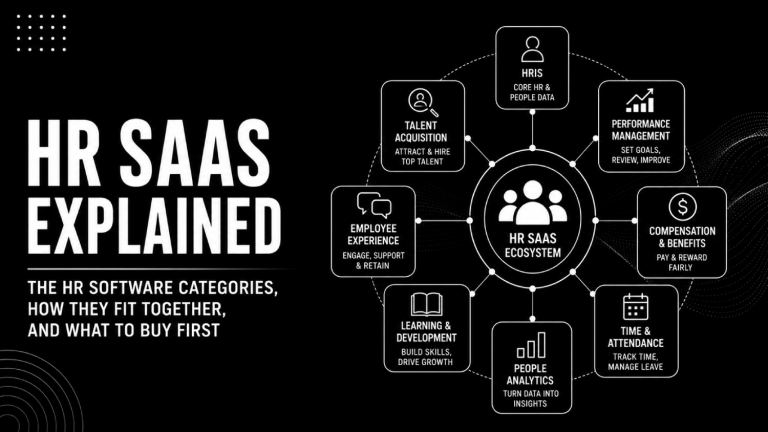
Total rewards technology is not one software category. It spans at least four distinct problem areas: running compensation cycles, pricing jobs against the market, auditing pay for equity gaps, and complying with pay transparency laws that now cover a material share of the US workforce. Each problem area has its own vendors, its own buyer, and its own implementation complexity. Buying a comp management module inside your HRIS and calling it done leaves three of those four problems unsolved.
Why Most Buyers Get the Total Rewards Tech Stack Wrong
The default assumption is that compensation software is a single category anchored to the HRIS. You buy Workday or BambooHR, activate the compensation module, maybe subscribe to a salary benchmarking survey, and assume you are covered. That assumption held up reasonably well when pay transparency was optional and pay equity lawsuits were rare.
Neither of those conditions is true anymore. State-level pay transparency laws now require employers to post salary ranges for roles in covered states, maintain records of how ranges were set, and demonstrate that ranges reflect market data. Pay equity litigation has expanded from simple equal-pay claims to regression-based statistical analysis of whether protected characteristics predict pay outcomes after controlling for legitimate factors like job grade, tenure, and performance. Your comp module cannot run a multivariate regression. Your survey subscription cannot generate a compliance audit trail.
The four categories of total rewards technology address four separate questions. What is the market paying for this role? Are we paying employees fairly relative to each other? Are our salary ranges legally defensible? And can we run a merit cycle without a spreadsheet? Answering all four requires four different tool types, and sometimes four different vendors.
How the Total Rewards Technology Stack Is Organized
The stack has a logical sequence. Market data feeds salary bands. Salary bands feed the equity analysis. Equity analysis informs what you post publicly. The merit cycle is where all of it gets executed. Each layer depends on the one below it.
| Layer | Problem It Solves | Primary Buyer | Key Terms |
|---|---|---|---|
| Core Comp Management | Running merit cycles, bonus allocation, approval workflows | Total rewards manager, HRBP | Merit cycle, compa-ratio, budget allocation |
| Market Pricing and Benchmarking | Setting pay ranges based on external market data | Compensation analyst, total rewards director | Market pricing, salary bands, geo differentials, job architecture |
| Pay Equity Analysis | Identifying and closing unexplained pay gaps by protected class | CHRO, legal, total rewards director | Pay gap analysis, regression analysis, adjusted vs unadjusted gap |
| Pay Transparency Compliance | Publishing salary ranges, maintaining audit trails, state law compliance | Legal, HR operations, total rewards | Pay transparency, range posting, compliance recordkeeping |
| Total Rewards Communication | Showing employees the full value of their comp and benefits package | HR generalist, benefits manager | Total rewards statement, benefits valuation |
Category 1: Core Compensation Management Platforms
Core comp platforms handle the annual or semi-annual merit cycle: budget pools, manager recommendations, approval chains, calibration, and letter generation. This is where most HR teams start, and for companies under 300 employees running straightforward merit cycles, this is often the only tool they need in the stack.
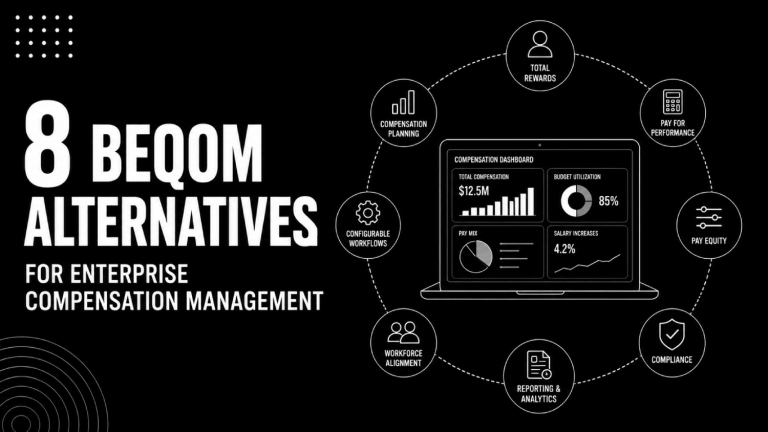
The key distinction here is whether the platform connects to performance data. A comp platform that cannot see performance ratings forces managers to open a separate tab during merit planning, which introduces errors and defeats the point of software. Our detailed coverage of compensation management software that connects to performance covers the leading platforms in this category, including Lattice Compensation, Deel, Rippling, Beqom, and others, with side-by-side feature and pricing comparisons. That article is the core spoke for this category. Start there if you are evaluating comp cycle tools.
Who Needs This First
Any company running merit cycles in spreadsheets. If your managers receive a shared Google Sheet during comp planning, the first tool you buy should be a core comp platform. Everything else in the stack assumes you have solved the basic cycle management problem.
Category 2: Compensation Benchmarking and Market Pricing Tools
Benchmarking and market pricing are related but not the same thing. A benchmarking subscription, such as those from Radford, CompData, or ERI Economic Research Institute, gives you survey data that represents what other companies report paying for a role. Market pricing is the process of taking that data and translating it into a defensible internal salary range for a specific job, in a specific location, at a specific level.
The gap between those two things is where most mid-market companies lose money. They buy a survey, pull the 50th percentile for a job title, and call that their pay range. That approach ignores job architecture alignment, geo differentials for remote workers in different cost-of-labor markets, and the difference between base pay and total cash. Tools built for market pricing, such as PayScale, Levels.fyi (for tech roles specifically), and CompAnalyst by ERI, add structure to that process.
Our article on the best compensation benchmarking tools for US mid-market companies compares these platforms in depth, including coverage, refresh frequency, and integration with comp management platforms.
The Salary Band and Job Architecture Problem
Market data is only useful if your internal job architecture is clean. A salary band for a “Senior Software Engineer” is meaningless if you have four different job titles doing the same work at different pay levels. Most companies building a comp tech stack for the first time discover that they need to clean up job architecture before the benchmarking data has anywhere to land.
Vendors like Aon Radford and Culpepper sell survey access alongside job leveling guidance. Standalone tools like PayScale Insight Lab and survey platforms often include job matching functionality, though the quality of that matching varies significantly. If your job architecture is a mess, no benchmarking tool fixes that automatically.
Geo Differentials and Remote Pay Policies
Geo differentials became a non-negotiable issue when companies went remote and distributed. Paying everyone at San Francisco rates is expensive. Paying everyone at national median rates loses candidates in expensive markets. The right answer is a location-based adjustment policy tied to cost-of-labor data, not cost-of-living data. Those two indices differ significantly for many markets. Tools that provide geo differential modeling, including ERI and PayScale, let you set a single range and then apply location-based adjustments without maintaining dozens of separate salary bands.
Category 3: Pay Equity Analysis Software
Pay equity analysis is a distinct technical problem that requires statistical methods most HR teams cannot perform in Excel. The goal is to determine whether, after controlling for legitimate pay factors like job level, tenure, performance, and department, employees in protected classes (gender, race, age, disability status) are paid less than comparable employees. That controlled analysis, called an adjusted pay gap analysis, is what matters legally and ethically. The unadjusted gap, the raw difference in average pay between men and women, for example, captures occupational sorting as much as pay discrimination.
Dedicated pay equity platforms run those regressions, flag outliers, and produce documentation you can share with legal counsel or regulators. Leading vendors in this space include Syndio, Trusaic, and PayAnalytics. Our head-to-head comparison of Syndio vs Trusaic vs PayAnalytics covers methodology differences, pricing models, and which platform fits which company size.
For a broader view of the category, our roundup of the best pay equity audit software platforms covers additional vendors including Trusaic, Syndio, Berkshire Associates, and others with coverage of specific use cases like OFCCP compliance and proactive remediation planning.
Who Owns Pay Equity Analysis Inside the Company
This is the category where the buyer is most often split between HR and legal. Pay equity audits produce results that are potentially privileged under attorney-client privilege if structured correctly, which means legal needs to be involved from the start. Total rewards directors usually run the analysis. Legal decides how to act on it. If your pay equity project sits entirely in HR without legal awareness, you are producing evidence that may not be protected.
How Often Should You Run Pay Equity Analysis
Annual is the minimum. Companies in highly regulated industries or those operating in states with active enforcement (California, Massachusetts, Illinois) should run analysis semi-annually or after major compensation events like a merit cycle or acquisition. The better pay equity platforms support continuous monitoring rather than point-in-time audits, which catches new gaps before they compound.
Category 4: Pay Transparency Compliance Tools
Pay transparency compliance is the newest and fastest-growing category in the total rewards tech stack. Colorado led with its Equal Pay for Equal Work Act in 2021. California, New York, Washington, Illinois, and a growing list of states and localities have followed. The requirements vary by jurisdiction but generally include posting salary ranges on job postings, providing ranges to employees upon request or promotion, and maintaining records demonstrating that ranges are grounded in market data.
Most HRIS platforms do not handle this out of the box. Posting a salary range in a job description is a recruiting workflow problem. Proving that range is defensible is a compensation data problem. Tracking which employees received range disclosures is a recordkeeping problem. Three separate workflows, three potential failure points.
Dedicated compliance tools like Syndio Pay Transparency, Trusaic, and PayScale include features specifically for building compliant salary ranges and generating audit trails. Our coverage of the best pay transparency compliance tools and our 17-point pay transparency compliance checklist provide the operational framework for both the tool selection and the compliance workflow.
Multi-State Compliance Is a Different Problem Than Single-State
If you are hiring in three states with transparency laws, you need a system that tracks which job postings are covered under which regulations, surfaces different requirements by jurisdiction, and flags when a new hire triggers a disclosure obligation. No spreadsheet handles this at scale. The software category built for this problem is small but growing. Most buyers in this situation are using either a dedicated pay transparency platform or a legal tech vendor with a comp data integration. Selecting purely on price here is a mistake: the cost of a non-compliant job posting or a missed employee disclosure is higher than the annual cost of most platforms in this category.
Category 5: Total Rewards Statement and Communication Platforms
Most employees significantly underestimate the total value of their compensation package because they see only the base salary number. Total rewards statement software generates personalized statements that show base pay, bonus, equity, benefits (with employer cost), retirement contributions, and any other elements of the package in a single view. The effect on perceived compensation value is consistently positive. An employee earning $90,000 in base with $25,000 in benefits, retirement matching, and equity who sees that as a $115,000 total package thinks differently about a $95,000 offer from a competitor.
Platforms in this category include Reward Gateway, Benify, Taulia, and dedicated total rewards statement tools like TotalRewards.com. Our comparison of the best total rewards statement software platforms covers usability, integration requirements, and which platforms work for companies that cannot export clean data from their HRIS.
The Integration Problem for Total Rewards Statements
Total rewards statements are only as good as the data feeding them. A platform that cannot pull benefits costs from your benefits administration system, equity data from your cap table tool, and retirement data from your 401(k) provider will require manual data entry, which defeats the purpose. Before evaluating statement vendors, map your data sources and assess which ones have APIs or export capabilities. Most mid-market companies have at least one system that requires a manual data pull, usually the 401(k) provider.
Category 6: Sales Compensation and Incentive Management
Sales compensation sits at the intersection of total rewards and revenue operations. The tools in this space, including CaptivateIQ, Varicent, Xactly, and Anaplan, manage commission structures, quota attainment, and incentive payouts for sales teams. This is technically a total rewards problem but it is almost always owned by revenue operations or finance rather than HR total rewards.
The reason it belongs in the total rewards stack discussion is that it creates comp equity problems when left unconnected. A sales rep’s total cash compensation may exceed an engineering director’s by a factor of two or three in a good quarter, which creates internal equity tension that total rewards leaders need visibility into. Our coverage of the best sales compensation and incentive management software covers this category in depth.
What Does a Total Rewards Technology Stack for a 500-Person Company Actually Look Like?
A 500-person company with one total rewards manager and one compensation analyst typically needs three tools, not four or five. The stack builds in a specific sequence based on what hurts most.
| Stage | Trigger | Tool to Buy | Approximate Category |
|---|---|---|---|
| 1 | Merit cycle runs in spreadsheets, managers complain | Core comp management platform | Cycle management |
| 2 | Offers are inconsistent, turnover in competitive roles | Benchmarking survey + market pricing tool | Market pricing |
| 3 | Hiring in Colorado, NY, CA, IL, or WA | Pay transparency compliance tool | Compliance |
| 4 | Board or legal asks about pay equity | Pay equity analysis platform | Equity analysis |
| 5 | Benefits renewal conversation reveals employees do not value the package | Total rewards statement platform | Communication |
Most 500-person companies are at Stage 2 or 3. Very few need all five simultaneously unless they are preparing for an IPO or responding to a pay equity complaint. Sequencing the stack correctly prevents buying tools you are not ready to use.
For the HRIS layer that underpins all of this, our comparison of the best HRIS platforms for 500-employee companies covers which platforms have native comp modules worth using versus which ones require a third-party integration.
How Do Market Pricing Tools Differ From Salary Benchmarking Survey Subscriptions?
A benchmarking survey is a data source. It collects pay data from participating companies and reports percentile distributions by job family, level, and geography. You get a spreadsheet or a dashboard showing what the 25th, 50th, and 75th percentiles are for a given role. That data is backward-looking (usually 6 to 12 months old) and dependent on who participated in the survey. If your industry or role is under-represented in the survey panel, the data is thin.
A market pricing tool adds a workflow layer on top of that data. It matches your internal job architecture to survey job families, applies geo differential adjustments, calculates where each employee sits within the range (compa-ratio), flags outliers, and generates documentation. Some tools, including PayScale and CompAnalyst, combine the data and the workflow in a single platform. Others, like Radford, sell the survey data and provide tools for accessing and slicing it, but expect you to do the range-setting work in your own comp platform.
The practical difference: a survey subscription answers “what is the market paying?” A market pricing tool answers “what should our salary range for this specific job be, given our location mix, pay philosophy, and job architecture?” Smaller companies often need only the survey. Companies with complex job families, multiple locations, and frequent leveling decisions need the full workflow tool.
What Software Do You Need to Comply With Pay Transparency Laws Across Multiple States?
Multi-state pay transparency compliance requires three things working together: a current salary range for every posted role, documentation showing how that range was determined, and a process for providing ranges to existing employees upon request or at certain employment milestones. No single off-the-shelf HRIS module covers all three.
The minimum viable stack for multi-state compliance includes a market pricing tool that generates defensible ranges and exports them in a format your ATS can consume for job posting, a comp management platform that stores current ranges against each job code, and a recordkeeping process (which some pay transparency compliance platforms automate) for employee-facing disclosure requests. Companies operating in four or more covered states typically invest in a dedicated pay transparency tool that maintains a jurisdiction map and flags when a new hire or job posting triggers a specific state’s requirements.
Our pay transparency compliance checklist walks through the state-by-state requirements. Before buying any tool in this space, confirm which states you are actively hiring in and which require disclosure to existing employees in addition to candidates. Those two requirements point to different workflows and different software features.
Do You Need a Compensation Consultant Before Buying Comp Technology?
For most companies under 300 employees, no. The tools are self-service enough that a capable total rewards manager or senior HRBP can implement them. For companies doing a ground-up job architecture redesign, preparing for an IPO, responding to a pay equity complaint, or integrating comp systems after an acquisition, a compensation consultant adds real value and pays for itself in avoided mistakes.
Major consulting firms offer total rewards advisory work alongside their HR transformation practices. Our comparison of the best compensation consulting firms covers independent firms and boutiques that specialize specifically in comp strategy and job architecture, including firms that are vendor-neutral and can help you select the right technology rather than just implementing a product they already sell.
How Compensation Technology Connects to Performance Management
Compensation decisions that are disconnected from performance ratings produce pay outcomes that feel arbitrary to employees and are difficult to defend to managers. The link between performance and pay requires data integration: performance ratings from your performance management system need to flow into your comp planning tool so managers can see the full picture when making merit recommendations.
Most enterprise HCM platforms (Workday, SAP SuccessFactors, Oracle HCM) include both modules and pass data natively. Mid-market companies using point solutions for performance and comp often rely on manual exports or a middleware integration. If you are evaluating whether your current performance platform connects cleanly to your comp workflow, our article on best performance management software for mid-market companies covers which platforms include native comp connections and which require integration work.
Frequently Asked Questions
What is the difference between pay equity and pay transparency?
Pay equity is an internal analysis of whether employees are paid fairly relative to each other after controlling for legitimate pay factors. It requires statistical analysis of your own workforce data. Pay transparency is an external requirement, set by state law in a growing number of US states, to disclose salary ranges to candidates and in some cases to current employees. They address different problems and require different tools. A company can be transparent about its ranges while still having significant internal equity gaps, and vice versa.
What is a compa-ratio and why does it matter for comp technology?
A compa-ratio is an employee’s actual pay divided by the midpoint of their salary range, expressed as a percentage. A compa-ratio of 100 means the employee is paid exactly at the midpoint. Below 100 means they are paid below midpoint; above 100 means above. Comp platforms calculate compa-ratios automatically once salary bands are loaded. This single metric drives most merit cycle decisions: managers see who is below midpoint and prioritize accordingly. Without defined salary bands, compa-ratio has no meaning, which is why market pricing precedes cycle management in the stack sequence.
How often should salary bands be updated?
At minimum, once per year, aligned with the merit cycle. Companies in fast-moving labor markets, particularly technology, should review bands semi-annually. The benchmarking data underlying your bands typically has a 6 to 12 month lag, so annual updates using fresh survey data are standard practice. Some market pricing tools support continuous market data feeds that flag when a band has drifted significantly from current market rates, which is particularly useful for high-demand job families where you are losing offers to competitors.
Can an HRIS handle pay equity analysis on its own?
No HRIS currently on the market for mid-market companies runs a statistically rigorous pay equity regression natively. Workday has some equity analysis features, but legal and total rewards teams at companies taking pay equity seriously use dedicated platforms like Syndio, Trusaic, or PayAnalytics. The methodological standards required for a defensible audit, including control variable selection, regression diagnostics, and remediation modeling, are beyond what a general-purpose HRIS builds for. This is one of the clearest examples of a category where the HRIS module is not a substitute for the specialist tool.
What is the typical cost of pay equity analysis software?
Pricing for pay equity platforms is not publicly listed by most vendors. Syndio, Trusaic, and PayAnalytics all use quote-based pricing, typically structured around employee count and scope of analysis. Based on publicly available information from compensation consultants and buyers who have disclosed contract ranges, companies with 500 to 2,000 employees generally budget in the range of $30,000 to $80,000 annually for a dedicated pay equity platform, though pricing varies considerably based on scope, frequency of analysis, and whether remediation modeling is included. The relevant comparison is not the software cost against other HR tools but against the cost of defending or settling a pay equity complaint, which routinely reaches seven figures for mid-market companies.
Do small companies (under 200 employees) need total rewards technology?
At under 200 employees, a core comp management platform is often the only tool that makes sense. A benchmarking survey subscription is worth it from the first hiring decision because it prevents setting offers by instinct. Pay equity analysis at this size can be done by a consultant running a one-time statistical analysis rather than a full platform subscription. Pay transparency compliance tools become necessary the moment you are posting roles in covered states, regardless of company size. Most state laws apply to all employers, not just large ones.
How does the total rewards stack connect to people analytics?
Compensation data is some of the most valuable input into workforce analytics. Turnover analysis by pay band, flight risk modeling that includes compa-ratio as a predictor, and headcount cost forecasting all depend on clean, structured comp data. Companies that have invested in people analytics but have messy comp data find their models are unreliable because pay is one of the strongest predictors of retention. Our coverage of the best AI people analytics platforms notes which platforms have native comp data connectors and which require custom integration work.
Where to Go From Here
The most common mistake in building a total rewards technology stack is buying horizontally before building vertically. Buying five tools that each do their job at 60% quality is worse than buying two tools that each do their job at 95% quality. Start with whatever is causing the most pain right now, solve it completely, and then move to the next layer.
For most companies reading this at 200 to 500 employees, the sequence is: core comp platform first, benchmarking data second, pay transparency compliance third if you are hiring in covered states. Pay equity analysis is the fourth investment, not the first, and it is the one most likely to need outside consultation on methodology before you buy software. Total rewards communication tools are the final layer, and they are only effective if the underlying data is clean.
Each category in this hub links to a dedicated spoke article with vendor comparisons, pricing detail, and selection criteria. Use the section most relevant to your current problem, not this hub page, to make your actual buying decision. The goal of this page is to show you the shape of the full stack so you buy the right tool in the right order, not to sell you on any single vendor.