
- Most companies believe their spreadsheet-based merit cycle is working because nobody has quantified what it costs when it breaks quietly on budget overruns, out-of-range employees, and manager overrides.
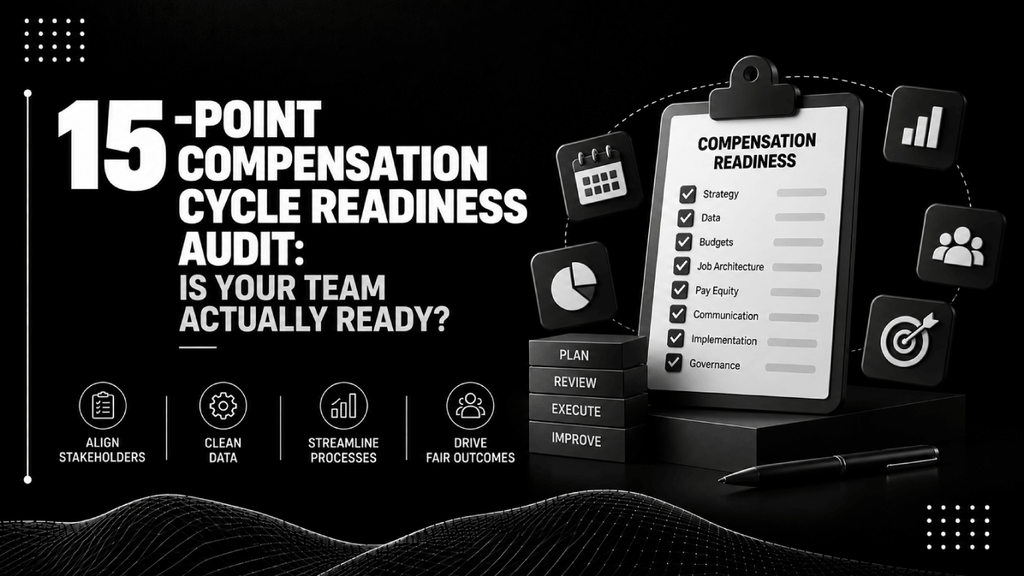
- A compensation review cycle has fifteen distinct readiness conditions. Most HR teams entering their cycle can confirm fewer than ten of them.
- The failures that hurt most, budget overage, salary compression, and missing letter generation, happen at the end of the cycle, after weeks of manager work that cannot be undone.
- This audit is designed to surface gaps before you open the planning window, not after managers have already submitted their recommendations.
- Dedicated compensation planning software prevents silent budget drift because it enforces guardrails in real time rather than reconciling after the fact.
A compensation review cycle readiness audit is a pre-cycle checklist that confirms your salary data, budget parameters, manager guidelines, approval workflows, and letter generation process are all in order before you open merit planning to managers. Teams that skip this audit discover their gaps only after the cycle closes, when payroll adjustments are already locked.
Every year, HR teams at companies from 200 to 2,000 employees open their merit cycle with spreadsheets they trust because last year went fine. Then, sometime in week three, a senior manager submits recommendations that blow their department budget by 40 percent, or HR discovers that 18 percent of the workforce is below range minimum and nobody flagged it during planning. By then, correcting course requires reopening submissions, having uncomfortable conversations with managers who thought they were done, or absorbing the budget damage quietly. This audit exists to prevent that. Use it before you set a cycle launch date.
Why Do Spreadsheet Compensation Cycles Fail Silently?
Spreadsheet cycles fail silently because they lack real-time constraint enforcement. A manager can enter a 12 percent merit increase for a high performer, see no warning, submit the form, and move on. HR sees the overage only when aggregating all submissions, often days later. The budget is already committed in the manager’s mind.
The second failure mode is data staleness. The salary data in your planning spreadsheet is only as current as the last export from your HRIS. If someone received an off-cycle adjustment after that export, your planning numbers are wrong from day one. Out-of-range employees, those sitting below band minimum or above band maximum, are especially likely to be missed this way because their exceptions are not visible at a glance in a flat file.
Third, spreadsheets have no approval workflow. You can build one with email chains and status columns, but there is no enforcement mechanism. A manager can skip their director’s review and submit directly. HR has no way to know without manually auditing submission timestamps. Purpose-built compensation management software enforces workflow, budget, and band compliance in the system rather than relying on everyone following email instructions correctly.
The 15-Point Compensation Cycle Readiness Audit
Work through each checkpoint before opening your planning window. A “no” or “unsure” on any of the first eight points should be resolved before managers receive access.
Section 1: Data Foundation (Points 1 to 4)
1. Is your HRIS employee data clean, current, and reconciled to payroll? Run a headcount report from your HRIS and compare it to your payroll register. Any discrepancy means your planning population is wrong before you start. Terminated employees in the planning file waste manager time. Active employees missing from it skip the cycle entirely.
2. Are salary bands current and loaded into your planning tool? If you updated bands after your last compensation review, confirm those updates are reflected in whatever system managers will use. Stale bands produce meaningless compa-ratio calculations and allow managers to recommend increases that look compliant but are not.
3. Have you identified every out-of-range employee? Pull a full compa-ratio distribution before the cycle opens. Flag anyone below band minimum (below 80 percent compa-ratio is a common threshold, though your bands may differ) and anyone above maximum. These employees need a deliberate decision, not the default merit workflow. If you do not flag them before the cycle, managers either ignore the issue or make ad hoc decisions with no consistency.
4. Are recent off-cycle adjustments reflected in base salary data? If you promoted five people in the last 60 days, their new salaries must appear in the planning data. Off-cycle adjustments that post after your data freeze date create ghost records where the system shows one number and payroll holds another.
Section 2: Budget and Guidelines (Points 5 to 8)
5. Is your total merit budget approved and translated into department-level allocations? Finance approves a total number. HR must translate that into per-department budgets before the cycle opens. If managers see only a company-wide figure, they cannot make tradeoffs. Budget allocation discipline is what separates a controlled cycle from a free-for-all.
6. Do manager guidelines exist in written form, and are they specific? “Be thoughtful with merit increases” is not a guideline. Managers need to know the target range by performance rating (e.g., top performers receive 4 to 6 percent, meeting-expectations employees receive 1.5 to 3 percent), whether lump sums are available, and what the hard ceiling is on any single recommendation. Without specifics, managers guess, and their guesses aggregate into budget overages.
7. Have you modeled the budget impact of your guideline ranges? Before publishing guidelines, run the math. If every employee rated “meets expectations” receives the midpoint of your guideline range, does that fit within your budget envelope? Many HR teams set guidelines without testing whether full compliance would stay on budget. A quick scenario model prevents a cycle where following the rules still breaks the budget.
8. Do you have a process for handling manager overrides? Define in advance what happens when a manager recommends an increase outside the guideline range. Who approves the override? Does it require justification in the system? Does it come from a separate discretionary pool? Without this defined before the cycle opens, every override becomes a one-off negotiation that HR has to manage manually while also closing the main cycle.
Section 3: Process and Workflow (Points 9 to 12)
9. Is your approval chain mapped and confirmed with each approver? For most companies, the chain runs manager to director to VP to HR business partner to total rewards. Every person in that chain needs to know they are in it, what their approval window is, and what happens if they miss the deadline. If you are discovering during the cycle that a VP thought they were not in the approval chain, you have lost days. Mapping this beforehand and confirming with each approver in writing takes one hour and prevents two days of cycle delay. Tools that handle performance calibration often have approval workflow built in, which is worth checking against your comp tool’s capability.
10. Is there a calibration session scheduled before managers submit recommendations? Calibration sessions align managers on performance ratings before merit recommendations are entered. If managers submit recommendations before calibration, you get merit decisions built on inconsistent rating distributions. The calibration session does not have to be long, but it must happen before the planning window opens, not after.
11. Do you have a plan for employees on leave during the cycle? Parental leave, medical leave, and extended LOA create gray areas. Does the employee’s manager still submit recommendations on their behalf? Does HR handle them centrally? Is there a default treatment? Decide this before the cycle so you are not making it up when the question arrives mid-process, which it always does.
12. Have you accounted for multi-currency or multi-country populations? If any portion of your workforce is paid in a currency other than USD, your budget modeling must include exchange rate assumptions. A merit cycle that looks on-budget in USD can exceed budget in local currency terms if exchange rates shift between modeling and payment. Define your rate assumption and lock it.
Section 4: Communication and Letter Generation (Points 13 to 15)
13. Are merit increase letters templated and legally reviewed? Letter generation is the step most teams treat as an afterthought. If you have 400 employees receiving increases, generating individual letters from a spreadsheet is a half-day of manual work with meaningful error risk. Template them in advance, have legal or HR counsel review the language (particularly around any language that could be read as a guarantee), and confirm how they will be delivered, through the HRIS, via PDF, or by manager hand-off.
14. Is your communication timeline set for employees, managers, and executives? The sequence matters. Executives should see aggregate results before managers are notified of approvals. Managers should know their team’s outcomes before employees do. Employees should receive communication before the increase appears in their paycheck, not on the same day. Map the communication sequence and attach actual dates to it before the cycle opens.
15. Do you have a post-cycle audit process for budget reconciliation? After all recommendations are approved, run a final reconciliation against your original budget. Confirm total spend by department and flag any departments that came in more than five percent over their allocation. Capture the reasons for overages now, while context is fresh, rather than in six months when Finance asks why the compensation line came in high. This step also feeds your modeling for next year’s guidelines.
What Does a Compensation Cycle Readiness Scorecard Look Like?
| Checkpoint | Category | Ready Before Cycle Opens? | Risk If Skipped |
|---|---|---|---|
| HRIS data reconciled to payroll | Data Foundation | Yes / No / In Progress | Wrong planning population |
| Salary bands current in planning tool | Data Foundation | Yes / No / In Progress | Meaningless compa-ratio output |
| Out-of-range employees identified | Data Foundation | Yes / No / In Progress | Compression missed; inconsistent treatment |
| Off-cycle adjustments reflected | Data Foundation | Yes / No / In Progress | Double-counting or missed eligibility |
| Budget approved and allocated by dept. | Budget and Guidelines | Yes / No / In Progress | No meaningful manager constraint |
| Written manager guidelines exist | Budget and Guidelines | Yes / No / In Progress | Inconsistent recommendations |
| Budget impact of guidelines modeled | Budget and Guidelines | Yes / No / In Progress | Compliant submissions exceed budget |
| Override process defined | Budget and Guidelines | Yes / No / In Progress | Ad hoc overrides, no audit trail |
| Approval chain confirmed with each approver | Process and Workflow | Yes / No / In Progress | Delays, missed approvals |
| Calibration session scheduled | Process and Workflow | Yes / No / In Progress | Merit built on inconsistent ratings |
| Leave policy for cycle defined | Process and Workflow | Yes / No / In Progress | Inconsistent employee treatment |
| Multi-currency assumptions locked | Process and Workflow | Yes / No / In Progress | Budget overruns from FX movement |
| Letter templates reviewed and ready | Communication | Yes / No / In Progress | Manual errors; legal exposure |
| Communication sequence with dates set | Communication | Yes / No / In Progress | Employees learn outcomes out of order |
| Post-cycle reconciliation process defined | Communication | Yes / No / In Progress | Budget variance untracked |
Print or export this table. Any row marked “No” or “In Progress” at cycle launch is a known risk you are accepting. The goal of this audit is not perfection on day one; it is making the risk-acceptance decision consciously rather than stumbling into it.
How Do Companies Avoid Manager Overrides Breaking the Merit Budget?
The honest answer is that spreadsheet-based cycles cannot reliably prevent it. A manager who knows their recommended 10 percent increase will be scrutinized can simply split the recommendation across base and a one-time payment, or describe it as an off-cycle promotion request submitted alongside the merit file. Without system-enforced guardrails, your only defense is manager goodwill and HR vigilance, neither of which scales.
Compensation planning tools prevent override abuse through three mechanisms. First, they enforce hard budget ceilings at the department level in real time, so the system will not accept a submission that puts the department over its allocation without triggering an escalation flag. Second, they require structured justification for any recommendation outside the guideline range, creating an audit trail that HR can review without chasing email threads. Third, they separate the planning interface from the approval interface, so the person entering recommendations and the person approving them cannot be the same individual without an explicit permission override that HR controls.
If you are running your first formal merit process and considering purpose-built tooling, the compensation benchmarking tools evaluation alongside your planning tool evaluation is worth doing together, because market data integration is a feature that separates useful tools from expensive spreadsheets with a nicer UI.
What Should Be Ready Before Opening a Compensation Planning Cycle?
Before managers receive access to the planning interface, four things must be true: your employee data matches payroll, your bands are current, your budgets are allocated by department, and your guidelines are in writing. These are not optional preparation steps. A cycle launched without them will require human intervention to correct errors that the system has no mechanism to catch.
Beyond those four non-negotiables, your calibration session should already be complete, your approval chain should be confirmed, and any populations with special treatment rules (out-of-range employees, employees on leave, international employees with FX exposure) should have documented handling instructions. The cycle itself is a data-entry and approval event. All the judgment work should be done before it opens.
What Does This Mean for First-Time Formal Merit Processes?
If this is your first structured merit cycle, you are likely moving from a model where founders or department heads made ad hoc pay decisions throughout the year. That history creates two specific problems that this audit will surface. First, your salary data is probably messy because nobody audited it during the ad hoc phase. Employees may have received increases that were never entered correctly, or their job titles may not match the bands you are now trying to apply. Block time for a data cleaning sprint before building your planning file.
Second, your managers have no experience with guidelines. They are accustomed to having full discretion. The first merit cycle with actual constraints will surface resistance, particularly from high-growth team leads who are used to retaining people by matching outside offers immediately. Your written guidelines, override process, and calibration session do double duty here: they enforce budget discipline and they set a new cultural expectation about how pay decisions are made. If you have a performance management platform that feeds rating data into your compensation tool, lean on it, because having managers see their team’s rating distribution before they open the merit form reduces the “I rated everyone a 4 to justify big increases” problem significantly.
For a broader view of how compensation tooling fits alongside performance and people analytics in a mid-market HR stack, the best HR software platforms for mid-market companies review covers where comp planning sits relative to adjacent tools worth evaluating at the same time.
How Does Compensation Planning Software Address These 15 Checkpoints?
Purpose-built tools do not eliminate the need for this audit. They enforce outcomes on roughly half the checkpoints automatically, and they make the other half faster to complete.
| Checkpoint | Spreadsheet Approach | Comp Planning Software |
|---|---|---|
| Out-of-range employee identification | Manual filter on exported data | Auto-flagged in planning view |
| Budget tracking during planning | Aggregate after close | Real-time by department |
| Manager override control | Email-based escalation, no enforcement | System-enforced with justification required |
| Approval chain enforcement | Email tracking, manual audit | Workflow routing, automated reminders |
| Letter generation | Mail merge, high error risk | Templated, system-generated at cycle close |
| Post-cycle reconciliation | Manual rebuild from submissions | Exportable report at close |
| FX handling for global teams | Manual conversion column | Built-in currency management (varies by vendor) |
Vendors worth evaluating for mid-market compensation planning include Payscale, beqom, Lattice Compensation, HiBob‘s compensation module, and Workday‘s compensation module for teams already on the HCM. Pricing for all of these is quote-based and varies significantly by headcount and feature tier. The beqom alternatives review covers the enterprise end of this category in detail if you are operating above 1,000 employees and need a tool built for complex plan structures.
Frequently Asked Questions
What is a compensation review cycle checklist?
A compensation review cycle checklist is a structured list of conditions that must be true before you open merit planning to managers. It covers data accuracy, salary band currency, budget allocation, manager guidelines, approval workflow, calibration scheduling, and letter generation readiness. Its purpose is to surface gaps before the cycle opens, when corrections are cheap, rather than after submissions are in, when corrections require reopening the process.
How early should we start merit cycle preparation before the effective date?
Most compensation teams begin preparation eight to ten weeks before the effective date of increases. That timeline allows three to four weeks for data cleaning and guideline development, two weeks for the active manager planning window, and two to three weeks for approval, letter generation, and payroll transmission. Teams running their first formal cycle should add two to three weeks for the inevitable data cleanup sprint that surfaces during audit point one.
What is a compa-ratio and why does it matter for the merit cycle?
A compa-ratio is an employee’s current salary divided by the midpoint of their salary band, expressed as a percentage. A compa-ratio of 100 means the employee sits exactly at midpoint. Below 80 typically indicates a significant under-market position that may require a corrective adjustment rather than a standard merit increase. Above 120 often means the employee is above band maximum, which creates a different problem: standard merit increases will push them further out of range and may require a lump sum payment instead of a base increase.
How do you prevent managers from gaming the merit budget?
Written guidelines with specific ranges by performance rating reduce gaming significantly, but they do not eliminate it in spreadsheet environments because there is no enforcement mechanism. Compensation planning software that shows managers their real-time budget utilization as they enter recommendations, and requires explicit justification and a second approval for any recommendation outside the guideline range, is the only reliable structural control. Cultural pressure and manager training help but are not substitutes for system enforcement.
What should we do with out-of-range employees during the merit cycle?
Out-of-range employees need a separate decision track from the standard merit workflow. Employees below band minimum often require a corrective increase that may exceed the standard guideline range, funded from a separate equity pool rather than the general merit budget. Employees above band maximum typically cannot receive base increases, so the options are a lump sum payment, no increase, or a band re-evaluation if the market has moved. Decide your approach before the cycle opens and document it in manager guidelines, because managers will ask.
Do we need dedicated compensation planning software or can a good HRIS module handle it?
A built-in HRIS compensation module is often sufficient for companies under 500 employees with simple plan structures, one or two countries, and a single merit cycle per year. Purpose-built tools earn their cost when you have multiple plan types (merit, bonus, equity), a global workforce with FX complexity, granular approval chains by business unit, or a requirement for advanced equity analysis and pay equity reporting. The honest test: if your current HRIS cannot flag out-of-range employees automatically and enforce budget ceilings at the department level, you have outgrown its comp capability.
How does performance data connect to the compensation cycle?
Performance ratings from your review cycle are the primary input to merit recommendations. The connection works best when performance data flows automatically from your performance management system into your compensation planning tool, rather than requiring HR to manually export and import ratings. If your tools are not integrated, build the data transfer step into your cycle timeline and verify the transfer before opening the manager planning window. Mismatched ratings between systems are a common source of manager confusion and re-work. Teams exploring how to connect these data flows may find the HR systems integration guide useful for understanding where handoffs typically break.
Running a Tighter Cycle Starts With Knowing Your Gaps
The 15 checkpoints in this audit are not aspirational standards. They are the minimum conditions for a merit cycle that does what it is supposed to do: distribute a fixed budget according to a defensible logic, without surprises to employees, managers, Finance, or HR. Every item left unchecked before the cycle opens is a problem that will surface during the cycle, at the worst possible time, when everyone is already busy and timelines are fixed.
Spreadsheets do not fail catastrophically. They fail silently. A manager recommendation that exceeds the guideline by three percentage points does not trigger any alarm. Multiply that across 40 managers and you have a budget overage that HR absorbs or explains to Finance. The right tooling closes that gap structurally rather than relying on manager compliance and HR vigilance at exactly the moment both are stretched thin.
Score this audit honestly. If you have fewer than ten “yes” answers, your cycle has known risks you should address before launch. If you have fewer than seven, consider whether this is the right moment to evaluate dedicated compensation planning software before opening the window at all. A delayed launch with clean data and enforced guardrails produces better outcomes than an on-time launch that requires three weeks of correction work afterward.