Physical Address
304 North Cardinal St.
Dorchester Center, MA 02124
Physical Address
304 North Cardinal St.
Dorchester Center, MA 02124

HR Tech SaaS may earn a commission when you buy through links on this page. Our recommendations are editorial and never paid for.
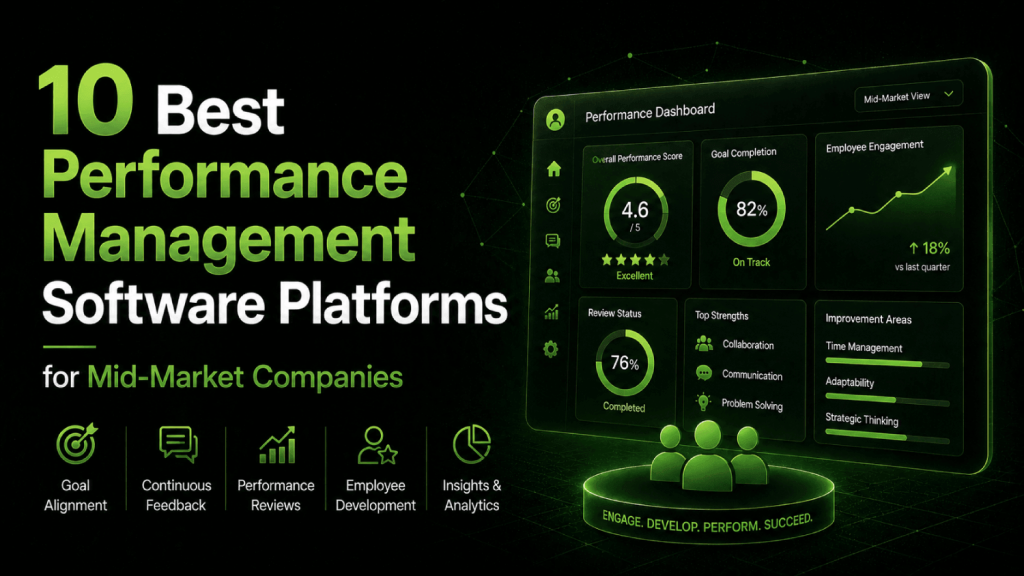
Finding the best performance management software for mid-market companies means looking past whichever platform runs the cleanest annual review cycle. For companies between 200 and 2,000 employees, the right platform connects individual goal-setting to company OKRs, makes 360 feedback something employees actually trust, supports calibration with structured data, and gives managers visibility into their team’s progress without requiring them to log in every day.
Most HR leaders at mid-market companies inherit an annual review process that runs on spreadsheets, survey forms, and a frantic two-week window every December. The problem is not the cadence. The problem is that annual reviews without continuous check-ins, goal tracking, and structured feedback produce data that is stale by the time anyone reads it.
At 500 employees, a manager might oversee eight to twelve direct reports. Without structured touchpoints throughout the year, their recall of an employee’s performance is dominated by recency bias. The performance review becomes a guess dressed up as a rating. Calibration sessions, where managers compare ratings across teams, then layer a second problem on top of the first: inconsistent standards applied to incomplete recollections.
Good performance management software does not just digitize the annual review. It builds the infrastructure for continuous feedback, keeps goals visible between managers and their reports, and gives HR the data to run calibration with something resembling objectivity. That is the bar this article uses to evaluate the tools below.
Before looking at specific platforms, it helps to have a framework for what good looks like at the 200-to-2,000-employee scale. Enterprise tools like Workday carry implementation overhead that most mid-market teams cannot absorb. Lightweight tools built for small businesses lack calibration depth and goal hierarchy. Mid-market buyers need something in between.
The features that separate adequate tools from genuinely useful ones are:
If a vendor’s demo spends forty minutes on AI-generated review summaries and ten minutes on how calibration actually works, that is a signal about where their product investment is concentrated. Ask them to demo the calibration view before anything else.
Lattice is the most widely adopted purpose-built performance platform in the US mid-market. Its review cycle engine is mature: you can run multiple simultaneous review cycles with different templates, cadences, and participant groups, which matters when you have different performance processes for engineering, sales, and operations.
Where Lattice earns its lead position is calibration. The calibration view lets HR pull all employee ratings into a grid, filter by team or manager, and make adjustments with a documented audit trail. For a 300-person company running its first structured calibration, this alone is worth the price of admission.
Goals in Lattice work well at the team level but the OKR hierarchy has historically been less intuitive than dedicated OKR tools. The 1:1 and feedback modules are solid. Reporting is strong for HR; manager-facing dashboards are decent but not the best in class. Pricing is not publicly disclosed at scale; Lattice quotes based on headcount and modules selected.
Culture Amp built its reputation on employee engagement surveys, and that science carries over into how it structures performance feedback. The platform’s review templates benefit from genuine research into what makes rating scales reliable. For HR leaders who care about feedback quality and not just completion rates, that matters.
The performance module has matured considerably. Review cycles, 360 feedback, and goal tracking are all present and functional. Where Culture Amp lags Lattice slightly is calibration depth and goal hierarchy for companies running OKRs seriously. It is a stronger choice for teams that want engagement and performance data in one platform than for teams who want the deepest performance-specific feature set.
Pricing is quote-based and typically bundled with the engagement module, which means the combined price can feel high if you already have a separate engagement tool.
Leapsome is the most integrated platform on this list. It combines performance reviews, OKR management, employee engagement surveys, and learning paths in a single product. For a fast-growing company that does not want to stitch together four separate tools, Leapsome is worth serious consideration.
According to Betterworks’ buyer guide, Leapsome is particularly strong for fast-growing mid-market companies with a global footprint. Its DACH-market roots mean it handles EU compliance requirements, data residency, and works-council configurations that US-built tools sometimes struggle with.
The trade-off is depth in any single module. If you want the most powerful standalone review cycle tool, Lattice beats it. If you want OKRs plus reviews plus learning without a Frankenstein integration, Leapsome wins. Pricing is quote-based.
Betterworks is purpose-built around continuous performance management, specifically the connection between goals and ongoing feedback. Its OKR module is among the most developed in the mid-market category: goal cascading, weighting, check-in cadences, and progress visualization all work cleanly.
The review cycle engine is solid but not as configurable as Lattice at the template level. Where Betterworks earns its place on this list is in manager adoption. The platform is designed around the idea that performance improvement happens in the check-in, not the annual review, and the manager-facing interface reflects that philosophy. Nudges, conversation prompts, and progress summaries are built to make manager behavior more consistent without requiring HR to chase completions manually.
Betterworks targets mid-market to enterprise and prices accordingly. Quote-only.
15Five originated as a weekly check-in tool and has since grown into a full performance platform covering reviews, OKRs, 360 feedback, and engagement. The weekly check-in cadence is still its strongest differentiator: it creates a continuous data stream of employee sentiment and progress that makes annual review conversations less reliant on memory.
For companies where manager coaching is a priority, 15Five’s manager development features are worth examining. The platform includes manager effectiveness scores and guided coaching tools that go beyond what most performance tools offer at this price tier. Review cycles and 360 feedback are solid but not as configurable as Lattice for complex org structures.
Pricing is one of the more transparent in the category. According to 15Five’s public pricing page, the Perform plan starts at $14 per person per month.
PerformYard is a focused, no-frills performance management platform that does review cycles, goal tracking, and 360 feedback without the broader HR suite ambitions of Leapsome or Culture Amp. For mid-market teams that want a dedicated performance tool with straightforward configuration and no implementation drama, it deserves a closer look.
Its configurability stands out: PerformYard can accommodate complex review structures including different forms for different departments, multi-rater 360 feedback, and goal alignment across levels. The HRIS integrations (BambooHR, ADP, Paylocity, and others) are clean, which matters if your core HR system is staying in place.
According to PerformYard’s public pricing page, the platform starts at $5 per person per month for the base tier, rising to $10 per person per month for the full feature set. That makes it the most accessible purpose-built option on this list for mid-market teams with tighter budgets.
HiBob is an HRIS-first platform with a performance module that punches above its weight. For mid-market companies between 100 and 1,000 employees that want a single system covering people data, payroll, time tracking, and performance, Bob is the most complete mid-market HRIS with credible performance functionality.
The performance module covers review cycles, 360 feedback, goal setting, and basic calibration. It is not as deep as Lattice or Betterworks on calibration specifically, but the integration with the core people data is a genuine advantage. When you run a review cycle in Bob, the reporting lines, tenure, and team structure are always accurate because they come from the same system of record.
According to sources including Rippling’s performance software guide, HiBob is consistently cited as a strong choice for mid-market organizations. Pricing is quote-based.
Rippling approaches performance management the way it approaches everything: as part of a unified workforce platform where HR, IT, and finance data connect. Its performance module covers review cycles, goal tracking, and feedback, but the real advantage is context. Rippling can surface performance data alongside compensation data, org structure, and device management in ways that standalone tools cannot.
For mid-market companies already using Rippling as their core HRIS, adding the performance module is a low-friction decision. For companies evaluating Rippling specifically for performance management without the broader suite, it is harder to justify against purpose-built tools. Calibration and 360 feedback are present but not the platform’s strongest features. Pricing is quote-based and modular.
BambooHR is the dominant HRIS for small to mid-market US companies, and its performance management features are a natural extension for teams already on the platform. Review cycles, self-assessments, peer feedback, and goal tracking are all included. For a company running BambooHR as its system of record and wanting to avoid adding another tool, the performance module is a reasonable choice.
The ceiling is lower than purpose-built tools. Calibration is basic, OKR hierarchy is limited, and the 360 feedback module lacks the configurability of PerformYard or Lattice. BambooHR is the right answer for companies at the lower end of the mid-market range (200 to 500 employees) that prioritize simplicity and HRIS consolidation over deep performance features.
According to BambooHR’s public pricing page, performance features are included in the Pro tier, with pricing available on request based on company size.
Workday’s performance management suite is built for companies that are already on Workday HCM. At the upper end of the mid-market range (1,000 to 5,000 employees), Workday’s depth in calibration, goal management, succession planning integration, and reporting is hard to match from a standalone tool.
The implementation overhead is real. If you are not already a Workday customer, starting there for performance management alone is not a practical decision. For teams on Workday that have not yet activated the performance modules, activating them with proper configuration is worth the effort. For help with that, see our guide to the best Workday consulting firms for implementation and optimization. Pricing is enterprise quote-only.
| Platform | Best For | Review Cycles | 360 Feedback | Goal/OKR Depth | Calibration | Public Pricing |
|---|---|---|---|---|---|---|
| Lattice | US mid-market, mature HR teams | Excellent | Strong | Good | Best in class | Quote-based |
| Culture Amp | Engagement + performance combined | Strong | Strong | Moderate | Good | Quote-based |
| Leapsome | Global mid-market, EU compliance | Strong | Strong | Excellent | Good | Quote-based |
| Betterworks | OKR-first, continuous feedback | Good | Good | Excellent | Good | Quote-based |
| 15Five | Manager coaching, weekly cadence | Strong | Good | Good | Moderate | From $14/person/mo |
| PerformYard | Budget-conscious, flexible cycles | Excellent | Strong | Good | Good | $5 to $10/person/mo |
| HiBob | HRIS + performance in one tool | Good | Good | Moderate | Moderate | Quote-based |
| Rippling | Existing Rippling customers | Good | Moderate | Good | Moderate | Quote-based |
| BambooHR | Smaller mid-market, HRIS-first teams | Moderate | Moderate | Basic | Basic | Quote-based |
| Workday | Upper mid-market already on Workday | Excellent | Strong | Excellent | Excellent | Enterprise quote |
This is the most consequential decision mid-market buyers face in this category. Purpose-built platforms (Lattice, Leapsome, Betterworks, 15Five, PerformYard) are deeper on every performance-specific feature. HRIS-native modules (HiBob, BambooHR, Rippling, Workday) win on data accuracy and system consolidation.
The case for purpose-built is straightforward: if your performance process is complex (multiple review templates, serious OKR infrastructure, structured calibration, 360 feedback with anonymity controls), a dedicated tool will almost always give you a better outcome than an HRIS module bolted on to manage payroll and org charts. The configuration options are richer, the UX is designed for the use case, and the vendor roadmap is focused on the problem you care about.
The case for HRIS-native is also real. Every time someone joins or leaves your company, every time a manager changes, every time a team restructures, a standalone performance tool needs to be updated. With an HRIS-native module, that data flows automatically. For HR teams without a dedicated people-ops person managing tool hygiene, that matters more than a slightly better calibration view.
A reasonable rule: if you have fewer than 400 employees and a lean HR team, start with the performance module in your HRIS. If you have 400 or more employees, a dedicated HR team, and genuine complexity in your review process, a purpose-built tool earns its overhead.
Calibration is where most performance software falls short, and it is the feature mid-market HR leaders undervalue most during demos. Calibration is the process of comparing ratings across managers and teams to correct for grade inflation, manager harshness, and inconsistent standards before final ratings are shared with employees.
A good calibration view does four things. First, it pulls all ratings into a single interface sorted by manager, team, or rating bucket. Second, it allows an HR administrator to adjust a rating with a documented reason, creating an audit trail. Third, it surfaces statistical anomalies: a manager whose team is rated significantly higher or lower than the organization average. Fourth, it preserves the pre-calibration and post-calibration state so you can see what changed and why.
Lattice does this better than any other mid-market platform. Leapsome and Betterworks are strong. HiBob and BambooHR give you basic views but not the statistical context. If calibration is a priority for your organization, it should be the first thing you test in any product demo, not the last.
When evaluating any HR platform with significant process implications, the HR software buying checklist covering 75 questions to ask before choosing an HRIS, payroll, ATS, or HCM platform is worth running through before you sign a contract.
Goal-setting software ranges from simple personal objective tracking to full OKR infrastructure with cascading, weighting, and company-level visibility. Mid-market companies rarely need the full OKR framework from day one, but they do need goals to be visible to both managers and direct reports, connected to something meaningful at the team or company level, and trackable without requiring a weekly manual update.
Betterworks has the most mature OKR infrastructure in this group. Its goal hierarchy, check-in cadence, and progress visibility are designed explicitly for organizations that run OKRs seriously. Leapsome is close behind, with the added advantage of connecting goals to compensation and development plans in the same platform.
Lattice’s goal module works well for team-level objectives but has historically been less intuitive at the full company cascade compared to Betterworks. 15Five handles goals adequately in the context of its weekly check-in rhythm. PerformYard’s goal features are functional but not the platform’s strength.
If goal alignment to company strategy is the primary driver of your performance software search, Betterworks deserves the top slot. If goals are one piece of a broader performance process that includes deep review cycles and calibration, Lattice is the better overall choice.
Most platforms in this category do not publish pricing at scale, which makes budget planning frustrating. Here is what public information reveals and what to expect in practice.
According to 15Five’s public pricing page, the Perform plan starts at $14 per person per month. According to PerformYard’s public pricing page, the base tier starts at $5 per person per month and rises to $10 per person per month for the full feature set. Those are the two most transparent pricing signals in the category.
Lattice, Culture Amp, Leapsome, Betterworks, HiBob, and Rippling are all quote-based. Buyer community discussions suggest purpose-built platforms in this tier often fall somewhere between $6 and $20 per person per month depending on module selection and contract length, but treat those figures as directional rather than definitive , your actual quote will depend on headcount, modules, and negotiation. Get quotes and negotiate on multi-year terms.
HRIS-native performance modules are usually priced as add-ons to the core HRIS contract. BambooHR includes performance in its Pro tier but does not publish per-seat pricing publicly. Rippling and HiBob price performance as modular additions to the core platform.
Performance software does not operate in isolation. At minimum, it needs a clean data feed from your HRIS to keep org structure, reporting lines, and employee records accurate. At best, it feeds into compensation planning, learning and development, and succession planning decisions.
The platforms with the tightest HRIS integrations are the HRIS-native ones, by definition. For purpose-built tools, the quality of the integration matters: Lattice, Leapsome, and Betterworks all have established integrations with major HRIS platforms (BambooHR, Workday, ADP, Rippling), but the sync depth varies. Ask vendors specifically about what triggers a sync, how quickly changes in the HRIS appear in the performance tool, and whether manager changes update automatically in active review cycles.
Performance data also increasingly feeds talent decisions beyond compensation. If you are thinking about how performance connects to internal mobility and promotion decisions, the best AI internal mobility platforms for enterprise talent teams covers how those use cases intersect. For broader workforce planning questions, the best AI people analytics platforms for workforce planning is worth reviewing separately, though performance analytics and workforce planning analytics are distinct problems with distinct tools.
| Company Size | Recommended Starting Point | Why |
|---|---|---|
| 200-400 employees | BambooHR (HRIS-first) or PerformYard (performance-first) | Low implementation overhead, transparent pricing, adequate depth for growing processes |
| 400-800 employees | Lattice, 15Five, or HiBob depending on stack | Enough process complexity to justify a purpose-built tool or a full-featured HRIS module |
| 800-2,000 employees | Lattice, Leapsome, or Betterworks | Calibration depth and OKR infrastructure become necessary at this scale |
| 2,000+ employees | Workday (if already on platform) or Lattice/Betterworks | Enterprise-grade calibration, succession integration, and reporting justify the complexity |
A purpose-built performance management platform (Lattice, Leapsome, Betterworks) is designed entirely around review cycles, goal management, 360 feedback, and calibration. An HRIS performance module (BambooHR, HiBob, Rippling) adds those features to a system primarily built for employee records, payroll, and org management. Purpose-built tools are deeper on performance-specific features. HRIS modules win on data accuracy because employee records stay in one system. The right choice depends on how complex your performance processes are and how lean your HR team is.
360 feedback, where an employee receives input from peers, direct reports, and managers rather than just their direct manager, is valuable at any company size. At 200 or more employees, where managers may have limited visibility into cross-functional work, structured peer feedback gives reviewers context they would otherwise miss. The platforms that do this well (Lattice, Leapsome, PerformYard) offer anonymity controls, configurable question sets, and the ability to select reviewers through a managed nomination process rather than a free-for-all. The platforms that do it poorly treat peer feedback as an afterthought with a single open text field.
Goal-setting features within performance platforms (Lattice, Culture Amp, 15Five) handle company-to-individual goal alignment adequately for most mid-market companies. Dedicated OKR platforms like Betterworks or Leapsome offer deeper features: goal weighting, contribution scoring, cascade visualization, and check-in cadence management. If OKRs are your primary management framework and you run quarterly OKR cycles seriously, the OKR depth in Betterworks or Leapsome justifies the tool. If goals are one part of a broader performance process, the goal module in Lattice or 15Five is usually sufficient.
Calibration is the process of comparing performance ratings across managers and teams before they are finalized, to correct for inconsistencies in rating standards. Some managers rate generously; others rate harshly. Without calibration, final ratings reflect manager personality as much as actual performance. Good calibration tooling in a platform (Lattice has the strongest in the mid-market) surfaces rating distributions by manager, allows HR to adjust ratings with documented reasons, and preserves a pre- and post-calibration audit trail. For any company using ratings to drive compensation decisions, calibration is not optional.
The biggest adoption killer is a platform that treats performance management as HR’s job rather than a manager’s job. Platforms designed for manager adoption (Betterworks and 15Five are the strongest here) build check-in prompts, conversation guides, and completion nudges into the manager workflow rather than requiring managers to log in and hunt for their tasks. Reporting that shows HR who has and has not completed check-ins, reviews, or goal updates also helps, because it allows targeted follow-up rather than organization-wide reminders that managers tune out.
Ask the vendor to show you calibration before they show you anything else. Ask how manager reporting lines update when someone transfers teams mid-cycle. Ask what happens to a review in progress if the reviewing manager leaves the company. Ask them to show you the manager-facing view of an active cycle, not just the admin view. Ask what the average implementation timeline looks like for a company your size and who owns the configuration. These questions surface operational reality faster than any feature walkthrough. If your team evaluates other HR platforms under similar scrutiny, the HR software buying checklist with 75 pre-purchase questions provides a full framework for that process.
Performance software does not directly reduce attrition, but it creates the conditions where managers can catch disengagement earlier, deliver more consistent feedback, and have compensation conversations grounded in documented performance rather than impressions. Platforms like Culture Amp that combine engagement surveys with performance data make the connection between feedback quality, goal clarity, and retention risk more visible. The mechanism is manager behavior, not software. The software makes better manager behavior more likely by structuring the interactions and lowering the friction.
Implementation timelines vary significantly by platform and process complexity. Purpose-built platforms like PerformYard and 15Five typically run two to eight weeks for a 500-person company, depending on how many custom review templates, goal hierarchies, and HRIS integrations are required. Lattice and Leapsome implementations at that size typically run four to twelve weeks. Workday performance module activations for existing Workday customers can range from six weeks to six months depending on configuration scope and whether you engage a consulting partner. The single biggest factor in implementation speed is how well your HRIS data is structured before you start.