
HR Tech SaaS may earn a commission when you buy through links on this page. Our recommendations are editorial and never paid for.
- Most buyers treat “HR chatbot” as a single category. There are three distinct ones: recruiting chatbots, employee support chatbots, and full HR service agents. Buying the wrong type wastes budget and creates compliance exposure.
- Recruiting chatbots (Paradox Olivia, Phenom, Mya) handle candidate screening and scheduling. Employee support chatbots (Leena AI, Moveworks, Workativ) handle policy questions and ticket deflection. A handful of platforms try to do both.
- Generative AI adds genuine value for FAQ deflection and onboarding guidance. It should not be left unsupervised on employee relations, termination, or benefits eligibility questions.
- Pricing varies from self-serve tiers under $100/month to six-figure enterprise contracts. The gap between those two worlds is real, and mid-market buyers often land in the wrong one.
- The tools below are ranked within their category, not against each other. A recruiting chatbot beating an employee support chatbot is a meaningless comparison.
The best AI HR chatbot depends on what problem you are solving. For recruiting automation and candidate scheduling, Paradox Olivia and Phenom lead the market. For internal employee support and HR ticket deflection, Moveworks and Leena AI are the strongest enterprise options. For small and mid-market teams that need both in one platform, tools like Workativ and MeBeBot offer a practical middle ground at lower price points.
Why Most HR Chatbot Comparisons Mislead Buyers
Most listicles rank Paradox next to BambooHR and call it a comparison. That tells you nothing useful, because those products are not competing for the same budget or the same problem. Paradox is a recruiting workflow tool. BambooHR is an HRIS. Putting them in the same table is like comparing a payroll system to an ATS.
The real split in this market is between three distinct product categories, and buying the wrong one is common. A TA leader who buys a recruiting chatbot expecting it to answer benefits questions will be disappointed. An HR ops team that buys an employee support bot expecting it to screen candidates will be equally frustrated.
Before evaluating any specific vendor, decide which of these three categories you actually need:
- Recruiting chatbots: Candidate-facing. Automate screening, FAQ answering for applicants, interview scheduling, and offer communications. Live at the top of the talent acquisition funnel.
- Employee support chatbots: Employee-facing. Answer HR policy questions, deflect IT and HR tickets, handle onboarding document requests, and surface knowledge base content. Live inside the intranet, Slack, or Teams.
- HR service agents: Broader platforms that combine both, plus workflow automation, HRIS integrations, and sometimes agentic task completion. Usually enterprise-priced and require significant implementation time.
With that framework in place, the ten tools below make a lot more sense.
What Is the Difference Between a Recruiting Chatbot and an Employee Support Chatbot?
A recruiting chatbot talks to candidates. It lives on your careers page, job listings, or inside an ATS, and its job is to move candidates through the funnel faster: screening questions, availability collection, interview scheduling, status updates. The best ones, like Paradox Olivia, handle the entire scheduling loop without recruiter involvement.
An employee support chatbot talks to your existing workforce. It answers “how many PTO days do I have left,” “where do I submit an expense report,” or “what is our parental leave policy” without someone from HR having to respond. The business case is ticket deflection: every question the bot answers is one that does not land in an HR inbox.
The distinction matters for compliance, too. A recruiting chatbot operates under EEOC, OFCCP, and similar hiring regulations. An employee support chatbot operating in the benefits or employee relations space touches ERISA, FMLA guidance, and workplace investigation territory. Generative AI that hallucinates a benefits answer is a different kind of liability than one that gives a candidate the wrong interview time.
The 10 Best AI HR Chatbots, Organized by Category
Recruiting Chatbots
1. Paradox Olivia
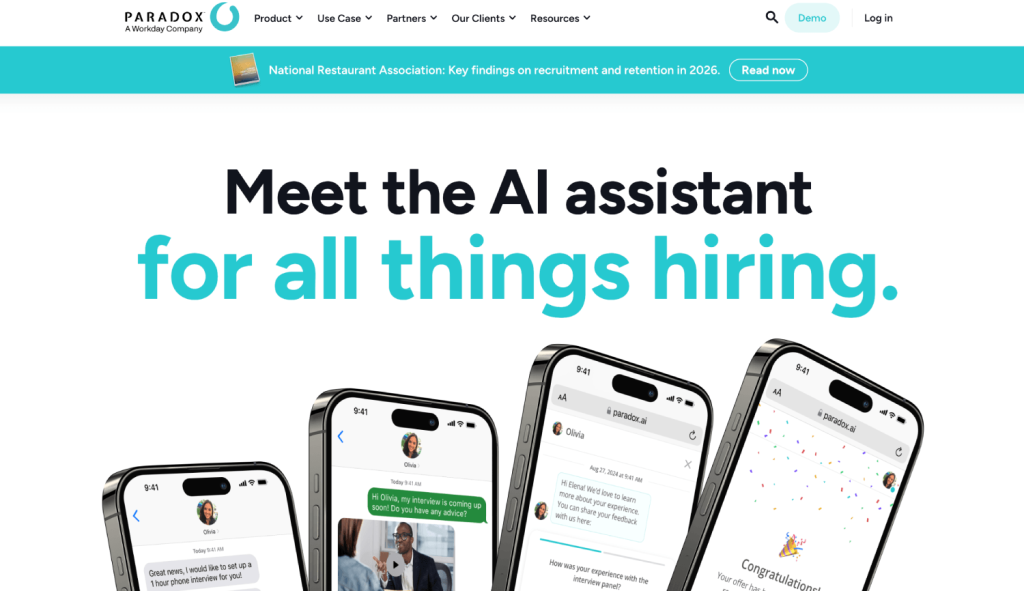
Paradox built Olivia specifically for high-volume recruiting, and it shows. Olivia handles candidate screening conversations, collects availability, books interviews directly into recruiter calendars, and sends reminders without human intervention. For hourly and frontline hiring at scale, it is the most mature product in this category.
The integration depth with major ATSs (Workday, SAP SuccessFactors, iCIMS, Greenhouse) is a real differentiator for enterprise buyers. Where Olivia gets complicated is cost: pricing is quote-only, and contracts are typically built for large enterprises. Mid-market teams sometimes find the implementation overhead disproportionate to their hiring volume. Olivia is the right choice when you hire hundreds of frontline workers per month and recruiter scheduling time is a documented bottleneck.
2. Phenom Talent Experience Platform
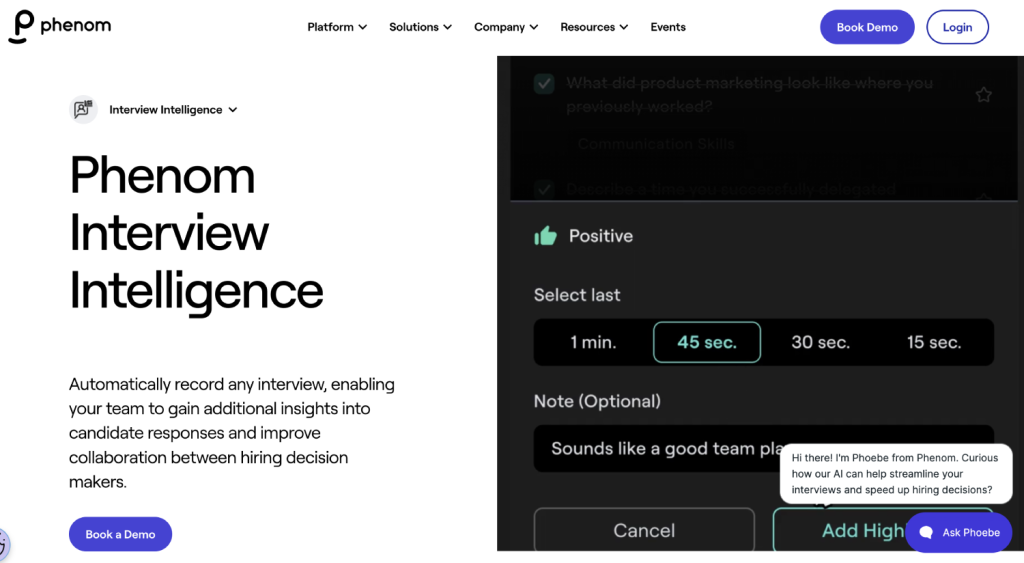
Phenom covers more of the talent lifecycle than a pure recruiting chatbot: career site personalization, candidate relationship management, recruiter productivity tools, and employee growth recommendations all sit in the same platform. The chatbot component handles candidate FAQ and scheduling, but the reason enterprises buy Phenom is the broader talent intelligence layer.
For TA leaders who also need internal mobility and employee career pathing alongside recruiting automation, Phenom is one of the few platforms that credibly spans both. Pricing is quote-only and skews enterprise. Teams under 500 employees will likely find it overbuilt.
3. Mya (now part of Greenhouse)
Mya was one of the original recruiting chatbots before being acquired by Greenhouse. Its conversational screening capability is strong, particularly for structured pre-screening question flows. The product no longer exists as a standalone purchase , its capabilities are embedded in the Greenhouse platform. If you are already on Greenhouse, the AI-assisted screening and scheduling tools are worth evaluating before adding a separate recruiting chatbot vendor.
4. XOR
XOR is a recruiting chatbot built around multilingual candidate engagement, which makes it relevant for global hiring teams or US operations with non-English-speaking applicant pools. It handles screening, scheduling, and WhatsApp-based engagement. The multilingual functionality is genuine, not an afterthought, which separates XOR from most competitors in high-volume hourly hiring contexts.
XOR pricing is not publicly listed and requires a demo conversation. For enterprise teams hiring globally, the multilingual capability is a stronger argument than for domestic-only hiring operations.
Employee Support and HR Service Desk Chatbots
5. Moveworks
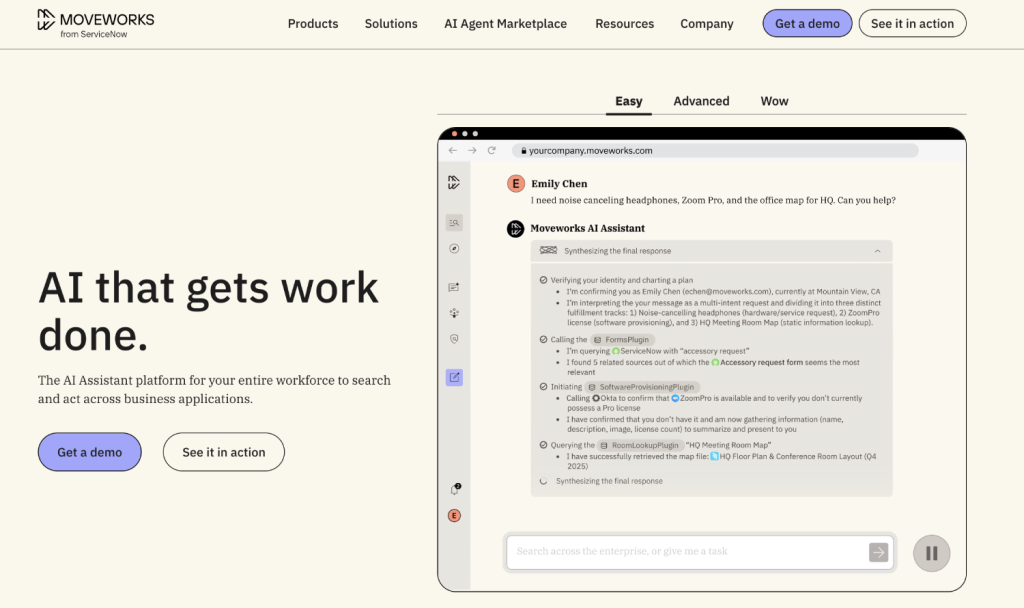
Moveworks started in IT service management and expanded into HR support. The core product resolves employee requests autonomously inside Slack and Microsoft Teams: policy lookups, document delivery, provisioning, and HR ticket resolution. The AI layer is genuinely capable, not just keyword matching dressed up as intelligence.
Moveworks integrates with ServiceNow, Workday, and major HRIS platforms, and the HR-specific module handles policy FAQ, onboarding task management, and benefits support. Pricing is enterprise-only and quote-based. The honest assessment: Moveworks is the strongest product in this category for large enterprises with complex HRIS and ITSM environments, but it is not a product you buy to answer 50 HR questions a week.
6. Leena AI
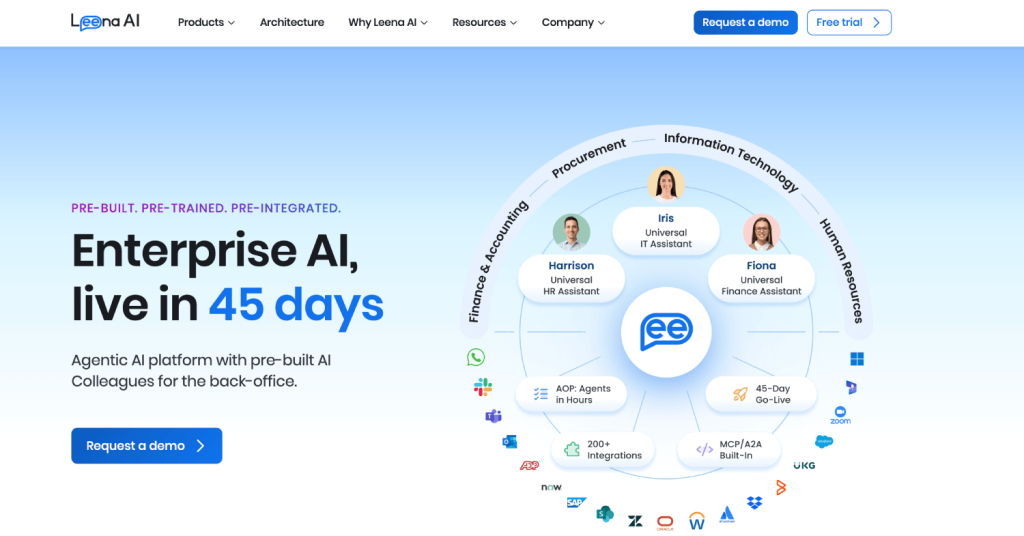
Leena AI is an AI HR assistant built around employee self-service: FAQ answering, policy support, onboarding workflows, and document generation. As noted in the AIHR tool directory, Leena AI handles FAQ, policy navigation, onboarding, and document generation within a single platform. The product is more specifically HR-focused than Moveworks, which makes it easier to deploy for an HR team that is not working alongside an IT operations team.
Leena AI’s multi-agent architecture means employees can query the bot as if they are asking a knowledgeable colleague, with the system drawing from HR policy documents, benefits information, and HRIS data simultaneously. Mid-market buyers looking for a Moveworks alternative without the enterprise implementation overhead should evaluate Leena AI closely.
7. Workativ
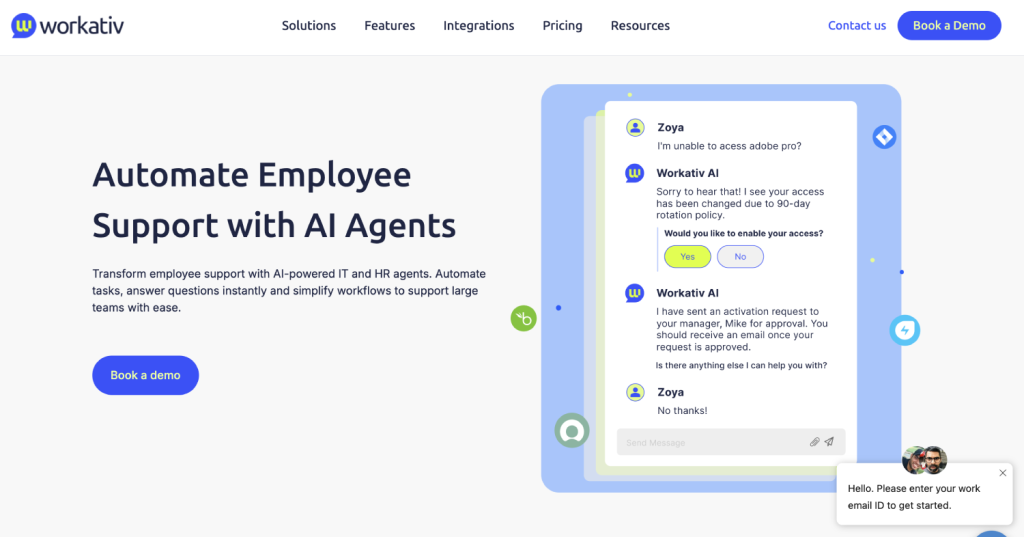
Workativ positions as an AI HR chatbot that resolves queries rather than just answering them, with multi-step workflow execution alongside FAQ responses. The differentiation is the workflow automation layer: Workativ can execute actions inside connected systems (updating records, triggering onboarding tasks, resetting passwords) rather than returning a text answer and leaving the employee to act on it.
Workativ is a realistic option for mid-market teams that need both HR and IT helpdesk automation without a Moveworks-level budget. Pricing is available on request, but the product is clearly built for smaller and mid-market deployments rather than enterprise.
8. MeBeBot
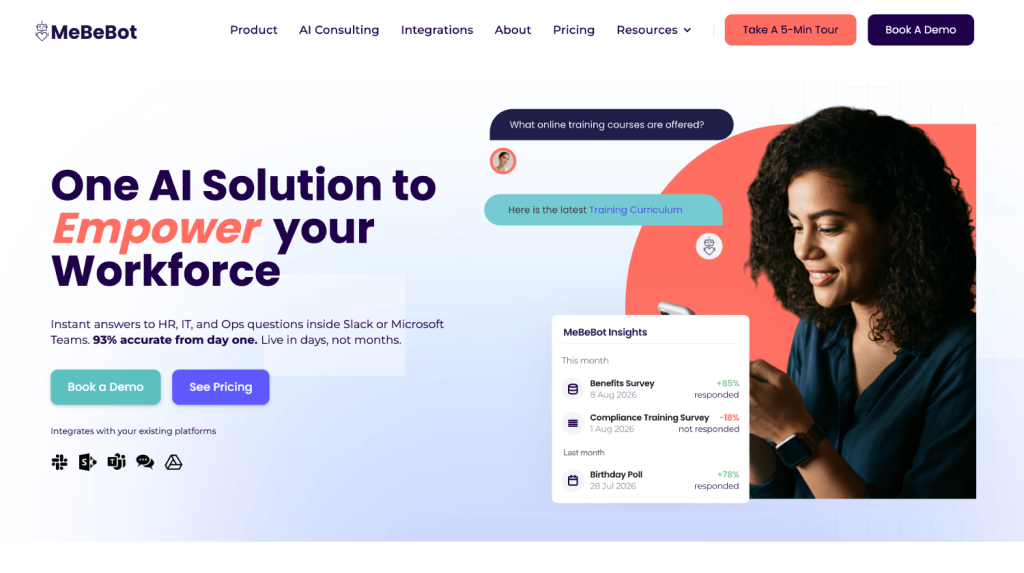
MeBeBot is one of the few AI employee support chatbots with transparent positioning around SMB and mid-market buyers. According to the AIHR HR tools list, MeBeBot handles HR support within a chatbot-first model. It deploys inside Slack and Teams, covers HR and IT FAQ, and is designed to be operational without a lengthy implementation engagement. For HR teams at companies between 200 and 1,000 employees that do not have a dedicated HRIS-integration team, MeBeBot is a practical starting point.
9. ServiceNow HR Service Delivery
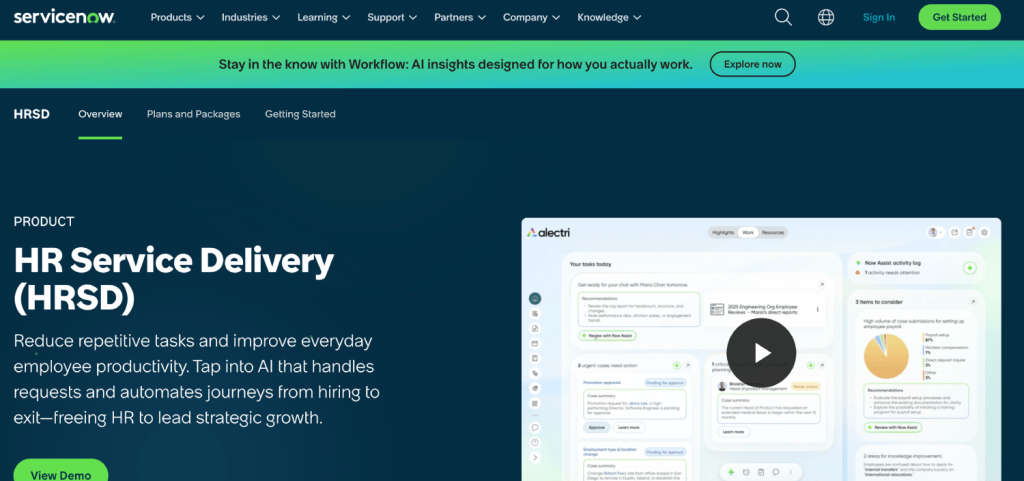
ServiceNow’s HR Service Delivery module deserves a place on this list because many enterprise HR teams are already in a ServiceNow environment. The Virtual Agent capability inside HR Service Delivery handles employee requests, policy queries, and case routing using conversational AI built on the same platform as the broader ITSM workflow.
The case for ServiceNow here is consolidation, not category leadership. If you are already running ServiceNow for IT, adding HR Service Delivery is a credible path to chatbot-enabled HR support without adding a net-new vendor. If you are not in the ServiceNow environment, this is not the right entry point for an HR chatbot purchase.
Dual-Purpose Platforms (Recruiting and Employee Support)
10. Eightfold AI
Eightfold AI spans both the talent acquisition and talent management sides of the house using a shared AI model trained on career trajectory and skills data. The recruiting component handles candidate matching and engagement. The employee-facing component supports internal mobility, career path recommendations, and workforce planning.
Eightfold is not primarily a chatbot product. The conversational interface is one element of a broader talent intelligence platform. Buyers who need a point solution for either recruiting chatbot or employee support will find Eightfold over-engineered. Large enterprises that want a single AI layer across the full talent lifecycle and are willing to invest in a multi-quarter implementation will find few credible alternatives at this scope. Pricing is quote-only.
Side-by-Side Comparison: Key Differences Across the Ten Tools
| Tool | Primary Category | Best For | Pricing Model | Slack/Teams Native | Generative AI Layer |
|---|---|---|---|---|---|
| Paradox Olivia | Recruiting | High-volume frontline hiring | Quote-only | No (careers site / ATS) | Yes |
| Phenom | Recruiting + Internal Mobility | Enterprise TA + career pathing | Quote-only | Limited | Yes |
| Mya (Greenhouse) | Recruiting | Greenhouse ATS users | Bundled with Greenhouse | No | Yes |
| XOR | Recruiting | Multilingual / global hiring | Quote-only | No (WhatsApp, SMS) | Yes |
| Moveworks | Employee Support | Large enterprise HR + IT | Quote-only | Yes | Yes |
| Leena AI | Employee Support | HR-specific self-service | Quote-only | Yes | Yes |
| Workativ | Employee Support | Mid-market HR + IT automation | Quote-based | Yes | Yes |
| MeBeBot | Employee Support | SMB to mid-market HR FAQ | Quote-based | Yes | Yes |
| ServiceNow HRSD | Employee Support | Enterprises already on ServiceNow | Enterprise licensing | Via integration | Yes |
| Eightfold AI | Talent Intelligence | Enterprise full-lifecycle AI | Quote-only | Limited | Yes |
Should You Use Generative AI for Employee Relations Questions?
Short answer: not without guardrails, and probably not at all for sensitive cases.
Generative AI performs well on policy lookup, benefits FAQ, onboarding document delivery, and repeatable process questions. The accuracy risk is low when the bot is drawing from a controlled, current knowledge base and the stakes of a wrong answer are modest. An employee who gets an incorrect answer about the coffee machine expense reimbursement threshold loses five minutes correcting it.
Employee relations is different. Questions about harassment complaints, performance improvement plans, FMLA eligibility determinations, accommodation requests, and termination processes carry real legal exposure if the AI answers incorrectly or inconsistently. A bot that tells one employee they are eligible for FMLA leave and tells another in an identical situation that they are not has just created a discrimination exposure. HR legal teams are increasingly aware of this, and the better enterprise vendors (Moveworks, Leena AI, ServiceNow) allow you to route sensitive topic categories to human agents rather than letting the AI respond.
The practical rule: if the answer to a question affects employment status, compensation, legal rights, or workplace safety, route it to a human. Configure your chatbot with that routing logic before you go live.
How Do You Evaluate an HR Chatbot Vendor Before Buying?
Most vendors will show you a polished demo with pre-loaded responses. That tells you what the UI looks like, not how the AI performs on your actual content. Ask for these five things specifically before signing anything.
- A sandbox test with your own HR documents. Upload your actual employee handbook, benefits guide, and PTO policy. Ask 20 real questions your employees send to HR. Score accuracy on your own scale. Any vendor that will not do this pre-sale is a vendor who knows the results would be unflattering.
- Escalation and routing logic. How does the bot handle questions it cannot answer confidently? Does it say so, route to a human, or hallucinate? See this in the demo, not in the pitch deck.
- Integration documentation for your specific HRIS. “We integrate with Workday” is not the same as “here is our certified Workday connector and the data fields it can read and write.” Ask for the integration spec sheet.
- Audit trail and conversation logs. For compliance, you need to know who asked what and what the bot said. This is particularly important for anything in the benefits or leave management space.
- Total cost including implementation and content maintenance. The licensing fee is only part of the cost. Training the model on your content, building workflows, ongoing knowledge base maintenance, and integration work add up. Ask for a total-cost-of-ownership estimate over 24 months, not just year one licensing.
Paradox Alternatives for Enterprise Recruiting
Paradox Olivia dominates the conversation in recruiting chatbots, but there are situations where it is not the right fit. If your ATS is not in Paradox’s integration list, if your hiring is primarily professional or technical rather than high-volume hourly, or if the contract size is disproportionate to your hiring volume, these alternatives are worth a hard look.
Phenom is the closest enterprise-grade alternative for companies that need recruiting chat alongside career site and internal mobility in a single platform. The implementation investment is similar to Paradox, but the breadth justifies it for some buyers.
XOR is the right alternative when multilingual candidate engagement is the primary requirement. Paradox’s multilingual capability exists but is not the product’s core strength.
If you are on Greenhouse, the Mya-derived AI capabilities built into the platform are worth exhausting before adding a separate recruiting chatbot vendor. Adding complexity and cost for incremental improvement is rarely the right call.
For professional hiring at lower volume, a combination of your ATS’s native scheduling tools plus a tool like Calendly or GoodTime handles a large share of what a recruiting chatbot does, without the recruiting chatbot price tag.
What Does an AI HR Chatbot Actually Cost?
Almost every vendor in this category lists pricing as quote-based, which creates a frustrating buying experience and makes budget benchmarking hard. Here is what is publicly known and what can be reasonably characterized.
Enterprise platforms (Moveworks, Paradox, Phenom, Eightfold, ServiceNow HRSD) are six-figure annual contracts in most deployment scenarios. Implementation services frequently add 30 to 50 percent on top of licensing in year one. These are not products you trial and decide on in a quarter.
Mid-market options (Workativ, Leena AI, MeBeBot) have not published public pricing pages, but positioning and target customer profiles suggest meaningfully lower price points than the enterprise tier. Contact each vendor directly for a quote with your employee count and use case specifics before a demo call, so you can screen for budget fit before investing sales time.
For a broader view of how AI tools are priced across the HR stack, the AI HR tools pricing guide on HR Tech SaaS covers the range across categories.
Which HR Chatbot Category Is Right for Your Company Size?
| Company Size | Recommended Category | Starting Point Tools | What to Avoid |
|---|---|---|---|
| 20-200 employees | Employee Support (light) | MeBeBot, HRIS-native bots (BambooHR, Rippling) | Enterprise platforms; overkill on budget and implementation |
| 200-1,000 employees | Employee Support or Recruiting (pick one) | Leena AI, Workativ, XOR | Dual-purpose enterprise platforms before proving single-use ROI |
| 1,000-5,000 employees | Both, likely separate tools | Paradox Olivia (recruiting), Moveworks or Leena AI (support) | Assuming one vendor can do both equally well |
| 5,000+ employees | Full HR service agent or talent intelligence | ServiceNow HRSD, Eightfold, Phenom | Point solutions that cannot integrate into existing enterprise systems |
If your HRIS already includes a chatbot or virtual assistant feature (Workday, SAP SuccessFactors, BambooHR, and Rippling all have some form of this), evaluate that capability against your requirements before adding a net-new vendor. The native tool often covers 70 percent of the use case at zero additional cost. For more on how HRIS platforms are adding AI features, see the HRIS platform comparison on HR Tech SaaS.
Frequently Asked Questions About AI HR Chatbots
1. What is an AI chatbot for internal employees?
An AI chatbot for internal employees is a conversational interface that answers HR and IT questions from your workforce without requiring a human to respond. It draws from your HR knowledge base, HRIS data, and policy documents to answer questions like “how do I update my direct deposit,” “what is the 401k match,” or “how do I request a leave of absence.” The better platforms execute actions inside connected systems rather than just returning text answers.
2. What is a recruitment chatbot?
A recruitment chatbot is a candidate-facing AI tool that automates early-funnel hiring tasks: pre-screening question flows, availability collection, interview scheduling, application status updates, and job matching. It lives on careers pages, inside ATS platforms, or in messaging channels like SMS and WhatsApp. The goal is to move candidates through the process faster and reduce the manual scheduling load on recruiters. Paradox Olivia is the most widely deployed example in enterprise recruiting.
3. Do recruiters actually use AI bots, and do candidates mind?
Adoption is growing among high-volume hiring teams, particularly in retail, logistics, healthcare, and hospitality, where recruiter-to-requisition ratios make manual screening unsustainable. Candidate reaction is mixed: scheduling automation is generally well-received because it is faster than waiting for a recruiter to reply. Screening conversations via chatbot are less universally accepted, and some candidate populations in professional hiring express frustration at not reaching a human earlier in the process. Transparency about when a candidate is talking to a bot versus a person is both an ethical best practice and increasingly a regulatory expectation in several jurisdictions.
4. How much does an AI HR chatbot cost per employee per month?
No major vendor in this category publishes per-employee-per-month pricing publicly. Enterprise platforms (Moveworks, Paradox, Phenom, ServiceNow HRSD, Eightfold) are structured as annual enterprise contracts, typically six figures. Mid-market tools (Leena AI, Workativ, MeBeBot) are quote-based but position for smaller deployments. Request quotes with your specific headcount and use case to get real numbers. Any estimate you read without a source attached is a guess.
5. Should HR use generative AI for employee relations questions?
Not without strict routing controls. Generative AI handles policy FAQ and onboarding well, where the cost of an occasional wrong answer is low. Employee relations questions involving harassment, FMLA eligibility, accommodation requests, PIP processes, or termination carry legal exposure if answered incorrectly or inconsistently. Configure your chatbot to route those topic categories to a qualified HR person. Every reputable vendor supports topic-based routing; if yours does not, that is a product deficiency worth raising before purchase.
6. What is the best HR chatbot for a mid-size company between 200 and 1,000 employees?
For employee support, Leena AI and Workativ are the two strongest mid-market options. Both deploy inside Slack and Teams, integrate with common HRIS platforms, and are built for teams that do not have a dedicated integration engineering team running the implementation. For recruiting automation in the same size range, XOR and the AI features inside an existing ATS (Greenhouse, Lever, or Ashby) are more proportionate than an enterprise-priced platform like Paradox.
7. How is an HR chatbot different from an HRIS self-service portal?
An HRIS self-service portal requires the employee to find the right section and complete a form or read a document. An HR chatbot meets the employee in a natural language interface, usually inside a tool they already use (Slack, Teams, or a mobile app), and either answers the question or executes the task directly. The chatbot reduces friction. Most enterprise HRIS platforms now offer both, and the two capabilities are converging, but the conversational interface is meaningfully better for infrequent users who do not know where to look inside an HRIS.
8. Can one HR chatbot handle both recruiting and employee support?
A few platforms attempt this. Eightfold AI and Phenom span both talent acquisition and employee-facing applications within a single AI layer. The trade-off is that products built for both are rarely the strongest in either category. Most HR ops and TA leaders at mid-market companies are better served by a dedicated recruiting chatbot and a separate employee support tool, then evaluating consolidation once they have proof points on both sides. For HR software buying frameworks, the HR stack guide for growing companies covers the sequencing logic.
The Decision That Actually Matters
Most buyers stall on this decision because they conflate the three categories, read a comparison that mixes recruiting bots with employee support tools, and conclude the market is too complicated to work through quickly. It is not. Decide which problem is most acute, pick the category that solves it, and evaluate two or three tools within that category. That decision tree takes an afternoon, not a quarter.
The generative AI question is worth taking seriously. Every vendor in this space now wraps a large language model around their product and calls it an AI HR chatbot. The meaningful differentiation is in the knowledge layer underneath, the workflow execution capability on top, and the routing intelligence that keeps sensitive questions away from autonomous AI responses. Ask specifically about those three things in every demo, and the vendor quality differences will surface fast.
One final note on sequencing: if you have not yet standardized your HR knowledge base, your chatbot will only be as good as your source content. A bot trained on a three-year-old employee handbook and an outdated benefits guide will deflect tickets at a low rate and generate employee frustration instead of reducing it. Content readiness is not a technical problem. It is an HR operations problem, and it needs to be solved before, not after, you buy the tool. For help thinking through HR operations maturity before a chatbot purchase, the HR operations framework on HR Tech SaaS is a useful starting point.