
HR Tech SaaS may earn a commission when you buy through links on this page. Our recommendations are editorial and never paid for.
- Spreadsheet scheduling breaks down the moment you have more than two locations, variable shifts, or staff who swap shifts without telling anyone.
- The right employee scheduling software cuts no-shows, prevents accidental overtime, and gives managers their Monday morning back.
- This list covers tools across SMB, mid-market, and specialized verticals: retail, healthcare, hospitality, construction, and field services.
- Homebase and When I Work are the strongest picks for small businesses. Deputy and Shiftboard scale further. 7shifts owns restaurants.
- Pricing varies from free to quote-based enterprise tiers. Most charge per active user per month, which matters for high-turnover teams.
The best employee scheduling software for shift-based teams depends on your industry and headcount. Homebase is the strongest free option for small businesses. Deputy and When I Work are the top mid-market picks for multi-location teams. 7shifts leads for restaurants. Shiftboard handles complex enterprise workforce scheduling. For field services and construction, ClockShark adds GPS time tracking to scheduling in one tool.
Why Spreadsheet Scheduling Fails Shift-Based Teams
A spreadsheet cannot text your employees when a shift opens. It cannot flag when a schedule puts someone into overtime. It does not know your labor laws, and it definitely does not update itself when someone calls in sick at 6 a.m. on a Saturday.
Shift-based businesses run on margins where a single no-show, a misread schedule, or an accidental overtime hour compounds into real money. The hidden cost is always manager time: the hours spent building the schedule, chasing confirmations, and manually adjusting when reality hits. Purpose-built shift scheduling software handles all of this automatically.
The category is distinct from broader HRIS or time-and-attendance tools. Scheduling software is scheduling-led: the primary job is building, communicating, and adjusting shifts in real time. Time tracking and payroll integrations come after, not before. If you are evaluating a full HR stack at the same time, the best HR software platforms for mid-market companies covers HRIS options that include scheduling modules, but for teams where scheduling is the operational core, a dedicated tool outperforms any HRIS scheduling add-on.
How We Evaluated These Employee Scheduling Tools
Every tool on this list was assessed across five criteria: ease of schedule building, mobile experience for employees, shift communication and swap management, labor cost controls, and integrations with payroll and POS systems. Pricing transparency was a factor. Tools with completely opaque pricing scored lower unless their feature set was genuinely differentiated.
The list skews toward US buyers but includes tools with strong UK, Australian, and Canadian coverage where relevant. Enterprise tools without a self-serve trial were included only when their enterprise-specific capabilities justified the entry barrier.
The 10 Best Employee Scheduling Software Platforms Compared
| Tool | Best For | Starting Price | Free Plan | Mobile App |
|---|---|---|---|---|
| Homebase | Small businesses, retail, restaurants | Free (paid from ~$20/location/mo) | Yes | Yes |
| When I Work | SMB to mid-market, multi-location | From $2.50/user/mo | No | Yes |
| Deputy | Mid-market, compliance-heavy industries | From $4.50/user/mo | No | Yes |
| 7shifts | Restaurants and food service | Free (paid from $29.99/location/mo) | Yes | Yes |
| Shiftboard | Complex enterprise scheduling | Quote-based | No | Yes |
| ClockShark | Field services and construction | From $7/user/mo | No | Yes |
| Sling | Cost-conscious SMBs, restaurants | Free (paid from $2/user/mo) | Yes | Yes |
| HotSchedules (Fourth) | Enterprise restaurants and hospitality | Quote-based | No | Yes |
| Humanity (TCP) | Healthcare, 24/7 shift operations | Quote-based | No | Yes |
| Connecteam | Deskless workforce, field teams | Free for small teams (paid from $29/mo) | Yes | Yes |
Which Employee Scheduling Software Is Best for Small Businesses?
1. Homebase
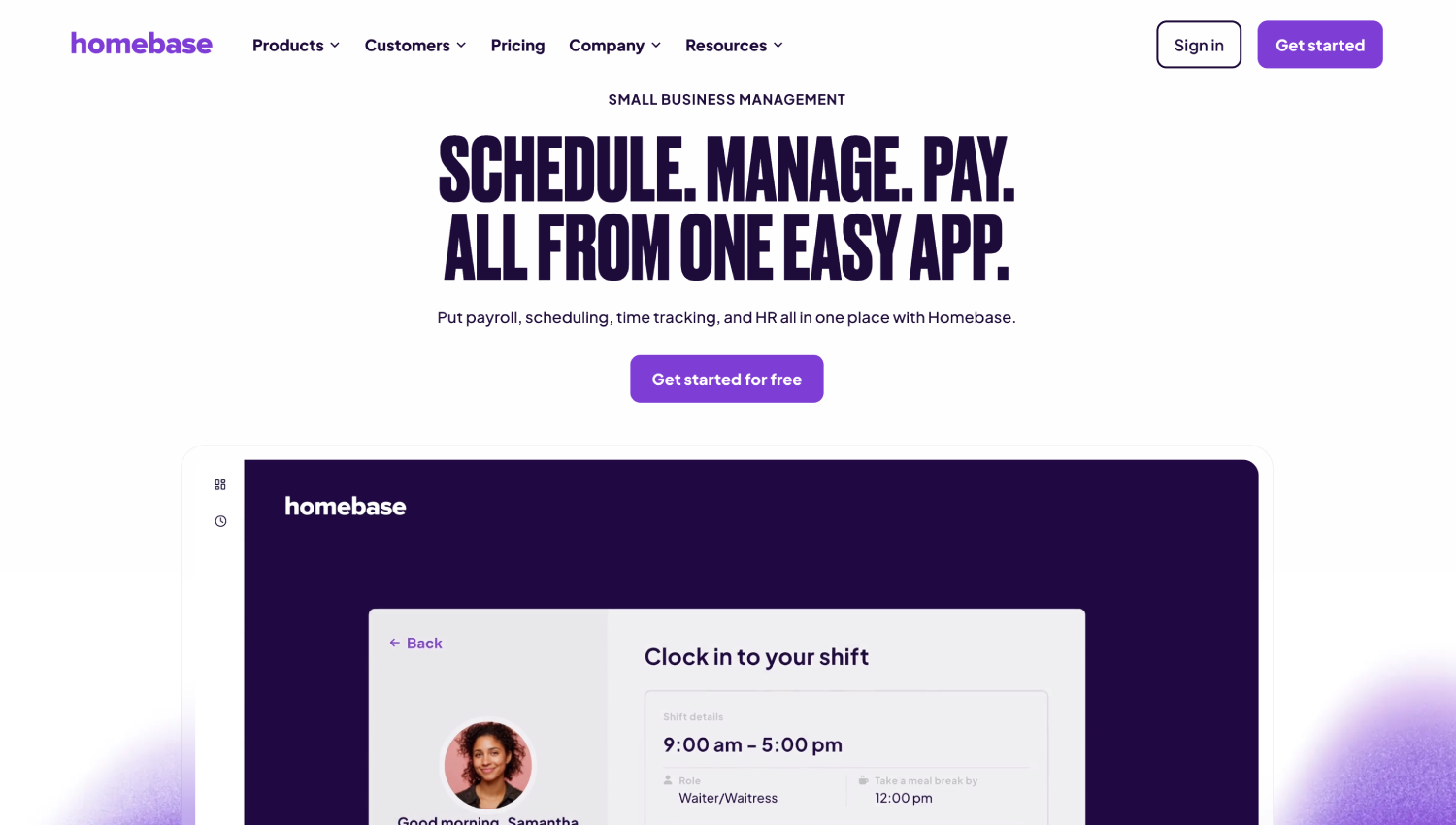
Homebase is the default answer for small businesses with hourly workers. The free plan covers one location with unlimited employees, which no other major competitor matches at this tier. Schedule building is drag-and-drop, employee availability is collected in-app, and shift reminders go out automatically.
What separates Homebase from cheaper alternatives is the depth of its free tier. Time clocking, team messaging, and basic labor cost tracking are all included without paying. Paid plans (starting around $20 per location per month, per Homebase’s public pricing page) add features like hiring, PTO tracking, and payroll. For a 20-person restaurant or retail store that wants to stop texting schedules via group chat, Homebase is the shortest path from chaos to managed.
The weak point is scale. Multi-location management works, but at 10-plus locations, the per-location pricing model becomes expensive relative to per-user alternatives like Deputy.
2. When I Work
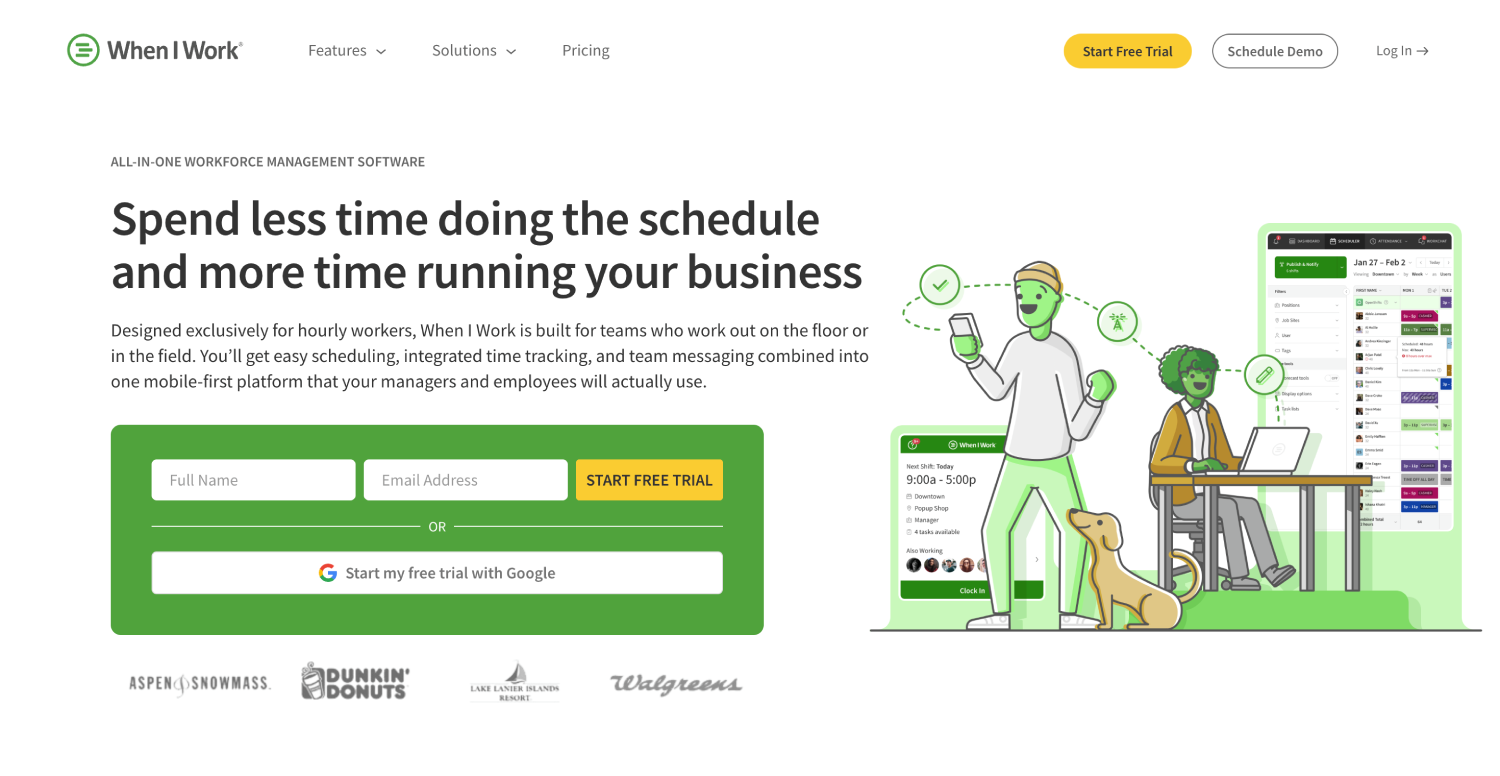
When I Work is the strongest all-around workforce scheduling app for teams that have outgrown the free-tier tools but are not ready for enterprise complexity. Scheduling, shift swapping, team messaging, and time tracking are all native. The mobile experience is consistently praised, which matters for hourly workers who check their schedule on their phone.
Per When I Work’s public pricing page, plans start at $2.50 per user per month. The per-user model means your cost scales predictably with headcount, and there is no per-location surcharge. For multi-location businesses where each location has a small team, this is often cheaper than Homebase at equivalent feature levels.
The scheduling interface supports templates, recurring schedules, and auto-scheduling based on availability and role. Managers can approve or deny shift swap requests from the app. Payroll integrations cover Gusto, ADP, Paychex, and QuickBooks, which handles most SMB payroll stacks.
3. Sling
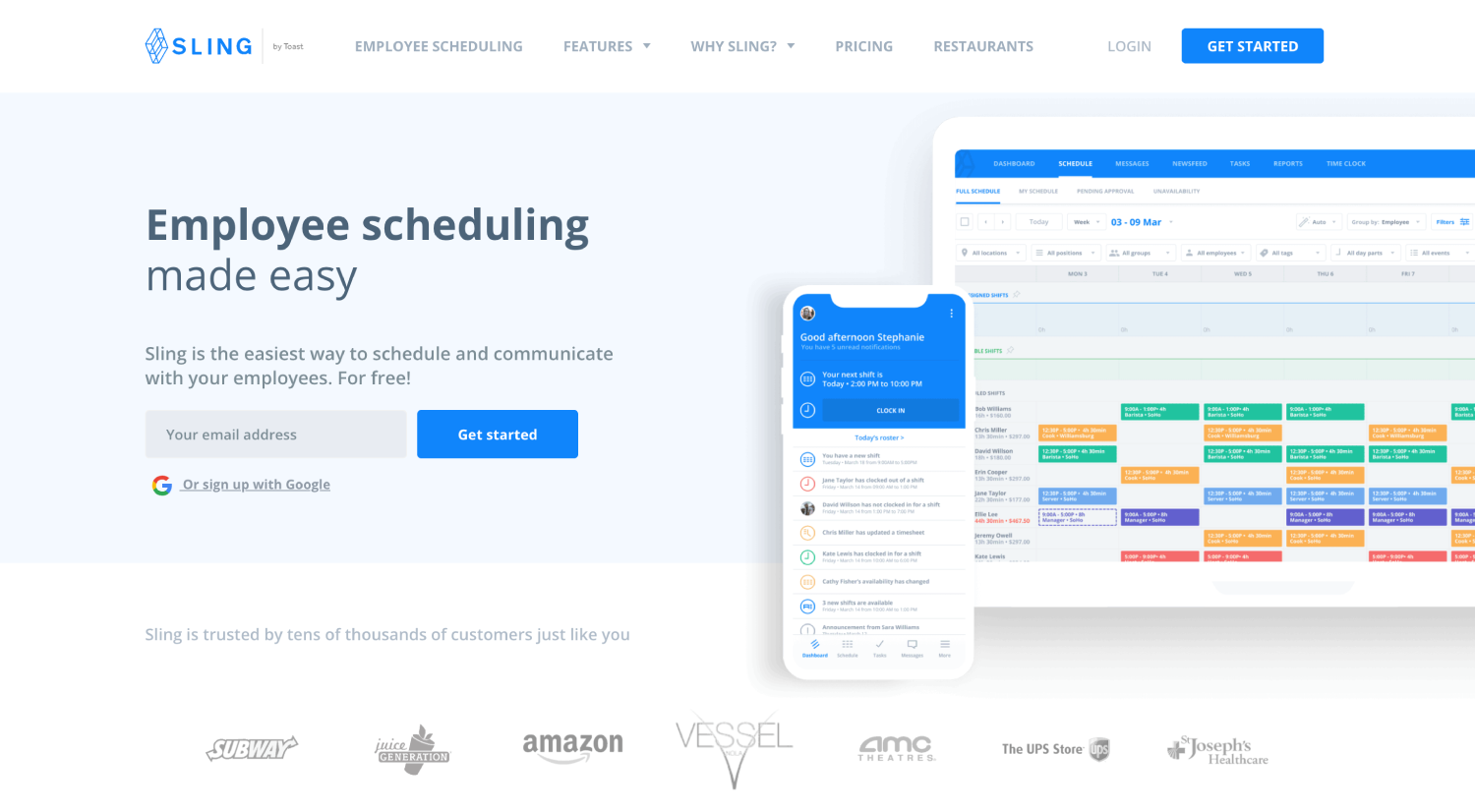
Sling competes with Homebase on price, with a free plan that includes scheduling and messaging for unlimited employees and locations. The paid tier starts at $2 per user per month per Sling’s public pricing page, adding time tracking, labor cost management, and POS integrations.
Sling’s differentiator is its built-in team communication tools, including newsfeed-style announcements and direct messaging. For managers who currently run their team on a WhatsApp group, Sling consolidates scheduling and communication in one place. The reporting is lighter than Deputy or When I Work, so it works better for owners who want simplicity over analytics.
Which Shift Scheduling Software Is Best for Mid-Market Teams?
4. Deputy
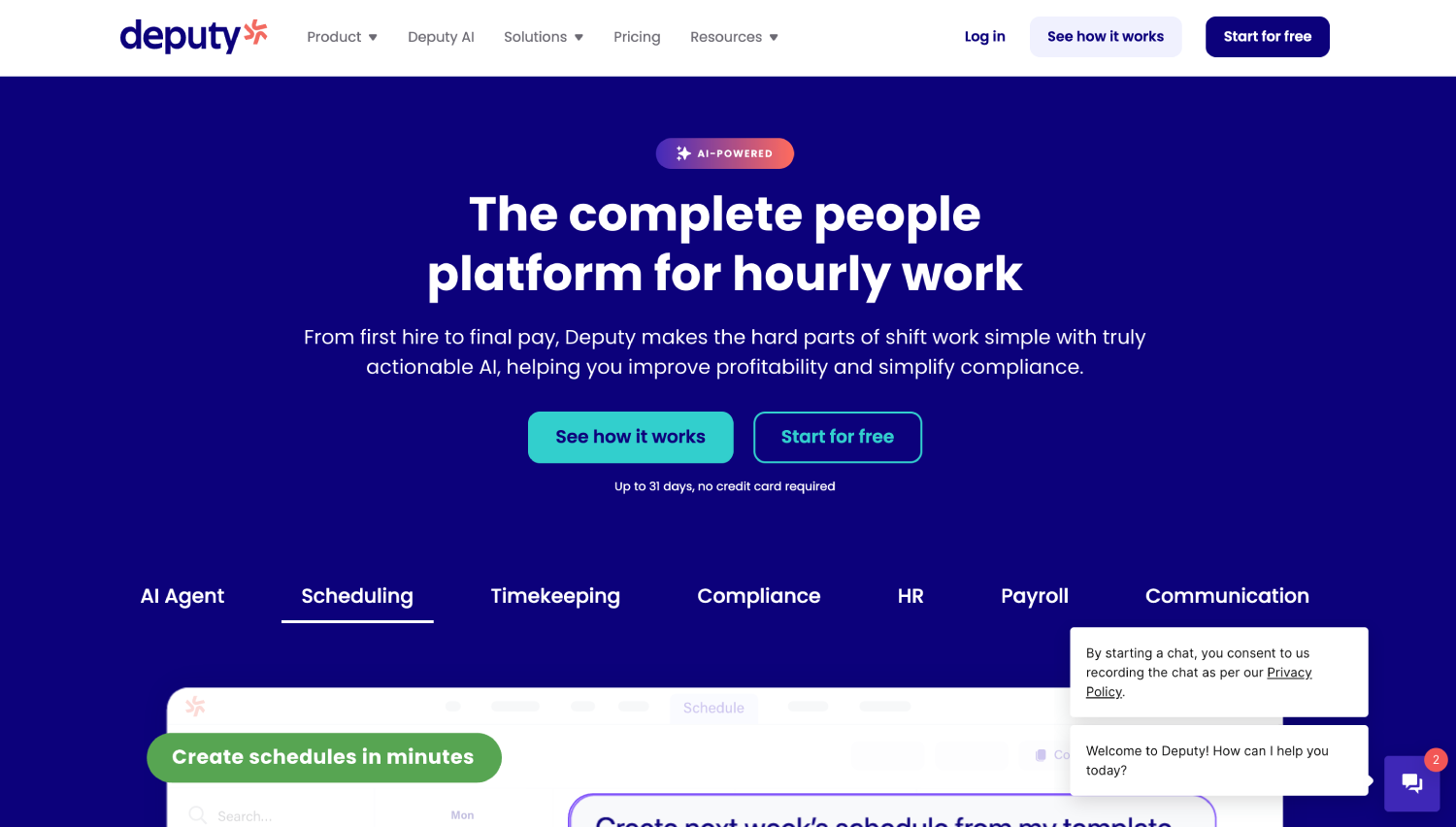
Deputy is the strongest mid-market pick for shift-based businesses operating across multiple locations with compliance complexity. Its scheduling tools are genuinely strong, but the real differentiation is in labor compliance: Deputy’s platform includes predictive scheduling and fair workweek support, with coverage that varies by jurisdiction , verify current supported locations on Deputy’s compliance page before purchase.
According to Deputy’s public pricing page, plans start at $4.50 per user per month for scheduling only, with higher tiers bundling time and attendance and HR features. For teams in regulated industries or jurisdictions with predictive scheduling mandates, that compliance layer alone justifies the cost premium over When I Work or Sling.
Deputy’s integration footprint is broad: payroll connections to ADP, Xero, QuickBooks, Rippling, and others, plus POS integrations with Square and Lightspeed. Setup is more involved than Homebase, but the implementation effort pays off faster for any team running 50-plus employees across locations.
5. Shiftboard
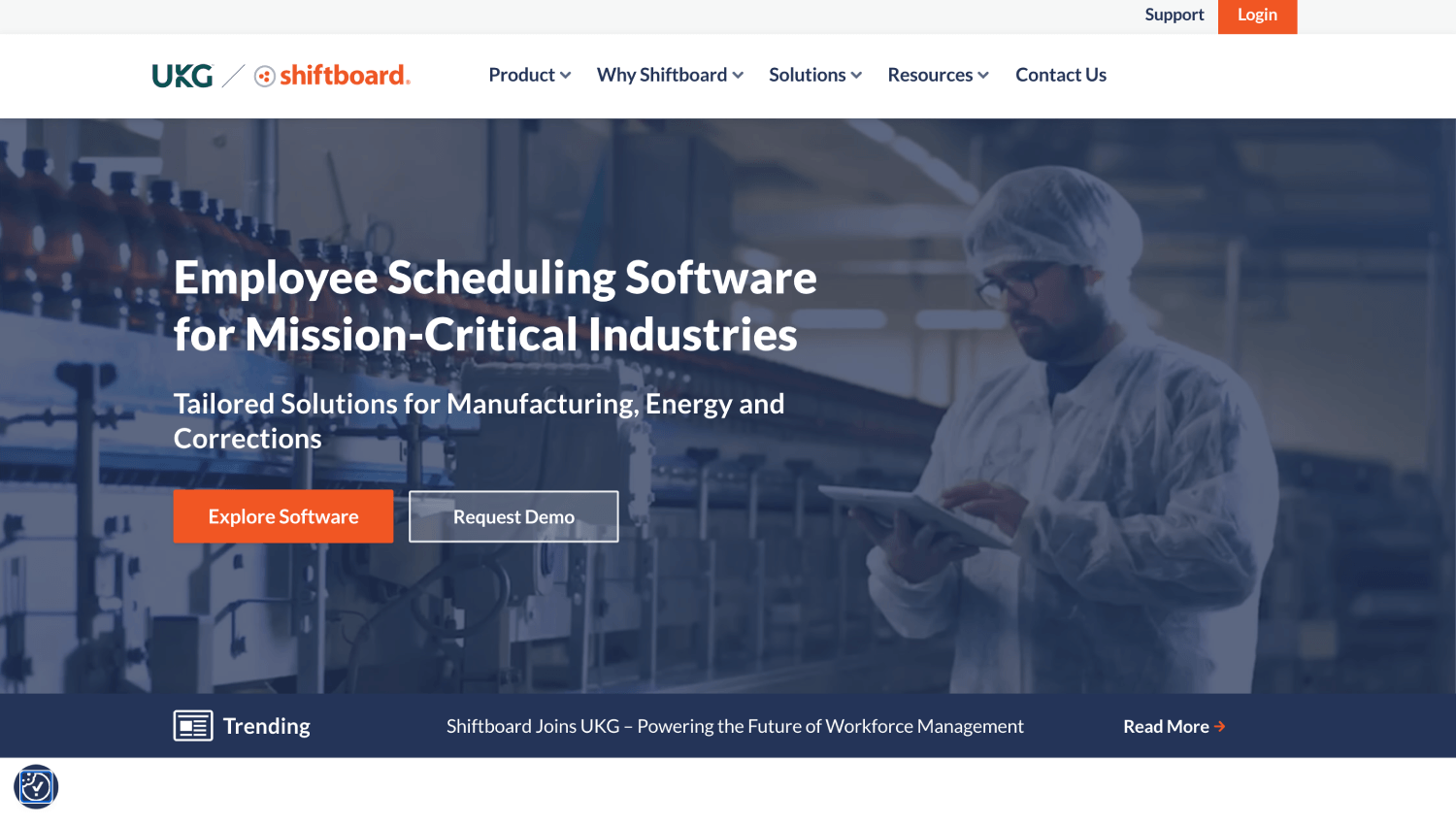
Shiftboard targets enterprise-level workforce scheduling: manufacturing plants, healthcare facilities, security firms, and any operation running complex multi-shift environments around the clock. Scheduling at this scale involves union rules, certifications, seniority-based assignment, and demand-based labor planning. Shiftboard is built for exactly this, with tools that no SMB-focused product comes close to matching.
Pricing is quote-based, which is standard for this complexity level. The implementation is not light, and Shiftboard is clear that it is a workforce management platform, not a quick-setup scheduling app. For a 500-person manufacturing operation where the wrong scheduling decision creates a safety liability, that depth is the point.
The trade-off is accessibility. Smaller teams will find it overkill, and the onboarding curve is steeper than anything else on this list. Buyers evaluating enterprise-level workforce tools should also review the best HRIS platforms for 500-employee companies to understand where scheduling fits within a broader HR stack.
Which Scheduling App Is Best for Specific Industries?
6. 7shifts (Restaurants)
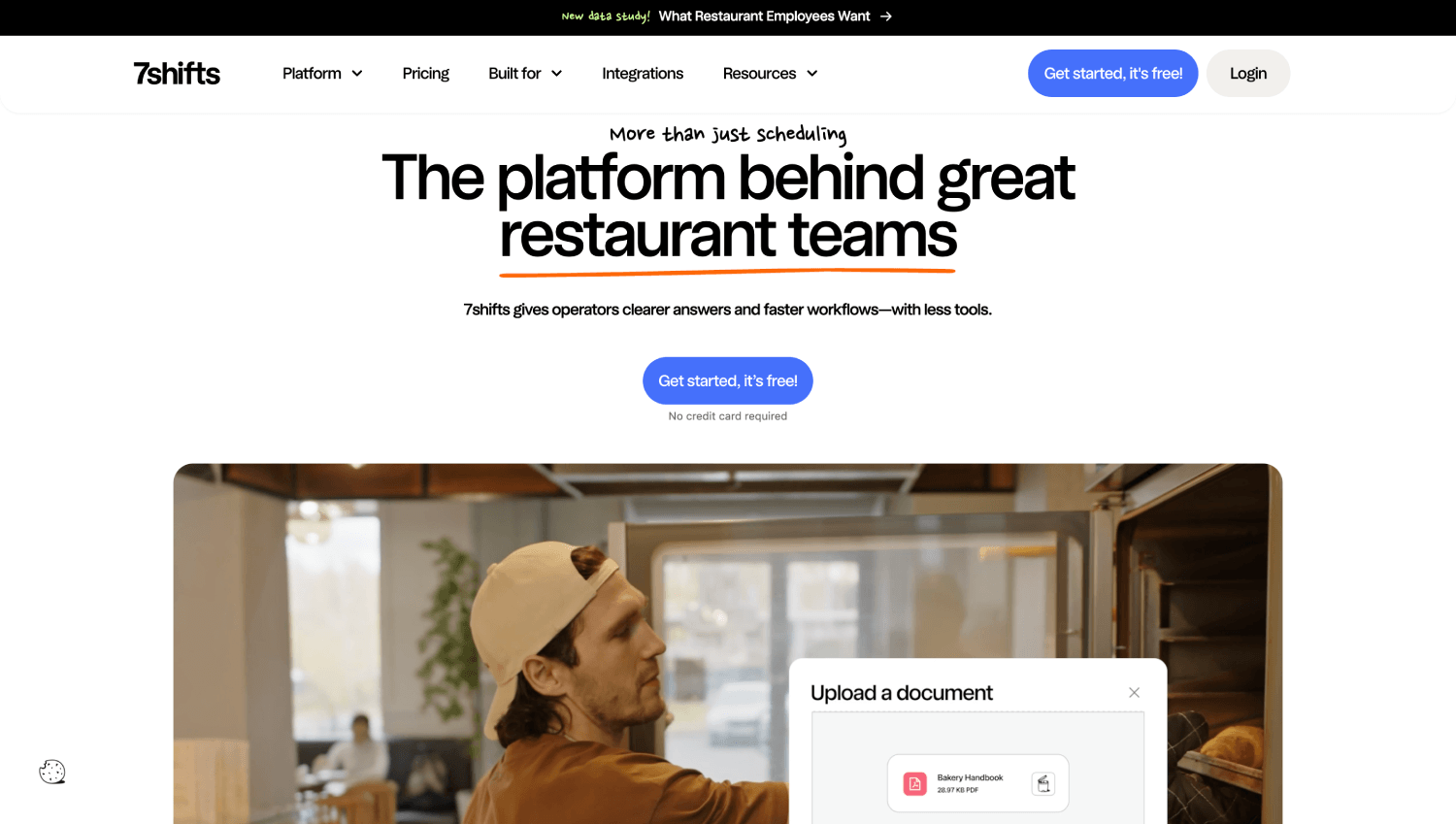
7shifts is the specialist pick for restaurant operators. The free plan covers one location up to 30 employees, and paid plans start at $29.99 per location per month per 7shifts’ public pricing page. That location-based model makes sense for restaurant groups managing each location as a separate P&L.
Where 7shifts earns its position is in restaurant-specific features: labor cost percentage tracking against sales, POS integration with Toast, Square, and Lightspeed, tip pooling calculations, and compliance with tip credit rules. The AI scheduling suggestion engine reads historical sales data to recommend optimal shift coverage. No general-purpose scheduling tool does this at the same depth.
Restaurant managers who have tried to force When I Work or Deputy to handle tip pooling and sales-based labor forecasting consistently end up here. The product is narrower than Deputy, but that narrowness is a feature for its target buyer.
7. HotSchedules (now Fourth)
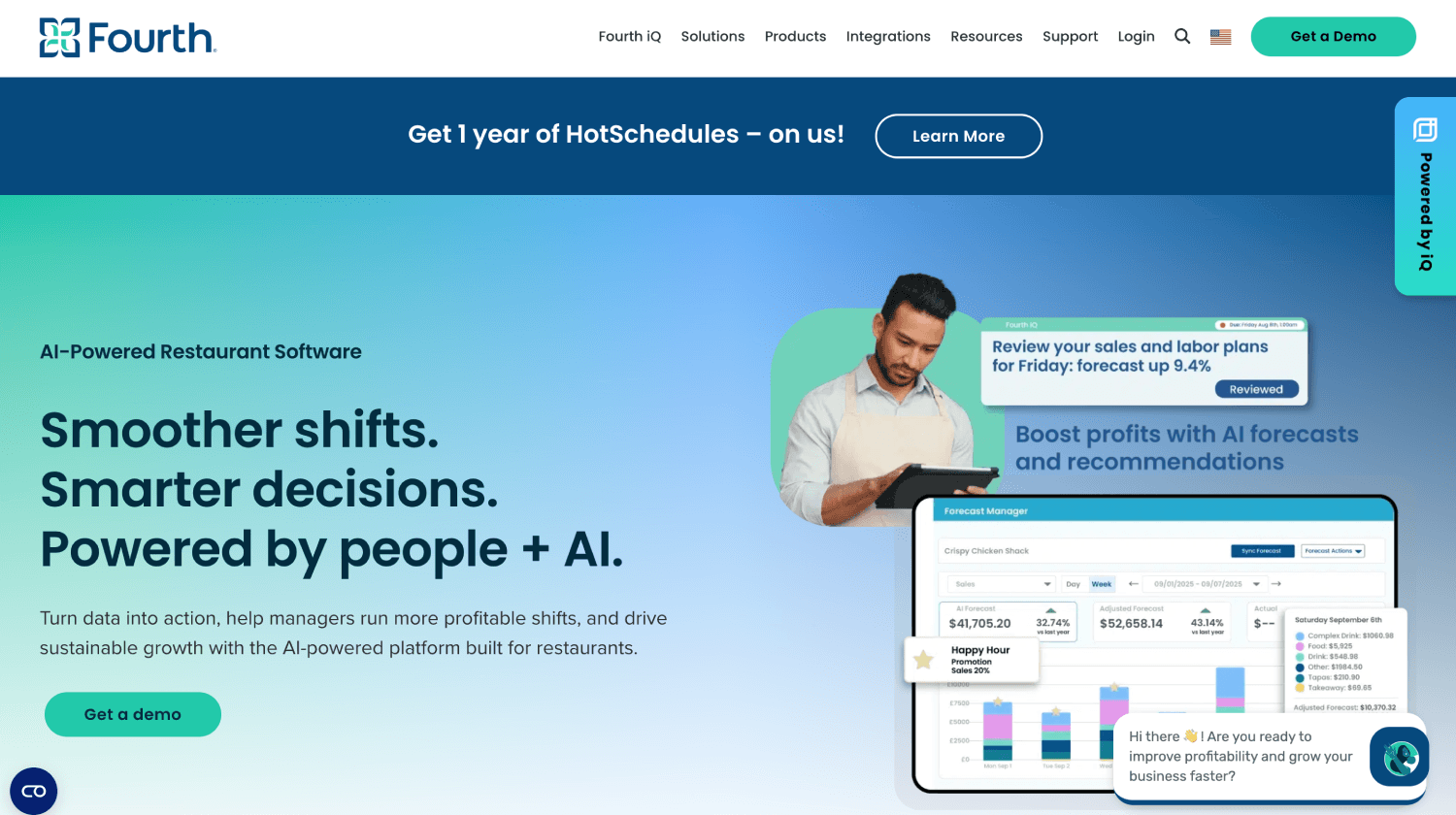
HotSchedules, now part of Fourth, serves enterprise restaurants and large hospitality groups. If 7shifts is for the independent restaurant operator and small chain, HotSchedules is for the 200-plus location franchise or hotel group. Pricing is quote-based.
According to Fourth’s product page, the platform combines demand forecasting, inventory management, and labor scheduling within its hospitality suite , the degree of integration between these modules should be verified with a Fourth sales team during evaluation, as capabilities can vary by contract tier. The core appeal for large hospitality operators is reducing the number of separate vendor relationships. A single-location or small-chain operator will pay more than necessary for capabilities they do not use.
8. ClockShark (Field Services and Construction)
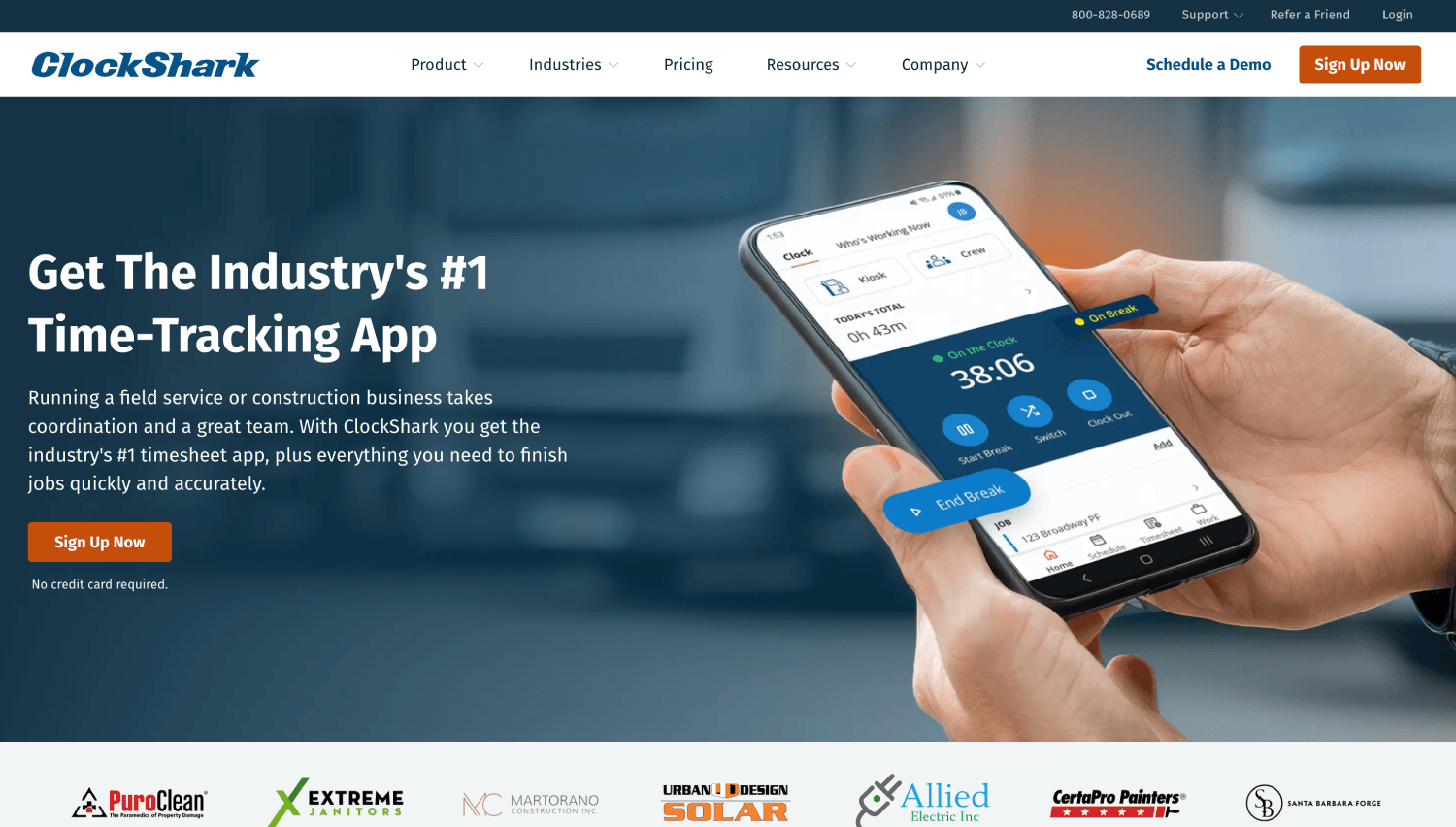
ClockShark is the scheduling and time tracking tool built for mobile workforces that never sit at a desk. Construction crews, field technicians, and landscaping teams clock in via GPS, which solves the buddy-punching and location-verification problem that desktop-based tools cannot touch.
According to ClockShark’s public pricing page, plans start at $7 per user per month. Scheduling is built around job sites rather than locations, which fits the project-based nature of construction and field services. Managers assign workers to jobs, track GPS timestamps, and export directly to payroll. For office-based scheduling software applied to field workers, GPS accountability is the feature that changes the conversation.
9. Humanity (TCP Software)
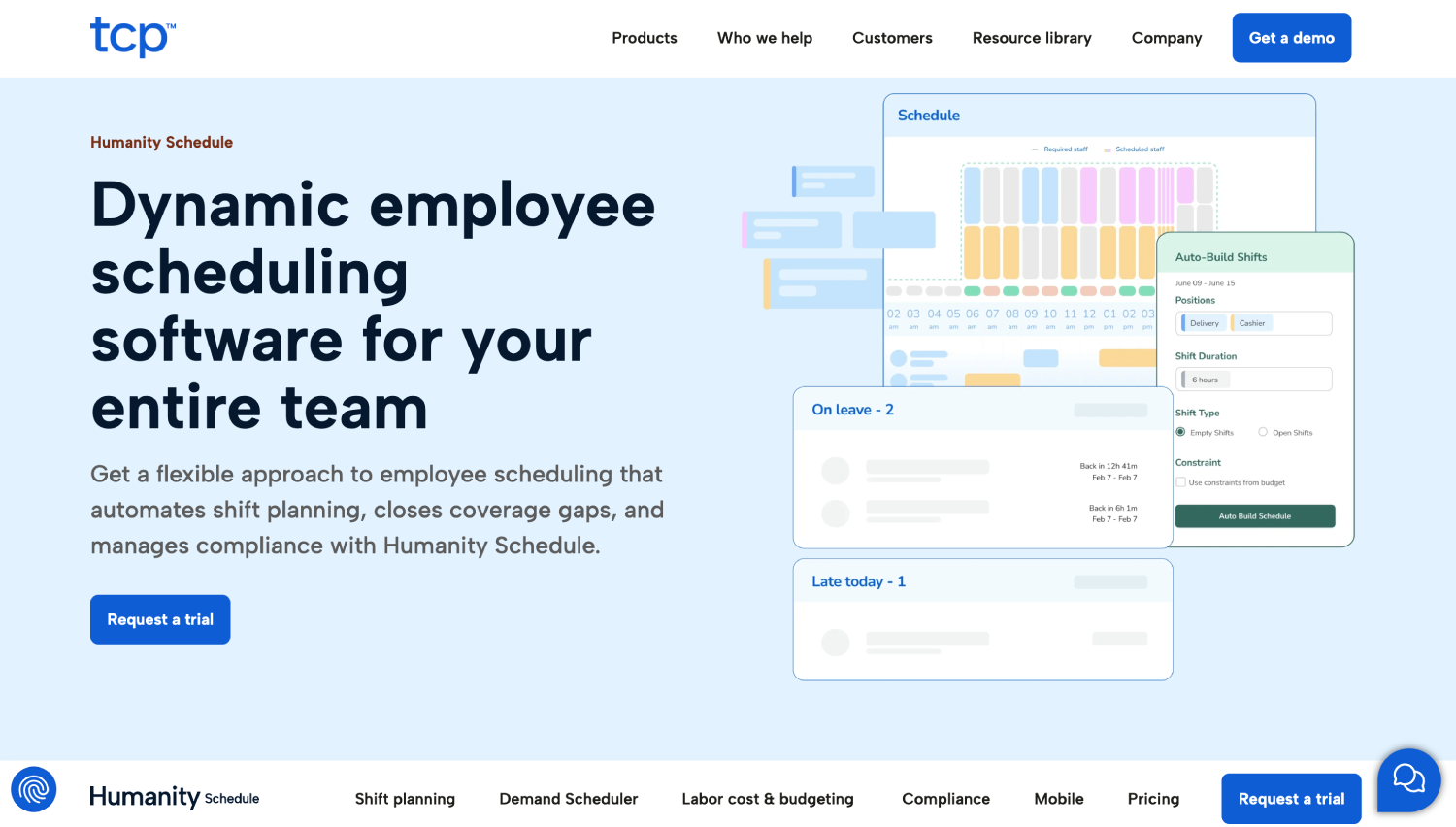
Humanity, now part of TCP Software, serves healthcare operators and large organizations running 24/7 shift operations. The scheduling engine handles self-scheduling, shift bidding, and automated compliance with healthcare-specific labor rules including nurse-to-patient ratios and required rest periods between shifts.
Pricing is quote-based. The platform is not a quick-setup tool, and it does not try to be. Healthcare HR teams evaluating workforce scheduling at scale should pair this evaluation with a broader look at people analytics platforms for US healthcare employers to understand the full data and staffing picture.
10. Connecteam
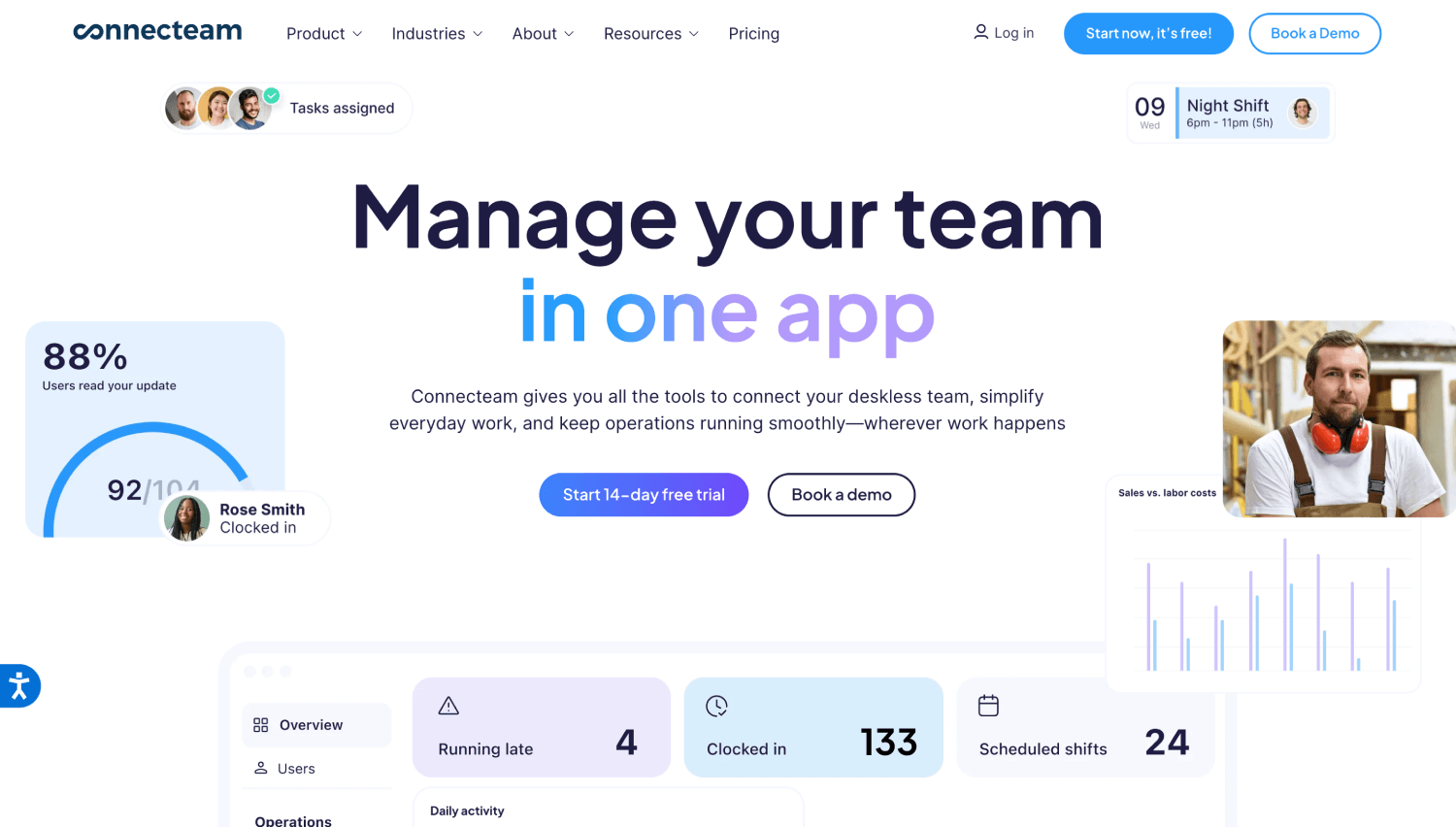
Connecteam targets deskless and field workforce management, combining scheduling, time tracking, task management, and internal communications in one app. The free plan covers teams up to 10 users. Paid plans start at $29 per month for up to 30 users per Connecteam’s public pricing page, which is a flat fee rather than per-user, making it cost-effective for small teams.
Connecteam’s scheduling module is solid, but the platform’s real value is in replacing the patchwork of group chats, paper forms, and phone calls that deskless teams rely on. For a landscaping company, cleaning service, or logistics operation where workers never touch a computer, Connecteam often replaces three separate tools in one go.
What Features Should You Prioritize in a Shift Scheduling App?
Not every feature on a vendor’s marketing page matters equally. The following breakdown is ordered by operational impact, not by how prominently vendors advertise each capability.
- Availability collection and conflict detection. Schedules built without real-time availability data create call-outs. The tool should collect employee availability and flag conflicts before the schedule publishes, not after.
- Shift swap and open shift management. Managers should not broker every swap. The tool should let employees initiate swaps, get manager approval, and update the schedule automatically.
- Labor cost visibility. Seeing projected labor costs as you build the schedule prevents overtime surprises. Tools that show cost-per-shift in real time during schedule construction save real money.
- Mobile-first employee experience. Hourly workers do not log into a desktop portal. If the employee-facing app is clunky, adoption fails and the schedule still lives in a text thread.
- Payroll integration. A schedule that does not feed into payroll creates a second data entry step. Verify that your specific payroll system (Gusto, ADP, Paychex, QuickBooks Payroll, Rippling) is on the vendor’s integration list before committing.
- Compliance tools. For US businesses in states with predictive scheduling or fair workweek laws, this is not optional. California, New York City, Chicago, Philadelphia, and Seattle all have specific requirements around advance notice and scheduling changes.
How Much Does Employee Scheduling Software Cost?
The pricing models across this category vary enough that comparing sticker prices without context misleads buyers. Here is how to think about total cost.
Per-user pricing scales with headcount and punishes high-turnover businesses. A 100-person retail team with 40% annual turnover will add and remove users constantly. Per-user pricing at $4 to $7 per month per active user is manageable at 100 people but can exceed the cost of a per-location model at larger scale.
Per-location pricing benefits multi-location businesses with large teams per site. Homebase and 7shifts both use this model. A restaurant with 40 staff in one location pays the same as one with 25 staff, which rewards density.
Flat-fee pricing (Connecteam’s model) works best for smaller teams under a fixed headcount threshold. Above that threshold, costs jump to the next tier.
Enterprise tools (Shiftboard, HotSchedules, Humanity) are quote-based. Expect implementation fees, training costs, and annual contracts. Factor in the hidden costs of HR software including integrations and configuration before comparing enterprise licensing quotes to SMB SaaS pricing.
How Does Employee Scheduling Software Connect to Your HR Stack?
Standalone scheduling tools work fine, but the efficiency gains compound when scheduling connects to the rest of your stack. Time and attendance data flowing into payroll eliminates manual entry. Scheduling data feeding into workforce analytics surfaces patterns like chronic understaffing on specific shifts or overtime clustering in specific departments.
For teams already running a broader HRIS, check whether your existing platform has a native scheduling module before buying a standalone tool. Rippling, UKG, and Ceridian Dayforce all include scheduling within their workforce management suites. The native module is rarely as deep as a specialist tool, but it connects to the rest of the platform by design.
For teams evaluating a full HR platform upgrade alongside scheduling, the HR software options for specific sectors and the HR software buying checklist provide a framework for evaluating the full stack together rather than piecemeal.
Frequently Asked Questions About Employee Scheduling Software
What is the best free employee scheduling software?
Homebase offers the strongest free tier for small businesses, covering one location with unlimited employees, time clocking, and team messaging at no cost. 7shifts has a free plan limited to one location and up to 30 employees, built specifically for restaurants. Sling and Connecteam also have functional free plans. Free plans consistently limit integrations, reporting, and multi-location management, so evaluate the paid tier before committing based on the free experience alone.
What is the difference between scheduling software and time and attendance software?
Scheduling software is forward-looking: it builds and publishes shifts, collects availability, manages swaps, and forecasts labor costs. Time and attendance software is backward-looking: it records when employees actually clock in and out, tracks exceptions, and feeds hours into payroll. Many tools in this list do both, but they are built from the scheduling side outward. Pure time-and-attendance tools like TSheets or Clockify are built from the tracking side inward, and their scheduling features are lighter.
Does employee scheduling software handle compliance with fair workweek laws?
Deputy is the strongest in this area among the tools reviewed, with built-in support for predictive scheduling and fair workweek laws across multiple US jurisdictions , verify current coverage directly with Deputy before purchase, as supported locations expand over time. When I Work offers some compliance alerts. Homebase and Sling handle basic overtime flagging but do not enforce predictive scheduling notice requirements automatically. If your business operates in a jurisdiction with these laws, compliance capability should be a primary evaluation criterion, not an afterthought.
How long does it take to implement employee scheduling software?
SMB tools like Homebase, When I Work, and Sling are designed for self-service setup and typically take one to three days to configure: import your employee list, set up roles and locations, and build your first schedule. Mid-market tools like Deputy take one to two weeks when integrations to payroll and POS are involved. Enterprise tools like Shiftboard and Humanity involve formal implementations measured in weeks or months, including data migration, training, and change management. Underestimating implementation time is the most common mistake buyers make in this category.
Can scheduling software integrate with payroll?
Most tools on this list integrate with major US payroll providers. When I Work, Deputy, and Homebase all connect to Gusto, ADP, Paychex, and QuickBooks Payroll. ClockShark exports timesheet data to major payroll systems. Always verify your specific payroll provider is supported before signing a contract. Niche or regional payroll providers are often excluded from standard integrations and require a CSV export workaround, which defeats part of the automation value.
Is scheduling software worth it for a business under 20 employees?
At under 20 employees, the math is straightforward. A free tool like Homebase or Sling costs nothing and replaces hours of weekly schedule management. The ROI is in manager time recovered, not in advanced analytics. Even at 10 employees across variable shifts, the combination of automated shift reminders, digital availability collection, and in-app swap management typically saves three to five hours of manager time per week. That payoff holds even at small headcounts.
What is the best scheduling app for restaurant staff?
7shifts is the category leader for restaurants, with POS integrations, sales-based labor forecasting, and tip pooling built into the product. For large restaurant chains and hospitality groups at enterprise scale, HotSchedules (Fourth) is the standard. Homebase and Sling work for restaurants but lack the sales-to-labor ratio tracking and POS depth that restaurant operators actually need to manage food and labor costs together.
Which Employee Scheduling Tool Should You Actually Buy?
The right answer splits cleanly by business type. Small businesses with one to three locations should start with Homebase or Sling on a free plan and upgrade only when they hit a specific feature wall. Growing multi-location businesses in retail, healthcare, or hospitality with 50 to 500 employees should evaluate Deputy first, with When I Work as a close second for teams where compliance complexity is lower. Restaurant operators should go directly to 7shifts. Field services and construction teams need ClockShark. Complex enterprise operations with union rules, certification requirements, or around-the-clock shifts belong in Shiftboard or Humanity.
The one mistake to avoid is buying an HRIS scheduling module and expecting it to perform at the level of a specialist tool. HRIS modules are built for occasional schedule visibility, not for the operational reality of a manager building a 40-person weekly schedule with five shift types, three open positions, and two people on approved leave. The specialist tools exist because the HRIS modules were not good enough.
Shortlist two tools, run trials with real managers on real schedules, and evaluate adoption from the employee side, not just the manager console. If your staff do not use the app to check their schedule and swap shifts, you have not solved the problem. You have just moved the spreadsheet to a different format.