
- Buying compensation survey data gives you market references. It does not give you a pay program. Job architecture, grade bands, and a pay philosophy are what make the data usable, and that work requires a consultant, not a license.
- The firms most worth hiring fall into two categories: boutiques that specialize in compensation design and large firms that bundle comp work into broader HR advisory. Both have trade-offs.
- For mid-market companies moving from ad hoc pay to formal bands, Pearl Meyer and Semler Brossy are the clearest fits. Compensia leads for pre-IPO and newly public tech companies with equity-heavy comp programs.
- Mercer, WTW, and Aon dominate enterprise and executive compensation, but their minimums and timelines often disqualify mid-market buyers.
- The firmest signal that you need a consultant rather than more data: managers are making individual pay decisions that deviate from any consistent logic, and HR cannot explain why any role is graded the way it is.
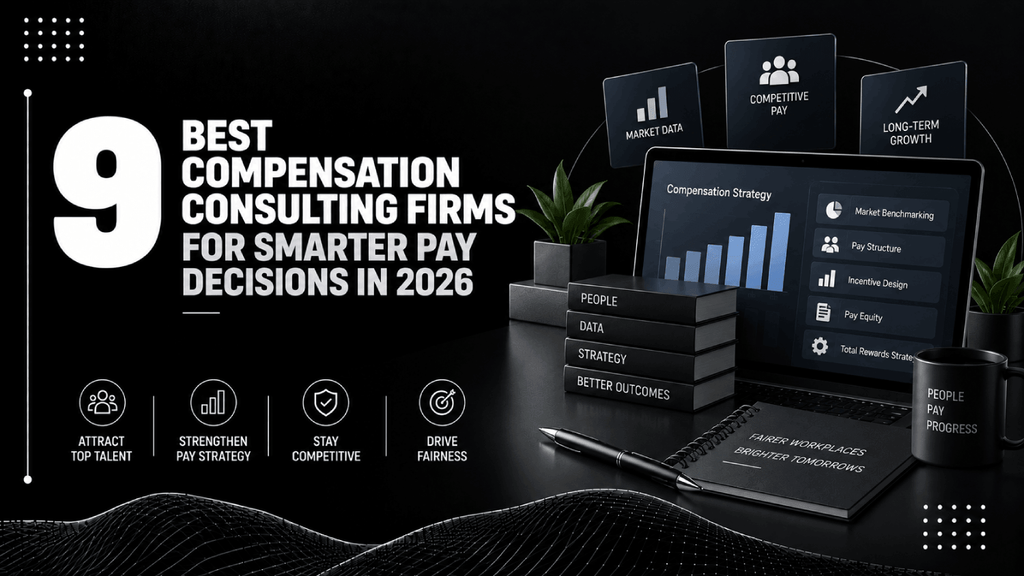
The best compensation consulting firms for most mid-market companies are Pearl Meyer, Compensia, and Semler Brossy for specialized work, with Korn Ferry, Radford (Aon), Culpepper, and a handful of regional boutiques covering specific niches from executive pay to global benchmarking. The right choice depends on company size, ownership structure, and whether you need job architecture built from scratch or an existing structure refreshed.
Why Survey Data Alone Does Not Produce a Compensation Strategy
Most HR teams make the same mistake. They buy Radford or Mercer survey data, match job titles to survey cuts, and call it a compensation program. The data tells you what the market pays a “Senior Software Engineer” at the 50th percentile. It does not tell you what a Senior Software Engineer is at your company, how that role relates to Staff Engineer or Principal Engineer, or when someone should move between them.
That definitional work is job architecture: the framework of levels, families, and career tracks that gives salary ranges something to anchor to. Without it, you end up with a spreadsheet of market data and managers who interpret it however serves their current retention problem. Compensation decisions become negotiation outcomes rather than policy outcomes.
The firms on this list all deliver something beyond data. They design the underlying structure. Some will also sell you survey participation, but the differentiated work is architecture, philosophy, and program design. If you only need market data, our guide to compensation benchmarking tools covers the software options in detail.
What Do Compensation Consulting Firms Actually Deliver?
The scope varies by firm and engagement, but most mid-market compensation consulting projects fall into one of four categories.
- Job architecture and leveling: Building or rebuilding the career framework, including job families, levels, grade definitions, and leveling criteria. This is the foundation everything else sits on.
- Salary structure design: Setting grade bands, midpoints, and range spreads tied to a specific market positioning strategy (e.g., 50th percentile base with 75th percentile total cash).
- Market pricing and survey methodology: Selecting appropriate survey sources, aging data, choosing comparator sets, and matching internal roles to external benchmarks with rigor.
- Incentive plan design: Structuring short-term and long-term incentive programs, including equity plan design, bonus mechanics, and pay mix strategy.
- Executive compensation advisory: Specific work for C-suite pay, board compensation, Say on Pay preparation, and proxy disclosure for public or pre-IPO companies.
A company at 150 people moving from startup to structured HR typically needs the first two. A company at 2,000 people with a functioning HRIS and a comp cycle that keeps producing complaints needs items three and four. A newly public company needs all five, delivered by someone who understands Regulation S-K and SEC disclosure requirements.
The 9 Best Compensation Consulting Firms Compared
| Firm | Best For | Primary Strength | Typical Client Size | Pricing Model |
|---|---|---|---|---|
| Pearl Meyer | Executive comp + broad-based design | Total rewards philosophy and program design | Mid-market to enterprise | Project-based, quote-only |
| Compensia | Pre-IPO and newly public tech companies | Equity plan design, SEC disclosure, tech sector | Growth-stage to public | Project-based, quote-only |
| Semler Brossy | Executive compensation and governance | Board advisory, proxy, pay-for-performance | Mid-market to large-cap public | Project-based, quote-only |
| Korn Ferry | Job architecture at scale | Global job leveling frameworks, survey data | Mid-market to enterprise | Subscription + project |
| Radford (Aon) | Tech sector benchmarking | Equity and cash survey data, market pricing | Startup to enterprise | Survey subscription + project |
| Mercer | Global enterprise comp programs | Broad survey coverage, total rewards strategy | Enterprise (1,000+) | Subscription + consulting |
| WTW | Executive pay and broad-based comp | Survey data, executive advisory, M&A comp | Mid-market to enterprise | Subscription + project |
| Culpepper | Survey participation and benchmarking | Cash compensation surveys, geographic data | Any size | Survey subscription |
| Pay Governance | Independent executive comp advisory | Board-independent pay governance | Public companies | Project-based, quote-only |
Pearl Meyer: Best for Total Rewards Program Design at Mid-Market
Pearl Meyer sits in a useful position: large enough to have deep expertise across executive and broad-based compensation, small enough that mid-market clients are not handed to junior staff. Their primary differentiator is that they work across the full rewards program, not just one slice of it.
What They Do Well
Pearl Meyer is particularly strong when a company needs to connect its pay philosophy to its job architecture and then cascade that into grade bands and incentive design. Many firms treat these as separate engagements. Pearl Meyer treats them as one integrated program, which produces more consistent outputs.
Their executive compensation practice is board-advisory grade, covering Say on Pay, peer group benchmarking, and long-term incentive design. But their broad-based work is equally capable, which matters when you need both levels of the house designed consistently.
Where They Fall Short
Pearl Meyer is not a software-forward firm. If you want compensation modeling tools, a technology platform for cycle management, or benchmarking software integrated into your HRIS, this is not the right partner. They deliver a framework, not a tool. You will need separate software to operationalize their work. Our review of the best compensation management software covers that side of the equation.
Best For
Companies between 200 and 2,000 employees that need both job architecture and executive compensation handled by one firm, or companies whose comp program has grown inconsistently and needs a full audit and rebuild.
Compensia: Best for Pre-IPO and Newly Public Technology Companies
Compensia is a specialized boutique focused almost entirely on equity-intensive compensation programs in the technology sector. If you are a company heading toward an IPO, recently public, or operating in a high-equity environment where getting pay design wrong creates SEC disclosure risk, Compensia belongs on your shortlist.
What They Do Well
Compensia’s equity plan design capability is their clearest strength. They understand the mechanics of option pools, RSU design, performance share units, and refresh grants at a level that general compensation consultants often do not. They also understand the regulatory context. Proxy disclosure, Regulation S-K, and Compensation Discussion and Analysis (CD&A) drafting are within their competency, which is rare for a firm of their size.
For a first-time public company trying to establish a peer group, set up a Compensation Committee process, and design an executive pay program that will hold up to institutional investor scrutiny, Compensia has done this work many times before.
Where They Fall Short
Their focus on tech sector and equity means they are less suited for non-tech industries, companies with complex global operations, or organizations where cash compensation design is the primary need. They are also not the right firm if you need broad-based job architecture for a large, multi-function organization.
Best For
Technology companies from Series C through two years post-IPO, or any company where equity is the dominant compensation lever and getting the program design right has board-level implications.
Semler Brossy: Best for Board-Level Executive Compensation Governance
Semler Brossy is an independent executive compensation advisory firm, meaning they work directly with boards and compensation committees without the potential conflicts that come from selling survey subscriptions or HR technology. That independence matters in governance-sensitive situations.
What They Do Well
Pay-for-performance alignment is where Semler Brossy earns their reputation. Their advisory work focuses on whether an executive pay program actually reflects company performance over time, which is the question institutional investors and proxy advisors like ISS and Glass Lewis focus on most. Semler Brossy is fluent in how ISS and Glass Lewis will score a pay program before it ever reaches an annual meeting vote.
They also do peer group design at a level of rigor that matters. Selecting the right comparators for executive pay benchmarking is not a mechanical task, and the wrong peer group produces misleading pay levels and governance risk.
Where They Fall Short
Semler Brossy does not do broad-based compensation work. They are not the right firm for building job architecture, designing grade bands, or conducting market pricing exercises for individual contributor and manager populations. Their scope is C-suite and board compensation, governed with care.
Best For
Public companies with active boards, companies preparing for a first Say on Pay vote, and any situation where the board’s compensation committee needs an independent advisor without conflicts from data products or technology sales.
Korn Ferry: Best for Job Architecture at Scale

Korn Ferry built its compensation practice partly around its proprietary job architecture framework, the Korn Ferry Hay Guide Chart method and its more modern job leveling approach. For companies that want a proven, globally recognized job leveling methodology rather than building one from scratch, Korn Ferry is the most structured option available.
Their survey data (the Korn Ferry Pay Database) is separate from their consulting practice but feeds into it. The integration between their leveling methodology and market data is tighter than most competitors. The trade-off is that adopting the Korn Ferry framework creates some dependency on their tools and methodology over time. Companies that later want to move off it face a re-architecture project.
Korn Ferry works best for companies with 500 or more employees who need a framework that can scale globally and survive management changes without requiring constant re-interpretation. For smaller companies, the overhead of a comprehensive Korn Ferry engagement is often more than the problem warrants.
Radford (Aon): Best for Technology and Life Sciences Benchmarking
Radford, now part of Aon, is the dominant survey provider for technology and life sciences compensation data. Their survey participation network in those sectors is larger than any competitor, which makes their benchmarks more reliable for roles where the talent market is primarily tech-sector driven.
Radford’s consulting work sits alongside their survey business. They can help with market pricing methodology, pay range design, and equity benchmarking, and the access to their own survey data during an engagement is a practical advantage. For companies that already participate in Radford surveys, there is logic in engaging them for consulting work that builds on that data foundation.
Radford is a poor fit for companies outside tech and life sciences, or for companies where equity is a minor part of the comp program. Their data depth outside those verticals is less competitive than Mercer or WTW.
Mercer, WTW, and Aon: When the Big Three Make Sense

Mercer, WTW (Willis Towers Watson), and Aon are the three largest compensation consulting firms globally. They have the broadest survey databases, the deepest geographic coverage, and the largest consulting bench. They also have minimum engagement sizes and project timelines that make them impractical for many mid-market buyers.
Use Mercer when you have a global workforce, complex benefit plan integration needs, or a comp program that touches multiple countries and regulatory environments. WTW is strongest for executive compensation, benefits consulting, and M&A-related comp integration work. Aon’s compensation practice outside of Radford is strong in actuarial-adjacent work and large-employer total rewards design.
All three are quote-only on pricing, and none of them publish engagement minimums. In practice, a meaningful consulting engagement at any of these firms typically requires a budget conversation before you know whether they will take the project. If your organization is under 500 employees, start with the boutiques above.
Culpepper: Best Low-Cost Entry Point for Survey Data and Benchmarking
Culpepper is a survey provider, not a full consulting firm, but they appear on this list because their survey data is often the right starting point for companies that need market references before they have the budget for architecture work. Their surveys cover cash compensation across a wide range of industries and geographies at a cost that is meaningfully lower than Mercer or Radford.
Culpepper does not replace a compensation consultant. They give you the market data layer. What to do with that data, how to build ranges from it, and how to connect it to a job architecture are questions their surveys cannot answer. Think of Culpepper as the data foundation you bring to a consulting engagement, or the tool you use while you are deciding whether to hire a consultant at all.
Pay Governance: Best for Independent Board Advisory
Pay Governance operates as an independent advisory firm focused on executive compensation and board governance, similar in positioning to Semler Brossy. Their practice is built around Compensation Committee advisory work without the conflicts that come from selling software or survey data.
Pay Governance is particularly active with mid-cap public companies where the board needs independent counsel and cannot easily access the Big Three firms at a workable cost. They publish regular market research on executive pay trends, which makes their public content a useful calibration tool even before you engage them. For companies preparing a first proxy or navigating a CEO transition, their specialty is well-defined.
How to Choose the Right Compensation Consulting Firm for Your Situation
The selection logic is simpler than most buyers make it. Answer three questions and the shortlist writes itself.
- What is your primary problem? If you have no job architecture, start with firms that specialize in it. Korn Ferry and Pearl Meyer are the clearest options. If you have architecture but a broken executive program, Semler Brossy or Pay Governance. If you are pre-IPO with heavy equity, Compensia.
- What is your organizational size? Under 500 employees, boutiques are more appropriate. The Big Three will quote you, but the engagement will be sized for a larger client. Over 2,000 employees, the Big Three become more competitive on value.
- Do you need ongoing advisory or a one-time project? Some firms, particularly the executive comp boutiques, work on retainer. Others are project-based. Know which model matches your internal capacity to manage the relationship.
For companies at the inflection point where pay decisions have become reactive and inconsistent, the immediate priority is job architecture. A salary structure without defined levels is just a table of numbers with no enforcement mechanism. Managers will always find a reason to work around ranges that have no supporting logic. The architecture work, paired with a clear pay philosophy, is what makes the data from any survey source actually useful.
If your HR team is simultaneously trying to evaluate compensation tools while doing this foundational work, the combination of a consulting engagement and the right software is worth planning together. People analytics platforms that surface pay equity gaps can help validate the architecture once it is built, as covered in our review of AI people analytics platforms for workforce planning.
What Should a Compensation Consulting Engagement Cost?
None of the firms on this list publish standard pricing, which is a deliberate practice. Engagement costs vary by scope, company size, data complexity, and deliverable set. That said, some directional guidance is publicly available from firms and from buyer communities.
A job architecture and salary structure project for a company of 200 to 500 employees with a single US geography typically runs in the range of a multi-month consulting engagement. The variable factors are how many job families need to be built, whether the firm is designing from scratch or inheriting existing roles, and how much change management support is included. Executive compensation advisory retainers for board-level work are priced separately and reflect the ongoing nature of Compensation Committee advisory relationships.
Buyers who want to reduce cost often separate the data layer from the architecture work, buying survey data directly from Culpepper or Radford and engaging a boutique for the design work on top of it. This approach works if the HR team has enough analytical capacity to process raw survey data. If they do not, the cost of the split is often higher than a single integrated engagement.
How Does Job Architecture Connect to HR Technology?
Job architecture is the upstream dependency for almost every HR technology investment that touches pay, performance, or careers. Compensation management software requires grade structures. Performance calibration requires defined levels. Internal mobility platforms need career tracks to surface relevant opportunities. Skills-based hiring platforms need job family definitions to match skills to roles.
Companies that try to implement compensation management software before their job architecture is clean typically end up configuring their architecture inside the tool, which produces a system-specific structure that does not translate anywhere else. Getting the architecture designed properly, usually with a consultant before the software selection, makes the downstream implementation cleaner and faster. If you are evaluating compensation software in parallel, our review of the best compensation management software covers how these tools vary in their ability to handle custom job architectures.
Pay equity analysis is another downstream dependency. You cannot run a meaningful pay equity model without consistent job levels. The Syndio, Trusaic, and PayAnalytics platforms reviewed in our pay equity platform comparison all assume that your job architecture is already in place.
Frequently Asked Questions
What is the difference between a compensation consultant and a compensation benchmarking tool?
A benchmarking tool gives you market data: what other companies pay for comparable roles. A compensation consultant designs the structure that makes that data usable, including job levels, grade bands, pay philosophy, and incentive design. The tool answers “what does the market pay?” The consultant answers “how should our pay program be built?” Most companies need both, in that order.
When should a mid-market company hire a compensation consulting firm?
The clearest signals are: managers regularly asking HR to make exceptions to pay ranges, new hire offers that compress against existing employee pay, difficulty explaining why two similar roles are graded differently, or a planned headcount expansion that will expose inconsistencies in your current structure. Any of these mean the underlying architecture needs work, not just better market data.
How long does a job architecture and salary structure project typically take?
For a company of 200 to 500 employees with a defined scope, a job architecture engagement typically runs two to four months from kickoff to final deliverable. Larger organizations with more job families, multiple geographies, or legacy role complexity take longer. The biggest timeline variable is internal stakeholder alignment, not the consultant’s capacity.
Can a compensation consulting firm help with executive compensation for a first-time public company?
Yes, and this is one of the highest-value use cases for firms like Compensia, Semler Brossy, and Pay Governance. A newly public company needs a peer group established, CD&A drafted, Compensation Committee processes formalized, and an executive pay program designed to withstand ISS and Glass Lewis scrutiny. Attempting this without a specialist advisor is a significant governance risk.
Do I need to participate in salary surveys to work with a compensation consultant?
Survey participation is not a requirement, but it often gives you access to better data at a lower cost during the engagement. Many consultants will recommend specific surveys to join before or during the project. Firms like Radford and Korn Ferry have direct incentives to add you to their survey panels, but independent boutiques like Pearl Meyer or Pay Governance will source data from multiple surveys without requiring your participation in any of them.
What is the difference between job leveling and job architecture?
Job leveling is the process of assigning specific roles to defined levels within a framework. Job architecture is the framework itself: the career tracks, job families, level definitions, and criteria that make leveling decisions consistent. You cannot do leveling well without a designed architecture underneath it. Most companies that struggle with leveling consistency are actually missing a designed architecture, not just leveling judgment.
How do compensation consulting firms charge for their work?
Most compensation consulting firms charge on a project basis with a fixed or capped fee agreed at scoping. Some executive compensation advisory firms work on annual retainers for ongoing Compensation Committee support. Survey providers like Culpepper and Radford charge subscription fees for data access. None of the major boutiques or Big Three firms publish standard rate cards. Expect to submit a brief scope and receive a proposal before any pricing conversation.
The Single Most Important Decision in This Category
Most buyers spend too much time comparing firms and not enough time clarifying the scope of their problem. A compensation consulting firm cannot fix a broken pay program if the organization does not have a clear pay philosophy to anchor the work. Before you send a brief to any firm, decide what your company believes about pay positioning, internal equity, pay transparency, and how compensation connects to performance. If you cannot articulate that, the consultant will spend the first month of a paid engagement extracting it from you.
The architectural work, the leveling, the grade bands, the pay philosophy documentation, produces an operating system for pay decisions. Survey data without that operating system is just raw material with no factory. Companies that make this investment once, with the right firm, typically find that the downstream decisions in performance cycles, promotions, and new hire offers become faster and more defensible. That defensibility matters more than any particular market positioning choice you make.
If your team is in the process of evaluating whether you need a compensation consultant or a different kind of HR advisor, the broader category of people operations consultants for scaling companies covers adjacent advisory work that sometimes overlaps with compensation design, particularly at the smaller end of the mid-market.