
- Most hiring teams pick assessment vendors based on price and interface. Validity evidence and adverse impact data are what actually hold up when a regulator or plaintiff attorney asks questions.
- SHL publishes the most extensive technical documentation of the three, with decades of peer-reviewed validity studies and broad norm groups. It is the right choice for enterprise teams with legal exposure and global hiring volume.
- Criteria Corp offers solid criterion-related validity evidence and a genuinely candidate-friendly experience, making it the strongest pick for mid-market teams hiring at scale across a variety of roles.
- Predictive Index is a behavioral assessment first, a cognitive assessment second. Its PI Cognitive Assessment has published validity data, but PI Behavioral Assessment relies on ipsative methodology, where respondents choose between descriptors rather than rating each independently, that many I-O psychologists treat with skepticism for selection purposes.
- All three vendors differ sharply on what they publish about adverse impact. SHL is the most transparent. Criteria is close behind. Predictive Index is the least forthcoming.
Choosing between Criteria Corp, Predictive Index, and SHL, the core Criteria vs Predictive Index vs SHL decision facing most mid-market and enterprise hiring teams, comes down to what you are actually measuring and what you can defend. SHL wins on psychometric rigor and global scale, making it the safest choice for enterprise legal environments. Criteria Corp wins on usability and value for mid-market volume hiring. Predictive Index works well for culture-fit conversations but carries real psychometric limitations when used as a primary selection gate.
Why Most Hiring Assessment Evaluations Start with the Wrong Criteria
The typical RFP for a hiring assessment platform asks about ATS integrations, candidate completion rates, and price per assessment. These are real operational concerns, but they are secondary. The primary question is whether the assessment measures what it claims to measure, and whether using it creates disparate impact on protected groups.
Adverse impact is the legal standard defined under the Uniform Guidelines on Employee Selection Procedures. If a selection procedure causes one demographic group to be selected at less than four-fifths the rate of the highest-selected group, it triggers scrutiny. An assessment with strong validity evidence and documented adverse impact analysis gives you a defense. One without documentation leaves you exposed.
Vendors know this, which is why their marketing materials use phrases like “predictive validity” and “scientifically validated” without always saying what those phrases mean. The real question is: validated against what criterion, with what sample, in what norm group, and at what subgroup difference rate? Most buyers never ask. When a charge gets filed, they wish they had.
This comparison holds all three vendors to that standard. Psychometric transparency, adverse impact data availability, norm group breadth, candidate experience, test length, and ATS integration quality are all scored below. Skills testing platforms like Vervoe operate in a different category. If you are weighing those, our Vervoe alternatives comparison is the better starting point.
How Do Criteria Corp, Predictive Index, and SHL Actually Compare on Validity Evidence?
Validity evidence is the foundation of any defensible assessment program. There are three types that matter in selection: criterion-related validity (does the score predict job performance?), content validity (does the test content represent the job?), and construct validity (does the test measure the psychological construct it claims to measure?).
SHL
SHL has the deepest published validity record of the three. The company has been publishing technical manuals and peer-reviewed research since the 1970s, and its Occupational Personality Questionnaire (OPQ) and Verify cognitive ability assessments have criterion-related validity studies across multiple industries and role families. SHL’s Verify range includes inductive, deductive, and numerical reasoning tests with published norm groups from over 200 countries. The breadth of its normative database is genuinely unmatched in this comparison.
SHL also publishes subgroup difference data in its technical documentation. Mean differences between demographic groups on cognitive ability measures are a known and uncomfortable reality in psychometric assessment. SHL does not hide this. It documents the standardized mean differences and offers alternative assessment approaches designed to reduce adverse impact without sacrificing predictive validity, such as its situational judgment tests and personality measures.
Criteria Corp
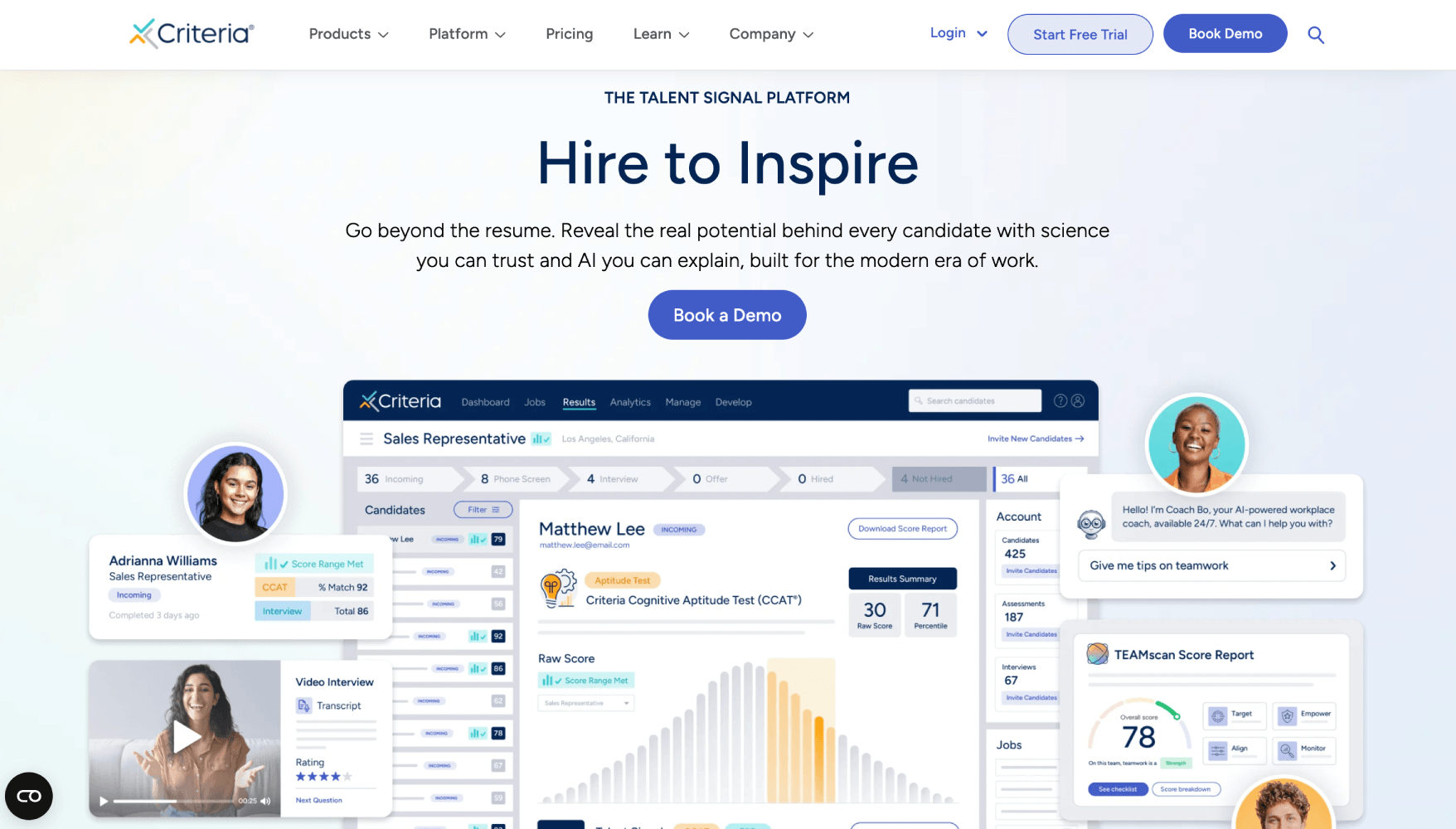
Criteria Corp publishes criterion-related validity studies for its CCAT (Criteria Cognitive Aptitude Test), its personality measures, and its emotional intelligence assessments. The CCAT’s technical manual documents validity coefficients from studies across multiple job families, and the company is transparent about sample sizes. Criteria also publishes adverse impact data in its technical documentation, specifically addressing racial and gender subgroup differences on the CCAT.
The honest assessment: Criteria’s validity evidence is solid, not exceptional. It lacks the volume and breadth of SHL’s research base. For most mid-market employers, that is an acceptable trade-off given the difference in cost and implementation complexity. For companies with significant legal exposure or OFCCP audit history, the thinner research base is worth noting.
Predictive Index
Predictive Index markets two primary products in the selection context: the PI Cognitive Assessment and the PI Behavioral Assessment. These deserve separate treatment because their psychometric standing is not equivalent.
The PI Cognitive Assessment has published validity evidence and is a generally accepted cognitive ability measure. The PI Behavioral Assessment uses an ipsative format, where respondents choose between descriptors rather than rating each one independently. Ipsative measurement is controversial in selection contexts. The limitation is that ipsative scores produce ipsative, not normative, data, which makes group comparisons statistically problematic and complicates adverse impact analysis. PI does not prominently surface this limitation in its buyer-facing materials. Practitioners evaluating PI for high-stakes selection decisions should read the technical documentation carefully before proceeding.
| Dimension | SHL | Criteria Corp | Predictive Index |
|---|---|---|---|
| Published criterion-related validity studies | Extensive, peer-reviewed, multi-industry | Solid, company-funded, published technical manual | PI Cognitive: published. PI Behavioral: limited and contested |
| Adverse impact data published | Yes, with subgroup difference reporting | Yes, in technical documentation | Limited; ipsative format complicates analysis |
| Norm group breadth | Global, 200+ countries | US-centric, growing international | US-centric |
| Third-party peer review | Extensive | Limited | Limited |
| Primary assessment type | Cognitive ability, personality (OPQ), SJT | Cognitive ability, personality, EI, skills | Behavioral (ipsative), cognitive ability |
Which Platform Has the Strongest Adverse Impact Risk Management?
Adverse impact is not a hypothetical concern. The EEOC continues to bring charges related to cognitive ability screening, and private litigation under Title VII remains active. If your assessment causes disparate selection rates and you cannot demonstrate job-relatedness and validity, you are exposed.
SHL is the most proactive vendor on this dimension. Beyond publishing subgroup data, it has invested in research on how to construct assessment batteries that reduce adverse impact while maintaining predictive validity. Situational judgment tests and structured personality measures generally produce smaller subgroup differences than pure cognitive ability tests. SHL’s guidance documents help practitioners build defensible combinations. This is a real differentiator, not marketing copy.
Criteria Corp’s adverse impact documentation covers the CCAT’s racial and gender subgroup differences and suggests combining cognitive ability with other assessment types to reduce overall battery-level adverse impact. The advice is sound. The documentation is good enough for most mid-market compliance needs, though it will not satisfy a thorough OFCCP audit the way SHL’s materials would.
Predictive Index’s situation is more complicated. The ipsative format of the PI Behavioral Assessment means traditional adverse impact analysis using the four-fifths rule is not directly applicable in the same way it is for normative measures. PI argues that this is a feature, not a bug, since it reduces score-based disparities. I-O psychologists would note that this argument conflates reduced measurability with reduced bias. Buyers using PI as a primary selection filter should consult employment counsel before scaling that practice.
If adverse impact documentation is your primary concern alongside broader compliance infrastructure, our roundup of AI HR compliance and bias audit tools covers platforms that can complement any of these three assessment vendors.
How Does Candidate Experience and Test Length Compare Across All Three?
Candidate completion rates are directly correlated with test length and perceived relevance. An abandoned assessment is a wasted screening event and potentially a candidate experience problem that ripples into your employer brand.
Criteria Corp consistently earns positive marks for candidate experience. The CCAT takes approximately 15 minutes to complete, the interface is clean and mobile-responsive, and candidates rarely report the assessment as feeling intrusive. Criteria has published guidance noting that shorter assessments with demonstrated validity are more defensible than long ones, and its product design reflects that position. For high-volume hiring roles where candidate drop-off is a real operational concern, Criteria is the practical choice.
SHL assessments vary more in length depending on the battery configured. A full Verify cognitive plus OPQ battery can run 45 to 60 minutes. Shorter versions exist, and SHL offers adaptive testing on some products, which reduces length without sacrificing measurement precision. Candidate feedback on SHL assessments is more mixed than on Criteria, particularly for entry-level candidates who may find the interface dated in some configurations. Enterprise teams with experienced talent acquisition staff to manage the process will not find this a dealbreaker. High-volume hourly hiring teams might.
Predictive Index’s candidate experience for the PI Behavioral Assessment is notably short, typically under 10 minutes, because the ipsative format limits the number of items needed. The PI Cognitive Assessment runs about 12 minutes. Fast completion rates make PI appealing operationally. The trade-off is the psychometric limitations described above.
| Platform | Typical Test Length | Mobile-Optimized | Adaptive Testing Available | Candidate Experience Rating (General Market) |
|---|---|---|---|---|
| SHL | 15-60 min depending on battery | Yes | Yes (Verify range) | Mixed; better for professional roles |
| Criteria Corp | 15-30 min typical | Yes | No | Generally positive |
| Predictive Index | 10-12 min (behavioral + cognitive) | Yes | No | Positive on speed; mixed on perceived relevance |
How Well Do These Platforms Integrate With Major ATS Platforms?
An assessment platform that requires manual data transfer into your ATS is not a platform, it is a spreadsheet workflow with extra steps. Integration quality determines whether the tool actually gets used consistently.
SHL has the deepest enterprise ATS integration catalog. It connects natively with Workday, SAP SuccessFactors, Oracle HCM, Greenhouse, Lever, and Taleo, among others. For companies running complex, multi-stage hiring workflows in an enterprise ATS, SHL’s integration maturity is a genuine advantage. The setup requires IT involvement, and enterprise implementations typically require a dedicated SHL customer success engagement, but the result is a stable workflow.
Criteria Corp integrates with over 100 ATS platforms, including Greenhouse, Lever, iCIMS, JazzHR, BambooHR, and Workday. The integrations are generally low-friction to configure, and Criteria’s support team is responsive during setup. For mid-market teams that do not have a dedicated TA technology lead, Criteria’s lighter-weight integration experience is a real operational advantage.
Predictive Index integrates with a narrower set of ATS platforms, with Greenhouse and Workday being the most commonly cited. PI’s platform is newer architecturally than SHL’s, but the integration surface area is smaller. Teams using less common ATS platforms should verify specific integration support before shortlisting PI.
For a broader view of how assessment tools fit into a full talent acquisition stack, our coverage of the best ATS platforms for mid-market companies maps which tools play well together.
What Interpretation Support Does Each Vendor Offer After Assessment Completion?
Raw scores are not decisions. Interpretation support determines whether a hiring manager actually uses the assessment data or ignores it.
SHL provides structured score reports with behavioral descriptors tied to role-relevant competencies. Its Hiring Manager Report is designed to be readable by non-psychologists. SHL also offers candidate-facing feedback reports, which are increasingly expected in European markets. For teams using SHL at scale, its library of role-specific benchmarks and structured interview questions derived from assessment results is a significant added value.
Criteria Corp’s score reports are straightforward and visually clean. The CCAT produces a score with a percentile benchmark. Criteria’s platform allows you to set score ranges and automate candidate routing, which reduces the cognitive load on recruiters. The reports are honest about what they can and cannot infer. Criteria is notably transparent in noting that no single assessment should be the deciding factor in a hiring decision, which is both legally sound and practically good advice.
Predictive Index’s interpretation layer is its most polished product feature. The PI platform generates “Reference Profiles” that map behavioral assessment results to named archetypes, which are easy for hiring managers and business leaders to discuss in plain language. This is pedagogically clever and genuinely useful for team-building conversations. For selection decisions, it creates a risk: hiring managers can anchor on the archetype label rather than the underlying behavioral dimensions, which can introduce subjectivity back into a process you were trying to structure.
Pricing: What Does Each Platform Actually Cost?
None of these three vendors publish standard per-assessment pricing on their public websites. All are quote-based. What is publicly observable:
Criteria Corp positions itself as the most accessible option for mid-market companies and openly markets a subscription model with unlimited assessments within a license tier. Mid-market buyers frequently report Criteria as meaningfully less expensive than SHL at equivalent hiring volumes, though neither vendor discloses list pricing and individual contract terms vary. SHL pricing scales with enterprise complexity, and enterprise contracts routinely involve significant annual commitments. Predictive Index pricing is also subscription-based and quote-driven, and is typically positioned between Criteria and SHL for mid-market accounts.
For a framework on evaluating total cost including implementation and integration fees, our guide to hidden costs of HR software covers the line items vendors do not put in their proposals.
Which Platform Wins for Specific Hiring Contexts?
The answer depends on what you are optimizing for.
SHL is the right choice for enterprise teams hiring globally, facing OFCCP scrutiny, or requiring the strongest defensible validity record. Its depth of technical documentation, global norm groups, and adverse impact research make it the safest bet when legal risk is a board-level concern. The cost is higher and the implementation is heavier, but for a 2,000-person company hiring in multiple countries, that trade-off is justified.
Criteria Corp is the right choice for mid-market teams hiring at volume in the US, where candidate experience and operational simplicity matter and legal exposure is manageable. The CCAT is a legitimate cognitive ability measure with published validity, the platform integrates easily, and the candidate experience is good enough that completion rates hold up across role types. Most teams in the 200 to 1,500 employee range will get better outcomes from Criteria than from either alternative.
Predictive Index works best as a team-alignment and manager-communication tool, not as a primary selection gate. If you want a shared language for how people work and what motivates them, PI’s behavioral profiles are useful in onboarding, team design, and manager coaching contexts. Using PI Behavioral as a selection filter without I-O psychology oversight is a risk most employment attorneys would advise against. The cognitive tool is more defensible used alone.
For teams evaluating cognitive assessments more broadly before committing to a full psychometric platform, our cognitive ability and pre-employment assessment tool roundup covers additional options including Wonderlic, Harver, and Arctic Shores.
Frequently Asked Questions
What is the difference between criterion-related validity and face validity in hiring assessments?
Criterion-related validity means the assessment score statistically predicts a job-related outcome, such as performance ratings or tenure. Face validity means the assessment looks like it should be relevant to the job. Face validity has no legal or scientific standing. Vendors sometimes describe assessments as “validated” when they only have face validity, which is not the same thing. Always ask for criterion-related validity studies with sample sizes, validity coefficients, and the performance criterion used.
Which of the three vendors publishes the most transparent adverse impact data?
SHL publishes the most detailed adverse impact documentation, including standardized mean differences between racial and gender subgroups on its cognitive ability tests. Criteria Corp also publishes subgroup difference data in its CCAT technical manual. Predictive Index publishes limited adverse impact data, and the ipsative format of its behavioral assessment makes traditional four-fifths rule analysis difficult to apply. For legal defensibility, SHL is the most transparent of the three.
Is the Predictive Index Behavioral Assessment appropriate for high-stakes hiring decisions?
Most I-O psychologists would say no, not as a primary selection gate. The ipsative format of the PI Behavioral Assessment prevents true normative comparisons between candidates and complicates adverse impact analysis. PI itself recommends against using any single assessment as the sole basis for a hiring decision, but the format limitations are an additional concern beyond that general caution. The PI Cognitive Assessment does not have this limitation and is more defensible in selection contexts.
What should I ask a hiring assessment vendor before signing a contract?
Ask for the full technical manual, not a summary brochure. Specifically request: the criterion-related validity coefficients and the performance criterion used, sample sizes for each validity study, subgroup difference data by race and gender, the norm group composition, and whether the norms are matched to your industry and role level. Also ask whether their assessments have been reviewed by an independent I-O psychologist. If a vendor cannot provide these documents before the contract is signed, that is your answer.
How do Criteria Corp, SHL, and Predictive Index compare on integration with Greenhouse?
All three integrate with Greenhouse. Criteria Corp’s Greenhouse integration is widely reported as straightforward to configure and stable in production. SHL’s Greenhouse integration is mature and supports multi-stage assessment triggers. Predictive Index’s Greenhouse integration is functional but covers fewer configuration options than the other two. Teams using Greenhouse should verify current integration documentation directly with each vendor before shortlisting, as integration capabilities change more frequently than vendor marketing materials reflect.
What is the typical cost of a Criteria Corp or SHL implementation for a mid-market company?
Neither Criteria Corp nor SHL publishes standard pricing. Criteria Corp is generally reported by mid-market buyers as the more accessible pricing tier, with subscription-based models that include unlimited assessments. SHL pricing at mid-market scale is typically higher and may include implementation fees for ATS integration. Both are quote-based. Request itemized proposals that include ATS integration fees, admin training, and any per-report charges that sit outside the base license.
The Decision Most Buyers Get Wrong
Hiring assessment decisions made on the basis of a slick demo, a low per-seat price, or a fast candidate-facing UI tend to look fine until they do not. The moment a hiring manager asks why a candidate was screened out, or a regulatory inquiry arrives, or your general counsel asks what the assessment actually predicts, the questions all converge on the same place: your technical documentation.
SHL wins this comparison on psychometric rigor. Criteria Corp wins it on practical fit for the majority of mid-market buyers. Predictive Index is a useful team-development tool that has been stretched into a selection product in ways the underlying methodology does not fully support.
The most useful thing you can do before shortlisting any of these vendors is to request their technical manual, not their case study deck. The gap between what a vendor markets and what it publishes in its technical documentation tells you more about the product than any sales call will. That gap is narrowest at SHL, reasonable at Criteria, and widest at Predictive Index. Buy accordingly. If you are building a broader talent acquisition evaluation process, our ATS implementation consultants guide and our AI interview tools comparison cover the adjacent decisions that typically get made at the same time.