
HR Tech SaaS may earn a commission when you buy through links on this page. Our recommendations are editorial and never paid for.
- BambooHR works well for companies under 200 employees that need clean employee records, simple PTO tracking, and basic onboarding. Past that point, its limitations in payroll depth, reporting flexibility, and global support start to cost real time.
- The most common reasons teams outgrow BambooHR are native payroll limitations (US-only, outsourced to a third party), weak workflow automation, and reporting that can’t handle multi-entity or complex org structures.
- Rippling is the strongest alternative if you want IT and HR in one platform. HiBob wins on employee experience and mid-market depth. Gusto beats BambooHR on payroll for small companies. Workday and Dayforce make sense only once you’re past 500 employees.
- Most buyers switching from BambooHR aren’t leaving because it’s bad. They’re leaving because it stopped growing with them.
- Before switching, audit what BambooHR actually can’t do versus what you haven’t configured. A bad setup is not a product limitation.
BambooHR is one of the best-known HRIS platforms for small and mid-sized businesses, and for good reason. It has a clean interface, quick implementation, and enough core HR functionality to handle most people ops work at companies under 200 employees. The problem is the market has moved. Competing platforms now offer deeper payroll, more flexible workflows, stronger analytics, and international support at comparable price points. If you’re searching for BambooHR alternatives, you’re likely hitting one of a handful of real walls: payroll that doesn’t fit, reporting you’ve outgrown, a headcount that spans multiple countries, or a workflow engine that requires too many workarounds. This article names the specific alternatives that solve each of those problems, with clear trade-offs for each.
When Does BambooHR Actually Become a Limitation?
BambooHR’s core HRIS is solid. Employee records, org charts, time-off management, onboarding checklists, eSignatures, and basic performance reviews all work as advertised. The gaps show up at growth inflection points.
Payroll is the most common breaking point. BambooHR’s payroll is US-only and has historically been less mature than dedicated payroll platforms. Teams that need multi-state complexity, detailed garnishments, or international payroll quickly find themselves bolting on a second system. That integration overhead adds up fast.
The second gap is reporting and analytics. BambooHR’s standard reports cover the basics, but building custom reports on compensation bands, headcount trends by department, or attrition cohorts requires significant manual work or an export to a spreadsheet. For HR teams being asked to present workforce data to a board or finance team, that’s a real problem.
The third gap is workflow automation. BambooHR’s workflow engine is limited. Approval chains, conditional logic, and automated task routing work for simple processes, but they break down when your org has multiple entities, complex org structures, or HR processes that span multiple systems.
Finally, BambooHR has no meaningful global payroll or employer of record capability. If you’re hiring outside the US, you need a separate tool from day one.
What Are the Best BambooHR Alternatives Right Now?
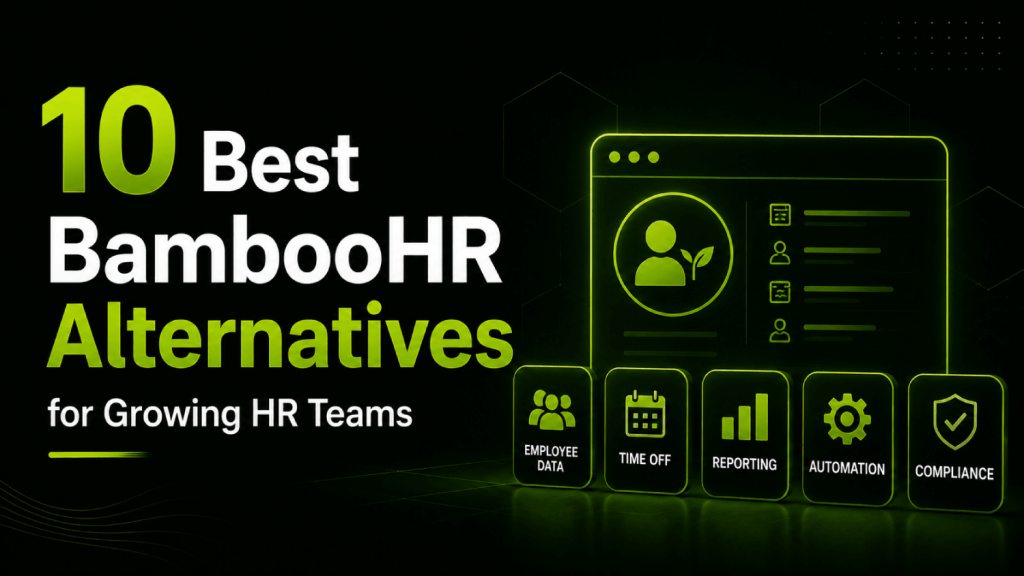
The ten platforms below cover the full range of companies that outgrow BambooHR, from 50-person startups needing better payroll to 2,000-person companies needing enterprise-grade workflows. Each entry specifies who it’s actually best for, not just who it’s marketed to.
| Platform | Best For | Key Strength Over BambooHR | Public Pricing |
|---|---|---|---|
| Rippling | Tech-forward companies, 50-2,000 employees | IT + HR unified platform, deep workflow automation | Starting at $8/user/month (public pricing page) |
| HiBob (Bob) | Mid-market, global-ready, employee experience focus | Stronger people analytics, multi-entity support | Quote-based |
| Gusto | Small businesses, US-only, payroll-first | Most mature native US payroll | Starting at $46/month + $6/person (Simple plan) |
| Workday HCM | 500+ employees, complex orgs | Enterprise-grade reporting, finance integration | Quote-based |
| Paylocity | Mid-market, payroll-heavy US companies | Payroll depth, engagement tools | Quote-based |
| Dayforce (Ceridian) | 300+ employees, continuous payroll | Real-time payroll calculation, WFM | Quote-based |
| Deel | Companies hiring internationally | Global payroll and EOR in one platform | EOR from $599/employee/month |
| Lattice | Performance-first, 100-1,000 employees | Best performance management and engagement tooling | Starting at $11/person/month |
| Personio | European companies, 50-500 employees | GDPR-native, European payroll support | Quote-based |
| Zoho People | Budget-conscious teams, SMB | Low cost, wide feature coverage | From $1.25/user/month |
Is Rippling Better Than BambooHR for Mid-Market Companies?
For most mid-market companies, yes. Rippling does things BambooHR structurally cannot: it manages IT provisioning, device management, and software access alongside HR and payroll in a single data layer. When an employee is onboarded in Rippling, their laptop can be shipped, Slack access granted, and payroll enrolled automatically. BambooHR requires manual handoffs or third-party integrations for all of that.
Rippling’s workflow automation is also meaningfully deeper. Its Formula Fields and compound approval chains handle the kind of conditional logic that BambooHR’s workflow builder can’t replicate. For companies with fast-changing org structures or complex provisioning needs, that gap is real.
The trade-off is cost and complexity. Rippling’s modular pricing means you pay for each component you add, and the full platform costs more than BambooHR. It also takes longer to implement and configure. BambooHR remains easier to manage for a solo HR generalist who needs clean, simple tooling without IT involvement.
Rippling vs BambooHR: Key Differences
- Rippling handles IT management (MDM, software provisioning) natively. BambooHR does not.
- Rippling’s native payroll runs in the US, Canada, and UK. BambooHR’s payroll is US-only.
- BambooHR has a simpler, faster implementation path for small HR teams.
- Rippling’s reporting and permission model is more granular than BambooHR’s.
- Rippling pricing is modular, which can get expensive quickly when you add payroll, benefits, and IT modules.
Is Gusto or BambooHR Better for Small Businesses?
Gusto wins on payroll. BambooHR wins on core HRIS depth. Which one to choose depends entirely on whether payroll or people management is your bigger pain point.
Gusto was built payroll-first and it shows. Automatic tax filings, multi-state payroll, contractor payments, and benefits administration are all handled natively and with less friction than BambooHR’s payroll module. If you’re running payroll in-house for the first time or need it to just work without configuration overhead, Gusto is the cleaner choice.
BambooHR’s employee self-service, onboarding workflows, and performance review tools are more developed than Gusto’s. Companies that need both strong payroll and strong HRIS functionality often end up running Gusto and BambooHR together, which is a legitimate approach but adds integration maintenance. For teams wanting a single system, Rippling or Paylocity tend to be better single-platform options.
If you’re currently evaluating Gusto against other payroll-first platforms, the best Gusto alternatives comparison covers the full competitive field in detail.
HiBob vs BambooHR: Which Is Better for People-First Mid-Market Companies?
HiBob, known as Bob, is the strongest direct BambooHR competitor for companies between 100 and 1,500 employees that care about employee experience and analytics. Its interface is genuinely better designed for employees, not just HR admins, which drives higher adoption rates than most HRIS tools in its tier.
Bob’s people analytics module is more capable than BambooHR’s out of the box. It surfaces attrition risk signals, compensation insights, and diversity breakdowns without requiring a data export. Multi-entity support is also more developed than BambooHR’s, making Bob a better fit for companies with subsidiaries or entities in multiple countries.
Where BambooHR still has an edge over Bob: it’s been around longer, has a larger integration marketplace, and is faster to implement for teams that don’t need multi-entity complexity. Bob’s implementation can take longer and requires more configuration effort upfront. Pricing for Bob is quote-based and not publicly disclosed , unlike Rippling, Lattice, Zoho People, and Gusto, which all publish starting rates , so you’ll need to go through a demo to get actual numbers.
When Does Workday Make Sense as a BambooHR Alternative?
Not before 500 employees. Workday HCM is enterprise-grade software with enterprise-grade implementation requirements. The reporting and financial planning capabilities are among the strongest available at scale, and the permission model handles very large, complex organizations well. For companies at that scale evaluating their options, the best HRIS platforms for 500-employee companies covers the right comparison set.
Below 500 employees, Workday’s cost and implementation complexity are almost never justified. The total cost of ownership includes multi-month implementations, consulting fees, and ongoing configuration work that smaller HR teams can’t absorb. BambooHR at least gets you functional in weeks, not months.
The comparison that matters more for most BambooHR switchers is Workday versus Dayforce versus UKG Pro, not Workday versus BambooHR. Those platforms operate in adjacent territory at the 300-800 employee range.
What Are the Best BambooHR Alternatives for International Hiring?
BambooHR has no global payroll or employer of record functionality. If your team is hiring outside the US, you need to either add a dedicated global tool or switch to a platform built for international employment from the start.
Deel is the most complete option for companies hiring across borders. Its platform combines EOR services (where Deel becomes the legal employer in a foreign country), contractor management, and global payroll in a single product. According to Deel’s public pricing page, EOR pricing starts at $599 per employee per month. That’s expensive for a single hire, but it eliminates the need for entity setup, local compliance expertise, or a separate HR tool for international employees.
Remote and Rippling Global are the two most credible alternatives to Deel for international hiring. Remote positions itself as IP-protective, which matters for technical roles, and its owned-entity model means fewer third-party risks than EOR aggregators. Rippling’s global payroll layer works best for companies that already use Rippling for US HR and want to extend it internationally.
For teams hiring specifically in Europe, Personio is worth evaluating. It was built for the European market, with GDPR-native architecture and payroll support for Germany, Spain, the UK, and other European markets. BambooHR’s European localization is thin by comparison.
Which BambooHR Alternative Wins on Payroll Depth for US Companies?
If you’re running payroll for a US-only company and need more depth than BambooHR offers, Paylocity and Dayforce are the two platforms most worth evaluating.
Paylocity handles complex US payroll scenarios well: multi-state filings, garnishments, shift differentials, and certified payroll for government contractors. Its engagement tools (surveys, social recognition, a community feed) are an unusual addition to a payroll-first platform, and they genuinely drive adoption in industries like retail, manufacturing, and healthcare where employee engagement is a real problem.
Dayforce uses a single continuous calculation engine for payroll, meaning pay is recalculated in real time as hours are logged, rather than in a batch at the end of the pay period. For companies with hourly or variable workers, that reduces payroll errors significantly. The trade-off is a longer implementation and more configuration work. For multi-state payroll strategy more broadly, the best payroll software for multi-state US companies covers the full competitive field.
What About Lattice, Leapsome, and Culture Amp as BambooHR Alternatives?
These platforms aren’t direct HRIS replacements for BambooHR. They’re performance management and engagement tools that often get evaluated alongside an HRIS switch.
Lattice has the most mature performance management product in the mid-market. OKR tracking, 1:1 agendas, performance reviews, and engagement surveys are all more developed than anything BambooHR offers in the performance module. According to Lattice’s public pricing page, plans start at $11 per person per month for the performance module.
The decision to add Lattice usually comes up when a company has already chosen its HRIS and realizes BambooHR’s performance tooling isn’t strong enough. Some teams run Lattice on top of Rippling or HiBob. That works reasonably well if you have clean HRIS data to sync, but it adds integration overhead. If performance management is the primary driver of your switch, evaluate Lattice as a point solution rather than a full BambooHR replacement.
If you’re exploring AI-powered tools alongside your HRIS evaluation, it’s worth reviewing what’s available in adjacent categories like AI people analytics platforms, which are increasingly relevant for HR teams being asked to do more with workforce data.
Is Zoho People a Legitimate BambooHR Alternative for Budget-Conscious Teams?
Zoho People is the most affordable full-featured HRIS on this list. According to Zoho People’s public pricing page, plans start at $1.25 per user per month. At that price point, the feature coverage (leave management, time tracking, performance reviews, onboarding, document management) is remarkable.
The honest trade-off: Zoho People’s interface is less polished than BambooHR’s, and the broader Zoho suite can feel clunky when integrating with non-Zoho tools. It also has a steeper configuration curve for admins who aren’t comfortable in software settings. For companies already using Zoho CRM or Zoho Recruit, the integration story improves significantly.
For pure budget constraint, Zoho People is a credible option. For teams that need a smooth employee experience or have limited HR admin capacity, BambooHR’s interface investment is worth paying for.
How Does Personio Compare to BambooHR for European Companies?
For companies headquartered in Europe or with a majority of their workforce there, Personio is a stronger foundation than BambooHR. BambooHR was built for the US market and retrofitted for international use. Personio was designed for the European regulatory environment from day one.
GDPR compliance is structural in Personio’s architecture, not an add-on. Payroll localization for Germany, Austria, Spain, and the UK is more developed than BambooHR’s. The recruiting module, while not as sophisticated as dedicated ATSs, handles European hiring workflows including GDPR-compliant candidate consent management.
Personio’s pricing is quote-based and scales with headcount and module selection. UK and German companies in particular tend to find Personio’s local support and compliance tooling worth the evaluation time.
What Should You Actually Audit Before Switching Away from BambooHR?
Before committing to a migration, run this audit. Many teams discover the problem is configuration, not the platform.
- Map your broken workflows. List every process where you’re doing manual work that should be automated. For each one, confirm that BambooHR can’t handle it before concluding you need a new system.
- Audit your integration map. BambooHR has a large integration marketplace. If your payroll, ATS, or benefits platform integrates natively, a workaround may exist.
- Check your reporting gaps. Export the exact report you can’t build in BambooHR and ask your shortlisted alternatives to build it live in a demo. Don’t take “yes we can do that” as an answer without seeing it.
- Get a data migration quote. Historical employee data, PTO balances, and performance records all need to migrate. Ask every vendor for a migration plan and timeline before signing.
- Estimate real total cost. BambooHR’s annual contract is often $6 to $10 per employee per month depending on plan, but the full cost includes any add-on modules. Compare full-stack costs, not per-seat list prices.
If you want a full framework for this kind of evaluation, the HR software buying checklist covers 75 questions to ask before choosing any HRIS, payroll, or HCM platform.
Frequently Asked Questions About BambooHR Alternatives
Is Workday better than BambooHR?
Workday is significantly more powerful than BambooHR for large, complex organizations, but it is not better for small or mid-market companies. Workday is built for 500-plus employee orgs with complex reporting, finance integration, and multi-entity needs. Its implementation cost and timeline alone make it impractical below that threshold. BambooHR is faster to implement, simpler to maintain, and more cost-effective for companies under 300 employees. The right question is whether you’ve actually outgrown BambooHR’s capabilities, not whether Workday is a more powerful system.
Is Rippling better than BambooHR?
Rippling is better than BambooHR for companies that need IT management, deeper workflow automation, or payroll in multiple countries. BambooHR is better for HR teams that want a simple, fast-to-implement HRIS without IT complexity. Rippling’s modular pricing can make it more expensive than BambooHR depending on which modules you activate. For tech-forward mid-market companies with an IT function, Rippling’s unified HR-IT platform is a genuine advantage that BambooHR cannot match architecturally.
Is Gusto or BambooHR better for a growing startup?
Gusto is better if payroll is your primary need. BambooHR is better if you need structured onboarding, performance reviews, and employee records management. For startups under 100 employees that run lean HR, Gusto’s all-in-one payroll and basic HRIS often covers enough ground. As headcount grows, BambooHR’s people management tools become more valuable. Many startups run Gusto early and migrate to BambooHR or Rippling between 75 and 150 employees when HRIS depth starts to matter more than payroll simplicity.
Why is Rippling so expensive compared to BambooHR?
Rippling charges per module, so the cost compounds as you add payroll, benefits, IT management, and additional HR tools. BambooHR bundles most HR features into two plans. A company using Rippling for HR, payroll, benefits, and IT provisioning will pay more than BambooHR for equivalent headcount. The cost difference is justified when the IT and automation capabilities create real operational savings, for example by eliminating manual onboarding tasks across HR and IT. If you’re only using Rippling for basic HRIS and payroll, the premium is harder to defend.
What is the closest HRIS to BambooHR in terms of simplicity and interface?
HiBob is the most comparable in terms of interface quality and ease of use at the mid-market level. Gusto is the closest for small companies with a payroll-first focus. Personio is the closest for European companies. None of these platforms is identical to BambooHR, but each one preserves the clean UX philosophy that makes BambooHR popular, while adding capabilities that BambooHR lacks. Teams that specifically value ease of use should ask for a self-guided trial before committing, since UX quality is subjective and implementation context matters.
Does BambooHR support international payroll?
No. BambooHR’s payroll is US-only. For international employee management, you need a separate platform. Deel, Remote, and Rippling Global are the three most commonly used options. Deel is best if you need employer of record services in countries where you don’t have a legal entity. Rippling Global works best for companies already on Rippling. Personio serves European payroll needs well for companies operating primarily in Germany, Spain, Austria, or the UK. BambooHR can store international employee data as an HRIS of record, but it cannot process payroll or manage local compliance outside the US.
How long does it take to migrate from BambooHR to another HRIS?
A typical BambooHR migration to a platform like Rippling, HiBob, or Paylocity takes between six and sixteen weeks depending on company size, data complexity, and the new platform’s implementation resources. The main variables are historical data migration, benefits carrier connections, payroll parallel runs, and workflow reconfiguration. Switching mid-year complicates payroll history and tax reporting. Most experienced HR teams plan migrations to start at the beginning of a calendar year or a new payroll period. Working with an implementation partner reduces risk significantly for teams without dedicated HRIS project management capacity.
The Bottom Line on Switching from BambooHR
BambooHR is not a bad product. It earns its reputation for ease of use, and most teams under 150 employees will never hit a wall that justifies the disruption of a platform migration. The companies that should seriously evaluate alternatives are those running US payroll that needs more depth (Gusto, Paylocity, Dayforce), those scaling internationally (Deel, Remote, Personio), those wanting HR and IT in one place (Rippling), or those needing stronger analytics and performance tooling at the mid-market level (HiBob, Lattice).
The most expensive mistake in HRIS buying is switching too early. The second most expensive is waiting too long. The right signal is not frustration with a feature. It’s a documented operational cost: manual hours that shouldn’t exist, data that can’t be produced when the CFO asks for it, or compliance exposure that a better platform would close. When you can quantify that, the migration cost becomes a business case rather than an IT project.
For teams evaluating a broader platform upgrade alongside the HRIS decision, the best HR software platforms for mid-market companies covers the wider field, including workforce management, ATS, and people analytics tools that typically come into scope at the same growth stage where BambooHR starts to show its limits.