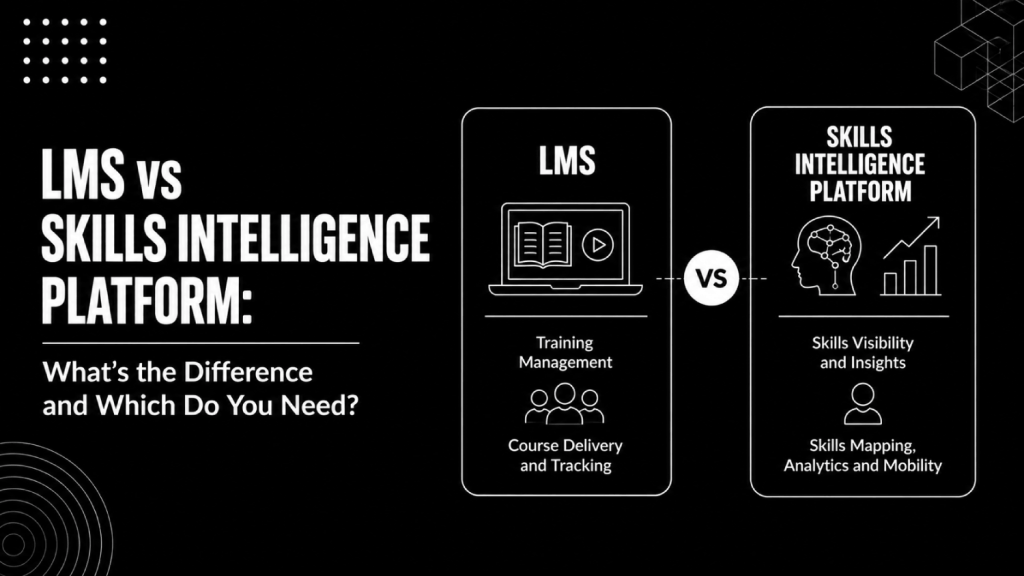

- An LMS delivers and tracks learning content. A skills intelligence platform maps, measures, and acts on the skills your workforce actually has.
- Most LMS platforms tag courses with skills labels. That is not skills intelligence. It is metadata.
- The distinction matters for buying decisions: if you need to know what skills exist across your organization and where the gaps are, an LMS cannot answer that question reliably.
- Many organizations need both tools, but for different jobs. The mistake is buying one and expecting it to do the other’s work.
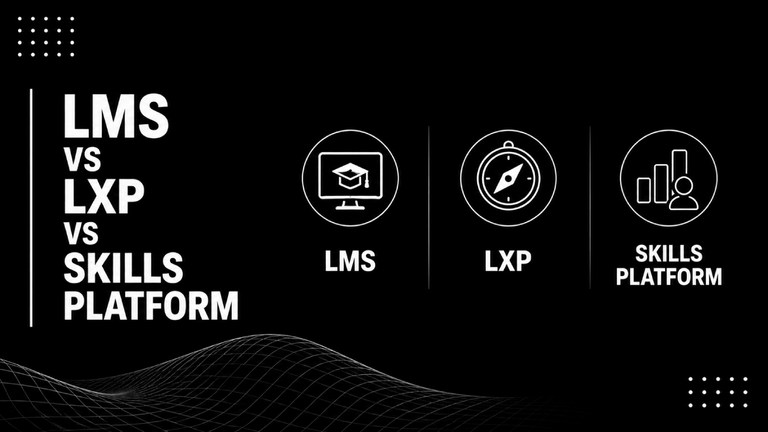
The LMS vs skills intelligence platform question comes up constantly in L&D and workforce planning conversations , and most buyers conflate the two categories long enough to make an expensive mistake. An LMS is a system for delivering structured learning and tracking completion. A skills intelligence platform is a system for defining, measuring, and analyzing the skills your workforce holds and needs. They solve different problems. An LMS tells you who finished a course; a skills intelligence platform tells you whether your workforce can actually do the work, where capability gaps exist, and which employees are ready for new roles.
Why HR Teams Keep Getting This Wrong
Most L&D leaders assume their LMS covers skills because it displays skill tags on course completions. That assumption is costing organizations real money in misallocated training budgets and missed internal mobility opportunities.
Here is what is actually happening inside a typical LMS: an employee completes a course labeled “Data Analysis.” The LMS records that completion and tags it to a skill. The system now shows that employee as having “Data Analysis” skills. Nobody verified whether they can actually analyze data. The tag came from course metadata, not from any assessment of actual capability.
A skills intelligence platform works differently. It pulls signals from multiple sources, including assessments, project history, job descriptions, performance reviews, and sometimes even work product, to build an inference about actual skill possession and proficiency level. The difference in data quality is large enough to change decisions.
What Does an LMS Actually Do?
An LMS handles three things well: content hosting, enrollment management, and completion tracking. Platforms like Cornerstone OnDemand, Docebo, SumTotal, and SAP SuccessFactors Learning exist to make sure the right people get assigned the right training, complete it, and have that completion recorded for compliance or development purposes.
The core use case for an LMS is compliance training at scale. A healthcare network needs to certify that every nurse completed HIPAA training this quarter. A financial services firm needs documentation that every advisor passed their annual regulatory refresher. The LMS is the system of record for those completions.
Where LMS platforms have expanded in recent years is into learning experience personalization and skills tagging. Vendors like Degreed and EdCast (now part of SAP) straddle the line between LMS and Learning Experience Platform (LXP), adding content curation and social learning on top of delivery and tracking. But even the most sophisticated LXP is not a skills intelligence platform. It is still primarily a learning delivery layer with richer personalization.
What Does a Skills Intelligence Platform Actually Do?
A skills intelligence platform answers questions an LMS cannot. Which skills does our workforce possess today, at what proficiency levels? Where are the gaps relative to our three-year strategic plan? Which employees have the hidden skills to step into a critical role before we post it externally?
Purpose-built skills intelligence platforms like Eightfold AI, Gloat, Beamery, SkyHive, and Workera build their core product around a skills ontology: a structured taxonomy of skills, sub-skills, and proficiency levels that maps across roles, industries, and internal job families. That ontology is the foundation for everything else the platform does.
From that foundation, these platforms infer and track skills across a workforce, identify internal talent for open roles or stretch assignments, surface skills gaps at the team or organizational level, and feed that data into workforce planning models. Some platforms also pull external labor market signals to tell you which skills are growing in demand or which are becoming obsolete in your industry.
For a closer look at the vendor field, our skills intelligence software comparison covers the leading platforms in detail.
What Is the Core Difference Between an LMS and a Skills Intelligence Platform?
| Capability | LMS | Skills Intelligence Platform |
|---|---|---|
| Primary job | Deliver and track learning content | Map and measure workforce skills |
| Skills data source | Course completion tags | Assessments, work history, performance data, job profiles |
| Proficiency measurement | Pass/fail or completion rate | Proficiency levels with inference logic |
| Skills taxonomy | Typically vendor-defined or HR-maintained | Purpose-built ontology, often updated with labor market data |
| Workforce planning use | Limited: reports on training activity | Native: gap analysis, scenario modeling, internal mobility |
| Internal mobility | Not a core feature | Core feature in most platforms |
| Integration with HRIS/HCM | Completion data feeds in | Bidirectional: skills data informs hiring, performance, succession |
| Compliance use case | Strong | Weak or none |
The table above shows what each system is designed to do. An LMS built for compliance training is not trying to be a skills intelligence platform. The problem arises when vendors add superficial skills features to an LMS and sell it as a complete skills solution, because buyers accept the framing without probing the data quality underneath.
Why “AI Skills Features” in Your LMS May Not Be Skills Intelligence
Most major LMS and HCM vendors have added something they call “skills AI” to their products in the last two years. Workday Skills Cloud, SAP SuccessFactors Skills, and Oracle Dynamic Skills all claim to give HR teams a view of workforce skills. Some of these implementations are more substantive than others.
The question to ask is simple: where does the skills data come from, and how is proficiency measured? If the answer is “from course completions and self-declarations,” the skills picture is incomplete. Course completion tells you someone sat through training. Self-declaration tells you what employees think they can do. Neither is a reliable proxy for actual capability.
Purpose-built platforms use multi-signal inference: they combine assessment results, project data, job tenure, peer feedback signals, and labor market benchmarks to estimate actual proficiency. The gap between a self-declared skill and an inferred skill with multiple evidence sources can be significant. If your workforce planning or internal mobility program is running on self-declared data, you should be skeptical of the outputs.
This distinction connects directly to the broader questions around talent intelligence. Our talent intelligence platform comparison covers how Eightfold, Gloat, Beamery, and others approach the underlying data problem.
Do I Need a Skills Intelligence Platform or an LMS?
You need an LMS if your primary problem is compliance training delivery, content assignment, or learning completion records. If your organization requires certifications, tracks mandatory training for regulatory reasons, or runs structured learning programs that need enrollment management, the LMS is the right tool. You almost certainly already have one.
You need a skills intelligence platform if your primary problem is any of the following: you do not know what skills exist across your organization; you are trying to build internal mobility programs and keep defaulting to external hiring; you are doing workforce planning but have no reliable data on current workforce capabilities; or you are trying to become a skills-based organization in any meaningful sense.
The organizations that benefit most from a skills intelligence platform are those where the cost of skills gaps is high and visible: technology companies facing rapid skill obsolescence, financial services firms managing regulatory and technical skill requirements, healthcare organizations with highly credentialed workforces, and manufacturers navigating automation transitions.
If you are thinking through the broader build-vs-buy question for a skills-based organization, our guide on building a skills-based organization covers the tools, workflows, and common mistakes in detail.
Can an LMS and a Skills Intelligence Platform Work Together?
Yes, and most mature implementations use both. The typical integration looks like this: the skills intelligence platform identifies a skills gap at the individual or team level, the LMS surfaces and assigns relevant learning content to close that gap, and the skills platform updates its model when learning is completed and when evidence of skill application accumulates over time.
This integration works well when both systems have APIs that allow bidirectional data flow. It works poorly when the LMS treats skills as static completion tags and does not pass structured proficiency data back to the skills platform. Before buying a skills intelligence platform, ask your LMS vendor what skills data they export and in what format.
The integration question also matters for your broader HR stack. If you are running Workday HCM, Cornerstone, or SAP SuccessFactors as your core system, check whether your skills platform of choice has a native or certified integration before assuming the data will flow cleanly. Our guide to HR system integration explains how data flows across HRIS, LMS, and adjacent tools.
What Should You Ask a Skills Intelligence Vendor Before Buying?
Three questions cut through most vendor demos quickly.
First, how does your platform infer skills that employees have not self-declared? If the answer relies primarily on self-assessments or course completions, you are looking at an LMS with better reporting, not true skills intelligence. A credible answer involves multiple data signals, a defined inference model, and some form of validation methodology.
Second, how is your skills ontology maintained? Skills obsolete fast in technology, finance, and healthcare. An ontology that was built two years ago and has not been updated against labor market signals is going to produce stale gap analyses. Ask how frequently it is updated, who maintains it, and whether you can customize it for your own job architecture without breaking the inference engine.
Third, how does your platform handle skills data privacy and employee consent? Skills inference touches employee data in ways that compliance teams in regulated industries will scrutinize closely. In European markets particularly, this touches GDPR in meaningful ways. For a structured approach to vetting vendor contracts, our AI HR vendor evaluation checklist covers the questions worth asking before signing.
Frequently Asked Questions
What is a skills intelligence platform?
A skills intelligence platform is software that defines, tracks, and analyzes the skills a workforce possesses and needs. It differs from an LMS by measuring actual skill proficiency using multiple data sources, including assessments, work history, and performance signals, rather than inferring skills from course completion alone. Leading platforms include Eightfold AI, Gloat, Beamery, SkyHive, and Workera. Most also include a skills ontology, workforce gap analysis, and internal mobility features.
What is the difference between an LMS and a skills platform?
An LMS delivers and tracks learning content. A skills platform maps and measures workforce capabilities. An LMS tells you who completed training; a skills platform tells you which skills your workforce actually holds and where the gaps are. The two tools solve adjacent but distinct problems. An LMS with skills tags is not a skills intelligence platform because completion metadata does not measure actual proficiency.
Do I need a skills intelligence platform if I already have a good LMS?
Having a strong LMS does not eliminate the need for a skills intelligence platform if you have workforce planning, internal mobility, or skills gap analysis requirements. The LMS handles content delivery and compliance; the skills platform handles capability measurement and talent decisions. Most organizations that are serious about skills-based workforce strategies find they need both, connected via integration so that learning activity informs the skills model and vice versa.
What is the difference between an LMS and an LXP?
An LMS is primarily an administrative system for assigning, delivering, and tracking structured learning. An LXP (Learning Experience Platform) adds personalization, social learning, and content discovery on top of those basics. Platforms like Degreed and EdCast sit in the LXP category. Neither an LMS nor an LXP is a skills intelligence platform; both remain fundamentally learning delivery tools, even when they include skills tagging features.
Which companies have purpose-built skills intelligence platforms?
Purpose-built skills intelligence platforms include Eightfold AI, Gloat, Beamery, SkyHive, and Workera. Large HCM vendors including Workday, SAP SuccessFactors, and Oracle have also built skills features into their core platforms, though the depth of skills inference varies. Talent intelligence vendors like Phenom also include skills features as part of broader talent acquisition and workforce planning suites.
What skills data does a skills intelligence platform actually use?
Skills intelligence platforms draw from several data sources to build a picture of employee capabilities: role and job description data, resume and LinkedIn profiles ingested at hiring, performance review content, assessment results, project participation records, and in some cases, work product signals. The more data sources the platform uses, the more reliable its proficiency inferences tend to be. Self-declarations and course completions are inputs, but they carry the least weight in a well-designed skills inference model.
How does skills intelligence connect to internal mobility?
Skills intelligence is the data foundation for internal mobility programs. If you do not have reliable proficiency data at the employee level, internal mobility recommendations reduce to matching job titles and tenures, which is a weak signal. A skills intelligence platform can surface employees who have adjacent skills that qualify them for open roles, identify who is within reach of a capability threshold with targeted development, and reduce the reliance on manager advocacy or seniority as the default criteria for internal movement. Our AI internal mobility platform comparison covers how these systems work in practice.
The Decision in Plain Terms
If your L&D function’s primary accountability is training delivery and compliance records, your LMS is probably doing its job. Buy a better one, or push your current vendor for better skills reporting, before spending on a new category of tool.
If your CHRO or CEO is asking questions about workforce capability, skills gaps, or whether you are ready to hire less and develop more, the LMS cannot answer those questions. The data it holds is too shallow. You need a system built specifically to measure skills, and that means a skills intelligence platform with a real ontology and a real inference model, not a course catalog with better search.
The way to hold these two tools in your head is simple: one is a delivery system, one is a measurement system. A great kitchen needs both a stove and a scale. Using the stove to measure ingredients does not work, no matter how good the stove is.