
TLDR
- Workday released its October 2026 Global Workforce Report, The Adaptability Advantage, on October 5, 2026, combining customer workforce data, Workday Recruiting requisitions, and two worker surveys.
- Only 28% of business leaders expect AI to reduce headcount, while 40% expect it to get more out of the employees they already have.
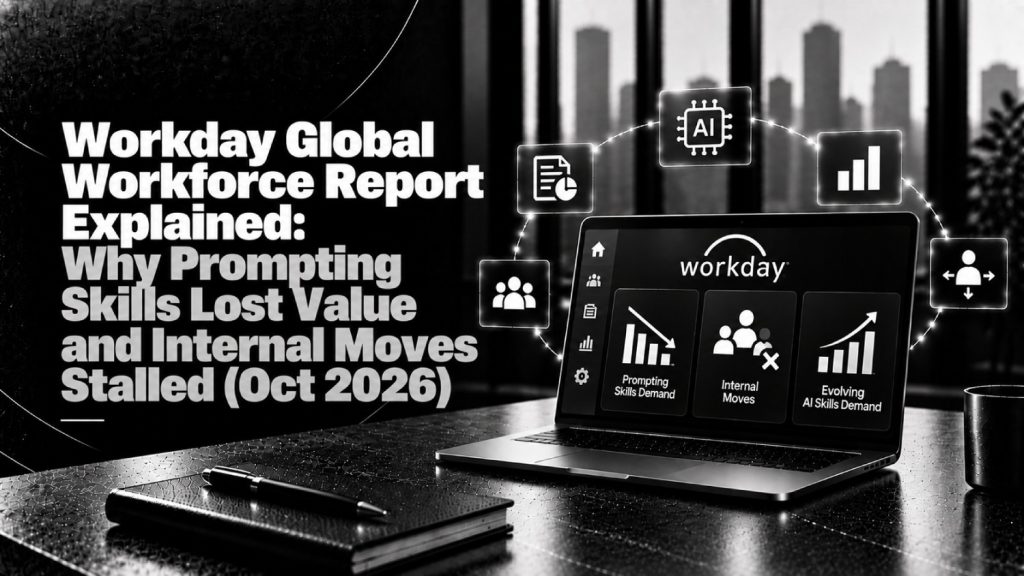
- Demand for basic AI skills such as simple prompting peaked in January 2026 and then fell 25%, while demand for building AI tools, automating workflows, and AI engineering climbed 51% between September 2025 and July 2026.
- Internal moves fell at 57% of employers, promotions stayed flat, and the median applicants per filled job rose to 69 from 58 while time to fill held at about 60 days.
- For HR tech buyers, the report points at three budget lines for 2027: skills intelligence, internal mobility, and recruiting tools that screen for applied skills instead of keyword volume.
What Workday published
On October 5, 2026, Workday released its October 2026 Global Workforce Report, titled The Adaptability Advantage. The headline finding is that most leaders expect AI to change the jobs people already hold rather than shrink the workforce, and that employees say they are not getting enough support to keep up.
The report draws on four data sources. Internal moves, promotions, turnover, and retention come from de-identified data inside Workday customers with at least 250 employees, matched year over year. Leader expectations and employee confidence come from a global survey of 6,001 employees and business leaders, including about 1,780 decision-makers. AI usage in jobs and job searches comes from the separate AI@Work Pulse survey of 5,944 workers. Skills demand comes from requisitions across roughly 550 enterprise employers using Workday Recruiting from September 2025 through July 2026.
“Employees may not be changing jobs, but their jobs are changing around them,” said Phil Willburn, vice president of people systems, intelligence and support at Workday.
The numbers that matter
| Metric | Finding | Source in the report |
|---|---|---|
| Leaders expecting AI to raise output of current staff | 40% | Global survey |
| Leaders expecting AI to reduce headcount | 28% | Global survey |
| Demand for basic AI skills after the January 2026 peak | Down 25% | Workday Recruiting requisitions |
| Demand for building AI tools, workflow automation, and AI engineering | Up 51% (Sept 2025 to July 2026) | Workday Recruiting requisitions |
| Mentions of management and leadership skills | Down 7% | Workday Recruiting requisitions |
| Mentions of training skills | Down 13% | Workday Recruiting requisitions |
| Employers where internal moves fell | 57% | Customer workforce data |
| Median applicants per filled job | 69, up from 58 | Customer workforce data |
| Time to fill | About 60 days, unchanged | Customer workforce data |
| Job seekers who used AI in their search | 84% | AI@Work Pulse |
| Voluntary turnover | About 16% a year | Customer workforce data |
Prompting is no longer a differentiating skill
The sharpest data point is the reversal in AI skills demand. Requests for basic AI skills such as simple prompting rose through late 2025, peaked in January 2026, and then dropped 25%. Over the same window, requisitions asking for people who can build AI tools, automate workflows, or do AI engineering climbed 51%.
Employers have stopped treating general AI literacy as a hiring signal because it is now assumed. What they pay for is applied ability: someone who can turn a manual approval chain into an automated workflow, or wire an agent into a payroll or ticketing process. That shift lines up with the wave of agentic HR launches this quarter, where the work moves from asking an assistant a question to configuring agents that act.
The report also flags an uncomfortable gap. Mentions of management and leadership skills in job postings fell 7%, and training skills fell 13%. Those are the capabilities that help teams absorb change, and companies are asking for less of them at the moment they need more.
The employee side: confident, but unsupported
In a September 2026 survey of 6,000 full-time employees, 79% said they know which skills they need to succeed, yet only 66% said their employer helps them build those skills. That 13-point gap is where most learning and skills budgets will be judged next year.
Workers are not short on willingness. 65% said they are confident they can learn new skills if asked. Among heavy AI users, 62% think AI will make their current skills less valuable, while 76% expect it to open new career opportunities. Teams building a response can start with our guides to building a skills-based organization and AI skills mapping tools.
Internal mobility is stalling
Internal moves fell year over year at 57% of employers, and promotion rates stayed essentially flat worldwide. Employees who tried to move internally most often cited paused hiring for the role, managers who did not support the move, and selection processes that did not feel fair.
About half of employees did not try to move internally at all last year. Of that group, 27% said they did not see an attractive opportunity inside their company. For HR leaders, that is a visibility problem as much as a supply problem, and it is the core argument behind talent marketplaces. Our internal mobility ROI business case walks through how to size it, and the Workday AI vs Eightfold vs Gloat comparison covers the main platforms.
Recruiting: more applicants, same speed
84% of job seekers told the AI@Work Pulse survey they used AI during their search. The median number of applicants per filled job rose to 69 from 58 a year earlier, which Workday describes as a possible consequence of AI making it easier to apply to many roles at once.
Volume did not speed anything up. Time to fill held at about 60 days, and employers said roles stay open mostly because candidates lack the right skills or because pay, location, or flexibility do not match. Competition is steepest in two sectors. Applicants per filled job rose 27% in financial services and 40% in technology and media, and 53% and 57% of applicants in those sectors said AI increased how many roles they applied to.
That pattern favors screening tools that assess applied skills over tools that simply process more resumes faster. Buyers comparing options can use our roundups of AI recruiting assistants for high-volume hiring and ATS platforms for mid-market companies.
“The question isn’t just whether someone has done the exact job before,” Willburn said. “It’s whether they can learn fast enough to solve the next problem.”
Retention looks stable, engagement does not
Voluntary turnover sits at roughly 16% a year, and about 70% of employees are still with the same company two years later. Workday’s data shows that staying does not mean buying in. In every industry analyzed, employees who plan to stay are less likely to recommend their employer, with the gap reaching 11 points in the public sector.
“There’s a lot of quiet unease in the workplace right now,” Willburn said. “Staying isn’t the same as buying in, and companies that treat it that way will pay for it in productivity.” A low quit rate can hide a disengagement problem, which is why pairing retention data with recommendation or eNPS signals in a people analytics platform gives a truer read.
What HR tech buyers should do with this
The report is a vendor study, but its requisition and workforce data come from live customer systems, which makes it more useful than an opinion survey alone. Four practical moves follow from it:
- Rewrite AI skill requirements. Replace generic “AI proficiency” lines in job architecture with specific applied skills such as workflow automation, agent configuration, and data handling.
- Fund the support gap. The 13-point gap between knowing and getting help is measurable. Track it in your own engagement survey and tie learning spend to closing it, using a skills intelligence platform where an LMS alone falls short.
- Fix internal mobility friction first. Paused requisitions, manager blocking, and unfair selection are process problems. A talent marketplace only helps once managers are measured on letting people move.
- Screen for applied skills. With applicant volume up and time to fill flat, invest in assessment and structured interviews over tools that only raise throughput.
Limits and open questions
- Workday sells HR and recruiting software, and the findings support the case for skills and mobility tools it offers. Weigh the conclusions with that in mind.
- The workforce data covers Workday customers with at least 250 employees, so small businesses and non-Workday shops may look different.
- The skills demand trend covers about 550 enterprise employers over ten months. It shows direction clearly, but it is a short window.
- The applicant increase is linked to AI only as a possible cause. The report does not isolate AI from other labor market factors.
FAQ
What is the Workday Global Workforce Report October 2026?
It is a report Workday released on October 5, 2026, titled The Adaptability Advantage. It combines de-identified workforce data from Workday customers, requisition skills data from about 550 Workday Recruiting employers, and two surveys of roughly 6,000 workers each to show how AI is changing jobs, skills demand, and internal mobility.
Does the report say AI is cutting jobs?
No. 28% of business leaders expect AI to reduce headcount, while 40% expect it to increase what existing employees can deliver and 34% expect it to change employees’ jobs.
Which AI skills are employers hiring for now?
Demand for basic AI skills such as simple prompting fell 25% after peaking in January 2026. Demand for building AI tools, automating workflows, and AI engineering rose 51% between September 2025 and July 2026.
Why are internal moves falling?
Internal moves fell at 57% of employers. Employees most often cited paused hiring for the target role, managers who did not support the move, and selection processes that felt unfair. Another 27% of those who did not try said they saw no attractive internal opportunity.
Is AI making hiring faster?
Not according to this data. Median applicants per filled job rose to 69 from 58, but time to fill stayed at about 60 days because more applications did not bring more qualified candidates.