
- Most workforce planning failures happen at the modelling assumptions level, not the spreadsheet level. Finance and HR argue about headcount because they use different inputs, not because either team is bad at math.
- The five firms below span boutique precision and global scale. Choosing the wrong type costs months of rework and a plan nobody trusts.
- Strategic workforce planning is distinct from financial headcount planning. It incorporates demand forecasting, attrition modelling, critical role mapping, and build-buy-borrow analysis that a finance model rarely touches.
- Software does not replace consulting here. The best workforce planning platforms still need someone to set the assumptions, calibrate attrition curves, and run the HR-finance alignment conversation.
- If your organization is under 500 employees, one or two of these firms may be too large to engage affordably. The right-sizing section below will help you sort that out quickly.
The five best workforce planning consulting firms for serious headcount decisions are Deloitte Human Capital, Aon’s People Advisory, Axiom Consulting Partners, Valeocon Management Consulting, and Orgvue’s Advisory Services. Each serves a distinct buyer profile: Deloitte for large enterprise transformation, Aon for data-heavy demand and supply modelling, Axiom for mid-market organizations wanting practitioner-led engagements, Valeocon for pure-play workforce modelling, and Orgvue for buyers who want consulting and software integrated into a single engagement.
Why Workforce Planning Is Not a Spreadsheet Problem Finance Already Solved
Finance owns the headcount budget. HR owns the people data. Neither team owns the assumptions that connect the two, and that gap is where workforce plans fall apart. A finance model might project 40 new hires in Q3 based on revenue targets. An HR model might flag that the talent pool for those roles carries a multi-month sourcing lead time and high first-year attrition in that function , illustrative numbers, but the kind of disconnect that plays out in nearly every planning cycle. Without a shared modelling framework, both teams are right and the plan is wrong.
Strategic workforce planning consulting firms exist to build that shared framework. They bring demand and supply modelling methodology, external labor market benchmarks, attrition forecasting logic, and scenario planning structure that neither internal team typically has the capacity or neutrality to build alone. A neutral third party also absorbs the political friction of telling a business leader that their hiring plan is arithmetically impossible given current sourcing pipelines.
The distinction from software matters here. Our workforce planning software comparison covers tools like Workday Adaptive Planning, Anaplan, and Planful. Those platforms execute models that humans design. Consulting firms design the models, set the methodology, and often run the first cycle before handing it off. Buying software before the methodology is in place is one of the most common and expensive mistakes in this category.
What Does a Strategic Workforce Planning Engagement Actually Deliver?
Most buyers come in expecting a headcount number. What they actually receive, from a competent firm, is a decision architecture: the segmentation of roles by criticality, a set of validated assumptions about internal supply and external labor market demand, attrition forecast models by function and tenure band, and two or three tested scenarios (typically a base case, an accelerated growth case, and a contraction case). The deliverable is not a report. It is a repeatable process the organization can run annually without the consultant in the room.
The build-buy-borrow framework is central to any serious engagement. Rather than defaulting to external hiring, a workforce planning consultant will model whether critical capability gaps are better filled by developing internal talent (build), acquiring experienced hires (buy), or accessing skills through contractors, partners, or gig arrangements (borrow). That analysis directly informs your recruiting strategy and, if done well, your people analytics platform investment.
Span of control analysis often surfaces as a secondary output. Consultants will map manager-to-IC ratios across the organization, flag where spans are too wide or too narrow relative to the work type, and model the cost and productivity implications of restructuring. This is the part of the engagement that surprises HR leaders most because it turns a people question into a CFO conversation almost immediately.
Which Workforce Planning Consulting Firm Is Best for Enterprise?
1. Deloitte Human Capital
Deloitte Human Capital is the default choice for large enterprise organizations running multi-year workforce transformation programs, particularly those where the planning engagement needs to connect to technology implementation, organizational design, and total rewards. The firm’s workforce planning practice sits within its broader Human Capital offering, which means a client can move from a strategic workforce plan into an HCM implementation engagement without switching vendors.
The practical implication: Deloitte’s workforce planning engagements tend to be comprehensive and expensive. They are built for organizations with the internal bandwidth to absorb a large consulting team and the budget to fund a multi-phase program. For organizations already working with Deloitte on an HRIS or HCM implementation, adding workforce planning as a workstream is a logical extension. For organizations that only need a focused modelling engagement, the firm may bring more overhead than the problem requires.
Deloitte’s strength is in complex, multi-geography scenarios where demand modelling needs to account for regulatory differences, local labor market variance, and workforce segmentation across multiple business units. If your organization is running a global headcount review across five or more countries, Deloitte has the infrastructure to run that analysis in parallel. Pricing is engagement-specific and not publicly disclosed.
2. Aon’s People Advisory
Aon’s People Advisory practice brings a data-density advantage that most pure-play HR consulting firms cannot match. Aon’s workforce planning work is grounded in its compensation and talent benchmarking data, which means the external supply side of a demand and supply model is built from proprietary benchmarks rather than public labor statistics alone. That distinction matters when you are modelling a niche technical role in a competitive labor market where government data lags reality by 18 months.
Aon is a strong fit for organizations where the CFO or finance team is driving the workforce planning initiative and wants quantitative rigour comparable to financial modelling. The firm is also well-positioned for attrition forecasting engagements where internal HR data needs to be benchmarked against external peer groups. Pricing is quote-based.
The trade-off is that Aon’s advisory practice sits inside a much larger organization. Buyers should be deliberate about who is staffed on the engagement. Senior practitioners who pitch the work are not always the ones who run the model.
3. Axiom Consulting Partners
Axiom Consulting Partners operates at a different scale from Deloitte and Aon, and that is precisely its advantage for mid-market buyers. Axiom focuses on organizational effectiveness and workforce strategy for companies that need practitioner-grade thinking without a global consulting firm’s overhead structure. Engagements are typically staffed by senior practitioners rather than junior analyst teams, which shortens the time from kickoff to usable output.
Axiom’s workforce planning work is strongest in critical role mapping and workforce segmentation, helping organizations distinguish between roles that are genuinely differentiating (where talent scarcity creates strategic risk) and roles that are important but not scarce. That segmentation is the foundation of a defensible build-buy-borrow decision. For mid-market companies where every hiring dollar is scrutinized, that prioritization is more immediately useful than a six-month transformation roadmap.
Axiom does not publish pricing, but buyers can expect engagement costs to land below the major global firms while retaining genuine strategic capability. This is the firm most likely to be right-sized for a 500 to 2,000 employee organization running its first structured workforce planning cycle.
4. Valeocon Management Consulting
Valeocon is the most specialized firm on this list. It is a pure-play workforce planning consultancy, which means the practice is not cross-subsidized by technology implementation, organizational design, or benefits brokerage. Every engagement is workforce planning, workforce modelling, or organizational analytics. That focus produces a depth of methodology that generalist HR consulting firms rarely match.
Valeocon is particularly strong in scenario planning and workforce modelling for organizations facing significant structural change: post-merger integration, large-scale restructuring, or entry into new markets. The firm’s modelling frameworks account for internal mobility pathways, promotion rates, and retirement curves alongside external hiring assumptions. The output is a workforce model that updates dynamically as assumptions change, not a static report.
The firm is European in origin and has strong credentials with large enterprise clients across financial services, healthcare, and public sector. US mid-market buyers may find the engagement model less familiar than working with a domestic firm. Pricing is not publicly disclosed.
5. Orgvue Advisory Services
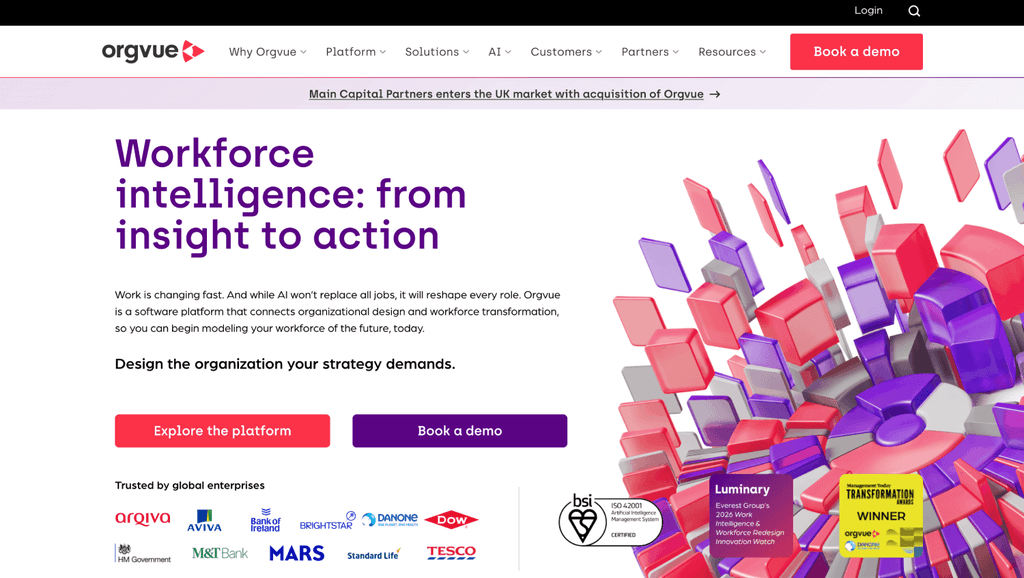
Orgvue occupies a category most other firms on this list do not: it is both a workforce planning software vendor and a consulting services provider. Orgvue Advisory runs workforce planning and organizational design engagements using Orgvue’s own platform as the modelling environment. For buyers who want consulting and technology in a single engagement, that integration eliminates the common problem of a consultant delivering a model in a format the client cannot maintain after the engagement ends.
Orgvue’s consulting work is strong on organizational design and span of control analysis, and the platform supports real-time scenario modelling that makes the scenario planning conversation with senior leadership significantly more interactive than a static deck. The embedded technology also means clients who continue with the Orgvue platform after the engagement have a running start on self-sufficiency.
The constraint is obvious: Orgvue Advisory’s consulting methodology is built around Orgvue’s platform. If your organization has already standardized on a different workforce planning tool, the advisory engagement may recommend infrastructure changes that create unnecessary complexity. Pricing for advisory engagements is quote-based and separate from the platform license.
Korn Ferry and Mercer: Where They Fit
Korn Ferry and Mercer both run workforce planning practices and both deserve mention, particularly for large enterprise buyers where their breadth of practice (executive search, total rewards, and HR consulting under one roof) is a genuine advantage. Korn Ferry’s workforce planning work is often embedded within broader organizational strategy engagements, while Mercer’s practice benefits from its Marsh McLennan data infrastructure and its depth in global compensation benchmarking.
Neither firm is the right first call if your primary need is a focused workforce modelling or attrition forecasting engagement. Both are better positioned when workforce planning is one component of a larger people strategy initiative. Buyers who want a direct conversation about where each firm would compete most credibly are encouraged to reach out through this site.
How Do You Choose Between Software and Consulting for Workforce Planning?
The answer depends on whether your organization has a workforce planning methodology before it has a tool. Most do not. Buying a platform like Workday Adaptive Planning, Pigment, or Mosaic before you have agreed on how to model attrition, how to define critical roles, and how to connect finance headcount targets to HR supply assumptions creates an expensive configuration problem, not a solution.
Consulting first is the right sequence when your finance and HR teams produce materially different headcount forecasts, when you have never run a formal build-buy-borrow analysis, or when you are heading into significant organizational change. After the methodology is established and the first planning cycle is complete, a software platform becomes genuinely useful for maintaining and updating the model. For organizations already running structured planning cycles and looking to scale or automate, software may be the right starting point.
The people analytics layer is related but distinct. If your question is about understanding historical workforce patterns, predicting flight risk, or measuring the productivity of workforce investments, that is analytics work, not planning work. Our comparison of the best AI people analytics platforms covers that category separately. Planning and analytics feed each other, but they require different tools and, often, different expertise.
| Firm | Best For | Core Strength | Scale Fit | Pricing |
|---|---|---|---|---|
| Deloitte Human Capital | Large enterprise transformation | Multi-geography, HCM-linked planning | 2,000+ employees | Quote-based |
| Aon People Advisory | Data-driven supply/demand modelling | Proprietary benchmarking data | 1,000+ employees | Quote-based |
| Axiom Consulting Partners | Mid-market first-cycle planning | Critical role mapping, senior staffing | 500 to 2,000 employees | Quote-based |
| Valeocon | Pure-play modelling and scenario planning | Dynamic workforce models, structural change | Enterprise | Quote-based |
| Orgvue Advisory | Consulting plus platform in one engagement | Org design, span of control, live scenario modelling | 1,000+ employees | Quote-based |
| Korn Ferry | Workforce planning within broader people strategy | Org strategy, executive alignment | Large enterprise | Quote-based |
| Mercer | Global compensation-linked planning | Total rewards data, global scale | Large enterprise | Quote-based |
What Should You Expect in a Workforce Planning Consulting Scope of Work?
A well-constructed engagement scope covers five components. Understand these before you sign anything.
- Current state audit: A review of existing workforce data quality, current headcount by function and geography, and the existing forecasting process. If your data is a mess coming in, expect this phase to take longer than the consultant’s initial estimate.
- Demand modelling: Translating business strategy and revenue plans into workforce requirements by role family, function, and location. This is where finance and HR need to be in the same room, and where a neutral third party earns its fee.
- Supply modelling: Mapping the internal pipeline (promotions, lateral moves, attrition) against external labor market availability. A rigorous supply model accounts for time-to-fill by role type, not just headcount totals.
- Gap analysis and scenario planning: Identifying where supply will not meet demand under each scenario, and what the cost and risk implications are. Most firms deliver two to four scenarios. More than four is usually noise.
- Recommendations and transition plan: The build-buy-borrow decision framework for each critical role segment, a prioritized action plan, and a handoff model for the client team to run subsequent planning cycles internally.
For organizations that have implemented or are evaluating HCM platforms, the HCM implementation partners hub covers the technology side of the equation. Workforce planning consulting and HCM implementation frequently overlap in timeline, and aligning both workstreams from the start prevents rework.
How Do Workforce Planning Consultants Handle Finance and HR Alignment?
This is the central problem, not a secondary one. Finance runs headcount from the top down: revenue per head ratios, cost-per-function targets, and growth percentages derived from board-approved financial models. HR approaches headcount from the bottom up: open requisitions, sourcing pipelines, role-level attrition patterns, and internal successor readiness. Both perspectives are valid. Neither is sufficient alone.
The consultant’s job is to get finance and HR working from a common set of assumptions. In practice, that starts with agreeing on a workforce segmentation framework , dividing roles into tiers based on strategic criticality and external scarcity. Once that segmentation exists, finance and HR can disagree productively: “We can cut headcount in tier-three roles with limited strategic risk” is a different conversation from “We are cutting 10% across the board.”
Attrition forecasting is often the specific point where the two teams diverge most sharply. Finance models attrition as a flat percentage. HR knows that attrition concentrates in the first 18 months of tenure, spikes in high-demand technical roles, and varies significantly by manager quality. A consultant who surfaces that granularity changes the headcount math. For organizations already investing in analytics infrastructure, connecting the consultant’s methodology to your people analytics data for CFO-level reporting is one of the higher-value outcomes of the engagement.
Frequently Asked Questions
What is the difference between workforce planning consulting and HR consulting?
HR consulting is a broad category covering everything from policy design to compensation benchmarking to organizational development. Workforce planning consulting is a specific sub-discipline focused on modelling future headcount needs against projected talent supply, usually incorporating demand forecasting, attrition analysis, and scenario planning. Most large HR consulting firms have a workforce planning practice, but several boutique firms specialize exclusively in workforce modelling. Buyers looking for workforce planning specifically should ask any firm how much of their annual revenue comes from workforce planning engagements versus broader HR advisory work.
How long does a strategic workforce planning engagement typically take?
A focused engagement covering a single business unit or function typically runs eight to twelve weeks. A full enterprise workforce planning engagement covering multiple geographies and business units typically runs sixteen to twenty-four weeks, depending on data readiness and the number of stakeholders involved. Data quality is the single biggest variable. Organizations with clean HRIS data and an established people analytics function will move faster than those starting from fragmented spreadsheets.
What data does a workforce planning consultant need to start?
At minimum: headcount by function, location, job family, and tenure band; attrition data for the past two to three years segmented by voluntary and involuntary; open requisition data with time-to-fill by role type; and the organization’s three-year business or revenue plan. The more granularly this data is segmented, the more defensible the resulting workforce model. Consultants will also want external labor market data, which they typically source from their own benchmarking databases or from providers like Lightcast or Burning Glass.
Can a small or mid-size company afford a workforce planning consultant?
Companies between 200 and 500 employees can generally afford a focused engagement with a boutique firm like Axiom Consulting Partners, particularly if the scope is limited to one or two critical functions rather than an enterprise-wide model. The economics shift when the engagement is scoped for full organizational coverage with multi-scenario modelling. For organizations under 200 employees, a fractional people operations leader with workforce planning experience may be more cost-effective than a formal consulting engagement. Our list of best fractional HR leaders covers that option.
What is the difference between workforce planning software and workforce planning consulting?
Software executes models. Consulting designs them. A platform like Workday Adaptive Planning, Pigment, or Orgvue will run scenario calculations, maintain headcount records, and update forecasts as inputs change. But the platform needs a methodology to run: agreed-upon definitions of demand, attrition curves calibrated to your actual historical data, and a segmentation framework built for your specific roles and geographies. A consulting engagement typically produces that methodology and runs the first one or two planning cycles, after which the organization can maintain the model in-platform. Buying software before the methodology exists usually means the platform is underused.
How do workforce planning consultants use build-buy-borrow frameworks?
The build-buy-borrow framework categorizes the sourcing strategy for each workforce segment based on how quickly the capability is needed, how available it is externally, and whether the organization has a viable internal development pathway. Build means investing in learning and development to grow the capability internally over 12 to 36 months. Buy means external hiring, which accounts for sourcing lead time and ramp time. Borrow means accessing skills through contractors, gig workers, or strategic partnerships, which delivers speed but not institutional knowledge retention. A workforce planning consultant will apply this framework by role segment, not as a blanket organizational policy.
The Decision Framework That Actually Works
The single most useful question to ask a prospective workforce planning consultant is this: what happens when finance and HR disagree on a key assumption? How a firm answers that question tells you everything about whether they have a real methodology or a well-packaged slide deck. The right answer involves a structured process for working through the disagreement, a defined escalation path, and a framework for documenting assumption sensitivity so the decision-maker understands what changes if the attrition rate is 15% instead of 10%.
Firms that can show you their assumption governance process, not just their deliverable templates, are the ones worth engaging. That rigor is what separates a workforce plan that survives its first board review from one that gets quietly shelved after the consultant leaves. For organizations evaluating both the consulting and technology layers simultaneously, connecting that engagement to your broader HR technology consulting strategy from the start will prevent the two workstreams from producing incompatible outputs.
The firms that do this work well share one characteristic: they care about what the organization can sustain after the engagement ends, not just what looks good in the final presentation. A workforce plan that requires a consultant in the room to update is not a plan. It is a dependency.