
- RPO is not just for Fortune 500 companies. Project and modular RPO models serve mid-market companies hiring as few as 25 to 200 roles per year, often at a lower cost per hire than agency fees.
- The right RPO model depends on your requisition load, not your headcount. Project RPO fits a 90-day hiring surge; enterprise RPO fits a steady 150-plus req load per year.
- Pricing structures vary widely. Management fee models, cost-per-hire models, and hybrid arrangements all exist. Getting three quotes is non-negotiable because there is no standard rack rate.
- Hiring manager satisfaction scores and ramp time matter as much as cost per hire. Providers differ sharply on how fast their sourcing pods get up to speed on your roles.
- Technology stack matters when evaluating providers. Some RPOs bring their own AI sourcing and talent intelligence tools; others plug into yours.
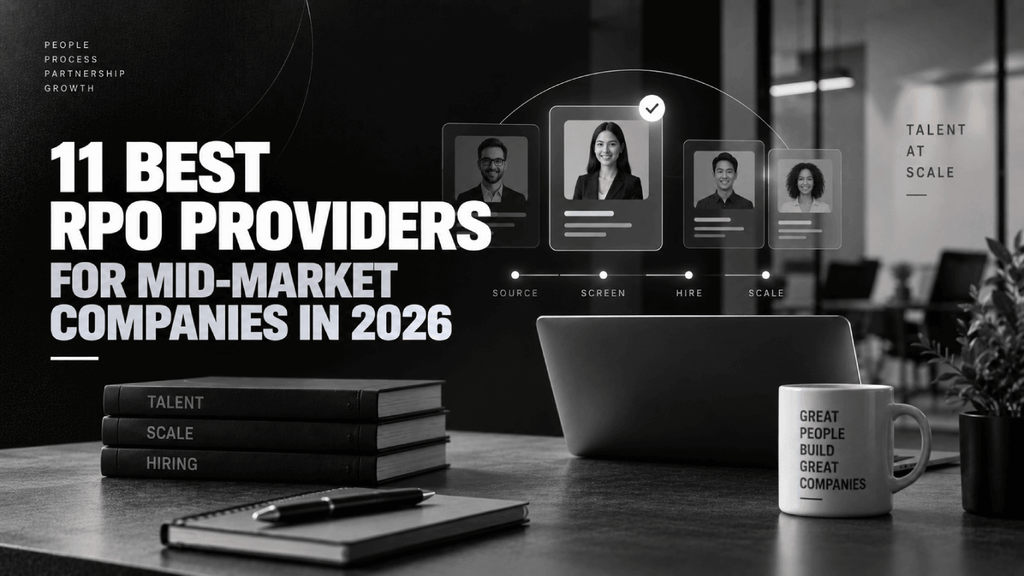
The best RPO providers for mid-market companies , and the answer to the search for the best RPO providers mid-market buyers should evaluate , include Sevenstep, Hudson RPO, Orion Talent, Cielo Talent, Allegis Global Solutions, Kforce RPO, Broadleaf Results, Recruitics, Talent Solutions (PeopleScout), and WilsonHCG. Most offer project and modular engagements sized for 50 to 500 annual hires, with pricing that typically undercuts retained agency fees on volume roles.
Why Mid-Market Buyers Think RPO Is Out of Reach (and Why They Are Wrong)
Most HR leaders at companies with 300 to 2,000 employees assume RPO is what Boeing or Bank of America buys. That assumption is wrong, and it costs them money every year. According to the Society for Human Resource Management, agency fees on professional roles routinely run 18 to 25 percent of first-year salary. An RPO arrangement on the same volume of roles, structured as a cost-per-hire or management fee model, typically comes in lower once you account for sourcing, screening, and coordinator time you would otherwise staff in-house.
The RPO market has moved toward modular and project structures specifically because mid-market demand is real. You do not need 500 annual requisitions to justify the conversation. If you are hiring 40 to 150 roles per year and struggling with recruiter-to-req ratios that stretch your team, project RPO is worth pricing out. If you are facing a defined hiring surge, say 60 roles in a new market over six months, project RPO almost always beats hiring two contract recruiters and hoping they ramp fast enough.
For a grounded look at the actual math, the RPO vs in-house recruiting cost comparison on HR Tech SaaS breaks down the true cost models side by side.
How RPO Is Priced for Mid-Market and What the Fee Models Actually Cover
RPO pricing uses three main structures, and providers often blend them. Understanding each one before you enter a vendor conversation saves you from comparing apples to shovels.
Management fee model: You pay a monthly retainer for a dedicated sourcing pod, typically including sourcers, a recruiter, and a coordinator. The fee covers labor but not technology or ad spend. Best for companies with a predictable, steady req load of 80 or more roles per year.
Cost-per-hire model: You pay a fixed amount per filled role, often tiered by job family or complexity. It behaves like a contingency agency but with structured SLAs, reporting, and dedicated capacity. Best for companies with variable hiring volume or project-based needs.
Hybrid model: A lower management fee plus a reduced cost-per-hire rate. Gives the provider a base to staff against and gives you a cost floor. Common in mid-market engagements where volume is real but not fully predictable.
Pricing is quote-based across every provider in this list. No mid-market RPO provider publishes rack rates, because the cost depends on role complexity, geography, volume, and how much of your existing tech stack the provider will use. Expect to share 12 months of historical hire data and your projected req load before getting a meaningful proposal.
| Provider | Best For | Minimum Scale | Pricing Model | Tech-Augmented | Project RPO |
|---|---|---|---|---|---|
| Sevenstep | Mid-market to enterprise, complex req mix | ~50 annual hires | Hybrid / management fee | Yes (proprietary analytics) | Yes |
| Hudson RPO | Professional services, global delivery | ~30 annual hires | Cost-per-hire / hybrid | Yes | Yes |
| Orion Talent | Technical, military veteran hiring, defense | ~25 annual hires | Cost-per-hire / project | Yes | Yes |
| Cielo Talent | Mid-market to enterprise, global hiring | ~75 annual hires | Management fee / hybrid | Yes (Cielo Talent Cloud) | Yes |
| Allegis Global Solutions | Contingent and permanent, complex programs | ~100 annual hires | Management fee | Yes | Limited |
| Kforce RPO | Technology and finance roles, US-focused | ~30 annual hires | Cost-per-hire | Moderate | Yes |
| Broadleaf Results | Manufacturing, logistics, volume hiring | ~50 annual hires | Cost-per-hire / hybrid | Moderate | Yes |
| Recruitics | Employer brand-led sourcing, high-volume | ~50 annual hires | Performance-based / hybrid | Yes (analytics platform) | Yes |
| PeopleScout | Mid-market to enterprise, diverse req mix | ~75 annual hires | Management fee / hybrid | Yes (Affinix) | Yes |
| WilsonHCG | Mid-market, strategic talent advisory | ~40 annual hires | Hybrid | Yes | Yes |
| Employ RightStar | Small to mid-market, US professional roles | ~20 annual hires | Cost-per-hire / project | Moderate | Yes |
Which RPO Providers Work Best for Companies Hiring Under 200 Roles Per Year?
Under 200 annual hires, your best options are providers that have explicitly built project and on-demand RPO products rather than trying to apply an enterprise delivery model to your volume. The full profiles below focus on the providers with the clearest mid-market fit.
1. Sevenstep
Sevenstep is one of the most analytically mature RPO providers in the mid-market space. Their delivery model centers on what they call “total talent intelligence,” where sourcing decisions are driven by real-time data on source effectiveness, time-to-fill by role family, and hiring manager satisfaction scores, not just recruiter intuition. For a mid-market HR leader who has been burned by agencies that could not tell them why a search took 90 days, the reporting depth here is a real differentiator.
They handle a wide req mix, from professional and technical to leadership roles, and they scale delivery up or down by requisition load. Their engagement models work for companies in the 50 to 500 annual hires range. Project RPO engagements for defined hiring surges are available and are a common starting point for new clients who want to test the relationship before a longer commitment.
Where they are less suited: very small hiring volumes (under 30 roles per year) where the overhead of a dedicated sourcing pod does not make economic sense. If you are at that stage, look at Orion or Employ RightStar first.
2. Hudson RPO
Hudson RPO operates in 20-plus countries and has a genuine mid-market capability that many global RPOs lack. They will engage companies hiring as few as 30 roles per year, and their project RPO product is one of the better-designed ones in the market: defined scope, defined timeline, defined deliverables, not an open-ended managed service. That distinction matters because it protects you from scope creep and makes budget approval easier internally.
Their technology approach is flexible. They can work inside your ATS rather than forcing a platform migration, which is a frequent complaint with larger RPOs that come with a proprietary tech requirement. Hiring manager satisfaction is a reported SLA metric in their standard contracts, which means you have a lever if delivery is slow. They are particularly strong in professional services, financial services, and life sciences hiring in the US, UK, and Australia.
The trade-off is depth of specialty expertise. For niche technical roles in defense or advanced manufacturing, their sourcing networks are thinner than Orion’s.
3. Orion Talent
Orion Talent has a sourcing network that is genuinely differentiated: according to Orion Talent’s own published positioning, they recruit heavily from the US military transition pipeline. If your roles require security clearances, structured operational discipline, or specific technical certifications common in defense and aerospace, their candidate pool is hard to replicate with standard sourcing. That is not a niche gimmick. It is a structural advantage for employers in those sectors who consistently lose on time-to-fill because their standard sourcing channels run dry.
Beyond the military pipeline, they have expanded into broader technical and professional RPO. Their project model works well for companies doing 25 to 150 annual hires who want defined outcomes rather than a monthly retainer. Cost-per-hire pricing is their most common mid-market structure, which makes the economics easy to model before you commit.
They are a strong fit for manufacturing, logistics, defense, and technology companies in the US. For companies with predominantly commercial, marketing, or creative roles, they are not the best primary provider.
4. Cielo Talent
Cielo sits in the upper mid-market and enterprise segment but has made explicit investments in serving companies with 75 to 300 annual hires. Their proprietary technology layer, Cielo Talent Cloud, combines candidate relationship management, sourcing automation, and analytics in a single platform that sits alongside your ATS. Whether that technology is genuinely additive or just a repackaged stack depends on what you already use. If you are running a basic ATS with minimal sourcing infrastructure, Talent Cloud adds real value. If you already run strong AI sourcing tools, you may find some overlap.
Cielo’s delivery is strong for professional and technical hiring across North America and Europe. Their global footprint is real, not just a website claim. For mid-market companies with a mix of domestic and international hiring, they handle both in a single engagement, which simplifies vendor management.
5. Allegis Global Solutions (AGS)
AGS is better known for managing contingent workforce programs, but their RPO practice is significant and handles permanent hiring well. They tend to work best when you have a complex mix of permanent and contingent needs and want a single vendor managing both. For pure permanent-hire RPO in the mid-market, they are a credible option but tend to require a higher minimum req volume than Sevenstep or Hudson before the economics work in your favor.
6. Kforce RPO
Kforce is primarily a staffing firm, but their RPO offering is built specifically around technology and finance roles in the US. If your hiring is concentrated in software engineering, data, accounting, or finance, their sourcing networks in those verticals are mature. They are less suited to broad role mixes. Their cost-per-hire model is straightforward to evaluate, and their minimum volume threshold is lower than most, making them accessible for companies doing 30 to 80 roles per year in those specialty areas.
7. Broadleaf Results
Broadleaf Results is an underappreciated option for mid-market manufacturing, distribution, and logistics companies. Their delivery model is built around volume hiring for hourly and skilled trades roles, and their sourcing operations in those categories are more targeted than generalist RPOs. For a 500-person manufacturer hiring 60 to 120 production and supervisory roles per year, they offer a better fit than a provider whose sweet spot is professional services hiring.
8. Recruitics
Recruitics takes a different approach. They lead with employer brand and programmatic recruiting analytics before adding RPO services on top. Their analytics platform tracks source-of-hire performance, cost per applicant, and quality-of-hire signals at a granularity most standalone RPOs cannot match. If your primary problem is that you are spending too much on job boards and getting poor applicant quality, their model attacks that problem directly. If your problem is recruiter capacity, a pure RPO provider may be a better primary choice.
9. PeopleScout (Talent Solutions)

PeopleScout, a TrueBlue company, operates at mid-market and enterprise scale with a technology layer called Affinix. Affinix is a candidate experience platform that wraps around your ATS and adds AI-assisted matching, mobile-first application flows, and analytics. The technology is genuinely built for recruiting, not a licensed off-the-shelf tool with a custom interface. Their RPO delivery spans high-volume hourly and professional hiring, and their project RPO product is available for defined hiring events.
10. WilsonHCG

WilsonHCG positions itself as a talent advisory firm as much as an RPO provider. In practice, that means their engagement model tends to include more strategic consultation around workforce planning, employer brand, and candidate experience alongside the delivery of hires. For a mid-market HR leader who wants an outside perspective on why their hiring is broken, not just a sourcing team to fill the queue, that framing has real value. Their minimum viable engagement is lower than many enterprise RPOs, and they handle project-based work well.
Teams evaluating WilsonHCG often also consider whether their tech stack needs an upgrade alongside the RPO engagement. The best ATS platforms for mid-market companies is worth reading in parallel if your current tracking system is part of the problem.
11. Employ RightStar
Employ RightStar operates primarily in the mid-Atlantic US and serves small to mid-market professional services companies. They are the smallest provider on this list and the most accessible for companies with 20 to 60 annual hires who cannot justify the minimum volumes larger RPOs require. Their delivery model is lean, their technology usage is selective, and their engagements are project-heavy. Do not shortlist them for global or high-volume programs. Do shortlist them if you are a DC-area professional services or government contracting firm with a modest but real RPO need.
What Is the Difference Between Project RPO and Full-Outsourcing for a Hiring Surge?
Full RPO means the provider takes end-to-end ownership of your recruiting function: sourcing, screening, coordinating, offer management, and reporting. You transition your internal recruiters out, supplement with RPO headcount, or simply hand over a function you never built internally. The contract is typically multi-year, and the provider staffs a dedicated pod to your account.
Project RPO is a defined engagement with a start date, an end date, a role target, and an agreed cost structure. The provider brings a team, runs the search, and exits cleanly when the project is done. There is no multi-year commitment, no infrastructure transfer, and no change to your existing team. You are buying capacity and execution for a specific window.
For a mid-market company facing a 90-day hiring surge, say opening a new office or responding to a contract award, project RPO is almost always the right structure. It is faster to contract, easier to budget, and lower risk than a multi-year managed service. The trade-off is that dedicated pod members often spend the first few weeks ramping on your roles, your culture, and your hiring managers’ preferences. Ramp time on a three-month project can eat a meaningful portion of your productive runway. The best providers mitigate this by assigning lead recruiters with documented experience in your sector from day one.
What Metrics Should Mid-Market Buyers Use to Evaluate RPO Provider Performance?
Cost per hire is the starting point, not the finish line. A provider who fills roles fast but at poor quality generates backfill costs that erode the savings within a year. The metrics that actually matter in an RPO SLA are:
- Time to submit qualified slate: how many business days from req opening to three qualified candidates in front of the hiring manager. This is where ramp time shows up.
- Hiring manager satisfaction score: measured by post-hire survey. A good provider will commit to a target score in the contract and offer SLA credits if they miss it.
- Offer acceptance rate: low acceptance rates signal candidate quality or comp positioning problems, and a good RPO partner diagnoses both.
- Recruiter-to-req ratio: the number of open requisitions each recruiter on your pod carries. Above 20 to 25 active reqs per recruiter, quality degrades. Ask every provider what ratio they staff to and what happens when volume spikes.
- SLA credit structure: understand what the provider owes you when they miss a commitment. Vague language about “best efforts” is not an SLA.
Evaluating AI-related claims from RPO vendors follows the same discipline as evaluating AI HR tools more broadly. The AI HR vendor evaluation checklist covers the right questions to ask about model transparency, sourcing bias, and data governance, all relevant when an RPO brings their own technology stack.
A Note on the Largest Global RPO Providers
The largest global RPOs, including Randstad Sourceright, ManpowerGroup Talent Solutions, and Korn Ferry, also serve the mid-market segment and each has a defined product for companies outside the Fortune 500. They are not profiled in detail here because their mid-market delivery models are less consistently differentiated from their enterprise work, and minimum viable engagements tend to skew higher in volume. If you represent one of these organizations and want to be included in a future update, the path is clear.
How Should Mid-Market HR Leaders Structure an RPO Vendor Selection Process?
Start with your data, not vendor conversations. Pull 12 months of time-to-fill by department, source-of-hire breakdown, offer acceptance rate, and cost per hire. If you do not have this data, that itself is a signal that an RPO’s reporting infrastructure would be additive. Go into vendor conversations knowing your req volume by quarter, your ATS, and your geographic footprint.
Run at least three provider conversations before issuing an RFP. Use those conversations to understand which model (project, modular, full) fits your situation. Issue a tight RFP with defined scenarios: “We hired 80 roles last year across these six job families in these four states. Model your approach and your cost.” Vague RFPs produce vague proposals.
Reference checks matter more in RPO than in software buying. Ask each provider for three mid-market client references, specifically companies with a similar hiring volume to yours. Ask those references about ramp time, recruiter turnover on the account, and whether SLA credits were ever issued. The answers tell you more than any capability deck.
Companies building out or replacing their broader HR stack alongside an RPO engagement should review the best HRIS implementation partners for mid-market companies to avoid sequencing conflicts between platform migrations and a new RPO go-live.
Frequently Asked Questions About RPO for Mid-Market Companies
What is the minimum company size or hiring volume for RPO to make sense?
There is no hard rule, but project RPO typically starts making economic sense when you have 25 or more roles to fill within a defined window, or when your annual hiring volume exceeds 40 to 50 roles and your internal team is consistently stretched. Below that, a part-time contract recruiter or a staffing agency is usually more cost-effective. The calculation changes fast when agency fees on multiple roles accumulate, so model both scenarios before deciding.
How does RPO pricing compare to traditional agency fees?
Agency fees on professional roles typically run 18 to 25 percent of first-year salary per placement, with no guarantee of quality or timeline. RPO cost-per-hire models are usually lower per role on volume, and management fee models become cheaper still once you account for the sourcing, screening, and coordinator labor you would otherwise carry internally. The savings are most visible when you are filling 50 or more roles per year, where aggregate agency fees become significant.
What is a sourcing pod in RPO and how is it staffed?
A sourcing pod is the dedicated team assigned to your account. In a typical mid-market engagement, it includes one or two recruiters, a sourcer who actively researches candidates, and a recruiting coordinator who manages scheduling and ATS hygiene. Some providers add a talent advisor or account manager who handles hiring manager relationships. The recruiter-to-req ratio within the pod determines output quality. Ask specifically how many active requisitions each recruiter will carry before you sign.
Can an RPO provider work inside my existing ATS?
Yes, most can. Hudson RPO explicitly positions ATS-agnosticism as a feature of their model. Providers like PeopleScout and Cielo have proprietary technology layers but layer them alongside your ATS rather than replacing it. The question to ask each provider is whether their reporting and analytics depend on their own platform or whether they can pull equivalent data from your existing ATS. The answer tells you whether a platform migration is a hidden cost in the engagement.
What is project RPO versus on-demand RPO?
Project RPO is a fixed-scope engagement tied to a specific hiring initiative: a defined number of roles, a defined timeline, and defined deliverables. On-demand RPO (sometimes called RPO as a service) is more flexible, where you can activate additional recruiter capacity by the week or month based on current req load without a defined project scope. Project RPO gives you more cost predictability. On-demand RPO gives you more flexibility. Mid-market companies with variable, seasonal, or unpredictable hiring volume often prefer the on-demand structure.
How do I evaluate an RPO provider’s AI and technology capabilities?
Ask the provider to demo specifically how their technology changes sourcing outcomes, not just their pipeline. A compelling demo shows you a candidate who was surfaced through their AI matching that would not have appeared in a standard LinkedIn search. Ask how their sourcing tools handle bias risks and what auditing they do on automated screening. For companies that care about bias and compliance, the AI HR compliance and bias audit tools space is worth understanding before you assess any RPO’s AI claims.
What SLA terms should I negotiate with an RPO provider?
At minimum, negotiate time-to-submit-slate (in business days), hiring manager satisfaction score targets, offer acceptance rate floors, and a clear SLA credit structure for misses. Also negotiate recruiter continuity terms, specifically the right to approve or reject replacements if a recruiter on your account turns over. Account-level recruiter churn is the most common source of delivery degradation, and contracts often have no protection against it by default.
The Most Important Thing Mid-Market Buyers Miss in RPO Evaluation
The providers on this list vary less on capability than on fit. Sevenstep and Cielo are analytically sophisticated but sized for companies that have real data to feed their models. Orion Talent is the right answer if your roles have a security or technical trades profile that generic sourcing cannot crack. Hudson RPO and WilsonHCG are the most accessible for companies with lower volume and a desire for a partner relationship rather than a vendor transaction.
The decision that matters most is the model choice, not the provider ranking. A project RPO engagement from a well-matched provider will almost always outperform a full-outsourcing contract with a larger provider where your req volume is too small to get their A-team. Size your commitment to your actual hiring reality, not the volume you hope to reach. You can always expand scope as the relationship proves out.
RPO is also not a substitute for a broken hiring process. If your hiring managers take three weeks to provide feedback, or your comp bands are consistently below market, an RPO will surface that faster than your internal team does, but it cannot fix it for you. Go into the engagement with aligned hiring manager expectations and a willingness to act on what the provider’s data tells you. That is the variable that separates clients who see strong ROI from those who end a contract after 12 months frustrated that nothing changed.