
- HR shared services outsourcing is not reserved for Fortune 500 companies. Mid-market teams from 300 to 3,000 employees are the fastest-growing segment for HR BPO providers.
- The financial case depends on transaction volume, not headcount alone. Once your HR function handles a high volume of routine transactions monthly, outsourcing cost-per-transaction often beats internal delivery , a rough working threshold used in the industry is around 500 routine transactions per month, though your specific break-even depends on loaded internal labor costs and the provider’s quoted rate.
- Not every provider on this list serves mid-market. Three of the eight are genuinely built for it. The rest have mid-market offerings that are enterprise contracts with the logo swapped.
- Tier 0 self-service (employee-facing knowledge base) and tier 1 case handling (first-response HR help desk) are where outsourcing saves the most money. Tier 2 and above still require internal HR judgment.
- Ask every provider for a cost-per-transaction model against your current volume before you sign anything. Most will provide it during scoping.
The best HR shared services providers for mid-market and enterprise companies are Alight Solutions, Conduent, Accenture HR BPO, ADP TotalSource, Mercer HR Outsourcing, TriNet HR+, Quess Corp, and OneSource Virtual. Each serves a different size, geography, and complexity profile. Mid-market teams at 300 to 2,000 employees are best served by ADP TotalSource, TriNet HR+, or OneSource Virtual before moving to full BPO models.
Why Most HR Leaders Dismiss Shared Services Too Early
The standard assumption is that HR shared services require a dedicated internal center of at least 50,000 employees to justify the overhead. That assumption was accurate in 2005 and has not been updated since. Modern HR BPO contracts are modular, consumption-based, and available to organizations a fraction of that size.
The real question is how many HR transactions your team handles monthly and what each one costs you internally. A 600-person company with high turnover in a regulated industry may process more HR transactions per employee than a stable 5,000-person professional services firm. Volume, not headcount, determines whether outsourcing makes financial sense.
Before evaluating any provider, map your transaction categories: payroll queries, benefits enrollment support, leave administration, onboarding documentation, compliance reporting, and employee data changes. If you cannot count them, ask your HR help desk or ticketing system. If you do not have an HR ticketing system, that gap is costing you more than outsourcing would.
What Is the Difference Between HR Shared Services and HR BPO?
HR shared services typically refers to a consolidated internal or semi-outsourced function where a dedicated team handles routine HR transactions for multiple business units. HR BPO (business process outsourcing) moves that function entirely outside the organization, to a third-party provider who owns the people, technology, and service level agreements.
In practice, the line is blurry. Many providers on this list offer both models. A company might run an internal shared services center supported by an outsourced technology platform, or might fully outsource tier 0 and tier 1 transactions while keeping tier 2 escalations in-house. The right model depends on how much control you want over HR policy interpretation, how standardized your processes are, and whether your HRIS can support self-service well enough to deflect tier 0 volume.
For companies running Workday, SAP SuccessFactors, or Oracle HCM, the technology layer is already half the infrastructure. If your HRIS implementation was done well, tier 0 self-service can deflect a meaningful share of routine queries before they hit a human , providers commonly cite 30 to 50 percent deflection rates for well-configured deployments, though results vary by industry and configuration quality. If your implementation was done poorly, you are paying an outsourcer to handle questions your HRIS should answer automatically.
At What Headcount Does HR Shared Services Outsourcing Make Financial Sense?
There is no universal headcount threshold. The financial case depends on three variables: monthly transaction volume, your current fully-loaded cost per transaction (salary, benefits, management overhead, and technology), and the provider’s quoted cost per transaction.
A rough starting point: organizations with fewer than 200 employees rarely benefit from full HR BPO because fixed contract minimums exceed internal costs. From 300 to 800 employees, selective outsourcing of high-volume, low-complexity transactions (payroll queries, benefits FAQs, PTO tracking) often breaks even or saves money. Above 800 employees with high transaction density, full shared services outsourcing almost always wins on cost once implementation is amortized over a three to five year contract.
The honest test is to pull three months of HR ticket data, categorize by tier, and estimate your internal cost per ticket including loaded labor. Then ask two or three providers to quote against that volume. If their cost-per-transaction is lower than yours and they can meet your service level agreement requirements (response time, resolution time, CSAT targets), the case is straightforward.
| Company Size | Recommended Model | Typical Monthly HR Transactions | Best Fit Provider Type |
|---|---|---|---|
| Under 300 employees | HRIS self-service + fractional HR | Under 200 | Not HR BPO, see fractional HR leaders |
| 300 to 800 employees | Selective transaction outsourcing | 200 to 600 | ADP TotalSource, TriNet HR+ |
| 800 to 3,000 employees | Full shared services or hybrid BPO | 600 to 2,500 | OneSource Virtual, Mercer, Alight |
| 3,000+ employees | Full HR BPO or internal SSC with BPO augmentation | 2,500+ | Accenture, Conduent, Alight |
Which HR Shared Services Providers Genuinely Serve Mid-Market Teams?
Most large HR BPO providers list “mid-market” as a target segment in their marketing and then quote contracts that only make sense for companies above 5,000 employees. The providers below are listed with an honest assessment of where their sweet spot actually is, not where their sales decks claim it is.
Two large offshore-focused providers, Genpact and WNS, are deliberately excluded from this list. Both are capable at scale and worth evaluating if you are running a global operation above 10,000 employees. For mid-market buyers, their contract minimums and delivery model complexity are rarely a match , and if your company is on a path toward significant global headcount expansion into regions like India or Southeast Asia, revisit both providers once you cross the 10,000-employee threshold or when multi-country payroll complexity justifies their engagement model.
1. ADP TotalSource
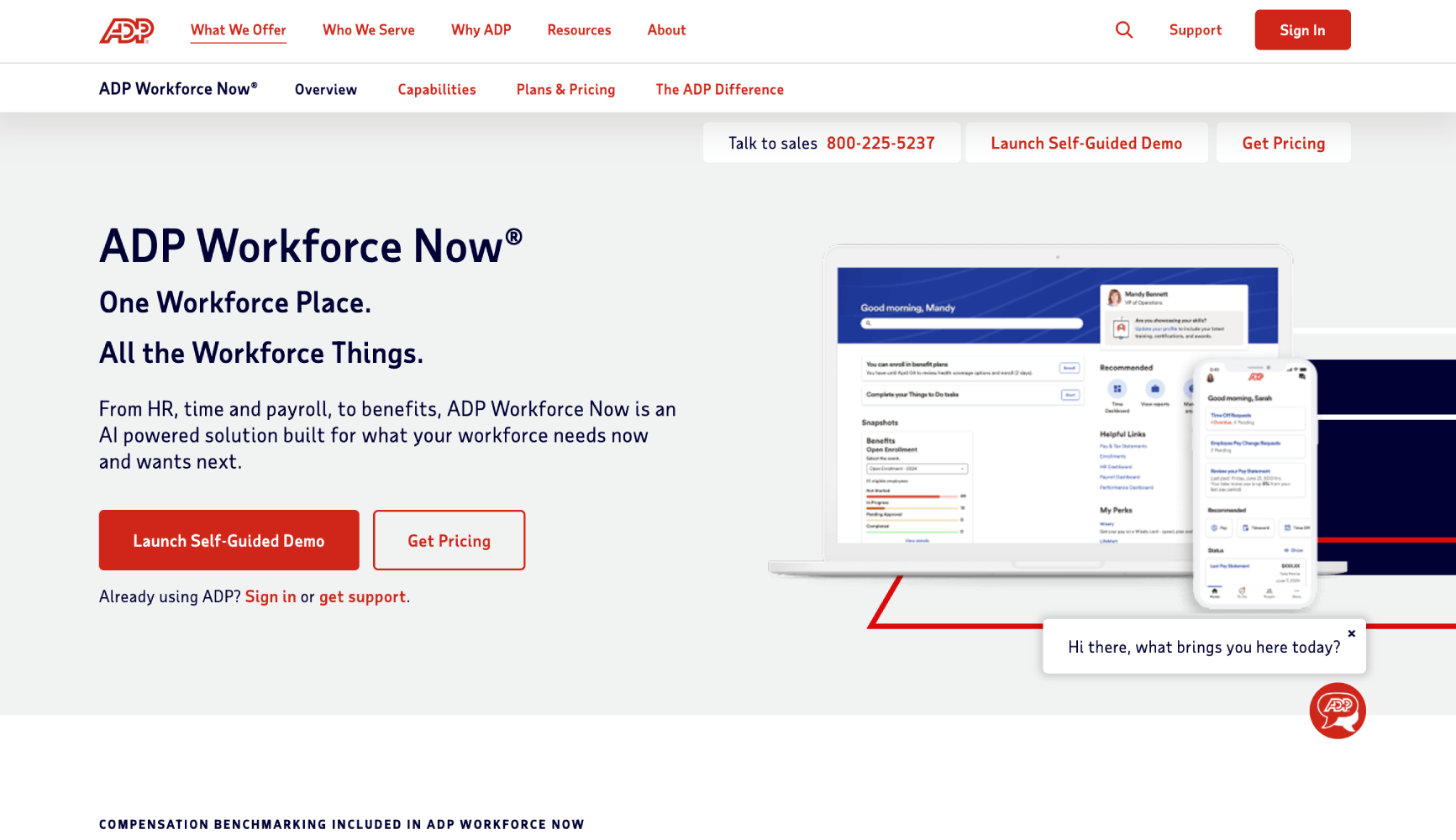
ADP TotalSource operates as a Professional Employer Organization (PEO) that bundles payroll processing, benefits administration, HR compliance support, and employee relations case handling into one co-employment contract. For mid-market companies between 50 and 1,000 employees, it is one of the most complete managed HR service offerings available at a predictable per-employee cost structure.
The co-employment model means ADP becomes the employer of record for benefits purposes, which gives smaller companies access to large-group health insurance rates they could not negotiate alone. The trade-off is that you surrender some HR policy flexibility, and your employees receive communications from ADP rather than exclusively from your brand.
TotalSource is best for companies that want to hand off payroll, benefits, and compliance risk wholesale rather than selectively outsource transaction categories. It is not the right fit if you have a mature HR function that wants to own policy and only offload execution.
2. TriNet HR+
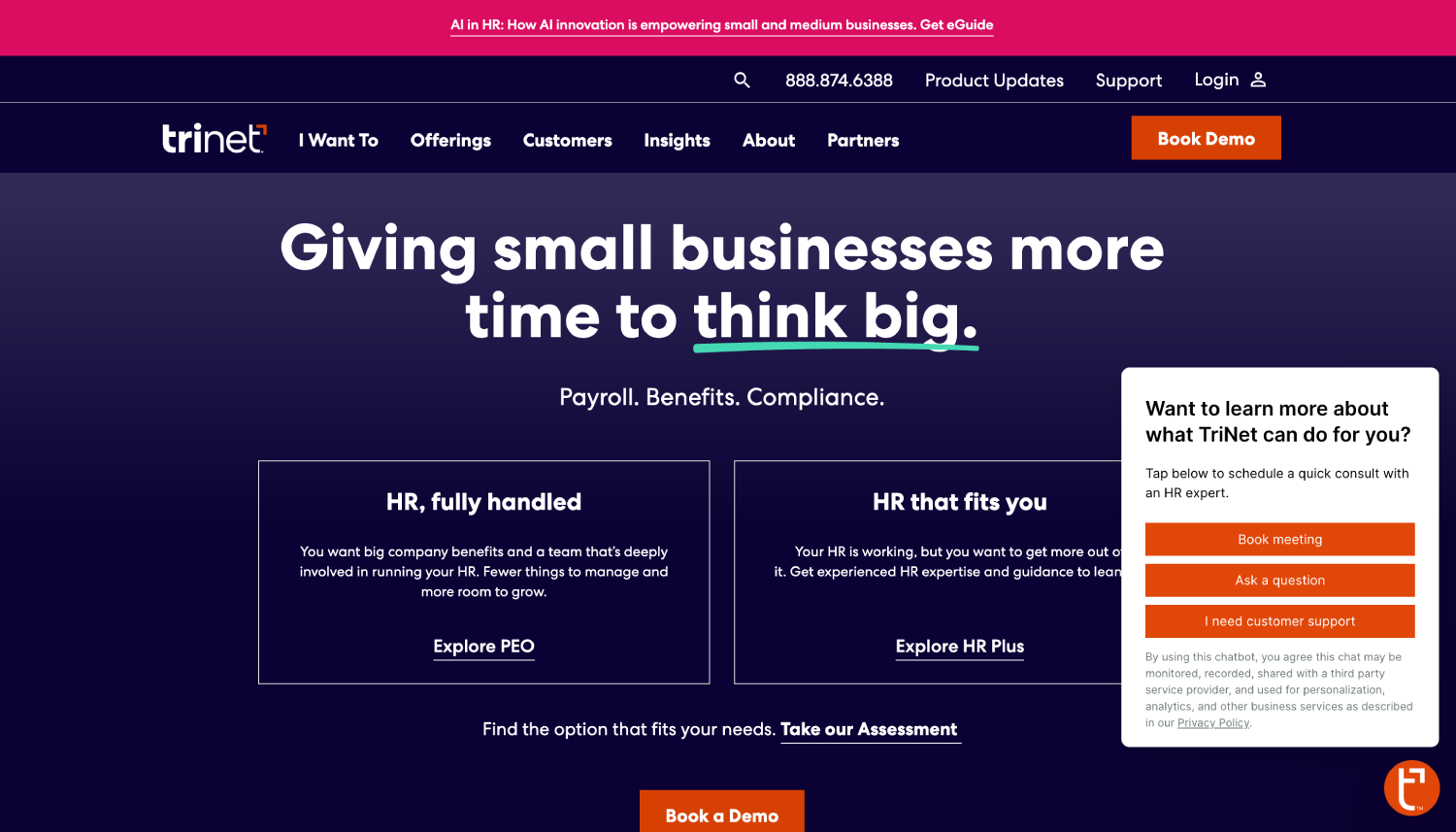
TriNet positions itself as a PEO for mid-market and high-growth companies, with vertical specializations in technology, life sciences, financial services, and professional services. Its HR+ service layer adds dedicated HR specialists who handle tier 1 and tier 2 employee relations cases on top of standard payroll and benefits administration.
Where TriNet differentiates from ADP TotalSource is in industry-specific HR guidance. A 400-person life sciences company has fundamentally different compliance obligations than a 400-person retailer. TriNet’s vertical model means the person handling your employee relations case understands your regulatory context rather than applying a generic script.
The ceiling is real: TriNet starts to feel constrained above 1,500 employees, particularly for companies with complex multi-state or multi-country payroll. At that point, the conversation shifts toward the providers below.
3. OneSource Virtual
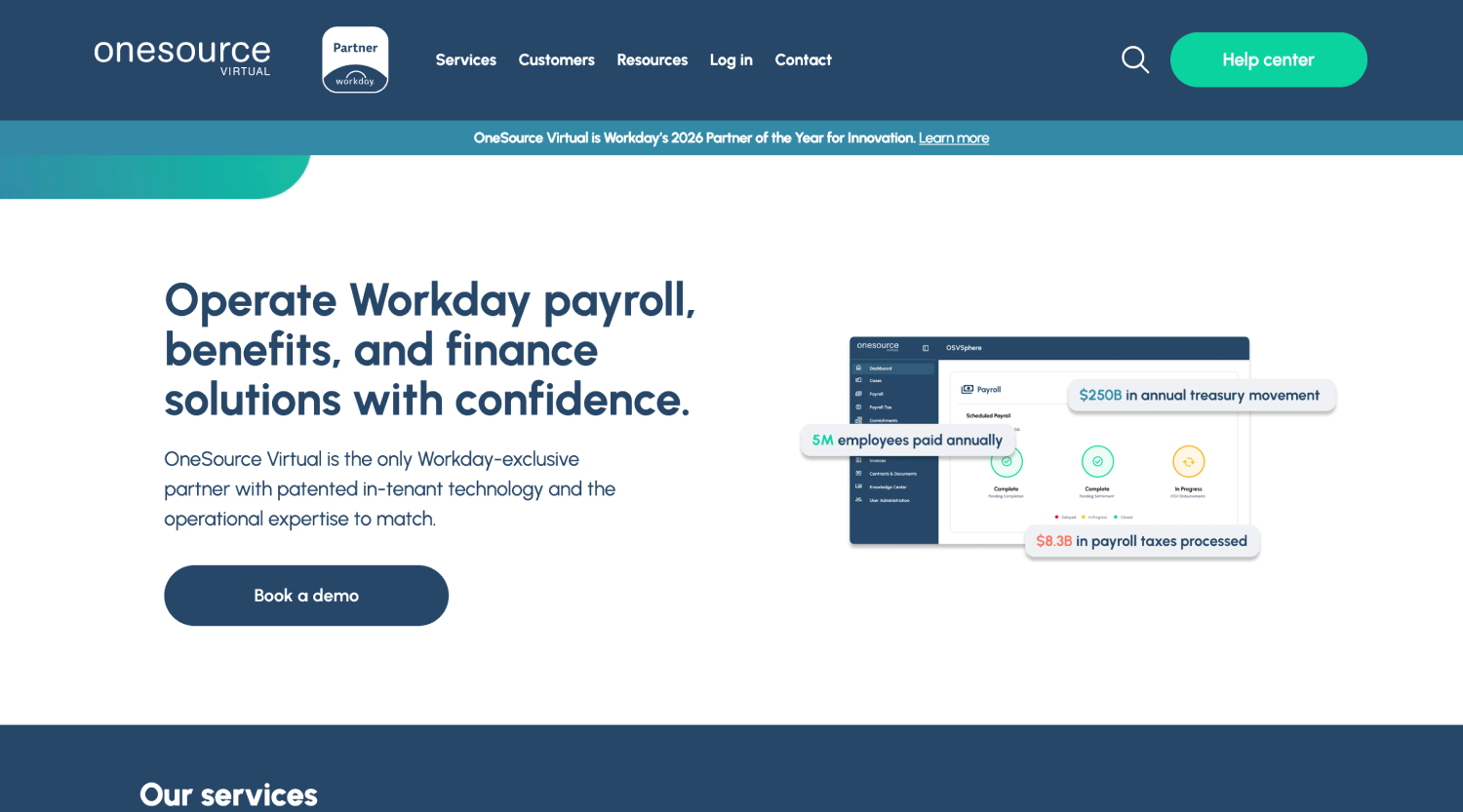
OneSource Virtual (OSV) is the most Workday-specific provider on this list. OSV built its entire delivery model around Workday HCM, offering managed payroll, benefits administration, accounts payable, and HR shared services to Workday customers who want to outsource the operational execution layer without leaving the Workday environment.
For mid-market companies between 500 and 5,000 employees running Workday, OSV removes a common frustration: the gap between what Workday can do and what your internal team has the capacity to configure, maintain, and run. OSV handles payroll processing, tax filing, year-end compliance, and benefits carrier connections while your internal HR team focuses on strategy and employee relations.
The dependency on Workday is both the strength and the constraint. If you are not on Workday, OSV is not relevant. If you are evaluating Workday and want to understand managed services options post-go-live, the best Workday managed services providers comparison covers OSV and its competitors in more depth.
4. Alight Solutions

Alight Solutions is one of the largest pure-play HR BPO providers globally, focusing on benefits administration, payroll outsourcing, and health and wealth solutions for enterprise and upper-mid-market employers. Its platform, Alight Worklife, consolidates employee benefits decision support, wellbeing programs, and HR service delivery into a single employee-facing interface.
Alight’s differentiation is depth in benefits administration complexity. Multi-plan health insurance setups, defined benefit pension administration, equity program support, and leave management across multiple jurisdictions are areas where Alight has more institutional capability than most providers on this list. That depth comes with a longer implementation timeline and a contract structure aimed at companies above 2,000 employees.
For buyers exploring adjacent AI tooling alongside BPO, Alight has been investing in AI-driven employee decision support within Worklife. That is worth examining alongside your BPO contract, though the AI layer should be evaluated separately rather than assumed as part of the outsourcing value proposition.
5. Conduent HR Solutions
Conduent emerged from Xerox’s business services spinoff and has built a substantial HR BPO practice around benefits administration, HR service center operations, and learning administration. Its scale is genuinely large-enterprise focused, with most published case studies referencing employers in the tens of thousands of employees.
Where Conduent is competitive for mid-market buyers is in its HR service center and case management capability. If your primary outsourcing goal is tier 1 case handling (first-response HR help desk, policy interpretation queries, leave requests) rather than full-stack BPO, Conduent can structure a narrower engagement around service delivery without requiring you to outsource payroll or benefits simultaneously.
The offshore delivery center model means you need to be specific about language requirements, escalation paths, and service level agreement penalties during contracting. Generic SLA commitments from offshore providers are often inadequate for companies with complex employee relations environments.
6. Accenture HR BPO
Accenture’s HR outsourcing practice is the most technology-forward on this list, built around SAP SuccessFactors, Workday, and Oracle HCM implementations paired with managed BPO delivery. Accenture is best positioned for companies that are simultaneously transforming their HR technology stack and want one provider to handle both the HCM implementation and the ongoing operational delivery.
This is not a mid-market play. Accenture’s HR BPO engagements typically require enterprise-scale volume and multi-year commitments. The differentiation is integration: Accenture’s consulting arm, system integration capability, and BPO delivery are coordinated under one relationship, which reduces the vendor management complexity that comes with running a separate SI and a separate BPO provider.
If you are running a Workday or SuccessFactors implementation alongside a BPO evaluation, the HR technology consulting firms comparison is worth reading before engaging Accenture’s sales team. Understanding the SI and BPO markets separately prevents you from bundling decisions that should be made independently.
7. Mercer HR Outsourcing
Mercer’s HR transformation and outsourcing practice sits at the intersection of HR advisory and operational delivery. Mercer brings a compensation and benefits consulting heritage that makes it particularly strong for companies outsourcing rewards administration, pension management, and global mobility support alongside core HR transactions.
The advisory-first model means Mercer will spend more time understanding your HR strategy before proposing an outsourcing structure. That is valuable if you want a provider who will challenge your current process design rather than simply lift and shift existing workflows to an offshore center. It also means longer sales cycles and higher initial engagement costs compared to providers who can quote from a standard service catalog.
For companies that want advisory and operational delivery from one firm rather than managing a separate people operations consultancy alongside an outsourcer, Mercer’s integrated model is worth the premium. For companies that have already done their process design work and want pure execution, less expensive options exist.
8. Quess Corp
Quess Corp is the least familiar name on this list for US buyers and the most relevant for companies with significant headcount in India or Southeast Asia. Quess provides HR outsourcing, payroll management, compliance administration, and staffing services across India, Singapore, Malaysia, and the Middle East, with a delivery model calibrated to the regulatory complexity of those markets.
For a US or UK company scaling into India, Quess offers a combination of employer of record services, payroll outsourcing, and HR shared services that most Western BPO providers cannot match for cost or local regulatory depth. Where a provider like Alight or Conduent will manage your India headcount from an offshore center with generalist knowledge, Quess operates with in-country specialists who understand Provident Fund compliance, gratuity calculations, and state-specific labor law in practice, not just in documentation.
Quess is not the right fit for companies whose workforce is entirely in North America or Europe. For companies expanding into the Asia-Pacific region, it deserves a place in any BPO RFP process.
How Do You Compare HR Shared Services Providers on Cost Per Transaction?
Most providers do not publish cost-per-transaction pricing publicly. The metric that matters for comparison is your total contract value divided by your total annual transaction volume across all HR service tiers. Getting to that number requires scoping calls with each provider, not just reviewing their marketing materials.
Before any scoping call, prepare a transaction inventory: how many payroll queries, benefits questions, leave requests, onboarding tasks, data change requests, and employee relations cases your HR team handles monthly. Break these into tier 0 (self-service, knowledge base resolution), tier 1 (first-contact resolution by a service center agent), and tier 2 (escalated cases requiring HR expertise). Providers price these tiers differently, and their quoted blended rates can obscure the true cost of complex tier 2 and tier 3 volume.
Ask every provider for their service level agreement commitments in writing before you discuss price. A provider quoting a low cost per transaction with a 48-hour first-response SLA is not equivalent to one quoting a higher rate with a four-hour SLA. For employee relations cases, resolution time directly affects employee experience and legal exposure. SLA specificity is not a negotiation afterthought.
| Provider | Best Fit Size | Core Strength | Technology Platform | Mid-Market Ready? |
|---|---|---|---|---|
| ADP TotalSource | 50 to 1,000 | PEO co-employment, benefits access | ADP Workforce Now | Yes |
| TriNet HR+ | 100 to 1,500 | Vertical-specific HR guidance | TriNet Platform | Yes |
| OneSource Virtual | 500 to 5,000 | Workday-native managed services | Workday | Yes (Workday clients only) |
| Alight Solutions | 2,000+ | Benefits administration depth | Alight Worklife | Upper mid-market only |
| Conduent | 5,000+ | HR service center operations | Multi-platform | Limited |
| Accenture HR BPO | 10,000+ | SI plus BPO integration | SAP, Workday, Oracle | No |
| Mercer HR Outsourcing | 2,000+ | Advisory plus rewards outsourcing | Multi-platform | Upper mid-market only |
| Quess Corp | Any (APAC focus) | India and SEA HR delivery | Multi-platform | Yes (APAC headcount) |
What Should an HR BPO Service Level Agreement Actually Cover?
A weak SLA is the most expensive mistake buyers make in HR outsourcing contracts. Generic commitments like “industry-standard response times” are meaningless. An SLA worth signing specifies first-response time by transaction tier, resolution time by transaction tier, escalation protocols with named owners, CSAT measurement methodology, and financial penalties tied to SLA misses.
For tier 1 transactions (standard leave requests, payroll query resolution, benefits enrollment support), first-response times should be measured in hours, not days. For tier 2 escalations (employee relations cases, accommodation requests, performance documentation), resolution timelines should be measured in business days with clear ownership at each stage. Any SLA that does not define what constitutes a “resolution” is writing you a blank check.
Knowledge base (tier 0) quality is often ignored in SLA negotiations and is where outsourcing value either compounds or erodes. A well-configured knowledge base can deflect a significant share of incoming HR queries before they become tickets , providers commonly reference 30 to 50 percent deflection rates for mature deployments, though this varies by industry, HRIS configuration, and employee adoption. Ask every provider how often their knowledge base is updated, who owns the content, and what their tier 0 deflection rate is across comparable client deployments. Providers who cannot answer that question have not measured it.
How Does AI Change the HR Shared Services Delivery Model?
AI is changing the economics of tier 0 and tier 1 delivery faster than most BPO providers are publicly acknowledging. AI-powered HR service chatbots and agent tools are deflecting queries that previously required a human service center agent, which compresses the transaction volume that justifies outsourcing costs. The question for buyers is whether their BPO provider is passing those efficiency gains back in pricing or capturing them as margin.
For a detailed look at how AI agents are reshaping HR service delivery before you lock into a multi-year BPO contract, the analysis of what AI agents can automate in HR service delivery covers the specific transaction categories where AI replaces human agents versus where it assists them. Understanding that boundary prevents you from paying a provider full BPO rates for work that AI is already doing for a fraction of the cost.
Providers like Alight (through Worklife), ADP (through Lyric HCM and Assist agents), and OneSource Virtual (through Workday’s AI layer) are embedding AI into their service delivery. The ADP AWS partnership and Assist agents announcement is worth reviewing before any ADP TotalSource scoping conversation, because the AI roadmap affects how the service delivery model will evolve over a three to five year contract term.
What Are the Realistic Implementation Timelines for HR BPO Contracts?
Implementation timelines for HR BPO engagements are systematically underestimated by buyers and, in competitive situations, by providers. A realistic baseline is six to nine months from contract signature to full steady-state delivery for a mid-market company outsourcing payroll, benefits administration, and tier 1 HR service center operations simultaneously.
The slowest phase is almost always process documentation and knowledge transfer. The provider cannot operate your HR service center without knowing your policies, your HRIS configuration, your benefits plan designs, and your escalation hierarchy. If your internal HR team has not documented these processes, the documentation work falls on them during implementation, usually while they are still handling full operational load. Budget for that overlap cost.
Technology integration is the second common delay. If your HRIS, payroll system, and benefits carrier systems do not have clean APIs or pre-built connectors to the provider’s delivery platform, integration work adds time and cost that is often not included in the initial quote. Ask for a detailed integration scope before you sign, not after.
Frequently Asked Questions About HR Shared Services and BPO
Which HR BPO providers actually serve mid-market companies rather than only large enterprise?
ADP TotalSource, TriNet HR+, and OneSource Virtual are the three providers on this list genuinely designed for mid-market organizations below 3,000 employees. ADP TotalSource and TriNet operate as PEOs and can engage companies from 50 employees upward. OneSource Virtual requires Workday HCM but serves clients from roughly 500 employees. Alight and Mercer can serve upper mid-market, but their minimum contract complexity is more appropriate for companies above 2,000 employees.
What is the difference between a PEO and an HR BPO provider?
A PEO enters a co-employment relationship, becoming the employer of record for tax and benefits purposes. This gives your employees access to the PEO’s pooled benefits purchasing power and shifts employment liability. An HR BPO provider operates as a third-party service vendor: they process your HR transactions but do not become your employees’ employer. PEOs are common for mid-market companies prioritizing benefits access. BPO is more common for larger organizations that want operational efficiency without changing the employment structure.
How do HR shared services providers charge, and what does cost per employee per month look like?
Most providers use one of three models: per-employee-per-month flat rates (common for PEOs and managed services), per-transaction pricing (more common for large-enterprise BPO), or blended FTE-plus-transaction structures. PEO providers like ADP TotalSource and TriNet do not publish per-employee pricing publicly and require a quote. Cost varies significantly by industry, employee demographics, benefits complexity, and transaction volume. Pricing is quote-based across all providers on this list. No provider in this category publishes a public pricing page with full rates.
What HR functions are typically included in a shared services outsourcing contract?
Standard inclusions are payroll processing and tax filing, benefits administration and open enrollment support, tier 0 and tier 1 HR help desk, leave administration, onboarding and offboarding transaction processing, and compliance reporting. Less commonly included are employee relations case management, performance management support, and HR business partner advisory services. Most providers offer modular contracts, meaning you can outsource specific functions without committing to full-stack BPO.
At what point should a company build an internal shared services center rather than outsource?
Internal HR shared service centers generally make sense above 5,000 employees when transaction volume is high enough to justify dedicated internal headcount, technology investment, and management overhead. Below that threshold, the fixed costs of an internal center typically exceed outsourcing costs unless your HR processes are highly standardized and your HRIS is well-configured for self-service. Companies between 1,000 and 5,000 employees often run hybrid models: internal HR business partners and internal HR leadership with outsourced transaction processing and tier 0 to tier 1 service delivery.
Should I evaluate HR BPO providers before or after choosing my HRIS?
Choose your HRIS first. Every BPO provider’s delivery model integrates with specific HCM platforms, and choosing a provider before a platform creates integration complexity that adds cost. OneSource Virtual requires Workday. Accenture is strongest on SAP and Workday. ADP TotalSource runs on Workforce Now. If you outsource first and then switch HRIS, you may trigger contract renegotiation or integration rebuild costs. The HRIS decision sets the foundation; the BPO decision layers on top of it.
How do I know if my current HR team’s cost per transaction is higher than what a BPO provider would charge?
Divide your total HR department cost (fully loaded: salaries, benefits, management overhead, HR technology licenses, office space) by the total number of HR transactions processed in a year. If you do not have a ticketing system that captures transaction volume, estimate by category: how many payroll queries, benefits calls, leave requests, and data changes does your team handle monthly? Then request a scoped cost-per-transaction quote from two or three providers against that volume. The comparison becomes arithmetically clear.
The Decision That Determines Everything Else
Most companies that dismiss HR shared services outsourcing do so without ever measuring their internal cost per transaction. That number, once calculated, tends to be surprising. HR teams absorb a large volume of routine, repetitive transactions that have nothing to do with HR strategy and everything to do with operational capacity. Outsourcing those transactions does not reduce your HR function’s strategic value. It creates space for it.
The decision that matters most is not which provider to choose. It is whether to outsource selectively (specific transaction categories, specific geographies) or comprehensively (full HR service delivery across the function). Selective outsourcing is almost always the right starting point for mid-market companies. One category at a time, with clear SLA commitments and a defined measurement period, before you expand scope.
If you are evaluating people operations advisory alongside operational outsourcing, those are two separate buying decisions that often get conflated. Advisory work from a firm that understands your HR strategy does not need to come from the same vendor executing your payroll transactions. Keeping those decisions separate gives you more negotiating room in both conversations.