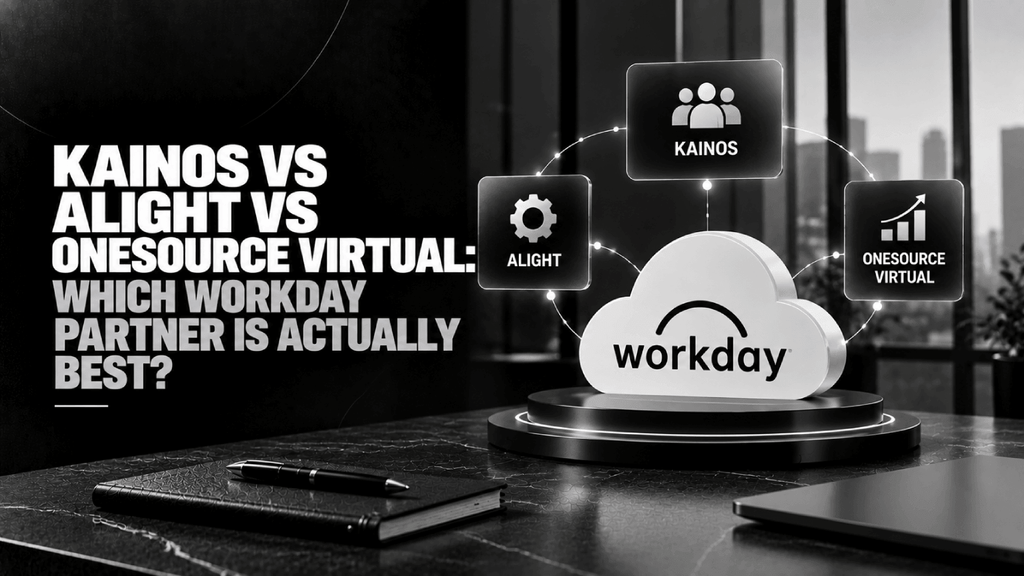

- Kainos, Alight, and OneSource Virtual (OSV) differ more on delivery model and release discipline than on day rate, and choosing the wrong one costs more than any rate difference.
- Kainos is the best fit for organizations that want Workday-specialist depth and structured release readiness without payroll BPO bundled in.
- Alight is the natural choice when you need payroll processing, benefits administration, and Workday AMS from one vendor under one contract.
- OSV is the strongest option for mid-market Workday customers who want US-based delivery, predictable pricing, and a named support team without enterprise-scale minimums.
- Offshore delivery mix, ticket SLA definitions, and contract exit terms differ sharply across all three, and buyers who skip those details routinely regret it at renewal.
Kainos, Alight, and OneSource Virtual are three of the most frequently shortlisted Workday application managed services (AMS) providers. Kainos is the specialist with the deepest Workday bench. Alight is the bundled BPO play that wraps payroll and benefits around AMS. OSV is the US-focused mid-market option with predictable pricing and named-team delivery. All three can keep your Workday instance healthy, but they are not interchangeable, and the gap between them shows up in SLA language, offshore mix, and what happens when a Workday release breaks something you rely on.
What Is Workday AMS and Why Does Provider Choice Matter?
Application managed services for Workday means ongoing post-go-live support: break-fix, configuration changes, release readiness testing, reporting, integrations, and optimization work, delivered under a retainer or ticket-based contract rather than a project statement of work. Most Workday customers outgrow their implementation partner’s hypercare window within six months and need a dedicated AMS relationship for years afterward.
The provider you choose determines how fast tickets move, how prepared your instance is for Workday’s twice-yearly feature releases, and whether you have a named consultant who knows your configuration or a rotating offshore queue. Those operational differences compound over a three-year contract. For context on how AMS fits into the broader partner market, see our roundup of the best Workday consulting firms for implementation, optimization, and support.
How Do the Three Delivery Models Actually Differ?
This is where buyers most often underestimate the gap. Each provider has a structurally different delivery model, and it affects everything from ticket routing to release preparation.
Kainos: Workday-Only Specialist Bench
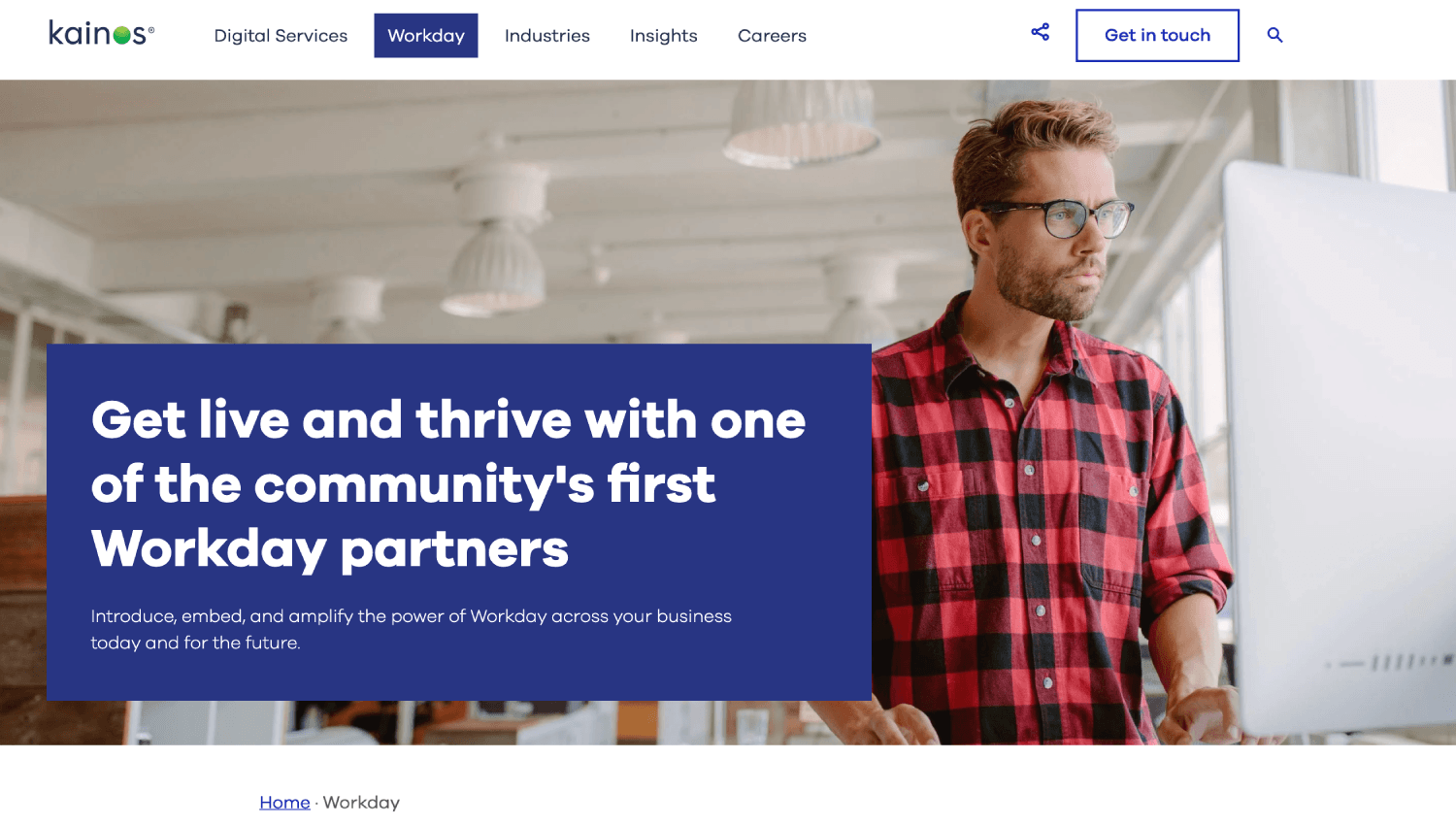
Kainos built its managed services practice entirely around Workday. The firm holds one of the highest Workday partner certifications, and its AMS team works exclusively on Workday HCM, Payroll, Financials, and Adaptive Planning. That specialization means you are less likely to get a generalist who learned Workday last quarter. Kainos operates delivery teams out of the UK, Ireland, Poland, and the US, so there is an offshore and nearshore component, but the firm is more transparent about team composition than most competitors.
Release readiness is a genuine differentiator for Kainos. The firm runs structured pre-release impact assessments for every Workday update, maps changes against your specific configuration, and delivers written readiness documentation before the release window opens. That is not universal practice in the AMS market.
Alight: BPO-First, AMS as an Add-On

Alight is primarily a benefits administration and payroll outsourcing firm. Its Workday AMS capability exists within a much larger BPO organization, which has real advantages if you want payroll processing, benefits carrier connections, and Workday system management from one vendor. The integration between Alight’s payroll operations and its Workday support team is genuine, not just a contract bundle, and that matters when a payroll configuration change requires coordination between system and process layers.
The trade-off is that Alight’s AMS support sits inside a larger service center model. Ticket routing can involve more tiers, and the named-consultant experience is less consistent than at a specialist shop. If you are buying Alight purely for AMS without the payroll BPO, you are paying for infrastructure that does not benefit you directly. For companies evaluating whether bundled payroll outsourcing makes sense alongside their Workday contract, see our guide on best global managed payroll providers.
OneSource Virtual: US-Focused, Named-Team Model
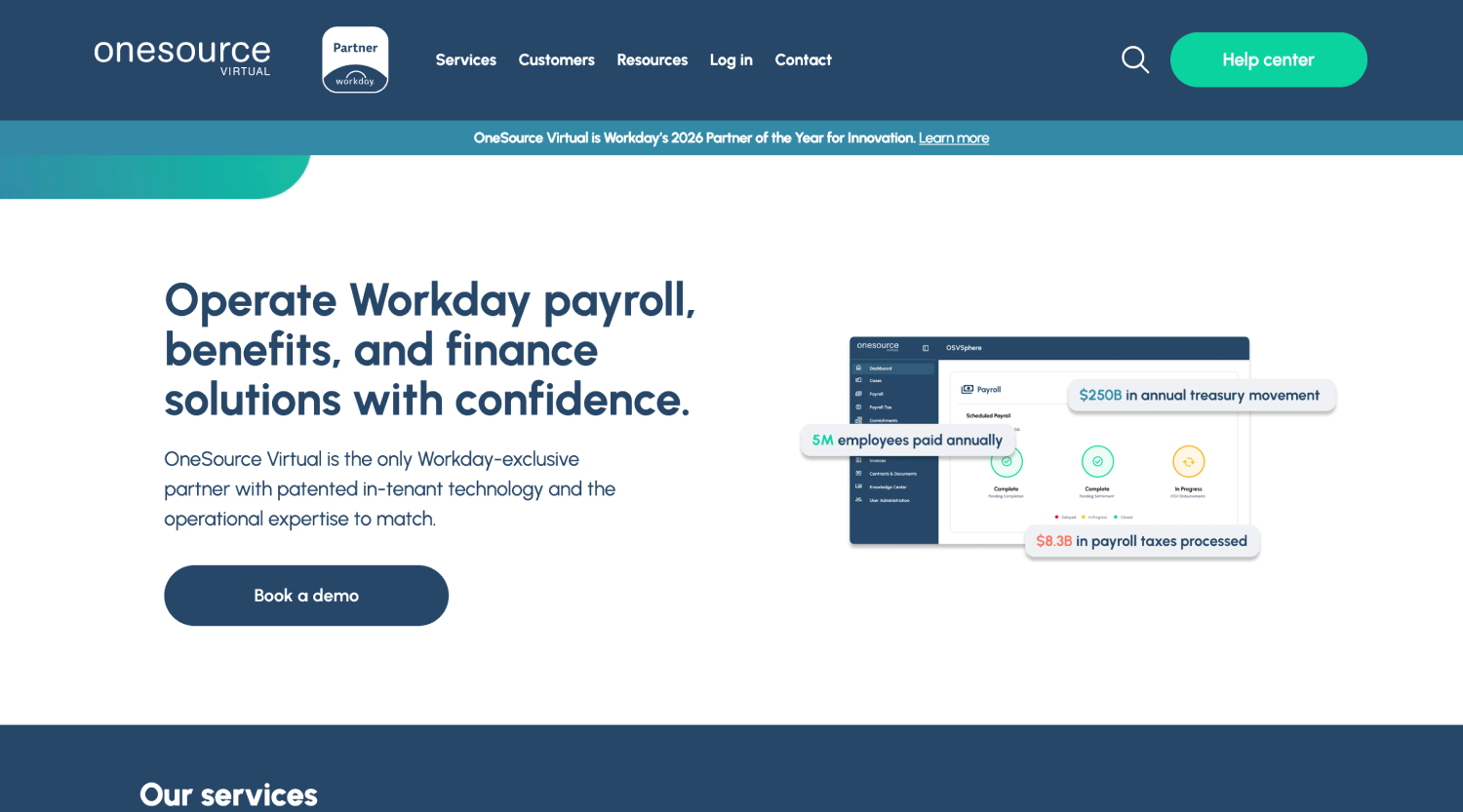
OSV operates almost entirely within the US and positions itself explicitly as a Workday-only provider, similar to Kainos in that regard. Its differentiating claim is the named-team model: clients are assigned a dedicated pod of Workday specialists rather than drawing from a shared queue. For mid-market buyers with 500 to 3,000 employees, that consistency is worth more than it sounds. You do not spend the first ten minutes of every support call explaining your payroll costing structure to someone who has never seen your tenant.
OSV also runs payroll outsourcing on the Workday platform (rather than a third-party system), which makes it a credible alternative to Alight for companies that want BPO bundling but prefer a US-delivery model. The limitation is geographic: OSV is not the right choice if you have significant payroll complexity outside North America.
Kainos vs Alight vs OneSource Virtual: Feature and Delivery Comparison
| Dimension | Kainos | Alight | OneSource Virtual |
|---|---|---|---|
| Workday specialization | Workday-only AMS | Workday AMS within broader BPO | Workday-only AMS and BPO |
| Payroll BPO bundling | No | Yes (core product) | Yes (Workday Payroll native) |
| Benefits administration | No | Yes (core product) | Limited |
| Delivery geography | UK, Ireland, Poland, US | Global (India-heavy offshore) | Primarily US |
| Named consultant model | Partially (engagement leads) | Service center model | Yes (dedicated pod) |
| Release readiness discipline | Structured, documented | Standard practice | Structured, documented |
| Mid-market fit (500-3,000 employees) | Strong | Better at enterprise scale | Purpose-built |
| Enterprise scale (5,000+ employees) | Strong | Core strength | Possible, less common |
| Contract flexibility | Moderate (project-based add-ons) | Lower (bundled contract terms) | Higher (flexible retainer tiers) |
| Pricing model | Quote-based | Quote-based | Quote-based |
How Do Ticket SLAs and Response Times Compare?
None of the three providers publish SLA terms publicly. All pricing and SLA documentation is quote-based and contract-specific, which means you must request the actual SLA schedules during procurement, not assume they match what a sales deck describes.
That said, there are structural patterns worth knowing. Alight’s service center model means tickets are triaged by tier before reaching a Workday-certified consultant. Initial response SLAs (often two to four hours for critical issues) are typically met, but time-to-resolution on configuration-level tickets can be longer because of internal escalation steps. Kainos tends to have faster time-to-resolution on complex configuration work because tickets route more directly to certified specialists. OSV’s named-pod model typically produces the most consistent experience for mid-market clients: you have fewer escalation layers, and your pod already knows your configuration.
When requesting SLA documentation, ask specifically for: P1 initial response time, P1 resolution SLA, P2 and P3 resolution SLAs, what constitutes a P1 (definitions vary), and whether SLAs reset when a ticket is escalated internally. Those five questions expose most of the gap between how SLAs are marketed and how they operate. If you are building your procurement process, our HR software RFP template with vendor comparison scoring includes a section for managed services SLA evaluation.
Which Provider Handles Workday Release Readiness Best?
Workday releases two major feature updates per year, and each one carries real regression risk for customized configurations. Release readiness, meaning the process of testing, documenting, and communicating changes before they hit your production tenant, is one of the clearest operational differentiators among AMS providers.
Kainos has invested heavily in tooling around release readiness. The firm conducts configuration-specific impact assessments and produces written change logs mapped to your tenant before each release. This is not just good practice for your HR team; it protects you if a release breaks a custom integration or reporting configuration that Workday’s standard notes would not flag.
OSV takes a similar approach and has built proprietary tooling to automate parts of the regression testing cycle. For mid-market clients without a large internal Workday team, OSV’s release management process effectively substitutes for the internal capability you probably do not have.
Alight performs release readiness work as part of its standard AMS retainer, but because its Workday AMS practice sits within a larger organization, the depth of configuration-specific documentation varies by account size. Larger Alight clients with dedicated account teams report good outcomes. Mid-market clients on shared service tiers sometimes find the release documentation generic rather than tenant-specific.
Kainos vs Alight for Bundled Workday Payroll BPO: Which Wins?
If payroll BPO is part of what you need, this comparison narrows. Kainos does not offer payroll outsourcing, so it exits this comparison immediately. The real choice is Alight versus OSV, and the deciding factor is where your payroll complexity lives.
Alight runs payroll on its own processing infrastructure, which means there is a translation layer between your Workday HCM configuration and Alight’s payroll engine. For organizations with complex US payroll, including multi-state, union, or high-volume hourly populations, Alight’s depth of payroll operations experience is genuinely difficult to replicate. The firm has decades of payroll administration experience and handles very large, complex payrolls. The cost is that changes to payroll configuration require coordination between two technical environments, and that handoff introduces friction.
OSV runs payroll natively inside Workday Payroll. Changes to compensation structures, earning codes, or deduction rules update in one system, and the team managing your AMS is the same team managing your payroll configuration. For organizations already on Workday Payroll or planning to implement it, OSV’s native model is cleaner operationally. The limitation is that OSV’s payroll coverage is primarily US-focused, while Alight can manage payroll in more countries.
Which Provider Is Best for Mid-Market vs Enterprise?
Company size and internal Workday capability shape this decision more than most buyers admit. The right AMS partner for a 600-person company with two Workday admins is structurally different from the right partner for a 12,000-person company with an internal HRIS team.
OSV is the clearest choice for mid-market organizations. The named-pod model means a smaller team is not lost in a queue behind enterprise accounts. Pricing tiers are designed to be viable at lower employee counts. OSV’s US-only delivery also aligns well with the typical mid-market company that has US-centric HR operations and does not need global payroll complexity. For more context on how mid-market companies approach their broader HR technology stack, see our comparison of the best HR software platforms for mid-market companies.
Kainos performs well across both mid-market and enterprise, but its model is most differentiated at the enterprise end where Workday configuration complexity is highest. A large Kainos account gets the full weight of the firm’s Workday certification bench. At smaller account sizes, you may find the engagement lead model thinner than OSV’s pod approach.
Alight is almost always the better fit at enterprise scale, particularly when payroll and benefits outsourcing are in scope. The firm’s infrastructure supports large, complex accounts, and the bundled contract structure makes more sense when you are buying multiple services. Alight’s cost structure is harder to justify for a mid-market buyer who only needs AMS.
How Does Offshore Delivery Mix Affect Your Choice?
Every provider in this market uses some combination of onshore, nearshore, and offshore delivery. The question is transparency and fit, not whether offshore delivery exists. Buyers who assume “onshore” means no offshore delivery are routinely surprised at contract signature.
Kainos is explicit about its delivery geography. The firm’s primary delivery centers are in Belfast, Dublin, and Gdansk, with US-based staff for client-facing roles and senior technical work. That mix is largely nearshore from a US perspective rather than deep offshore, and Kainos is generally willing to disclose the composition during procurement.
Alight uses India-based delivery for a significant portion of its support operations. For repetitive ticket types and lower-complexity work, that model is cost-efficient and the quality is often fine. For complex configuration work or sensitive payroll issues, buyers frequently report preferring onshore or nearshore escalation, and getting it requires clear contract language specifying escalation paths.
OSV’s delivery is predominantly US-based, which is its primary positioning claim against larger competitors. For buyers with data residency requirements, union configurations, or organizational sensitivity to offshore HR data handling, OSV’s model removes a variable that some HR leaders do not want to manage.
What Does Contract Flexibility Look Like Across the Three?
Contract structure is where mid-market buyers most often get hurt. Bundled BPO contracts with Alight are typically multi-year commitments with significant early termination costs, because Alight’s model requires investing in implementation of its own platforms alongside Workday configuration. That investment needs to be recovered over a contract term. Buyers who need to renegotiate scope, downsize, or exit during an economic downturn find Alight contracts harder to restructure than they expected.
Kainos contracts tend to be structured around retainer tiers with project add-ons. Scope can be adjusted at renewal, and the firm does offer shorter-term arrangements for specific optimization projects alongside the core AMS retainer. That flexibility is useful if your Workday footprint is changing, for example if you are adding Workday Payroll or Adaptive Planning and need to expand AMS scope mid-contract.
OSV has the most modular pricing approach of the three. Retainer tiers can expand or contract based on headcount or support volume, and the firm is generally more willing to negotiate mid-contract adjustments than Alight. For growing mid-market companies where headcount can move meaningfully in either direction, that flexibility has real financial value.
Frequently Asked Questions
What is the difference between Workday AMS and Workday managed services?
The terms are used interchangeably in the market. Application managed services (AMS) refers to ongoing post-go-live support for a Workday instance, covering break-fix, configuration, release readiness, integrations, and optimization. Managed services is the broader category that may also include payroll or benefits process outsourcing. When a vendor says “Workday managed services,” confirm whether they mean AMS only, or AMS plus BPO, because the contract structure and cost differ significantly.
How much does Workday AMS cost?
All three providers, Kainos, Alight, and OSV, are quote-only. Pricing depends on your Workday module footprint, headcount, ticket volume, and whether BPO services are included. Mid-market AMS retainers in the US market typically range from low six figures to mid six figures annually, but that range is wide enough to be nearly useless without a scoped proposal. Request pricing alongside SLA documentation to compare the two together. See our breakdown of what HRIS, payroll, and HCM really cost for context on total Workday program costs.
Is Kainos or OneSource Virtual better for a 1,000-person company?
OSV is generally the better fit at 1,000 employees for a US-centric organization. The named-pod model provides continuity that Kainos’s engagement-lead model only partially replicates at that account size. Kainos is stronger for organizations where Workday configuration complexity is high, for example multi-country HCM or complex Payroll implementations, where the depth of Kainos’s certification bench justifies the engagement model.
Can Alight replace my internal Workday admin team?
Alight’s AMS service can handle the configuration and support work an internal admin team would perform, but it does not replace the strategic HR systems ownership that internal staff provide. Alight manages what you ask it to manage. Someone on your team still needs to own the Workday roadmap, prioritize configuration requests, and manage the vendor relationship. Buyers who fully outsource Workday ownership to Alight without retaining any internal Workday expertise often find themselves with less control over their own system than they expected.
What should I ask for in a Workday AMS SLA review?
Request the full SLA schedule, not the summary in the sales deck. Ask specifically for P1 through P4 initial response and resolution times, the exact definition of each priority tier, whether SLAs reset on internal escalation, monthly reporting frequency, and penalty or credit terms for SLA breaches. Also confirm whether release readiness activities are included in the retainer or billed separately. Those questions expose most of the meaningful differences between AMS contracts that look similar on the surface.
How do Workday AMS providers handle Workday’s twice-yearly releases?
The best providers conduct tenant-specific impact assessments before each release, mapping Workday’s change documentation against your configuration to identify regression risks. Kainos and OSV both have structured processes for this. Alight performs release readiness work as part of the standard retainer, but the depth of tenant-specific analysis varies by account tier. Ask each provider to walk you through their last release readiness cycle for a client with a similar configuration to yours. The specificity of their answer tells you more than any marketing document. For a broader look at how Workday’s platform evolves, see our analysis of Workday AI versus SAP Joule versus Oracle AI for HR.
Does OneSource Virtual work for companies outside the US?
OSV’s AMS practice can technically support multi-country Workday HCM configurations, but its payroll BPO is primarily US-focused. If your Workday instance includes significant international payroll complexity in Europe, APAC, or LATAM, OSV is not the right primary AMS partner. Kainos or Alight would be more capable for global footprints, with Alight having more global payroll operations depth. For multi-country payroll context, our guide to top Workday managed services providers covers additional options with global delivery.
How to Shortlist and What to Do Next
The clearest framework for narrowing this decision: start with geography and BPO scope. If you need payroll or benefits outsourcing bundled with AMS and you operate primarily in the US, OSV deserves a serious look. If you need global BPO scale, Alight is the practical choice. If you need pure AMS without BPO, Kainos is the strongest specialist. Everything else, SLAs, offshore mix, release readiness, is a layer on top of that structural decision.
Request SLA schedules, not summaries, from every provider you shortlist. Ask each one to describe their last Workday release readiness cycle in detail, including what they delivered to the client before the release window opened. Request references from clients at a similar employee count and Workday module footprint to yours. Those three steps will surface more meaningful differentiation than any RFP scoring matrix. For a broader implementation perspective before engaging any AMS provider, our guide to best HRIS implementation partners for mid-market companies covers the evaluation criteria that carry over from implementation into ongoing support.
The day rate matters less than buyers expect. What compounds over three years is whether your provider catches a release regression before it hits production, whether your tickets reach someone who knows your configuration, and whether you can renegotiate scope when your business changes. Those are the terms worth scrutinizing before you sign.