
- Outplacement is not just a courtesy. It reduces wrongful termination claims, protects employer brand during the window when disgruntled former employees are most active, and shortens the time departing workers spend without income.
- Pricing varies from flat per-employee fees under $500 for self-serve access to dedicated coaching packages above $3,000 per person. What you pay should map to seniority, volume, and legal exposure, not vendor prestige.
- The best providers for most mid-market employers are Challenger, Gray and Christmas; Intoo; and Career Arc for volume RIF events. Larger enterprise accounts often contract with Lee Hecht Harrison or RiseSmart secondarily.
- Landing rate and redeployment rate are the only metrics that prove ROI. Demand them contractually before signing.
- WARN Act compliance, notice period support, and alumni goodwill all depend on how fast the provider can onboard departing employees. Activation speed matters as much as coaching quality.
Outplacement providers are firms that help employers support workers through involuntary separation by offering career coaching, resume services, job search access, and emotional support. The top providers for employers in 2026 include Challenger, Gray and Christmas, Intoo, Career Arc, Lee Hecht Harrison, RiseSmart, Keystone Partners, Right Management, Careerminds, Bolster, Latitude, and Onward. The right choice depends on employee volume, seniority mix, geographic footprint, and how fast you need to activate support after a reduction in force.
Why Do Employers Still Treat Outplacement as Optional?
Most HR leaders know outplacement exists. Few treat it as a risk-management tool with a verifiable return. The dominant belief is that severance check and outplacement are both gestures of goodwill, one financial and one symbolic. That framing is wrong, and it is expensive to hold.
When an employee is separated involuntarily, the 30 to 90 days after the conversation are when litigation risk, Glassdoor damage, and NLRB complaints are most likely to materialize. Outplacement shortens that window by giving departing employees an immediate forward path. A worker who starts interviewing within the first week is less likely to spend that week talking to an employment attorney. Employment law firms regularly cite prolonged unemployment and a feeling of abandonment as primary factors in whether separated workers pursue claims.
The WARN Act layer adds more urgency. For employers conducting a reduction in force affecting 100 or more employees at a single site, the WARN Act requires 60 days advance notice. Outplacement providers with notice period support programs can help HR teams structure that notice period productively rather than letting it become a morale collapse. Smaller RIFs under 100 employees face fewer federal obligations but equivalent reputational exposure.
After a RIF, your remaining workforce is watching how you treated the people who left. The redeployment rate, meaning how many departing employees land new roles within 90 days, is the fastest signal to survivors that the company acted with integrity. That signal affects retention, which affects your recruiting costs over the next 18 months. If your team is modeling those costs, the AI people analytics platforms category has tools built specifically for post-RIF workforce planning scenarios.
How Is Outplacement Priced Per Employee and What Is Included?
Outplacement pricing follows three broad models. Understanding which model a vendor uses tells you more about the actual experience your employees will receive than any feature checklist.
Per-employee flat fee: The most common model for mid-market buyers. You pay a fixed amount per separated employee, typically covering a defined duration (30, 60, or 90 days) and a defined scope (resume review, coaching hours, job board access). Prices range from under $500 for self-serve digital programs to $2,500 or more for dedicated one-on-one coaching packages. Most providers are quote-based and pricing varies by volume and seniority tier , published rates are not standard across the category. For a broader view of how HR software vendors structure pricing, see our guide to HR software pricing.
Duration-based subscription: Some providers charge for a defined service window regardless of how many sessions the employee uses. This model benefits employers because unused sessions do not roll over as wasted cost, and it benefits employees because there is no incentive for the provider to rush them out.
Outcome-based or landing fee: A small number of providers charge a success fee triggered when the departing employee lands a new role. This model aligns provider incentives with actual outcomes but is rare and typically limited to executive-level placements.
| Provider | Best For | Pricing Model | Coaching Format | RIF Activation Speed |
|---|---|---|---|---|
| Challenger, Gray and Christmas | Mid-market, executive | Per-employee, quote-based | Dedicated coach | 24-48 hours |
| Intoo (Gi Group) | Mid-market, volume RIF | Per-employee, tiered | On-demand + live coach | Same day |
| Career Arc | High-volume, hourly workforce | Per-employee or site license | Digital-first, tech-enabled | Same day |
| Lee Hecht Harrison (LHH) | Enterprise, global | Quote-based | Dedicated coach, in-person option | 24-48 hours |
| RiseSmart (Randstad) | Enterprise, tech-enabled | Quote-based | On-demand + coach | Same day |
| Keystone Partners | Northeast US, professional roles | Per-employee, quote-based | Dedicated coach | 48 hours |
| Right Management (ManpowerGroup) | Global enterprise | Quote-based | Dedicated coach, in-person | 24-48 hours |
| Careerminds | SMB, budget-conscious | Per-employee, flat rate | Virtual coach | Same day |
| Bolster | Executive and C-suite | Quote-based | Peer network + dedicated | 48-72 hours |
| Latitude | Mid-market, regional US | Per-employee, quote-based | Dedicated coach | 48 hours |
| Onward | Tech layoffs, individual access | Per-employee, low-cost | Digital-first | Same day |
| Career Transitions (Savannah) | Regional US, SMB | Per-employee, quote-based | Virtual + in-person hybrid | 48 hours |
Which Outplacement Providers Are Best for a RIF Under 100 Employees?
Small RIFs create a different buying problem than large ones. Enterprise providers built for 500-person events will not optimize for a 40-person RIF. You need a provider with per-employee pricing that does not penalize low volume, fast activation so separated employees can begin immediately, and digital-first delivery because you probably cannot justify flying coaches to a single office location.
Intoo
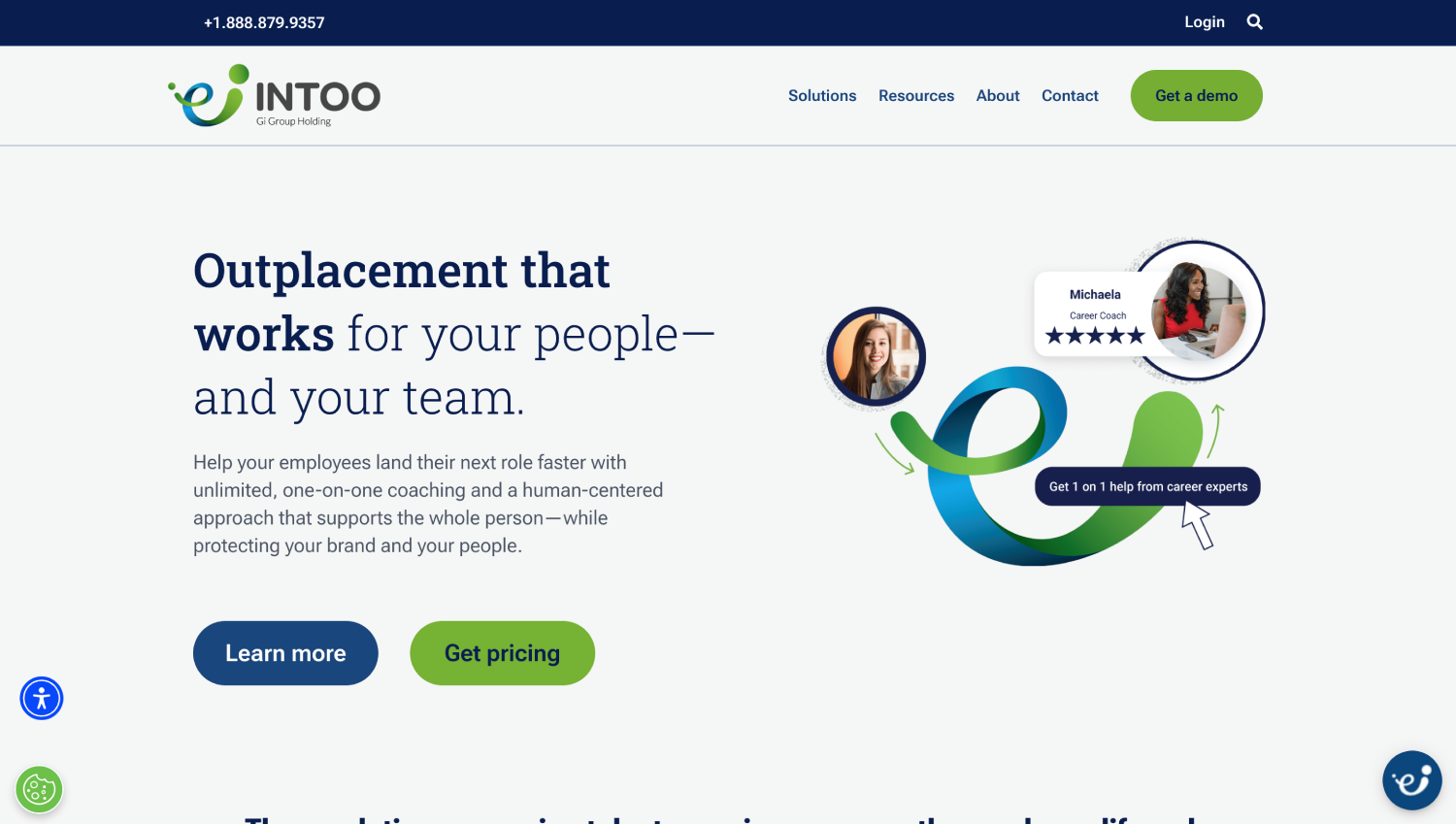
Intoo (owned by Gi Group) is the clearest choice for mid-market employers running a RIF under 100. Their platform activates same-day, the coaching experience is live video with dedicated coaches rather than pre-recorded content, and their employer dashboard gives HR a real-time view of program participation. Pricing is tiered and quote-based, but they are genuinely accessible for sub-100 headcount events in a way that LHH and Right Management are not.
Careerminds
Careerminds competes on price more explicitly than almost anyone else in this category. Their virtual delivery model keeps per-employee costs down, and they publish a landing rate guarantee on their site, meaning they commit to placing employees in new roles or extending the program at no additional cost. For HR leaders who need to justify outplacement spend to a CFO skeptical of soft ROI, that guarantee is a useful anchor point.
Career Arc
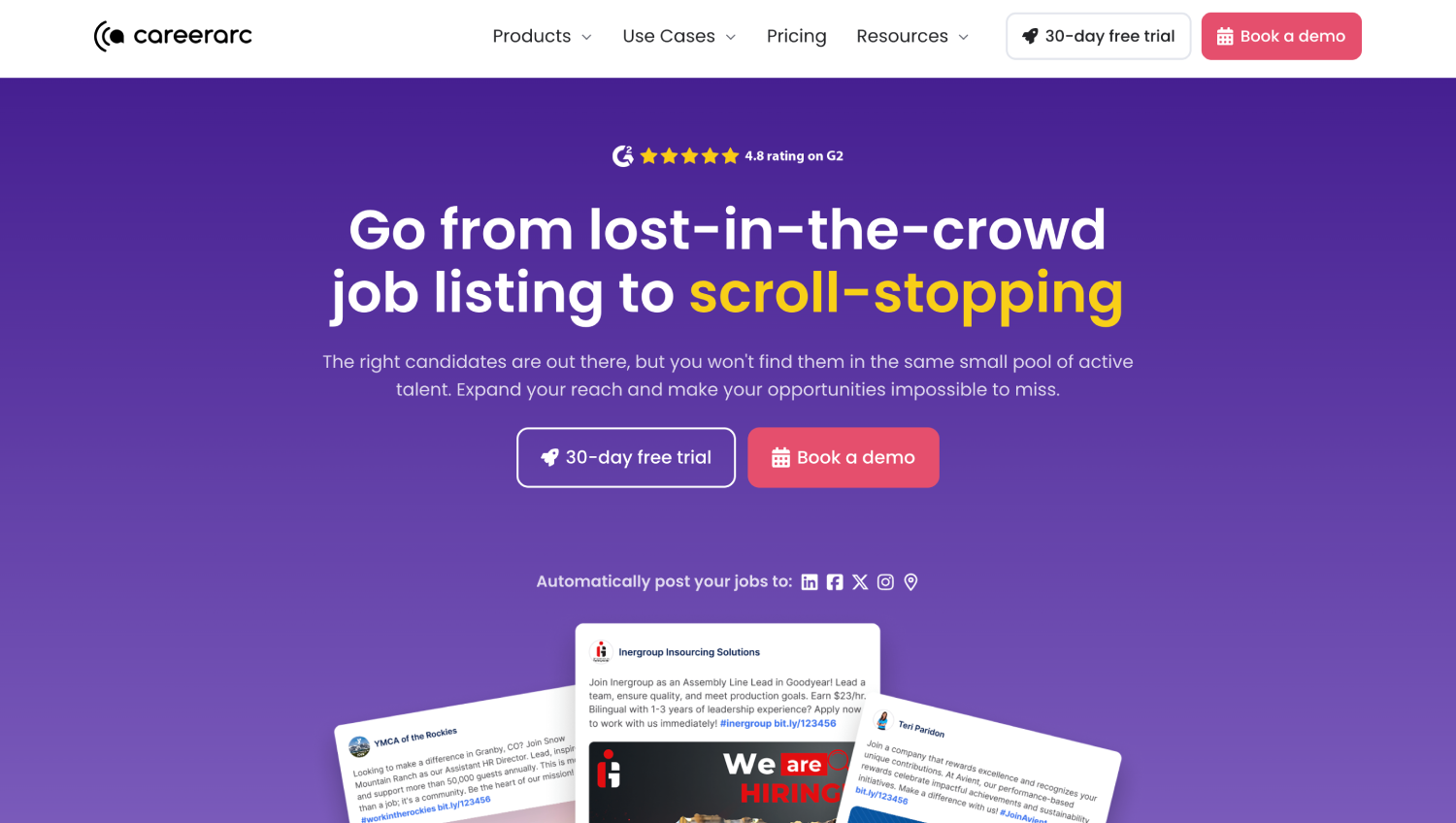
Career Arc built its platform for high-volume hourly workforces, but their technology scales down well. Their social media job search tools and employer branding protection features are genuinely differentiated. If your RIF involves frontline or hourly workers whose job search will happen primarily on LinkedIn and social platforms, Career Arc is the right call. They also offer a site-licensing model that can make per-employee math favorable at certain volume thresholds.
Which Providers Are Best for Executive-Level Career Transition Services?
Executive outplacement is a separate product category in practice, even when offered by the same firms. A VP or C-suite executive being separated needs peer-level coaching, board access, market positioning strategy, and discretion. They do not need a resume template and a job board subscription.
Challenger, Gray and Christmas

Challenger, Gray and Christmas is the oldest outplacement firm in the US and remains the strongest independent brand for executive-level career transition. Their coaches are senior practitioners with industry-specific backgrounds rather than generalist career counselors. Their monthly job market data is cited regularly by major news outlets, which gives departing executives confidence that the firm has genuine market intelligence. For mid-market employers separating director to C-suite talent, this is the default choice.
Bolster
Bolster is newer and built specifically for executive and board-level transitions. Their model combines a peer community of executives with dedicated coaching, and they have a marketplace where companies post fractional and interim executive roles. For a CTO or CFO being separated, Bolster’s access to interim opportunities is a faster path to income than a traditional job search. Pricing is quote-based and positioned at the premium end of the market.
Right Management

Right Management, part of ManpowerGroup, has the deepest global footprint of any provider on this list. For multinational employers separating senior leaders across multiple countries, Right Management can deliver consistent executive coaching in markets where most US-centric firms cannot operate. Pricing is quote-based and reflects the global service premium.
Do Outplacement Services Actually Reduce Wrongful Termination Claims?
The short answer: yes, with caveats about how you deploy them.
Wrongful termination claims are driven by two factors more than any others. The first is financial distress. When a separated employee cannot pay their bills, litigation becomes an attractive income option. Outplacement that accelerates job landing shortens the distress window and reduces that incentive. The second factor is perceived disrespect. Employees who feel abandoned or blindsided are more likely to reframe the separation retroactively as discriminatory or retaliatory.
Offering outplacement, and communicating it clearly at the separation meeting, signals that the company is taking responsibility for the transition. Employment attorneys note this in their own client intake processes. A worker who has been offered resume coaching, career counseling, and job board access by their former employer is harder to position as a victim of abandonment.
The caveat is that outplacement must be offered proactively, not as a response to a complaint. Offering it after an attorney sends a demand letter looks like damage control rather than good-faith support, and courts treat the timing accordingly. Build outplacement into the separation package from the start, document the offer in writing, and make activation easy. Providers like Intoo and Career Arc offer same-day access, which matters because the separation conversation itself is the moment of highest emotional volatility.
For employers building out their broader compliance posture around workforce changes, the employee relations case management software category is worth reviewing alongside outplacement vendor selection.
What Should You Demand in an Outplacement Contract Before Signing?
Most HR leaders negotiate on price and forget to negotiate on accountability. These are the contract terms that actually matter.
- Landing rate commitment: What percentage of program participants land new roles within 90 days? Ask for historical data by seniority tier, not aggregate.
- Coaching hours guarantee: How many live coaching hours does each participant receive? “Unlimited access to our platform” is not the same as a committed number of human coaching hours.
- Activation SLA: How quickly can a departing employee access services after HR submits their information? Same-day is achievable. Anything over 48 hours is a red flag for RIF scenarios.
- Reporting access: Does the employer dashboard show participation rates, coaching session completions, and landing data in real time? You cannot manage what you cannot see.
- Geographic coverage: If your employees are in multiple states or countries, confirm in the contract that coaching is available in each location, not just the vendor’s home market.
- Program extension policy: What happens if an employee has not landed a role when their program term expires? Some providers extend at no cost; others do not.
The redeployment rate is a related metric that matters for internal RIFs. If your organization is restructuring rather than purely downsizing, some separated employees may be eligible for roles in other business units. Providers like Lee Hecht Harrison offer redeployment support as part of their RIF packages, matching departing employees to open internal roles before the separation is finalized. That saves money on external recruiting and improves alumni goodwill simultaneously. For organizations investing in broader internal mobility infrastructure, the AI internal mobility platforms category addresses this systematically.
Which Outplacement Providers Are Best for Enterprise and Global Employers?
Enterprise employers need three things that smaller providers cannot reliably deliver: global geographic coverage, consistent coaching quality across hundreds or thousands of participants simultaneously, and integration with HRIS and HCM platforms so HR is not managing outplacement enrollment through spreadsheets.
Lee Hecht Harrison

Lee Hecht Harrison is the largest outplacement firm by revenue and operates across dozens of countries worldwide. Their platform combines human coaching with digital tools, and their enterprise-grade reporting dashboard is more mature than most competitors. For employers running large-scale reductions in force where consistency of experience matters legally and reputationally, LHH is the default enterprise choice. They are not the most forward-looking firm in the market, but their operational reliability at scale is hard to match.
RiseSmart
RiseSmart, now part of Randstad, built the most tech-forward platform in the enterprise segment. Their AI-assisted resume and job matching tools accelerate job search timelines, and their data reporting gives employers cleaner ROI evidence than most providers. For HR leaders who need to present outplacement ROI to a CFO, RiseSmart’s reporting outputs make that conversation easier. They operate across North America, Europe, and Asia-Pacific.
Right Management
Right Management covers more countries than any other firm on this list and has the deepest bench for in-person executive coaching outside North America. For global enterprise employers with significant headcount in Europe, Asia, or Latin America, Right Management is often the only provider that can genuinely deliver localized coaching in local languages at the required scale. Pricing is entirely quote-based and reflects that global premium.
What Is the Difference Between Outplacement and Career Transition Services?
These terms are used interchangeably in the market, but there is a practical distinction worth knowing. “Outplacement” originated in the 1960s as a service provided to executives being separated, typically delivered in person through retained firms. “Career transition services” is the broader, more modern term that covers digital-first, self-serve, and hybrid programs serving employees at all levels.
Most vendors now use career transition services as their preferred language because it covers a wider range of delivery models and carries less negative connotation than “outplacement,” which some employees associate with being packaged off. For buyers, the term difference is mostly cosmetic. What matters is the specific scope of the engagement: coaching hours, resume support, job board access, interview preparation, and emotional support resources.
Salary negotiation coaching is increasingly included in premium programs because separated employees who negotiate their next offer more effectively feel better about their former employer. That goodwill effect, what providers call alumni goodwill, reduces the probability of negative reviews and reduces the probability that former employees actively discourage candidates from joining your organization. If your talent acquisition team is investing in employer brand, that alumni goodwill calculation belongs in the same model. For the broader talent acquisition context, the AI sourcing tools category shows how employer brand affects pipeline quality directly.
How Do You Evaluate Outplacement Vendors Without Getting Burned by Marketing Claims?
Every outplacement vendor will tell you their landing rates are above market and their coaching quality is exceptional. None of them will show you audited data by default. Here is how to sort actual performance from vendor marketing.
- Ask for landing rate data segmented by seniority and industry. A 90% landing rate for individual contributors in a tight labor market is not the same as an 80% landing rate for senior directors in a slow economy. Aggregate numbers hide variance.
- Request three client references from companies that used the provider for a RIF of similar size and composition to yours. Call those references and ask specifically about activation speed, coach quality, and how the provider handled employees who were struggling emotionally rather than just logistically.
- Run a pilot before a large contract. If you have an upcoming RIF, ask the provider to serve a subset of employees on a pilot basis with reporting access. Real data from your own population beats any case study they can produce.
- Test the employee experience yourself. Create a test account and go through the first 48 hours of the program as if you were a separated employee. The gap between the sales demo and the actual experience is often significant.
- Check Glassdoor for your target provider, not just your own company. Former clients and former employees of the outplacement firm itself leave reviews that surface operational issues the sales team will not mention.
For buyers building out a broader vendor evaluation process, the AI HR vendor evaluation checklist covers due diligence frameworks that apply across HR tech categories, including outplacement.
Frequently Asked Questions About Outplacement Providers
What is the average cost of outplacement services per employee?
Pricing varies significantly by seniority, program duration, and delivery model. Digital self-serve programs for individual contributors can run under $500 per employee. Dedicated one-on-one coaching packages for director-level and above are typically priced above $2,000 per employee, with executive programs at VP and C-suite level running substantially higher. Most enterprise providers are quote-based and will not publish rates publicly. Volume discounts apply for RIFs affecting more than 50 employees at a time.
How long do outplacement programs typically last?
Most programs are structured for 30, 60, or 90 days, with some providers offering six-month programs for senior leaders. The duration should match the expected job search timeline for the seniority level being supported. Individual contributors in high-demand roles may land within 30 days. Senior leaders in niche industries may need 90 to 180 days of support. Ask providers whether they extend programs at no additional cost if a participant has not landed when the term expires.
Do outplacement services work for hourly and frontline workers?
Yes, but the delivery model matters. Traditional coach-led programs designed for professional workers do not translate well to frontline employees who may not have LinkedIn profiles or who conduct their job search through different channels. Career Arc is specifically designed for this segment, with social media job search tools and employer branding components. Intoo and Careerminds both offer tiered programs that can be calibrated for hourly worker profiles. The critical requirement is mobile-first access, since frontline workers are less likely to use desktop platforms.
Is outplacement required by law in the United States?
Outplacement is not legally required under federal law, including the WARN Act. The WARN Act requires advance notice for covered plant closings and mass layoffs but does not mandate career transition services. Some state-level regulations and collective bargaining agreements may include outplacement provisions. Outplacement is most frequently included as a negotiated component of a severance package rather than as a standalone legal obligation. However, the liability reduction and employer brand protection arguments for offering it are strong regardless of legal requirement.
What is a landing rate and is it a reliable metric?
A landing rate is the percentage of outplacement program participants who secure a new position within the program term. It is the primary outcome metric in the industry and the most useful number to benchmark across providers. The caveat is that landing rates are self-reported by vendors, not independently audited. A “landing” may be defined differently: some providers count any new employment including part-time or contract work, while others count only full-time permanent roles. When requesting landing rate data, ask for the specific definition used and whether it includes contract or gig placements.
How fast should an outplacement provider be able to activate after a RIF notification?
Same-day activation is achievable with digital-first providers like Intoo, Career Arc, and Careerminds. Enterprise providers with in-person coaching components typically take 24 to 48 hours. For RIF events where WARN notice has already been issued and employees are still working their notice period, activation speed is less critical. For immediate separations where employees are leaving the building the same day, same-day access is important because the first 24 hours after separation are the highest-risk window for both emotional distress and legal action.
What is alumni goodwill and why does it matter to employers?
Alumni goodwill refers to the long-term disposition former employees hold toward their former employer. It affects whether former employees refer candidates to the company, leave positive or negative reviews on Glassdoor and Blind, and whether they are willing to return to the organization in the future. Talent acquisition research consistently finds that boomerang hires tend to ramp faster and stay longer than external hires, though the magnitude varies by role and industry. Outplacement that helps employees land quickly and feel supported during the transition is one of the strongest inputs to alumni goodwill, particularly in industries where talent pools are small and reputation travels fast.
The Bottom Line on Choosing an Outplacement Provider
The category has matured enough that the gap between a good outplacement program and a bad one is not about brand recognition. It is about activation speed, coaching quality at the specific seniority level you are supporting, and reporting transparency that lets you demonstrate ROI after the program ends.
For most mid-market employers running a RIF under 100 employees, Intoo is the clearest choice for professional roles and Career Arc is the clearest choice for hourly and frontline workers. For executive separations where reputation and discretion matter, Challenger, Gray and Christmas has the strongest independent brand and the deepest coaching bench. Enterprise buyers with global footprint should evaluate LHH and Right Management in parallel, paying close attention to how each defines landing rate and what their extension policy looks like when employees hit the end of their program term without a new role.
The employers who get the most from outplacement are the ones who build it into their separation process before a RIF is announced, negotiate the contract terms that matter (activation SLA, coaching hours, reporting access, extension policy), and treat the employee experience as a proxy for how their brand will be perceived by everyone still inside the building. That connection between how you treat people on the way out and how easy it is to hire people on the way in is the single most underestimated dynamic in workforce management.