
- People intelligence platforms are a distinct category combining workforce analytics, skills data, and behavioral signals into a unified layer for talent decisions.
- The term is increasingly used by vendors to mean different things. SAP SuccessFactors, Visier, and specialized AI vendors like Eightfold all claim it. Their actual capabilities differ significantly.
- People intelligence is not people analytics renamed. Analytics tells you what happened. Intelligence tells you what to do about it, and increasingly, executes automatically.
- Knowing the category definition helps buyers cut through vendor positioning and evaluate platforms on what actually matters: data breadth, skills inference quality, and decision support.
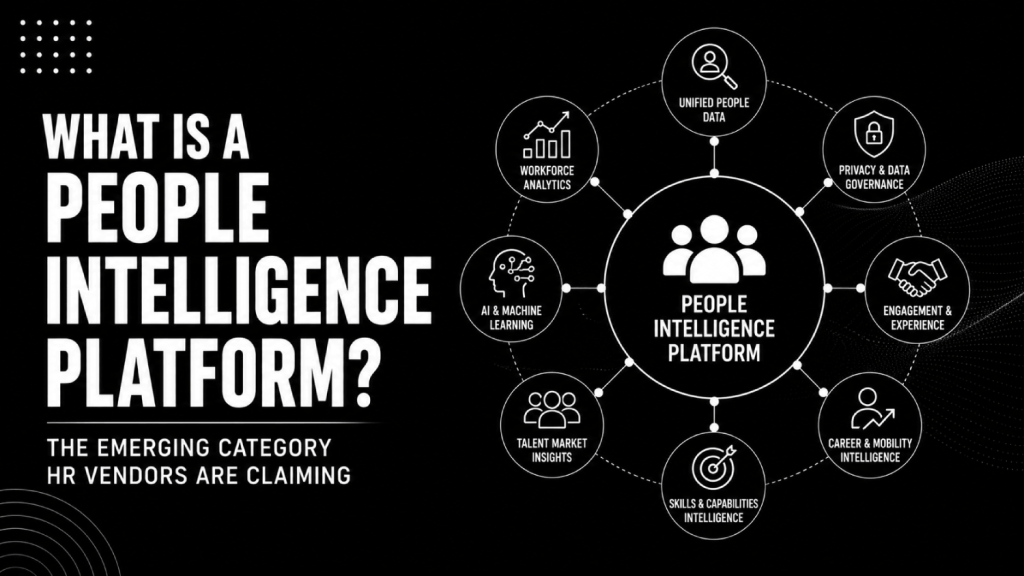
A people intelligence platform is a software system that aggregates data about your workforce from multiple sources, applies AI to identify patterns in skills, performance, behavior, and attrition risk, and surfaces recommendations that HR leaders and managers can act on. The category sits above traditional reporting tools and below full HCM suites, built specifically to turn workforce data into forward-looking decisions rather than backward-looking summaries.
Why “People Intelligence” Is Both Real and Overused
Every vendor selling anything near HR analytics is now claiming people intelligence as a category. That does not make it meaningless. It means buyers need a sharper definition than what vendors provide, because the label gets applied to everything from basic dashboards to deep AI inference engines.
People intelligence sits at the intersection of three older categories that are themselves poorly differentiated: people analytics, talent intelligence, and workforce planning. SAP’s product page describes its offering as “an AI-driven application that can bring together people, skills, and business data from SAP SuccessFactors solutions.” That is a reasonable starting description, but it anchors people intelligence to a single HCM suite, which misses the broader point.
A better working definition: people intelligence platforms gather, cleanse, and analyze data that paints a picture of workforce skills, experience, and behavior, then layer AI recommendations on top of that picture. The output is not a report. It is guidance on who to promote, which roles are retention risks, where skill gaps exist, and what the workforce will likely look like given current hiring and attrition trends.
How People Intelligence Differs from People Analytics
People analytics is the practice of collecting and measuring workforce data. People intelligence is what that data is used to do. The distinction matters more than it sounds.
A people analytics platform answers “how many employees resigned last quarter and why?” A people intelligence platform answers “which employees are most likely to resign in the next 90 days, and what intervention has the highest probability of retaining them?” The first is descriptive. The second is predictive and, in the most advanced tools, prescriptive.
Traditional people analytics tools work primarily with HRIS data: headcount, tenure, compensation, performance ratings. People intelligence platforms pull from a broader set of sources: internal job history, skills inferred from work products, engagement signals, organizational network data, and in some cases external labor market data. That external layer is what separates people intelligence from a well-built Workday dashboard.
For a more detailed breakdown of how these categories relate to each other, the people analytics vs workforce analytics vs talent intelligence explainer covers the definitional boundaries in depth. This article focuses specifically on what makes a platform qualify as people intelligence rather than one of those adjacent categories.
What Does a People Intelligence Platform Actually Do?
The functional architecture of a genuine people intelligence platform has three layers. Most vendors cover at least one. Few cover all three well.
Layer 1: Data Aggregation and Enrichment
The foundation is pulling together workforce data from HRIS systems, ATS platforms, LMS logs, performance tools, engagement surveys, and often external labor market databases. This is not just ETL work. The platform needs to normalize job titles across systems, reconcile skills described in different taxonomies, and identify the same person across multiple data sources. Vendors like Visier and Sapient Insights have built proprietary data models to handle this. It is harder than most buyers expect.
Layer 2: Skills Inference and Taxonomy
Skills data is the core currency of people intelligence. Platforms in this category do not just store the skills employees self-report. They infer skills from job history, internal project assignments, completed learning content, and in some cases from work artifacts like documents and code commits. Eightfold AI has built its platform on this inference model, using deep learning to map skills across both internal talent data and an external talent dataset. Gloat takes a similar approach for internal mobility.
The quality of the underlying skills ontology determines how reliable the recommendations are. Buyers evaluating platforms in this category should ask directly: how does your platform handle skills that do not yet appear in your ontology? The answer reveals how future-proof the system actually is. The topic of skills ontology in HR tech is worth understanding before any vendor conversation.
Layer 3: Decision Support and Workflow Integration
Raw intelligence is only valuable if it reaches the person making a decision at the right moment. The third layer is where platforms diverge most sharply. Some deliver insights through dashboards that HR leaders review periodically. More advanced platforms push signals into existing workflows: a Workday manager view, a Slack alert, a hiring manager briefing in an ATS. The most capable systems are moving toward agentic behavior, where the platform not only identifies an attrition risk but drafts a retention conversation guide or surfaces an internal role that matches the employee’s inferred career interest.
Which Vendors Are Claiming the People Intelligence Category?
The vendor field for people intelligence is genuinely fragmented. The same label is applied to platforms with very different architectures and use case focuses. The table below maps the major vendors by their primary data model and where they are strongest.
| Vendor | Primary Data Model | Strongest Use Case | Pricing Model |
|---|---|---|---|
| Eightfold AI | Skills inference from talent graph | Talent acquisition and internal mobility | Quote-only |
| Visier | HRIS + operational data benchmarked against industry | Workforce planning and retention analytics | Quote-only |
| Beamery | Talent CRM with skills taxonomy overlay | Talent pipeline and skills strategy | Quote-only |
| Gloat | Internal skills graph and opportunity matching | Internal mobility and workforce agility | Quote-only |
| SAP SuccessFactors People Intelligence | SAP HCM + external data | Enterprise workforce analytics on SAP estates | Quote-only |
| Findem | Attribute-based talent data from external sources | External talent sourcing and market intelligence | Quote-only |
| VoiceSignals | Behavioral and psychological science signals | Manager and team behavioral insights | Quote-only |
What this table shows is that no single platform dominates the full people intelligence stack. Eightfold and Gloat are strongest on skills inference and internal talent movement. Visier leads on workforce planning and cross-company benchmarking. SAP’s offering is best understood as people intelligence for organizations already running SuccessFactors who do not want to add a separate data layer. A detailed look at how these and other platforms compare is covered in the best talent intelligence platforms comparison.
People Intelligence vs Talent Intelligence: Where the Categories Split
Talent intelligence is outward-facing. It answers questions about the external labor market: what skills are competitors hiring for, where does talent for a specific role concentrate geographically, what does supply and demand look like for a given job family. People intelligence is inward-facing. It answers questions about the people already inside your organization.
The confusion between the two categories is real and has a practical consequence. A buyer who needs to understand internal attrition risk and build succession pipelines is solving a people intelligence problem. A buyer who needs to understand whether they can hire 50 machine learning engineers in Austin within 8 months is solving a talent intelligence problem. Many platforms offer both, but their depth in each varies considerably. Buying a strong talent intelligence platform for an internal people problem, or vice versa, is a common and expensive mistake.
Some vendors, Eightfold most visibly, have built platforms that genuinely span both. Their talent graph connects external market data to internal employee profiles. That integration is technically impressive and commercially significant. It is also the exception rather than the rule.
What Separates a Genuine People Intelligence Platform from a Dashboard
The single most useful buying filter is this: does the platform surface answers to questions you have not yet asked, or does it only answer questions you explicitly configure?
A dashboard, however sophisticated, requires you to define the metrics, build the views, and check the reports. A people intelligence platform should proactively surface insights you were not looking for: a retention risk in an engineering team before attrition spikes, a skills cluster that is underused internally and expensive to hire externally, a manager whose direct reports consistently outperform before transferring out. If a vendor demo consists primarily of showing you pre-built dashboards, you are looking at analytics software dressed up in people intelligence marketing.
The questions to pressure-test this distinction in a vendor evaluation are specific. Ask for an example of an insight the platform surfaced to a customer that the customer had not asked for, and what decision it informed. Ask how the platform handles new skills that emerge in the market before they appear in the vendor’s ontology. Ask what happens to the recommendations when underlying HRIS data is incomplete or inconsistent. These questions separate systems that can reason about workforce data from systems that display it attractively.
For buyers building a formal evaluation, the AI HR vendor evaluation checklist covers these and related questions across the full buying process.
When Does an Organization Actually Need a People Intelligence Platform?
Smaller organizations rarely need a dedicated people intelligence platform. The signal-to-noise ratio in small workforce data is too low for statistical reliability, and a good HRIS with reporting features covers most use cases adequately. The investment is hard to justify at that scale.
The use cases that genuinely justify the category typically emerge as companies grow into the mid-market and beyond. At that size, organizations start experiencing problems that require actual inference rather than counting: succession planning across hundreds of roles, identifying which employees have adjacent skills for a new product initiative, and predicting which departments will face critical skill gaps given current hiring and attrition trends. These are problems that spreadsheets and standard HRIS reporting cannot solve. For context on where a dedicated HRIS built for that scale ends and a people intelligence layer begins, it helps to understand what your core HR platform is already doing well.
The second signal that a people intelligence platform is warranted is data fragmentation. When skills data lives in one system, performance data in another, learning completion in a third, and compensation in a fourth, and no one can answer a question like “who are our top performers in this skill cluster who have not had a promotion discussion recently,” a people intelligence platform provides real value. It is doing integration and inference work that no individual system was built to do. This scenario of fragmented HR data is more common than most organizations admit, and the consequences extend beyond inconvenience into actual workforce risk.
If your organization already uses AI-powered people analytics platforms for workforce planning, a people intelligence layer adds value primarily through its skills inference and proactive alerting capabilities, not through better reporting.
Frequently Asked Questions
What is a people intelligence platform?
A people intelligence platform is a software system that aggregates workforce data from multiple HR sources, applies AI to identify patterns in skills, performance, behavior, and attrition risk, and surfaces forward-looking recommendations for HR leaders and managers. Unlike traditional people analytics tools that report on what has already happened, people intelligence platforms are designed to answer predictive questions, which employees are likely to leave, where skill gaps will emerge, which internal candidates are best suited for an open role, and in more advanced implementations, to take action within existing HR workflows.
What is the difference between people intelligence and people analytics?
People analytics is the discipline of measuring and reporting on workforce data. People intelligence is the application of AI to that data to generate predictive and prescriptive recommendations, not just descriptions of what has already happened. A people analytics tool tells you that attrition in engineering was 18% last year. A people intelligence platform tells you which engineers are most likely to leave in the next quarter and why.
Which vendors offer people intelligence platforms?
The main vendors claiming this category include Eightfold AI, Visier, Beamery, Gloat, SAP SuccessFactors People Intelligence, Findem, and VoiceSignals. Each has a different primary strength. Eightfold and Gloat focus on skills inference and internal talent movement. Visier focuses on workforce planning and benchmarking. SAP’s offering is designed for organizations already on SuccessFactors. Pricing for all of them is quote-only.
Is people intelligence the same as talent intelligence?
No. Talent intelligence focuses on external labor market data: competitor hiring trends, geographic talent supply, skills demand signals. People intelligence focuses on your internal workforce: who has which skills, who is at risk of leaving, where career opportunities should be surfaced internally. Some platforms, most notably Eightfold, span both by connecting an external talent graph to internal employee data. Most platforms are stronger in one area than the other.
What data sources does a people intelligence platform use?
At minimum, people intelligence platforms pull from HRIS data, performance management systems, and sometimes skills or learning records. More capable platforms also ingest engagement survey data, organizational network analysis signals, ATS data, and external labor market databases. The breadth and quality of data ingestion is one of the most meaningful differences between platforms in this category and should be a primary question in any vendor evaluation.
Do you need a separate people intelligence platform or does your HRIS cover this?
Most HRIS platforms, including Workday, SAP SuccessFactors, and Oracle HCM, offer analytics and reporting features that cover basic workforce metrics. They do not, in most implementations, provide the skills inference, proactive alerting, or cross-system data synthesis that defines a dedicated people intelligence platform. The gap is most visible in skills-based use cases: identifying hidden internal talent, predicting skill gaps, and modeling workforce capability against future business scenarios.
What size company benefits from a people intelligence platform?
Organizations in the mid-market and above with meaningful data across multiple HR systems are the primary buyers. Below that threshold, the statistical reliability of small-sample workforce data limits the value of AI inference. The clearest buying signal is when HR leaders cannot answer cross-system questions about skills, performance, and retention without manual data assembly, or when succession planning and workforce scenario modeling require more than what standard HRIS reporting provides.
The Category Is Real. The Labels Are Not Yet Standardized.
The skepticism that people intelligence is just a marketing relabel is understandable, because many vendors are using it that way. A platform that adds an AI summary feature to its attrition dashboard is not a people intelligence platform in any meaningful sense. The category has real substance, but buyers have to look past the label to what the system actually does with data.
The most useful mental model: people intelligence platforms turn workforce data into recommendations, not reports. If what you get out of a demo is a better version of something you could build in Workday or Power BI, you are evaluating an analytics tool. If the demo shows the system surfacing insights about your workforce that would require a team of analysts weeks to produce manually, and connecting those insights to talent actions inside the systems your managers actually use, that is the category.
The vendors worth evaluating seriously all start from a skills data foundation, because skills are the connective tissue between workforce planning, talent acquisition, internal mobility, and learning. That foundation is where the real differentiation lives, and it is the first thing worth interrogating in any platform conversation.