
Guild vs InStride vs Workforce Edge: Which Tuition Assistance Platform Fits Hourly Workforces?
Guild vs InStride vs Workforce Edge for hourly workforces: payment models, school networks, coaching, pricing models, implementation time and 2026 changes, verified November 2026.
TL;DR
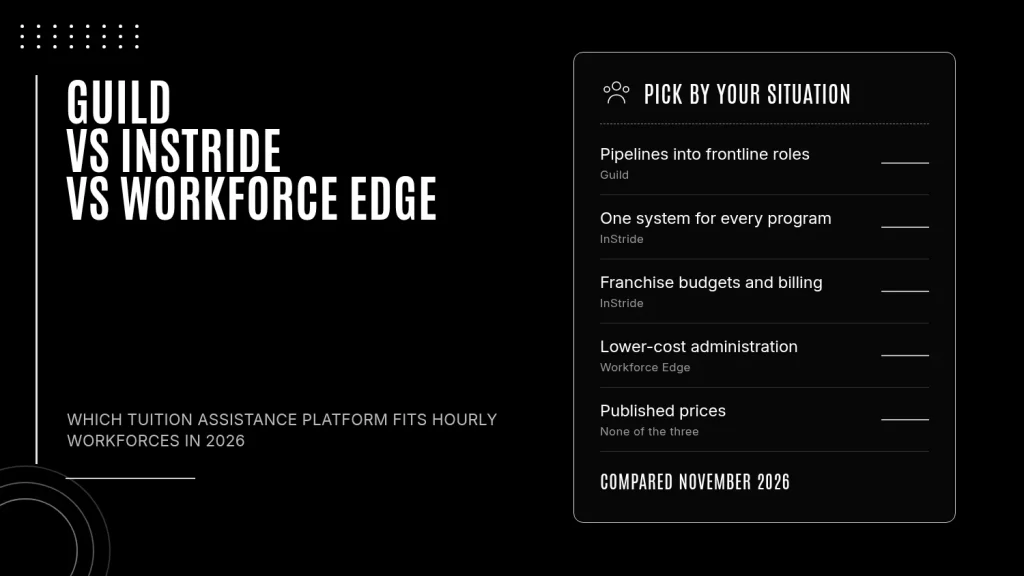
For most hourly workforces, choose Guild if you want a curated learning marketplace with coaching and career pathways, InStride if you want upfront tuition, reimbursement, flexible learning funds and student loan repayment in one program, and Workforce Edge if your priority is low-cost administration with tuition-aligned pricing at partner schools.
- None of the three publishes a price. Workforce Edge is the only one that explains its model: a one-time setup fee plus an annual platform fee, with tuition spend kept separate.
- Scale, per each company: Workforce Edge had 83 corporate agreements covering about 4.03 million employees on September 30, 2026; InStride serves 1.5 million eligible employees across 80+ organizations; Guild supported more than 250,000 learners in 2025.
- Workforce Edge is owned by Strategic Education, which also owns Strayer and Capella universities. Ask how its partner network is presented to employees.
- InStride is the only one with a published franchise model, where each location sets its own eligibility, budget and billing.
- The tax-free limit for employer education help is $5,250 per employee in 2026 and rises to $5,400 in 2027.
If you are weighing Guild vs InStride vs Workforce Edge, you are probably trying to fix a familiar problem: a tuition reimbursement program that hourly employees rarely use, because they cannot afford to pay a semester upfront and wait months to be paid back. All three platforms pay schools directly so most learners pay nothing out of pocket, but they are built around different ideas of what an education benefit should do.
This guide compares them on what matters for shift-based, frontline and part-time workforces: how each one pays for learning, which schools and programs employees can reach, how much support learners get, how each prices its service, how long implementation takes, and what changed at each company in 2026.
How we compared them (last updated November 14, 2026). Written by Jane Miller. We read each company’s homepage, employer FAQ, product pages and 2025 to 2026 press releases, plus Strategic Education’s third-quarter 2026 earnings release for Workforce Edge figures and IRS guidance for the tax limits. Outcome statistics are the vendors’ own and are labelled that way. We have not run hands-on trials, and no vendor paid to be included. This is not tax or legal advice.
Guild vs InStride vs Workforce Edge at a Glance
Guild sells a talent platform built around a curated marketplace and coaching, InStride sells a unified education strategy anchored by Arizona State University, and Workforce Edge sells benefits administration from the owner of Strayer and Capella. The details, from each company’s own pages:
| Guild | InStride | Workforce Edge | |
|---|---|---|---|
| Best for | Large frontline employers that want pathways into specific roles | Employers merging several education programs, including franchise systems | Cost-focused employers that want administration plus discounted partner tuition |
| Ownership | Guild Education, Inc. (independent, certified B Corp) | Independent; founded in 2019 to extend the Starbucks and ASU partnership | Strategic Education, Inc. (Nasdaq: STRA), owner of Strayer and Capella |
| Payment models | Upfront or deferred tuition; tuition reimbursement product | Upfront tuition, reimbursement, flexible learning funds, student loan repayment | Direct billing at in-network schools; employer-set funding models; out-of-network options |
| Catalog | Curated marketplace from GED and ESL to master’s degrees | 2,500+ programs | 750+ programs (May 2026) |
| Learner support | Credentialed coaches plus 24/7 AI support in multiple languages | Enrollment coach, academic advisor, success coach, education advisor | Advising and 1:1 success coaching |
| Published pricing | No, quote only | No, quote only | No numbers; setup fee plus annual fee |
| Implementation | Under a month for tuition reimbursement (U.S.) | Not published | About 10 to 12 weeks |
| Scale (latest public figure) | 250,000+ learners supported in 2025 | 1.5 million eligible employees, 80+ organizations | 83 corporate agreements, about 4.03 million employees |
Quick Pick: Which One Fits Your Hourly Workforce?
Start with your biggest constraint: budget, school choice, a specific role shortage, or a franchise structure.
| Your situation | Shortlist first | Why |
|---|---|---|
| Large retail, healthcare or logistics workforce; you need pipelines into licensed or technician roles | Guild | Guild Navigator builds cohort pathways into licensed and certified roles, as in Amazon Career Choice |
| You run tuition reimbursement, a debt-free degree and student loan help as separate programs | InStride | One system for upfront tuition, reimbursement, flexible learning funds and loan repayment |
| Franchise or multi-brand business where each operator funds its own benefit | InStride | Location-level eligibility, budgets and billing are part of its published franchise model |
| You mainly want to cut admin and tuition cost without a full program redesign | Workforce Edge | Setup plus annual fee, partner tuition savings, and staff who process requests and documents |
| Many employees prefer to study in Spanish | Workforce Edge | Northbridge University joined in March 2026 with programs in English and Spanish |
| Global workforce outside the U.S. needs reimbursement too | Guild | Its tuition reimbursement product supports employers in nearly every country, in ten languages |
| Small employer with a simple $5,250 reimbursement policy | Consider a lighter tool | All three are built for large programs; see the alternatives below |
Key Numbers Snapshot (Verified November 2026)
These are the latest public figures from each company or its parent, with the date each was published. Treat outcome claims as vendor-reported.
| Figure | Value | Source and date |
|---|---|---|
| Workforce Edge corporate agreements | 83, employing about 4,030,000 people | Strategic Education Q3 2026 results, Sept. 30, 2026 |
| Strategic Education employer-affiliated enrollment | 34.7% of U.S. Higher Education enrollment, up from 32.7% | Same release, Q3 2026 |
| Workforce Edge catalog | 750+ programs; 80+ employer partners | SNHU partnership release, May 26, 2026 |
| InStride reach | 1.5 million eligible employees, 80+ organizations, 2,500+ programs | InStride homepage, read Nov. 14, 2026 |
| InStride 2025 results | Participation more than doubled; degree completions up 76% | InStride release, Jan. 22, 2026 |
| Guild 2025 results | More than 250,000 learners supported; 90,000 role changes over the last decade | Guild release, Jan. 29, 2026 |
| Guild Academy | More than 300,000 learners as of 2025 | Guild release, Jan. 29, 2026 |
| Tax-free education assistance limit | $5,250 in 2026; $5,400 in 2027 | EY summary of Rev. Proc. 2026-35, Nov. 9, 2026 |
How Are Guild, InStride and Workforce Edge Different?
The main difference is what each company is trying to sell you: a talent pipeline, a single education strategy, or a cheaper way to run the benefit you already have.
- Guild calls itself a workforce development platform. It sells three products: Guild Grow (the education benefit and marketplace), Guild Academy (cohort-based capability programs) and Guild Navigator (pipelines into hard-to-fill licensed and certified roles).
- InStride pitches itself as a way to stop managing education benefits and start delivering workforce strategy. It brings upfront tuition coverage, reimbursement, flexible learning funds, student loan repayment, Career Education Paths and Capability Accelerators into one program.
- Workforce Edge is described by its parent, Strategic Education, as “a full-service education benefits administration solution for employers” (Q3 2026 release). Its pitch is budget control and visibility, funded mostly from money you already spend on education.
If you have not yet narrowed the market to these three, our roundup of the best tuition assistance platforms for employers compares seven options, including reimbursement-first tools such as Tuition.io.
Guild, InStride and Workforce Edge Compared One by One
Guild: Best for Frontline Pipelines Into Specific Roles
Guild suits large employers with big frontline populations that want education spend tied to specific roles and promotions. Its homepage FAQ says Guild uses upfront or deferred tuition assistance so most learners do not pay out of pocket, with tuition reimbursement also available. The Learning Marketplace runs from foundational education (GED and ESL) through certificates, bootcamps and associate, bachelor’s and master’s degrees.
Support is a strength. Guild says eligible employees get credentialed coaches and support specialists, plus AI-enabled support around the clock in multiple languages. Its February 17, 2026 product update expanded the tuition reimbursement product to nearly every country with ten fully localized languages, AI eligibility checks and claims processing, and U.S. implementation in under a month. On October 5, 2026 Guild announced a Workday Certified Integration that syncs employee eligibility from Workday HCM.
Named employers include Chipotle, Target, Walgreens, JPMorgan Chase, Hilton, Spectrum and Providence. In July 2026 Amazon picked Guild Navigator as a Career Choice partner to train hourly employees as maintenance and engineering technicians. Guild’s outcome figures (learners 2x less likely to leave, 90,000+ role changes) are its own.
- Best for: Fortune 1000 employers in retail, healthcare, logistics and manufacturing that want coaching and role pathways, not just payments.
- Ask before you sign: Ask which Guild product you are buying (Grow, Academy or Navigator), how the marketplace is curated for your roles, and what happens to learners if you later narrow the catalog.
InStride: Best for Unifying Several Education Programs
InStride suits employers that already run several education programs and want them in one system with one set of reports. Its homepage lists upfront tuition coverage, tuition reimbursement, flexible learning funds, student loan repayment, Capability Accelerators and Career Education Paths, with reporting on spend, skills and roles.
InStride was founded in 2019 to extend the 2014 Starbucks and Arizona State University partnership, and ASU remains its best-known school. It says it offers 2,500+ programs, and its FAQ lists non-degree options including certificates, industry credentials, English-language learning and CDL training, which matter for hourly roles. A June 2025 release added dependent education benefits.
For franchise systems it is the clearest fit: its franchise offering lets each location set eligibility, budget and billing while the franchisor sees anonymized reporting. On November 2, 2026 the KFC Foundation launched a program with InStride giving eligible restaurant employees $5,000 per school year, plus up to $600 for books and $100 for fees. Outcome figures such as a 226% average three-year ROI and 90%+ retention are InStride’s own.
- Best for: Enterprises and franchise systems that want reimbursement, debt-free degrees and loan repayment managed together, with ASU as an anchor school.
- Ask before you sign: Ask what share of the 2,500+ programs is open to your employees, how student loan repayment is funded, and how franchisee billing and reporting work.
Workforce Edge: Best for Low-Cost Administration
Workforce Edge suits employers that want to run their education benefit more cheaply and with better visibility, without redesigning it from scratch. Its FAQ says it handles day-to-day work such as processing requests, reviewing documents and answering employee questions, with a dedicated enterprise partner manager and customer success manager who meet you quarterly.
Employees get advising and 1:1 success coaching and can choose degrees, certifications, bootcamps and short courses. Schools in its network include Strayer and Capella (both owned by its parent), Southern New Hampshire University (added May 2026) and Northbridge University, the first partner to teach in Spanish (March 2026). Its Tech Skills Academy (June 2026) adds tech pathways with Simplilearn and Emerge Education. Caesars Entertainment lets employees use the benefit at out-of-network schools too.
Customers include Walmart’s Live Better U program, Best Buy (since July 2025) and Caesars. Workforce Edge says partner pricing has saved employers up to 24% in learning expenses; that figure is its own.
- Best for: Large employers that want to cut admin work and tuition cost, especially if Strayer, Capella or SNHU programs suit their workforce.
- Ask before you sign: Ask how the catalog is ordered for employees, what share of enrollments go to Strayer and Capella, and how out-of-network requests are paid.
What Matters Most for Hourly and Frontline Employees?
Hourly employees use education benefits when there is no upfront cost, the schedule is flexible, the first step is small, and someone helps them choose. Here is how the three compare on those points, based on what each company publishes:
| Hourly need | Guild | InStride | Workforce Edge |
|---|---|---|---|
| No upfront tuition | Upfront or deferred tuition | Upfront tuition coverage | Direct billing and tuition-aligned pricing at partner schools |
| Small first steps | GED, ESL, certificates, bootcamps | English-language learning, CDL, certificates, credentials | Short-form courses, certifications, bootcamps, high school diploma (per Walmart learner stories) |
| Help choosing | Credentialed coaches plus 24/7 AI support | Enrollment coach, academic advisor and success coach | Advisors and 1:1 success coaching |
| Language access | Reimbursement product in ten languages | Not specified | Spanish-language programs through Northbridge University |
| Part-time and day-one eligibility | Set by employer | Set by employer (some programs start on day one for full- and part-time staff) | Set by employer (Caesars covers full- and part-time staff) |
| Multi-location operators | Single employer program | Franchise model with location-level budgets and billing | Single employer program |
Eligibility is your decision, not the vendor’s. If you exclude part-time staff or add long waiting periods, none of these platforms will fix participation. For training that happens on shift rather than in a degree program, pair your education benefit with one of the best frontline training platforms for deskless workers.
What Each Platform Includes
All three cover direct payment and coaching; they differ on student loan repayment, franchise billing and system integration.
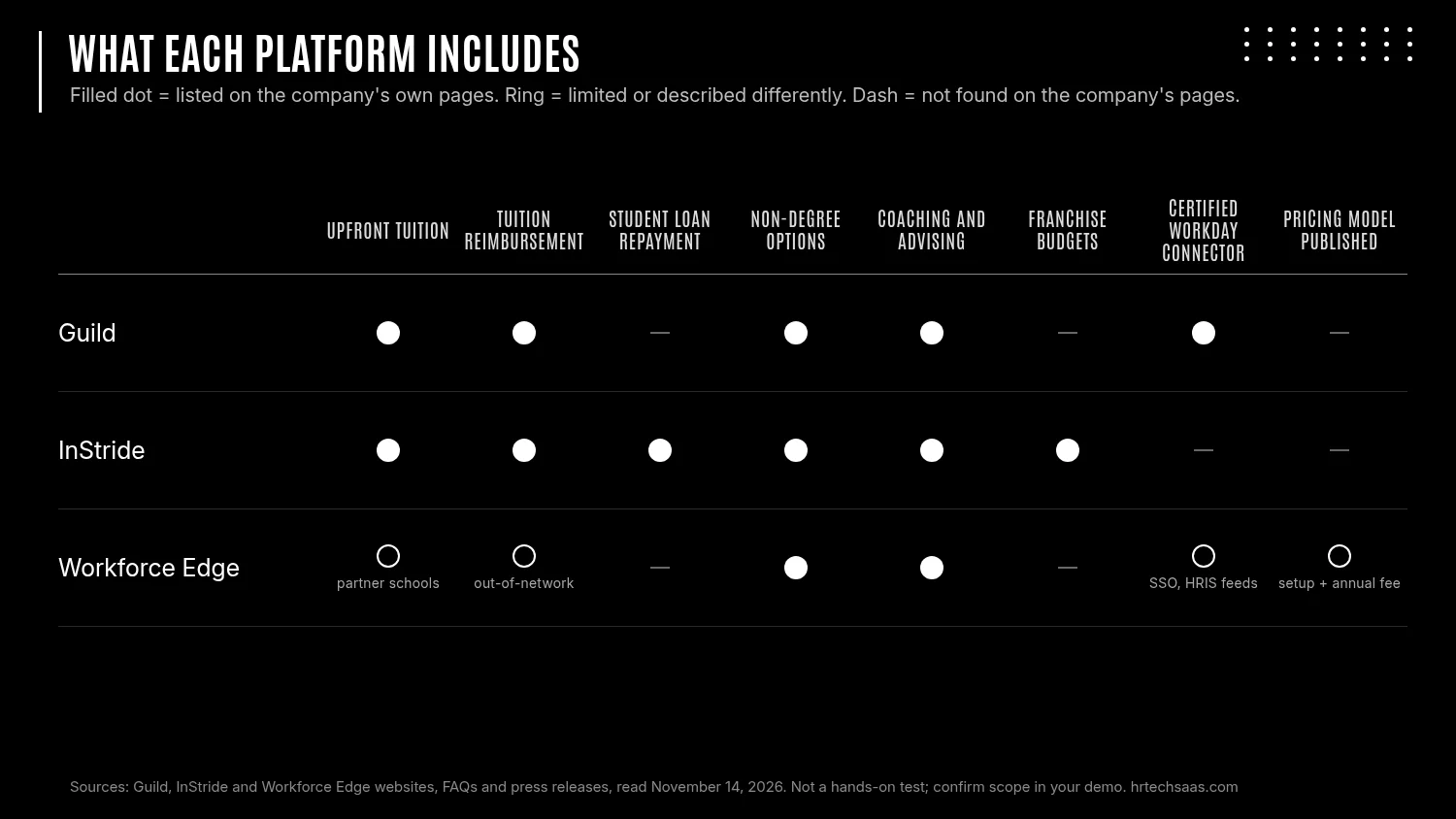
A ring means the feature is limited or described differently; a dash means we could not find it on the company’s pages, not that it is impossible. Confirm each item in your demo.
How Much Do Guild, InStride and Workforce Edge Cost?
None of the three publishes a price, so you will get a custom quote; budget separately for the platform fee and for the tuition itself.
- Workforce Edge gives the most detail. Its pricing FAQ describes a one-time setup fee for configuration and connections, then an annual fee covering the platform, support, reporting and your account team. Tuition money stays separate and under your control, and the fee depends on headcount, program complexity and integrations.
- Guild and InStride quote on request and do not describe their fee structure publicly. Some software directories list per-employee estimates for InStride, but these are not from InStride and we could not verify them.
- Tuition spend is usually the bigger number. Under Section 127, employers can pay up to $5,250 per employee tax-free in 2026, and student loan payments count toward that limit permanently under the 2025 tax law. From 2027 the limit is indexed to inflation; the 2027 figure is $5,400. See the IRS Section 127 FAQ for plan rules.
Ask each vendor to price the same scenario: your eligible headcount, expected participation, the programs you want to cover, and any HRIS and payroll connections. If you are folding education into a wider flexible benefit, compare that cost with the lifestyle spending account platforms that many employers use for learning stipends.
Who Owns the Schools, and Why It Matters
Workforce Edge’s parent also owns two of its partner universities, InStride grew out of an ASU partnership, and Guild curates a marketplace of outside schools; each setup shapes which programs employees see first.
Strategic Education reports that employer-affiliated students made up 34.7% of its U.S. Higher Education enrollment in the third quarter of 2026, up from 32.7% a year earlier (Q3 2026 release). That is a normal business model for an education company, and it is also why Workforce Edge can offer tuition-aligned pricing at Strayer and Capella. It means you should check how programs are ranked and recommended in the employee portal.
InStride’s ASU roots show in many of its programs, such as tuition scholarships to ASU Online. Guild selects schools for its marketplace and says each program is vetted for quality and outcomes. In every case, ask for enrollment by school for a client similar to you.
How Long Does Implementation Take?
Workforce Edge says about 10 to 12 weeks, Guild says under a month for its U.S. tuition reimbursement product, and InStride does not publish a timeline.
- Workforce Edge says a dedicated team handles setup, configuration, testing and launch, using connections you likely already have, such as SSO and HRIS data feeds. Most of the work is matching the platform to your existing policies.
- Guild says its tuition reimbursement product can be implemented in under a month, and its Workday HCM connector replaces manual file transfers for eligibility. A full Guild Grow marketplace program with coaching and pathways is a larger project; ask for a timeline.
- InStride builds programs with each employer, and franchise programs add location-level setup. Ask for a dated launch plan.
Whichever you pick, test the eligibility feed with a sample of part-time and newly hired employees before launch. Our employee benefits technology stack guide shows where an education platform sits next to benefits administration and payroll.
What Changed at Each Company in 2026?
All three expanded in 2026: Guild into global reimbursement and Workday, InStride into franchise and ROI tools, and Workforce Edge into new schools and tech pathways.
| Date (2026) | Company | What happened |
|---|---|---|
| Jan. 22 | InStride | 2025 results: participation more than doubled; 1.3 million eligible employees |
| Jan. 29 | Guild | 2025 results: more than 250,000 learners supported |
| Feb. 17 | Guild | Tuition reimbursement expanded to nearly every country, ten languages |
| Mar. 17 | Workforce Edge | Northbridge University joins as first Spanish-language school |
| Mar. 31 | InStride | Beyond Banyan partnership for a finance-ready ROI framework |
| May 26 | Workforce Edge | SNHU joins the network with 200+ online programs |
| Jun. 8 | Workforce Edge | Tech Skills Academy launches |
| Jul. 23 | Guild | Selected for Amazon Career Choice via Guild Navigator |
| Oct. 5 | Guild | Workday Certified Integration for eligibility data |
| Nov. 2 | InStride | KFC Foundation program: $5,000 per school year for eligible restaurant employees |
| Nov. 5 | Workforce Edge | Q3 2026 results: 83 corporate agreements, about 4.03 million employees |
A note on Walmart: Workforce Edge’s March 2026 blog credits “Walmart’s partnership with Workforce Edge” for Live Better U. Some third-party pages say Workforce Edge replaced Guild at Walmart, and one even says InStride built Workforce Edge, which is wrong; Strategic Education owns it. Neither Walmart nor Guild has published a statement on Guild’s current role, so treat replacement claims as unconfirmed.
Questions to Ask in Every Demo
- Show the employee sign-up and program search on a phone, as a part-time hourly worker would see it.
- Which schools and programs will our employees see first, and why? Share enrollment by school for a client like us.
- How are out-of-network schools paid, and what does the employee pay upfront?
- What does the eligibility feed need from our HRIS, and how are new hires and status changes handled?
- List every fee in year one: setup, platform, per-learner, coaching and integration.
- Which outcome metrics will we get, and can we export them to measure retention and internal moves ourselves?
Bring your own baseline. Our internal mobility ROI business case template shows how to measure promotion and retention gains from your own HR data rather than vendor averages.
Alternatives Worth a Look
If none of the three fits, look at reimbursement-first and open-network tools. Tuition.io combines tuition and student loan benefits, EdAssist by Bright Horizons says it can pay almost any education provider, and lifestyle spending accounts can fund short courses. Our tuition assistance platforms guide covers these options. For hands-on trades roles, compare the best apprenticeship providers for employers.
Frequently Asked Questions
Is Guild better than InStride?
It depends on your goal. Guild is stronger for large frontline employers that want a curated marketplace, coaching and pathways into specific roles, plus global tuition reimbursement in ten languages. InStride is stronger if you want upfront tuition, reimbursement, flexible learning funds and student loan repayment in one program, or if you run a franchise system.
How much does Workforce Edge cost?
Workforce Edge does not publish prices. Its FAQ says pricing has two parts: a one-time setup fee for configuration and connections, and an annual fee covering the platform, support, reporting and a dedicated account team. Tuition money is separate. The fee depends on employee count, program complexity and integrations.
Who owns Workforce Edge?
Strategic Education, Inc. (Nasdaq: STRA) owns Workforce Edge. The same company owns Strayer University and Capella University, which are partner schools on the platform. As of September 30, 2026, Workforce Edge had 83 corporate agreements covering about 4.03 million employees.
Does Guild still offer tuition reimbursement?
Yes. Guild says it mainly uses upfront or deferred tuition so learners do not pay out of pocket, and it also sells a tuition reimbursement product. In February 2026 Guild expanded that product to nearly every country with ten languages, AI claims processing, and U.S. implementation in under a month.
Which platform is best for franchise businesses?
InStride is the only one of the three with a published franchise model. Each franchise location can set its own eligibility rules, budget and billing, while the franchisor gets anonymized reporting across the brand. KFC Foundation and Taco Bell programs both run through InStride.
How much tuition assistance is tax-free in 2026?
Under Section 127, employers can provide up to $5,250 per employee in 2026 tax-free, including payments toward student loans. The limit is indexed to inflation from 2027, when it rises to $5,400. Amounts above the limit are generally taxable wages unless another exclusion applies.
Do these platforms work for part-time employees?
Yes, if you make them eligible. All three can serve part-time and frontline staff, and some employers on InStride and Workforce Edge cover part-time workers from day one. Eligibility rules are set by the employer, so check your policy before blaming the platform for low participation.
The Bottom Line: Match the Platform to Your Goal
Pick Guild to build pipelines into specific roles, InStride to unify several education programs or serve franchises, and Workforce Edge to run your current benefit at lower cost.
Whichever way your Guild vs InStride vs Workforce Edge shortlist leans, price the same headcount with each, ask who sees which schools first, and test sign-up as an hourly employee would. For the wider market, see our full guide to the best tuition assistance platforms for employers.


