7 Best Compport Alternatives for Compensation Planning and Pay Reviews
Seven Compport alternatives compared module by module, with verified pricing, ownership changes and a checklist for switching between pay review cycles.
TL;DR
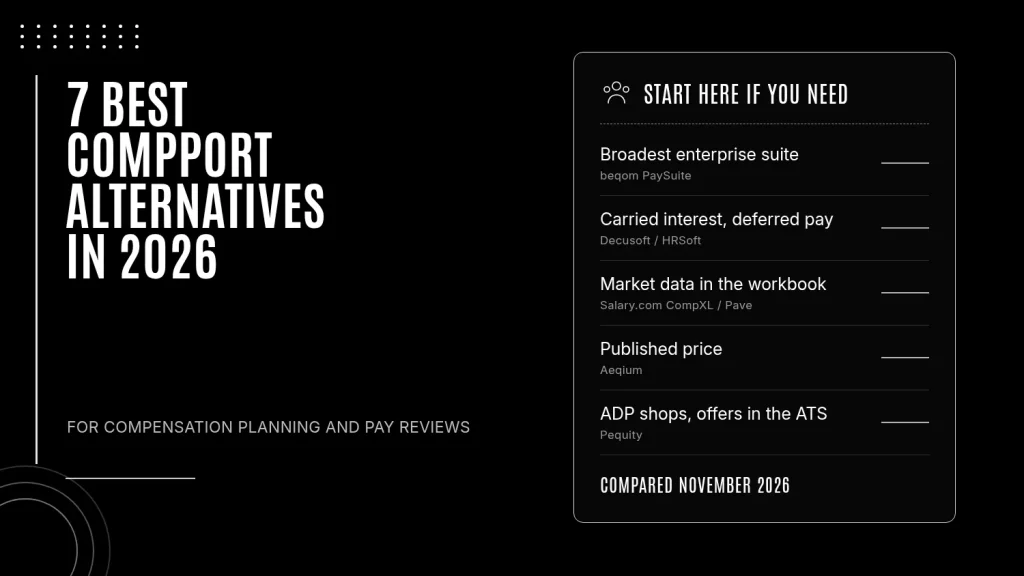
The best Compport alternatives in 2026 are Salary.com CompXL, Compose by Decusoft, HRSoft, beqom PaySuite, Aeqium, Pave and Pequity. Pick by the Compport module you rely on most: merit and bonus cycles, long-term or sales incentives, pay equity, or planning with market data built in.
- Only one alternative publishes a price: Aeqium starts at $15,000 a year for up to 300 employees, with implementation and support included. Compport and the other six quote on request.
- Closest like-for-like replacements for Compport’s breadth (merit, bonus, LTI, sales incentives, statements): beqom PaySuite and Compose by Decusoft.
- Planning with market data in the same tool: Salary.com CompXL Max and Pave. Compport itself works on market data you license.
- Ownership and packaging changed: ADP bought Pequity in October 2025, and Pave now sells Compensation Planning as an add-on to its Agentic Workflows package.
- Switch after a cycle closes. Compport puts most implementations at 8 to 12 weeks, and beqom quotes three to nine months for large enterprises.
Most teams search for Compport alternatives for one of two reasons. Either the renewal quote has arrived and there is no public price to compare it with, or the comp team has found that a very configurable platform also needs a lot of configuring every cycle. In both cases the useful question is not “which tool is best” but “which tool replaces the parts of Compport we actually use”.
This guide compares seven alternatives against Compport’s own module list, using each vendor’s homepage, product pages and pricing pages read on November 13, 2026. Where a vendor does not publish a price or a feature, we say so instead of guessing.
How we chose these alternatives (last updated November 13, 2026). Written by Liam Thompson. We started from Compport’s own homepage, compensation planning page and CompportIQ page, listed the modules it sells, then read each alternative’s homepage, pricing page and product pages to see which of those modules it covers. We only included dedicated compensation planning platforms that can run a full merit cycle, and left out salary data vendors and HRIS add-ons. We have not run hands-on trials; everything below comes from public vendor material. No vendor paid to be listed.
Compport Alternatives at a Glance
Start with the alternative that matches your biggest Compport workload, then check pricing model and integrations. All details come from the vendors’ own pages, read November 13, 2026.
| Alternative | Best for | Strongest Compport module it replaces | Pricing (as published) |
|---|---|---|---|
| Salary.com CompXL | Planning with live market data in the workbook | Merit and bonus cycles, plus market pricing | Quote; demo first |
| Compose by Decusoft | No-code configurability, including carried interest | Every plan type, from merit to executive and deferred pay | Quote |
| HRSoft | Large US enterprises in financial services | LTI, carried interest and variable pay | Custom quote for Grow, Scale or Elevate packages |
| beqom PaySuite | Global enterprises tying pay to performance and pay equity | Merit, STI, sales incentives, LTI and pay equity in one suite | Quote |
| Aeqium | Mid-market teams that want a published price | Merit and bonus cycles, bands, offer letters | From $15,000 a year up to 300 employees |
| Pave | Tech companies that want peer data and planning together | Merit, promotion, bonus and equity refresh cycles | Free data tier; planning is a quoted add-on |
| Pequity (ADP) | Comp cycles plus recruiter pay guidance in the ATS | Comp cycles, pay bands and offers | Quote |
What Does Compport Do, and Why Do Teams Look for Alternatives?
Compport is an enterprise compensation management platform that covers merit cycles, bonus planning, long-term and sales incentives, pay equity, total rewards statements, candidate offer letters and HR analytics on one configurable platform. Its pitch is depth of configuration: the Compport homepage calls it the industry’s only “no-limits” compensation platform.
The company describes its scale differently on different pages. The homepage says 200+ companies, 1 million+ employees and 15+ industries; the CompportIQ page says 300+ customers, 37+ countries and 1.5 million+ users. Named customers on its site include Dr. Reddy’s Laboratories, Universal Robina Corporation, Security Bank, Storable and Excelerate Energy, spanning India, the Philippines and the US. CompportIQ, which Compport introduced in September 2026 and offers in early access, adds AI agents for salary reviews, pay equity, benchmarking and scenario modelling on top of the core platform.
Teams usually start looking elsewhere for these reasons:
- No public price. The pricing section lists three models, employee-based, product-based and tailored, without figures, so there is nothing to benchmark a renewal against.
- Configuration effort. The flexibility that lets Compport fit unusual plans also means someone has to own that configuration every cycle. Teams with simple merit and bonus programs may not need it.
- Market data sits elsewhere. CompportIQ compares pay against “your licensed market data”. If you want benchmarks inside the planning tool without a separate survey license, look at CompXL or Pave.
- Fit with the HR stack. Compport lists native two-way API integrations with Workday, SAP SuccessFactors, Oracle HCM, ADP, Darwinbox, UKG and BambooHR on its enterprise best practices page. If your HCM is not on that list, or your HCM vendor now owns a comp tool, the calculus changes.
If you are building a shortlist from scratch rather than switching, start with our main guide to compensation management software, which covers how planning tools connect to performance reviews.
Which Alternatives Cover Each Compport Module?
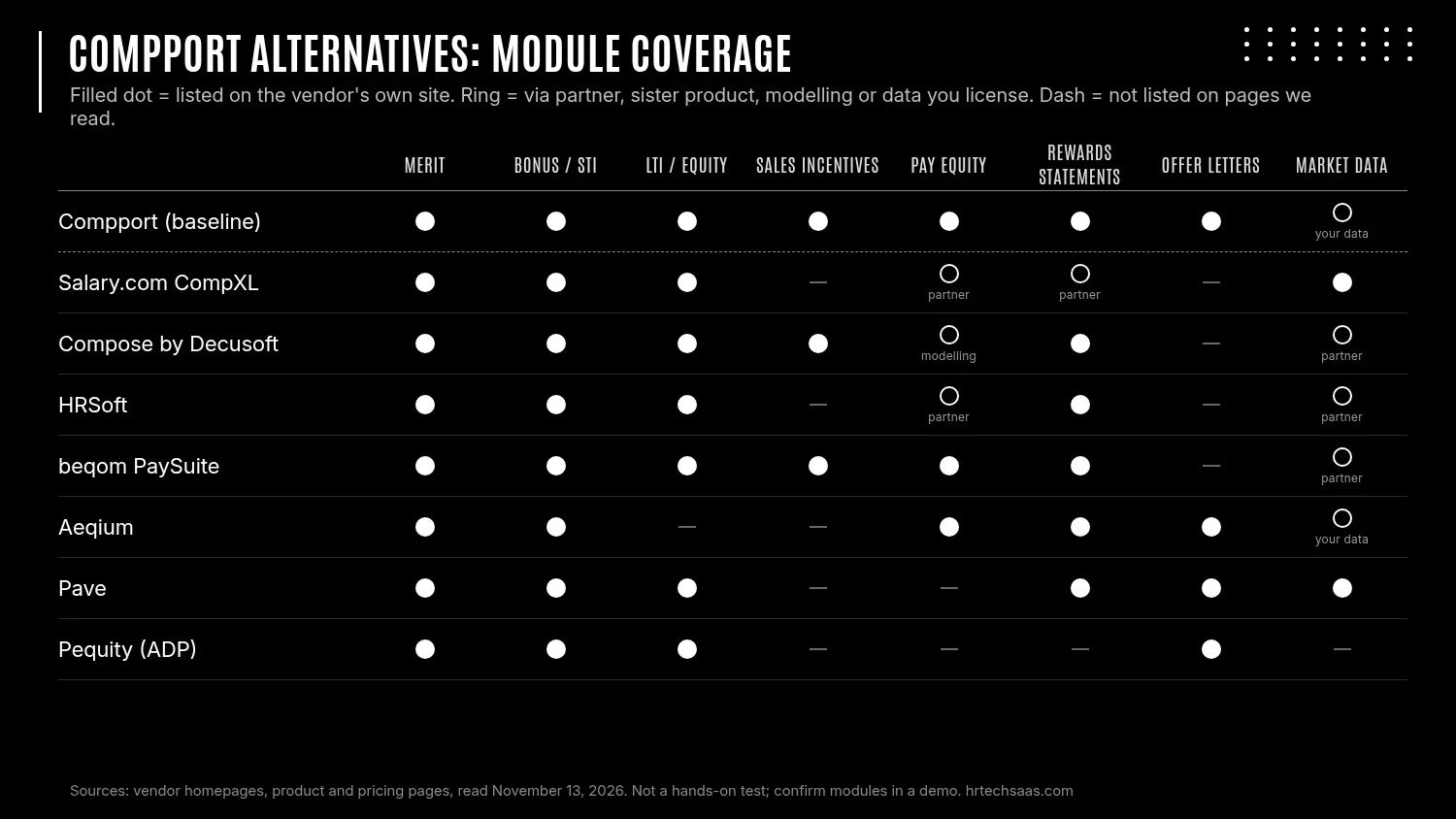
Map each Compport module you use to an alternative before you book demos; no single alternative lists every module Compport sells. “Yes” means the vendor lists the capability on its own site; “Partner” means it comes through a partner or a separate product from the same company; a dash means we did not find it on the vendor pages we read, so ask.
| Compport module | CompXL | Decusoft | HRSoft | beqom | Aeqium | Pave | Pequity |
|---|---|---|---|---|---|---|---|
| Merit and salary reviews | Yes | Yes | Yes | Yes | Yes | Yes | Yes |
| Bonus and STI | Yes | Yes | Yes | Yes | Yes | Yes | Yes |
| Long-term incentives and equity | Yes (equity) | Yes | Yes | Yes | – | Yes (equity refresh) | Yes (equity refresh) |
| Sales incentives | – | Yes | – | Yes | – | – | – |
| Pay equity | Partner (Salary.com) | Modelling only | Partner | Yes | Yes | – | – |
| Total rewards statements | Partner (Salary.com) | Yes | Yes | Yes | Yes | Yes | – |
| Candidate offer letters | – | – | – | – | Yes | Yes | Yes (ATS extension) |
| Market data built in | Yes | Partner | Partner | Partner (Mercer, WTW) | Imports yours | Yes | – |
The 7 Best Compport Alternatives for Compensation Planning and Pay Reviews
The order reflects how much of a typical Compport setup each platform can replace, how clearly it documents its capabilities, and how transparent its pricing is. Each entry covers what the vendor publishes, who it suits and what to ask before you sign.
1. Salary.com CompXL: Best for Planning With Market Data Built In
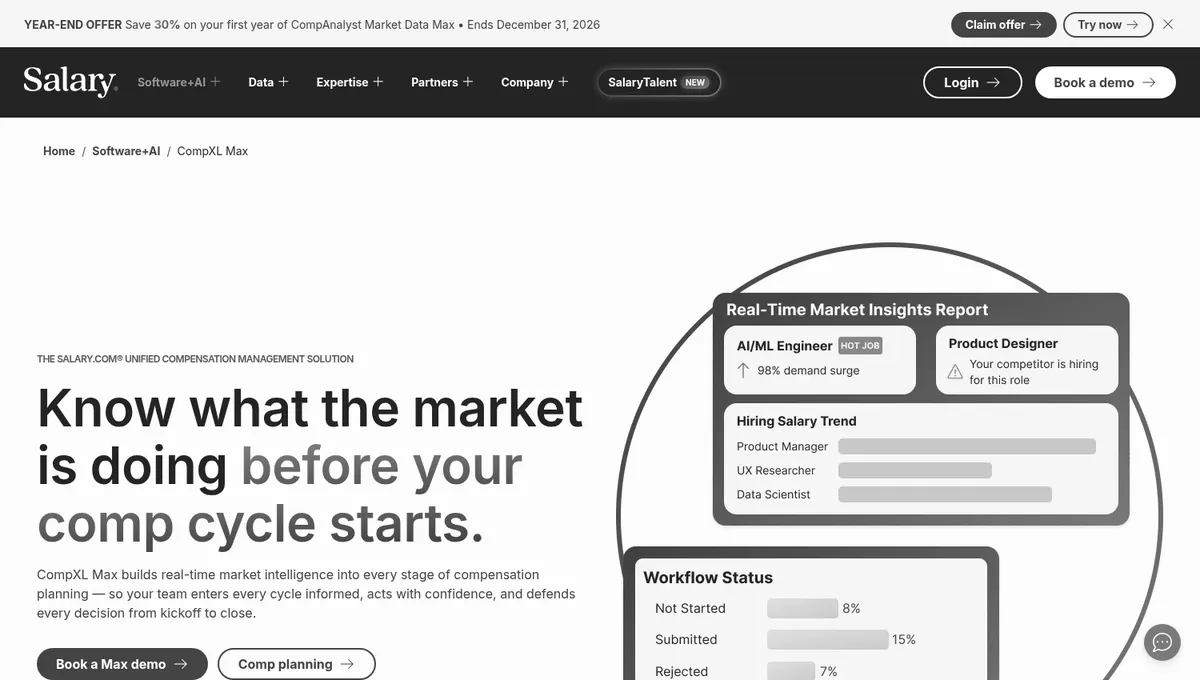
CompXL is the alternative to pick if your main frustration with Compport is that market data lives outside the planning tool. Salary.com’s CompXL Max page describes a full planning workbook for merit, bonus, equity and total compensation, with manager and admin worksheets, approval chains, budget controls by group and an audit trail of every change.
The Max layer is what sets it apart. It automatically matches every employee to a benchmark job with an AI confidence score, puts live job posting pay data, compa-ratios and market differentials inside the workbook, sends a pre-planning insights report on pay-to-market alignment and compression before the cycle opens, and flags employees paid below market minimum as potential flight risks.
An AI Review Assistant answers cycle questions such as which managers have not submitted. Salary.com says it is trusted by 10,000+ organizations. Pricing is not published.
- Best for: US-led mid-market and enterprise comp teams that want benchmarks and merit planning from one vendor.
- Ask before you sign: Ask which Salary.com data products are included in your CompXL quote, whether pay equity and total rewards statements are extra, and how sales incentive plans would be handled.
2. Compose by Decusoft: Best Like-for-Like Match for Configurability
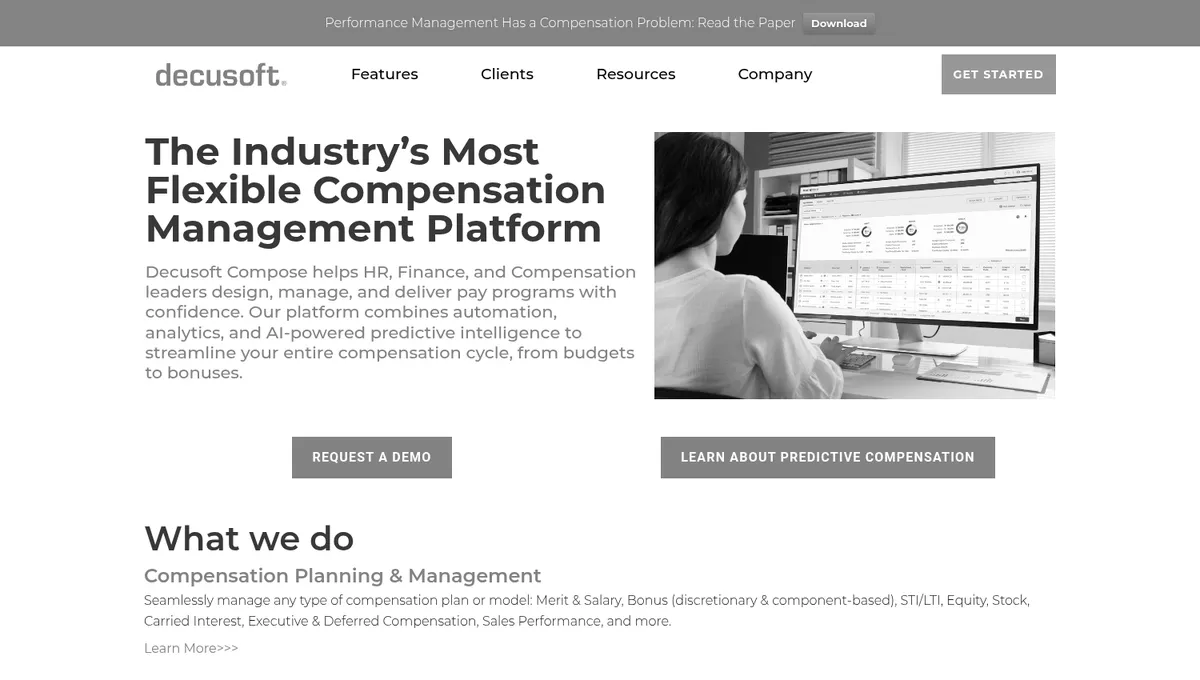
Compose is the closest match to Compport’s “configure anything” positioning, and it goes further on plan types used in financial services. Decusoft’s homepage lists merit and salary, discretionary and component-based bonus, STI and LTI, equity and stock, carried interest, executive and deferred compensation, and sales performance, all on one no-code platform with Excel-like planning grids.
The Compose page adds automated employee communication letters and total rewards statements, multi-currency support for global cycles, generative AI for querying compensation data, and a choice to run the whole process yourself, part of it, or as a full service. Decusoft says Compose follows SOC 2 Type II and GDPR standards and integrates with existing payroll and HCM systems.
For market data it relies on third-party integrations, including a partnership with Payfederate for AI market pricing and job architecture. Pricing is by quote.
- Best for: Banks, asset managers and other firms with many plan types, deferred pay or carried interest.
- Ask before you sign: Ask how much of the configuration your team will own after go-live, and what the full-service option costs per cycle.
3. HRSoft: Best for Large US Enterprises With Complex Variable Pay

HRSoft suits large enterprises whose Compport use is mostly bonus, LTI and executive pay rather than broad-based merit. Its site lists total compensation planning, pay for performance, LTI management, modelling and calibration, variable compensation, carried interest, milestone bonus, compensation statements, budgeting tools and international features. Its industry pages focus on financial services, investment management, manufacturing, business services, healthcare and retail.
HRSoft sells three packages on its packages page: Grow, for companies moving off spreadsheets; Scale, for multi-country companies with complex automation needs; and Elevate, for companies with a large global footprint. All three are custom quotes.
Pay equity and benchmarking are listed under its partner programme rather than as native modules, so check how those partners connect before you rely on them. HRSoft’s product is COMPview; it is a separate company from Salary.com, which owns CompXL.
- Best for: US enterprises in financial services or healthcare with heavy bonus, LTI or carried interest programmes.
- Ask before you sign: Ask which package covers your countries and plan types, and which pay equity and benchmarking partners are included versus licensed separately.
4. beqom PaySuite: Best for Global Enterprises Linking Pay, Performance and Pay Equity
beqom is the broadest like-for-like replacement for Compport at enterprise scale, covering every compensation component plus pay equity and performance management. Its compensation management page lists salary and merit, short-term incentives with multi-KPI payout curves, spot bonuses, executive compensation, sales incentive management and cash-based LTIs, with support for all currencies, 30 languages and 100K+ concurrent users.
Pay equity comes from PayAnalytics, which beqom acquired, and the homepage says the platform handles pay equity and transparency reporting for the US, EU and beyond, and partners with Mercer and WTW for market data. beqom says it is used by more than 5 million employees and over 40 S&P 500 companies; its about page says it was founded in 2009 by former SAP executives. Its own FAQ puts enterprise implementations at three to nine months.
Pricing is by quote. If beqom is already your incumbent, see our beqom alternatives guide.
- Best for: Global enterprises with tens of thousands of employees, EU pay transparency obligations and sales comp to consolidate.
- Ask before you sign: Ask for a phased plan (merit first, then LTI or sales incentives) and whether PayAnalytics is priced as a separate module.
5. Aeqium: Best Published Price for Mid-Market Comp Teams
Aeqium is the only alternative here that publishes a price, which makes it the easiest to benchmark a Compport renewal against. Its pricing documentation (last reviewed October 15, 2026) says it starts at $15,000 a year for organizations up to 300 employees. Above that, price depends on contract length and the number of employees in your cycles, with no per-module or per-seat fees.
Two details matter for budgeting. The contract is sized to the largest population in any cycle you run during the term, not your total headcount, and implementation, data import, integration setup and ongoing support are included at no extra cost.
Market survey data is not resold, so you license Radford, Mercer, WTW or another source separately and Aeqium imports it. The homepage lists configurable merit matrices, bonus formulas, approval chains and proration, salary bands, pay equity monitoring, an employee total rewards portal and interactive offer letters, and says it is SOC 2 Type 2 audited.
- Best for: Mid-market companies running merit and bonus cycles that want a clear, published starting price.
- Ask before you sign: Ask how long-term incentives and sales commissions would be handled, and get the contract sizing rule confirmed in writing.
6. Pave: Best for Tech Companies That Want Peer Data and Planning Together
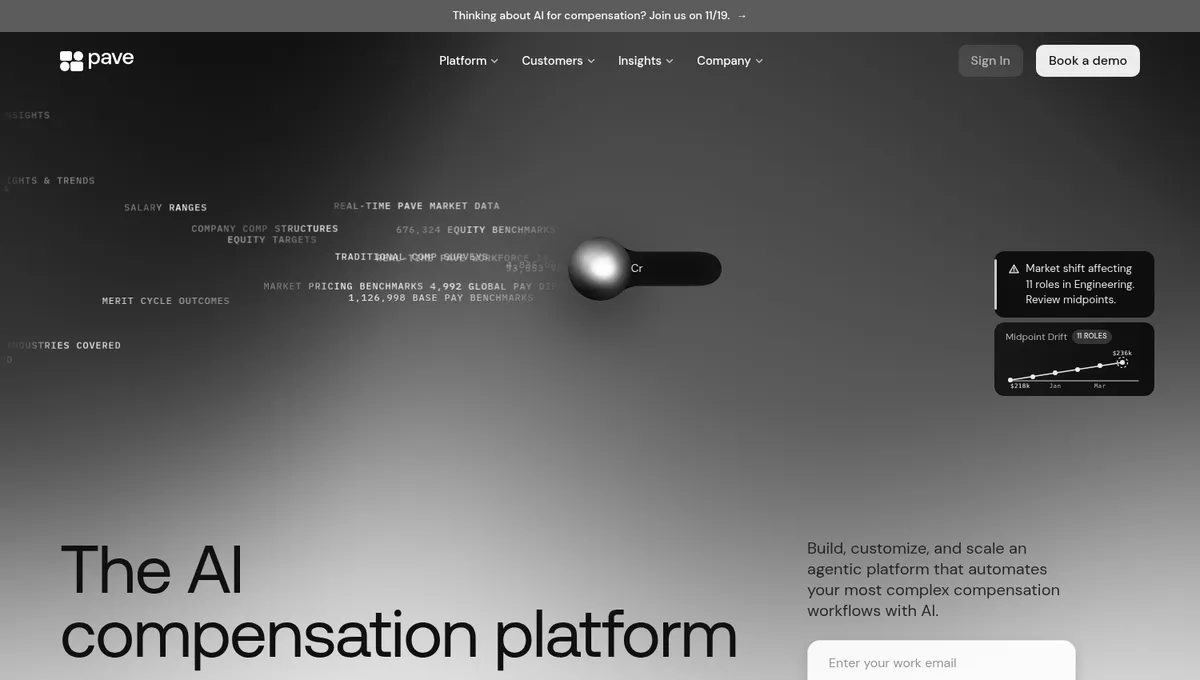
Pave replaces Compport’s planning module with merit cycles built on its own real-time peer data from 9,000+ integrated companies. Its compensation planning page covers merit, promotion, bonus and equity refresh cycles, top-down and bottom-up budgets, guardrails, custom columns and planning windows, white-labelled reward letters and live cycle analytics.
Check the packaging before you compare quotes. Pave’s pricing page now lists Compensation Planning, Team View, Total Rewards and Visual Offer Letter as add-ons available with its top Agentic Workflows package, which also includes market pricing and the Pave Agent.
Market Data Lite is free, with benchmarks for 290+ job families in the US and one other market. Pave does not list sales incentive or pay equity modules. Our Pave vs Ravio vs Figures comparison covers its data model in detail.
- Best for: Venture-backed and technology companies with equity programmes that want data, bands and cycles in one place.
- Ask before you sign: Ask what Agentic Workflows plus the Compensation Planning add-on costs at your headcount, and how deep Pave’s data is for your non-tech roles.
7. Pequity (ADP): Best for Comp Cycles Plus Pay Guidance for Recruiters
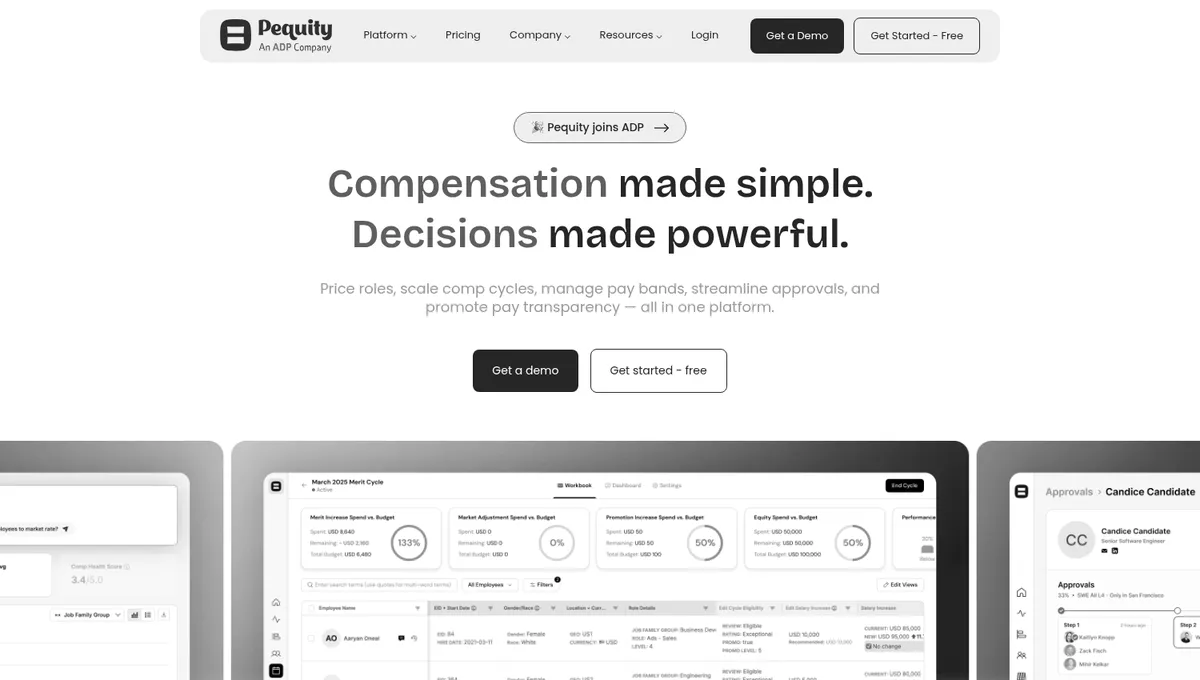
Pequity combines comp cycles and pay bands with a Chrome extension that puts pay guidance inside your applicant tracking system, and it is now owned by ADP. ADP announced the acquisition on October 29, 2025, and Pequity’s customer FAQ says the deal closed on October 28, 2025, that Pequity remains available as a standalone product, and that existing contracts and pricing stayed the same.
The homepage covers role pricing, comp cycles, pay bands, approvals and pay transparency, with SOC 2 Type 2, GDPR, MFA and SSO.
Pequity’s help center describes merit, bonus, equity refresh and promotion cycles with configurable budgets, formulas and manager workbooks, and a direct integration with ADP Lyric HCM. Its pricing page asks for a quote and says Pequity is aimed at companies with one or more compensation team members.
- Best for: Growth-stage and mid-market companies on ADP, or teams that want comp cycles and recruiter pay guidance from one tool.
- Ask before you sign: Ask how the roadmap differs for ADP and non-ADP customers, and whether pay equity analysis is native or needs another tool.
Which Compport Alternative Fits Your Situation?
Choose by the job you need done, not by feature count: the right alternative depends on plan complexity, company size and where your market data comes from.
| Your situation | Shortlist | Why |
|---|---|---|
| Global enterprise, many plan types, EU pay transparency | beqom PaySuite | Merit, STI, sales, LTI and pay equity in one suite, 30 languages |
| Financial services with deferred pay or carried interest | Compose by Decusoft, HRSoft | Both list carried interest and executive or deferred plans |
| Want benchmarks inside the merit workbook | Salary.com CompXL, Pave | Market data built into planning |
| Mid-market, needs a price before a demo | Aeqium | From $15,000 a year up to 300 employees, implementation included |
| Tech company with equity refresh cycles | Pave | Equity refresh cycles plus real-time peer data |
| Running ADP, or recruiters need pay guidance in the ATS | Pequity | ADP-owned, Lyric integration, ATS Chrome extension |
| Mostly sales commissions, not merit | A dedicated sales comp tool | See our sales compensation software guide |
If sales commissions are the main workload you want to move, a dedicated tool from our sales compensation software list will usually fit better than any of the seven above. If your main gap is employee-facing statements, compare our total rewards statement software picks.
How Do You Switch Away From Compport Without Disrupting a Pay Review?
Time the switch around your merit cycle, export everything that proves past decisions, and confirm the new tool can write approved changes back to your HRIS.
- Start early enough. Compport’s own implementation guide says most compensation implementations take 8 to 12 weeks, and beqom quotes three to nine months for large enterprises. Count back from the date your next cycle opens and add time for user testing.
- Switch between cycles. Do not move platforms while a merit or bonus cycle is open. Close the cycle in Compport, pay it, then cut over.
- Export the audit trail. Compport logs calculations and overrides with user and timestamp. Export those logs, final letters and cycle results for every past cycle you may need to defend, including pay equity reports.
- Rebuild plan rules on paper first. Document every merit matrix, proration rule, eligibility rule and bonus formula from your Compport configuration so the new vendor can quote against real complexity, not a demo plan.
- Confirm the write-back. Compport sends approved results back to the HRIS through its two-way integrations. Ask each alternative to name its integration method for your HCM (API or SFTP) and test the write-back during user testing.
- Check readiness. Run through our compensation cycle readiness audit before the first cycle on the new platform.
- Read your notice period. Find the renewal clause in your Compport order form so you do not auto-renew while you evaluate.
How Much Do Compport Alternatives Cost?
Only Aeqium publishes a price, starting at $15,000 a year for up to 300 employees; Compport and the other six alternatives quote on request. Here is what each vendor says drives its price.
| Vendor | Published price | What sets the price (per vendor) |
|---|---|---|
| Compport | Not published | Employee-based, product-based or tailored pricing |
| Aeqium | From $15,000 a year up to 300 employees | Contract length and employees in your largest cycle; implementation and support included; survey data licensed separately |
| Pave | Free Market Data Lite; planning by quote | Planning is an add-on to the Agentic Workflows package |
| HRSoft | Not published | Grow, Scale or Elevate package |
| Salary.com CompXL | Not published | Data products and modules in scope |
| Compose by Decusoft | Not published | Plan types and how much of the process Decusoft runs for you |
| beqom PaySuite | Not published | Modules (comp, pay equity, performance), headcount and geographies |
| Pequity | Not published | Custom quote |
Add the cost of any salary surveys you license separately, internal time for data clean-up, and any implementation fees, which beqom’s own FAQ lists as a cost to watch.
Frequently Asked Questions
What is the best alternative to Compport?
It depends on the module you rely on. beqom PaySuite is the broadest enterprise replacement, covering merit, bonus, sales incentives, LTI and pay equity. Compose by Decusoft matches Compport’s configurability and adds carried interest. Salary.com CompXL and Pave build market data into planning, and Aeqium is the only option with a published price.
How much does Compport cost?
Compport does not publish prices. Its compensation planning page lists three pricing models, employee-based, product-based and tailored, and asks you to book a demo. Third-party directories show estimates, but none come from Compport, so ask for a written quote naming modules, headcount and implementation fees.
Is there a cheaper alternative to Compport with public pricing?
Aeqium is the only alternative in this list with a published price. Its pricing documentation says it starts at $15,000 a year for organizations up to 300 employees, with implementation, integration setup and support included, and market survey data licensed separately from your own provider.
Which Compport alternative is best for global companies?
beqom PaySuite lists support for all currencies, 30 languages and 100K+ concurrent users, and handles pay equity reporting for the US and EU. Compose by Decusoft and HRSoft also support multi-currency global cycles. Compport itself says it operates in 37+ countries, so compare country coverage against your own footprint.
Who owns Pequity now?
ADP acquired Pequity, announcing the deal on October 29, 2025. Pequity’s customer FAQ says the acquisition closed on October 28, 2025, that Pequity remains available as a standalone product, and that existing contracts and pricing stayed the same. Pequity now integrates directly with ADP Lyric HCM.
How long does it take to replace Compport?
Plan for two to three months at minimum. Compport says most compensation implementations take 8 to 12 weeks, depending on data readiness, integrations and approval workflows, while beqom says large enterprise implementations typically run three to nine months. Switch between cycles, never during an open merit or bonus cycle.
The Bottom Line: Replace the Compport Modules You Actually Use
The right Compport alternative is the one that covers the modules your team runs every cycle, with an integration you can test before you sign.
Choose beqom PaySuite for the broadest enterprise suite, Compose by Decusoft or HRSoft for complex financial services pay, Salary.com CompXL or Pave for planning with market data built in, Aeqium for a published price, and Pequity if you run ADP or want recruiter pay guidance. Export your audit trail, document your plan rules and give yourself at least a full quarter before the next cycle. For the wider market, see our guide to compensation management software and our pay equity audit software picks.