
HR Tech SaaS may earn a commission when you buy through links on this page. Our recommendations are editorial and never paid for.
- Gusto works well up to roughly 50 to 100 employees with straightforward US payroll , beyond that, its limits in multi-state compliance, HRIS depth, and reporting become friction points.
- The right alternative depends on where the pain is: multi-state payroll complexity, global hiring, performance management, headcount analytics, or enterprise HRIS.
- Rippling is the most direct upgrade for US-focused companies that want one platform across HR, IT, and finance. ADP Run and Paychex are better for companies that want compliance-heavy multi-state payroll with hands-on support.
- Several tools on this list cost roughly the same as Gusto at lower headcounts but offer greater platform depth for companies scaling past 100 people.
- Switching payroll platforms mid-year is painful. Read this before you commit to a contract.
The most common Gusto alternatives for companies that have outgrown basic payroll are Rippling, ADP Run, Paychex, BambooHR, Justworks, OnPay, Deel, Paylocity, Gusto’s own upgrade path through TriNet, and HiBob. Each one fits a different growth stage and pain point. Rippling and Paylocity suit mid-market companies that need a unified HR and payroll platform. ADP and Paychex suit compliance-heavy multi-state operations. Deel and Oyster suit companies adding international headcount.
Why Are Companies Switching Away from Gusto?
Gusto built its reputation on being approachable. Clean UI, transparent pricing, and payroll that works without a dedicated HR ops person. That reputation is earned. For a company with 30 employees in two states, Gusto is genuinely good.
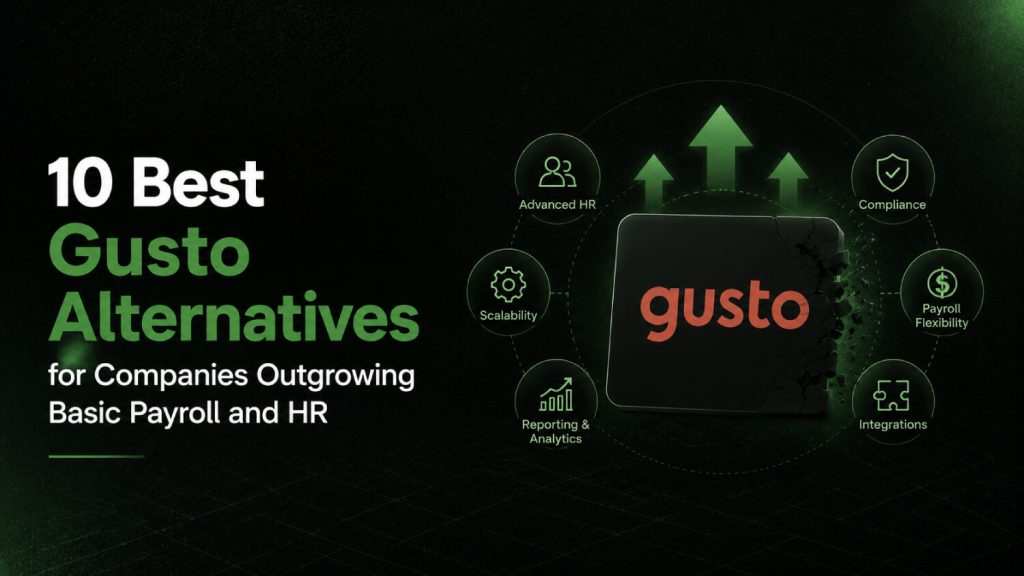
The problem is that “approachable” eventually becomes “thin.” Companies start running into Gusto’s ceiling when they need org chart depth and headcount planning that goes beyond basic employee records, when they hire in five or more states and need compliance automation that keeps pace with changing withholding rules, or when they want performance reviews, compensation bands, and L&D tracking inside the same system. Gusto offers some of these features, but HR teams at 150-plus employees consistently report having to bolt on separate tools to cover the gaps.
There is also a support issue. Gusto’s customer support model has received consistent criticism from users at higher employee counts where payroll errors are expensive and wait times on live support become unacceptable. Users on r/smallbusiness have surfaced exactly this complaint: US-based support quality matters most when payroll breaks, and Gusto’s model strains under that pressure.
For teams evaluating a full platform switch, the HR software buying checklist with 75 questions to ask before choosing an HRIS, payroll, ATS, or HCM platform is worth running through before shortlisting vendors.
Which Gusto Alternative Is Right for Each Company Type?
| Company Type | Best Fit Alternative | Why |
|---|---|---|
| US startup, 50-200 employees, wants everything in one platform | Rippling | HR, IT, payroll, finance in one system; strong automation |
| Multi-state US company with complex compliance needs | ADP Run or Paychex | Deep tax compliance engine, hands-on support teams |
| Mid-market company that wants strong HRIS and engagement tools | Paylocity or BambooHR | Better performance, learning, and analytics modules |
| Company hiring internationally | Deel or Oyster HR | EOR coverage, global payroll, contractor compliance |
| Startup that wants PEO model with benefits bundling | Justworks | Co-employment model, better benefits access for small teams |
| Small business wanting Gusto-level simplicity with better support | OnPay | Comparable pricing, US-based support, clean payroll |
| Mid-to-large company wanting enterprise HCM without Workday cost | Paylocity or Paychex Flex | More HRIS depth than Gusto, scalable to enterprise |
The 10 Best Gusto Alternatives
1. Rippling
Rippling is the most logical upgrade for a Gusto customer whose first complaint is “I need everything in one place.” Rippling runs HR, IT, and payroll from a single employee record, which means when you onboard someone, their payroll, laptop provisioning, app access, and benefits enrollment all trigger from one workflow. Gusto does not do IT and does not connect devices.
Payroll in Rippling handles multi-state filings with a more automated compliance engine than Gusto. The reporting layer is deeper, with pre-built workforce analytics that Gusto’s basic reporting cannot match. Rippling’s pricing is modular and not publicly listed in full; they require a quote, and the final number depends on which modules you activate. Customers report it running higher than Gusto for similar headcounts, but the platform consolidates tools that would otherwise cost separately.
The trade-off is implementation complexity. Rippling is more powerful and more complicated to configure than Gusto. Teams without an HR ops or IT ops function should factor in setup time.
2. ADP Run
ADP Run targets small-to-mid businesses that are outgrowing Gusto specifically because of payroll compliance weight. ADP’s compliance infrastructure is among the deepest in the market. They have compliance specialists, tax filing guarantees, and a dedicated support model that is substantially different from Gusto’s self-serve approach.
Where ADP Run earns its place is multi-state payroll. If you are filing in 10-plus states and managing garnishments, PTO accrual rules, and diverse pay schedules, ADP’s engine handles it with less manual intervention. ADP Run’s pricing is quote-based and not publicly listed. It typically runs higher than Gusto for comparable headcounts, but for companies where a single payroll error costs more than the platform premium, that is a reasonable trade.
ADP’s UI is older and less polished than Gusto’s. The employee self-service experience is functional but not modern. Teams that have been told “we moved to Gusto because it’s easy” may hear pushback when moving to ADP Run.
3. Paychex Flex
Paychex Flex occupies similar territory to ADP Run but skews toward companies that want a dedicated payroll specialist assigned to their account. Paychex’s account management model is a genuine differentiator. When something breaks, you call a person who knows your account, not a support queue.
Paychex Flex has more HRIS functionality than ADP Run, including performance reviews, recruitment modules, and learning management that are optional add-ons. For companies that want to consolidate payroll and some HRIS features under one contract with live support, Paychex is worth a serious evaluation. Pricing is quote-based.
The downside is that the platform feels fragmented. The payroll engine is strong; the newer HRIS modules feel bolted on rather than native. If core payroll and compliance are the priority and deep HRIS is secondary, that trade-off is acceptable.
4. Paylocity
Paylocity is built for mid-market companies in the 50 to 1,000 employee range that want a single platform covering payroll, HR, benefits administration, performance management, and employee engagement. It sits a step above Gusto in platform depth and a step below Workday in complexity.
Paylocity’s engagement tools , surveys, social recognition, peer feedback , are genuinely differentiated. For HR teams that care about reducing turnover and measuring culture, these are not cosmetic features. The payroll engine is solid for US multi-state operations. Pricing is not publicly listed; expect a quote. Paylocity consistently appears on shortlists for companies in the 100 to 500 employee range looking for Gusto alternatives with more HRIS depth.
Implementation takes longer than Gusto. Plan for 8 to 12 weeks for a full rollout, and budget for either internal HR ops time or an implementation partner.
5. BambooHR
BambooHR is the right call when Gusto’s limits are felt most in HRIS depth rather than payroll mechanics. BambooHR’s employee records, org charts, performance review workflows, hiring pipeline, and onboarding automation are all more developed than Gusto’s equivalents. If your team is saying “we need a proper HRIS, not just payroll,” BambooHR is the most direct answer.
The payroll add-on exists and covers US payroll, but BambooHR is fundamentally an HRIS with payroll attached rather than a payroll platform with HR features attached. That distinction matters. Companies with complex payroll requirements often end up running BambooHR for HRIS alongside a separate payroll tool like OnPay or Gusto itself. That is not a failure mode; it is a deliberate architecture choice some mid-market teams make.
Pricing is not publicly listed and is per-employee-per-month on a quote basis. BambooHR tends to be priced accessibly relative to enterprise HCMs, which is part of why it lands on so many mid-market shortlists.
6. Justworks
Justworks operates as a Professional Employer Organization, which is a fundamentally different model than Gusto. In a PEO arrangement, Justworks becomes the employer of record for your US workforce. That structure gives your employees access to large-group benefits rates and offloads a significant share of HR compliance liability to Justworks.
According to Justworks’ public pricing page, their basic plan starts at $59 per employee per month and their Plus plan (which includes medical, dental, and vision benefits) starts at $99 per employee per month. For early-stage companies that cannot negotiate competitive benefits on their own and want HR compliance off their plate, that structure often works out favorably compared to managing payroll, benefits, and compliance separately.
The ceiling of the PEO model is also its strength: once you have the HR infrastructure and scale to manage benefits and compliance independently, you typically move off a PEO and onto a full HRIS. Justworks is a growth-stage tool, not a long-term enterprise play.
7. OnPay
OnPay is the most direct like-for-like Gusto alternative for small businesses that want equivalent simplicity with better customer support. According to OnPay’s public pricing page, pricing is $40 per month base plus $6 per employee per month, which matches Gusto’s comparable tier and was also cited in Reddit threads on Gusto alternatives as a key reason users switch. US-based support is a recurring point in OnPay’s favor among users who moved from Gusto.
OnPay handles all US states, covers W-2s and 1099s, and files federal and state taxes. It also supports agricultural payroll, which Gusto does not, making it the default recommendation for farms and agribusiness on the payroll software shortlist. The HRIS depth is similar to Gusto: solid for basics, thin above 100 employees if you need performance, succession, or analytics.
8. Deel
Deel enters the conversation as a Gusto alternative specifically when a company starts hiring outside the US. Gusto’s US payroll is good; its global story is limited. Deel’s platform covers contractor payments in 150-plus countries and EOR employment in 100-plus countries.
According to Deel’s public pricing page, their global payroll solution starts at $29 per employee per month, and contractor management starts at $49 per contractor per month. EOR pricing is quote-based and typically in the range of $599 per employee per month, though this varies by country. For a company moving from Gusto with 80 US employees and adding 10 hires in the UK, Germany, and Canada, Deel provides the compliance infrastructure that Gusto simply does not have.
Deel also offers US payroll now, meaning some companies use it as a full replacement for Gusto rather than a supplement. The US payroll module is newer than Gusto’s and is not yet the primary reason to choose Deel, but it is improving.
9. Oyster HR
Oyster HR competes directly with Deel in the EOR and global payroll space. It markets itself on compliance depth and employee experience in international markets, particularly for companies hiring in Europe where employment law is dense. Oyster’s platform includes cost-of-employment calculators by country, which helps finance teams model the total cost of a hire before committing.
For companies whose primary reason to leave Gusto is international hiring, the Deel versus Oyster decision comes down to geographic coverage, support model preference, and pricing. Both are worth requesting quotes on before deciding. Oyster’s pricing is not fully public; they publish starting rates that vary by contract type and country.
10. TriNet
TriNet is a PEO like Justworks but targets companies in the 50 to 500 employee range with industry-specific HR compliance needs, particularly in professional services, tech, and financial services. TriNet brings benefits packages, HR advisory services, and risk mitigation that go beyond what Gusto provides.
According to the Paylocity competitive overview, TriNet is noted as the only PEO provider among the major Gusto alternatives, which gives it a distinct position in the market. Pricing is not publicly listed and is negotiated per company based on headcount and benefits selection. TriNet is worth evaluating when the conversation is about HR compliance risk and benefits access, not just payroll mechanics.
Gusto vs Rippling: Which One Actually Wins?
Rippling wins for companies that want one platform to manage HR, IT, and payroll together. Gusto wins for companies that want simple, affordable US payroll without IT or deep HR complexity. The gap between them is not primarily about payroll quality; both run clean payroll for US teams. The gap is about what sits around the payroll engine.
Rippling’s IT automation , device management, app provisioning, access control , is a category Gusto does not compete in. For a tech company where each new hire needs a laptop, 12 SaaS app licenses, and Slack access on day one, Rippling automates all of that through a single onboarding workflow. Gusto requires separate tools for each of those steps. The productivity argument for Rippling builds as headcount grows.
On price, Rippling is typically more expensive than Gusto for a comparable US payroll-only setup. The math flips when you factor in the tools Rippling replaces: an MDM platform, an identity management tool, and a more capable HRIS. For a company already paying for those separately, Rippling’s per-employee cost consolidates rather than adds.
Gusto vs ADP: Which Is Better for Multi-State Companies?
ADP wins for multi-state compliance depth and dedicated support. Gusto wins on user experience and transparent pricing. For a company filing payroll taxes in more than six states with complex garnishment rules, different state PTO laws, and local municipality taxes, ADP’s compliance engine handles edge cases that Gusto’s system requires more manual intervention to manage.
The support model is the starkest difference. ADP assigns account representatives. Gusto routes you to a support queue. When payroll breaks before a pay date, that distinction is not trivial. Companies that have experienced a Gusto support delay during a live payroll issue almost universally cite support as their primary reason for switching to ADP or Paychex.
ADP Run is also better positioned for companies that anticipate growing past 500 employees. At that point, the natural migration is from ADP Run to ADP Workforce Now, staying in the ADP product family. Gusto does not have an equivalent enterprise tier to grow into.
What Does Payroll Software Like Gusto Actually Cost at Scale?
Gusto’s pricing is public. According to Gusto’s public pricing page, the Simple plan is $40 per month plus $6 per person per month, the Plus plan is $80 per month plus $12 per person per month, and the Premium plan is $180 per month plus $22 per person per month. At 100 employees on the Plus plan, that is $1,280 per month.
Most of the alternatives on this list are quote-based at comparable headcounts, which makes direct price comparison difficult. The honest answer is that Gusto is cheaper than most alternatives at low headcounts and competitive at mid-market headcounts, but the cost difference narrows as headcount grows because alternatives consolidate more tools. The relevant question is not “what is the per-seat cost” but “what is the total cost of the HR and IT tools this platform replaces.”
For companies evaluating full HR software stacks at mid-market scale, the best HR software platforms for mid-market companies covers the full category, not just Gusto alternatives.
Which Signs Tell You It Is Time to Leave Gusto?
Five clear indicators suggest a company has outgrown Gusto:
- Multi-state payroll complexity is growing. You are adding states regularly, managing different pay rules, and your HR team is spending manual time on compliance checks Gusto should automate.
- You are hiring internationally. Gusto does not cover EOR employment or multi-currency global payroll in a meaningful way. Any international hire forces you to add a separate tool anyway.
- Performance management is happening in spreadsheets. Gusto’s performance features are basic. If review cycles, comp planning, and goal tracking are in Google Sheets, you have outgrown the platform.
- Reporting requests are exceeding Gusto’s export capability. Finance and the board want workforce analytics that Gusto’s reporting layer cannot produce without manual exports and Excel work.
- Support wait times are affecting payroll operations. If you have waited more than a few hours for a support response on a live payroll issue, the platform is not matching your operational risk profile.
For companies that have hit multiple of these signals simultaneously, a full HRIS evaluation may be the right move rather than just swapping payroll vendors. The best payroll software platforms for multi-state US companies covers the compliance and multi-state dimension in more depth.
Frequently Asked Questions About Gusto Alternatives
What is the best alternative to Gusto for small businesses?
OnPay is the most direct like-for-like alternative for small businesses. According to OnPay’s public pricing page, it costs $40 per month plus $6 per employee per month, matching Gusto’s Simple tier. OnPay covers all US states, handles W-2s and 1099s, and consistently receives higher marks for US-based customer support. Justworks is the better option if you want a PEO model that bundles HR compliance and benefits access alongside payroll.
Does Rippling compete with Gusto?
Yes, directly. Rippling positions itself as the platform Gusto customers graduate to when they need HR, IT, and finance in one system. Both run US payroll, but Rippling adds device management, app provisioning, and a more powerful HRIS layer. Gusto wins on simplicity and price at low headcounts. Rippling wins for companies above roughly 50 employees that want automation across HR and IT operations in one workflow.
Is ADP better than Gusto for multi-state payroll?
For most multi-state scenarios above 6 to 8 states, ADP Run handles compliance complexity more thoroughly than Gusto. ADP’s tax compliance engine, garnishment processing, and dedicated support model are built for the edge cases that arise in complex multi-state operations. Gusto is built for simplicity; ADP is built for compliance depth. The trade-off is that ADP’s user experience is less polished and its pricing is higher.
What is the cheapest Gusto alternative?
OnPay matches Gusto’s pricing almost exactly at $40 base plus $6 per employee per month, making it the closest cost equivalent. For companies that want basic US payroll without extra HR features, OnPay and Gusto are essentially price-equivalent. Most other alternatives on this list, including Rippling, ADP, Paychex, and Paylocity, cost more than Gusto for comparable headcounts, though they typically offer more depth in return.
What are the best Gusto alternatives for companies hiring globally?
Deel and Oyster HR are the primary alternatives for international hiring. Deel covers contractor payments in 150-plus countries and EOR employment in 100-plus countries, with global payroll starting at $29 per employee per month according to their public pricing page. Oyster HR competes on similar ground with a strong focus on European employment compliance. Both provide the legal infrastructure Gusto does not offer for hiring outside the US.
Can BambooHR replace Gusto entirely?
Not for every company. BambooHR replaces Gusto well as an HRIS for employee records, performance management, onboarding, and hiring. Its payroll add-on covers US payroll basics for many companies. For businesses with complex payroll requirements including multi-state filings, contractor payments, or international employees, BambooHR’s payroll module may not be sufficient on its own. Many teams run BambooHR alongside a dedicated payroll tool.
What should I know before switching from Gusto mid-year?
Switching payroll platforms mid-year creates a split-year tax reporting problem. Your W-2s at year-end will reflect payroll data from two different systems. Most platforms can import year-to-date earnings to produce clean W-2s, but this requires careful data migration and verification. If possible, switching at the start of a new tax year or at your fiscal year boundary reduces the administrative complexity significantly. Always run parallel payroll for at least one cycle before going fully live on the new platform.
What is the best Gusto alternative for companies between 100 and 500 employees?
Paylocity or Rippling, depending on whether the primary gap is HRIS depth or platform consolidation. Paylocity fits companies that want stronger performance management, engagement tools, and analytics alongside payroll, all within a single mid-market HRIS. Rippling fits companies where the primary driver is consolidating HR, IT, and payroll into fewer systems. Both are purpose-built for the 100 to 500 employee range in a way that Gusto is not.
The Decision Is Simpler Than It Looks
Most companies that outgrow Gusto already know their specific pain point. Payroll breaking in multiple states is an ADP or Paychex conversation. Needing global hiring capability is a Deel or Oyster conversation. Wanting a proper HRIS with performance and analytics is a Paylocity, BambooHR, or Rippling conversation. The mistake is treating this as a generic “best payroll software” search when it is actually a targeted replacement for a specific gap.
The companies that take longest to switch are ones that are vaguely dissatisfied with Gusto but haven’t named the specific failure. If your HR team is complaining that “Gusto just isn’t cutting it,” push them to articulate exactly where it fails. That answer will determine which platform belongs on your shortlist.
For companies evaluating AI-driven HR capabilities alongside their platform decision, it is worth understanding what vendors mean when they claim AI features, since that language is applied to everything from basic automation to genuine machine learning. The AI HR vendor evaluation checklist with 50 questions CHROs should ask before buying provides a structured framework for separating real capability from marketing. And for teams scaling rapidly who are also adding recruiting infrastructure alongside their HRIS, the best AI people analytics platforms for workforce planning covers what a data-mature HR stack looks like above 500 employees.