
HR Tech SaaS may earn a commission when you buy through links on this page. Our recommendations are editorial and never paid for.
- Most founders searching for HR tech software development services waste months talking to generalist dev shops that have never touched payroll tax logic, HRIS data models, or ATS compliance requirements.
- The firms that build good HR products are a distinct subset: they understand worker classification rules, SOC 2 requirements, bi-directional HRIS integrations, and why a broken payroll calculation is a legal liability, not just a bug.
- This list covers nine firms with verifiable HR tech track records across HRIS, ATS, payroll, and adjacent categories, including AI-native HR tools.
- The right partner depends on your product stage, compliance surface area, and whether you need a technical co-builder or a full product team.
- If you are buying HR software rather than building it, our comparison of the best HR software platforms for mid-market companies covers the vendor landscape instead.
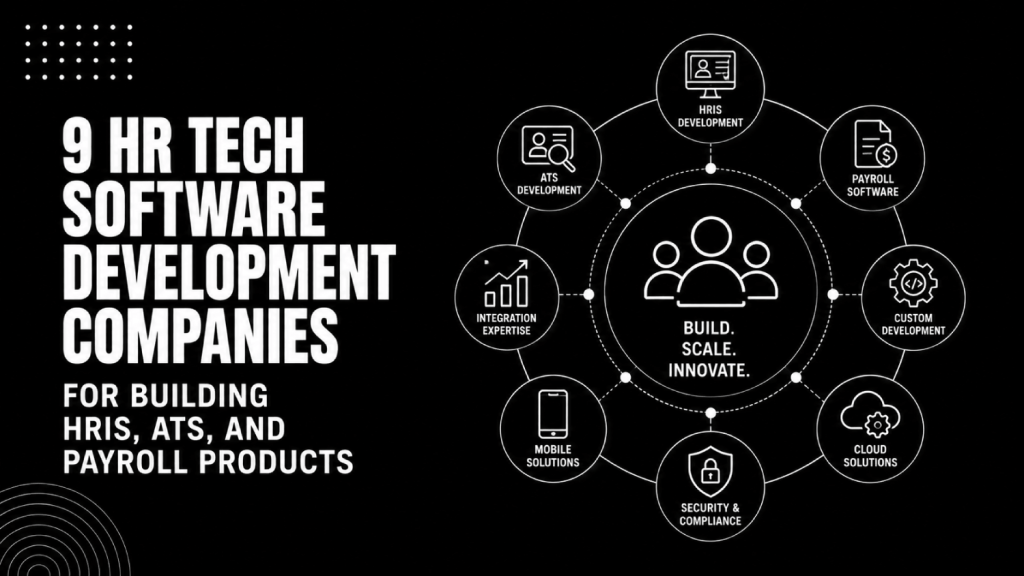
Firms that specialize in HR tech software development services build products like HRIS platforms, applicant tracking systems, and payroll engines, with domain knowledge of compliance requirements, HR data models, and third-party integrations that generalist development shops typically lack. Nine companies stand out for this work in 2026: TechMagic, Evrone, Relevant Software, Attract Group, Jelvix, Intellectsoft, Orangesoft, Cleveroad, and Sloboda Studio. Each brings a distinct focus, from startup-stage MVP builds to enterprise-grade payroll and compliance engineering.
Why Does HR Tech Software Development Require a Specialist?
Payroll is not a CRUD application. A payroll engine has to handle federal and state tax tables, garnishments, multi-jurisdiction rules, retro pay, and year-end W-2 generation. A mistake is not a UX problem. It is a compliance violation with real penalties attached.
HRIS platforms carry sensitive PII across employee records, compensation data, performance history, and benefits elections. The data model is more complex than most SaaS categories, and the integration surface area is wide: you are expected to connect with payroll processors, benefits carriers, background check providers, identity management systems, and often finance ERPs. For context on how these integrations work in production, the HR systems integration guide on data flows between HRIS, payroll, ATS, benefits, and finance explains what buyers and builders alike should expect.
ATS products have their own compliance layer: EEOC data collection, candidate data retention policies, interview scoring fairness, and increasingly, requirements under emerging AI hiring laws in jurisdictions like New York City and the EU. A dev shop that has never built one will underestimate all of it.
What Should You Look for in an HR Tech Development Partner?
Before reviewing any firm, define your evaluation criteria. The following table captures the most important dimensions for HRtech product development engagements.
| Criterion | Why It Matters for HR Tech | What to Ask the Vendor |
|---|---|---|
| HR domain experience | Payroll logic, HRIS data models, and ATS compliance are not general software knowledge | Show me a payroll product or HRIS you have shipped |
| Compliance knowledge | SOC 2, GDPR, CCPA, EEOC, and state-specific labor rules affect architecture decisions | How do you handle multi-jurisdiction payroll tax logic? |
| Integration library | HR products live or die on their integrations with payroll processors, ADP, Gusto, Plaid, benefits APIs | Which HR APIs and payroll rails have you integrated before? |
| AI/ML capability | AI sourcing, candidate matching, and HR chatbot features are now table stakes in new products | Have you built NLP-based candidate matching or AI-assisted screening? |
| Security posture | Employee data is highly regulated and a breach target | What is your SOC 2 Type II status? How do you handle secrets management? |
| Engagement model | Dedicated team vs. staff augmentation changes how fast you ship | Will I have a dedicated team or shared resources? |
| Pricing transparency | Fixed-price vs. time-and-materials changes your risk profile dramatically | Do you offer fixed-price discovery phases? |
9 HR Tech Software Development Companies Worth Evaluating
1. TechMagic
TechMagic is a Ukraine-based software development firm with an explicit focus on HR tech, listing HRIS and HRM application development as a named practice area. Their stated client base spans startups through established businesses, which means they have built both greenfield products and extensions on existing HR platforms. Their public positioning calls out user experience as a priority alongside functional completeness, which matters more in HR tech than most categories because HR tools have notoriously bad adoption rates when the UI is poor.
TechMagic’s strength is mid-size product teams that need a full-stack partner rather than pure staff augmentation. If you are building an HRIS MVP and need someone who has done it before, they are a credible first call. Pricing is not publicly disclosed; expect a project scoping conversation before any numbers appear.
2. Evrone
Evrone positions itself specifically around HRMS and HRIS development, calling out HCM application development in its service lines. Based in Europe with distributed delivery, Evrone’s public materials describe reliable and easy-to-use HRIS, HRMS, and HCM applications as a core output. For founders building in the European market who need a partner familiar with GDPR data residency requirements in HR systems, this matters.
Evrone’s work spans both custom builds and modernization of legacy HR systems. That second capability is underrated: a surprising number of HRtech founders are rebuilding or re-platforming an older product, not starting from zero. Pricing is quote-based.
3. Relevant Software
Relevant Software is a Ukraine-based product development firm with documented experience in HR software development, including custom HRIS, workforce management tools, and talent acquisition systems. They operate on a dedicated team model, meaning you get a stable group of engineers assigned to your product rather than being pulled from a shared pool.
Their published case studies include HR and workforce management products, which gives them more credibility than firms that list HR tech as one vertical among twelve. For founders at the seed or Series A stage who need a product team rather than individual contractors, Relevant Software fits the profile.
4. Attract Group
Attract Group is a Ukrainian development firm that has published materials specifically on HR software development, covering custom HRIS, payroll system builds, and employee management platforms. Their documented work includes both web and mobile HR applications, which matters if you are building an HR tool with a field-worker or mobile-first use case.
They offer both fixed-price and time-and-materials engagements. Fixed-price works best for well-scoped features; time-and-materials is more appropriate for exploratory product development. Ask them clearly which model applies to your engagement before signing anything.
5. Jelvix
Jelvix is a development firm with a named HR tech practice, covering talent management systems, workforce analytics, and custom HRIS builds. They have published content around AI integration in HR products, including machine learning features for candidate matching and predictive analytics. For founders building AI-native HR tools rather than retrofitting AI onto a legacy product, that published experience is a meaningful signal.
Jelvix works with mid-market and enterprise clients and has US-based account management alongside offshore delivery. That combination reduces the coordination friction that makes purely offshore engagements difficult for fast-moving product teams. Pricing is not publicly listed.
6. Intellectsoft
Intellectsoft is a software development company with an established HR tech vertical, covering HRIS platforms, employee experience products, and HR automation. Their published work includes enterprise-grade HR products, and they have documented experience with AI and ML integration in HR systems. They operate across the US, UK, and Eastern Europe.
For founders targeting large enterprise buyers, Intellectsoft’s enterprise delivery experience matters. Enterprise HR products have different architecture requirements than SMB tools: more complex permission models, more demanding audit trail requirements, and significantly more integration surface area. Knowing your dev partner has shipped into that environment is not optional.
7. Orangesoft
Orangesoft is a Belarusian development firm with published experience in HR software, including custom employee management systems and HR mobile applications. Their public portfolio includes HR-adjacent products in the workforce and talent space. They operate on both dedicated team and project-based models.
Orangesoft is a reasonable fit for founders building HR products with a strong mobile component, or for teams that want project-based fixed-scope work rather than an ongoing dedicated team. For complex payroll or compliance-heavy HRIS builds, verify their specific experience in those areas before committing.
8. Cleveroad
Cleveroad is a Ukrainian product development firm with published case studies in HR software and workforce management. Their service line includes custom HRIS development, employee scheduling systems, and HR mobile apps. They have documented experience with both greenfield product builds and integrations into existing HR stacks.
One area where Cleveroad differentiates is UX-first design. HR software has an adoption problem industry-wide: tools get purchased and then employees avoid them. A partner who treats design as a first-class concern rather than a cosmetic layer is worth paying attention to, particularly if your product competes with tools like BambooHR or HiBob where UI quality is part of the value proposition.
9. Sloboda Studio
Sloboda Studio is a Ukraine-based Ruby on Rails and React-focused development firm with experience in HR SaaS products. Their public portfolio includes recruitment platforms and HR automation tools. The Ruby on Rails specialization is worth noting: several well-known HR SaaS products were originally built on Rails, and if you are in that stack or considering it, having a partner with deep Rails experience reduces technical debt accumulation early.
Sloboda Studio is best suited for early-stage founders who know their tech stack and need a focused team rather than a large agency. They are not the right choice for enterprise-scale builds requiring complex multi-tenant architecture from day one.
How Do These Firms Compare Across Key Dimensions?
| Firm | Best Stage Fit | Key HR Domains | Notable Capability | Geography |
|---|---|---|---|---|
| TechMagic | Startup to mid-market | HRIS, HRM | Full-stack HR product builds | Ukraine / distributed |
| Evrone | Startup to enterprise | HRIS, HRMS, HCM | GDPR-aware European HR builds | Europe / distributed |
| Relevant Software | Seed to Series A | HRIS, ATS, workforce mgmt | Dedicated team model | Ukraine |
| Attract Group | Startup | HRIS, payroll, employee mgmt | Web and mobile HR apps | Ukraine |
| Jelvix | Mid-market to enterprise | Talent mgmt, HRIS, analytics | AI/ML integration in HR products | US / Europe / distributed |
| Intellectsoft | Mid-market to enterprise | HRIS, HR automation, employee experience | Enterprise-grade delivery | US / UK / Eastern Europe |
| Orangesoft | Startup | Employee mgmt, mobile HR | Mobile-first HR apps | Belarus |
| Cleveroad | Startup to mid-market | HRIS, scheduling, workforce | UX-first HR product design | Ukraine |
| Sloboda Studio | Early-stage startup | Recruitment platforms, HR automation | Ruby on Rails / React specialization | Ukraine |
What Does Building an HRIS Product Actually Require?
A production-grade HRIS covers employee records, org chart management, compensation history, benefits administration, document management, time-off tracking, and reporting. Each of those modules has compliance surface area. Employee records must handle state-specific fields (some states require specific leave balance disclosures, for example). Compensation data touches equal pay audit requirements. Document management intersects I-9 retention rules.
Most generalist dev shops scope an HRIS like a standard database application. HR tech specialists scope it as a compliance-coupled data product. That difference determines whether your product is saleable to mid-market buyers who have legal and HR teams that will audit your compliance posture before signing.
If you are building an HRIS and thinking about the integration layer, the 11 HR integration platforms that connect HRIS, payroll, ATS, and finance covers what buyers expect your product to connect with out of the box. Building a product that cannot connect to ADP, Workday, or Greenhouse is a sales problem, not just a technical one.
What Does Building an ATS Product Require?
Applicant tracking systems carry their own development complexity. At minimum, a production ATS needs job requisition management, multi-channel job posting distribution, a candidate database with search and filter, a configurable interview pipeline, offer letter generation, and EEOC data collection. That is the floor, not the ceiling.
The AI features that candidates and hiring managers now expect include resume parsing, candidate ranking, automated scheduling, and conversational screening. These are not trivial engineering problems. Resume parsing alone requires a solid NLP pipeline that handles unstructured text across hundreds of formatting variations. For context on what buyers expect from AI-powered recruiting tools, the best AI sourcing tools comparison shows the feature bar that new products are measured against.
Any ATS operating in the EU, or processing applications for US federal contractors, has additional compliance requirements around candidate data retention, right-to-erasure flows, and structured data export. Build those in from the start. Retrofitting GDPR compliance onto an ATS schema is expensive and error-prone.
What Does Building a Payroll Engine Require?
Payroll is the highest-stakes HR product category to build from scratch. A payroll engine must calculate gross pay, apply pre-tax deductions (401k, FSA, HSA), apply federal and state withholding, handle FICA taxes, process post-tax deductions, and generate the net pay figure. Then it must produce ACH files or integrate with a payment rail, generate pay stubs in the required format, and maintain a compliant audit trail.
Multi-state payroll multiplies the complexity. Each state has its own supplemental withholding rates, unemployment tax rates, and wage and hour laws. Some states have local taxes on top of state taxes. Building a payroll engine that handles all 50 states plus DC accurately is a two-plus year engineering project if built from scratch. Most product teams are better served by building on top of a payroll API like Finch or Check rather than building raw payroll calculation logic themselves. Ask any development partner whether they will build on a payroll API layer or build the calculation engine from scratch, and get a clear answer before scoping begins.
Build vs. Buy: When Does Building Your Own HR Product Make Sense?
Most companies should buy HR software, not build it. Building makes sense in a narrow set of scenarios: you are founding an HR SaaS company to sell to others, you have a genuinely differentiated workflow that no existing vendor supports, or you are a large enterprise with specific compliance or data sovereignty requirements that commercial HRIS vendors cannot meet.
If you are a startup or mid-market company deciding whether to buy an HRIS or build one internally, buy. The build-vs-buy analysis almost always favors buying unless you are in the HRtech business yourself. The HR software buying checklist of 75 questions to ask before choosing an HRIS, payroll, ATS, or HCM platform is a faster path to a solution for most organizations than scoping a custom build.
For HRtech founders and product teams reading this, the calculus is different. You are building a product others will buy. That is where the firms on this list become relevant.
How Much Does HR Tech Software Development Cost?
None of the nine firms on this list publish fixed pricing, and that is standard for this category. Development costs vary too much based on scope, team size, and duration to publish a rate card. What you should expect:
A dedicated team of four engineers (two backend, one frontend, one QA) plus a project manager from Eastern European firms typically runs somewhere in a wide range depending on the firm, seniority mix, and engagement structure , get a formal proposal from each firm and verify rates directly before budgeting. For general market context on Eastern European software development rates, published industry surveys from sources such as Glassdoor and Accelerance’s annual software development outsourcing guides provide current benchmarks, though rates shift and vary significantly by country and seniority level. An HRIS MVP with core modules is a substantial time investment; expect to scope timeline carefully with the partner you select before committing. A production-grade ATS with AI features takes longer. A payroll engine, as noted above, is a multi-year project if built from scratch regardless of team size.
US-based firms with onshore teams cost more. If your product requires close collaboration across time zones, or if your compliance requirements demand onshore legal review of the codebase, budget accordingly.
Frequently Asked Questions
What is HR tech software development?
HR tech software development refers to the engineering work involved in building human resources technology products: HRIS platforms, applicant tracking systems, payroll engines, employee experience tools, workforce analytics platforms, and AI-powered HR assistants. It differs from general software development because HR products require specific domain knowledge of compliance requirements, payroll tax logic, HR data models, and integrations with benefits carriers, payroll processors, and identity management systems.
How do I find an HR software development company with real HR tech experience?
Ask for shipped products, not just project descriptions. A firm with genuine HR tech experience can name an HRIS or ATS they built, describe how they handled multi-jurisdiction payroll logic, and explain their approach to SOC 2 compliance. If a development firm lists HR tech as one industry among twenty on their website and cannot point to a specific HR product in production, treat them as a generalist, not a specialist. Request references from HR tech founders they have worked with, not just case study PDFs.
Should I build my HRIS on a payroll API or build the payroll engine from scratch?
For most HRtech founders, building on a payroll API layer (such as Finch or Check) is faster and lower-risk than building raw payroll calculation logic. A payroll engine that handles all US states accurately requires years of engineering and continuous maintenance as tax tables change annually. Payroll APIs abstract that complexity and let your team focus on the product differentiation that makes your HRIS competitive. Build from scratch only if your compliance requirements or revenue model specifically require owning the calculation layer.
What compliance requirements affect HR software architecture?
SOC 2 Type II governs data security and is required by most enterprise HR buyers. GDPR affects any product processing employee data for EU-based workers, requiring data residency controls, right-to-erasure flows, and consent management. CCPA applies to California employees. EEOC requirements govern ATS products collecting applicant demographic data. Emerging AI hiring laws (New York City Local Law 144, EU AI Act provisions on automated employment decisions) affect any HR product using machine learning in hiring workflows. These requirements should inform architecture decisions from day one, not be retrofitted later.
How long does it take to build an HRIS MVP?
Based on practitioner experience across HR product builds, a credible HRIS MVP covering employee records, org management, time-off tracking, basic reporting, and one or two integrations typically takes somewhere in the range of four to six months with a dedicated team of four to five engineers , though scope, complexity, and team velocity all affect this significantly. That produces a genuinely usable product, not a demo. Reaching a production-ready HRIS that enterprise buyers will purchase generally requires a further year or more of continued development after the MVP, accounting for security hardening, additional integrations, compliance features, and the user experience refinements that come from early customer feedback. Always scope timeline directly with your development partner based on your specific feature set.
What integrations should an HRIS product support at launch?
At minimum, a new HRIS should connect to at least one major payroll processor (ADP, Gusto, or a payroll API), a background check provider, an ATS, and an identity management system (Okta or Azure AD for SSO). Benefits administration connectivity (carrier feeds or a benefits platform API) is expected by mid-market buyers. The HR integration platforms guide covers the standard integration expectations buyers bring to HRIS evaluations. Build those into your product roadmap before you hit your first enterprise sales conversation.
Is it worth hiring an HR tech specialist dev shop over a generalist agency?
For HRIS, payroll, and ATS products: yes. The compliance requirements, data model complexity, and integration expectations in HR tech are specific enough that a generalist team will either underscope the project or discover the complexity mid-build, at which point costs increase and timelines slip. The premium for a specialist is real but smaller than the cost of a failed or delayed build. For simpler HR-adjacent products (an employee scheduling app, a basic survey tool), a strong generalist firm with good product instincts can deliver without HR domain depth.
The Decision Most HRtech Founders Get Wrong
The most common mistake HRtech founders make when choosing a development partner is optimizing for hourly rate instead of domain depth. A cheaper generalist team that has never built payroll logic will cost more in the long run when they discover mid-project that multi-state withholding requires a full compliance layer they did not scope.
The second mistake is treating development as separate from go-to-market. The integrations your product supports on day one determine which buyers you can close. Building an HRIS with no ADP integration means you cannot sell to any company currently running on ADP, which is a large share of the mid-market. The firms that build the best HR products understand this and build integration readiness into the architecture from the start, not as an afterthought when the first enterprise prospect asks about it.
If your product eventually reaches a point where you are implementing it at customers or helping buyers select an HR stack, the HR software implementation checklist covering data migration, integrations, payroll, permissions, and rollout gives you a practitioner’s view of what buyers encounter post-purchase. Building a product that makes that checklist easier to complete is how you earn renewals.