
TLDR
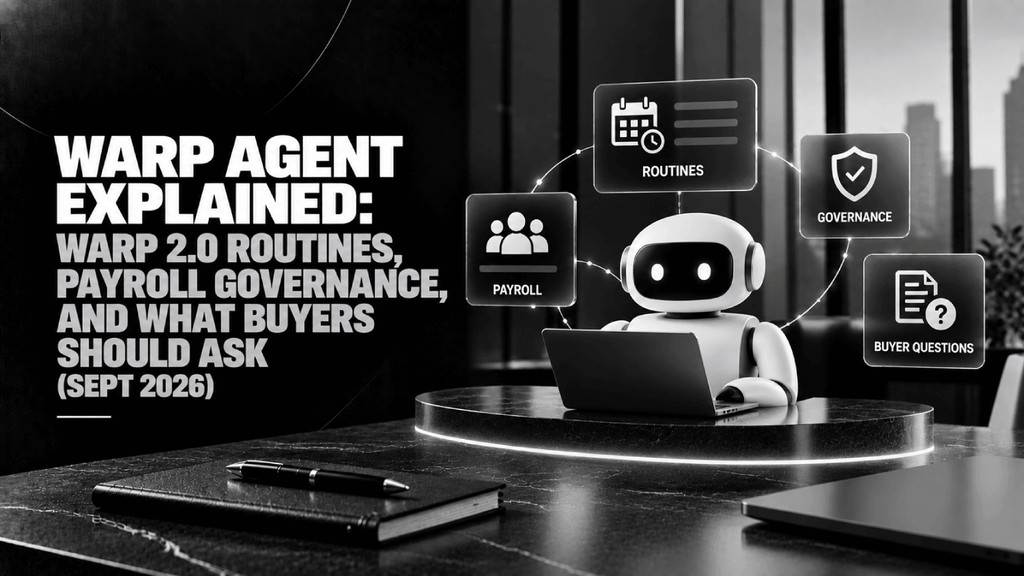
- On Sept. 25, 2026, Warp (Poaster Technologies) launched Warp Agent as the centerpiece of Warp 2.0: an always-on agent for onboarding, multi-state tax, benefits, policy Q&A, and event-driven Routines that run without a prompt.
- Primary sources: Warp’s own Warp Agent product post, a same-day SiliconANGLE exclusive, and Warp’s EZ Newswire release.
- Buyer-relevant product facts: Routines fire on events (offer signed, tax notice) or schedules; each Routine has its own autonomy setting and run log; the agent inherits the permissions of the person it acts for; money movement has hard limits the agent cannot change; early access is toggled in Settings for existing customers.
- SiliconANGLE reports pricing from $35 per person per month, with limited agent usage on all plans and purchasable capacity. Warp’s release says 1,000+ companies and $85 million raised (Battery, Peak XV, Sapphire, Sound, YC, and others).
- For buyers: this is AI-native people-ops execution (payroll/tax/onboarding write paths), not another ATS recruiting-agent launch. Ask which Routines are live in your footprint, what requires approval vs acts alone, and how rollback and audit work when payroll or tax actions fail.
Sept. 25, 2026 put another AI-native HCM story on the board. Warp published Warp 2.0 around Warp Agent: software that claims to finish people-ops workflows, not only draft answers for a human to click.
That framing matters for HrTechSaas readers who already track agentic payroll and HCM. It is a different buyer question from recruiting agents inside an ATS, and a different one from enterprise HCM assistants bolted onto systems designed for keyboard operators.
This draft sticks to the Sept. 25 launch facts, governance claims, and evaluation questions. It is not a rewrite of Paychex WISE Hire, Workable AI Recruiting Agents GA, Rippling AI Lab Bengaluru, or the evergreen AI HR agents explained guide.
What Warp announced
Per Warp’s Warp 2.0 / Warp Agent post (Ayush Sharma, CEO) and the same-day EZ Newswire release:
- Warp Agent onboards new hires, handles tax compliance, enrolls benefits, enforces company policies, and answers pay/policy questions without waiting to be asked.
- Routines are jobs the agent owns. They run on a schedule or when something happens in the company. Warp says most Routines are automatically enabled.
- Example offer-signed Routine: register in a new state, set up payroll, enroll benefits and 401(k), order a laptop, create Google and Slack accounts, send a first-day message.
- Other named behaviors: resolve tax notices; check payroll variances before every payroll; custom plain-language Routines (for example, 30-day new-hire check-ins summarized for managers, or Monday headcount/payroll-by-state for the CFO).
- Context claimed: role, location, compensation, tax profile, benefits, manager, device, and change history, under the same permissions model that governs people in Warp.
- Escalation: when a task still needs a person (Warp cites some tax portals that require a human with Power of Attorney), the agent brings in a company employee or a Warp specialist and keeps a record.
Ayush Sharma said in the release: “Much of the work HR teams are tasked with is procedural, repetitive, and high volume. We’re rebuilding the technical foundation of HR work to automate that work and give people teams more time to spend on their people.”
In SiliconANGLE’s exclusive, Sharma also positioned the company against incumbents: “We believe we are building what comes after Workday.” Treat that as competitive rhetoric. The product evaluation still has to land on write paths, coverage, and controls.
SiliconANGLE detail buyers should pin
The SiliconANGLE exclusive (Paul Gillin, updated Sept. 25, 2026) adds commercial and control detail not fully spelled out in the short newswire:
| Claim / fact | Source framing | Buyer use |
|---|---|---|
| Warp Agent part of Warp 2.0 | SiliconANGLE + Warp blog | Confirm which modules ship in early access vs later |
| Natural-language Routines customers can configure | Both | Ask for template library vs blank-canvas risk |
| Admin controls for access, autonomous actions, and approvals | SiliconANGLE | Map to your RACI for payroll and tax |
| Extra restrictions on hard-to-reverse actions, especially payroll/payments | SiliconANGLE + Warp blog (money hard limits) | Require a demo of blocked money moves |
| Audit trail: who created a Routine, approvals, last run, next run | SiliconANGLE | Export/sample logs for security review |
| Preconfigured Monday executive report (payroll, schedules, compliance risks, hiring trends, upcoming hires) | SiliconANGLE | Useful, but secondary to tax/onboarding write paths |
| Onboarding time claim: high-growth companies often spend 10–20 hours managing a new hire in the first 30 days; customers report under 2 hours | SiliconANGLE (Warp estimate / customer reports) | Vendor claim: ask for your cohort’s measured hours |
| Early access; all plans include limited usage; higher tiers get more; add-on capacity; prices from $35/person/month | SiliconANGLE | Model seat + usage, not seat alone |
| Raised $85M, including a $60M round in June; NYC-based | SiliconANGLE / Warp about blurb | Funding context, not product proof |
Warp’s blog also cites growth claims (7X year over year, $200M+ tax penalties saved, on track for $2B+ payroll volume this year) and named AI-native customers. Treat growth and penalty-savings figures as vendor claims unless you get customer references in your segment.
Governance: what Warp says is built in
Warp’s post is unusually explicit that agentic people ops touches payroll, SSNs, addresses, benefits elections, and access grants. The control story they put forward:
- Every action has an identity, a scope, a written rationale, and a rollback.
- The agent works only within the permissions of the person it is acting for.
- Money movement has hard limits the agent cannot change.
- Per workflow, the company sets recommend-only, act-after-approval, or act-on-its-own.
- Approvals and overrides are supposed to change how the next similar case is handled.
That is the right category of questions. It still is not a substitute for your own security questionnaire, SOC reports, and a staged pilot where payroll write-backs stay on approval until the log looks clean for several cycles. For category context, pair this news with AI agents for HR service delivery and AI HR agents explained.
How this differs from other hub drafts and site pages
HrTechSaas already covers nearby agent stories:
- Paychex WISE Hire (recruiting agents inside Flex / Paycor / SurePayroll)
- Workable AI Recruiting Agents GA (ATS-native agents + credits/MCP)
- Rippling AI Lab Bengaluru (Employee Graph + agentic action direction)
- UKG Bryte Voice / Agentic Pay and ADP AWS partnership (enterprise payroll/HCM AI paths)
- Evergreen: best payroll software for multi-state companies, HR chatbot examples
This draft is different:
- Same-day Warp Agent / Warp 2.0 news (Sept. 25, 2026)
- Focus on AI-native people ops execution (state tax registration, payroll setup, benefits, IT provisioning Routines), not ATS recruiting agents
- Not a Rippling alternatives listicle and not a generic chatbot roundup
Do not merge this into the Paychex or Workable URLs. Different vendor, different workflow surface, different buyer question.
Who should care, and what to ask
Prioritize a read-out if you:
- Are hiring into new U.S. states and state registration / unemployment / paid leave setup is eating People Ops cycles
- Run lean People Ops (Warp’s narrative targets 100–1,000 person companies and founders below that) and are evaluating AI-native HCM vs bolted-on assistants
- Already shortlisted Rippling, Deel, Gusto, or other modern HCM stacks and need a clean comparison on agent write paths
- Care more about tax notice handling and payroll variance checks than about recruiting chatbots
Ask Warp (and your counsel / security) before expanding autonomy:
- Which Routines are on by default in early access, and which are recommend-only until you flip them?
- For a first hire in a new state, which registrations, accounts, and filings does the agent complete end to end today, and which still need a human or Warp specialist?
- Show a failed payroll or tax action: what does rollback look like, who is notified, and what lands in the audit log?
- How are money-movement hard limits configured, and can a compromised admin identity raise them?
- What is included in the $35/person plan’s agent usage, and how do overages price at your headcount?
- How does the agent treat employees with split tax residences, contractors, or equity-heavy comp where “full context” is incomplete?
- What SOC 2 / data residency / subprocessors cover payroll, benefits elections, and device provisioning actions the agent triggers?
- If Warp’s pitch is “after Workday,” which enterprise controls (custom approval chains, union rules, complex benefits) are explicitly out of scope for v1?
The take: execution agents need a pilot with the write path gated
Warp’s Sept. 25 story is coherent: stop selling another chat layer on a click-through HCM, and sell an agent that owns Routines with permissions, rationale, and rollback. That is the right product thesis for AI-native people ops.
Your job is narrower. Treat early access as a controlled pilot. Keep payroll and tax Routines on approval until the run log matches what your team would have done. Measure hours saved on new-state onboarding and tax-notice handling, not on Monday exec-report novelty. Compare write-path coverage against Rippling’s agent direction and against your current multi-state payroll stack before you accept the “after Workday” slogan as a buying reason.
FAQ
What is Warp Agent?
Warp Agent is Warp’s always-on people-ops agent, launched with Warp 2.0 on Sept. 25, 2026, for onboarding, tax compliance, benefits, policy answers, and configurable Routines.
What are Routines?
Routines are jobs the agent owns and runs on a schedule or when a company event occurs (for example, offer signed or tax notice received). Each Routine has autonomy settings and a run log.
Is Warp Agent generally available?
Warp describes a rollout through early access. Existing customers enable it from the Early Access tab in settings; non-customers request a demo.
How much does it cost?
SiliconANGLE reports prices beginning at $35 per person per month, with limited agent usage included by plan and optional additional capacity. Confirm current packaging in a quote.
How is this different from Paychex WISE Hire or Workable agents?
Those launches are recruiting/TA agent stories. Warp Agent is positioned around payroll, multi-state tax, benefits, and broader people-ops execution inside an AI-native employee management platform.
Who is the CEO and where is Warp based?
Ayush Sharma is founder and CEO. Warp is New York–based and, per its release, has raised $85 million.
What should buyers do this week?
If Warp is already on your shortlist, book a Routine demo that includes a new-state hire and a tax-notice path, request sample audit logs, and keep money-moving actions on approval for the first pilot cycles.