
HR Tech SaaS may earn a commission when you buy through links on this page. Our recommendations are editorial and never paid for.
- ATS implementation is not a setup task. It shapes recruiter workflows, scorecard quality, hiring manager adoption, reporting accuracy, and compliance posture for years after go-live.
- Most recruiting teams underinvest in implementation and overpay for it later through misconfigured pipelines, broken integrations, and data they cannot trust.
- The best consultants specialize by platform. A Greenhouse expert and an iCIMS expert are not interchangeable.
- Beyond configuration, the right consultant handles data migration from your old ATS, HRIS integrations, permissions architecture, and recruiter training.
- This list covers independent consulting firms and boutique specialists, not the vendor’s own professional services teams.
The best ATS implementation consultants handle far more than flipping on job stages. They configure permissions, scorecards, interview plans, integrations, and reporting pipelines, then migrate your historical data without losing it. The right consultant for your team depends on your ATS platform, company size, and whether you are doing a fresh build or migrating from a legacy system. This list covers ten firms with documented expertise across Greenhouse, Lever, Ashby, iCIMS, Workday Recruiting, SmartRecruiters, and other major platforms.
Why Does ATS Implementation Actually Matter?
Most recruiting teams treat ATS implementation as a one-time administrative task: add your job stages, upload an offer letter template, invite your recruiters. That assumption costs them quietly for years.
A misconfigured ATS produces bad data. If offer stages are named inconsistently, or interviewers skip scorecards because they are buried three clicks deep, your time-to-fill and pass-through rate reports become meaningless. Hiring managers disengage because the system creates friction instead of removing it. Recruiters build workarounds outside the platform, which means your pipeline visibility disappears into inboxes and spreadsheets.
The configuration decisions made in the first eight weeks of an ATS deployment determine whether you can answer basic questions two years later, questions like: which sourcing channel produces the hires who stay past twelve months, or which interview stage is where candidates drop off for a specific role family. If the underlying taxonomy is wrong, the reports are wrong. No BI tool fixes that upstream problem.
Compliance is another underappreciated dimension. EEOC data collection, dispositioning logic, and adverse action workflows are not defaults you can ignore. A consultant who has done this before knows which fields are required, which are risky, and which integrations create audit exposure. If you are hiring in the EU, GDPR data retention rules add a layer that most in-house teams are not equipped to configure correctly on their first attempt.
For teams evaluating their broader HR software stack, the HR software buying checklist on this site covers the questions to ask before selecting any platform, including ATS, and is worth reviewing before you begin implementation planning.
What Should an ATS Implementation Consultant Actually Deliver?
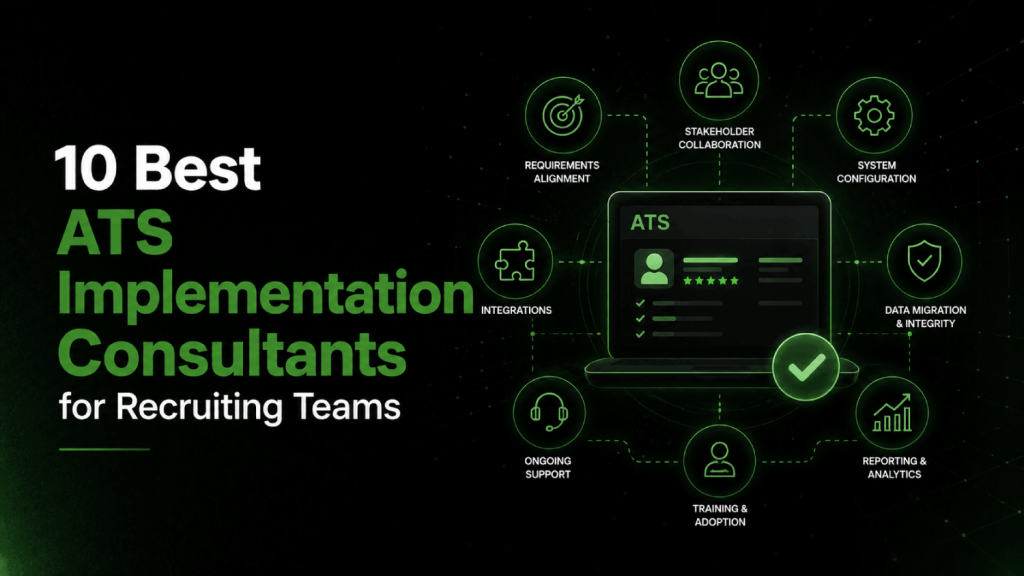
Before evaluating any firm, align on scope. A qualified ATS implementation consultant should cover six distinct workstreams.
- Process mapping: documenting your current hiring workflows, identifying what to keep, what to standardize, and what to retire before touching the system.
- Configuration: building stages, pipelines, job requisition forms, custom fields, scorecard templates, and offer workflows inside the platform.
- Permissions and roles: defining who can see what, who can move candidates, who approves requisitions, and who has reporting access. Getting this wrong creates both security risks and recruiter frustration.
- Integrations: connecting the ATS to your HRIS, background check provider, assessment tools, job boards, Slack or Teams, and HRIS for headcount approvals. Each integration has its own authentication, field mapping, and sync logic.
- Data migration: extracting candidate and job data from your previous ATS, cleaning and transforming it, and loading it without corrupting your new system’s historical record.
- Training and enablement: recruiter training, hiring manager onboarding, and documentation so the system does not degrade the moment the consultant offboards.
A vendor’s own professional services team typically covers items one through three competently. Independent consultants add value on items four through six, and on the political work of getting hiring managers to actually use the system as configured.
How to Evaluate an ATS Implementation Consultant Before You Hire Them
Ask every candidate consultant the same four questions and compare answers directly.
First: How many implementations of this specific platform have you done in the last eighteen months, and what was the average company headcount? Platform-specific experience matters more than general HR tech experience. An iCIMS implementation at a 3,000-person company has almost nothing in common with an Ashby implementation at a 200-person startup.
Second: Walk me through how you handle data migration from [your current ATS]. Migration is where most projects fail. A consultant who gets vague on this is telling you something important.
Third: What does your permissions and roles architecture look like for a company our size? The answer reveals whether they think systemically or just tactically.
Fourth: What does your post-go-live support model look like, and do you offer any audit services six months after launch? The best implementations include a 90-day checkpoint. Anything can look good at go-live. What matters is whether the system is still being used correctly when the consultant is gone.
The 10 Best ATS Implementation Consultants for Recruiting Teams
1. Brightscout
Brightscout is a digital product and HR technology consultancy with a documented Greenhouse practice. Their recruiting operations work includes full-funnel configuration, scorecard design, and HRIS integration work. They are a reasonable fit for mid-market teams who need design-thinking brought into the process mapping phase, not just technical configuration. Their work tends to run on the higher end of the market rate, and their engagements are structured as full projects rather than hourly retainers.
2. Rockcrest
Rockcrest positions explicitly as an ATS consulting firm for talent acquisition teams. Their public messaging focuses on Greenhouse, Lever, and Ashby specifically, with services covering configuration, workflow design, and integration support. For teams that want a boutique that lives inside the TA operations space rather than a generalist HR tech firm, Rockcrest is worth evaluating. Pricing is not publicly disclosed; expect a project scoping conversation.
3. HR Technology Consultants
HR Technology Consultants is one of the few firms whose website leads with ATS implementation as a core service. They cover process mapping, system configuration, and implementation across multiple platforms. Their positioning covers both mid-market and enterprise, which means you should ask specifically about their experience with your platform and your company size before assuming fit. They appear in the top organic results for “ATS implementation consultants,” which reflects some depth of market presence in this category.
4. Recruiting Toolbox
Recruiting Toolbox approaches ATS implementation from the recruiting operations and process design side rather than the technical configuration side. Their strength is in the upstream work: defining interview structures, building scorecard frameworks, and designing the hiring process before it gets encoded into the system. Teams that already have technical resources but need help with the process design layer benefit most from their model. They are not the right choice if your primary need is integration engineering or data migration.
5. Talent Function
Talent Function is a recruiting operations consultancy with a strong focus on talent acquisition strategy and technology implementation. Their work includes ATS selection, configuration, and recruiter enablement. They are particularly well-suited to teams going through an ATS selection process and wanting the same firm to carry through to implementation, rather than handing off between a selection consultant and an implementation consultant. Engagements are typically project-based.
6. Cielo Talent
Cielo is primarily known as an RPO provider, but their technology consulting practice covers ATS implementation, optimization, and integration work at enterprise scale. For companies with 1,000-plus employees running complex multi-country hiring, Cielo has the bench strength to handle iCIMS, Workday Recruiting, and SAP SuccessFactors implementations that smaller boutiques cannot staff. The trade-off is cost: Cielo’s engagements are enterprise-priced, and the relationship skews toward managed services rather than standalone consulting.
7. Accenture HR Technology Practice
Accenture’s HR technology practice covers enterprise ATS implementations, typically in conjunction with larger HCM transformations. If you are implementing Workday Recruiting or SAP SuccessFactors Recruiting as part of a broader HCM deployment, Accenture has certified resources. They are not the right fit for a standalone Greenhouse or Ashby implementation at a company under 1,000 employees. The overhead and cost structure do not justify it. For teams evaluating enterprise HCM platforms alongside their ATS, the comparison of Workday AI vs SAP Joule vs Oracle AI for HR provides useful context on how recruiting fits into the broader enterprise stack.
8. Independent ATS Implementation Consultants
This is a different model from the firm-based entries above. A growing number of former talent technology practitioners , including alumni from Greenhouse, Lever, and Ashby’s own implementation teams , now operate as independent ATS implementation consultants. Finding them requires LinkedIn research and referrals from peer TA leaders in recruiting operations communities, not a vendor directory. The advantage is deep platform-specific expertise at a lower cost structure than a full consulting firm. The risk is capacity: an independent consultant may not be available on your timeline, and you have no firm backstop if they become unavailable mid-project. Because this is a referral-driven market, the most reliable way to locate a qualified independent specialist is to ask directly in communities like Talent Ops Community or peer Slack groups for a warm introduction to someone who has done your specific platform and migration combination.
9. Randstad RiseSmart
Randstad RiseSmart sits at the intersection of HR outsourcing and technology implementation. Their recruiting technology services include ATS configuration and optimization work, primarily for mid-to-large enterprise clients. Their strength is in change management and recruiter adoption, which is often where ATS implementations fail after go-live. Teams that have already struggled with adoption on a previous implementation should weight that capability heavily when evaluating consultants.
10. Mercer | Mettl HR Technology Advisory
Mercer’s talent technology advisory practice covers ATS selection, implementation planning, and vendor management at the enterprise level. They are positioned for organizations where the ATS implementation is part of a broader talent technology transformation and where procurement, legal, and compliance stakeholders need to be managed alongside the technical build. For a straightforward Ashby or Lever implementation, this is overengineered. For a 5,000-person company implementing iCIMS with seven country-specific workflows, they are worth talking to.
Which ATS Platforms Need Specialist Consultants?
Not all ATS platforms have the same implementation complexity, and not all have an active independent consulting market.
| ATS Platform | Implementation Complexity | Independent Consultant Availability | Primary Use Case |
|---|---|---|---|
| Greenhouse | Medium-High | Good | Mid-market, structured hiring orgs |
| Lever | Medium | Moderate | Mid-market, CRM-forward teams |
| Ashby | Medium-High | Growing; fewer specialists than Greenhouse or Lever | High-growth startups and scaleups |
| iCIMS | High | Good | Enterprise, high-volume hiring |
| SmartRecruiters | High | Moderate | Enterprise, global hiring |
| Workday Recruiting | Very High | Good (certified partners) | Enterprise HCM-integrated orgs |
| Jobvite | Medium | Limited | Mid-market |
| Breezy HR | Low-Medium | Limited | SMB |
Greenhouse has a well-developed independent consulting market relative to other mid-market ATS platforms. This is partly because Greenhouse’s configurability is deep enough that most teams benefit from outside expertise, and partly because the platform has been in market long enough that experienced practitioners have left Greenhouse’s own implementation team and set up independent practices. Ashby is newer, which means fewer independent specialists exist , most are former Ashby employees or power users from high-growth tech companies, and the referral pool is still small.
Workday Recruiting implementations almost always require a certified Workday consulting firm rather than a generalist ATS consultant. The integration surface area with the broader HCM suite is too large for a firm without Workday certification to handle responsibly.
What Does an ATS Implementation Consultant Cost?
Pricing for ATS implementation consulting is not publicly standardized, and most firms quote based on scope. That said, there are rough market bands worth knowing before you open negotiations.
Boutique specialists focused on Greenhouse, Lever, or Ashby for companies in the 100 to 500 employee range typically price projects somewhere between $15,000 and $50,000, depending on integration complexity, data migration requirements, and whether training is included. Those figures are directionally consistent with what TA leaders share in peer communities like Talent Ops Community , treat them as a planning benchmark rather than a quoted rate, since actual pricing varies by region, consultant reputation, and project scope.
Enterprise implementations on iCIMS, SmartRecruiters, or Workday Recruiting commonly reach six figures when you factor in multi-system integration, change management, and phased rollout support. Accenture and Mercer-level engagements are priced accordingly.
The cheapest option is almost never the right one for ATS implementation. A $5,000 project that leaves your permissions architecture broken, your HRIS integration misfiring, or your historical data corrupted will cost far more than the delta to fix. Get references, ask for a post-implementation audit, and confirm that training is included in scope before signing.
ATS Migration vs. Fresh Implementation: Different Problems, Different Consultants
Migrating from an existing ATS is harder than building fresh, and consultants who are strong at fresh implementations are not always strong at migrations.
Fresh implementations have the advantage of a clean slate. The challenge is process design: getting stakeholders to align on workflows before the system encodes those workflows in concrete. A consultant who is strong at facilitation and can run effective discovery sessions with recruiting ops, HR, legal, and finance adds real value here.
Migrations add a data problem on top of the process problem. Your old ATS has candidate records, job histories, and application data that you need to move without losing EEOC records, corrupting offer history, or breaking the audit trail. The extraction logic depends on your old platform’s API or export capabilities. The transformation logic depends on field mapping between old and new schemas. The load logic depends on your new platform’s import tooling. Most ATS platforms offer limited native migration support, which is exactly where an experienced migration consultant earns their fee.
Ask any prospective consultant specifically: what is your process for extracting data from [your current ATS], and can you provide a reference from a client who migrated from that specific platform? A consultant who has done that exact migration before will handle it in roughly half the time of one who has not.
What Integration Work Should You Expect at Implementation?
The integrations your ATS needs to support are often what make or break recruiter adoption. Recruiters who have to manually enter candidate information into a background check portal, or who cannot see a hiring manager’s calendar availability from inside the ATS, find workarounds quickly, and those workarounds degrade your data quality within weeks.
At minimum, plan for these integrations at implementation:
- HRIS (for headcount plan sync, offer approval, and new hire creation)
- Background check provider (Checkr, Sterling, or equivalent)
- Calendar and scheduling (Google Calendar or Microsoft 365)
- Communication (Slack or Teams for hiring manager notifications)
- Job boards (LinkedIn, Indeed, and niche boards)
- Assessment tools if your process uses them
- Compensation planning tools if offer approvals route through them
Each integration has its own authentication setup, field mapping, and sync cadence. A consultant who says “integrations are usually straightforward” has not done enough of them. The complexity depends on your HRIS vendor’s API health, your IT team’s response time on authentication approvals, and the specific version of each platform you are running. Budget time for integrations to take twice as long as quoted, and make sure your consultant has done your specific HRIS-to-ATS combination before.
For teams also evaluating how AI tools plug into the recruiting stack beyond core ATS configuration, the coverage of AI sourcing tools and LinkedIn Recruiter alternatives covers how those tools typically integrate with Greenhouse, Lever, and Ashby.
How Do You Know If Your Current ATS Is Misconfigured?
Most recruiting teams running an ATS for more than eighteen months are dealing with some level of configuration drift. The symptoms are recognizable.
Reporting feels unreliable, and recruiters know it. Time-to-fill numbers do not match what the team actually experiences. Pipeline conversion rates show impossible spikes because candidates are being moved in bulk to close out requisitions. Hiring managers skip scorecards or submit them days after interviews. Certain pipelines have accumulated dozens of stages that nobody can explain. Source attribution is blank or defaults to “other” for a significant share of applications.
These are not platform problems. They are configuration and adoption problems, and an experienced consultant can audit them in a structured half-day session. Some firms offer ATS audits as a standalone service before committing to a full reconfiguration engagement. If your system has been live for more than two years with minimal governance, an audit before implementation planning will surface issues that would otherwise derail your timeline.
Teams evaluating whether their broader HR technology decisions are working should also review the best HRIS implementation partners list, since ATS and HRIS implementations frequently intersect when the new hire workflow crosses systems.
Frequently Asked Questions
What does an ATS implementation consultant do?
An ATS implementation consultant configures your applicant tracking system from the ground up: building pipeline stages, interview plans, scorecard templates, permissions, and custom fields based on your actual hiring process. They also handle integrations with your HRIS, background check vendor, and scheduling tools, migrate data from your previous ATS, and train recruiters and hiring managers on the configured system. The goal is a working system that produces reliable data, not just a technically installed one.
How long does an ATS implementation take?
A typical mid-market implementation on Greenhouse, Lever, or Ashby for a company with 200 to 1,000 employees takes eight to sixteen weeks from kickoff to go-live. That range extends when data migration from a legacy system is involved, when integration complexity is high, or when stakeholder alignment on process design is slow. Enterprise implementations on iCIMS or Workday Recruiting regularly run four to nine months. Consultants who promise faster timelines without scoping the integration and migration work first are usually underestimating the project.
Do I need a consultant if my ATS vendor provides implementation support?
Vendor professional services teams handle the core configuration competently, but they are often limited in scope and time. They configure what you tell them to configure. An independent consultant will push back on bad process design, has done the same implementation for peer companies, and brings benchmarks the vendor’s team will not share. For integrations with third-party tools and for data migrations from competing platforms, an independent consultant typically has deeper hands-on experience than the vendor’s own team.
What is a Greenhouse implementation consultant?
A Greenhouse implementation consultant specializes in configuring Greenhouse for recruiting teams. Their work includes building structured hiring processes within the platform, configuring job approvals and offer workflows, setting up interview kits and scorecards, managing permissions for different user roles, and connecting Greenhouse to HRIS and other tools via its API and native integrations. Several independent consultants specialize in Greenhouse specifically, including alumni from Greenhouse’s own implementation team who have moved into independent practice.
What should I ask an Ashby implementation consultant before hiring them?
Ask how many Ashby implementations they have completed in the past twelve months, and at what company sizes. Ashby is relatively new to market, so the pool of independent specialists is smaller than for Greenhouse or Lever. Confirm they have handled Ashby’s analytics configuration specifically, since that is one of its strongest features and requires deliberate setup to produce useful reports. Ask for references from companies that migrated to Ashby from another ATS, as migration experience is rarer than fresh implementation experience.
What is the difference between ATS implementation and ATS optimization?
Implementation refers to the initial configuration of a new ATS: building the system from scratch, migrating data, and training users. Optimization is work done on a system that is already live, typically to fix configuration drift, improve reporting accuracy, clean up permissions, or add integrations that were deferred at launch. Many ATS implementation consultants also offer optimization engagements as standalone services, which can be valuable for teams that went through a rushed implementation or inherited a system from a previous team.
How do I find a Lever implementation consultant?
Start with Lever’s partner directory, which lists implementation partners that have been vetted by the vendor. Beyond that, referrals from peer TA leaders in recruiting operations communities are the most reliable source. Lever is now part of Employ Inc., which has consolidated it with Jobvite and JazzHR. Ask any prospective consultant whether their Lever experience is current, since the platform has evolved since the acquisition and older implementations may not reflect the current product.
Can a recruiting operations consultant also handle ATS implementation?
Sometimes, but not always. Recruiting operations consultants who come from a process design background are excellent at the upstream work: defining hiring stages, building scorecard frameworks, and aligning stakeholders on interview structures. The technical configuration, integration engineering, and data migration work requires hands-on platform experience. The best ATS implementation engagements pair process design expertise with technical configuration depth. If your consultant is strong on process but light on technical, confirm they have a technical resource on their team or in their network before signing.
The Decision That Shapes Everything Downstream
ATS configuration decisions made in week one of an implementation are often invisible until month eighteen, when your head of talent asks why time-to-hire data does not match what recruiters report, or why sourcing attribution is blank for a third of last quarter’s hires. By then, unpicking the misconfiguration is a project in itself.
The consultants on this list represent different points on the spectrum from boutique platform specialists to enterprise transformation firms. The right choice depends entirely on your platform, your company size, and whether you are building fresh or migrating. A 300-person company implementing Ashby needs a different partner than a 4,000-person company going live on iCIMS with seven country configurations. Scope the work honestly before you price it, and weight platform-specific experience above all other credentials.
For teams also making decisions about the tools that plug into the ATS, including AI interview tools, talent intelligence platforms, and people analytics systems, those are separate buying decisions with their own evaluation criteria. The AI HR vendor evaluation checklist is worth reviewing before committing to any tool that will be integrated into your newly configured ATS. A well-implemented ATS is the foundation. What you build on top of it is the strategy.