
HR Tech SaaS may earn a commission when you buy through links on this page. Our recommendations are editorial and never paid for.
- Cognitive ability tests measure reasoning, problem-solving, and learning speed , not job skills. Conflating the two leads to wrong vendor choices.
- The strongest tools in this category combine psychometric rigor with modern candidate experience and ATS integrations.
- AI-enhanced scoring is now table stakes; what separates vendors is validity evidence, bias audit trails, and compliance documentation.
- Best overall for mid-market hiring teams: Criteria Corp. Best for enterprise predictive hiring: Talogy. Best for high-volume hourly roles: Wonderlic.
- Pricing across this category is almost entirely quote-based , budget planning requires direct vendor outreach.
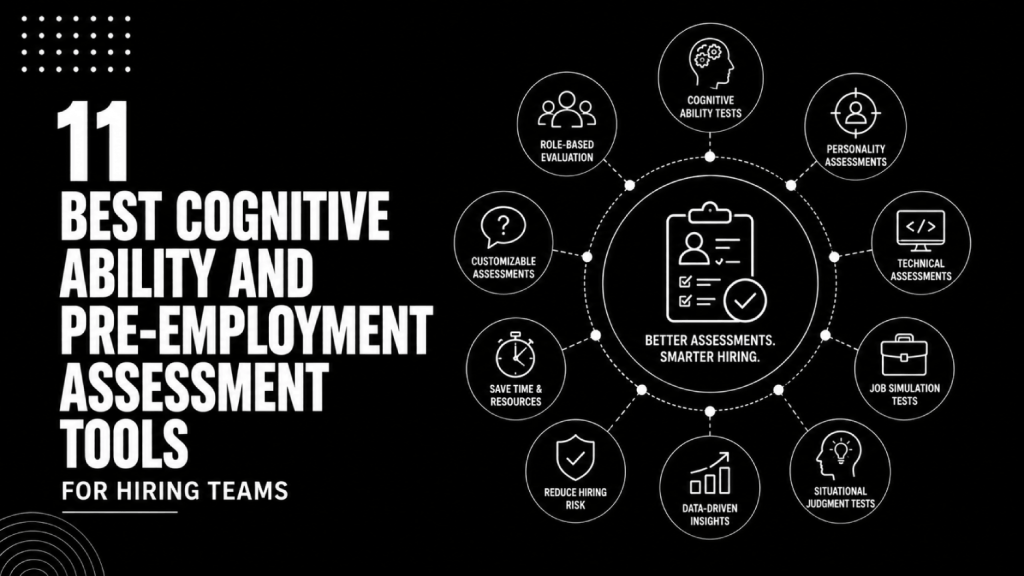
The best cognitive ability testing tools for hiring teams include Criteria Corp, Talogy, Wonderlic, the Predictive Index Cognitive Assessment, Hogan Assessments, Revelian, McQuaig, Arctic Shores, Harver, Mettl by Mercer, and Bryq. Each serves a distinct hiring context: volume, seniority level, bias audit requirements, and ATS connectivity all factor into which tool fits your workflow.
Why Skills Tests and Cognitive Tests Are Not the Same Thing
Most hiring teams come to this category looking for “assessment software” and end up comparing apples to wrenches. A skills test tells you whether someone can write Python or build a pivot table. A cognitive ability test tells you how quickly someone learns new systems, how they reason through ambiguous problems, and how they process information under time pressure.
The distinction matters for two reasons. First, job performance prediction. Decades of industrial-organizational psychology research support this , according to Schmidt and Hunter’s 1998 meta-analysis published in Psychological Bulletin, general cognitive ability ranks among the strongest individual predictors of job performance across roles. Second, legal defensibility. In the US, pre-employment tests that produce disparate impact across protected groups require validation evidence. Cognitive tests have more published validity data than almost any other assessment format, which matters when your legal team asks hard questions.
If you’re building a full pre-employment workflow that also includes skills simulations, see our breakdown of Vervoe alternatives for skills-based hiring , that category is distinct from what’s covered here.
What Should You Evaluate Before Choosing a Cognitive Assessment Vendor?
Five things separate a serious cognitive assessment vendor from one selling rebranded trivia questions. Validity evidence: does the vendor have published, peer-reviewed studies linking their test scores to job performance outcomes? Adverse impact data: can they show you subgroup score distributions and what mitigation steps they take? ATS integration: does it connect to Greenhouse, Lever, Workday, or whatever you run? Candidate experience: mobile-optimized, accessible, and fast to complete. Compliance documentation: EEOC, OFCCP, and EU AI Act readiness materials should be available on request, not buried under an NDA.
Vendors who cannot produce a technical manual with validity coefficients on request should be disqualified immediately. This is not a high bar , it is the baseline.
The 11 Best Cognitive Ability and Pre-Employment Assessment Tools
| Vendor | Best For | AI-Enhanced | Pricing Model | Notable Differentiator |
|---|---|---|---|---|
| Criteria Corp | Mid-market, volume hiring | Yes | Subscription, tiered | Breadth of validated tests, strong ATS integrations |
| Talogy | Enterprise, complex roles | Yes | Quote-based | Deep I/O psychology team, job-fit modeling |
| Wonderlic | High-volume, hourly | Yes | Quote-based | Longest validity track record in the market |
| Predictive Index (PI Cognitive) | SMB to mid-market | Yes | Quote-based | Paired behavioral assessment for full candidate picture |
| Hogan Assessments | Executive and leadership hiring | Yes | Quote-based | Personality + cognitive integration for senior roles |
| Revelian (Criteria-owned) | APAC market, gamified testing | Yes | Quote-based | Game-based cognitive modules with strong validity data |
| McQuaig | SMB, straightforward deployment | Limited | Subscription | Simple word-survey format, fast candidate completion |
| Arctic Shores | Early-career, graduate hiring | Yes | Quote-based | Game-based, bias-audited, no CV shortlisting required |
| Harver | High-volume customer service | Yes | Quote-based | Situational judgment + cognitive combined modules |
| Mettl by Mercer | India/emerging markets, enterprise | Yes | Quote-based | Proctoring + cognitive in one platform |
| Bryq | Bias-reduction focused teams | Yes | Subscription | Culture-add alignment layered on cognitive scores |
1. Criteria Corp
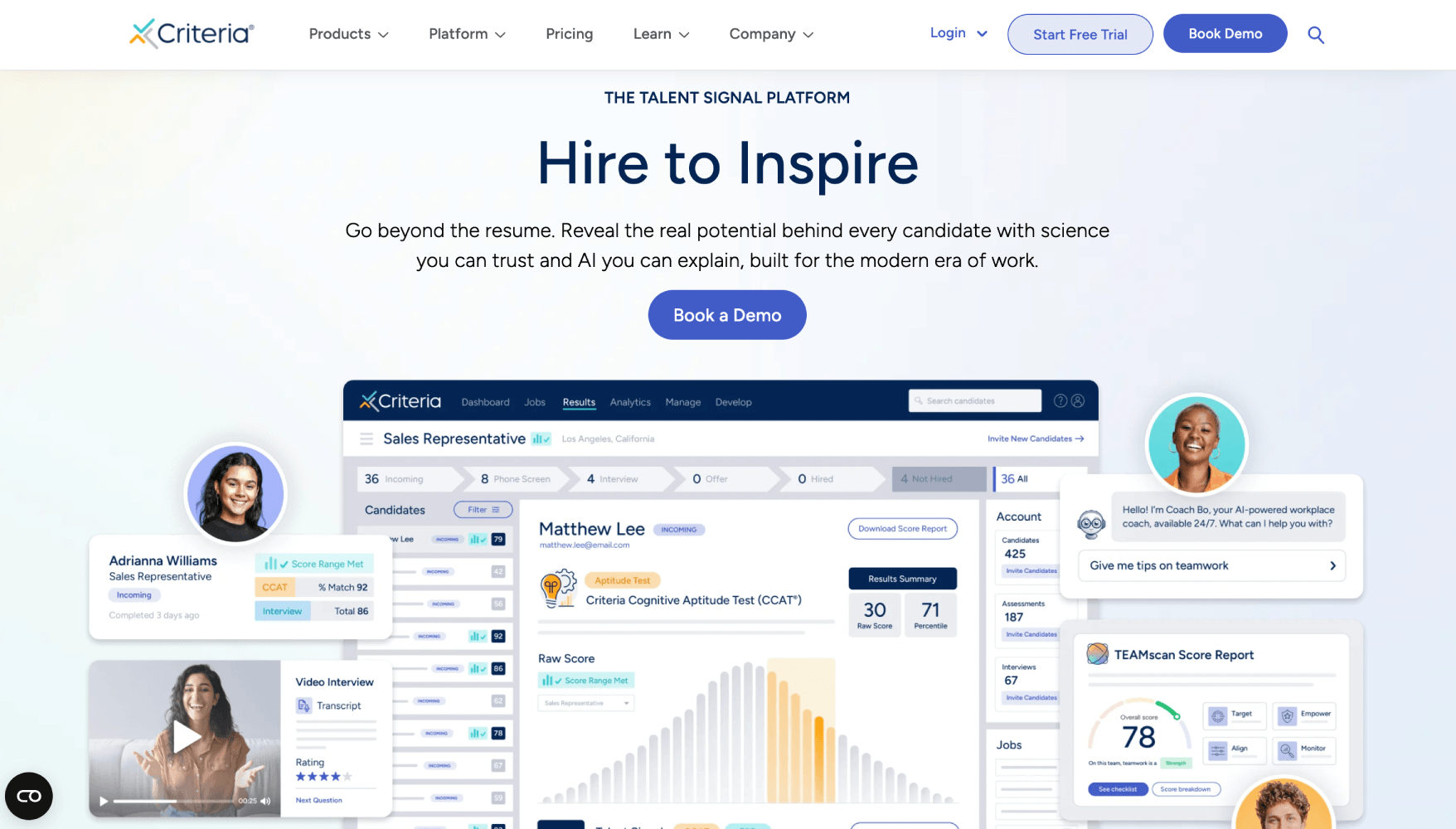
Criteria Corp is the most practically accessible cognitive assessment platform in this list. Their core product, the CCAT (Criteria Cognitive Aptitude Test), is a 50-question timed test covering numerical, verbal, and spatial reasoning, with well-documented validity data and published adverse impact statistics. The platform integrates directly with most major ATS systems including Greenhouse, Lever, and iCIMS.
Criteria’s subscription pricing is publicly tiered by volume , their pricing page is publicly accessible, making it one of the few vendors where budget estimation does not require a sales call. Their interface is clean, candidates complete the CCAT in under 20 minutes, and recruiters get score reports that translate raw scores into role-relevant benchmarks. The limitation: depth of I/O consulting support is thinner than Talogy or Hogan for complex role modeling.
Best for: Mid-market HR teams that want a defensible, fast-to-deploy cognitive test without a months-long implementation.
2. Talogy
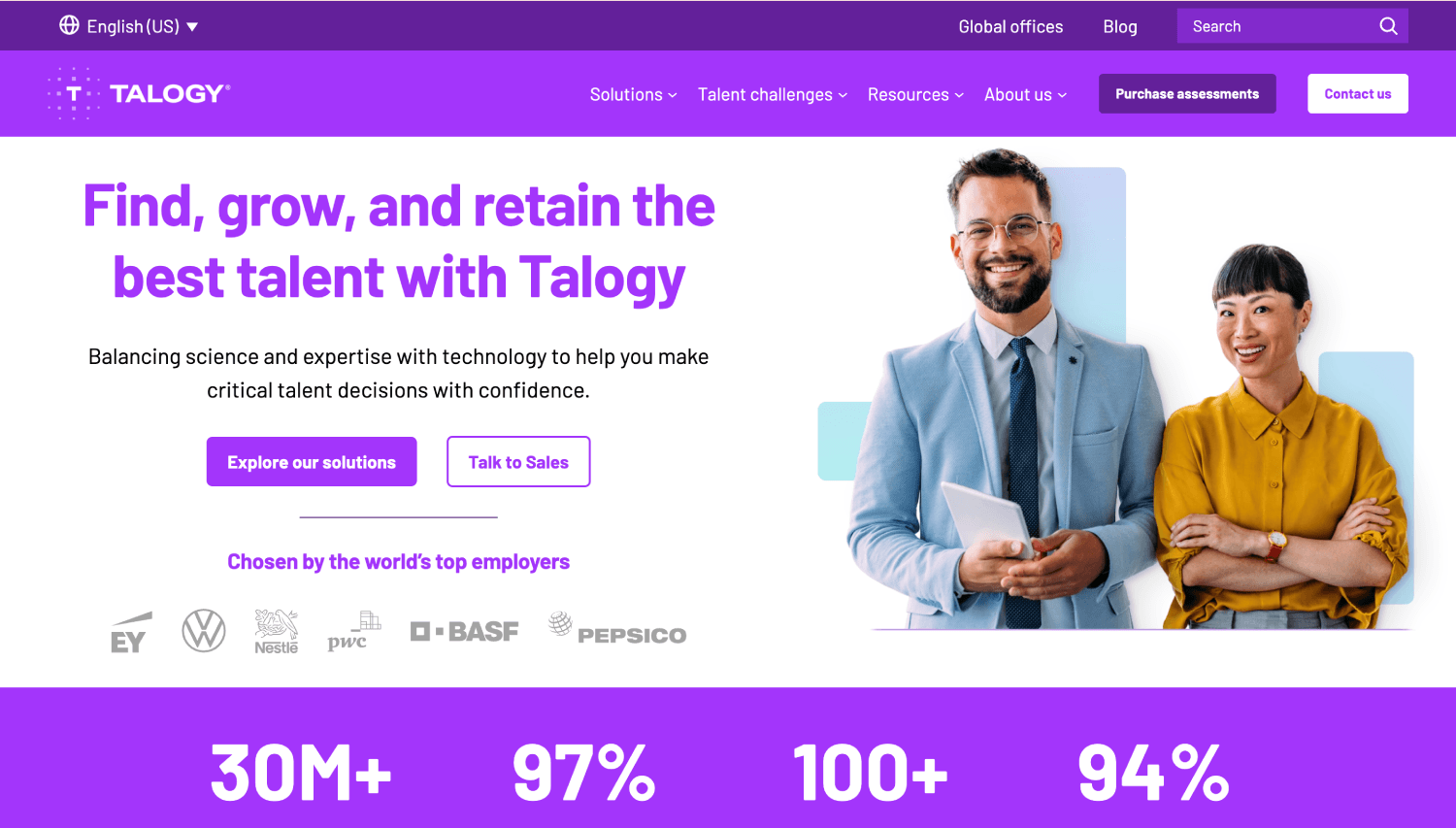
Talogy (formerly PSI Talent Management and Cubiks, merged) brings a serious industrial-organizational psychology infrastructure to enterprise hiring. Their cognitive battery covers reasoning across verbal, numerical, and abstract dimensions, and they offer job-family-specific score weighting built on their own validity research database.
Where Talogy earns enterprise budgets is consulting depth. They will run a job analysis study for you, map cognitive dimensions to specific performance outcomes, and provide documentation packages for OFCCP audits or EU AI Act compliance queries. Pricing is entirely quote-based and scales with scope. The onboarding timeline is longer than Criteria’s but the validity evidence is more customized.
Best for: Enterprise talent teams filling specialized or high-stakes roles where legal defensibility and custom job-fit modeling justify a longer procurement cycle.
3. Wonderlic
Wonderlic has the longest commercial track record in cognitive aptitude testing. The Wonderlic Personnel Test has been used in hiring for decades, and their newer WonScore product wraps cognitive, motivation, and personality into a single composite for recruiters. Their validity evidence base is among the most cited in the occupational literature.
The modern platform handles high-volume workflows well. Automotive dealers, logistics companies, and call centers are their sweet spot. Candidates can complete assessments on mobile, and score reports are designed for line managers, not just HR specialists. Pricing is quote-based.
Best for: High-volume hourly or semi-skilled hiring where speed and simplicity matter and where managers, not HR, are the primary score consumers.
4. Predictive Index Cognitive Assessment (PI CA)
Predictive Index sells the cognitive assessment as one half of a paired evaluation alongside their behavioral assessment (the PI Behavioral Assessment). The cognitive piece is a 12-minute, 50-question timed test measuring general cognitive ability, very similar in structure to the CCAT.
The real value of PI CA is the pairing. When cognitive score and behavioral drive data are combined in their Hire product, recruiters get a “Job Match” score that accounts for both thinking speed and work style. This is a meaningful differentiator for teams already using PI’s behavioral tool or teams that want a combined picture without buying two separate vendors.
Best for: SMB and mid-market teams that want cognitive data as part of a broader behavioral hiring framework, not as a standalone tool.
5. Hogan Assessments
Hogan Assessments is the market standard for executive and leadership-track hiring. Their Hogan Business Reasoning Inventory (HBRI) measures tactical and strategic reasoning, and it is designed for professional and managerial roles, not entry-level volume hiring. Hogan’s personality assessments (HPI, HDS, MVPI) are what most buyers know, and the cognitive piece integrates cleanly with those.
Hogan requires certified practitioners to administer and debrief assessments. That certification requirement is a real onboarding cost. For teams filling 20 senior roles a year, it is worth it. For teams filling 200 hourly roles, it is overkill.
Best for: Executive search, leadership development programs, and succession planning at companies that already use Hogan’s personality suite.
6. Revelian
Revelian (now owned by Criteria Corp) offers game-based cognitive assessments with published validity data. Their Cognify product uses abstract reasoning games to measure cognitive ability in a format that feels fundamentally different to candidates than a traditional timed test. Adverse impact data shows meaningful reduction in score gaps on certain demographic dimensions compared to traditional formats.
The game-based approach is not just a candidate experience gimmick. Revelian’s technical documentation covers convergent validity with standard cognitive measures. The product is especially strong in Australia and Southeast Asia, where Revelian originated. For APAC hiring or global teams wanting an alternative format, Revelian is the most validated game-based cognitive option available.
Best for: Teams in APAC markets, early-career pipelines, and organizations specifically trying to reduce format-based performance anxiety without sacrificing cognitive measurement quality.
7. McQuaig
McQuaig offers a simpler, word-survey format cognitive assessment that candidates complete in roughly 15 minutes. The McQuaig Mental Agility Test (MMAT) is easy to set up and interpret. The platform’s broader suite combines cognitive with behavioral and job fit assessments in a straightforward package aimed at SMBs.
McQuaig does not have the depth of validity research infrastructure that Criteria, Talogy, or Hogan carry. The SERP data notes McQuaig as among the top tools in the market, and for simple deployment without heavy consulting overhead, it earns that mention. Where it falls short is enterprise scalability and integration depth.
Best for: SMBs and growing teams that want a quick, low-friction cognitive data point as part of a broader hiring process.
8. Arctic Shores
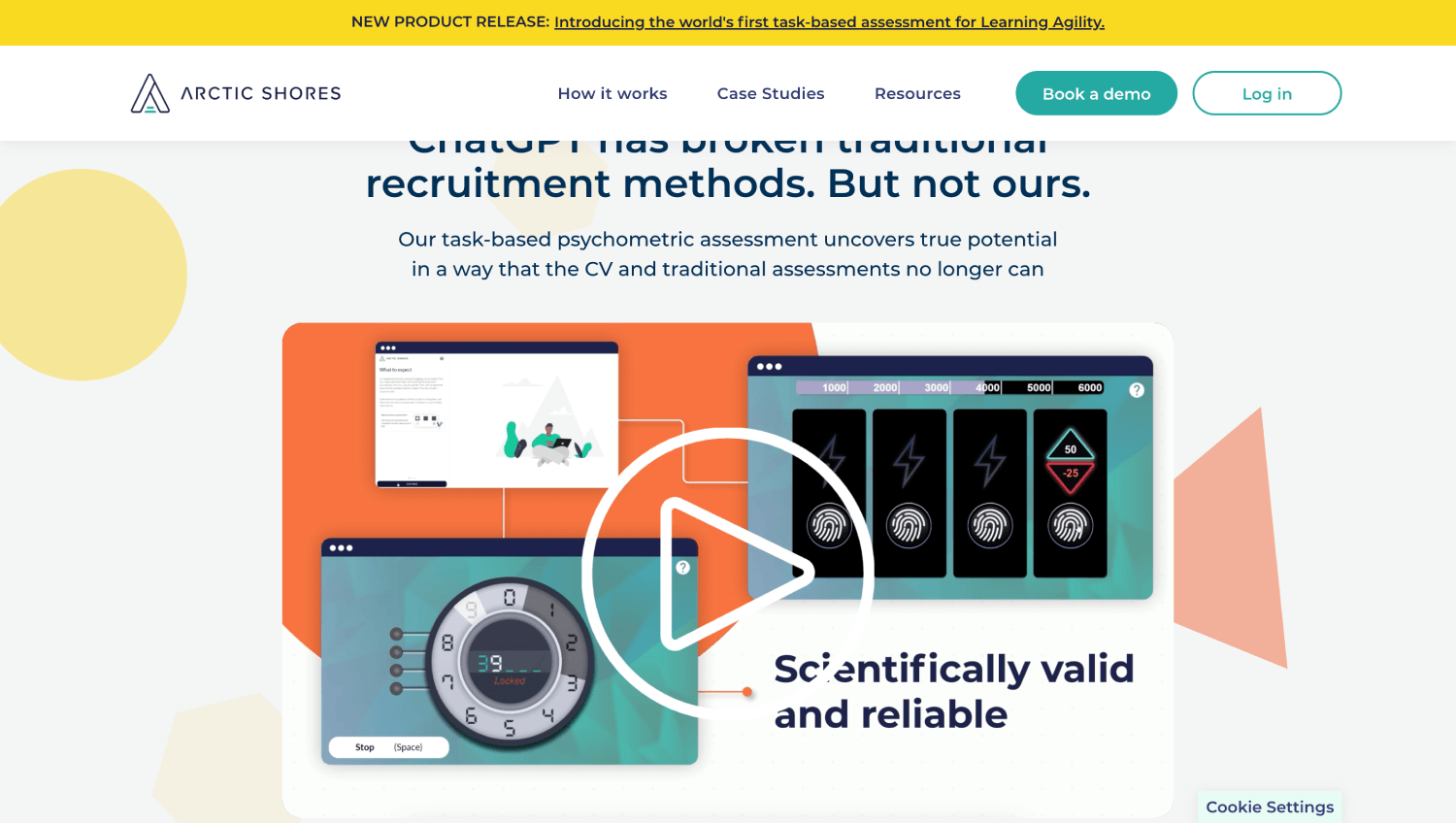
Arctic Shores is the most explicitly bias-conscious vendor in this list. Their game-based cognitive assessment is designed without CV screening as a prerequisite, and they publish their adverse impact data publicly as a matter of stated commercial commitment. Their target market is early-career and graduate hiring, where traditional cognitive tests have historically disadvantaged candidates from non-elite educational backgrounds.
Arctic Shores integrates with major ATS platforms and produces candidate score reports that explain performance in plain language. Their AI scoring layer has faced questions similar to those raised across the broader AI hiring tool market, which is why their published bias audit data matters. Teams evaluating this vendor should read those reports before contracting. For a broader framework on evaluating AI hiring tool fairness, the AI HR compliance and bias audit tools guide covers the evaluation checklist in detail.
Best for: Employers committed to expanding early-career talent pipelines beyond traditional CV-screened pools, particularly in the UK and European markets.
9. Harver
Harver targets high-volume hiring, particularly in customer service, BPO, retail, and logistics. Their assessment module combines cognitive ability measurement with situational judgment tests, realistic job previews, and culture fit elements in a single candidate-facing workflow. The cognitive component is not the standalone star , it is integrated into a sequence designed to predict performance in frontline roles.
Harver’s platform connects to Workday, SAP SuccessFactors, and other enterprise HRIS and ATS systems. Their reporting layer gives talent acquisition leaders pipeline conversion data alongside assessment scores, which is useful for high-volume ops teams. Pricing is quote-based and volume-driven.
Best for: TA leaders at companies hiring hundreds to thousands of frontline workers annually who need cognitive data embedded in a full assessment workflow rather than a standalone test.
10. Mettl by Mercer
Mettl, acquired by Mercer, is strongest in the India market and emerging markets broadly, though it serves global enterprise clients. Their cognitive assessment library is extensive, and the platform includes AI-powered online proctoring built in , a significant differentiator for organizations running large-scale assessments where cheating mitigation matters.
Mercer’s backing gives Mettl credibility in enterprise procurement cycles, particularly for clients already using Mercer for compensation or talent advisory work. The cognitive assessment quality is solid, and the proctoring integration reduces the need for a separate invigilation tool. The platform is notably more complex to configure than Criteria or McQuaig.
Best for: Enterprises in India, South Asia, and multinationals running high-stakes volume assessment programs where proctoring and cognitive testing need to live in a single workflow.
11. Bryq
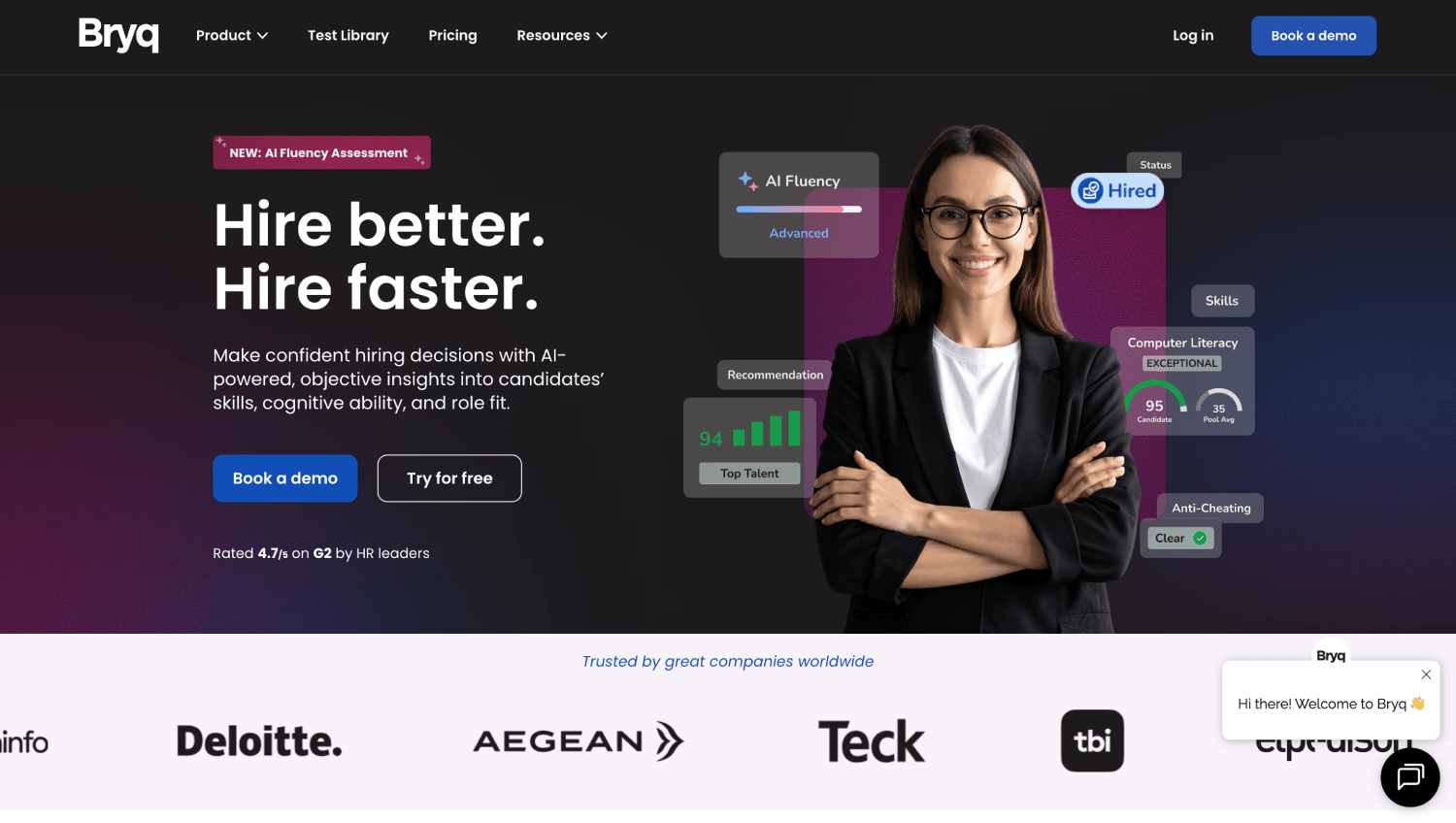
Bryq takes a distinct approach. Rather than selling a standalone cognitive battery, they layer cognitive assessment alongside culture-add alignment scoring, and they position the combined output as a bias-reduction tool. Recruiters see a ranked candidate list that weights cognitive fit alongside role and team compatibility without surfacing demographic data.
Bryq’s AI-driven matching engine is the thing most buyers find interesting. Their cognitive module covers reasoning and problem-solving, and the platform produces a role-specific candidate score rather than a raw aptitude percentile. Subscription pricing is available, making cost estimation more straightforward than most competitors in this list.
Best for: Teams specifically trying to operationalize structured, bias-aware hiring at scale, where cognitive score alone is not the hiring signal but one input in a fairer overall process.
How Do These Cognitive Assessment Tools Compare on Key Buying Criteria?
| Vendor | Published Validity Data | Adverse Impact Documentation | ATS Integrations | Candidate Completion Time | Game-Based Option |
|---|---|---|---|---|---|
| Criteria Corp | Yes | Yes | Strong (20+ native) | 15-20 min | Via Revelian |
| Talogy | Yes (extensive) | Yes | Good | 20-35 min | No |
| Wonderlic | Yes (extensive) | Yes | Good | 12-15 min | No |
| Predictive Index | Yes | Yes | Good | 12 min | No |
| Hogan Assessments | Yes (extensive) | Yes | Moderate | 25-30 min | No |
| Revelian | Yes | Yes (published) | Good | 15-20 min | Yes (Cognify) |
| McQuaig | Limited public data | Limited | Basic | 15 min | No |
| Arctic Shores | Yes | Yes (published) | Good | 20-25 min | Yes |
| Harver | Yes | Yes | Strong | 20-30 min (full flow) | No |
| Mettl by Mercer | Yes | Moderate | Good | Varies | No |
| Bryq | Yes | Yes | Good | 15-20 min | No |
What Does AI Actually Do in Cognitive Assessment Tools?
The term “AI-enhanced” gets applied loosely across this category. It is worth being specific about what vendors actually mean. In most cases, AI in cognitive assessment tools operates in one of three ways: adaptive testing (the system adjusts item difficulty based on prior responses), AI-based scoring and norming (models update score benchmarks as more data accumulates), and predictive outcome modeling (the platform correlates historical score data with downstream performance or retention metrics).
Adaptive testing is the most technically meaningful. A properly implemented adaptive test can measure cognitive ability with fewer questions than a fixed-length test while maintaining the same statistical precision. Criteria’s CCAT is not adaptive. Mettl and Harver offer adaptive options for certain modules. Arctic Shores’ game-based format is inherently adaptive by design.
What AI does not do in this category: generate new test items autonomously without psychometric review, guarantee bias elimination, or replace the validity study process. Any vendor claiming their AI “solves bias” without published subgroup data is marketing, not science. For teams evaluating where AI adds real value versus hype in hiring tools broadly, the AI interview tools guide covers the same question in the video assessment context.
What Are the Legal and Compliance Risks of Cognitive Ability Testing in Hiring?
Cognitive ability tests, as a class, produce measurable adverse impact on certain racial and ethnic groups. This is a documented finding in the industrial-organizational psychology literature, not a fringe concern. In the US, any selection procedure that produces disparate impact on a protected class is subject to EEOC Uniform Guidelines scrutiny, which requires employers to demonstrate job-relatedness and validity.
Practically, this means three things. First, use validated tests, not generic online quizzes branded as aptitude tests. Second, document the job analysis that connects test scores to job requirements. Third, consider score banding or combination scoring (cognitive plus other predictors) rather than hard cutoffs. Several vendors in this list, Talogy, Hogan, and Criteria, provide validation documentation packages that are designed for exactly this compliance use case.
In the EU, the AI Act’s requirements around high-risk AI systems used in employment contexts add another compliance layer. Vendors serving European clients should be able to provide conformity documentation and explainability reports. Arctic Shores and Bryq are ahead of most competitors here in terms of transparency materials. For a full view of how AI compliance requirements intersect with hiring tools, see the AI HR compliance and bias audit tools roundup.
How Should You Integrate Cognitive Assessments Into Your Hiring Workflow?
Cognitive tests work best after an initial screen, not as the first gate. Deploying a cognitive test before any human or structured review of a candidate’s basic qualifications is both legally riskier and candidate-experience negative. The most defensible workflow is: job application, then ATS-based minimum qualification filter, then cognitive assessment, then structured interview.
Placement in the funnel also affects completion rates. Tests sent after a brief recruiter phone screen see meaningfully higher completion than tests sent immediately on application. Vendors like Harver build this sequencing into their platform logic. For teams running structured interview workflows downstream of cognitive screening, the AI interview tools comparison covers how to connect these layers.
Score interpretation matters as much as score collection. Raw percentile scores without role-specific benchmarks mislead hiring managers. Every vendor in this list offers some form of role-benchmarked reporting; the quality varies. Ask vendors for sample score reports and benchmark methodology documentation before signing.
Frequently Asked Questions About Cognitive Ability Testing Tools
What is the most widely used cognitive ability test for hiring?
The Wonderlic Personnel Test has the longest commercial track record in employment screening. In the modern SaaS era, Criteria Corp’s CCAT (Criteria Cognitive Aptitude Test) is among the most widely deployed, partly because of Criteria’s accessible subscription pricing and ATS integrations. The Predictive Index Cognitive Assessment is also widely used, particularly among mid-market US companies already using PI’s behavioral tools.
How is a cognitive ability test different from a skills assessment?
A skills assessment tests what someone already knows how to do, such as writing SQL, building a financial model, or handling a customer complaint scenario. A cognitive ability test measures underlying mental processing capacity: how quickly someone reasons through novel problems, manipulates abstract information, or draws inferences from data. Cognitive tests predict learning speed and adaptability. Skills tests predict current task performance. For most roles, both data points have value and serve different hiring decisions.
Can cognitive ability tests cause legal problems for employers?
They can, if deployed without validity evidence and job-relatedness documentation. Cognitive tests as a class produce adverse impact on certain racial and ethnic groups, which triggers EEOC Uniform Guidelines scrutiny in the US if a selection procedure produces disparate impact. The legal defense requires showing the test is valid for the specific job in question. Established vendors like Talogy, Hogan, Wonderlic, and Criteria provide validation documentation for exactly this purpose. Using an unvalidated test from an unknown provider is where real legal exposure lives.
What is the difference between a cognitive test and a psychometric test?
Psychometric testing is the broader category. It covers any standardized, scientifically validated measurement of psychological attributes, including personality, values, behavioral style, emotional intelligence, and cognitive ability. Cognitive ability tests are a subset of psychometric testing. When vendors market “psychometric tests for hiring,” they often mean a suite that includes both cognitive and personality measures. Hogan, Predictive Index, and Talogy all sell combined psychometric packages that include cognitive components.
How long should a pre-employment cognitive test take?
Most validated cognitive tests run 12 to 25 minutes. Wonderlic and PI Cognitive Assessment both complete in 12 to 15 minutes. Game-based formats like Arctic Shores and Revelian typically run 15 to 25 minutes. Tests much shorter than 12 minutes generally lack enough items to produce statistically reliable scores. Tests longer than 30 minutes see measurably higher candidate dropout rates in high-volume contexts. Optimal length depends on role stakes: 12 to 15 minutes for volume hiring, 20 to 30 minutes for professional and managerial roles.
Do cognitive ability tests work for remote and global hiring?
Most modern cognitive testing platforms are browser-based and mobile-optimized, making them functional for remote and international candidates. Proctoring is the complicating variable. For high-stakes assessments where test security matters, vendors like Mettl offer integrated AI proctoring. For APAC-specific deployments, Revelian (now Criteria-owned) and Mettl have the strongest regional support infrastructure. Localization quality, including language availability and cultural norm samples, varies significantly across vendors and should be verified for any non-English-dominant market.
How do cognitive assessment tools connect to broader talent intelligence workflows?
Cognitive assessment data becomes more useful when it flows into a broader talent data infrastructure rather than sitting in a point solution silo. Some talent intelligence platforms can ingest third-party assessment scores to enrich candidate or employee profiles. Teams building out a connected talent stack should check vendor API documentation and consider how assessment data will persist post-hire for internal mobility and development decisions. The talent intelligence platform comparison covers the broader category of tools that sit downstream of assessment.
Which Cognitive Assessment Tool Should You Actually Buy?
The clearest framework is to start with two questions: what seniority level are you hiring, and how much legal defensibility documentation do you need? For mid-market teams hiring across a range of roles and wanting fast deployment with solid validity evidence, Criteria Corp is the most practical starting point. For enterprise teams filling professional and leadership roles where a failed hire costs hundreds of thousands of dollars, Talogy or Hogan is worth the longer procurement and higher cost. For high-volume hourly hiring, Wonderlic’s track record and simplicity are hard to argue with.
If candidate experience or bias reduction is your primary driver, look at Arctic Shores or Bryq. Both have made bias audit transparency a commercial differentiator, not an afterthought. If you are building out a connected hiring tech stack that includes AI sourcing and structured interviewing, check whether your shortlisted assessment vendor connects cleanly to your ATS before anything else. The most valid cognitive test in the market is useless if score data does not flow into the system where your recruiters make decisions. For teams also evaluating how cognitive assessment connects to a broader AI-driven recruiting workflow, the AI sourcing tools overview covers what sits at the top of that funnel.
Cognitive ability is a genuinely predictive signal. The vendors who have built serious businesses around it have decades of validation research backing them. The vendors who have not are selling something that looks the same but is not. Ask for the technical manual. If they cannot produce one, that is your answer.