
HR Tech SaaS may earn a commission when you buy through links on this page. Our recommendations are editorial and never paid for.
- SkyHive is strong on labor-market data and its quantum labor analysis, but several alternatives beat it on ontology depth, HRIS integrations, or internal mobility workflows.
- The right alternative depends on whether your primary use case is external labor-market benchmarking, internal skills mapping, talent marketplace activation, or workforce planning.
- Eightfold, Lightcast, Beamery, Gloat, Faethm by Pearson, TechWolf, and Workera each occupy a distinct position in this category.
- Pricing across all of these platforms is quote-only. Do not let a vendor lock you into a single skills ontology without confirming portability of your data.
- Integration depth with your HRIS and ATS matters more than any individual feature. A skills platform you cannot connect to Workday, SAP SuccessFactors, or Greenhouse is an island.
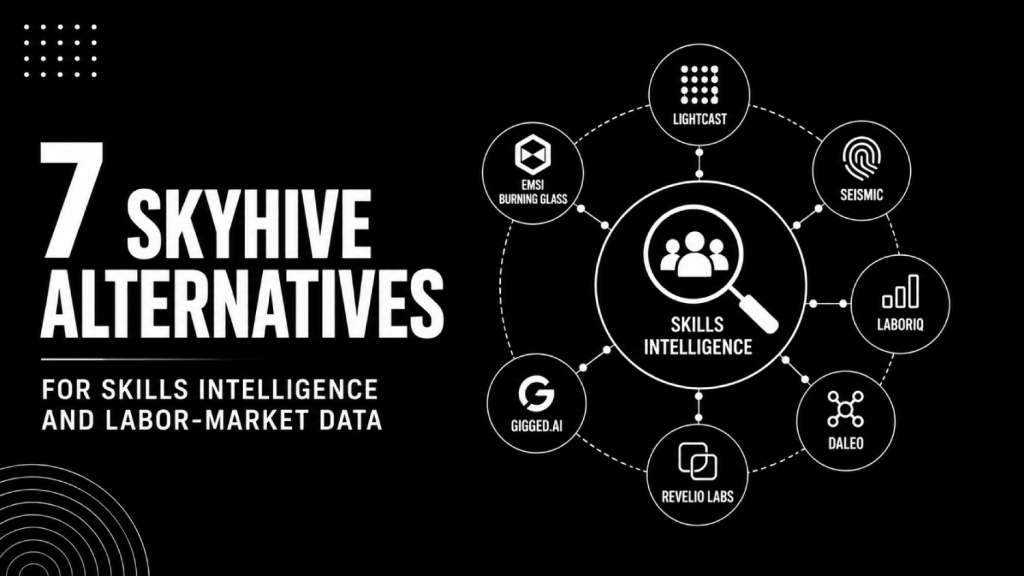
The best SkyHive alternatives for skills intelligence and labor-market data are Lightcast (for external labor-market depth), Eightfold AI (for AI-driven talent intelligence at scale), Beamery (for skills-based talent lifecycle management), Gloat (for internal talent marketplace activation), Faethm by Pearson (for workforce scenario planning), TechWolf (for skills inference from work data), and Workera (for technical skills assessment tied to learning).
Why Are Buyers Looking for SkyHive Alternatives?
SkyHive built a credible position around what it calls Quantum Labor Analysis: a method of mapping skills adjacencies and labor-market dynamics using real-time job posting data and proprietary skills graph technology. That is genuinely useful for workforce planning teams trying to understand where skills supply is tightening or where internal talent can pivot.
The reasons buyers start looking elsewhere fall into a few consistent patterns. SkyHive’s integration footprint is narrower than some competing platforms, which matters when you need skills data flowing into Workday HCM or SAP SuccessFactors automatically. Some HR leaders find the labor-market data focus strong but the internal-mobility and employee-facing features underdeveloped compared to dedicated talent marketplace platforms. Others need a skills ontology that connects directly to learning pathways or assessment data, which SkyHive does not own.
None of this makes SkyHive a bad product. It makes it a specific product, and the alternatives below each do something different well.
How Do These Platforms Differ on Ontology Depth and Labor-Market Data?
Before covering individual tools, it helps to separate two things that often get conflated: skills ontology and labor-market data. A skills ontology in HR tech is a structured taxonomy of skills, their relationships, and their hierarchy. Labor-market data is the external signal: job postings, wage trends, hiring velocity, and skills demand by geography and sector. Some platforms do both; most are stronger on one than the other.
| Platform | Ontology Depth | Labor-Market Data | Internal Mobility | Best Fit |
|---|---|---|---|---|
| Lightcast | High (EMSI + Burning Glass) | Very High | Low | Workforce planners, economists, L&D strategists |
| Eightfold AI | Very High (deep inference) | Medium | High | Enterprise talent intelligence + internal mobility |
| Beamery | High (Skills Cloud) | Medium | Medium-High | Skills-based talent lifecycle management |
| Gloat | Medium-High | Low | Very High | Internal talent marketplace activation |
| Faethm by Pearson | Medium | High (scenario modeling) | Low | Strategic workforce planning, automation impact |
| TechWolf | High (inferred from work data) | Low | Medium | Skills inference without self-reporting |
| Workera | High (technical skills) | Low | Medium | Technical skill assessment + learning alignment |
Which SkyHive Alternative Is Best for Labor-Market Intelligence: Lightcast
Lightcast is the closest direct competitor to SkyHive on external labor-market data. It was formed from the merger of EMSI and Burning Glass Technologies, combining two of the largest US labor-market data sets. The result is a platform with deep coverage of job postings, wages, regional skills supply and demand, and program-to-workforce outcome data.
Where SkyHive emphasizes skills adjacency and internal workforce mobility use cases, Lightcast is built for teams that need to answer questions at a macro level: which skills are growing in a given metro, what wage premiums are emerging for specific competencies, or whether a planned workforce expansion into a new geography is feasible given local talent supply. Educational institutions, economic development agencies, and large workforce planning teams are its natural home.
The trade-off is that Lightcast is not a talent management platform. It does not connect to your HRIS to surface an individual employee’s skill profile, and it has no native employee-facing features. It is an intelligence and analytics layer, not a workflow tool. Pricing is quote-only.
Which Alternative Is Best for Enterprise Talent Intelligence at Scale: Eightfold AI
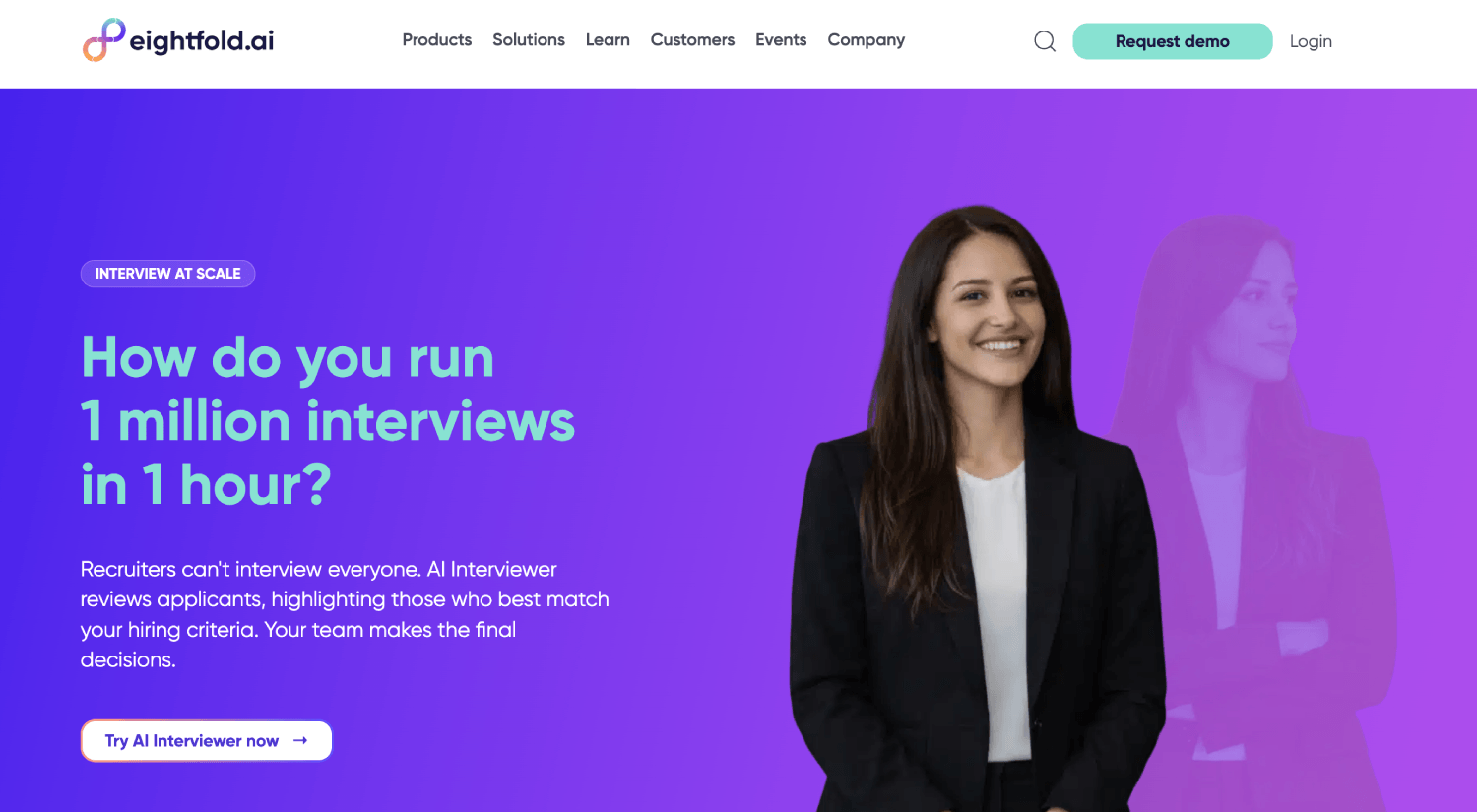
Eightfold AI takes a fundamentally different approach from SkyHive. Rather than starting with labor-market data, Eightfold starts with the employee and candidate record, inferring skills from resumes, work history, performance data, and project involvement using a deep learning model trained on a large global talent dataset.
The result is a platform that can answer both external questions (who in the market has the skills we need?) and internal ones (which employees have adjacent skills that qualify them for a role we’re about to backfill?) from the same interface. For enterprises running combined recruiting and internal mobility programs, that unified view is genuinely valuable. Eightfold integrates with Workday, SAP SuccessFactors, Oracle HCM, and most enterprise ATSs.
Eightfold’s ontology is deep by design, covering skills, potential, and career trajectory rather than just current stated skills. The weakness is implementation complexity: standing up Eightfold properly at a large organization takes time and requires feeding it quality data. Pricing is quote-only. For a broader comparison, see the full breakdown of the best talent intelligence platforms.
Which Alternative Is Best for Skills-Based Talent Lifecycle Management: Beamery
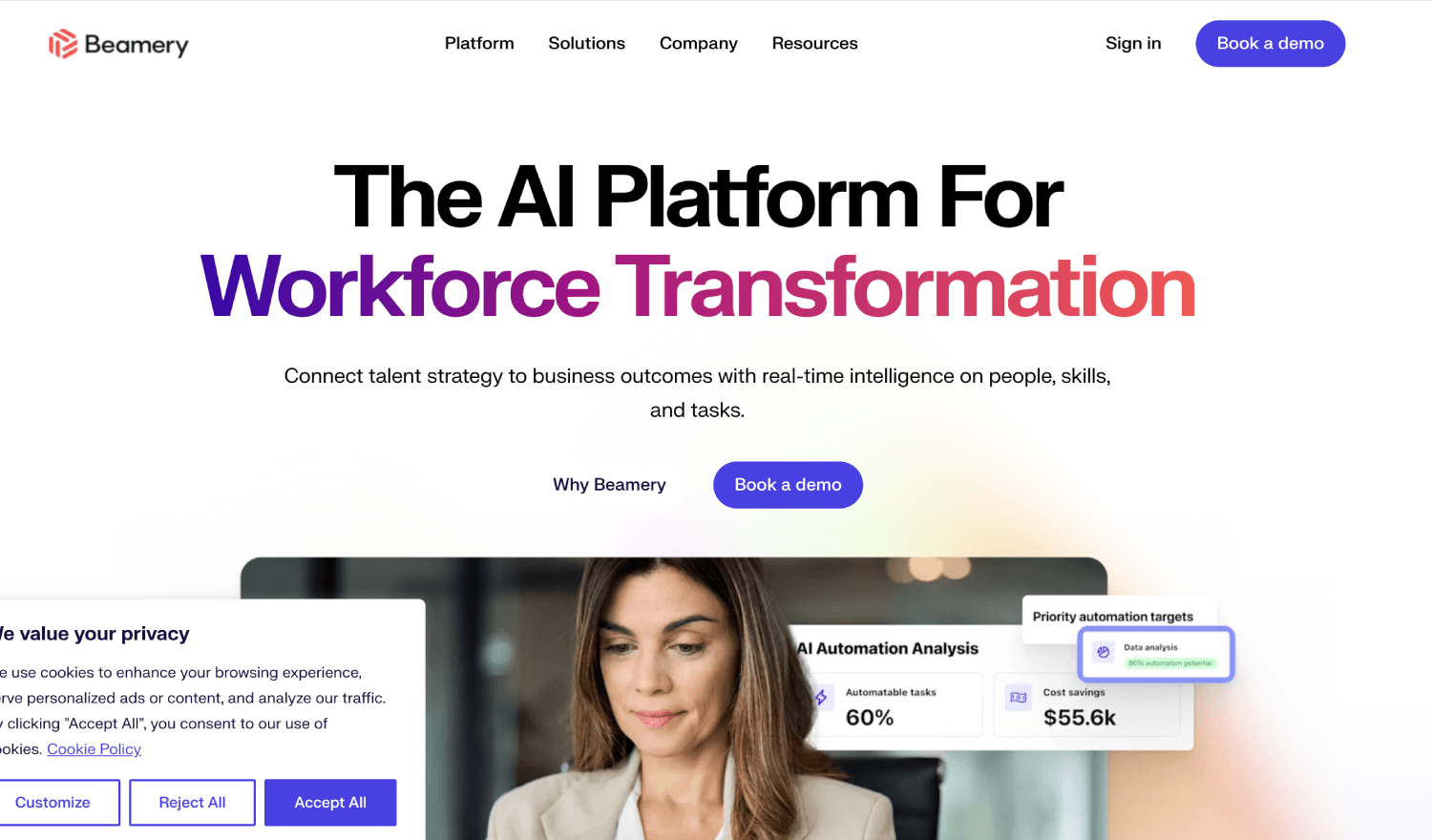
Beamery positions itself around what it calls a Skills Cloud: a dynamic skills graph that connects talent acquisition, internal mobility, and workforce planning under one platform. The key differentiator versus SkyHive is that Beamery spans the full talent lifecycle, from sourcing and candidate relationship management through to career development for existing employees.
For organizations building skills-based hiring practices, that breadth matters. Beamery lets you define a role in terms of skills rather than job titles, match candidates and internal employees against that profile, and track how the organization’s skill coverage evolves over time. The Skills Cloud includes market signals, but Beamery’s real strength is the workflow layer on top of the skills data.
Beamery is best suited for companies above 2,000 employees that already have a CRM or talent pipelining function and want to connect it to internal mobility. For smaller teams, the surface area is more than they need. Pricing is quote-only. Beamery also appears in the Phenom vs Beamery vs Eightfold comparison if you are evaluating those three head-to-head.
Which Alternative Is Best for Activating an Internal Talent Marketplace: Gloat
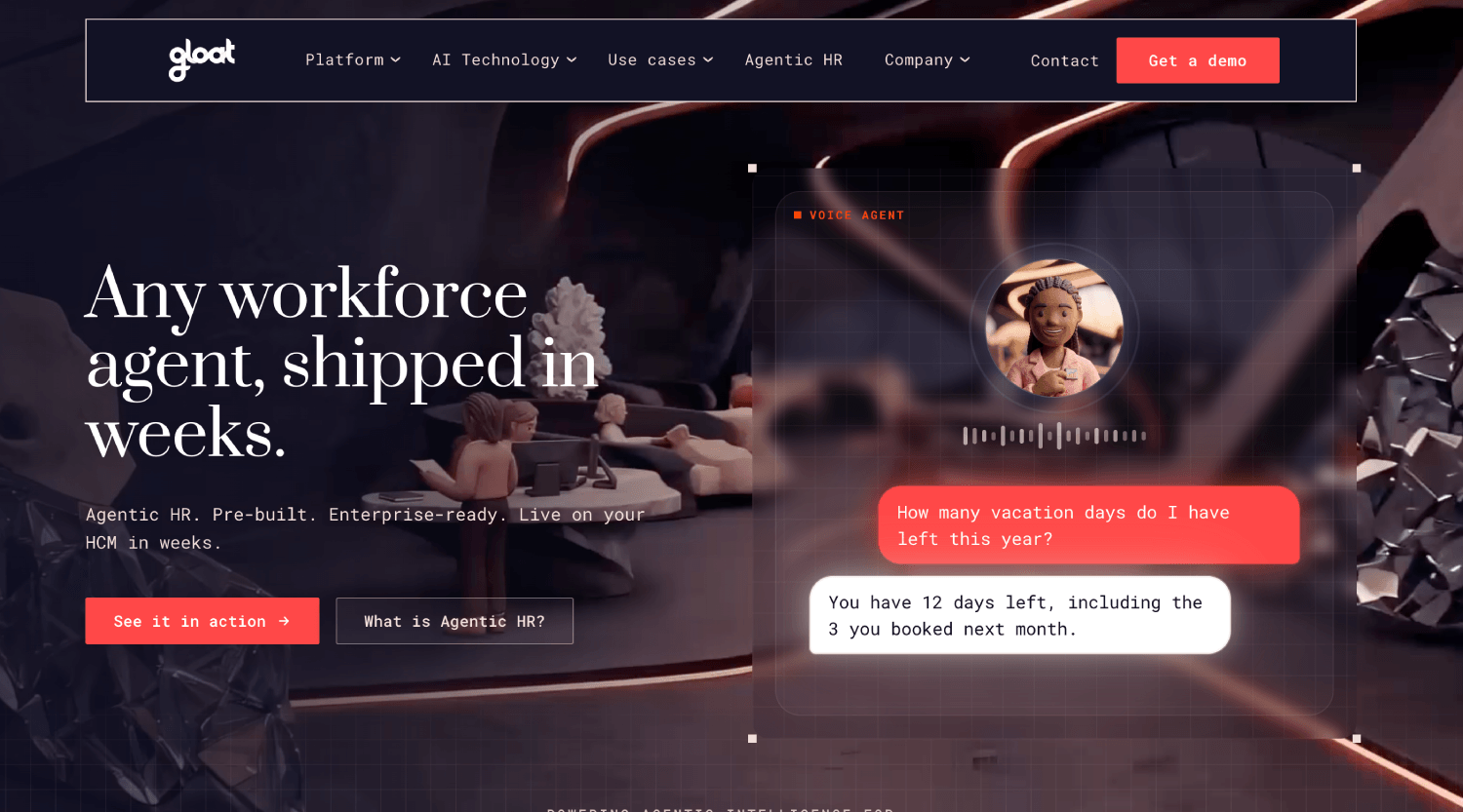
Gloat is the most employee-facing platform on this list. Its primary product is an AI-powered internal talent marketplace: a system that surfaces gig assignments, project opportunities, mentoring connections, and open roles to employees based on their skills and career interests. The skills intelligence capability exists to power that marketplace, not as a standalone data product.
That distinction matters if you are evaluating SkyHive for workforce planning or labor-market benchmarking. Gloat will not replace those use cases. Where it wins is in driving actual workforce agility: getting employees to move skills laterally before a backfill becomes necessary. Organizations that have deployed Gloat typically report measurable improvements in internal mobility rates, though specific figures vary by company size and industry configuration.
Gloat integrates with Workday, SAP, Oracle, and major LMS platforms. It is a post-HRIS layer, not a standalone HR system. Pricing is quote-only. For a detailed head-to-head, the Gloat vs Fuel50 vs Eightfold comparison covers the internal talent marketplace category in depth.
Which Alternative Is Best for Automation Impact and Workforce Scenario Planning: Faethm by Pearson

Faethm by Pearson occupies a niche that no other platform on this list owns: predictive workforce planning focused on the impact of automation, AI adoption, and macroeconomic shifts on job families and skills requirements. Pearson acquired Faethm to combine its labor-market modeling capability with Pearson’s learning content and credentials infrastructure.
If your workforce planning question is “which roles in our organization face the highest automation risk over the next three to five years, and what skills should we be building now?” then Faethm has more specific answers than SkyHive or most alternatives. It models the intersection of technology adoption curves and skill depreciation at a role-family level.
The limitation is that Faethm is a strategic planning and advisory tool more than a day-to-day HR workflow platform. It does not have an employee-facing interface and does not connect to HRIS data in the way that Eightfold or Beamery do. It is best used by workforce strategy teams, HR transformation leads, and CHROs who need a defensible analytical foundation for reskilling investment decisions. Pricing is quote-only.
Which Alternative Is Best for Inferring Skills Without Self-Reporting: TechWolf
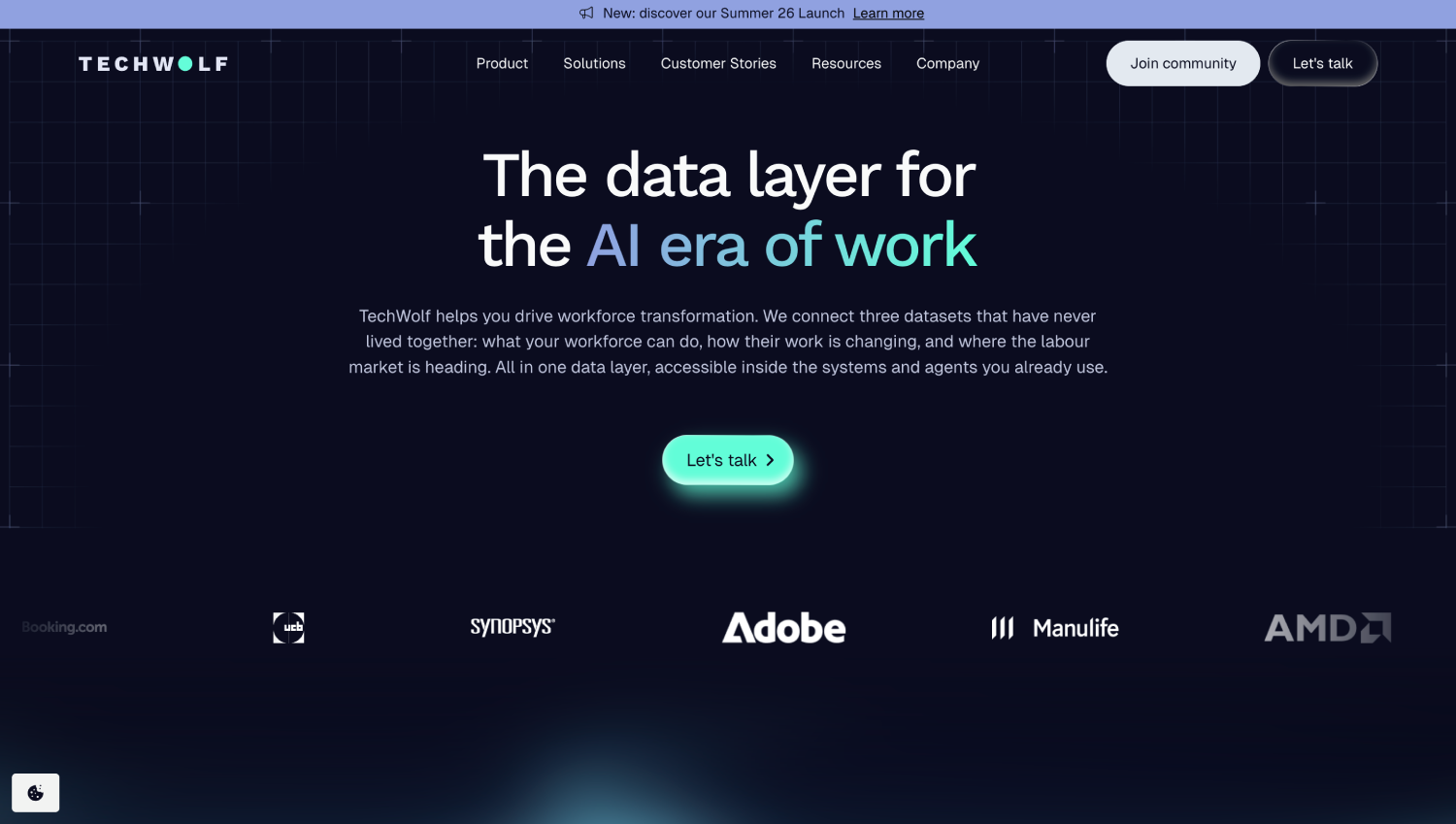
TechWolf solves a specific problem that most skills intelligence platforms sidestep: the accuracy gap between self-reported skills and actual demonstrated capability. Most platforms rely on employees entering their skills manually or on resumes as a proxy. TechWolf infers skills from work artifacts: emails, documents, calendar data, project outputs, and collaboration tool activity, using NLP to build a real-time skills profile without requiring employee input.
This is a meaningful differentiation. Self-reported skills data is notoriously unreliable. Employees omit skills they consider obvious, inflate skills they want to develop, and rarely update profiles after initial entry. TechWolf’s inferred model gets closer to ground truth, which makes downstream decisions, whether for internal mobility, learning recommendations, or workforce planning, more reliable.
The privacy architecture is worth scrutinizing before deployment. TechWolf processes communication and document data at an aggregate level with privacy controls, but any tool that reads work activity requires careful governance review, employee communication, and likely works council or legal consultation depending on jurisdiction. Pricing is quote-only.
Which Alternative Is Best for Technical Skill Assessment Connected to Learning: Workera
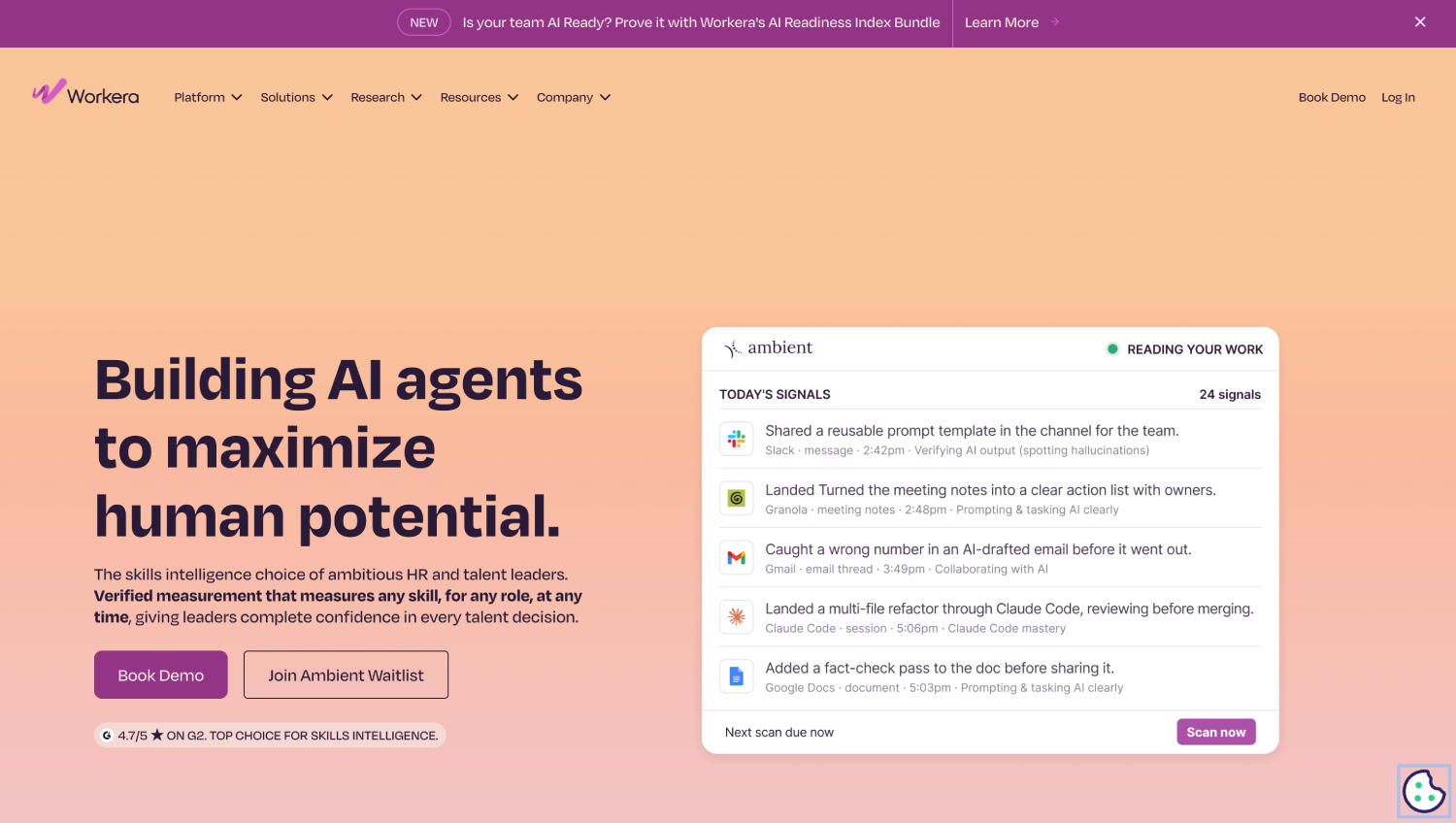
Workera is the narrowest platform on this list in scope but the deepest in a specific lane. Founded by former members of Andrew Ng’s AI education work, Workera focuses on assessing technical and AI-adjacent skills, mapping them to precise proficiency levels, and connecting those assessments to structured learning recommendations.
For organizations building AI literacy programs or reskilling technical workforces, Workera produces more granular skill measurement than any other platform here. It does not attempt to cover the full HR workflow. The output is a skills gap profile at an individual and team level, calibrated against actual assessed performance rather than self-report or resume inference.
The limitations are scope and depth of coverage. Workera excels at technical, data, and AI skill domains. For broader skills intelligence covering soft skills, leadership competencies, or functional business skills, it is not the right tool. For a fuller picture of where Workera sits, see Workera alternatives for skills intelligence and assessment. Pricing is quote-only.
How Do These SkyHive Competitors Compare on Integrations and Implementation?
Skills intelligence platforms are only as useful as their connections to the systems where decisions actually happen. A skills graph that does not feed into your ATS, HRIS, or LMS is a reporting layer you will stop using within six months.
| Platform | Workday | SAP SuccessFactors | Oracle HCM | Native ATS Integration | LMS Integration |
|---|---|---|---|---|---|
| Lightcast | Via API | Via API | Via API | Limited | Limited |
| Eightfold AI | Yes | Yes | Yes | Yes (multiple) | Yes |
| Beamery | Yes | Yes | Yes | Yes (multiple) | Yes |
| Gloat | Yes | Yes | Yes | Limited | Yes |
| Faethm by Pearson | Via API | Via API | Via API | No | Via Pearson |
| TechWolf | Yes | Yes | Yes | Limited | Yes |
| Workera | Via API | Via API | Via API | No | Yes |
Implementation timelines vary significantly. Eightfold and Beamery both require structured implementation projects, typically three to six months to full production use at enterprise scale. Gloat and TechWolf tend to move faster given narrower initial scope. Lightcast and Faethm are analytics tools that can be onboarded more quickly but deliver less operational value without a connected workflow. Before any purchase, run the vendor through a structured AI HR vendor evaluation checklist to pressure-test their integration claims.
What Should You Actually Evaluate When Comparing Skills Intelligence Platforms?
Most vendor demos show you the best-case version of their skills graph. Here are the questions that surface real capability differences.
How is the skills ontology maintained and updated?
Skills decay fast. AI engineering skills from 2022 are materially different from those required today. Ask each vendor how frequently their ontology updates, whether they use real-time labor-market signals or periodic batch updates, and who makes the call on adding or deprecating skill nodes. A static ontology degrades in value within 12 months.
Can you bring your own taxonomy or must you use theirs?
Most platforms require you to map your internal job architecture to their ontology. Some allow hybrid models where you maintain custom skill definitions alongside their standard taxonomy. Vendors that require full adoption of their taxonomy create a switching cost that is worth pricing explicitly before signing.
How is data portability handled at contract end?
Skills profiles built inside these platforms represent organizational IP. Confirm before signing: what data can you export, in what format, and what happens to derived skills profiles the platform generated from your employee data? This is especially relevant with AI-inferred profiles from tools like TechWolf and Eightfold.
What does the skills data actually power?
The best skills intelligence platforms are not dashboards, they are decision engines. A platform that produces a skills heatmap but does not connect to a hiring workflow, a learning recommendation engine, or a succession planning tool is a reporting cost with no operational ROI. Ask vendors to show you a decision that their customers make differently because of the skills data, with a specific example.
Frequently Asked Questions
What is SkyHive used for?
SkyHive is a skills intelligence platform that uses labor-market data and skills graph technology to help organizations map workforce skills, identify skills gaps, and connect employees to internal opportunities. Its Quantum Labor Analysis methodology maps skills adjacencies using real-time job market signals. HR teams use it primarily for workforce planning, internal mobility, and skills-based talent strategy.
How does Lightcast compare to SkyHive for labor-market data?
Lightcast (formed from EMSI and Burning Glass) has broader and deeper external labor-market data coverage than SkyHive, drawing on one of the largest job postings databases in the US. SkyHive focuses more on skills adjacency mapping and internal workforce applications. Lightcast is the stronger choice for strategic workforce planning and geographic talent supply analysis; SkyHive is more operationally integrated for employee-facing mobility workflows.
Is Eightfold AI a direct SkyHive competitor?
Eightfold competes with SkyHive in the skills intelligence space but from a different angle. SkyHive starts with external labor-market data; Eightfold starts with employee and candidate records and infers skills through AI. Eightfold is stronger for talent acquisition and internal mobility workflows; SkyHive has stronger labor-market benchmarking. They overlap on skills gap analysis and workforce planning but serve different primary buyers.
Which skills intelligence platform is best for internal talent mobility?
Gloat is the strongest dedicated internal talent marketplace platform, with the most developed employee-facing interface for surfacing gig work, projects, and internal roles based on skills. Eightfold and Beamery also support internal mobility but as part of broader talent intelligence suites. SkyHive supports mobility use cases but is not as deep on the employee experience side as Gloat.
Do any of these platforms work for companies under 500 employees?
Most platforms in this category are built for enterprises above 1,000 employees. Workera is the most accessible at smaller scale for technical teams. TechWolf also works at lower headcount. Lightcast has products used by educational institutions and economic development agencies at various scales. Eightfold, Beamery, and Gloat are generally only cost-justified above 1,000 to 2,000 employees.
What is the difference between a skills ontology and labor-market data?
A skills ontology is a structured framework defining skills, their relationships, and their hierarchy within a taxonomy. Labor-market data is external signal: job postings, wage data, hiring velocity, and skills demand trends by geography and industry. Skills ontologies help you organize and classify what your workforce knows; labor-market data tells you what the external market values and where supply is tightening. The best platforms combine both.
How much do skills intelligence platforms cost?
All major skills intelligence platforms, including SkyHive, Lightcast, Eightfold, Beamery, Gloat, Faethm, TechWolf, and Workera, are priced on a quote-only basis. Pricing typically depends on employee headcount, module selection, integration complexity, and contract length. None of these vendors publish list pricing. Budget conversations generally start in the low six figures annually for enterprise deployments.
The Right Framework for Choosing a SkyHive Alternative
Skills intelligence buying decisions go wrong when teams conflate two distinct needs. If you need external labor-market benchmarking to inform workforce planning decisions, Lightcast or Faethm is the relevant comparison. If you need an internal skills graph that powers hiring, mobility, and development workflows, Eightfold, Beamery, or Gloat is the right category. Buying a labor-market analytics tool when you need a talent marketplace, or vice versa, produces a platform that gets used intensively for the first quarter and abandoned by year two.
TechWolf earns serious consideration if your organization has struggled with skills data quality. Self-reported skills taxonomies degrade quickly without active governance. An inferred model removes that maintenance burden, but it requires privacy architecture work that most HR teams underestimate before signing. For teams building AI and technical workforce capability specifically, Workera produces assessment depth that no other platform here matches. Understanding how skills intelligence software categories differ before starting vendor conversations will sharpen the requirements you bring to demos.
The decision ultimately comes down to where skills data needs to live to be useful. A skills graph that feeds your HRIS, ATS, and LMS automatically will generate adoption and measurable outcomes. One that lives in a separate analytics environment, requiring manual export and interpretation, will not. Map your integration requirements first, then evaluate ontology depth and labor-market coverage. In that order.