
HR Tech SaaS may earn a commission when you buy through links on this page. Our recommendations are editorial and never paid for.
- Talent intelligence platforms analyze your workforce and the external labor market to inform decisions: who to hire, who to develop, where skills are declining, what roles are at risk.
- Internal talent marketplaces operationalize internal movement: matching employees to open roles, projects, gigs, and mentors inside your organization.
- Buying a talent intelligence platform when you need an internal marketplace is like buying a GPS when you need a car. The insight alone does not move anyone anywhere.
- Most organizations above 2,000 employees need both layers eventually, but the right starting point depends on whether your immediate problem is insight or execution.
- Several vendors, including Eightfold AI and Gloat, now sell both capabilities, which makes the category boundary blurrier but does not eliminate the underlying distinction.
Talent intelligence platforms and internal talent marketplaces are not the same product. Talent intelligence is an insight layer: it reads your workforce data, external labor market signals, and skills taxonomies to tell you what you have, what you need, and what is changing. An internal talent marketplace is an execution layer: it creates a visible, searchable inventory of internal opportunities and matches employees to them. One informs workforce decisions. The other operationalizes internal movement. Your organization likely needs both, but rarely at the same time, and rarely from the same vendor.
Why Do Buyers Confuse These Two Categories?
The confusion is partly a vendor problem. Platforms like Eightfold, Beamery, and Gloat all use the word “talent” prominently, all claim AI as a differentiator, and all sell into the same enterprise HR buyer. Some now offer components of both categories in a single platform. A vendor’s marketing rarely volunteers the distinction when obscuring it closes more deals.
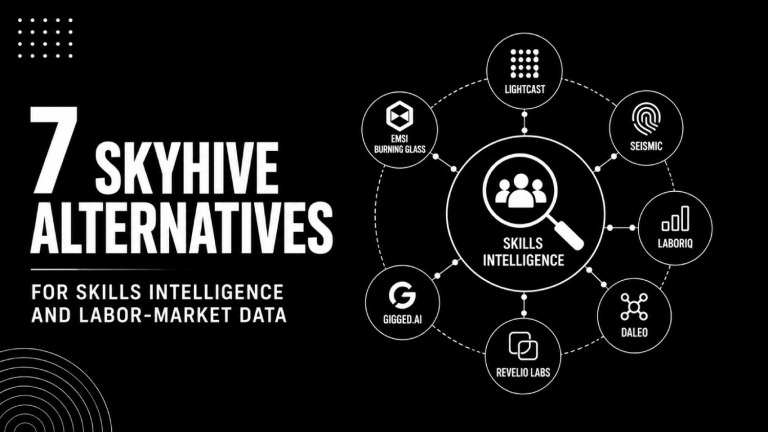
The confusion is also a symptom of how HR tech categories mature. Talent intelligence emerged from recruiting and HR analytics roots, borrowing from labor market data companies like Lightcast (formerly Burning Glass and EMSI). Internal talent marketplaces emerged from learning and development, internal mobility, and gig-work concepts inside large enterprises. They converged on the same territory: skills. Both categories now speak the language of skills-based organizations, which makes them sound interchangeable even when their architectures, users, and workflows are fundamentally different.
What Does a Talent Intelligence Platform Actually Do?
A talent intelligence platform aggregates external candidate data, internal workforce records, and labor market signals, then applies AI to surface patterns a human analyst would miss. Platforms like Eightfold, Gloat, Beamery, and Findem sit above your ATS and HRIS, reading data from both and adding a third layer: real-time labor market intelligence about skills supply, demand, and compensation trends.
The primary user of a talent intelligence platform is an HR leader, workforce planner, or CHRO. These tools produce answers to strategic questions. Which roles will be hardest to fill in 18 months? Which of our employees have skills that map to roles we have not yet created? Where is our workforce most exposed to automation? What does it cost to hire versus develop a capability externally?
Talent intelligence platforms do not typically put anything in front of employees. They inform the decisions HR makes on behalf of employees. That distinction matters for adoption, budget justification, and implementation sequencing.
Core capabilities of a talent intelligence platform
- Skills inference from resume, profile, and work history data without employees self-reporting
- Labor market benchmarking against external job posting and hiring trend data
- Flight risk and retention modeling based on workforce signals
- Workforce planning scenarios tied to headcount and skills gap projections
- Diversity pipeline analytics across external talent pools
- Candidate rediscovery from existing ATS data
The output is almost always a dashboard, a report, or an alert surfaced to an HR or recruiting leader. The action that follows is a human decision: open a new requisition, greenlight a reskilling program, adjust a compensation band.
What Does an Internal Talent Marketplace Do?
An internal talent marketplace is a platform employees interact with directly. According to Gartner’s market definition, internal talent marketplaces are worker-facing platforms that use AI-enabled skills management to match people with experiential development opportunities. That includes full-time role transfers, short-term projects, mentoring relationships, stretch assignments, and job shadowing.
The primary user here is the employee. Secondary users are managers (who post project needs or endorse skills) and HR operations (who monitor movement rates and fill times). The platform is designed to make internal opportunities visible and friction-free enough that employees actually find and pursue them before looking externally.
Companies like Fuel50, Gloat, Hitch Works, and Phenom compete in this space. The core value proposition is retention through internal mobility: employees who can see a career path and access internal opportunities stay longer and develop faster than those who cannot.
Core capabilities of an internal talent marketplace
- Employee-facing opportunity boards surfacing roles, projects, gigs, and mentors
- AI matching between employee skills profiles and internal opportunities
- Skills self-assessment and manager endorsement workflows
- Internal application and expression-of-interest tracking
- Manager dashboards showing team members exploring internal moves
- Learning path recommendations tied to career goals
The key architectural difference from a talent intelligence platform: employees build and own their profiles. Internal talent marketplaces rely on employee-generated data. Talent intelligence platforms work largely with system-generated and passively collected data.
Side-by-Side: Talent Intelligence Platform vs Internal Talent Marketplace
| Dimension | Talent Intelligence Platform | Internal Talent Marketplace |
|---|---|---|
| Primary user | HR leaders, workforce planners, CHROs | Employees, managers, HR ops |
| Core output | Insight, analysis, recommendations | Opportunity matching, internal mobility |
| Data source | ATS, HRIS, external labor market feeds | Employee-generated profiles, manager input |
| Workflow it replaces | Manual workforce planning, analyst reporting | Informal internal referrals, email-based moves |
| Adoption dependency | HR team adoption; employee-invisible | Requires employee buy-in and profile completion |
| Integration requirements | ATS + HRIS; external data feeds | HRIS + LMS; sometimes ATS |
| Time to value | Faster initial insight; slower strategic ROI | Slower setup; ROI tied to actual internal moves |
| Budget owner | CHRO, workforce strategy | CHRO, L&D, talent management |
| Typical contract value | Quote-only (most vendors do not publish pricing) | Quote-only (most vendors do not publish pricing) |
| Examples | Eightfold, Beamery, Findem, Lightcast | Gloat, Fuel50, Hitch Works, Phenom, Eightfold |
Eightfold appears in both columns deliberately. It sells a platform that includes both talent intelligence and internal marketplace functionality, which is common among the larger players. That breadth can be a reason to buy or a reason to be skeptical, depending on how deeply either layer is implemented.
What Business Problem Are You Actually Trying to Solve?
The fastest way to pick the right category is to name your problem with specificity. Generic problems produce wrong purchases.
“We don’t know what skills we have” is a talent intelligence problem. The answer requires aggregating and inferring skills data from existing workforce records, not building an employee-facing marketplace before you know what you are working with.
“We’re losing good people because they can’t see career paths internally” is a talent marketplace problem. Employees are leaving for lateral moves they could have made internally, and the solution is a visible, easy-to-use internal opportunity system, not another dashboard for HR.
“We’re spending too much on external hiring when we have internal candidates we don’t know about” is a talent intelligence problem with a talent marketplace execution layer. You need intelligence to identify the internal candidates and a marketplace to surface opportunities to them. This is the case for both, and it is more common than buyers expect at organizations above 3,000 employees.
“We need to plan our workforce for a major transformation in the next two years” points to workforce planning software that may sit adjacent to or on top of a talent intelligence platform. Our workforce planning software guide covers the tools that handle scenario modeling and headcount forecasting specifically.
When Should You Buy a Talent Intelligence Platform First?
Buy talent intelligence first if your organization lacks a structured view of workforce skills and cannot connect external hiring trends to internal capability gaps. Without that foundation, an internal marketplace becomes a well-designed platform matching employees to opportunities based on incomplete or inaccurate skills data.
Talent intelligence is also the right first purchase if you are in active workforce planning mode: restructuring, acquiring a business, entering a new market, or facing regulatory-driven changes to your workforce composition. These situations require analysis before action. An internal marketplace cannot tell you which roles to create or eliminate. A talent intelligence platform can.
Organizations that have recently invested in AI people analytics platforms may find significant capability overlap with entry-level talent intelligence offerings. Before buying a standalone talent intelligence platform, audit what your existing HCM or analytics tools already cover. Workday, SAP SuccessFactors, and Oracle HCM all include workforce analytics modules that handle some talent intelligence use cases natively.
When Should You Buy an Internal Talent Marketplace First?
Buy an internal talent marketplace first if your attrition is driven by lack of internal visibility and your immediate goal is retention through internal mobility. This is measurable: if exit interview data shows employees leaving for roles they could have held internally, a marketplace addresses that problem directly. Workforce planning analytics does not.
Companies with large hourly or frontline workforces where shift mobility, cross-training, and internal gig work are common also get faster ROI from a marketplace. The use case is concrete and high-frequency. Employees interact with the platform constantly, which drives adoption in a way that enterprise workforce planning tools rarely achieve.
A talent marketplace without underlying skills intelligence is not useless, but it is less precise. It will surface matches based on job title, tenure, and self-reported skills rather than inferred competencies and labor market signals. For many mid-market organizations, that level of matching is good enough to start generating value. Do not let perfect be the enemy of functional.
What About Skills Intelligence as a Separate Category?
Skills intelligence has emerged as a distinct category adjacent to both talent intelligence and internal talent marketplaces. Where talent intelligence platforms tend to sit in an HR analytics or workforce planning workflow, skills intelligence tools focus specifically on building, maintaining, and activating a skills ontology for the organization.
Vendors like Degreed, Cornerstone OnDemand, and SAP SuccessFactors include skills intelligence components in broader learning or HCM platforms. Pure-play skills intelligence vendors are rarer. More often, skills intelligence is a feature set inside a larger talent intelligence platform or an internal marketplace, not a standalone category you should be shopping for independently.
If a vendor pitches you “skills intelligence” as a standalone product, ask what sits above it (workforce planning) and what sits below it (the activation layer that puts skills data to work for employees). A skills taxonomy with no activation mechanism is a taxonomy project, not a software purchase.
Do You Need Both? A Practical Sequencing Guide
Most enterprise HR teams end up buying both categories over time. The question is sequencing, not either/or. Here is a practical framework by organizational stage:
| Organization Profile | First Purchase | Second Purchase | Rationale |
|---|---|---|---|
| 500-2,000 employees, high attrition, limited internal mobility | Internal talent marketplace | Talent intelligence layer (2-3 years out) | Retention ROI is immediate; workforce planning complexity is manageable manually |
| 2,000-5,000 employees, workforce transformation underway | Talent intelligence platform | Internal talent marketplace | Transformation requires skills gap analysis before you build mobility infrastructure |
| 5,000+ employees, multiple business units, global hiring | Both, ideally integrated | N/A | Complexity demands insight and execution in parallel; integration reduces data fragmentation |
| High-growth scaleup, 200-500 employees | Neither yet; use HRIS + ATS analytics | Internal talent marketplace at 500+ headcount | Category-level platforms require sufficient headcount to generate meaningful signals and justify cost |
When evaluating vendors who sell both capabilities in a single platform, apply the same scrutiny you would to any bundled offering. Check whether the talent intelligence layer is substantive (proprietary skills ontology, external labor market data, workforce planning workflows) or thin (a skills tagging feature dressed up as intelligence). The same test applies to the marketplace layer: does it drive employee adoption, or does it surface a list of open jobs employees could find on your intranet?
Our AI HR vendor evaluation checklist has 50 questions worth running through for any platform in this space, particularly around data ownership, skills taxonomy methodology, and integration depth.
How Does the Buy Decision Change If You Already Have Workday, SAP, or Oracle?
If your HRIS is Workday, SAP SuccessFactors, or Oracle HCM, your buying calculus changes significantly. All three vendors have invested in skills management, internal mobility, and workforce analytics in recent years. Our comparison of Workday AI, SAP Joule, and Oracle AI for HR covers what each platform now handles natively.
The honest answer is that native HCM capabilities in these areas are improving but still lag behind specialized vendors on depth. Workday Skills Cloud and SAP’s skills framework provide baseline skills management. Neither matches the labor market data depth of a Lightcast-powered talent intelligence platform or the employee experience quality of a purpose-built marketplace like Gloat or Fuel50.
The decision is fundamentally a build-versus-buy argument inside your existing contract. Activating Workday’s native mobility features costs less upfront and requires no new integration. Buying a best-of-breed marketplace or intelligence platform costs more but delivers a more capable product. For organizations where internal mobility or workforce planning is a strategic priority, the specialist vendor typically wins on capability. For organizations where it is a nice-to-have, native HCM features are usually sufficient.
What Are the Real Implementation Risks in Each Category?
Talent intelligence platforms fail most often at the insight-to-action gap. The platform generates analysis that nobody acts on because HR does not have the process infrastructure to translate workforce planning outputs into hiring decisions, L&D investments, or manager conversations. Buying the platform without redesigning the workflow around it produces an expensive dashboard.
Internal talent marketplaces fail most often at adoption. Employees will not complete profiles, explore opportunities, or apply internally if the platform feels like extra work, if managers do not release their people for internal moves, or if the culture treats internal applications as disloyal. Technology cannot fix a hoarding culture. Before buying a marketplace, assess whether your managers are incentivized to develop and release talent or to protect headcount.
Both categories share integration risk. Neither platform delivers full value in isolation from your HRIS. Talent intelligence platforms need clean, current employee data to generate accurate skills profiles. Internal talent marketplaces need accurate org data to enforce eligibility rules and surface the right opportunities. Check integration documentation before you sign. Our HR software implementation checklist covers the data migration and integration questions worth asking before any major platform purchase.
Frequently Asked Questions
What is a talent intelligence platform?
A talent intelligence platform is an AI-powered analytics layer that aggregates internal workforce data, ATS data, and external labor market signals to help HR leaders make better decisions about hiring, workforce planning, and skills development. It does not typically have an employee-facing interface. Vendors include Eightfold AI, Beamery, Findem, and Lightcast. These platforms answer questions like “what skills are we missing,” “who is at flight risk,” and “what roles will be hardest to fill in 18 months.”
What is an internal talent marketplace?
An internal talent marketplace is an employee-facing platform that surfaces internal career opportunities, including open roles, project assignments, mentoring relationships, and stretch assignments, and matches employees to them using AI. The goal is to increase internal mobility, reduce attrition, and improve employee development. Employees build profiles, express interest in opportunities, and apply internally through the platform. Gloat, Fuel50, Phenom, and Hitch Works are representative vendors in this category.
Can one platform do both talent intelligence and internal marketplace?
Some platforms, most notably Eightfold AI, sell both capabilities in a unified product. Beamery also combines talent intelligence, CRM, and some marketplace functionality. Whether the combined offering is deep enough in both areas depends heavily on your use case. Buyers should evaluate the intelligence layer and the marketplace layer separately, even within a single vendor platform, rather than assuming integration means equal capability across both.
What is the difference between internal mobility and talent intelligence?
Internal mobility describes the actual movement of employees across roles, projects, and functions within an organization. Talent intelligence is the analytical capability used to understand your workforce’s skills, gaps, and potential. Talent intelligence can inform an internal mobility strategy by identifying which employees have the skills to fill which roles. An internal talent marketplace operationalizes mobility by making opportunities visible and accessible to employees. Mobility is what happens. Intelligence informs what should happen.
Do I need skills intelligence as a separate purchase?
In most cases, no. Skills intelligence typically arrives as a feature set embedded in either a talent intelligence platform or an internal talent marketplace. If a vendor sells “skills intelligence” as a standalone product without an adjacent insight layer or activation layer, push back on whether you are buying a complete workflow or just a taxonomy project. Standalone skills management tools like those in Degreed or Cornerstone are more relevant if your primary use case is learning path recommendation, not workforce planning or internal mobility.
How much do talent intelligence platforms and internal talent marketplaces cost?
Neither category publishes standard pricing. Virtually every vendor in both categories, including Eightfold, Gloat, Beamery, Fuel50, and Findem, sells on a quote-only basis. Pricing typically scales with employee headcount and the number of product modules activated. Enterprise contracts in both categories commonly run to six figures annually. Budget accordingly and request multiple vendor quotes before negotiating, because the gap between initial quotes and final contract value in this space is often significant.
What company size makes sense for these platforms?
Internal talent marketplaces typically generate meaningful ROI at 500 or more employees, where the internal opportunity pool is large enough to drive real matching. Talent intelligence platforms are most valuable at 1,000 or more employees, where manual workforce analysis becomes impractical and skills data is sufficiently complex to require AI-assisted inference. Below those thresholds, your existing HRIS analytics and a structured internal jobs board may serve you well enough while you build toward a platform investment.
How complex is integration with an existing ATS or HRIS?
Integration complexity varies significantly by vendor and by what systems you already run. Talent intelligence platforms typically connect to your ATS and HRIS through pre-built connectors or API integrations, but data quality on your end matters as much as connector availability. If your employee records are inconsistent or your ATS data is incomplete, the platform’s skills inference will reflect those gaps. Internal talent marketplaces primarily need clean HRIS data for org structure, eligibility rules, and employee profiles. Some also connect to your LMS and ATS. Before signing, request the vendor’s integration documentation and ask specifically which fields are required versus optional, what the typical data sync cadence is, and whether your existing ATS or HRIS is on their certified integration list. For a broader pre-purchase integration checklist, our HR software buying checklist covers the right questions to ask any vendor before you commit.
The Decision in Plain Terms
If your board asked you “do we know what our workforce is capable of and where our biggest gaps are,” you need talent intelligence. If your employees keep leaving for opportunities they could have found internally, you need a talent marketplace. If the answer to both questions is “yes, that’s us,” sequence the intelligence layer first so the marketplace has accurate skills data to work with.
The vendors that sell both will pitch you a unified platform as the obvious answer. That pitch is sometimes right, particularly for large enterprises that can absorb the implementation complexity and contract cost of a full suite. For organizations earlier in their maturity curve, buying a purpose-built point solution in the category where your problem is sharpest will deliver faster ROI than an ambitious platform where half the capabilities sit unused for two years.
Before you sign anything in either category, run through what your HRIS already covers. Many organizations paying for a talent intelligence platform are duplicating analytics they could activate in Workday or SAP with configuration work. The reverse is also true: many organizations trying to build internal mobility on top of a native HCM module are fighting tool limitations that a purpose-built marketplace would have solved in a quarter. Know which problem you are solving before you decide how big a platform you actually need. For a deeper look at the specific vendors competing in these spaces, the best AI internal mobility platforms guide covers the marketplace side in detail.