
HR Tech SaaS may earn a commission when you buy through links on this page. Our recommendations are editorial and never paid for.
- Most HR teams have dashboards. What they lack is someone who can translate attrition rates and headcount variance into a board-ready recommendation.
- People analytics consulting firms specialize in closing that gap, combining data engineering, HR strategy, and statistical modeling into something your internal team rarely has bandwidth to build alone.
- The best firms range from boutique specialists who embed with your team for 90 days to Big Four practices that run multi-year transformation programs, so fit matters more than brand.
- Expect engagement costs to vary widely; boutique project fees typically start in the range of $10,000 to $20,000 based on publicly discussed market rates, while Big Four and strategy firm engagements are quote-only and typically six figures annually.
- Before shortlisting anyone, clarify whether you need data infrastructure work, insight generation, or executive storytelling, because most firms are strong in only one or two of those three areas.
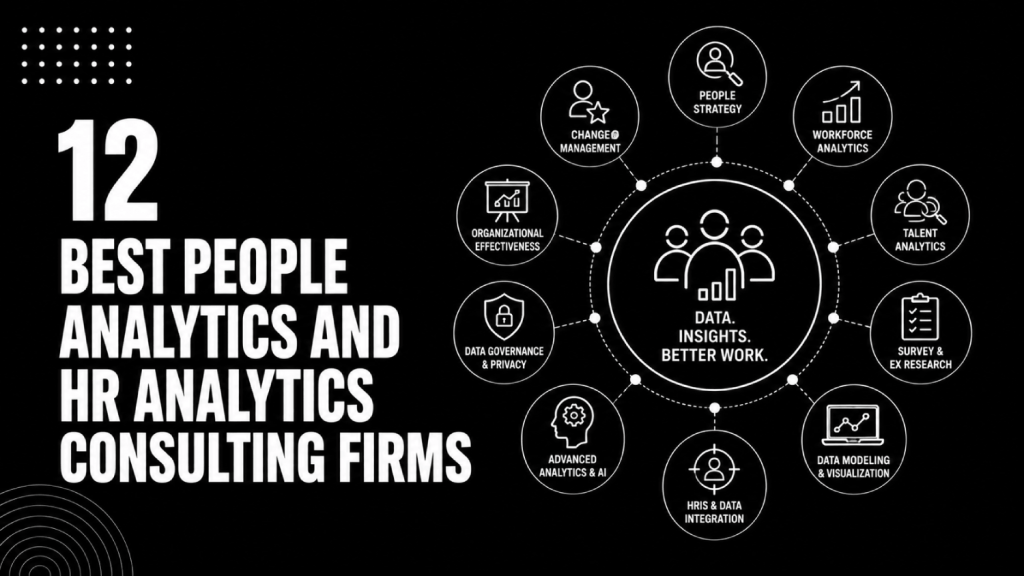
The best people analytics consulting firms are specialist practices that connect HR data to business decisions, not just visualization vendors or generalist HR advisors. The right firm depends on whether your core problem is dirty data, missing analytical capability, or an inability to turn outputs into executive action. This list covers 12 firms across that spectrum, from boutique analytics specialists to workforce strategy arms of global consultancies, with notes on what each does distinctly well and where they fall short.
Why Do HR Teams Need People Analytics Consultants in the First Place?
You probably already have Workday, or Visier, or some combination of dashboards pulling headcount, turnover, and time-to-fill. The problem is not data access. HR teams are rarely staffed with the combination of data scientists, organizational psychologists, and storytellers needed to turn raw HR data into a C-suite-ready workforce strategy.
People analytics consulting fills that gap. A good firm brings three things you likely cannot hire fast enough: statistical rigor (regression analysis, survival modeling, predictive attrition), HR domain expertise (knowing which metrics actually connect to business outcomes), and change management capability (getting line managers and finance leaders to act on what the data says).
If you are evaluating whether you need a consultant or a platform, the article on how to choose a people analytics platform without buying another dashboard nobody uses is worth reading first. Many teams discover they need both, but in a specific sequence.
How to Evaluate People Analytics Consulting Firms Before You Shortlist
Most vendor evaluation processes for consulting firms are weak. HR leaders ask for a sample deliverable, check references in the same industry, and go with whoever seemed most confident in the pitch. That approach misses the questions that actually predict whether an engagement will produce decisions or a PowerPoint.
Before shortlisting any HR analytics consulting firm, clarify your own problem category:
- Data infrastructure: Your HR systems do not talk to each other, or the data coming out is unreliable. You need data engineering first.
- Analytical capability: You have clean data but no one on the team who can run predictive models or design a measurement framework.
- Insight activation: You have models and dashboards but leadership does not act on them. You need an executive translator.
Firms that are excellent at data infrastructure are often weak at executive storytelling, and vice versa. Ask every prospective firm to describe their last three engagements in terms of which problem category it was. If they cannot answer that cleanly, that is itself an answer.
The AI HR vendor evaluation checklist covers the broader vendor selection process, but for consulting specifically, the most important questions are around data governance practices, deliverable ownership after the engagement ends, and whether they build internal capability or create dependency.
What Are the 12 Best People Analytics and HR Analytics Consulting Firms?
The firms below represent the market across size, specialization, and use case. None are listed here because they paid for placement.
1. Insight222
Insight222 is arguably the most recognized boutique in people analytics consulting globally. Founded by David Green and Ian Bailie, the firm combines a research and advisory function with direct consulting engagements. Their People Analytics Program is a peer network and learning resource used by analytics teams at large enterprises, which means their consulting work reflects what leading teams are actually doing, not just theory.
Their strongest use cases are analytics operating model design (how to structure a people analytics team), measurement frameworks, and capability building inside HR. They are not a data engineering firm. If your core problem is messy data pipelines, they will help you think about it but will not build the infrastructure themselves.
Insight222 does not publish public pricing; engagements are scoped and quoted individually.
Best for: Enterprise HR teams standing up or maturing a people analytics function from scratch.
2. PwC People Analytics
PwC’s workforce analytics practice is one of the largest in the market and appears in G2’s list of top HR analytics consulting providers. The breadth is real: PwC brings data science, HR strategy, and technology implementation under one roof, which matters for complex transformations that touch payroll systems, finance modeling, and organizational design simultaneously.
The trade-off is scale. PwC engagements run through large teams, which means senior partners set strategy and junior consultants do execution. If you need deep, sustained senior attention on a specific analytics problem, a boutique will often outperform. PwC earns its billing rate on complexity and regulatory context, not on highly customized analytical modeling. PwC does not publish public pricing; all engagements are quote-only.
Best for: Large enterprises running multi-workstream HR transformations where people analytics is one component of a larger program.
3. Deloitte Human Capital
Deloitte Human Capital publishes the Global Human Capital Trends report annually, which gives their consulting work genuine research grounding. Their workforce analytics capability sits inside a broader human capital practice, so engagements often blend organizational network analysis, talent strategy, and technology advisory.
Deloitte is particularly strong when your analytics challenge is inseparable from an organizational design or workforce planning question. They are less compelling for pure data-layer work or for teams that want to build internal analytics capability without long-term consulting dependency. All engagements are quote-only; Deloitte does not publish public pricing.
Best for: HR leaders who need workforce analytics embedded inside a broader organizational strategy engagement.
4. Mercer
Mercer’s workforce analytics and planning practice is built on top of an extensive proprietary compensation and labor market database, one of the largest in HR consulting. That external benchmarking foundation separates Mercer from most competitors: their internal workforce analytics is enriched with external market context that pure-play analytics firms cannot match.
If your analytics questions include compensation equity analysis, competitive talent positioning, or labor market scenario modeling, Mercer’s data assets make them a strong choice. For internal culture analytics or engagement measurement, they are solid but not differentiated. Mercer’s consulting engagements are quote-based; their compensation survey subscriptions are separately purchasable and priced on request.
Best for: Companies where people analytics is tightly coupled to compensation strategy, total rewards benchmarking, or labor market intelligence.
5. Sequoia Advisory
Sequoia Advisory appears in G2’s HR analytics consulting category as one of the more reviewed boutique options. Sequoia’s practice connects benefits and total compensation analytics with broader workforce strategy, which is a distinct angle. Most people analytics firms treat compensation as adjacent; Sequoia treats it as central.
Their client base skews toward high-growth technology companies where total compensation complexity is high and the analytics around offer competitiveness, retention risk, and equity dilution genuinely drives decisions. If you are a traditional mid-market manufacturer, the fit is less obvious. Sequoia does not publish public pricing; engagements are retainer-based and quoted individually.
Best for: High-growth tech companies that need people analytics tied directly to compensation and total rewards decisions.
6. Satrix Solutions
Satrix Solutions is a specialized firm focused on employee experience research and analytics. Their work is largely survey-based, connecting employee listening data to retention predictions and engagement drivers. They appear in G2’s HR analytics consulting category, and their differentiation is methodological rigor: they apply NPS-style measurement frameworks to HR, which produces cleaner causality claims than most engagement survey platforms generate on their own.
They are not a full-stack analytics firm. If your problem is attrition modeling, workforce planning, or organizational network analysis, Satrix is not the right fit. For employee listening analytics specifically, they are among the more methodologically serious options available. Satrix works on project-based fees; pricing is not publicly disclosed.
Best for: Companies that want rigorous statistical analysis of employee survey data to identify real retention drivers.
7. Workpartners
Workpartners, a UPMC company, approaches workforce analytics from a health and productivity angle. Their analytics practice connects absence data, health claims, productivity metrics, and workforce demographics to model workforce risk and cost. That is a narrow but genuinely useful specialization for employers in healthcare, manufacturing, or any sector where workforce health costs are a material line item.
Workpartners appears in G2’s HR analytics consulting provider list. Their differentiation is the UPMC health system data and clinical expertise behind the analytical models, which pure HR consulting firms cannot replicate. Pricing is quote-only.
Best for: Self-insured employers and healthcare organizations that need workforce analytics connected to health and absence cost modeling.
8. McKinsey People Analytics
McKinsey’s people analytics capability sits inside their People and Organizational Performance practice. The work tends to be high-stakes and high-level: executive talent analytics, organizational health measurement, and linking workforce data to financial outcomes. McKinsey brings external benchmarking from their Organizational Health Index, which has been applied across thousands of companies, giving their analytical frameworks genuine comparative grounding.
McKinsey engagements are expensive and designed for executive-level strategic decisions, not operational HR analytics. If you need dashboards refreshed or a Workday reporting layer cleaned up, McKinsey is not the right call. For a board-level workforce strategy that needs statistical backing, few firms compare. McKinsey does not publish public pricing; all engagements are quote-only.
Best for: Large enterprises making C-suite workforce strategy decisions where the cost of the engagement is small relative to the decision size.
9. Aon Human Capital Analytics
Aon’s human capital analytics practice combines proprietary compensation survey data and actuarial modeling with workforce analytics capability. Like Mercer, their competitive advantage is external data: Aon’s compensation surveys, benefits benchmarking, and actuarial models give their workforce analytics an external validity that pure-play HR consultants cannot match.
Aon tends to be strongest on workforce risk quantification: what is the financial exposure from flight risk in critical roles, from benefits cost trajectory, from workforce aging? That risk framing resonates with CFOs in ways that traditional HR analytics often does not. Aon’s consulting engagements are quote-only; their compensation survey subscriptions are separately available.
Best for: Companies that need workforce analytics framed in financial risk terms, particularly for CFO or board audiences.
10. Radford (now Aon Salary Surveys)
Radford, now integrated into Aon’s compensation practice, has long been the compensation benchmarking standard for technology companies. Their analytics work at the intersection of equity compensation, cash benchmarking, and workforce planning makes them distinctly useful for pre-IPO and growth-stage tech companies managing equity dilution against attrition risk.
For companies outside tech, or for analytics work that goes beyond compensation, Radford’s narrow specialization becomes a constraint. The data assets are exceptional; the breadth of analytical work is limited. Survey subscriptions and project-based analytics work are priced on request.
Best for: Pre-IPO and high-growth technology companies managing compensation equity analytics and market positioning.
11. Concentra Analytics (formerly The Concentra Group)
Concentra Analytics is a UK-based boutique that has built a reputation for rigorous people analytics methodology, including organizational network analysis, workforce modeling, and HR data quality assessment. Their approach is deliberately technical: they engage with your data infrastructure directly rather than working off cleaned exports, which matters when the real problem is upstream data quality.
Concentra works primarily with UK and European organizations, and their expertise in GDPR-compliant analytics design is a genuine differentiator for companies operating under EU data protection requirements. North American companies without European exposure will find fewer reference clients. Concentra works on project-based fees; pricing is not publicly disclosed.
Best for: UK and European organizations that need technically rigorous people analytics with strong data governance and GDPR compliance.
12. Crunchr
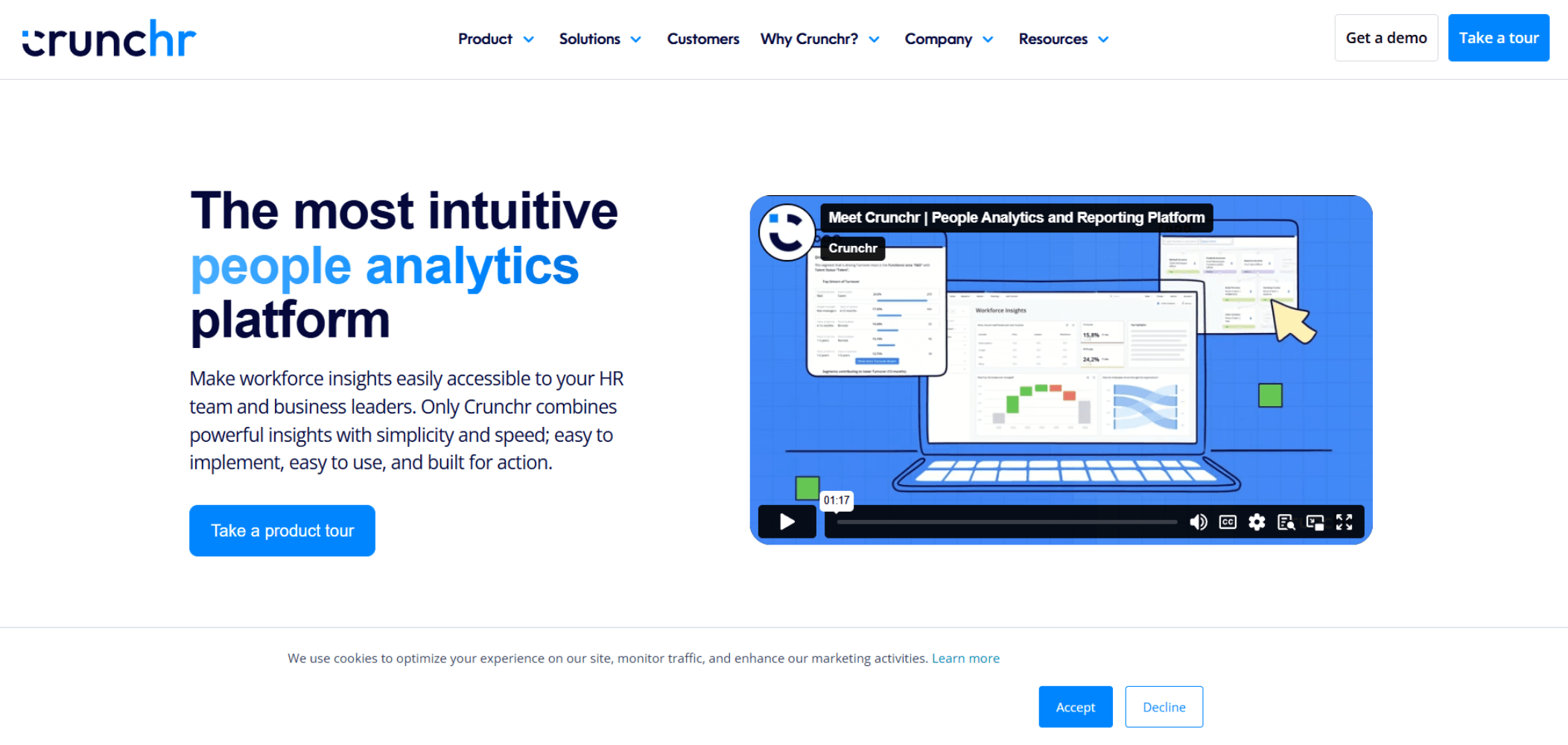
Crunchr is a Netherlands-based firm that combines a people analytics SaaS platform with consulting services, making them a hybrid option. Their consulting practice specifically helps organizations activate the platform, design workforce planning models, and build internal analytics capability. The platform-plus-consulting bundling can accelerate time to insight but also creates dependency risk if you later want to move to a different analytics tool.
Crunchr is particularly strong in European markets and workforce planning use cases. Their consulting is tightly scoped to platform activation rather than open-ended analytics strategy, which is a strength for teams that want defined deliverables and a weakness for teams that want exploratory work. Pricing for the platform and consulting bundle is available on request.
Best for: European mid-market and enterprise companies that want an integrated platform and consulting service for workforce planning.
People Analytics Consulting Firms Compared: A Quick Reference
| Firm | Best Use Case | Company Size Fit | Pricing Model | Geographic Strength |
|---|---|---|---|---|
| Insight222 | Analytics operating model, capability building | Enterprise (1,000+) | Retainer / program (quote-only) | Global |
| PwC People Analytics | Large HR transformation programs | Enterprise (2,000+) | Quote-only | Global |
| Deloitte Human Capital | Workforce analytics + org design | Enterprise (2,000+) | Quote-only | Global |
| Mercer | Compensation and labor market analytics | Mid-market to enterprise | Project / retainer (quote-only) | Global |
| Sequoia Advisory | Total rewards and people analytics | Growth-stage tech (200-2,000) | Retainer (quote-only) | US |
| Satrix Solutions | Employee listening analytics | Mid-market (200-2,000) | Project-based (quote-only) | US |
| Workpartners | Health and productivity analytics | Mid-market to enterprise | Quote-only | US |
| McKinsey People Analytics | Executive workforce strategy | Enterprise (5,000+) | Quote-only | Global |
| Aon Human Capital Analytics | Workforce risk quantification | Mid-market to enterprise | Quote-only | Global |
| Radford / Aon Salary Surveys | Compensation equity analytics | Growth-stage to enterprise tech | Survey subscription + project (quote-only) | US, global tech |
| Concentra Analytics | Org network analysis, data quality | Enterprise (1,000+) | Project-based (quote-only) | UK / Europe |
| Crunchr | Workforce planning, platform activation | Mid-market (500-5,000) | Platform + consulting bundle (quote-only) | Europe |
What Does a People Analytics Consulting Engagement Actually Cost?
Pricing for HR analytics consultants is not publicly disclosed by any of the firms on this list, and the range is genuinely wide. Every firm here , from boutiques like Satrix Solutions and Concentra to global practices like PwC and McKinsey , operates on a quote-only basis. None publish pricing pages.
Based on publicly discussed market rates in HR practitioner communities and industry forums, boutique engagements for a defined analytics project , such as an attrition model or a listening analytics program , are generally discussed in the range of $15,000 to $50,000. Retained boutique relationships start higher. These figures reflect practitioner-shared experience rather than published rates, and actual costs will vary significantly based on scope, data complexity, and the firm’s seniority mix.
Big Four and strategy firm engagements (PwC, Deloitte, McKinsey) should be treated as six-figure minimums for meaningful work. These are not appropriate for mid-market companies running a single analytics workstream.
Mid-tier firms like Mercer and Aon sit in between: project work is quote-based but often more accessible than Big Four rates, and their subscription-based data products (compensation surveys, benchmarking tools) can be purchased separately from consulting services.
If cost is a constraint and your core challenge is the analytics platform itself rather than the consulting, the best AI people analytics platforms article covers software options that replace some (though not all) of what a consultant delivers. For a broader view of how HR software pricing works across categories, the guide to HR software pricing is a useful reference.
When Should You Hire a People Analytics Consultant vs. Build In-House?
The case for hiring externally is strongest when the problem has a defined endpoint, when you need external benchmarking data you cannot produce internally, or when you are trying to build internal credibility for a new analytics function and need external validation to get budget.
Build in-house when the analytics work is continuous, when your data is proprietary in ways that make external sharing difficult, or when you have enough analytical volume to justify a full-time hire. A single data scientist or people analyst with good tooling often produces more value per dollar than a consulting engagement once you pass about 1,000 employees.
The hybrid model , hiring a consultant to design the framework and build the first model, then transitioning ownership to an internal hire , is underused. The best consulting engagements explicitly plan for their own obsolescence. If a firm resists building internal capability, that is a flag.
For teams that are also evaluating the underlying data infrastructure, the guide on HR data integration: when to buy an iPaaS, hire a consultant, or build in-house covers the decision framework in detail.
What Are the Four Types of HR Analytics, and Which Consulting Firms Cover Each?
HR analytics work falls into four progressively complex categories: descriptive (what happened), diagnostic (why it happened), predictive (what will happen), and prescriptive (what should we do about it). Most HR teams operate primarily at the descriptive level. Most consulting engagements that produce real value operate at the diagnostic and predictive levels.
Here is how the firms on this list map against those four levels:
- Descriptive: Any firm on this list can help, including platform-only options. If this is your only need, you probably do not need a consultant.
- Diagnostic: Satrix Solutions, Concentra Analytics, Sequoia, and Mercer are strong here. Deloitte and PwC cover it within larger engagements.
- Predictive: Insight222, Concentra, PwC, and Deloitte bring real modeling capability. Crunchr’s platform handles parts of this for workforce planning specifically.
- Prescriptive: McKinsey, Deloitte, and Mercer are best positioned when prescriptive analytics must connect to board-level decisions. Aon is strong when the prescription is framed in financial risk terms.
Understanding the connection between people analytics outputs and workforce cost, retention, and productivity is often what separates a consulting engagement that drives action from one that produces a report.
What Should You Ask a People Analytics Consulting Firm Before Signing a Contract?
The screening questions that actually differentiate firms from each other are not about methodology. Every firm will tell you they are rigorous. Ask these instead:
- Show me the last three deliverables you produced for a client at our stage. What decision did each one drive?
- What does data ownership look like at the end of the engagement? Do models, documentation, and code belong to us?
- Who will actually be doing the work day-to-day, and what is their background?
- How do you handle situations where the data does not support the hypothesis the HR team came in with?
- What does success look like at 90 days, and how will we measure it?
Question four is the most diagnostic. A firm that has never delivered an uncomfortable finding to a client either has not done enough work or sanitizes results. Neither is acceptable for serious analytics work.
If the engagement involves an AI-powered analytics platform as part of the scope, the questions CFOs should ask before buying an AI-powered HR analytics vendor provides a complementary framework.
Frequently Asked Questions About People Analytics Consulting
What is the average cost of an HR analytics consultant?
No firm on this list publishes public pricing. Based on publicly discussed market rates in HR practitioner communities, boutique people analytics consulting firms are generally discussed as charging project fees in the range of $15,000 to $50,000 for a defined engagement, such as an attrition model or a measurement framework design. Retained boutique relationships generally start higher. Big Four firms including PwC, Deloitte, and McKinsey are quote-only with six-figure minimums as a working assumption for meaningful work. Pricing varies significantly based on scope, data complexity, and firm size.
What does a people analytics consultant actually do week to week?
On a typical engagement, a people analytics consultant spends the first few weeks assessing data quality and availability across HRIS, ATS, payroll, and survey systems. Mid-engagement work focuses on building analytical models, identifying patterns in attrition, performance, or workforce cost data, and validating findings with HR and business leaders. The back half of an engagement is usually about translating findings into executive presentations and designing the ongoing measurement process the internal team will own after the consultant leaves.
What is the difference between people analytics consulting and HR technology consulting?
HR technology consulting focuses on selecting, implementing, or optimizing HR software systems such as HRIS, ATS, or payroll platforms. People analytics consulting focuses on extracting business insight from workforce data, regardless of which systems that data lives in. Some firms, particularly the large generalist consultancies, do both. Specialist people analytics firms generally do not implement software. If your primary need is system implementation, see the guide on best HRIS implementation partners instead.
Do I need a people analytics platform before hiring a consulting firm?
Not necessarily, though having clean, accessible data from your core HR systems will reduce consulting costs significantly. Firms that do data engineering work as part of their engagement, such as Concentra Analytics, can work with raw data from multiple systems. Firms focused on insight generation and strategy, such as McKinsey or Insight222, typically expect reasonably clean data inputs. Before engaging a consultant, audit what data you have, where it lives, and whether it can be exported reliably. That audit alone will scope the engagement accurately.
What does workforce analytics consulting cover that HR consulting does not?
Workforce analytics consulting is specifically quantitative: it uses statistical models and data analysis to answer workforce questions. Traditional HR consulting often relies on qualitative assessment, benchmarking surveys, and practitioner judgment. The distinction matters because some HR consulting firms market analytics capability that is actually just survey benchmarking or dashboard configuration, not predictive modeling. When evaluating a firm, ask what analytical methods they use and what tools they use to apply them.
How long does a typical people analytics consulting engagement last?
Defined project engagements typically run 60 to 120 days, covering data assessment, model building, and executive output. Analytics operating model design engagements, where the goal is to stand up an internal people analytics function, usually run six months to a year. Ongoing retainer relationships with quarterly deliverables are also common for companies that have not yet hired a full internal analytics team. The right duration depends on whether you are solving a specific question or building a long-term capability.
Which people analytics consulting firms are best for mid-market companies?
For mid-market companies between 500 and 5,000 employees, the best-fit firms are typically Sequoia Advisory for total rewards analytics, Satrix Solutions for employee listening analytics, Mercer for compensation benchmarking combined with workforce data, and Crunchr for workforce planning. Big Four firms are generally overscoped and overpriced for single-workstream mid-market engagements. Boutiques deliver better value at this company stage because senior practitioners do the actual work rather than delegating to junior teams.
Picking the Right Firm Comes Down to One Question
The firms on this list are genuinely different from each other. PwC and McKinsey will never compete with Satrix Solutions on employee listening analytics, and Satrix will never compete with McKinsey on board-level workforce strategy. The market is segmented by problem type and company stage in ways that make most head-to-head comparisons meaningless.
One question cuts through the noise: what decision are you trying to make, and who will be held accountable for acting on it? If the answer is your CFO or CEO, you probably need a firm with board-level credibility and external benchmarking data. If the answer is your CHRO or VP of People, a boutique specialist who embeds with your team and builds internal capability will produce better outcomes at lower cost.
People analytics consulting only creates value when it changes a decision. If you cannot name the decision upfront, no firm on this list will save the engagement.