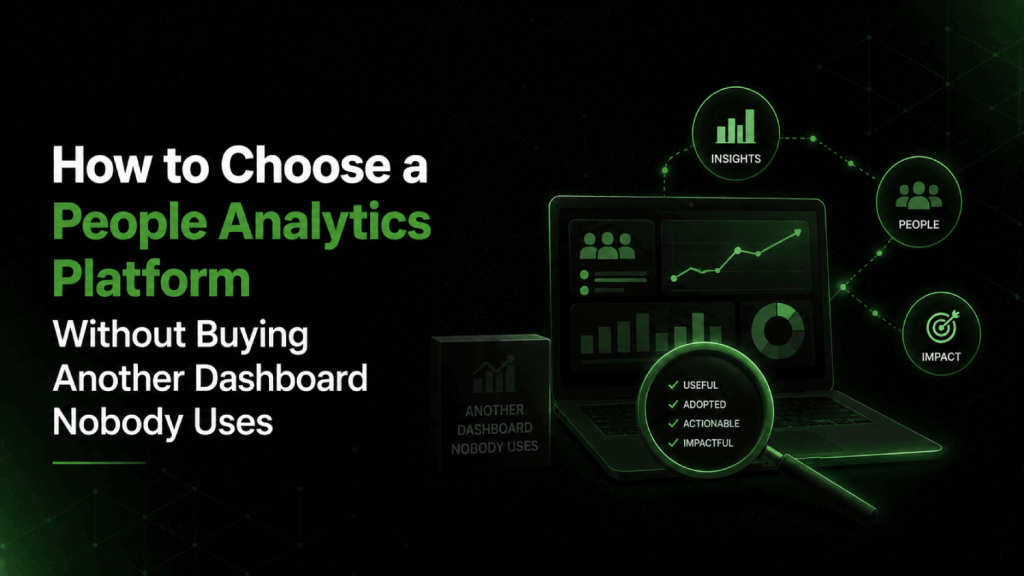

- Most people analytics platforms fail because of adoption, not features. A dashboard nobody opens changes nothing.
- The right evaluation criteria are decisions, data quality, manager workflows, and privacy governance , not chart types or color themes.
- Vendors will demo their best-case data. Your job in the evaluation is to stress-test against your actual data, your actual integration environment, and your actual managers.
- Implementation risk is underestimated in almost every purchase. Budget, timeline, and internal data readiness matter more than the platform’s feature list.
- A people analytics platform that changes one executive planning conversation per quarter is worth more than one that generates fifty reports nobody reads.
To choose a people analytics platform that actually works, evaluate it against the decisions your organization needs to make, the quality of data it can ingest from your existing systems, the workflows it puts in front of managers rather than analysts, and how it handles employee privacy and consent. A platform that scores well on all four of those dimensions will outperform a better-looking product that scores poorly on two of them.
Why Do Most People Analytics Dashboards Fail Before Anyone Builds One?
The failure mode is predictable. An HR team spends four months evaluating platforms, picks the one with the most impressive demo, pays the implementation fee, and launches to managers who log in twice and never return. The data team keeps pulling the same spreadsheets. The executive team asks the same questions they always asked. The platform gets renewed once, then quietly cancelled.
This happens because buyers optimize for the wrong thing. Dashboard flexibility is a real feature. Data visualization matters. But neither one is the constraint. The constraint is whether the platform gives the right person the right information at the moment they are making a decision. If it does not clear that bar, no amount of drill-down interactivity matters.
The current SERP is full of evaluation guides that reduce the question to “data integration, analytical capabilities, and user-friendliness.” Those criteria are necessary but not sufficient. They describe the table stakes, not the differentiator. This guide on how to choose a people analytics platform focuses on the harder questions: the ones most buyers skip because they are less comfortable to ask, and the ones that predict whether a platform will change behavior or just generate reports.
What Problem Are You Actually Trying to Solve?
Before you look at a single vendor, write down the three to five workforce decisions your organization makes badly right now. Not the metrics you wish you tracked. The decisions. Examples: we do not know which business units are flight risks before people resign; we cannot tell the CFO whether our total workforce cost is in line with revenue growth; our succession planning is based on manager opinion with no data backing it.
Those decisions should be the filter for every demo you sit through. Ask the vendor: show me how your platform would have helped us make this specific decision six months ago. A vendor who cannot answer that question with your example data is selling a tool, not a solution.
The reason this matters for vendor selection is that different platforms are built for different decision types. Some are optimized for workforce planning and headcount modeling (useful for finance and HR leadership). Others are built for manager-facing people dashboards (useful for team health and retention signals). A few are genuinely capable of predictive analytics at the individual or cohort level. Most are somewhere in between. If you do not know your use case before you evaluate, you will get sold on whatever the vendor is best at.
How Should You Score Data Readiness Before Buying?
Data readiness is the single most underrated factor in a people analytics purchase. Platforms do not create clean data. They surface what you have. If your HRIS has inconsistent job codes, your ATS has no structured outcome data, and your payroll system does not sync with your headcount model, no analytics platform will fix that for you.
Before you issue an RFP, audit your current data environment against this checklist:
| Data Source | Do You Have It? | Is It Clean and Consistent? | Does It Have an API or Standard Export? |
|---|---|---|---|
| HRIS (headcount, tenure, org structure) | |||
| ATS (hiring funnel, time-to-fill, source data) | |||
| Payroll (compensation, total cost per employee) | |||
| Performance system (ratings, OKRs, review cycles) | |||
| Engagement survey data (scores, response rates) | |||
| Learning and development (completions, certifications) | |||
| Workforce planning / headcount model |
Every row where the answer to columns two or three is “no” is a risk you need to price into the implementation before you sign. Some platforms include data transformation and cleansing services. Most do not. Know which category you are buying before you compare proposals.
For HR teams operating with an enterprise HCM like Workday, SAP SuccessFactors, or Oracle HCM, native analytics modules exist within those platforms. Whether those native tools are sufficient or a dedicated analytics layer is worth the added cost depends on whether your use case requires cross-system data stitching. If your workforce questions live entirely inside Workday, buying a separate platform is harder to justify. If you need to connect HRIS data with finance, real estate, or operational performance data, a standalone platform has a real advantage. For a deeper look at how those enterprise HCM platforms compare on AI capabilities, see the Workday AI vs SAP Joule vs Oracle AI comparison.
What Questions Should You Ask Every People Analytics Vendor?
Vendor demos are theater. Everyone’s demo data is clean, their integrations are pre-built, and their sample dashboards look like they were designed for a magazine cover. Your job is to break the demo by asking questions the vendor did not rehearse.
On data integrations
- Which of our specific systems do you have pre-built connectors for, and what is the maintenance model when those systems release API updates?
- How does your platform handle data that is structured inconsistently across business units , for example, job titles that mean different things in different regions?
- What happens when a source system goes offline or changes its schema? Who is responsible for fixing the break?
On actual adoption
- What percentage of your customers’ licensed users log in at least once per month? (Benchmark the answer against their contract. If they do not know this number, that is an answer.)
- Can you show us three customer examples where a specific business decision was changed because of your platform? Not “insights were surfaced” , a decision that was different.
- How do managers access their data? Is it embedded in a workflow they already use, or do they need to log into a separate product?
On privacy and compliance
- How does your platform handle GDPR, the UK GDPR, and state-level US privacy laws for employee data?
- What are the minimum cohort sizes before individual-level data gets masked or suppressed?
- How does your platform handle right-to-deletion requests for employees who have left?
On implementation and ongoing support
- What does the implementation timeline look like for a company at our size and tech stack, and what internal resources do we need to commit?
- What is your median time-to-first-insight after contract signature?
- After go-live, who owns ongoing data quality maintenance , your team or ours?
For a more complete set of vendor evaluation questions, the AI HR vendor evaluation checklist for CHROs covers 50 questions applicable across HR tech categories, including analytics platforms.
How Do You Evaluate Manager-Facing Versus Analyst-Facing Platforms?
This distinction matters more than any feature comparison. Analyst-facing platforms are built for HR data teams who want to run custom queries, build models, and generate reports for leadership. Manager-facing platforms are built to put clear, decision-relevant signals in front of line managers who will not run their own queries and do not have time to learn a new product.
Both are legitimate product categories. The mistake is buying an analyst-facing platform when your actual use case requires manager adoption, or vice versa.
| Dimension | Analyst-Facing Platform | Manager-Facing Platform |
|---|---|---|
| Primary user | HR data analyst, CHRO | Line manager, business unit leader |
| Typical interaction | Custom reports, model building, data exploration | Pre-built dashboards, alerts, nudges |
| Integration depth needed | High , requires clean, multi-source data | Moderate , can work with HRIS + survey data |
| Time to value | Longer , depends on data prep | Faster , limited configuration required |
| Risk if adoption fails | Expensive shelfware | Low engagement, unused alerts |
| Best fit company profile | 500+ employees with a dedicated people analytics function | Any size with distributed manager responsibility for retention |
Most buyers at 200 to 500 employees need a manager-facing product. Most buyers evaluating at 1,000+ with a data team already in place can support an analyst-facing platform. Companies trying to bridge both often end up paying for two products, which is sometimes the right answer and sometimes a sign that neither selection was targeted enough.
What Does Good People Analytics Look Like for Workforce Planning?
Workforce planning is the use case where people analytics creates the most direct business value, and also where most platforms oversell their capability. Good workforce planning analytics connects headcount, cost, attrition risk, and hiring pipeline into a single model that the CFO and CHRO can use together. Bad workforce planning analytics gives you a headcount dashboard that is always two months stale because it only syncs with one system.
When evaluating platforms for workforce planning specifically, ask whether the product supports scenario modeling. Can you model what happens to total workforce cost if attrition in a specific business unit increases by ten percent? Can you run a hiring plan against a revenue forecast? Most mid-market platforms support static reporting on these dimensions. Fewer support genuine scenario modeling without a significant amount of manual setup or custom development.
If workforce planning is your primary use case and your CFO is a stakeholder in this purchase, the evaluation should include finance in the room. Finance will ask questions about data latency, auditability of models, and whether the output can feed into existing planning tools like Anaplan or Workiva. Those are the right questions. For more on connecting workforce data with finance planning, the people analytics framework for CFOs covers the connection between workforce cost, retention, and productivity in detail.
How Do Privacy and AI Bias Risks Factor Into Platform Selection?
Employee data carries legal and ethical obligations that buyer-side HR leaders routinely underestimate at the platform selection stage. By the time legal gets involved, the contract is half-negotiated and nobody wants to restart the process.
Get privacy governance into your evaluation criteria from day one. Key questions include: how is employee data stored, who can access it at the vendor level, and what data residency options exist if you have employees in the EU or UK? For platforms that include predictive features , flight risk scores, performance predictions, promotion recommendations , additional questions apply about how the underlying models were trained, what protected characteristics they were tested against, and whether outputs meet requirements under the EU AI Act for high-risk AI systems in employment contexts.
Platforms that include AI-generated recommendations about individual employees are likely to be classified as high-risk AI systems under the EU AI Act for customers with EU employees. That classification triggers transparency, documentation, and human oversight obligations on the buyer side, not just the vendor. If a vendor cannot produce documentation on model fairness testing and auditability, that is a disqualifying gap for any organization with EU employees. The AI HR compliance and bias audit tools guide covers what due diligence looks like in practice.
How Do You Score and Compare People Analytics Vendors Before a Final Decision?
A structured scorecard prevents the loudest demo from winning the evaluation. Score each vendor on the dimensions below, weighted by your organization’s specific priorities. The weights in parentheses are a starting point, not a mandate.
| Evaluation Dimension | Suggested Weight | What Good Looks Like | Red Flags |
|---|---|---|---|
| Decision alignment (does it answer our actual use cases?) | 25% | Vendor demos using your example decisions and realistic data | Generic demo with no customization to your questions |
| Data integration depth and reliability | 20% | Pre-built connectors to your exact systems, clear maintenance SLAs | Long list of “supported” integrations with no live references |
| Adoption model (how managers and leaders use it) | 20% | Evidence of sustained usage from reference customers | Vendor cannot provide monthly active user data for existing customers |
| Privacy governance and compliance readiness | 15% | Data residency options, anonymization controls, AI Act documentation | No documentation on model training data or fairness testing |
| Implementation realism (timeline, internal resource requirements) | 10% | Specific timeline with milestone ownership clearly assigned | Vague “standard 8-12 week implementation” with no detail |
| Total cost of ownership over three years | 10% | Transparent per-seat or per-employee pricing with no surprise add-ons | Implementation, support, and data services all quoted separately and vaguely |
Run this scorecard after a structured demo and reference check, not after a sales pitch. Require that reference customers be from a similar industry, company size, and HR tech stack , not just any existing customer the vendor chooses to put forward.
For a broader HR software buying process, the HR software buying checklist with 75 vendor questions provides a parallel framework applicable across HRIS, ATS, and analytics categories.
What Are the Most Common People Analytics Implementation Risks?
Implementation is where most analytics investments die quietly. The platform is bought, the kickoff meeting happens, and then three things go wrong in sequence: the data migration takes longer than expected because source systems were messier than the IT team admitted, the internal project lead gets pulled onto a higher-priority initiative, and by the time the platform is ready to launch, the executive sponsor has moved on to the next priority.
The risks that matter most, and how to address them before you sign:
- Unclear data ownership: Assign a named internal owner for each data source before the contract is signed. If nobody owns payroll data cleanliness, nobody will fix it when the integration breaks.
- No defined success metrics: Before go-live, write down what “success at 90 days” looks like in concrete terms. If you cannot write that down, the platform was bought for a problem you have not fully defined.
- Underestimated manager training: A platform that requires manager behavior change needs a change management plan, not just a product tutorial. Budget for it explicitly.
- Privacy review happening after contract: Legal and privacy reviews that happen post-signature create expensive delays. Run them in parallel with the commercial negotiation.
- No sunset plan for existing reporting: If the new platform is supposed to replace ten spreadsheet reports but those reports keep running, the old behavior wins. Explicitly deprecate what the platform replaces.
For teams that want a structured checklist for the implementation process itself, the HR software implementation checklist covering data migration, integrations, and rollout provides a step-by-step framework.
How Do Talent Intelligence Platforms Overlap With People Analytics?
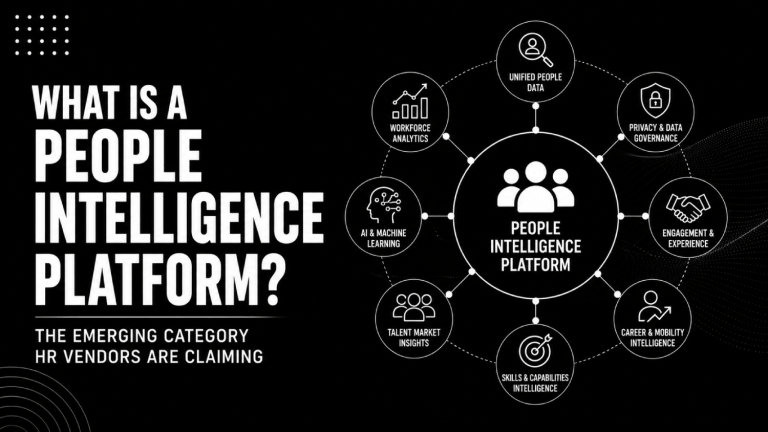
Buyers often encounter talent intelligence platforms during a people analytics search, and the categories overlap enough to cause confusion. People analytics platforms are primarily focused on your internal workforce: who you have, how they are performing, what they cost, and where they are likely to go. Talent intelligence platforms layer in external market data: what skills are in demand, how your compensation compares externally, where talent is concentrating geographically.
Products like Eightfold AI, Gloat, and Beamery blend talent intelligence with internal mobility and workforce planning features. They are relevant to this buying decision if your use case includes skills-based workforce planning or talent marketplace functionality, but they are a different category from a core people analytics platform. For a detailed comparison of those tools, the talent intelligence platform comparison covering Eightfold, Gloat, Beamery, and Findem covers the distinctions in detail.
Frequently Asked Questions
What is the difference between people analytics and HR reporting?
HR reporting tells you what happened: headcount last quarter, time-to-fill last month, attrition rate last year. People analytics tells you why it happened and, at its best, what is likely to happen next. The practical difference is that reporting looks backward and requires a human to interpret it, while analytics is designed to surface patterns, predictions, and recommendations that feed forward into decisions. Most platforms sold as analytics tools are, in practice, sophisticated reporting tools. Ask the vendor to show you a predictive output, not just a historical trend.
How many employees do you need before people analytics makes sense?
The threshold is typically around 200 to 300 employees for basic workforce analytics, and 500 or more before predictive features become statistically meaningful. Below those thresholds, sample sizes are generally too small for reliable patterns, and most HRIS platforms have sufficient built-in reporting. The exception is companies with high-volume, high-turnover workforces , retail, logistics, healthcare at scale , where even a smaller headcount can generate enough data for attrition modeling.
How long does it take to implement a people analytics platform?
For a mid-market company with a reasonably clean HRIS and one or two additional data sources, vendors typically claim three to six months from contract signature to consistent usage. Larger organizations with messier data environments or more complex integrations often run six to twelve months before real adoption, based on common vendor guidance. Vendors routinely quote shorter timelines in sales cycles. Build your business case on the longer estimate and treat anything faster as upside, not the plan.
What should a people analytics platform cost for a company with 500 employees?
Most dedicated people analytics platforms at this size are priced on a per-employee-per-month basis or on a platform fee plus per-seat model. Pricing is almost universally quote-based among the leading vendors. You should expect to see proposals in a wide range depending on the depth of features, integration complexity, and whether implementation services are bundled. Get at least three proposals and require that implementation, support, and any data services be quoted as part of the total cost, not as line items you discover later.
Can a people analytics platform replace Excel-based workforce planning?
For organizations where workforce planning happens in spreadsheets, a platform can replace the manual data assembly and version control problems. Whether it replaces the actual modeling depends on whether the platform supports scenario analysis, which most do at least partially. The more honest framing: a platform replaces the data grunt work. It does not replace the judgment that a capable analyst or HR leader brings to interpreting the output. Teams that think a platform makes headcount planning automatic usually find it makes the data available but leaves the hard decisions exactly where they were.
What employee privacy obligations apply to people analytics platforms?
If your employees are in the EU or UK, GDPR applies to all employee data processing, including analytics. You are the data controller and the vendor is a data processor , meaning you carry legal responsibility for how the data is used. For US-based employees, state-level privacy laws are expanding, and sector-specific rules may apply. Platforms that generate AI-driven predictions about individual employees may trigger additional obligations under the EU AI Act’s high-risk AI provisions. Legal review before contract signature is not optional for any organization with EU employees.
How do you measure the ROI of a people analytics platform?
The most defensible ROI calculation ties the platform to decisions that changed. Attrition that was predicted and prevented in a high-value team, headcount growth that was right-sized against a revenue forecast, a hiring ramp that was adjusted before a budget cut hit. Calculate those outcomes in dollars and compare to total platform cost over three years. The calculation will be imperfect, but any methodology that requires you to name the specific decisions the platform influenced is more credible than a generic cost-per-insight framework.
The Mental Model That Actually Holds
People analytics platforms are infrastructure for decision-making, not decision-making itself. The best ones disappear into the workflows of the people who need them: a manager who sees a retention alert in a tool they already use, a CHRO who walks into a board meeting with a workforce cost model that connects to the CFO’s numbers, a recruiting leader who can show time-to-productivity data that actually changes how hiring plans get approved. Those outcomes do not come from the platform alone. They come from the platform being selected and implemented against a real decision architecture, with real data, and with someone accountable for adoption on the internal side.
The dashboards matter only after all of that is in place. When buyers start with dashboards, they almost always end up with dashboards. When they start with decisions, they sometimes end up with a platform that earns its cost.
Write down the three decisions your organization made badly in the last year that better workforce data would have changed. If you cannot write those down, you are not ready to evaluate vendors. If you can, every step of this guide maps directly to ensuring the platform you choose can actually close those gaps.