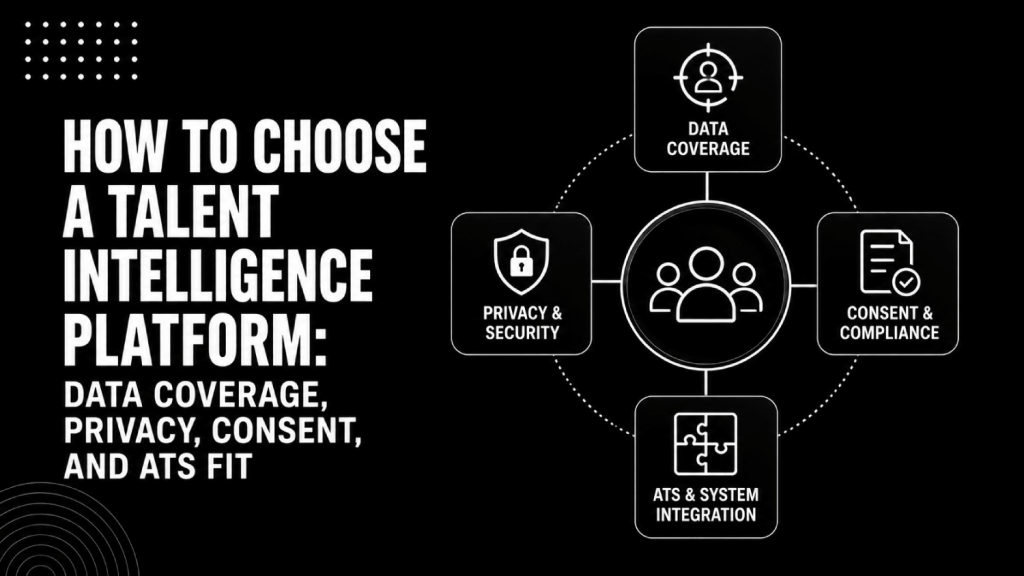

- Most buyers evaluate talent intelligence platforms on demo quality and vendor brand recognition. The decisions that actually determine ROI are data coverage depth, consent architecture, privacy compliance posture, and how cleanly the platform integrates with your existing ATS.
- External data sourcing is where these platforms differ most. Some aggregate from hundreds of public web sources; others rely on a single licensed data partner. The difference affects candidate match quality in ways a demo will never reveal.
- Consent and privacy handling are not just legal boxes to check. Under GDPR, CCPA, and the EU AI Act, your vendor’s data practices become your liability if a candidate complains or a regulator audits.
- ATS integration depth determines whether a talent intelligence layer actually gets used. A platform that requires manual exports to Greenhouse or Workday Recruiting will be abandoned within six months.
- Pricing for enterprise talent intelligence is almost universally quote-based. Build your business case before entering vendor negotiations, not after.
To choose a talent intelligence platform, evaluate four factors in order: the breadth and freshness of the external talent data, how the vendor handles individual consent and data subject rights, whether its privacy posture survives GDPR or CCPA scrutiny, and how deeply it integrates with your ATS and HRIS. Demo polish and company size are irrelevant signals.
Most HR leaders go into a talent intelligence RFP with the wrong mental model. They treat it like buying an ATS or an LMS, where the primary question is features and the secondary question is price. Talent intelligence is different because the product is data, and data quality, sourcing method, and legal provenance are what determine whether the platform produces accurate recommendations or expensive noise. This guide covers how to choose a talent intelligence platform , the evaluation criteria that separate useful tools from expensive noise.
What Does a Talent Intelligence Platform Actually Do?
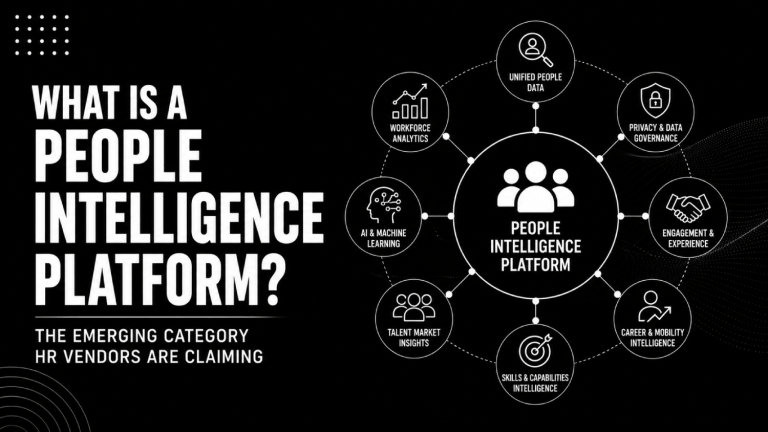
A talent intelligence platform aggregates internal and external talent data, applies AI models to it, and surfaces recommendations for hiring, workforce planning, internal mobility, and skills gap analysis. The internal data layer typically includes your HRIS, ATS, and performance system. The external layer is scraped or licensed from public web sources, professional networks, job postings, and academic records.
The major platforms in this category include Eightfold AI, Beamery, Findem, Phenom, and Gloat. Each has a different emphasis: Eightfold skews toward AI-native skills inference and internal mobility; Beamery toward CRM-style candidate relationship management; Findem toward attribute-based external sourcing; Phenom toward candidate experience; and Gloat toward internal talent marketplaces. For a full side-by-side comparison, see our review of the best talent intelligence platforms.
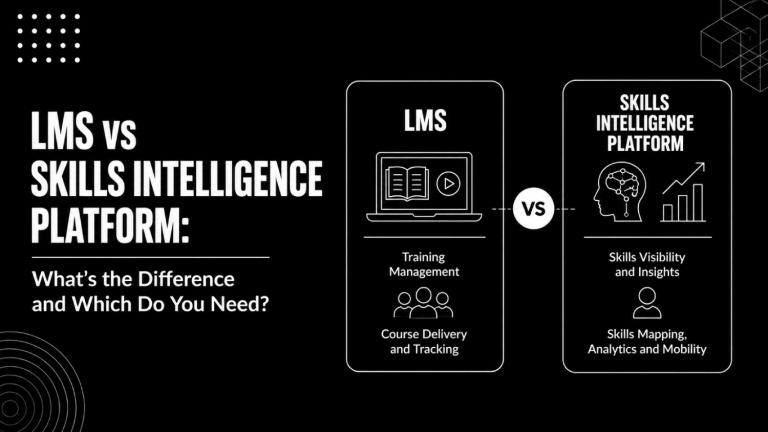
Understanding the distinction between talent intelligence and adjacent categories matters before you buy. People analytics, workforce analytics, and talent intelligence overlap but are not interchangeable. Talent intelligence is primarily outward-facing (market data, external candidate pools, competitive benchmarks) and secondarily inward-facing (skills graphs, internal mobility). People analytics platforms focus inward. Buying the wrong category is a common and expensive mistake.
How Do You Evaluate Talent Data Coverage and Quality?
Data coverage is the most consequential evaluation criterion and the one vendors are least transparent about. Ask every vendor to answer three specific questions: Where does your external talent data come from? How frequently is it refreshed? What is your deduplication methodology?
Source diversity matters because any single data source introduces systematic gaps. A platform that aggregates only from LinkedIn-equivalent professional networks will have weak coverage for skilled trades, healthcare roles, and markets outside North America and Western Europe. A platform that also indexes GitHub, academic publications, patent filings, and job board activity gives you a materially broader signal on technical and specialist candidates.
Freshness matters because talent data decays fast. A profile that shows someone as a software engineer at a company they left 18 months ago produces bad recommendations and recruiter frustration. Ask vendors for their median time-to-refresh on a changed profile and test it. Pull five candidates you know have recently changed jobs and verify whether the platform shows their current role.
Deduplication quality determines whether a candidate with three slightly different name spellings across three sources appears as one person or three. Poor deduplication inflates apparent coverage numbers without improving actual coverage. Run a sample search on a niche role and count the duplicate records manually during the proof of concept.
What External Data Sources Should You Ask About?
The short list of sources to ask every vendor about: professional networks (LinkedIn-equivalent data), company websites, job boards, GitHub and similar code repositories, patent databases, academic publications, news and press releases, and conference speaker records. Vendors that aggregate from ten or more distinct source types will outperform those relying on two or three in most enterprise use cases.
Also ask whether the vendor licenses data from data brokers or aggregators, and if so, which ones. This is not just a coverage question. It is a consent and privacy question, covered in the next section.
Why Does Talent Intelligence Consent and Privacy Architecture Determine Your Legal Exposure?
When a talent intelligence platform processes data about individuals who have not applied to your company, those individuals have not consented to anything. That is the core legal tension in the category, and it is real.
Under the EU’s General Data Protection Regulation, processing personal data requires a lawful basis. Vendors typically rely on “legitimate interests” to justify aggregating publicly available profile data without direct consent. That justification has limits and has been challenged in multiple EU member states. If your company operates in the EU or employs EU citizens, your vendor’s legal basis documentation should be your first due diligence request, not an afterthought.
CCPA gives California residents the right to know what personal data is collected about them, the right to delete it, and the right to opt out of sale. If a candidate submits a data subject access request to your vendor and the vendor cannot fulfill it within the statutory window, that is your problem as much as theirs. Ask every vendor: do you have a documented data subject rights fulfillment process, and what is your SLA for handling opt-out requests?
Per the EU AI Act enforcement schedule, the Act began phased enforcement in 2024 and classifies AI systems used in employment decisions as high-risk. That means vendors operating in the EU must meet transparency, documentation, and human oversight requirements. For a detailed breakdown of what these requirements mean in practice, see our coverage of AI HR compliance and bias audit tools.
What Consent Architecture Questions Should You Ask Vendors?
Get specific answers to these questions before signing any contract:
- What lawful basis do you rely on for processing non-applicant data in the EU? Can you provide the full legitimate interests assessment?
- How do you handle opt-out requests from individuals who have not applied to our company?
- Do you honor Do Not Sell/Do Not Share requests under CCPA automatically, or does our team need to manage that?
- If a data subject files a complaint with a supervisory authority about data you processed, what is your indemnification position?
- How do you handle data deletion when a candidate profile is removed from source sites?
Vendors that cannot answer these questions clearly are vendors whose data practices you are inheriting without understanding them. Inherit them with a contract that holds the vendor liable, or do not inherit them at all.
How Does ATS Integration Depth Affect Actual Platform Adoption?
The most common failure mode in talent intelligence implementations is a platform that works well in isolation but creates friction where it meets your ATS. Recruiters do not switch tools mid-workflow. If surfacing a candidate match from the intelligence platform requires copying a URL into Greenhouse or Workday Recruiting by hand, adoption collapses within 90 days.
There are three tiers of ATS integration to evaluate. A native integration means the talent intelligence platform has a pre-built, maintained connector to your ATS with bidirectional data sync. An API integration means data can flow between systems but requires configuration and ongoing maintenance from your IT team. A CSV or manual export is not an integration; it is a workaround that will fail in production.
Before signing, run a live test in your proof of concept. Take a candidate surfaced by the talent intelligence platform and track every click required to move that candidate into an active requisition in your ATS. Count the clicks. If the number is above three, your recruiters will not use it.
Which ATS Platforms Have the Strongest Native Integrations?
Greenhouse, Workday Recruiting, Lever, Ashby, and iCIMS have the widest native integration coverage across the major talent intelligence vendors. SAP SuccessFactors and Oracle Taleo have integration options but are frequently slower to update when vendors release new features. If your ATS is more niche, you will likely be negotiating a custom API build into your contract, which adds implementation time and cost.
Also verify that the integration covers data flow in both directions. Pushing a candidate from the intelligence platform into your ATS is table stakes. Pulling internal applicant data, interview outcomes, and offer acceptance back into the intelligence platform is what trains the model to improve recommendations over time. One-way integrations produce static recommendations that degrade relative to your actual hiring patterns.
What Evaluation Framework Should You Use Across Vendors?
Use this scoring matrix during structured vendor evaluation. Weight each dimension according to your organization’s priorities, but do not skip any category.
| Evaluation Dimension | What to Test | Red Flags |
|---|---|---|
| Data Coverage | Profile accuracy for your target roles; coverage in your primary hiring geographies; freshness of recently-changed profiles | Coverage claims backed only by total profile count, not verified accuracy rates |
| Consent and Privacy Architecture | Legitimate interests documentation for EU; CCPA opt-out SLA; data subject rights fulfillment process | Vague references to “compliance” without documentation; inability to name their lawful basis |
| EU AI Act Readiness | High-risk AI documentation; human oversight controls; bias audit cadence | No internal AI governance program; no disclosed model update process |
| ATS Integration | Native connector to your ATS; bidirectional sync; click count in live workflow test | Integration requires ongoing IT maintenance; no bidirectional data flow |
| Internal Data Integration | Ability to ingest HRIS, LMS, and performance data; skills graph construction from internal sources | Only uses external data; internal layer requires heavy custom configuration |
| Skills Ontology Quality | Depth of skills taxonomy in your industry; ability to add custom skills; update frequency | Generic skills ontology not updated for emerging roles; no customization without professional services |
| Model Transparency | Ability to explain why a candidate was recommended; bias audit reports; model update notifications | Black-box recommendations with no explainability layer |
| Implementation Timeline | Time to first value; implementation support included vs. scoped separately | Six-month implementations with no interim value; implementation cost not disclosed until late in process |
Pricing across this category is almost entirely quote-based. As of their public vendor websites, Eightfold, Beamery, Phenom, and Findem do not publish list prices. Build your total cost model including implementation fees, integration work, and ongoing admin before comparing vendor quotes. Hidden costs in HR software implementations are consistently larger than buyers expect, and talent intelligence platforms are no exception.
How Should You Evaluate AI Model Quality and Bias Risk?
Every talent intelligence vendor claims to use AI. The meaningful distinction is between vendors whose AI produces explainable, auditable recommendations and vendors whose AI is a black box that cannot tell you why it ranked one candidate above another.
Explainability matters for two reasons. Legally, EU AI Act requirements for high-risk AI systems include meaningful human oversight, which is impossible if recruiters cannot see the rationale behind a recommendation. Practically, recruiters adopt recommendations they understand and ignore recommendations that feel arbitrary.
Ask each vendor to show you a candidate recommendation and walk you through the factors that drove the ranking. If the answer involves phrases like “proprietary deep learning” without a specific factor breakdown, that is a vendor who cannot satisfy EU AI Act requirements in their current form. For the contract language that protects you when a vendor’s AI model changes post-deployment, see our guide to AI HR vendor model monitoring contract clauses.
Bias risk is specific, not abstract. Ask vendors what protected characteristics their model has been tested against, when the last bias audit was conducted, who conducted it, and whether the results are available. A vendor that has conducted an independent third-party audit will say so clearly. A vendor that describes an internal “fairness review” without external validation is telling you something important about their actual governance posture.
What Is the Difference Between Talent Intelligence and Talent Marketplace Platforms?
Talent intelligence platforms focus primarily on data aggregation and AI-driven recommendations. Talent marketplaces focus on connecting employees to internal opportunities, projects, and gigs. The categories overlap but serve different primary use cases.
If your primary need is sourcing external candidates and building competitive talent pools, a talent intelligence platform is the right category. If your primary need is reducing attrition by improving internal mobility, a talent marketplace like Gloat, Fuel50, or Eightfold’s internal mobility module is more directly relevant. Buying a full talent intelligence suite when you only need internal mobility is an expensive mismatch. For a structured comparison of when each category is the right buy, see our analysis of talent intelligence platforms vs. internal talent marketplaces.
Many enterprise vendors now sell both capabilities as a bundled suite. Bundling can create efficiency, but it also creates dependency. Before committing to a suite, confirm that each module would be your best standalone choice for that use case. A strong talent intelligence layer paired with a weak internal mobility module is a worse outcome than two point solutions that integrate cleanly and each genuinely lead their category.
How Does Skills Ontology Quality Affect Platform Recommendations?
A skills ontology is the structured taxonomy that maps job titles, tasks, and competencies to discrete skills. Every talent intelligence platform relies on one, and quality varies significantly across vendors.
Ontology weaknesses show up in specific, predictable ways. A shallow taxonomy may map “Python” to a generic “programming” bucket that conflates data science, backend engineering, and DevOps roles. Platforms with infrequently updated ontologies often miss role titles that entered the market in the last 18 months. Coverage gaps in non-technical functions , supply chain, legal operations, clinical care , are common because those skills taxonomies are genuinely complex and require domain expertise to build well.
Test ontology quality directly during your proof of concept. Enter five roles that are genuinely difficult to hire for in your organization and examine the recommended candidate profiles. If the matches are off, the ontology is the likely culprit. Ask vendors how frequently their ontology is updated, whether updates are automated or curated, and whether you can add custom skills or job families without a professional services engagement. For a deeper look at how skills ontologies work across HR platforms, see our explainer on skills ontology in HR tech.
What Should Be in Your Talent Intelligence Vendor Contract?
Standard SaaS contracts are written for the vendor. These clauses protect you specifically in the talent intelligence context:
- Data source transparency: The vendor must disclose all sources used to populate the talent database and notify you within 30 days of adding a new source category.
- Data subject rights SLA: The vendor must fulfill deletion and access requests from individuals within the statutory GDPR/CCPA window (30 days for GDPR, 45 days for CCPA), and must indemnify you against penalties arising from their failure to do so.
- Model change notification: The vendor must notify you at least 30 days before deploying a material update to ranking or recommendation models. You retain the right to pause deployment pending your own review.
- Bias audit disclosure: The vendor must share results of annual independent bias audits covering protected characteristics relevant to your jurisdiction.
- Integration SLA: The vendor must maintain API compatibility with your ATS and provide advance notice before any breaking changes. Negotiate the notification window during contracting , 90 days is a reasonable target to push for, though vendor willingness varies.
- Data portability on termination: All data derived from your internal systems must be returnable in a standard format within 30 days of contract end.
The AI HR vendor evaluation checklist covers additional contract terms worth reviewing before you finalize any enterprise AI HR purchase.
Frequently Asked Questions
What is the difference between a talent intelligence platform and an ATS?
An ATS manages the workflow of active job applications: job posting, candidate tracking, interview scheduling, and offer management. A talent intelligence platform aggregates and analyzes talent data from internal and external sources to produce recommendations for sourcing, workforce planning, and skills development. The two categories are complementary, not interchangeable. Most enterprise recruiting teams use both, with the talent intelligence platform feeding candidates into the ATS workflow.
How do talent intelligence platforms handle GDPR compliance for non-applicant data?
Most talent intelligence vendors rely on “legitimate interests” as the lawful basis for processing publicly available profile data from individuals who have not applied. This justification requires a documented balancing test showing the vendor’s interest in processing outweighs the individual’s privacy interests. GDPR compliance in this category is contested and has faced regulatory scrutiny in several EU member states. Require your vendor to provide their full legitimate interests assessment before signing.
Does the EU AI Act apply to talent intelligence platforms?
Yes. Per the EU AI Act enforcement schedule, AI systems used in employment-related decisions , including recruitment screening and candidate ranking , are classified as high-risk. This classification requires documentation, transparency measures, human oversight mechanisms, and conformity assessments. Vendors selling into the EU market must meet these requirements under the Act’s phased enforcement timeline. Ask vendors for their EU AI Act compliance roadmap and whether they have completed a conformity assessment.
What ATS integrations should I require before signing a talent intelligence contract?
Require a native, pre-built, bidirectional integration with your specific ATS, not an API that your IT team must configure and maintain. Test the integration in a live environment during the proof of concept by tracking the steps required to move a recommended candidate into an active requisition. Require a contractual SLA that the vendor will maintain API compatibility with future versions of your ATS and provide advance notice of any breaking changes.
How do I evaluate data coverage quality during a proof of concept?
Pull five to ten specific candidates you already know well, including people who recently changed jobs, people in niche technical roles, and people with non-traditional career paths. Check whether the platform reflects their current employer and title. Run targeted searches for three to five roles that are genuinely hard for your team to fill and evaluate the match quality in those results. Ask the vendor for accuracy and freshness benchmarks, then test those claims directly rather than accepting vendor-supplied demos.
What is skills ontology and why does it matter for talent intelligence?
A skills ontology is the structured taxonomy an AI model uses to map job titles, tasks, and experience to discrete skills. The quality of a platform’s ontology directly determines recommendation accuracy. A weak ontology produces matches that look plausible but miss the role’s actual requirements. Test ontology quality by searching for your hardest-to-fill roles during the proof of concept and evaluating whether the recommended candidates genuinely match your hiring criteria, not just surface-level job title similarity.
Is talent intelligence pricing publicly available?
Pricing is not publicly disclosed by the major talent intelligence vendors, including Eightfold, Beamery, Phenom, and Findem, as of their public vendor websites. Contracts are typically structured around annual license fees, with pricing tied to employee count, number of requisitions, or the scope of data access. Implementation fees are almost always separate and can be substantial. Build a total cost model covering software license, implementation, integration work, and internal admin time before comparing quotes.
What Decision Framework Should You Use Before Signing?
Before entering final negotiations, answer these four questions with evidence, not assumptions. First: can this vendor demonstrate accurate, fresh data coverage for the specific roles and geographies where you actually hire? Second: can they provide written documentation of their consent and privacy architecture, with specific answers to the data subject rights questions above? Third: does their ATS integration work in a live test environment, not just a vendor-controlled demo? Fourth: can they explain, in plain language, why a specific candidate was ranked the way they were?
If any of these four questions produces an unsatisfying answer, keep evaluating. A talent intelligence platform that fails on data quality produces bad hires. One that fails on privacy architecture creates regulatory liability. One that fails on ATS integration gets abandoned. One that fails on explainability exposes you to EU AI Act enforcement. Address these before you sign , they do not get easier to fix after the contract is in place.
The right platform is the one that scores well on the dimensions that actually drive outcomes, not the one with the most impressive demo. Build your evaluation rubric before you see your first product demonstration, and require vendors to respond to that rubric rather than defaulting to their standard pitch sequence. That shift in process is the most reliable way to reach a decision you will still be comfortable with 18 months into the contract.