
- People analytics, workforce analytics, and talent intelligence are not synonyms , and confusing them is the most common way HR buyers end up with a platform nobody uses.
- People analytics is about understanding your existing workforce through data: turnover risk, engagement, manager effectiveness, and headcount cost.
- Workforce analytics typically extends that scope to operational and contingent labor, with a focus on scheduling, labor cost, and capacity planning.
- Talent intelligence points outward at the labor market: skills supply, competitive talent conditions, and internal mobility powered by skills graphs.
- Buying the wrong category wastes budget and creates a platform nobody uses. Matching the category to the actual business question is the only way to get value.
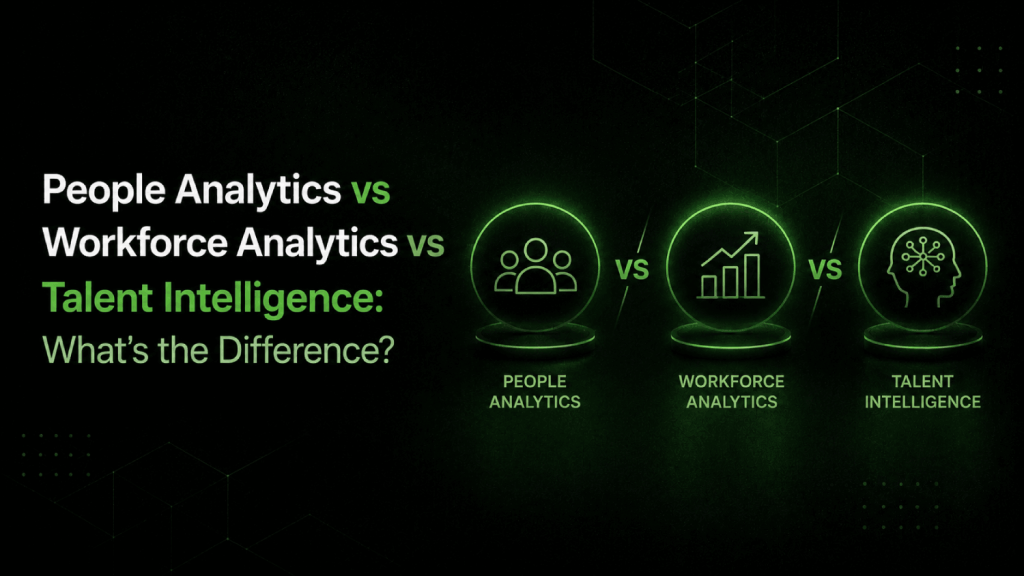
The distinction between people analytics vs workforce analytics vs talent intelligence matters more than most buyers realize before they sign a contract. People analytics focuses on internal workforce data to answer HR and business questions. Workforce analytics covers a broader operational scope, including hourly, shift-based, and contingent workers, with an emphasis on labor cost and efficiency. Talent intelligence combines internal skills data with external labor market signals to support decisions about hiring, succession, and talent mobility. All three use HR data, but they serve different functions and different buyers.
Why Buyers Confuse These Three Categories
The confusion is understandable. Vendors caused most of it. A recruiting software company rebrands its reporting tab as “talent intelligence.” An HRIS vendor calls its headcount dashboard “people analytics.” A workforce management platform markets itself as “workforce intelligence.” The labels float freely.
SHRM describes talent analytics as also called “people analytics or workforce analytics” in its own glossary, which tells you exactly how far the conflation has gone, even among authoritative HR bodies. When the professional association treats these as interchangeable, buyers have no reliable signal from the market.
The cost of getting this wrong is concrete. A company buying a people analytics platform to solve a skills-gap problem will get excellent turnover dashboards and no usable skills data. A company buying a talent intelligence platform to solve a headcount cost problem will get a beautiful skills ontology and no labor cost modeling. Mismatched tools either get abandoned or get retrofitted into use cases they were never designed for.
What Is People Analytics, Exactly?
People analytics is the practice of using data about your existing employees to support HR and business decisions. The data sources are internal: your HRIS, ATS, payroll system, engagement survey tools, and performance data. The questions it answers are backward-looking and present-tense: who is leaving, why are they leaving, which managers are producing flight risk, where is headcount spend concentrated, and what predicts performance.
The buyer for people analytics is usually the CHRO, a VP of People, or a people analytics team lead. The CFO becomes a stakeholder when headcount cost and productivity metrics are on the table. The output is dashboards, reports, and models that the HR team uses to brief the business.
Common use cases include attrition prediction, pay equity analysis, diversity reporting, manager effectiveness scoring, and workforce cost analysis. The tools in this category include platforms like Visier, One Model, Crunchr, and OrgVue, as well as people analytics modules embedded in enterprise HCM systems like Workday and SAP SuccessFactors.
If you want a deeper look at how to evaluate platforms in this category before buying, the guide on choosing a people analytics platform without buying another dashboard nobody uses covers the framework in detail.
What Is Workforce Analytics, and How Does It Differ?
Workforce analytics shares some DNA with people analytics but expands the scope in two directions: it covers a broader workforce population, and it focuses more heavily on operational efficiency and labor cost.
Where people analytics tends to center on full-time employees and HR outcomes, workforce analytics is built for organizations with complex labor structures: hourly workers, shift-based teams, seasonal staff, and contingent labor alongside permanent employees. The questions shift accordingly. Instead of “which employees are at risk of leaving,” the questions become “are we scheduling the right number of people for this store on Saturday,” “what is our overtime cost trending toward this quarter,” and “how does our labor cost per unit compare across locations.”
The buyer changes too. Workforce analytics is frequently purchased by operations leaders, supply chain heads, or finance teams alongside HR. In retail, healthcare, logistics, and manufacturing, workforce analytics sits closer to the operations stack than to the HR stack. Vendors like UKG, Kronos (now part of UKG), Ceridian Dayforce, and Workforce.com compete in this space.
One practical test: if your core workforce question involves scheduling, labor law compliance, shift coverage, or per-location efficiency, you are in workforce analytics territory. If your question involves retention, engagement, or performance across a salaried workforce, you are in people analytics territory. The line is not perfectly clean, but it is clean enough to guide a procurement decision.
What Is Talent Intelligence, and Why Is It a Separate Category?
Talent intelligence is the category that causes the most confusion because it sits at an intersection: part people analytics, part labor market research, part AI-driven skills matching. Its defining feature is the combination of internal talent data with external labor market data to answer questions that neither data source could answer alone.
The external data layer is what separates talent intelligence from people analytics. A talent intelligence platform ingests signals from job postings, LinkedIn profiles, patent filings, academic publications, and open-source repositories to build a real-time picture of skills supply and demand across the market. That external context is then mapped against your internal workforce skills profile to surface gaps, risks, and opportunities.
Talent intelligence answers questions like: Where in the labor market can we find engineers with this specific AI skills combination? Which of our current employees has the skills profile closest to a role we need to fill externally? If we lose our head of product, what does the external replacement market look like in this geography? Which roles are becoming structurally harder to hire for, and how much time do we have before that’s a crisis?
The platforms built specifically for this category include Eightfold AI, Gloat, Beamery, Findem, and Lightcast. Each takes a somewhat different angle: Eightfold and Gloat emphasize internal mobility and skills graphs; Beamery emphasizes talent CRM and market intelligence; Lightcast specializes in labor market data as a foundational layer. For a full breakdown of how these platforms compare, the talent intelligence platform comparison covering Eightfold, Gloat, Beamery, and Findem goes deep on feature differences.
Workforce Intelligence: Is It a Fourth Category?
Some vendors and analysts use “workforce intelligence” as a distinct term, while others use it interchangeably with workforce analytics or people analytics. The honest answer is that it is not a fully distinct category yet, though some vendors are trying to make it one.
Where vendors use it distinctively, workforce intelligence tends to mean a layer above raw workforce analytics: not just reporting on what the workforce looks like today, but modeling what it should look like in the future given business strategy. That puts it adjacent to strategic workforce planning, which involves headcount scenario modeling, skills forecasting, and supply-demand gap analysis at an organizational level.
TechWolf has argued for a distinction between “workforce intelligence” (focused on skills and workforce structure) and “work intelligence” (focused on how work itself is organized). This framing has not been adopted by the broader market , it is TechWolf’s own positioning, not a recognized category split , but it illustrates the direction the space is moving as skills-based organization becomes a more concrete goal for large enterprises. Treat it as a vendor-defined term, not an industry-standard one.
For procurement purposes: if a vendor pitches you a “workforce intelligence” platform, ask specifically what business questions it answers and what data it uses to answer them. That question will place it in one of the three primary categories above more reliably than the label will.
A Side-by-Side Comparison of the Three Categories
| Dimension | People Analytics | Workforce Analytics | Talent Intelligence |
|---|---|---|---|
| Primary question | What is happening with our employees and why? | Are we deploying labor efficiently and compliantly? | Where is skills supply and demand, internally and in the market? |
| Data sources | HRIS, payroll, engagement surveys, ATS, performance systems | Time and attendance, scheduling, payroll, contingent labor systems | Internal HRIS + external job market, LinkedIn, skills databases |
| Workforce covered | Primarily full-time salaried employees | All worker types including hourly, shift, and contingent | Internal employees plus external talent market |
| Primary buyer | CHRO, VP People, People Analytics team | Operations, Supply Chain, Finance, HR | CHRO, Talent Acquisition, HR Strategy |
| Key outputs | Dashboards, attrition models, DEI reports, manager scorecards | Labor cost reports, scheduling optimization, compliance alerts | Skills gap maps, talent market signals, succession risk, mobility recommendations |
| Time orientation | Present and recent past | Real-time and near-term operational | Present state plus forward-looking market trends |
| Representative vendors | Visier, One Model, Crunchr, OrgVue | UKG, Ceridian Dayforce, Workforce.com | Eightfold, Gloat, Beamery, Lightcast, Findem |
How Do These Categories Overlap With HR Analytics and Talent Analytics?
HR analytics is the oldest term in this family and arguably the broadest. It describes the general practice of applying data analysis to HR decisions, without specifying which tools, which data sources, or which workforce population. People analytics emerged as a more specific and practitioner-oriented term for the same core practice, with an implication of more sophisticated modeling and a closer link to business outcomes.
Talent analytics is similarly broad. SHRM treats it as interchangeable with people analytics and workforce analytics, which reflects how vendors have used the term. In practice, when companies say “talent analytics,” they usually mean analytics specifically applied to recruiting and talent acquisition: time-to-fill, source quality, offer acceptance rates, and pipeline conversion. That is a narrower scope than people analytics and a narrower scope than talent intelligence.
The honest summary: HR analytics and talent analytics are umbrella terms that have blurred into near-synonyms for people analytics. Talent intelligence is genuinely distinct because of its external labor market data layer. Workforce analytics is genuinely distinct because of its operational and multi-workforce-type focus. If a vendor uses “HR analytics” or “talent analytics” as their primary label, ask what specific questions the platform is designed to answer before assuming it maps to any of the three primary categories.
Which Category Do You Actually Need?
Start with the business question, not the platform label. Most organizations that think they need talent intelligence actually need better people analytics first. You cannot build an accurate internal skills graph if your HRIS data is incomplete or inconsistently structured. Talent intelligence tools that rely on employee profiles to build skills models will produce low-quality outputs if the underlying HR data is unreliable.
A useful sequence for mid-market companies (roughly 200 to 2,000 employees):
- Get your people analytics foundation in place first. Clean HRIS data, consistent job architecture, and basic attrition and engagement reporting are prerequisites for anything more sophisticated.
- Add workforce analytics if you have significant hourly, shift-based, or contingent labor populations. If your workforce is entirely salaried knowledge workers, most workforce analytics functionality is already covered by your HRIS and people analytics tool.
- Layer talent intelligence when you have a real skills mobility or external talent market problem. The trigger is usually one of three things: succession risk in critical roles, a strategic shift that requires skills you do not currently have, or a board-level push toward skills-based hiring and internal mobility.
Enterprise organizations above 5,000 employees often run all three categories simultaneously, but with clear ownership. People analytics typically sits in HR. Workforce analytics typically sits in operations or finance. Talent intelligence typically sits in talent acquisition or HR strategy. Buying one platform and expecting it to serve all three buyers rarely works.
For companies evaluating the full people analytics category before deciding, the guide on the best AI people analytics platforms for workforce planning includes hands-on platform assessments. For the internal mobility angle specifically, which is where talent intelligence and people analytics most directly overlap, the comparison of AI internal mobility platforms for enterprise talent teams is worth reading before buying.
Where AI Changes the Picture
All three categories have added AI capabilities over the past two years, but they have added different kinds of AI for different purposes.
In people analytics, AI appears primarily as predictive modeling: attrition risk scores, pay equity anomaly detection, and manager effectiveness signals. The models run on your internal data, and the AI’s job is to surface patterns your team would not find manually.
In workforce analytics, AI typically handles scheduling optimization and demand forecasting: predicting how many workers you need on a given shift given historical traffic patterns, local events, and real-time sales data. This is a well-established application that predates the current AI hype cycle.
In talent intelligence, AI is doing something more ambitious: building and maintaining a dynamic skills ontology that maps skills relationships across millions of job postings, employee profiles, and labor market signals. Eightfold, for example, uses a deep learning model trained on hundreds of millions of career trajectories to infer skills that employees may have even if they have never listed them explicitly. That is a qualitatively different AI application than predictive attrition modeling, and it requires a much larger and more diverse training dataset to work reliably.
The risk of AI-washing is highest in talent intelligence because the claims are hardest to verify. Any vendor can say their platform uses AI to map skills. The real test is whether the skills ontology is maintained and updated as the labor market changes, whether it covers your specific industry and job families with real depth, and whether the recommendations it generates are accurate enough that recruiters and managers actually act on them. Asking for a live demo on your own data is the minimum bar before buying.
For a rigorous framework to pressure-test any AI HR vendor’s claims, the 50-question AI HR vendor evaluation checklist for CHROs is a practical starting point.
How Do These Categories Relate to Workforce Planning?
Workforce planning is the strategic process of aligning your workforce supply with business demand over time. It draws on all three analytics categories but is not synonymous with any of them.
People analytics provides the baseline: how many people do we have, in what roles, at what cost, with what attrition rate. Workforce analytics provides the operational reality: are we actually deploying those people effectively, and what does our contingent labor picture look like. Talent intelligence provides the market context: where will the skills we need come from, how long will it take to hire or develop them, and what are we competing against externally.
Workforce planning without people analytics is guesswork. Workforce planning without talent intelligence means making headcount decisions without knowing whether the external talent you are counting on is actually available. The categories are complementary at the planning layer even when they are separate platforms.
The full treatment of how these tools fit into planning workflows is covered in the guide on workforce planning software for headcount forecasting and scenario modeling.
Frequently Asked Questions
What is the difference between people analytics and workforce analytics?
People analytics focuses on your salaried, full-time employee population and answers HR questions about retention, engagement, performance, and headcount cost. Workforce analytics covers a broader population including hourly, shift-based, and contingent workers, with a stronger focus on scheduling efficiency, labor cost control, and operational compliance. The buyer for people analytics is usually HR leadership; the buyer for workforce analytics often includes operations, finance, or supply chain leaders.
What is talent intelligence and how is it different from people analytics?
Talent intelligence combines your internal workforce data with external labor market data, including job postings, skills databases, and competitive talent signals, to answer questions about skills supply and demand. People analytics is primarily introspective, drawing only on internal data. Talent intelligence answers questions people analytics cannot: what skills exist in the external market, how does our internal skills profile compare to competitors, and where should we hire versus develop. According to the LinkedIn article on this distinction, people analytics “focuses primarily on analyzing the workforce within an organization” while talent intelligence encompasses broader market data.
Are people analytics and HR analytics the same thing?
Effectively yes, though HR analytics is the older and broader term. People analytics emerged as a more specific label emphasizing predictive modeling and business outcome linkage, rather than just HR reporting. Many HR technology vendors use both terms interchangeably. In practice, if a platform is marketed as either HR analytics or people analytics, you should evaluate it against the same criteria: what internal data does it connect, what questions does it answer, and how close to business outcomes are those answers.
What is workforce intelligence, and is it a distinct category?
Workforce intelligence does not yet have a fully standardized definition. Some vendors use it to mean a more strategic layer of workforce analytics, focused on forward-looking headcount modeling rather than operational reporting. Others use it interchangeably with people analytics or workforce analytics. When evaluating a platform marketed as workforce intelligence, ask specifically what business questions it answers and what data sources it draws from. That will place it in one of the three primary categories more reliably than the label alone.
Can one platform cover people analytics, workforce analytics, and talent intelligence?
A few enterprise HCM platforms like Workday and SAP SuccessFactors offer modules that touch all three categories, but depth varies significantly across them. Workday’s people analytics capabilities are stronger than its labor market intelligence. Purpose-built platforms like Visier for people analytics or Eightfold for talent intelligence typically outperform all-in-one HCM modules in their specific category. Most mid-market organizations run at least two separate platforms to cover these needs adequately.
What is an example of people analytics in practice?
A concrete example: your people analytics platform shows that voluntary attrition in the engineering organization has risen from 12 percent to 19 percent over six months. The platform’s model identifies that the attrition is concentrated in employees with two to four years of tenure reporting to a specific group of managers. HR investigates and finds a combination of compensation gaps and poor manager feedback scores. The business response is a targeted compensation review and manager coaching program, not a company-wide retention initiative. The platform made the diagnosis possible without a manual data pull across multiple systems.
What are the 5 C’s of talent?
The “5 C’s of talent” is a framework that varies by source and has no single authoritative definition in the research literature. Common versions include Competence (skills and capabilities), Commitment (engagement and dedication), Contribution (performance and output), Culture fit (values alignment), and Compensation (rewards alignment). It is used in talent management conversations but does not map directly to any specific analytics platform category. If a vendor uses this framework in a sales pitch, ask how their platform actually measures each dimension before assuming the framing is operationally meaningful.
The Decision That Actually Matters
The category labels will keep shifting as vendors rebrand and the market consolidates. What will not shift is the underlying logic: each category is built around a different data architecture, answers different business questions, and requires different buyer coalitions to purchase and adopt successfully.
If your core problem is understanding and improving what is happening with your current employees, start with people analytics. If your core problem is managing a complex, multi-type labor force efficiently and compliantly, evaluate workforce analytics platforms. If your core problem is knowing where the skills you need exist, internally and externally, and making better decisions about building versus buying talent, talent intelligence is the right category.
Buy for the problem you have now, not the roadmap the vendor describes in the demo. The most expensive analytics mistake is buying a sophisticated platform for a problem you have not yet diagnosed clearly enough to solve.