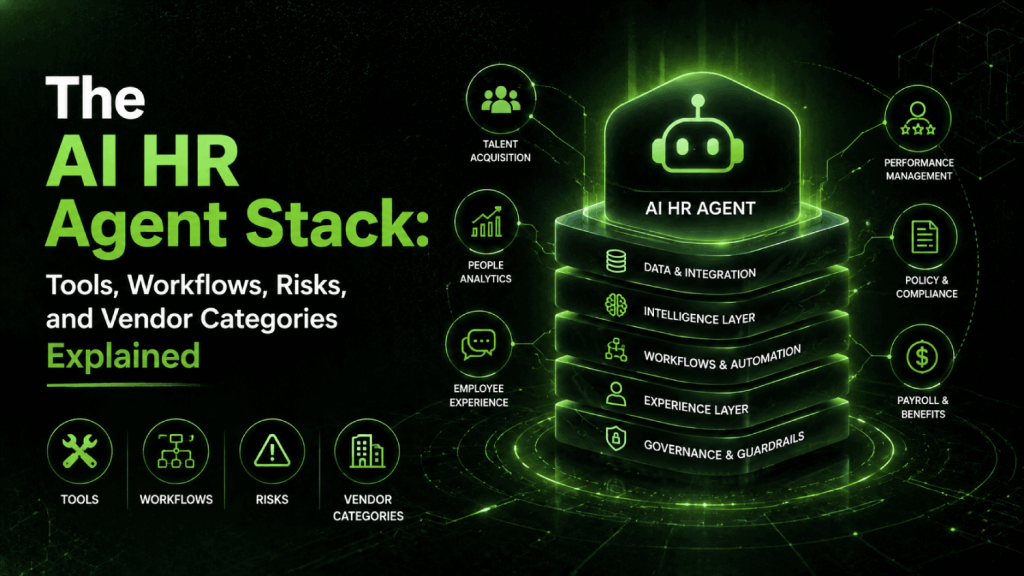

- Most buyers treat an AI HR agent as a single product purchase. It is not. It is a stack decision involving at least six distinct layers, each of which can break independently.
- The six layers are: systems of record, knowledge and data sources, workflow orchestration, integration and permissions, the agent interface, and governance plus analytics.
- Skipping any layer does not make it disappear. It means a human fills the gap manually, or the agent produces wrong outputs with no one catching them.
- Vendor categories matter more than vendor names at this stage. Knowing what category you are buying in prevents you from buying two tools that do the same thing and missing one you actually need.
- The hardest layer to buy is governance. Most HR buyers leave it until after the agent is live, which is exactly backwards.
An AI HR agent stack is the set of interconnected software layers an organization needs to deploy, run, and govern AI agents across HR workflows. It includes a system of record (HRIS or HCM), a knowledge base or policy store, a workflow orchestration layer, integration connectors and permissions management, an agent interface employees interact with, and a governance and analytics layer that monitors outputs and flags errors. Buying a single AI chatbot or copilot tool covers one layer at most.
Why Most AI HR Agent Purchases Fail Before They Scale
The default purchase path looks like this: an HR leader sees a demo of an AI agent that answers employee questions, routes approvals, and writes job descriptions. The demo looks clean. They buy it. Six months later, the agent is partially live on one use case, the IT team is fighting about data access, and nobody has documented what the agent is allowed to decide on its own.
The problem is not the tool. The problem is that the tool was sold as a complete solution when it is actually one component of a stack that requires five other components to work. An AI HR agent that cannot read from your HRIS has no reliable data. One without a permissions layer will either do nothing sensitive or do everything sensitive, both of which are wrong. One without a governance layer produces outputs nobody audits.
Buyers who understand the stack before they buy make better individual tool decisions and avoid the most expensive mistake in HR tech: buying a workflow tool before your data house is in order.
What Are the Six Layers of an AI HR Agent Stack?
The stack has six functional layers. Each layer has a job, a set of vendor categories that fill it, and a failure mode if it is missing.
| Layer | Function | Vendor Categories | Failure Mode If Missing |
|---|---|---|---|
| 1. System of Record | Source of truth for people data | HRIS, HCM, payroll platforms | Agent uses stale or wrong employee data |
| 2. Knowledge and Policy Store | Structured source for HR policies, FAQs, and procedures | Knowledge management, LMS, internal wikis | Agent gives inconsistent or incorrect policy answers |
| 3. Workflow Orchestration | Sequences agent tasks across systems and approvals | Agentic AI platforms, RPA, workflow automation | Agent handles one-step tasks only, cannot complete multi-step processes |
| 4. Integration and Permissions | Controls what data the agent can read, write, and execute | iPaaS, API management, identity and access management | Security gaps or agent cannot access the systems it needs |
| 5. Agent Interface | Where employees and managers interact with the agent | AI chatbots, copilots, embedded UI, Slack/Teams bots | Adoption fails because the interaction layer is clunky or inaccessible |
| 6. Governance and Analytics | Monitors outputs, flags bias, tracks performance, escalates to humans | HR analytics platforms, bias audit tools, AI observability tools | Errors compound undetected; compliance risk accumulates silently |
Layer 1: What Does the System of Record Do in an Agentic HR Stack?
The system of record is the foundation. Every agent action that touches real employee data, compensation, job history, or org structure needs to pull from and write back to a reliable source of truth. Without this, the agent is essentially making things up from whatever data happened to be in its training set or cache.
In practice, this means your HRIS or HCM platform has to expose its data through APIs that your agent can call. Platforms like Workday, SAP SuccessFactors, Oracle HCM, BambooHR, HiBob, and Rippling all have API layers, but the quality and scope of those APIs vary considerably. Some expose read-only endpoints for most objects; others allow agents to write back data like updating job titles, triggering payroll changes, or marking onboarding tasks complete.
For organizations already running a major HCM suite, the system-of-record question is largely answered. The real question is whether your HCM vendor’s native AI layer is sufficient, or whether you need a third-party agentic layer on top. The Workday AI vs SAP Joule vs Oracle AI comparison covers exactly this trade-off for enterprise buyers.
Payroll Data as a Separate Concern
Payroll data is often stored in a separate system even when you have a unified HRIS. If your agent handles employee queries about pay, benefits, or deductions, it needs payroll read access. Most agentic HR platforms do not come with pre-built payroll connectors for every payroll provider. Verify this before assuming it works out of the box.
Layer 2: Why Does the Knowledge and Policy Store Matter?
The system of record stores facts about people. The knowledge and policy store stores facts about rules. An agent handling employee questions about parental leave, PTO balances, or expense reimbursement needs access to your actual policies, not a generic answer from a foundation model trained on internet text.
This is where most AI HR chatbot deployments break. A vendor demos an agent that answers PTO questions beautifully. In production, employees at your company have three different PTO policies depending on their country, employment type, and hire date. The agent, trained on generic HR data, conflates them and gives employees the wrong answer. The fix is a structured knowledge base with version-controlled policy documents, tied to employee attributes so the agent serves the right policy to the right person.
Vendors operating in this layer include dedicated knowledge management platforms like Guru and Notion, as well as HR-specific knowledge bases built into platforms like ServiceNow HR and Zendesk. Some agentic HR platforms like Leena AI and Moveworks manage a policy knowledge layer natively. The question to ask any vendor: how does the system handle policy updates, and how quickly do those updates propagate to the agent’s responses?
Layer 3: What Is Workflow Orchestration and Why Does It Define the Agent’s Actual Capability?
A single-step AI agent answers a question. A multi-step AI agent completes a process. Workflow orchestration is what separates a chatbot from a genuine HR agent.
Consider a new hire onboarding process. An orchestrated agent might: check the HRIS to confirm start date and role, send the new hire a welcome sequence, route IT provisioning requests to the right queue, assign onboarding tasks in the LMS, send the manager a checklist, and follow up at day three, day seven, and day thirty. Each step is a separate action across a separate system. Without an orchestration layer, a human has to hand off between each step.
The orchestration layer can be built in several ways. Some organizations use general-purpose workflow automation platforms like Workato or Zapier to connect HR system actions. Others use HR-native platforms with built-in orchestration, like IBM watsonx Orchestrate, which IBM positions as an AI agent platform for automating work across enterprise applications, including HR processes such as onboarding, benefits administration, and employee service requests. Newer agentic AI infrastructure platforms like StackAI position themselves as enterprise orchestration layers that connect to over 100 integrations for read, write, and execute tasks within existing systems.
The honest framing here: orchestration is the most technically complex layer to implement. It requires someone, either IT or a specialist partner, to define the workflow logic, map the edge cases, and test failure paths. Vendors who promise you can deploy a fully orchestrated onboarding agent in a day are selling the happy path. Budget for the unhappy paths.
Agentic AI vs. RPA: They Are Not the Same Thing
Robotic process automation tools like UiPath and Automation Anywhere automate deterministic, rule-based tasks. They do not handle ambiguity. Agentic AI orchestration is different: the agent can interpret natural language inputs, make conditional decisions, and call different downstream actions depending on context. In an HR context, this distinction matters when a workflow requires judgment, not just execution.
Layer 4: How Do Integration and Permissions Limit What an Agent Can Actually Do?
Every agentic capability described above depends on the agent being allowed to take that action. Integration and permissions are where technical architecture meets HR governance, and where the most expensive mistakes get made.
The integration problem is that HR runs on 10 to 20 different tools at most companies of 200-plus employees: an HRIS, an ATS, a payroll provider, a benefits broker portal, an LMS, a performance management tool, a compensation tool, and various communication platforms. Getting an AI agent to act coherently across these requires either native integrations, a middleware layer (iPaaS), or custom API work. MuleSoft, Boomi, and Workato sit in this middle layer. Some newer HR platforms like Rippling are designed around a unified data model, which reduces integration friction significantly.
The permissions problem is subtler. When an AI agent runs on behalf of an employee, what identity does it carry? Can it access data that the employee themselves cannot see? Can it write to records the employee has no authority to change? Most organizations have not thought through role-based access for AI agents as distinct from role-based access for human users. Before deploying an agentic layer, IT and HR need to define an explicit permissions model for agent identities, separate from human identity management.
Layer 5: What Agent Interfaces Work in HR Contexts?
The interface layer is where the investment becomes visible to employees and managers. Get this wrong and adoption craters regardless of how well the underlying stack is built.
HR agent interfaces come in four main forms. Chat interfaces embedded in Slack or Microsoft Teams are the highest-adoption option for knowledge worker populations because employees already live in those tools. Dedicated HR portals with an AI chat layer work better for deskless or frontline workers who do not use Slack. Embedded copilots within existing HR tools (such as the AI sidebars now appearing in Workday, SAP, and Oracle) reduce context switching for managers doing HR tasks inside those platforms. API-first agent layers, where the agent is callable from any interface, serve developers and organizations with custom internal tooling.
Platforms like Microsoft Copilot for Microsoft 365 and its HR integrations are gaining traction in enterprise environments where M365 is already deployed. Standalone HR-native interfaces from vendors like Moveworks, Leena AI, and Espressive compete specifically on HR use case depth. The best AI HR chatbots comparison covers this layer in detail if you are evaluating interface vendors specifically.
Multi-Channel Is Not the Same as Omnichannel
An agent available on both Slack and a web portal is multi-channel. An agent that maintains conversation context, task state, and employee history across both channels is omnichannel. Based on practitioner experience evaluating these platforms, most current HR agents handle channel switching by starting a new session rather than resuming an existing one , which means they are multi-channel at best. Ask vendors directly: if an employee starts a request on Slack and finishes it on the web portal, does the agent retain state? The answer tells you more than the feature list does.
Layer 6: Why Governance and Analytics Are the Layers Buyers Always Buy Last and Regret
Governance is the layer that determines whether your AI HR agent is defensible. Every other layer determines whether it works. Governance determines whether it is legal, fair, and auditable.
In an HR context, governance covers four things. First, output monitoring: does someone or something review what the agent recommended, approved, or communicated? Second, bias auditing: are agent outputs in recruiting, performance, or compensation systematically disadvantaging protected groups? Third, human escalation paths: when does the agent hand off to a human, and is that path fast enough to matter? Fourth, audit logging: can you reconstruct what the agent did, when, why, and based on what data?
The EU AI Act classifies many HR AI uses as high-risk, including AI used in recruitment, performance evaluation, and work allocation. This is not a future concern for EU-operating companies. It is a current compliance requirement. AI HR compliance and bias audit tools represent a growing vendor category specifically addressing this layer.
Analytics is the operational side of governance. An agent running at scale generates data about what employees ask, what workflows succeed or fail, where agents escalate, and where they do not. AI people analytics platforms can ingest this data to surface patterns: which manager populations generate the most policy exception requests, which onboarding steps have the highest failure rate, which job families generate the most pay-equity agent flags.
Most HR buyers deploy the governance layer after something goes wrong. A better sequence is to define governance requirements before selecting any other layer, because the governance layer constrains what the other layers are allowed to do.
How Do These Layers Map to Specific HR Workflow Categories?
The stack description above is abstract. Here is how the layers map to the three HR workflow categories where AI agents are being deployed most aggressively right now.
Recruiting and Talent Acquisition
System of record: ATS (Greenhouse, Ashby, Lever, Workday Recruiting). Knowledge store: job description library, interview question bank, hiring rubrics. Orchestration: AI sourcing agents that find, score, and sequence outreach to candidates. Integration: LinkedIn, job boards, calendar tools, background check providers. Interface: recruiter copilot or candidate-facing chatbot. Governance: bias audit on screening decisions, EEOC/GDPR logging of candidate data handling.
The best AI sourcing tools and AI interview tools fill the interface and partial orchestration layer for this workflow. Neither replaces the governance layer.
Employee Self-Service and HR Service Delivery
System of record: HRIS (Workday, HiBob, BambooHR, Rippling). Knowledge store: policy wiki, employee handbook, benefits summaries. Orchestration: multi-step workflows for leave requests, expense approvals, job change requests, and IT provisioning. Interface: Slack/Teams bot or HR portal chatbot. Governance: audit log of agent decisions, escalation tracking, response accuracy monitoring.
This is the highest-volume use case and where the AI agents for HR service delivery guide goes deeper on what should and should not be automated.
Internal Mobility and Career Development
System of record: HRIS plus skills data store. Knowledge store: job architecture, competency framework, internal job postings. Orchestration: matching employees to open roles, surfacing learning recommendations, alerting managers to flight risk signals. Interface: employee-facing career hub or manager dashboard. Governance: fairness auditing on internal opportunity distribution, particularly across demographic groups.
Talent intelligence platforms like Eightfold, Gloat, and Beamery operate across the orchestration, interface, and partial system-of-record layers for this use case. A detailed comparison of these vendors appears in the talent intelligence platforms guide.
What Does an AI HR Agent Stack Actually Cost to Build?
There is no single number. The cost depends on which layers you already have covered and which you need to buy or build. The table below gives a rough category mapping.
| Layer | If You Already Have It | If You Need to Buy It | Pricing Model |
|---|---|---|---|
| System of Record | Likely covered by existing HRIS/HCM | Mid-market HRIS starts at low per-employee-per-month fees; enterprise HCM is quote-only | Per employee/month or annual license |
| Knowledge Store | Often partially covered by existing wiki/intranet | Dedicated knowledge platforms vary; many HR-native agents bundle this | Per user/month or bundled |
| Workflow Orchestration | Rarely covered; this is usually the gap | Agentic platforms are predominantly quote-based at enterprise scale; vendors including Moveworks and IBM watsonx Orchestrate do not publish per-employee rates, reflecting the custom scoping involved | Quote-only for most enterprise agentic platforms |
| Integration / Permissions | Partially covered if you have iPaaS | iPaaS licensing adds cost; custom API work adds implementation cost | Usage-based or annual license |
| Agent Interface | Partially if already using M365 Copilot or Slack | HR-native agent interfaces are predominantly quote-based | Quote-only or per-seat |
| Governance / Analytics | Rarely covered out of the box | Bias audit and compliance tools are quote-based; analytics platforms vary | Quote-only to per-employee-per-month |
One honest observation: the cost of not buying the governance layer correctly tends to show up as legal and compliance exposure rather than a SaaS line item. That makes it easy to deprioritize during budget discussions. It should not be.
How Should You Sequence the AI HR Agent Stack Build?
Build sequence matters more than most buyers realize. The wrong order creates rework.
- Audit your system of record first. If your HRIS data quality is poor, clean that before deploying any agent. An agent trained on dirty data produces confidently wrong outputs. Data quality problems do not get better when you add AI on top.
- Define governance requirements before selecting tools. What can the agent decide autonomously? What requires human approval? What must be logged? Define these before you evaluate orchestration or interface vendors, because those constraints eliminate certain tools from contention.
- Select the orchestration layer based on your specific workflows. Do not pick an orchestration platform based on what use cases it demo’d best. Pick it based on whether it can handle your actual HR workflows, edge cases included.
- Build the knowledge store in parallel with integration work. Both take longer than expected. Starting them sequentially adds months to the timeline.
- Deploy the interface layer last. This is counterintuitive because the interface is what employees see. But if the underlying layers are not working, the interface just exposes the failures faster.
- Treat analytics as an ongoing operation, not a launch deliverable. Define the metrics you will track from day one, and make sure someone owns reviewing them. A governance layer nobody monitors is not a governance layer.
Which Vendors Operate Across Multiple Stack Layers?
Most vendors claim to cover more layers than they actually do well. The categories below reflect where vendors genuinely compete versus where they are stretching.
Full-suite HCM vendors (Workday, SAP SuccessFactors, Oracle HCM) cover the system of record thoroughly and are building out orchestration and interface layers natively. Their strength is data integration across their own modules. Their weakness is that their agentic capabilities are generally less mature than dedicated agentic AI vendors.
HR-native agentic platforms (Moveworks, Leena AI, Espressive, IBM watsonx Orchestrate) cover the orchestration, knowledge, and interface layers with HR-specific training. They typically require integration with your existing HRIS rather than replacing it. Their strength is HR workflow depth. Their weakness is that each has a different integration breadth, and buyers frequently discover gaps at the implementation stage.
General-purpose agentic infrastructure platforms (StackAI, LangChain, Microsoft Copilot Studio) let you build custom agentic workflows. They are flexible but require more technical implementation work. They are appropriate when your HR workflows are non-standard or your integration requirements are complex enough that off-the-shelf HR agents cannot cover them.
Point solution vendors (AI sourcing tools, interview tools, onboarding platforms, performance management tools) typically cover one workflow deeply and one or two stack layers within that workflow. They are not full-stack solutions. If you are buying best-of-breed point solutions, you need a plan for how they connect at the orchestration and data layers.
Frequently Asked Questions
What is the difference between an AI HR agent and an AI HR chatbot?
An AI HR chatbot answers questions. An AI HR agent takes actions. A chatbot might tell an employee their PTO balance. An agent submits the leave request, updates the HRIS, notifies the manager, and schedules a calendar block. The distinction matters for stack planning because agents require orchestration, integration, and permissions layers that chatbots do not. Chatbots are single-layer deployments; agents are multi-layer deployments.
Do I need to replace my HRIS to deploy an AI HR agent?
No. Most agentic HR platforms are designed to layer on top of existing HRIS platforms through API integrations. The real question is whether your current HRIS has the API coverage the agent needs. Some older HRIS platforms have limited or read-only APIs, which restricts what an agent can actually do. Verify API write access for the specific actions you need before assuming your existing HRIS is sufficient.
How should HR teams handle AI agent failures or wrong outputs?
Every AI HR agent deployment needs a documented escalation path: a defined point at which the agent hands off to a human, a way for employees to flag wrong answers, and a human owner who reviews escalations on a defined cadence. Technically, this requires audit logging, confidence thresholds that trigger escalation, and a ticketing or case management system where escalated issues land. Escalation design is part of governance layer planning, not an afterthought.
What HR workflows are AI agents least suited for?
Anything involving significant judgment, legal exposure, or emotional sensitivity should not be fully automated. Terminations, performance improvement plans, accommodation decisions, and grievance handling all require human judgment and legal defensibility that current AI agents cannot provide. Agents can support these workflows by surfacing relevant data, drafting documents, or checking for process compliance, but a human must make and own the decision. The AI agents for HR service delivery guide covers the automation boundary in detail.
Is an AI HR agent stack compliant with the EU AI Act?
Several HR AI uses are classified as high-risk under the EU AI Act, including AI systems used in employment decisions, recruitment, and work allocation. High-risk classification requires conformity assessments, documentation, human oversight mechanisms, and transparency to affected individuals. This is not optional for EU-operating companies. Your governance layer must be designed to meet these requirements, and your vendors need to be able to provide documentation supporting conformity assessment. Verify this at the contract stage, not after deployment.
How long does it take to build an AI HR agent stack?
For a mid-market company deploying a focused use case (employee self-service on a clean HRIS), a realistic timeline is three to six months from vendor selection to stable production. For enterprise deployments across multiple workflows, twelve to eighteen months is common. The longest phases are typically data quality remediation, integration work, and knowledge base construction, none of which vendors include in their sales-cycle timeline estimates. Build those buffers into your project plan.
Should I buy a bundled HR agent platform or best-of-breed components?
Bundled platforms reduce integration complexity but constrain flexibility. Best-of-breed stacks give you the strongest tools at each layer but create integration overhead and potential gaps between layers. For companies under 500 employees or deploying a single primary use case, a bundled platform is usually the right starting point. For enterprise buyers with complex workflows across multiple geographies, a best-of-breed approach with a clear integration strategy tends to be more durable. The AI HR vendor evaluation checklist has specific questions to ask bundled platform vendors about what their bundle actually covers.
What internal roles are needed to manage an AI HR agent stack?
At minimum, you need an HR operations owner who governs the knowledge base and escalation process, an IT or systems owner who manages integrations and permissions, and an analytics owner who reviews agent performance data. At larger organizations, a dedicated AI governance role or committee makes sense. The mistake most companies make is assigning the entire stack to the HR team, who generally do not have the technical depth to manage the integration and permissions layers without IT partnership.
The Mental Model That Changes How You Buy
Think of the AI HR agent stack the way you think about a payroll implementation. Nobody buys payroll software expecting it to work without a data migration, a chart of accounts, a compliance review, and a parallel run period. They buy it knowing there is a set of surrounding work that must happen for the software to function correctly. AI HR agents are the same. The vendor product is real and it works, but only inside a stack that has been properly built around it.
The practical implication is that your first AI HR agent purchase should be evaluated not just on what the agent does, but on which layers it covers and which layers it expects you to already have. A vendor who cannot clearly map their product to specific stack layers is either selling a point solution or does not yet understand the problem well enough. Both are useful signals in an evaluation.
Start with one workflow, one use case, and a governance layer defined before you go live. The buyers who move carefully on the first deployment are consistently the ones who scale faster on the second and third. Speed in AI HR agent deployment is mostly a function of how well the underlying stack was built, not how aggressively the rollout was pushed.