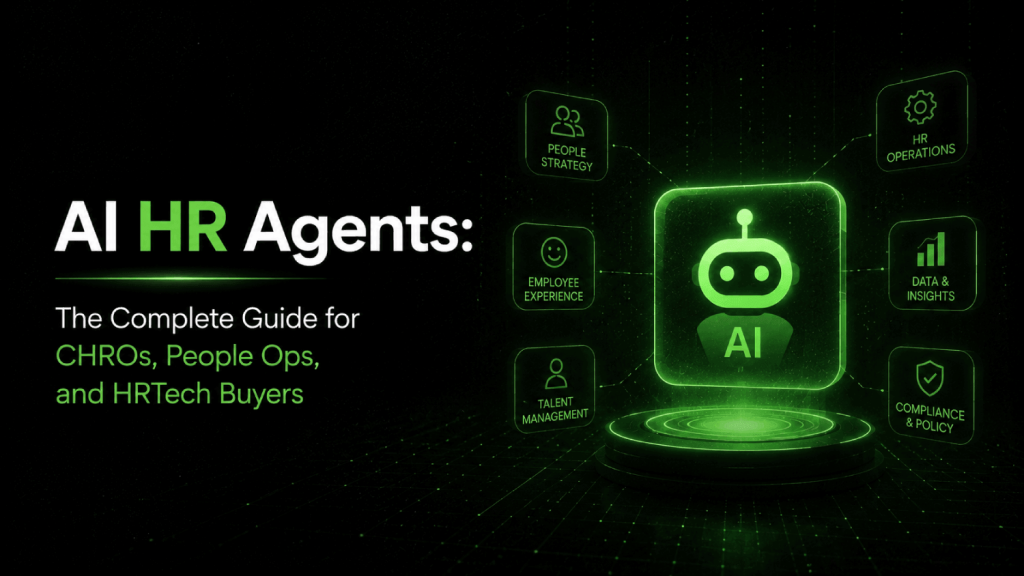

- AI HR agents are not chatbots. They are goal-directed software that can plan, act across multiple systems, and loop back on results without a human triggering each step.
- The meaningful line between a copilot and an agent is autonomy: a copilot drafts, an agent executes. Most tools sold as “agents” today sit somewhere in between.
- The highest-value agent use cases right now are in recruiting workflow coordination, onboarding orchestration, policy Q&A with action, and workforce analytics triggering.
- Governance is the blocking problem. Agents that can write to your HRIS, trigger payroll changes, or send candidate communications need defined ownership, audit trails, and hard escalation rules before deployment.
- The buy-versus-build decision is real. Native agents in Workday, SAP Joule, and Oracle HCM are maturing faster than most standalone vendors want to admit.
AI HR agents are software systems that combine a large language model with planning logic and tool access, allowing them to complete multi-step HR workflows autonomously across connected systems. Unlike chatbots that respond to single prompts, or copilots that require human confirmation at each step, agents can initiate tasks, call APIs, retrieve and write data, and adapt based on intermediate results to reach a defined goal.
What Are AI HR Agents, and How Are They Different From Chatbots and Copilots?
Most HR buyers encounter the term “AI agent” after three or four vendors use it to describe very different things in the same quarter. The word has been applied to everything from FAQ bots to fully autonomous workflow orchestrators. That range is not a marketing accident. It reflects a genuine architectural spectrum.
A chatbot responds. It takes a question and returns an answer, usually from a fixed knowledge base. Our separate deep-dive on AI HR chatbots for employee support and recruiting covers that category specifically. Chatbots are one interface through which an agent might communicate, but they are not agents on their own.
A copilot assists. It drafts a job description, summarizes a performance review, or surfaces a candidate shortlist, and then waits for a human to approve and act. Microsoft Copilot in Microsoft 365 is the most familiar example. The human stays in the loop at every consequential step.
An agent acts. It receives a goal, not just a prompt, and works through a sequence of steps to reach that goal. It can call external tools, read and write across connected systems, evaluate whether intermediate results are on track, and try alternative paths when they are not. The defining characteristic is that it does not stop and wait after each sub-task.
| Category | Input | Output | Human touchpoint | System access |
|---|---|---|---|---|
| Chatbot | Single question | Single answer | Every exchange | Read-only knowledge base |
| Copilot | Task request | Draft or recommendation | Before any action | Read; writes with approval |
| HR Agent | Goal or trigger | Completed workflow | On exception or escalation | Read and write across systems |
In practice, most commercial “HR agents” in 2025 are somewhere between copilot and full agent. They complete some steps autonomously and pause for approval on high-stakes actions like sending an offer letter or updating compensation records. That is actually the right design for where organizational trust in these systems currently sits.
What Can AI HR Agents Actually Do Today?
The use case list matters more than the architecture definition. According to Oracle’s published documentation on AI agents in HR, current deployable use cases span talent acquisition, employee experience, and workforce planning. IBM’s overview adds benefits administration and onboarding coordination. Workday’s blog frames agents as providing autonomous, scalable workflow support across hiring, engagement, and workforce planning.
Below is a grounded breakdown of what is actually running in production, versus what is in vendor roadmaps or pilots.
Recruiting Workflow Coordination
This is the most mature agent category. Agents can ingest an approved job requisition, post to configured job boards, screen incoming applications against defined criteria, schedule screening calls by accessing calendar APIs, send status communications to candidates, and surface a ranked shortlist to the hiring manager. Each of those steps would individually take recruiter time. Done end-to-end without human involvement until the shortlist, it compresses weeks to days on high-volume roles. For a broader look at the sourcing and screening tools that feed into this layer, the comparison of AI sourcing tools and LinkedIn Recruiter alternatives is worth reviewing alongside this guide.
Onboarding Orchestration
Agent-driven onboarding connects HR systems, IT provisioning, payroll, and manager workflows. When a hire is confirmed in the ATS, an agent can trigger HRIS record creation, send Day 1 instructions, assign learning content, flag incomplete I-9 or right-to-work documentation, and escalate blockers without a coordinator manually chasing each step. The platforms doing this most coherently today are embedded within enterprise HCM suites rather than standalone point solutions.
Policy and Benefits Q&A With Action
This is where the line between chatbot and agent becomes operational. A chatbot tells an employee what the parental leave policy says. An agent tells them, then initiates the leave request, routes it to their manager, updates the workforce calendar, and notifies payroll, all from one employee interaction. The action capability is what makes it an agent. Companies running this at scale report significant reductions in HR ticket volume, though vendor-specific figures vary and should be requested directly from each vendor during evaluation.
Workforce Analytics Triggering
More advanced deployments connect people analytics outputs directly to agent actions. When an attrition risk model flags a segment of employees above a defined threshold, an agent can surface that flag to the relevant HRBP, generate a briefing document from the underlying data, and schedule a follow-up task, without waiting for a weekly analytics review. Tools in the AI people analytics category are increasingly building agent-like triggering into their workflow layers.
Internal Mobility Matching
Agents that sit on top of skills graphs can monitor open roles, match current employees against those roles based on skills and performance data, and proactively surface opportunities to employees and managers. This requires a well-maintained skills taxonomy to work at all, which is the infrastructure challenge most companies underestimate. The AI internal mobility platforms category covers the vendors building in this space.
What Is the Architecture Behind an HR Agent?
Understanding the stack helps you evaluate vendors honestly. An HR agent typically has four layers working together.
The reasoning layer is the large language model: GPT-4 class models, Gemini, or a fine-tuned variant. This handles natural language understanding, planning, and response generation. The tool layer is the set of APIs and integrations the agent can call: your HRIS, ATS, payroll system, calendar, communication tools, and document storage. The memory layer lets the agent maintain context across a multi-step task and, in some designs, across sessions. The orchestration layer is the planning logic that breaks a goal into steps, sequences them, evaluates results, and decides when to escalate or loop back.
Most enterprise HR platforms are now building proprietary orchestration on top of foundation models they license rather than own. Workday AI, SAP Joule, and Oracle AI each take a different architectural approach to this, and those differences have real implications for what the agent can access, how auditable its decisions are, and how tightly it integrates with your existing data.
HR Copilots vs. HR Agents: When Does the Distinction Actually Matter?
For a CHRO evaluating a purchase, this distinction matters in two specific situations: compliance exposure and operational ownership.
On compliance, a copilot that drafts a candidate rejection email puts a human between the AI output and the legal record. An agent that sends that rejection autonomously does not. In jurisdictions with AI employment law requirements, including New York City’s Local Law 144, the EU AI Act’s forthcoming HR-specific provisions, and Colorado’s AI hiring legislation, autonomous action by AI in consequential employment decisions creates a different liability posture than AI-assisted action. The AI HR compliance and bias audit tools category is directly relevant to anyone deploying agents in hiring workflows.
On operational ownership, a copilot failure means a human made a bad decision with bad AI input. An agent failure means the system made a bad decision and may have already taken action on it. That requires a different escalation model, different audit logging, and a named owner who is accountable for agent behavior. Most HR teams have not built that accountability structure yet, and most vendors do not help them do it.
What Does Agentic AI in HR Actually Look Like in Practice?
The gap between demo environments and production deployments is wider in agentic AI than in almost any other software category. In a demo, the agent handles the clean path: complete data, clear approval rules, no edge cases. In production, applicant data is missing fields, approvers are out of office, job descriptions conflict with compensation bands, and the agent needs to know what to do with all of that.
Three patterns separate mature deployments from failed ones.
Defined Scope With Hard Guardrails
Successful deployments start with a narrow, well-bounded use case. Not “automate recruiting.” Instead: “For roles below a defined grade level in defined locations, the agent can screen, schedule, and shortlist without human intervention. For all other roles, it drafts and waits.” The narrower the initial scope, the faster trust builds and the easier failure modes are to catch.
Explicit Escalation Logic
Every agent deployment needs a written escalation map before it goes live. When the agent encounters an edge case, who does it notify? Through what channel? Within what timeframe? What happens if that person does not respond? This is not a software configuration. It is an organizational policy decision that HR leadership must make before deployment, not after the first incident.
Audit Trails That Are Actually Readable
Vendors will tell you their agents are auditable. Ask to see the audit log and evaluate whether an HR professional who did not build the system could understand what the agent did, why it did it, and what data it used to make each decision. Many audit logs are technically complete but practically unreadable by non-engineers. That is not adequate for employment compliance purposes.
Which HR Functions Are Ready for Agent Automation, and Which Are Not?
Readiness depends on three factors: how structured the workflow is, how high the stakes are if the agent makes an error, and how clean your underlying data is. The table below reflects current production realities, not vendor roadmaps.
| HR Function | Agent Readiness | Blocking Condition |
|---|---|---|
| High-volume screening and scheduling | High | Bias audit requirements |
| Onboarding task coordination | High | Clean HRIS and IT integration |
| Policy Q&A with leave initiation | High | Policy data quality |
| Attrition risk alerting | Medium | People analytics maturity |
| Internal mobility matching | Medium | Skills taxonomy completeness |
| Performance review generation | Medium | Manager trust, legal review |
| Compensation decisions | Low | Legal liability, governance gaps |
| Termination workflow | Low | Legal exposure, human judgment required |
| Workforce planning strategy | Low | Requires human context, political judgment |
The “low readiness” category is not “will never be automated.” It is “the organizational, legal, and technical infrastructure to do it responsibly does not exist at most companies today.” Vendors who tell you otherwise are selling roadmap as product.
What Are the Real Risks of Deploying AI HR Agents?
The risks fall into four categories that CHROs and people ops leaders need to address before deployment, not as an afterthought.
Discriminatory Outcomes at Scale
An agent that screens 50,000 candidates carries a screening bias at 50,000 times the scale of a single recruiter. If the screening criteria encode historical patterns, a protected class disadvantage that was small in manual recruiting can become legally significant at agent scale. This is not theoretical. New York City’s Local Law 144 already mandates annual bias audits for automated employment decision tools used in hiring. The EU AI Act classifies AI systems used in employment decisions as high-risk, requiring conformity assessments, documentation, and human oversight measures. You need a bias audit process built into the deployment plan, not bolted on later.
Data Access Scope Creep
Agents need data access to function. The risk is that a vendor with broad API access to your HRIS, ATS, and performance data has constructed a data model of your workforce that sits on their infrastructure and is subject to their retention policies, security posture, and contractual terms. Before deployment, map exactly what data the agent reads, what it writes, where intermediate results are stored, and what happens to that data if you terminate the contract.
Accountability Gaps
When an agent makes a bad hiring decision or sends an incorrect policy answer that an employee acts on, who is accountable? The vendor’s terms of service will not answer that question in your favor. HR leadership needs to own agent behavior operationally, even when the agent was acting without human input. That requires naming a responsible owner for each agent deployment, the same way you would name an owner for a payroll process.
Over-Reliance on Clean Data
Agents surface patterns and take actions based on the data they can access. If your job descriptions are inconsistently written, your skills taxonomy is six years old, or your HRIS has 15% incomplete records, the agent does not become less functional. It becomes confidently wrong. Data readiness is a prerequisite for agent deployment, not a nice-to-have.
Build vs. Buy: When Does Native Agent Capability Win?
The build-versus-buy decision for HR agents is more complex than for most HR software because the category has two distinct tiers: agents built natively into HCM platforms and standalone agent layers built on top of your existing stack.
If your company is already on Workday, SAP SuccessFactors, or Oracle HCM, the native agent capabilities in those platforms have structural advantages that are hard for a standalone vendor to overcome. The data is already there. The integrations already exist. The audit trail sits in the same system as the action. The compliance posture is covered under the same enterprise agreement. The trade-off is that native agents are constrained to what the platform can see. If your recruiting happens in Greenhouse and your performance management is in Lattice, a Workday agent operating in isolation covers a fraction of the workflow.
Standalone agent platforms, including vendors like Eightfold, Beamery, and emerging purpose-built agent layers, can operate across a broader set of connected systems. Their limitation is integration depth and data ownership. Every system they connect to requires an API integration that you have to maintain. If one integration breaks, the agent’s logic breaks with it. For a deeper look at the talent intelligence vendors building in this space, the talent intelligence platform comparison is a useful complement to this guide.
The decision rule: if 80% of the workflows you want to automate live within a single HCM platform, start with native agents. If the workflows are genuinely cross-system, evaluate standalone platforms with significant integration coverage and a clear data governance model.
What Should CHROs and Buyers Evaluate Before Purchasing an HR Agent Platform?
The evaluation criteria for an agent platform differ from standard HR software evaluation in important ways. Feature lists and UI demos are less informative. Production behavior under edge cases is what matters.
Five questions that should be non-negotiable in any vendor conversation:
- What does the agent do when it encounters a decision it was not trained to make? Ask for a live demonstration, not a written answer. The vendor should be able to show you exactly what the escalation behavior looks like and where the ticket lands.
- What is the complete data access scope, and where is agent memory stored? Get this in writing before procurement. The vendor’s data processing addendum should answer it. If it does not, that is the answer.
- What does the audit log contain, and who can read it? Request a sample audit log from a production customer. It should be readable by a non-engineer and should include the data inputs that drove each agent decision, not just the decision itself.
- What bias testing has been done on the screening or matching logic? Ask for methodology and results, not a general statement about fairness. Any vendor deploying agents in hiring should have an independent third-party audit to show you.
- What is the SLA for agent failures, and what is the rollback procedure? If the agent sends 500 incorrect candidate communications, how fast does the vendor respond, and how do you remediate? This is an operational question with real business consequences.
For a fuller due diligence framework across HR AI vendors broadly, the AI HR vendor evaluation checklist covers 50 questions worth working through before signing any agreement.
Is AI Eliminating HR Jobs?
The honest answer is that agents are automating specific tasks, not roles, and the roles most at risk are those built primarily around task execution rather than judgment. High-volume scheduling coordination, repetitive candidate screening, policy lookup and routing, and form processing are all tasks that agents can handle more consistently and at lower cost than humans. The roles that own those tasks will change.
HR roles built around judgment, relationships, organizational context, and accountability are not at near-term risk from agents. A good HRBP’s value is not in knowing what the parental leave policy says. It is in knowing when a manager’s interpretation of that policy is creating a retention problem, and what to do about it. Agents do not have that organizational context, and they will not in the near term.
What changes is where HR professionals spend their time. Teams that deploy agents well spend less time on coordination and more time on the analysis and judgment work that the agent surfaces. Teams that deploy agents poorly spend time managing agent failures and cleaning up incorrect automated actions. The difference between those two outcomes is largely determined by how seriously leadership takes the governance work before deployment.
Frequently Asked Questions About AI HR Agents
What are AI agents in HR?
AI agents in HR are software systems that combine a large language model with tool access and planning logic, allowing them to complete multi-step HR workflows autonomously. Unlike chatbots that answer single questions, HR agents can plan a sequence of actions, call APIs across HR systems, write data back to those systems, and adapt based on intermediate results. Current production use cases include recruiting coordination, onboarding orchestration, policy Q&A with action, and attrition risk alerting.
How are HR agents different from HR copilots?
The difference is where the human sits in the workflow. A copilot assists by drafting, summarizing, or recommending, and requires a human to take each consequential action. An agent executes a defined goal across multiple steps without waiting for human input at each stage. In practice, most commercial HR agents in 2025 are hybrid: they automate lower-stakes steps and pause for human approval before taking high-stakes actions like sending offers or updating payroll records.
What HR tasks can an AI agent handle without human approval?
High-volume application screening against predefined criteria, interview scheduling via calendar APIs, onboarding task tracking and nudging, policy Q&A response, internal mobility opportunity notifications, and attrition risk flagging to HRBPs are all being handled autonomously in production deployments today. Tasks with legal consequences, including offer letter transmission, compensation adjustments, and termination workflows, should require human approval until organizations have established audit and governance frameworks that satisfy their legal counsel and compliance teams.
What compliance obligations apply to AI HR agents?
If your agent makes or influences employment decisions, several legal frameworks are directly relevant. New York City’s Local Law 144 requires annual bias audits for automated employment decision tools used in hiring. The EU AI Act classifies AI systems used in employment as high-risk, requiring conformity assessments, documentation, and human oversight measures. Colorado’s SB 205 creates similar obligations for consequential decisions. Regardless of jurisdiction, organizations should maintain audit logs for any agent action in a hiring or performance workflow and have a documented process for human review on escalations.
Should we build our own HR agent or buy from a vendor?
Buy, in almost every case, unless you have a dedicated ML engineering team and a specific workflow that no commercial solution addresses. The infrastructure cost of building and maintaining a production-grade agentic system, including model access, tool integrations, escalation logic, monitoring, and audit logging, is significant. Commercial platforms, especially those native to your HCM, give you integration depth and compliance documentation that a custom build cannot match in a reasonable timeframe. Custom builds make sense for very large organizations with unusual workflow requirements that commercial agents cannot serve.
Which vendors offer AI agent capabilities in HR?
Enterprise HCM platforms with native agent capabilities include Workday (Workday Illuminate), SAP SuccessFactors (SAP Joule), and Oracle HCM (Oracle AI Agents). Standalone platforms with agent-like capabilities include Eightfold AI, Beamery, Gloat, and a growing set of point-solution vendors in recruiting and onboarding. Microsoft Copilot for HR covers the copilot end of the spectrum. The distinction between what each vendor calls an “agent” and what is actually a copilot or workflow automation varies significantly and should be tested in a structured pilot.
What data does an HR agent need to function effectively?
At minimum, a recruiting agent needs clean job description data, applicant data with consistent fields, a defined screening rubric, and calendar integration. An onboarding agent needs HRIS integration, IT provisioning API access, and a task library. A policy agent needs a well-structured, current policy knowledge base with clear versioning. The consistent theme is data quality. Agents amplify the quality of your underlying data, which means poor data quality produces confident errors at scale, not just occasional mistakes.
What does “agentic AI in HR” mean?
Agentic AI refers to AI systems capable of taking sequences of actions toward a goal, rather than responding to single prompts. In an HR context, agentic AI can initiate tasks, call external tools, make intermediate decisions, and complete multi-step workflows without a human triggering each step. The term is often used to distinguish this class of system from earlier AI tools in HR, such as predictive analytics dashboards or chatbot Q&A, which provided information but did not take action in connected systems.
Where Does This Leave HR Leadership Right Now?
The category is real, the technology works, and the production use cases are narrow enough that a measured first deployment is achievable for most mid-market and enterprise HR teams in the next 12 months. The companies that deploy well will have done the boring prerequisite work: cleaned up their data, written clear escalation rules, named accountable owners, and built audit logging before the first agent goes live, not in response to the first incident.
The companies that deploy poorly will have done the opposite. They will have signed a vendor contract based on a demo that handled clean data, deployed without escalation procedures, and discovered the accountability gap when the agent did something a human would not have done. That scenario plays out in public in employment litigation, not in a vendor’s post-mortem document.
The most useful mental model for a CHRO evaluating this category: treat each agent deployment the same way you would treat hiring a new employee into a process role. You would define their scope, give them clear decision-making authority within it, specify exactly what they should escalate and to whom, hold them accountable to an audit trail, and review their output regularly. An agent requires exactly the same organizational scaffolding. The difference is that when you get it right, the agent operates that process at a scale and consistency no human team can match.