
HR Tech SaaS may earn a commission when you buy through links on this page. Our recommendations are editorial and never paid for.
- Background check software is not a commodity. Vendor choice affects turnaround time, FCRA exposure, ATS integration depth, and candidate experience in ways that vary significantly across the market.
- The strongest tools for high-volume hiring are Checkr and First Advantage. For SMBs that want FCRA guardrails with minimal setup, GoodHire and Cisive are worth a close look.
- FCRA compliance is not a checkbox. Your vendor must support adverse action workflows, dispute resolution, and permissible purpose documentation, not just deliver a report.
- Most HRIS-native screening modules are thin. If your HRIS offers background checks as an add-on, verify turnaround time, court access, and compliance tooling before assuming it’s sufficient.
- Pricing across this category is mostly quote-based or per-check. A few vendors publish base rates publicly. Expect meaningful variation by check type, geography, and volume.
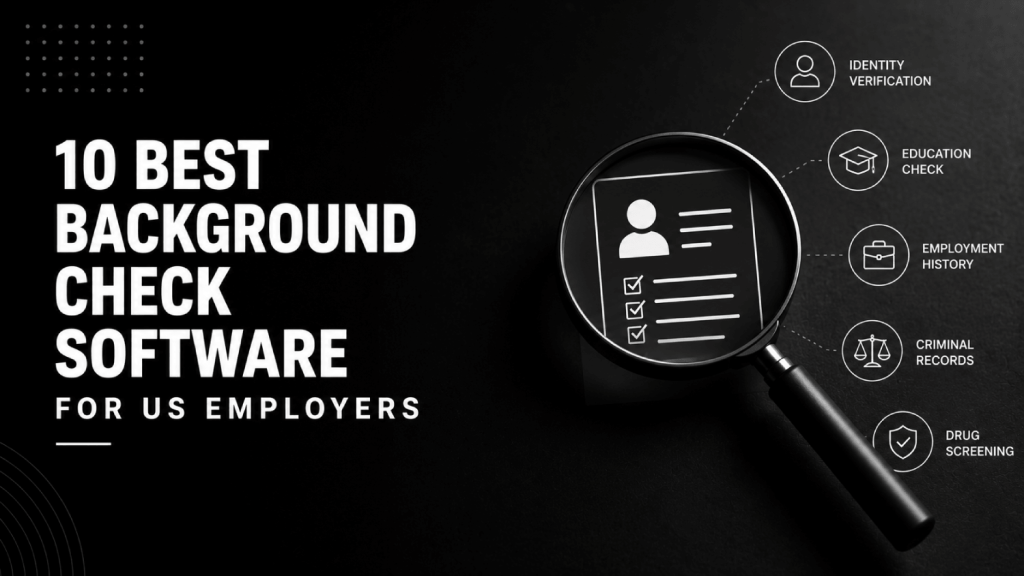
The best background check software for US employers depends on hiring volume, workforce type, and how much FCRA compliance infrastructure you want built into the tool versus managed manually. Checkr and Sterling lead for high-volume, API-first environments. GoodHire, Accurate Background, and HireRight are strong mid-market options with solid compliance tooling. First Advantage and Cisive serve regulated industries with deep verification coverage. For small businesses, Certn and Zinc are accessible entry points.
Why Background Check Software Is Its Own Buying Decision
Most HR buyers treat background screening as a feature of their ATS or HRIS. It is not. The vendors in this category sit at the intersection of legal compliance, data infrastructure, and candidate experience in ways that generic HR platforms cannot replicate with a bolt-on module.
The core risk is the Fair Credit Reporting Act. The FCRA governs how consumer reports, including employment background checks, are obtained and used. Violations carry civil liability, and the requirements around adverse action notices, permissible purpose, and candidate disclosure are specific enough that a poorly designed workflow creates real exposure. Your vendor either automates those workflows correctly or it does not. There is no partial credit.
Turnaround time matters too, and it varies more than vendors admit. Criminal record checks depend on court access, and not every provider has the same coverage or refresh cadence. A vendor claiming 24-hour turnaround on criminal checks may be returning database results, not actual courthouse records, which has different accuracy and legal implications. Know what you are buying.
If you are building out a broader pre-hire workflow and want to see how background check software fits into the full recruiting stack, the best ATS platforms for mid-market companies covers how screening integrations vary by system.
What to Look for in Employment Screening Software
Before reviewing specific vendors, here is the evaluation framework that matters for US employers.
- FCRA compliance tooling: Does the platform automate adverse action notices, pre-adverse action letters, and candidate dispute workflows? Or does it leave that to you?
- Court access and accuracy: Does the vendor use primary source courthouse records, national databases, or a mix? Understand the difference before you assume “comprehensive criminal check.”
- Turnaround time by check type: Criminal, employment verification, education verification, and drug screening all have different timelines. Get specifics, not averages.
- ATS and HRIS integrations: Native integrations with Greenhouse, Lever, Workday, or your stack reduce manual handoff. Verify these are maintained, not legacy API connections.
- Candidate experience: Candidates complete the authorization step. A clunky portal increases abandonment and delays the check, which delays your hire.
- Volume pricing and contract flexibility: Enterprise vendors want annual commitments. If your hiring volume fluctuates, negotiate pay-per-check or minimum thresholds accordingly.
The 10 Best Background Check Software Platforms for US Employers
1. Checkr
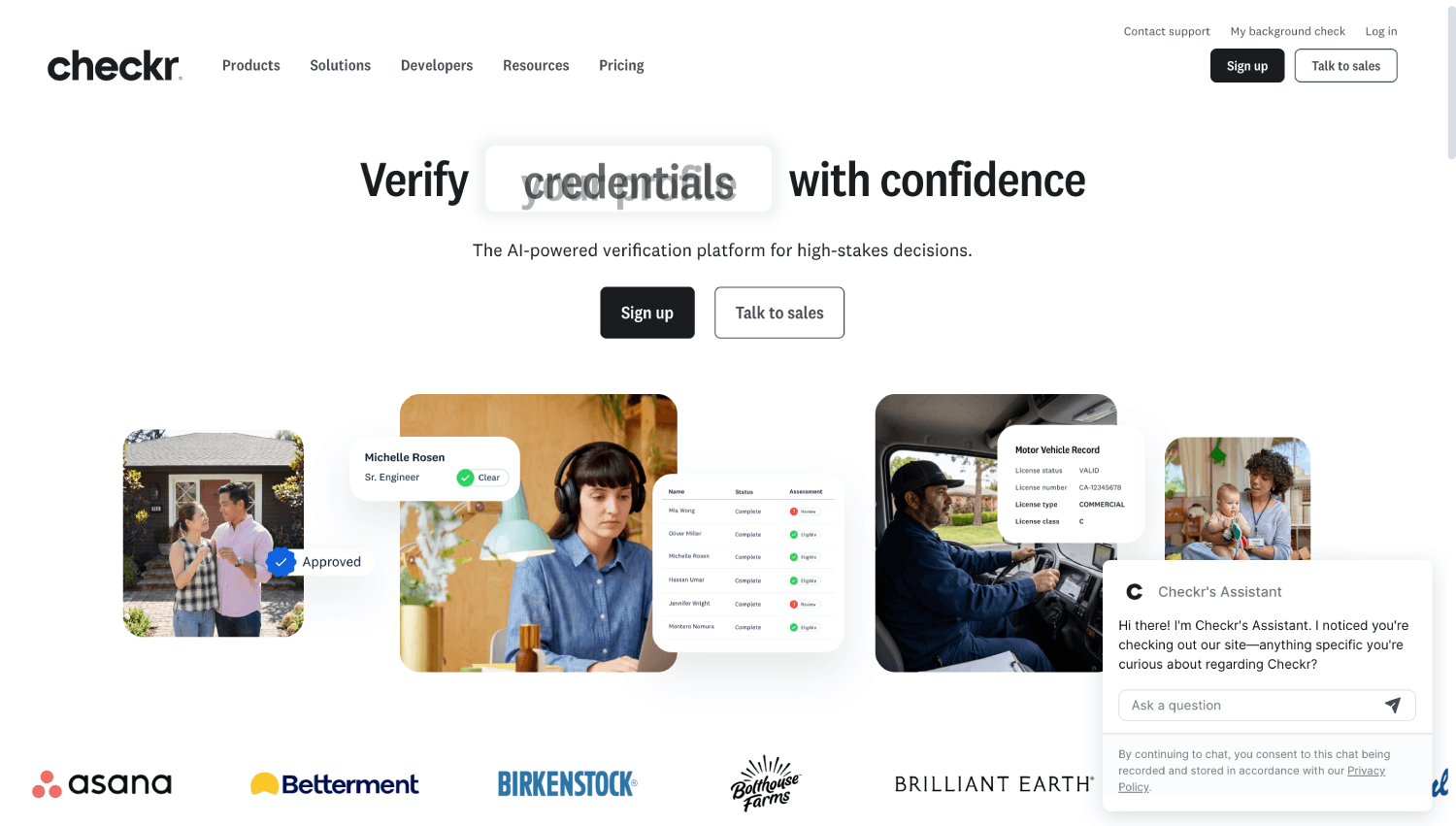
Checkr is the default choice for high-volume, tech-forward hiring environments. The platform is API-first, integrates with over 100 ATS and HR platforms, and uses a combination of AI and human review to process criminal records, employment history, and identity verification at scale.
Checkr is FCRA compliant and builds adverse action workflows into the platform. The candidate-facing interface is clean, which matters for high-volume pipelines where candidate drop-off during the screening step is a real problem. Gartner’s background check software reviews consistently list Checkr among the top-rated platforms in the category.
The limitation worth knowing: Checkr is optimized for domestic US checks. If you have international hiring needs alongside domestic volume, you will need to evaluate whether Checkr’s international coverage matches your specific geographies before committing.
Best for: Tech companies, gig economy platforms, and any employer with high domestic US volume and a need for ATS integration depth.
2. Sterling
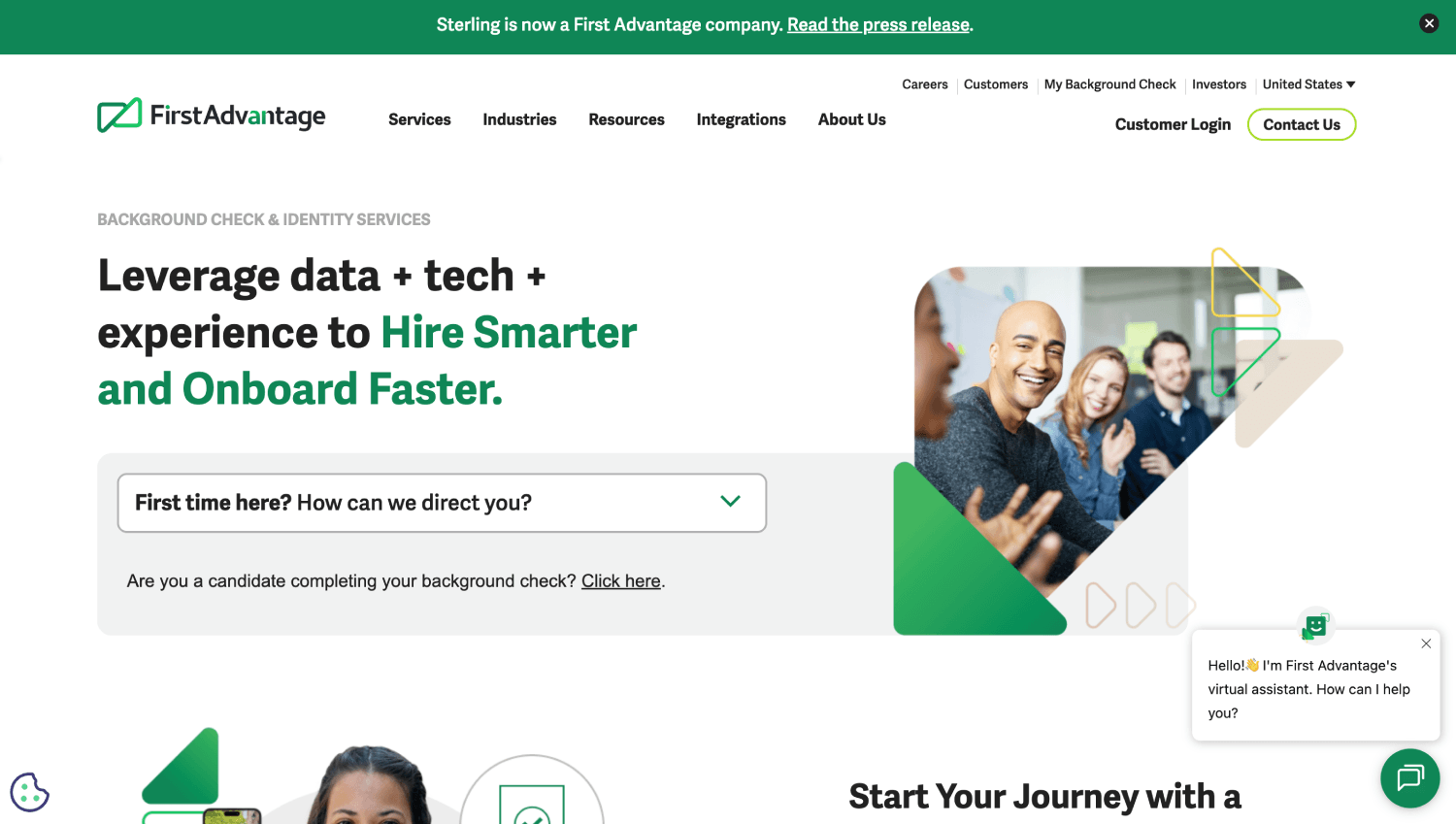
Sterling, now operating as Sterling, a First Advantage Company following their merger, offers one of the broadest service sets in the market: criminal background checks, drug screening, employment and education verification, identity solutions, and post-hire monitoring. The combined entity brings scale that few competitors can match.
Sterling’s strength is depth of verification coverage, particularly for regulated industries where primary source verification of credentials matters. The platform integrates with major enterprise HCM systems including Workday and SAP SuccessFactors. The trade-off is complexity. Mid-market companies may find the implementation heavier than their needs require.
Best for: Enterprise employers and regulated industries (healthcare, financial services, government contractors) that need broad verification types and post-hire monitoring.
3. First Advantage
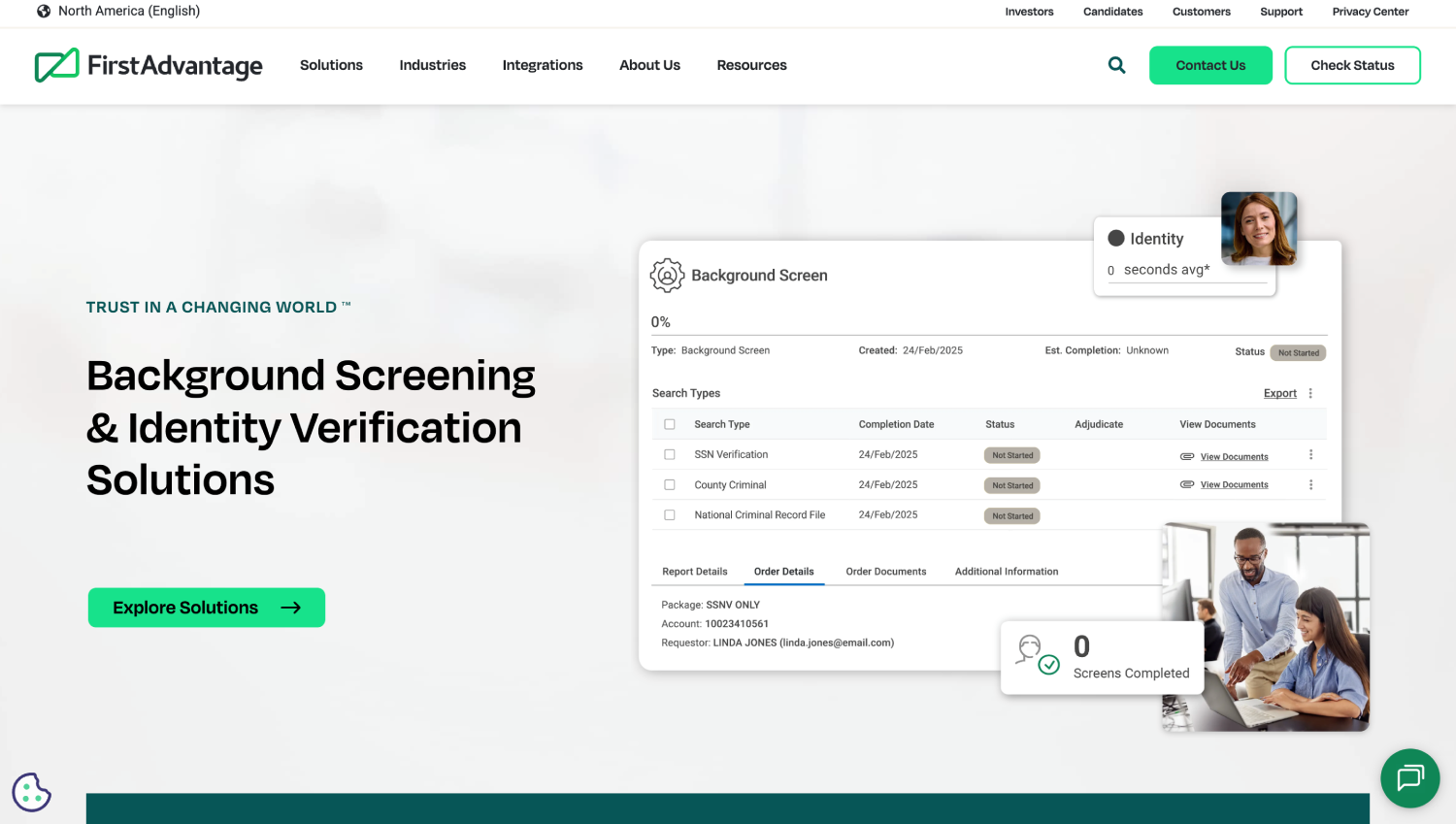
First Advantage is one of the largest employment screening companies in the world by volume. After the Sterling merger, First Advantage operates as the parent entity with global reach across more than 200 countries and territories.
The platform’s strength for US employers is its combination of criminal record access, drug and health screening, and a compliance framework designed for employers in regulated industries. First Advantage has invested in candidate-facing technology to reduce authorization friction, which has historically been a weaker point for large-volume screening providers.
Best for: Large enterprises with global hiring needs and complex compliance requirements across multiple jurisdictions.
4. GoodHire
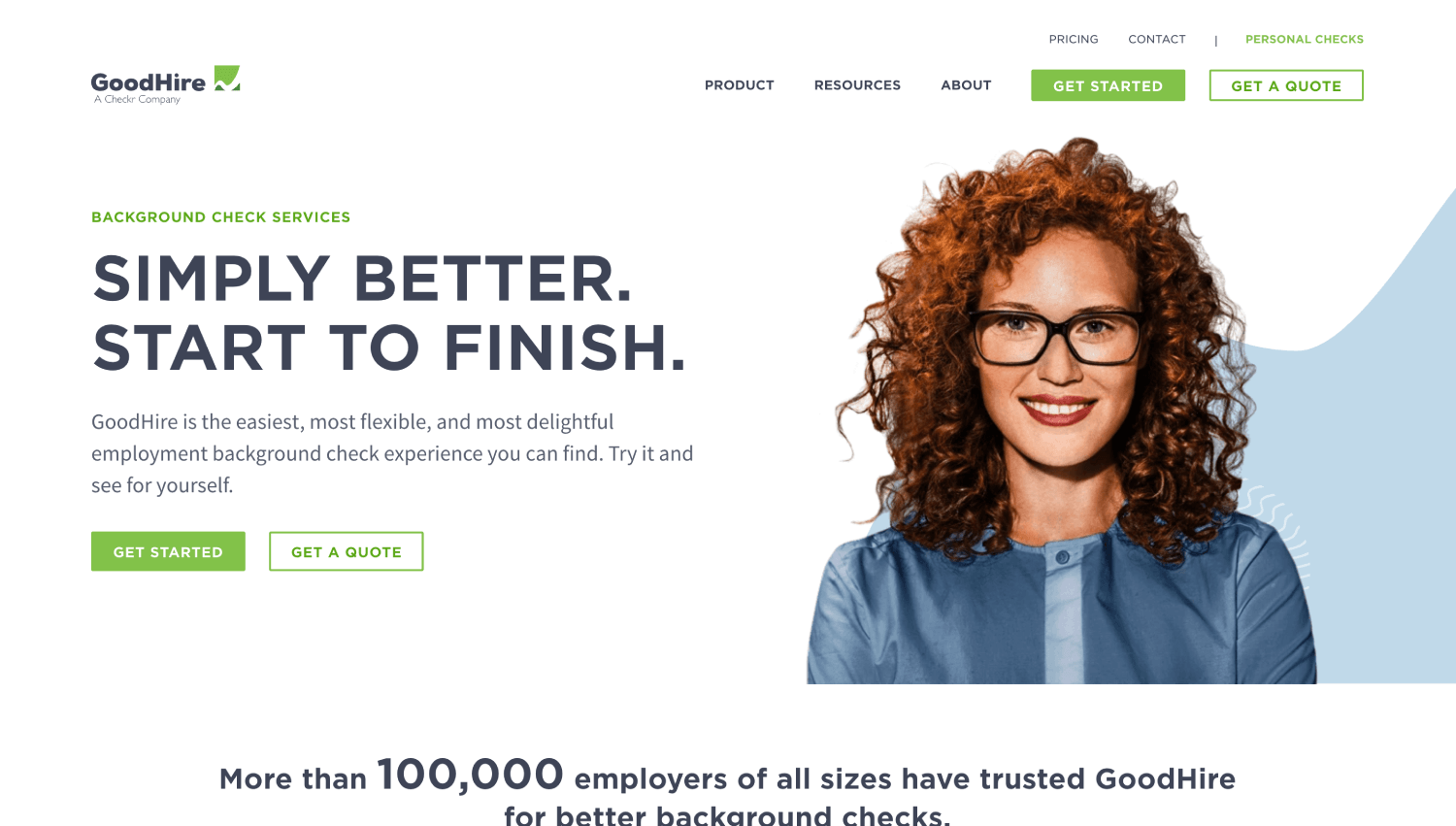
GoodHire is one of the more explicitly FCRA-forward platforms in the market. Their public positioning around FCRA compliant background checks reflects a genuine investment in compliance tooling rather than just marketing language. Adverse action workflows, candidate dispute handling, and required disclosures are built into the product.
GoodHire is well suited for SMBs and mid-market companies that want to run checks without a dedicated compliance team managing the legal workflow. The platform is not as API-deep as Checkr, but it does integrate with popular ATS tools and offers a usable self-service interface for lower-volume hiring teams.
Pricing is partially transparent. GoodHire lists some per-check rates publicly, which is unusual in a category where most vendors require a quote for everything. Verify current rates on their pricing page before budgeting.
Best for: SMBs and mid-market companies that want FCRA compliance built into the workflow without heavy implementation overhead.
5. Accurate Background
Accurate Background competes squarely in the mid-market segment with a platform that covers criminal background checks, employment and education verification, drug testing, and international checks. The company emphasizes both compliance and speed, with a particular focus on reducing time-to-hire friction in the screening step.
Accurate integrates with a wide range of ATS and HRIS platforms, and the company has invested in a candidate-facing mobile experience that reduces the time candidates take to complete their authorization. Their compliance tooling includes adverse action support, which puts them on par with GoodHire for FCRA workflow management.
Best for: Mid-market employers who want a full-service background check platform with solid ATS integrations and a faster candidate completion flow.
6. HireRight
HireRight has been in the employment screening market for decades and brings genuine depth in enterprise-grade verification. The platform covers the full range of employment screening services: criminal records, drug and health screening, employment and education verification, professional license verification, and international checks.
HireRight is particularly strong on global coverage. For US employers with significant international hiring, HireRight’s country-specific compliance frameworks and local screening infrastructure are meaningful advantages. The platform integrates with Workday, Oracle, SAP SuccessFactors, and other enterprise HCM systems.
The downside is that HireRight is not optimized for simplicity. Smaller teams or companies without a dedicated HR compliance function may find the platform heavier than necessary.
Best for: Enterprise employers with substantial international hiring and existing enterprise HCM integrations.
7. Cisive
Cisive focuses on regulated industries where background check accuracy is not just an HR preference but a legal requirement. Healthcare, financial services, and transportation employers represent the core of Cisive’s customer base. The platform offers primary source verification, which means courthouse pulls and direct-source credential checks rather than relying solely on commercial databases.
Cisive also offers continuous monitoring, which matters for employers in industries where post-hire license status or criminal activity must be tracked. This is a real differentiator from platforms that only operate at the point of hire.
Best for: Healthcare, financial services, and transportation employers that need primary source verification and post-hire continuous monitoring.
8. DISA Global Solutions
DISA Global Solutions is the dominant specialist in drug and alcohol testing program management, with background check services layered alongside. For employers in safety-sensitive industries under DOT regulations or with complex drug testing programs, DISA’s infrastructure is genuinely hard to replicate with a general-purpose screening vendor.
DISA’s background check capabilities are solid but secondary to their drug testing program depth. If drug screening is the core of your screening program, DISA warrants serious evaluation. If it is a minor element, a more general platform likely serves you better.
Best for: Transportation, energy, and construction employers with DOT-regulated drug testing programs who need integrated background checks alongside their compliance programs.
9. Certn
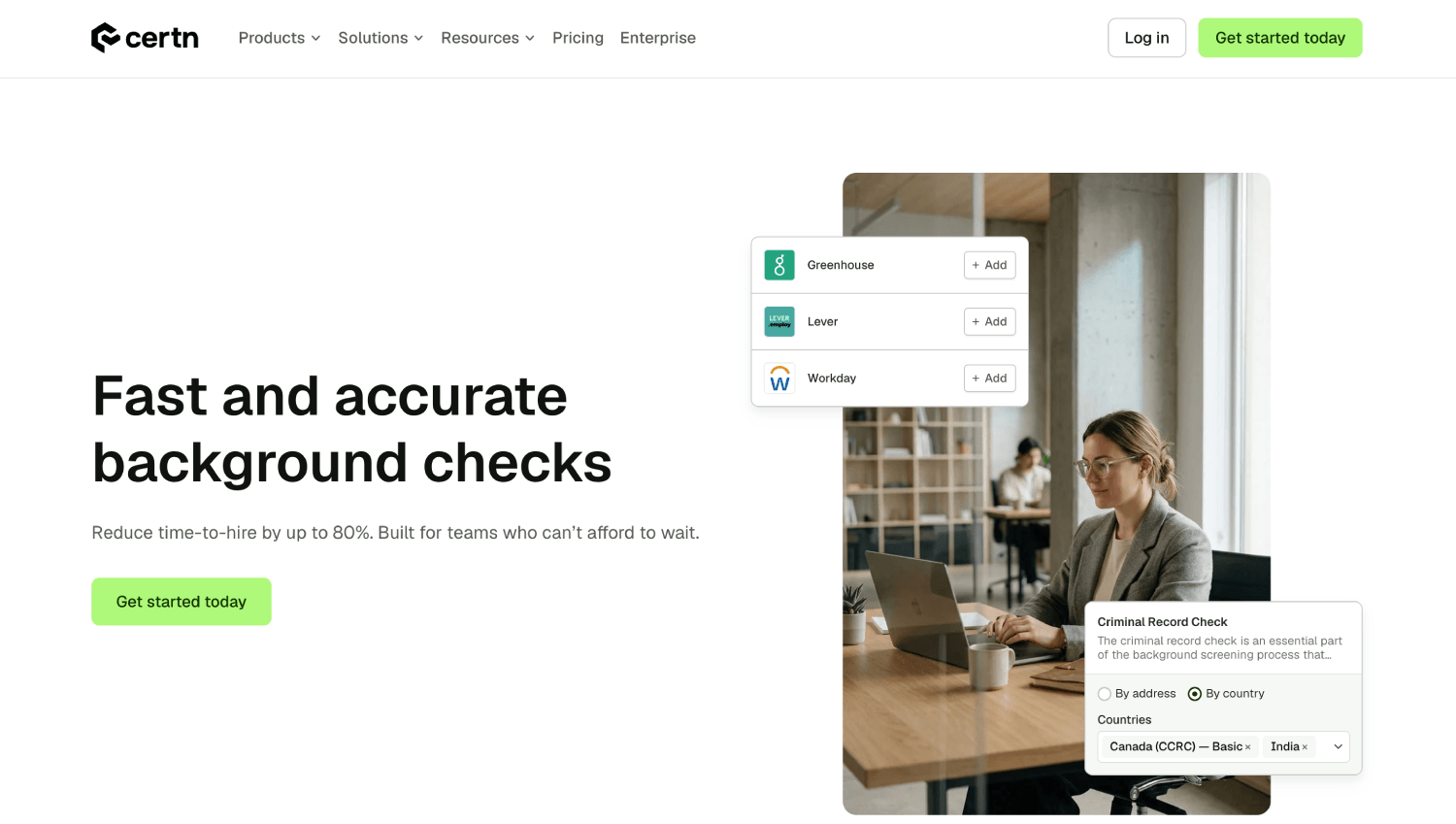
Certn is a newer entrant in the employment screening software market that has built a reputation for speed and a modern candidate experience. The platform uses AI to accelerate identity verification and integrates with ATS tools including Greenhouse, Lever, and others. Certn covers US checks and has broader international coverage than many similarly priced competitors.
For companies that care about candidate experience metrics in their screening workflow, Certn’s mobile-first interface and faster authorization flow are genuine advantages. Pricing is quote-based. The platform is newer, which means the enterprise-grade compliance infrastructure is still maturing compared to HireRight or Cisive.
Best for: Tech-forward mid-market companies that prioritize candidate experience and ATS integration over deep compliance customization.
10. IntelliCheck (or Zinc for international/UK-first)
For employers with mixed domestic and international screening needs at the smaller end of the market, Zinc offers a lightweight, reference-check-first approach with identity and right-to-work verification layered in. Zinc originated in the UK market but covers international checks relevant to US companies hiring across borders.
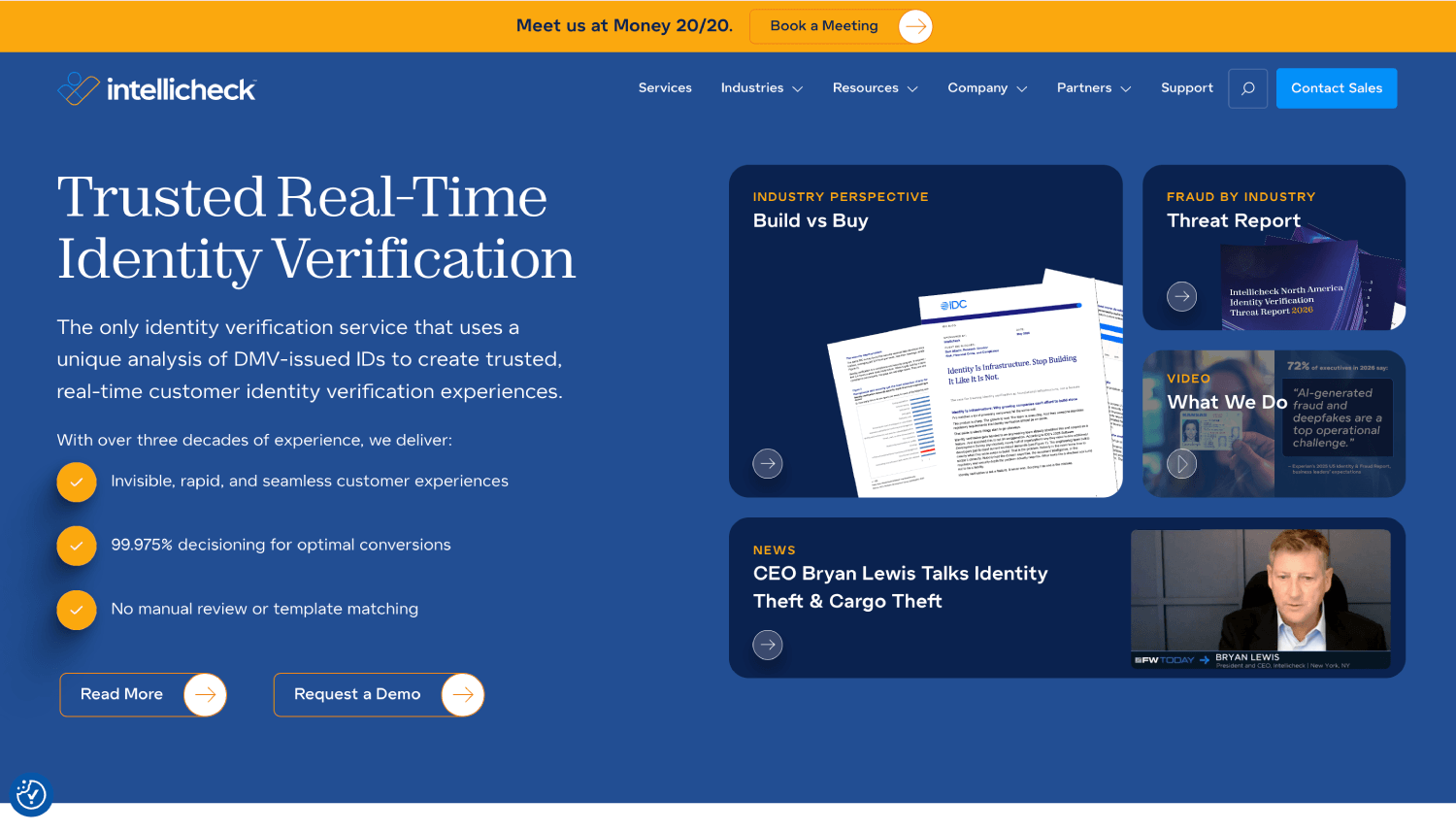
For a purely US-domestic alternative at the smaller company end, IntelliCheck focuses on identity verification and document authentication, which pairs well with a separate criminal background check vendor for companies that want best-of-breed point solutions rather than a single-vendor suite.
Best for: Small companies or those with international reference and identity verification needs who want lightweight tooling rather than a full-service screening platform.
Background Check Software Comparison: Features, Strengths, and Best Fit
| Vendor | Best For | FCRA Tooling | Key Strength | Pricing Model |
|---|---|---|---|---|
| Checkr | High-volume, tech companies | Yes | API depth, ATS integrations, speed | Per check, volume tiers |
| Sterling | Enterprise, regulated industries | Yes | Verification breadth, post-hire monitoring | Quote-based |
| First Advantage | Large enterprise, global | Yes | Global coverage, scale | Quote-based |
| GoodHire | SMBs, mid-market | Yes, explicit | Transparent pricing, compliance UX | Per check, some public rates |
| Accurate Background | Mid-market | Yes | Candidate completion speed, integrations | Quote-based |
| HireRight | Enterprise, international | Yes | Global reach, enterprise HCM integrations | Quote-based |
| Cisive | Healthcare, financial services | Yes | Primary source verification, monitoring | Quote-based |
| DISA Global Solutions | DOT/safety-sensitive industries | Yes | Drug testing program depth | Quote-based |
| Certn | Tech mid-market, candidate UX | Yes | Speed, modern interface, international | Quote-based |
| Zinc | Small companies, international | Varies by region | Reference checks, lightweight setup | Per check / subscription |
What Does FCRA Compliant Screening Actually Require from Your Software?
FCRA compliance in employment screening is not about the background check itself. It is about the process surrounding it. The statute requires employers to follow a specific sequence before and after using a consumer report to make an adverse employment decision, and the software you choose either supports that sequence or forces you to manage it manually.
A compliant pre-employment background check workflow requires: a clear disclosure to the candidate that a report will be obtained, a signed authorization before the check runs, a pre-adverse action notice with a copy of the report if you intend to decline based on findings, a waiting period giving the candidate time to dispute, and then a final adverse action notice if you proceed. Every step has timing requirements. None of this is optional.
When evaluating vendors on FCRA compliance, ask these specific questions: Does the platform generate and send pre-adverse and adverse action notices automatically? Does it track the waiting period and enforce it in the workflow? Does it store candidate authorizations in a retrievable format? Does it have a dispute intake process that routes back to your team? If the vendor answers “yes” to all four, you are looking at genuine compliance tooling. If the answer involves the phrase “we provide templates you can customize,” you are looking at a documentation product, not a compliance workflow.
For a broader look at compliance tooling across the hiring process, the best AI HR compliance and bias audit tools covers adjacent categories worth evaluating alongside screening.
How Much Does Background Check Software Cost?
Most enterprise-grade background check vendors do not publish pricing. Sterling, First Advantage, HireRight, Accurate Background, Cisive, and DISA are all quote-based, and pricing varies significantly by check type, volume, and contract length.
GoodHire publishes per-check rates for common packages on their public pricing page, making it one of the few vendors in the category with transparent base rates. Checkr uses a per-check model with volume tiers, and their pricing is accessible through their sales process though not fully public. Zinc and Certn are also available on a per-check basis.
When budgeting for background check software, account for the following variables beyond the base per-check rate:
- Criminal check type: county, state, federal, and national database checks are priced differently and carry different accuracy profiles
- Employment and education verification: these are typically priced per verification attempt, not per candidate
- Drug screening: separate fee structure, often tied to clinic network access
- Annual minimums: enterprise contracts frequently include minimum spend commitments regardless of actual volume
- Implementation and integration fees: ask explicitly whether ATS integration setup is included or billed separately
If your hiring volume is unpredictable, push for per-check pricing without annual minimums. Most enterprise vendors will negotiate on minimums for companies in growth mode with upside volume potential.
Should You Use Your HRIS’s Built-In Background Check Feature?
Rippling, BambooHR, and other HRIS platforms offer background check integrations or built-in screening modules. For very small companies running a handful of checks per year, these can be sufficient. For anyone doing meaningful hiring volume, they are worth scrutinizing carefully.
The core issue is that HRIS-native screening modules are almost always powered by a third-party background check vendor in the background, and the integration layer can reduce control over the compliance workflow. You may not know which screening provider is running your checks, what their court access coverage looks like, or whether the adverse action workflow is handled correctly. That ambiguity is a problem when FCRA exposure comes into play.
Before defaulting to your HRIS’s built-in option, ask the vendor: who runs the actual background check, what is their court access methodology, and who is liable for FCRA compliance workflow errors. The answers are clarifying.
If you are evaluating your broader HR tech stack and trying to decide what to buy as a standalone point solution versus what to get from your HRIS, the HR tech stack guide for 50-person companies breaks down that build-versus-bundle trade-off clearly.
How Do Background Check Integrations Work with an ATS?
The best-case ATS integration with a background check platform does the following: triggers automatically when a candidate reaches a designated stage in the pipeline, sends the disclosure and authorization request to the candidate, returns the completed report status to the ATS record, and surfaces any flags within the ATS view without requiring the recruiter to log into a separate portal.
Checkr’s integration library is the broadest in the market. Greenhouse, Lever, iCIMS, Workday Recruiting, SmartRecruiters, and others all have maintained Checkr integrations. HireRight and Accurate Background also maintain enterprise ATS integrations, though the depth of bi-directional data flow varies. Certn has prioritized ATS integration quality as a competitive point, and their Greenhouse and Lever connections work well in practice.
When you are evaluating integrations, ask the vendor for a demo of the specific ATS you use, not a generic overview. The difference between a true native integration and a webhook-based workaround affects your team’s daily workflow in concrete ways.
For context on how screening fits into the broader recruiting technology stack, the best AI sourcing tools and the best AI interview tools cover upstream and downstream tools that background check software connects to.
Frequently Asked Questions About Background Check Software
What do employers use to screen job applicants?
Most employers use dedicated employment screening software from vendors like Checkr, Sterling, GoodHire, HireRight, or Accurate Background. These platforms run criminal background checks, verify employment and education history, and coordinate drug screening. Some employers use screening modules built into their ATS or HRIS, but those are typically powered by a third-party background check provider in the background. Standalone screening software generally offers more control over the compliance workflow and check methodology than HRIS-native options.
How long does a FCRA background check take?
Turnaround time depends on the check type. Identity verification and national criminal database checks can return results within hours. County courthouse criminal checks take longer because they depend on court access and staff availability, typically one to five business days for most jurisdictions. Employment and education verification times vary based on how responsive the previous employer or institution is. Vendors advertising across-the-board 24-hour turnaround are generally relying on database results rather than primary source courthouse records, which is a meaningful accuracy trade-off.
Is Checkr FCRA compliant?
Yes. Checkr is FCRA compliant and builds adverse action workflows, candidate disclosure, and authorization management into its platform. Checkr is accredited by the Professional Background Screening Association (PBSA), which sets industry standards for background check companies. That said, FCRA compliance is an operational responsibility, not just a vendor one. Your own process for reviewing reports, sending adverse action notices, and respecting waiting periods must align with the statute regardless of which platform you use.
What is the difference between a national criminal database check and a county courthouse check?
A national criminal database search queries aggregated criminal record databases compiled from various state and county sources. It is fast but not comprehensive. Records may be outdated, missing, or incomplete because counties vary in how and how often they report to these databases. A county courthouse check goes directly to the courthouse of record and pulls the most current information available. It is slower but more accurate. Most compliance-conscious employers run both, using the national database check as a lead generator to identify which counties to then query directly.
Do I need a separate background check vendor if my ATS already offers one?
Not necessarily, but evaluate carefully. ATS-embedded background check modules are convenient, but you should know which vendor is running the actual check, what their coverage methodology is, and how the adverse action workflow is handled. If your ATS cannot clearly answer those questions, or if you are running high hiring volumes in regulated industries, a dedicated screening platform gives you more control and auditability. The convenience of a single-vendor workflow is real, but not if it creates compliance ambiguity.
What is the Professional Background Screening Association (PBSA) accreditation?
PBSA accreditation is a voluntary industry standard administered by the Professional Background Screening Association. Accredited firms must meet specific standards around data security, court access practices, consumer protection, and compliance with applicable law including the FCRA. It is not a government certification, but it is the closest thing the industry has to an independent quality signal. When evaluating vendors, PBSA accreditation is a baseline credibility indicator, not a guarantee of quality.
Can background check software handle international checks for US-based employers?
Most major US employment screening vendors offer international checks, but coverage quality varies significantly by country. HireRight and First Advantage have the broadest international infrastructure. Checkr’s international coverage is more limited relative to its domestic depth. For employers with significant international hiring, evaluate each vendor’s specific country coverage for your target markets rather than accepting a general claim of “global” capability. Country-specific criminal record access, privacy law compliance, and turnaround times differ substantially from domestic US checks.
What should I include in an RFP for background check software?
An RFP for employment screening software should cover: court access methodology (database versus primary source), FCRA compliance workflow specifics (adverse action automation, dispute handling), ATS and HRIS integration details, drug screening network size and geographic coverage, turnaround time commitments by check type, pricing structure and annual minimum requirements, PBSA accreditation status, data security certifications, and escalation and support processes for disputed results. For a broader vendor evaluation framework, the HR software RFP template provides a structured approach adaptable to this category.
The Right Shortlist for Your Situation
If you are running more than a few hundred background checks per year and care about ATS integration quality, Checkr should be on your shortlist. If you are in a regulated industry where credential verification depth matters, Sterling or Cisive are the right conversations to have first. For mid-market companies that want FCRA compliance without a dedicated compliance team managing the workflow manually, GoodHire and Accurate Background are both solid, with GoodHire offering the unusual advantage of some public pricing transparency.
The vendors in this category are not interchangeable. The differences in court access methodology, FCRA workflow automation, ATS integration depth, and industry specialization are real and consequential. A vendor that is excellent for a gig economy platform may be a poor fit for a hospital system, and vice versa. The comparison table above gives you enough signal to cut the list from ten to three. From there, ask each finalist for a workflow demo specific to your check types and ATS, get clarity on who owns FCRA compliance in disputed cases, and check their PBSA accreditation status before signing anything.
The hidden cost in this category is not the per-check fee. It is the cost of a failed adverse action workflow, a disputed check that slows down a critical hire, or a platform that cannot integrate with your ATS without manual reconciliation. Buy for the compliance infrastructure first, the price second.