
- Most internal recruiting budgets dramatically undercount true cost because they exclude recruiter benefits, employer taxes, technology overhead, and manager time spent interviewing.
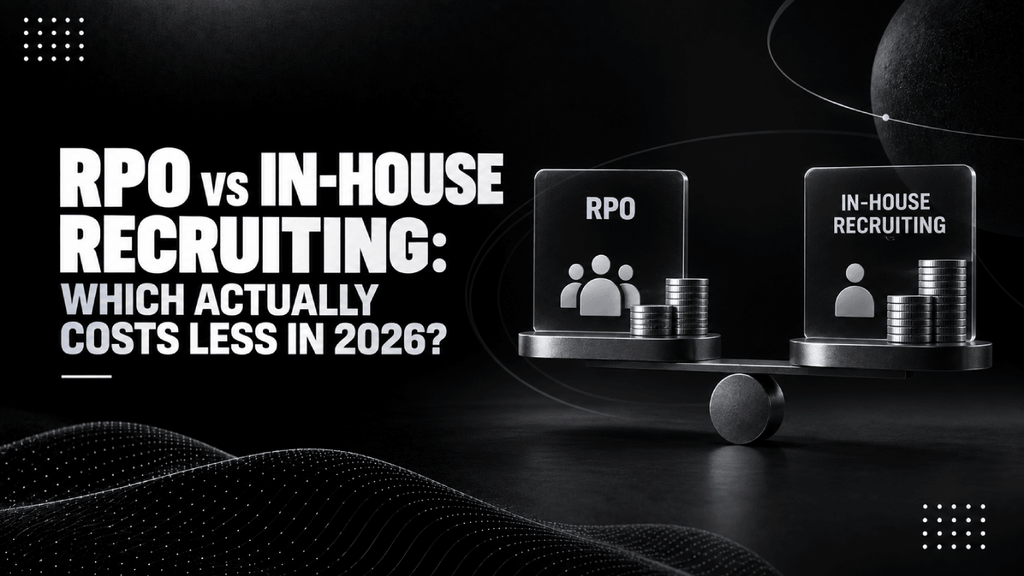
- The correct comparison for RPO vs in-house recruiting cost is fully loaded internal cost against variable RPO cost at your actual requisition volume, not salary versus RPO fee.
- Companies with predictable, high-volume hiring typically favor in-house teams. Companies with seasonal spikes or specialized roles often pay less with RPO, even after the provider’s margin.
- A hybrid model, permanent staff for evergreen roles and RPO for surges, outperforms both pure options for most mid-market companies between 200 and 2,000 employees.
- Agency spend leakage is the hidden variable that destroys in-house cost arguments. If your internal team fills fewer than 70% of roles without contingency agencies, your real cost per hire is far higher than your model shows.
In-house recruiting is cheaper than RPO only when your internal team is running at high utilization year-round, filling roles without agency backup, and your fully loaded recruiter cost is actually being measured. For most mid-market companies, none of those three conditions hold simultaneously. RPO often costs less in real terms once you account for fixed salary during low-volume periods, benefits burden, technology licensing, and the contingency agency fees that quietly accumulate when internal capacity runs out.
Why the “In-House Is Cheaper” Assumption Usually Fails
The belief that in-house recruiting is obviously cheaper rests on a single number: recruiter salary. Someone on your team costs $80,000 per year. An RPO provider charges a fee per hire or a monthly management fee. The salary looks lower. The comparison is wrong because it is incomplete.
A recruiter’s salary is roughly 50 to 70 percent of their fully loaded cost to the employer. Add employer-side payroll taxes (typically around 7.65% in the US for FICA alone), health insurance, retirement contributions, paid time off, and any variable bonus, and you are already well above base salary. Recruiting-specific costs layer on top: your ATS licensing allocation, LinkedIn Recruiter seats, background check platform fees, assessment tools, and the HR manager time spent on offer approvals, compensation benchmarking, and compliance review. A $90,000 base recruiter in a mid-market US company commonly carries a fully loaded annual cost between $130,000 and $160,000 before a single requisition is opened.
That cost is fixed. It runs whether you have 40 open roles or 4.
What Is the Fully Loaded Cost of an Internal Recruiter Versus an RPO Seat?
Breaking this down into a comparable unit helps. If your recruiter fills 60 roles per year (a reasonable mid-market throughput for a generalist corporate recruiter), and their fully loaded cost is $145,000, your internal cost per hire from salary and overhead alone is roughly $2,400. That looks competitive against RPO.
Add the costs that rarely appear in the HR budget but are real: hiring manager time spent reviewing resumes, conducting interviews, and making decisions. If a manager earning $120,000 annually (typical at mid-market rates for a people manager) spends eight hours per hire across screening calls, interviews, and debrief conversations, that is roughly $460 of manager time per role. Multiply across 60 hires and you have added $27,600 to your internal cost model that never appears on the recruiting budget line.
The other invisible cost is agency leakage. When internal capacity runs short, most TA teams turn to contingency recruiters who charge 15 to 25 percent of first-year salary. If your internal team fills 50 roles directly and sends 10 to agencies at an average fee of $18,000 per placement, that is $180,000 in agency spend that did not appear in anyone’s “in-house recruiting cost” calculation. It shows up in procurement or finance as a separate line, invisible to the HR budget comparison.
| Cost Category | In-House (Per Recruiter, Annual) | RPO (Per Hire, Variable) |
|---|---|---|
| Base salary / management fee | $85,000, $110,000 | Included in RPO fee |
| Benefits and employer taxes (typically 30-35% of base) | $25,000, $38,000 | Included in RPO fee |
| ATS, LinkedIn Recruiter, tech stack | $8,000, $18,000 | Often included (confirm per contract) |
| Agency leakage (overflow roles) | Highly variable, often $50,000+ | Usually eliminated or capped |
| Hiring manager time cost | $400, $600 per hire | $400, $600 per hire (unchanged) |
| Ramp and training cost | $5,000, $15,000 per new recruiter | None (absorbed by provider) |
RPO pricing models vary significantly. Project RPO (for a defined hiring push) typically runs as a fee per hire. Enterprise RPO arrangements often use a monthly management fee plus a per-hire component. Hybrid RPO augments existing internal teams on a per-recruiter or per-requisition basis. Pricing is quote-based at most providers including ManpowerGroup RPO, Kforce, Allegis RPO, and Cielo. For professional roles in a competitive market, per-hire fees commonly fall in the $3,000 to $8,000 range as an editorial benchmark based on typical mid-market engagements, though complex or executive roles run higher and you will need direct quotes to model against your actual volume.
At What Requisition Volume Does In-House Recruiting Become Cheaper Than RPO?
The crossover point depends on three variables: your annual hire volume, the consistency of that volume across months, and your agency leakage rate. Run both through a fixed-versus-variable cost lens.
In-house cost is largely fixed. One recruiter, regardless of whether they close 40 or 70 roles this year, costs roughly the same annually. If your volume is high and steady, that fixed cost gets spread across more hires, and the per-hire number falls. At 80 or more hires per recruiter per year with low agency leakage, internal recruiting is genuinely competitive.
RPO cost scales linearly with volume. More hires means more fees. At low to moderate volume, RPO can be cheaper than carrying a full-time recruiter who sits partially idle. At high, consistent volume, the per-hire RPO fee typically exceeds what the same work would cost internally.
The number that changes the calculation most is seasonality. A retail company that hires 200 people in September and October and 30 people across the remaining months cannot staff to peak demand without paying for idle capacity for most of the year. RPO absorbs that variability. The internal team required to handle the peak would cost more than an RPO engagement priced per hire for those same 200 roles. This is why the hybrid model, an internal core team for the baseline volume and RPO or specialist recruiting partners for surge periods, outperforms either pure option for most mid-market companies.
How Does Requisition Seasonality Affect the RPO vs. In-House Cost Comparison?
Seasonality is the variable most internal recruiting cost models ignore entirely. If you build the model on annual averages, you miss the cost of peak-month failure: roles that stay open because internal capacity is overwhelmed, hired agency recruiters at premium fees, and the business cost of unfilled positions.
Consider a company with 150 planned hires per year, but with 60 of them concentrated in Q1 due to a fiscal-year headcount release. Staffing to handle 60 hires in one quarter means carrying two to three full-time recruiters. For the remaining nine months, those recruiters are filling 90 roles, or 30 to 45 roles per person. At that utilization, the cost per hire climbs well above what an RPO engagement would have cost for the Q1 surge alone.
RPO providers price this kind of engagement as project RPO, scoped to a defined period and volume. It is a well-understood commercial structure and most providers will quote a per-hire rate for a defined surge without requiring a long-term enterprise contract. For the company above, a Q1 project RPO engagement alongside a small permanent internal team for the remaining volume is almost certainly cheaper than carrying the full headcount year-round.
Tools like AI people analytics platforms can help model this by forecasting hiring demand patterns from historical attrition and headcount data, which makes the RPO business case far easier to quantify before going to a CFO.
How to Build an RPO Business Case for a CFO
Finance leaders will accept an RPO proposal if the comparison is honest and the model is conservative. The common mistake is presenting RPO as a cost-cutting initiative rather than a cost-restructuring one. Most RPO engagements do not dramatically reduce total spend. They shift fixed cost to variable cost and reduce agency leakage. That framing lands better with a CFO than promising savings that may not materialize.
Build the business case in four layers.
- Fully loaded internal cost: Salary, benefits, employer taxes, technology, and a reasonable estimate of manager interview time per hire. Do not use salary alone.
- Agency leakage audit: Pull the last 12 months of contingency agency invoices. This number shocks most TA leaders when they see it in one place. It is frequently 20 to 40 percent of total recruiting spend and is the strongest argument for RPO.
- Volume and seasonality map: Chart monthly hires over the last two years. If the variance is greater than 30 percent between peak and trough months, RPO has a structural advantage.
- RPO quote at actual volume: Get at least two provider quotes based on your real requisition mix, not an idealized average. Model the RPO cost against your fully loaded internal cost at peak volume, trough volume, and the annual average.
Present both scenarios to the CFO: fully internal (with accurate cost), and hybrid RPO. Do not present RPO-only unless your volume actually justifies eliminating internal recruiting capacity. Most CFOs respond well to the hybrid model because it preserves institutional knowledge inside the company while capping exposure to volume spikes.
If you want a structured template for this, the downloadable cost model below pre-builds these four layers with adjustable inputs for your recruiter count, average salary, benefits rate, tech stack cost, agency spend, and requisition volume by month.
Download: RPO vs. In-House Recruiting Cost Model
The model is a spreadsheet that calculates fully loaded internal cost per hire, estimated RPO cost at your volume, the crossover point where internal becomes cheaper, and the projected savings or cost difference from a hybrid approach. Input your own numbers and it produces a one-page CFO-ready summary.
What Do RPO Providers Actually Include, and What Costs Extra?
Understanding what is inside the RPO fee prevents the most common budget surprise. Most enterprise RPO engagements include recruiter labor, sourcing, screening, interview coordination, offer management, and reporting. The recruiter’s ATS access and LinkedIn Recruiter seat are typically included, though you should confirm whether they use your ATS instance or their own.
What is often excluded: job advertising spend (often passed through at cost), background check fees, assessment platform fees, relocation costs, and any signing bonuses or referral fees. Some providers bundle background checks; most do not. If you are currently paying for an AI sourcing tool or talent intelligence platform internally, clarify whether the RPO provider replaces that cost or adds to it.
Transition cost is the other budget item that rarely appears in the initial RPO proposal. Moving from internal to RPO requires knowledge transfer, ATS access provisioning, integration with your HRIS, and a ramp period where both teams are operating in parallel. For large enterprise RPO transitions this can run into six figures. For project or hybrid RPO at mid-market scale, it is typically manageable but should be explicitly negotiated and capped in the contract.
Where Does RPO Underperform In-House Recruiting?
RPO is not the right answer for every hiring situation. Three specific scenarios consistently favor internal teams.
Executive and senior leadership hiring almost always belongs in-house or with a retained executive search firm, not an RPO provider. RPO is optimized for volume and process efficiency. C-suite and VP-level searches require relationship networks, confidentiality management, and institutional knowledge that RPO recruiters handling dozens of mid-level requisitions simultaneously are rarely positioned to deliver.
Highly specialized technical roles with small talent pools also tend to perform better with dedicated internal recruiters who build community presence over time. An internal recruiter who has spent two years building relationships in a niche engineering community will outperform an RPO recruiter rotating across clients every six months. If your growth depends on hiring a specific technical profile repeatedly, the investment in an internal specialist pays off.
Culture-dependent roles where employer brand and candidate experience are genuinely differentiating also favor internal teams. RPO recruiters represent your company to candidates, and quality varies. The best providers train their teams on your culture and values; the weakest ones treat your roles like any other account. If candidate experience is a strategic priority, evaluate RPO providers rigorously on how they represent employer brand, not just on process efficiency metrics. Reading through AI interview tools and structured interviewing platforms that RPO providers use is one way to assess how sophisticated their candidate experience infrastructure actually is.
Frequently Asked Questions
Is RPO cheaper than in-house recruiting for a 300-person company?
It depends on hire volume and seasonality, but RPO is often competitive or cheaper at this company size because the fully loaded cost of two or three internal recruiters, including benefits, technology, and agency leakage, frequently exceeds what a project or hybrid RPO engagement costs for the same volume. The key test is whether your requisition load justifies full-time internal headcount at consistent utilization. If you hire fewer than 50 roles per year or have significant seasonal spikes, RPO usually wins on cost.
What is the average cost per hire with RPO versus in-house?
Neither figure is universal. Cost per hire with RPO varies by provider, role type, and volume commitment, and most providers give quote-based pricing rather than publishing rates. Internal cost per hire depends entirely on whether you calculate it correctly using fully loaded recruiter cost. The meaningful comparison is your own fully loaded internal cost per hire (including agency leakage and manager time) against two or three RPO quotes at your actual volume. Generic benchmarks will mislead you.
What is agency spend leakage and why does it matter for this comparison?
Agency spend leakage is the contingency recruiter and staffing agency fees that internal recruiting teams incur when they cannot fill roles with internal capacity. It appears in finance or procurement budgets rather than HR budgets, which is why it is routinely excluded from in-house cost comparisons. For mid-market companies, this leakage can run $50,000 to $200,000 or more annually depending on team size, open requisition load, and role complexity. RPO engagements typically eliminate or cap this cost by building overflow capacity into the contract, which often makes the RPO model cheaper in total even when the RPO fee looks higher than internal salary.
What is the difference between project RPO, enterprise RPO, and hybrid RPO?
Project RPO covers a defined hiring initiative with a set scope, timeline, and volume. Enterprise RPO is a full outsourcing arrangement where the provider manages all or most of your recruiting function on an ongoing basis. Hybrid RPO augments an existing internal team, typically for overflow volume, specialized roles, or geographic expansion. Mid-market companies most commonly use project or hybrid RPO because they want to retain internal recruiting capability while capping exposure to volume spikes without committing to a full enterprise contract.
How long does it take to transition from in-house to RPO?
A project RPO engagement can be operational in two to four weeks for a provider already familiar with your ATS and role types. A full enterprise RPO transition, including knowledge transfer, ATS integration, and team handover, typically takes 60 to 90 days. Factor this ramp period into your business case. During transition, parallel costs are real: internal recruiters who have not yet been redeployed and the incoming RPO team both drawing cost simultaneously for a period.
Should RPO replace my internal TA team entirely?
Rarely, unless your recruiting volume is very low and unpredictable. The hybrid model is more common and more defensible. Internal recruiters carry institutional knowledge, maintain employer brand relationships, and own the hiring manager relationship in ways that external providers struggle to replicate. The stronger argument for RPO is eliminating agency leakage, absorbing volume spikes, and filling specialized roles where you lack internal expertise, not replacing the entire function. For companies evaluating how their broader HR tech stack supports talent acquisition, reviewing ATS platforms for mid-market companies alongside RPO models often surfaces capability gaps that change the build-versus-buy math.
The Decision Framework: Fixed Cost, Variable Volume, and Honest Math
The best recruiting model for your company is not the one that sounds most efficient in a slide deck. It is the one that accurately prices your actual volume, your actual seasonality, and your actual agency leakage against a real RPO quote. The companies that consistently make the wrong choice are the ones comparing recruiter salary to RPO fees without accounting for either variable correctly.
Before you decide, do three things: audit your last 12 months of contingency agency spend and bring it into your internal cost model, map your monthly hire volume to identify your peak-to-trough ratio, and get at least two RPO quotes at your real volume rather than an idealized average. That exercise alone will tell you more than any benchmark report.
If your monthly hire volume varies by more than 30 percent and your agency leakage exceeds $75,000 per year, a hybrid RPO model almost certainly costs less in total than a fully internal function. If your volume is high and steady and your team is filling roles without agency backup, keep it internal and invest in AI recruiting tools that increase throughput per recruiter rather than paying an RPO margin. The honest math, not the conventional wisdom, should drive the decision.