
- Most HR tech founders hire an SEO agency or a content shop and wonder why pipeline never materializes. GTM for HR tech requires ICP clarity, sales motion design, channel sequencing, and category positioning before a single blog post gets written.
- A true GTM agency owns the full launch motion: positioning, messaging, demand capture, outbound sequencing, and sales enablement. A content agency owns one lever.
- HR tech buyers are skeptical, slow to switch, and committee-driven. Agencies that do not understand procurement cycles, CHRO buying psychology, and compliance anxiety will waste your budget.
- The ten agencies below specialize in, or have demonstrable depth in, HR tech GTM. Each serves a different stage, motion, or budget.
- Pricing where available is noted from public sources. Most specialist GTM firms are quote-based at the project level.
The best go-to-market agency for HR tech , sometimes called a go to market agency for HR tech , combines deep category knowledge of the HR software market with full-funnel GTM execution: ICP definition, positioning, demand generation, sales enablement, and channel strategy. Generic B2B SaaS agencies can handle tactics, but HR tech has specific buyer psychology, long sales cycles, and committee-driven procurement that requires category-specific expertise.
Why Does HR Tech Need a Specialized GTM Agency?
HR software buyers are not like software buyers in other verticals. CHROs and VP-level HR leaders evaluate tools through a lens of organizational risk, employee trust, and compliance exposure. Fintech buyers care about returns. HR buyers care about what happens if the tool fails on day one of open enrollment or surfaces a biased hiring decision.
Generic B2B SaaS agencies apply playbooks built for DevTools, fintech, or martech. Those playbooks assume a technical buyer who self-educates quickly, responds to product-led growth, and closes in a short cycle. HR tech does none of those things reliably. Enterprise HRIS deals regularly run six to twelve months. Even mid-market ATS evaluations involve IT, legal, and finance sign-off alongside HR.
The other problem is category noise. The HR tech market has hundreds of vendors competing for the same keywords, the same analyst relationships, and the same conference floor space at events like HR Tech Conference and SHRM. A GTM agency that does not understand how to position you against Workday, BambooHR, or a well-funded startup in your category will produce messaging that sounds like every other vendor in the space. Buyers who are already exhausted by vendor sameness will tune it out.
If you are evaluating your content and SEO vendors separately, the best HRtech SEO agencies and content marketing agencies for HRtech SaaS are covered in separate guides. This list focuses specifically on firms that own the broader GTM motion, not just one channel.
What Does a GTM Agency for HR Tech Actually Do?
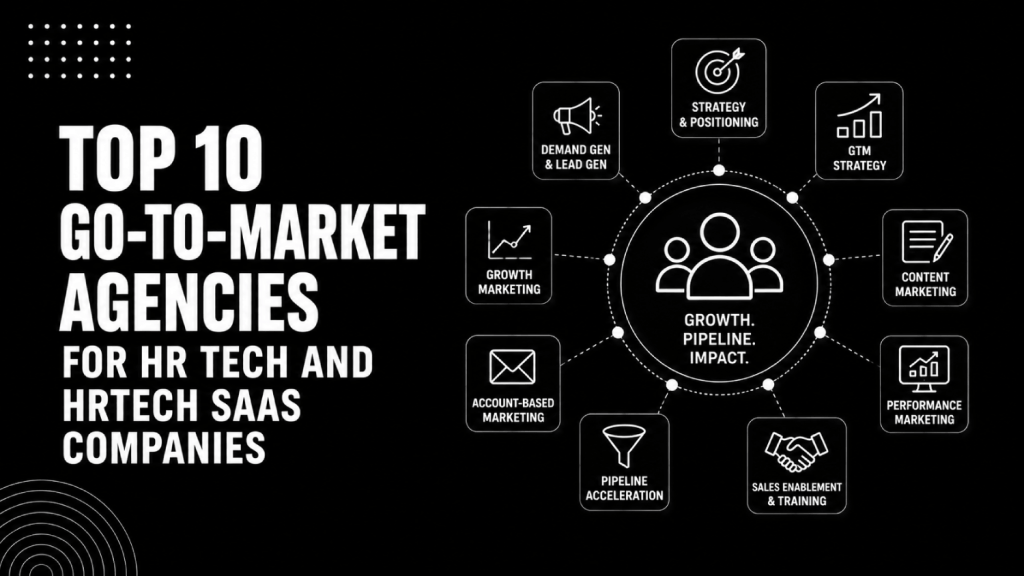
A legitimate GTM agency for HR tech does more than run paid ads or produce thought leadership content. The core deliverables look like this: ICP definition and buyer persona research, competitive positioning and messaging architecture, channel strategy across outbound, inbound, and partner, sales enablement materials, and launch sequencing with clear pipeline metrics.
Some firms also own demand generation execution, analyst relations, and category creation strategy if you are building a new market rather than entering an existing one. The best ones tie every activity back to pipeline, not impressions or MQLs that never close.
On budget: most specialist GTM firms are quote-based and do not publish rates. The range varies significantly by agency size, scope, and whether the engagement is strategy-only or includes execution. Strategy-only sprints are typically priced as fixed-fee projects; ongoing execution retainers run on monthly fees that scale with deliverable scope. The budget section below covers the market structure in more detail.
How Were These Agencies Selected?
Each agency on this list was evaluated against four criteria: evidence of HR tech clients or category specialization, the breadth of GTM services offered beyond content or SEO alone, publicly visible work or case studies, and relevance to the HRtech SaaS founder or CMO running a launch or scale motion. No agency paid to be included.
Where an agency is primarily an SEO or content shop that dabbles in strategy, it belongs on a different list. If it runs ads without owning positioning, same answer. The bar here is full GTM ownership or clear specialization in a GTM function that HR tech companies consistently underinvest in.
Top 10 Go-To-Market Agencies for HR Tech and HRTech SaaS Companies
| Agency | GTM Specialty | Best For | Pricing Signal |
|---|---|---|---|
| Walker Sands | PR, brand, demand gen, GTM strategy | Series B+ HR tech launching into enterprise | Quote-based |
| Vonazon | HubSpot-native demand gen and GTM execution | Mid-market HRtech SaaS scaling inbound | Quote-based |
| Team 4 Marketing | Digital GTM for HR tech and HR software vendors | Founders needing digital-first GTM execution | Quote-based |
| Brilliant Metrics | Full-funnel analytics-led GTM | HR tech teams that need data-validated channel mix | Quote-based |
| Refine Labs | Demand creation, dark social, pipeline-led GTM | HRtech SaaS post-Series A tired of MQL theater | Quote-based |
| Metadata.io | B2B paid GTM execution and autonomous demand gen | HR tech paid acquisition at scale | Quote-based |
| Directive Consulting | Search-led GTM for B2B SaaS | HRtech SaaS with strong search demand and conversion gaps | Quote-based |
| Skaled Consulting | Sales motion design and GTM enablement | HR tech with a built product but no repeatable sales motion | Quote-based |
| Gpac Growth | GTM strategy and fractional CMO services | Early-stage HR tech needing strategic GTM without full-time exec | Quote-based |
| Winning by Design | Revenue architecture and GTM design for SaaS | HRtech SaaS with PLG or expansion-led growth goals | Quote-based |
1. Walker Sands

Walker Sands is one of the most visible B2B marketing and PR agencies with demonstrated HR tech depth. Their public positioning explicitly calls out HR tech as a served vertical, and their GTM services span brand strategy, PR, demand generation, and integrated campaign execution. For HR tech companies entering the enterprise segment where analyst relations and earned media credibility matter as much as paid pipeline, Walker Sands has the infrastructure to execute across all three.
The tradeoff is scale and cost. Walker Sands is built for companies that already have Series B funding or revenue to justify a full-service agency relationship. Seed-stage founders will find them expensive for early-stage validation work.
2. Vonazon
Vonazon operates as a HubSpot-native demand generation and GTM execution agency. For HRtech SaaS companies already on HubSpot or planning to migrate to it, Vonazon’s model is efficient: they own the tech stack, the campaign architecture, and the reporting in a single relationship. Their GTM work is particularly strong on inbound pipeline development and marketing operations.
Their limitation is the platform dependency. If you are running Salesforce plus Marketo or a custom stack, their native advantage shrinks. For B2B HR tech under 200 employees with a clean HubSpot instance, they are one of the more cost-effective ways to build a repeatable inbound GTM motion.
3. Team 4 Marketing

Team 4 Marketing positions explicitly as a digital marketing agency for HR tech and HR software companies. Their site names the HR software vertical directly, which separates them from generalist B2B agencies that list every industry as a served market. Their service set covers SEO, paid digital, and GTM campaign execution with an HR tech lens.
For founders who need a single agency that understands HR buyer personas without spending the first three months educating their team on what an HRIS is, Team 4 removes onboarding drag. They are not the largest firm on this list, but the category focus is a genuine differentiator at the execution level.
4. Brilliant Metrics
Brilliant Metrics takes an analytics-first approach to GTM execution. Their model starts with measurement architecture before touching any channel, which means HR tech companies get a clear attribution picture before committing budget to paid, content, or outbound. For HR tech CMOs who have been burned by vanity metrics and MQL targets that do not correlate to closed revenue, this sequencing is valuable.
The analytics-first approach does add time to ramp. If you need pipeline in 60 days, this is not the right starting point. If you need to understand why your existing channels are not converting and build a defensible growth model, Brilliant Metrics is worth the conversation.
5. Refine Labs
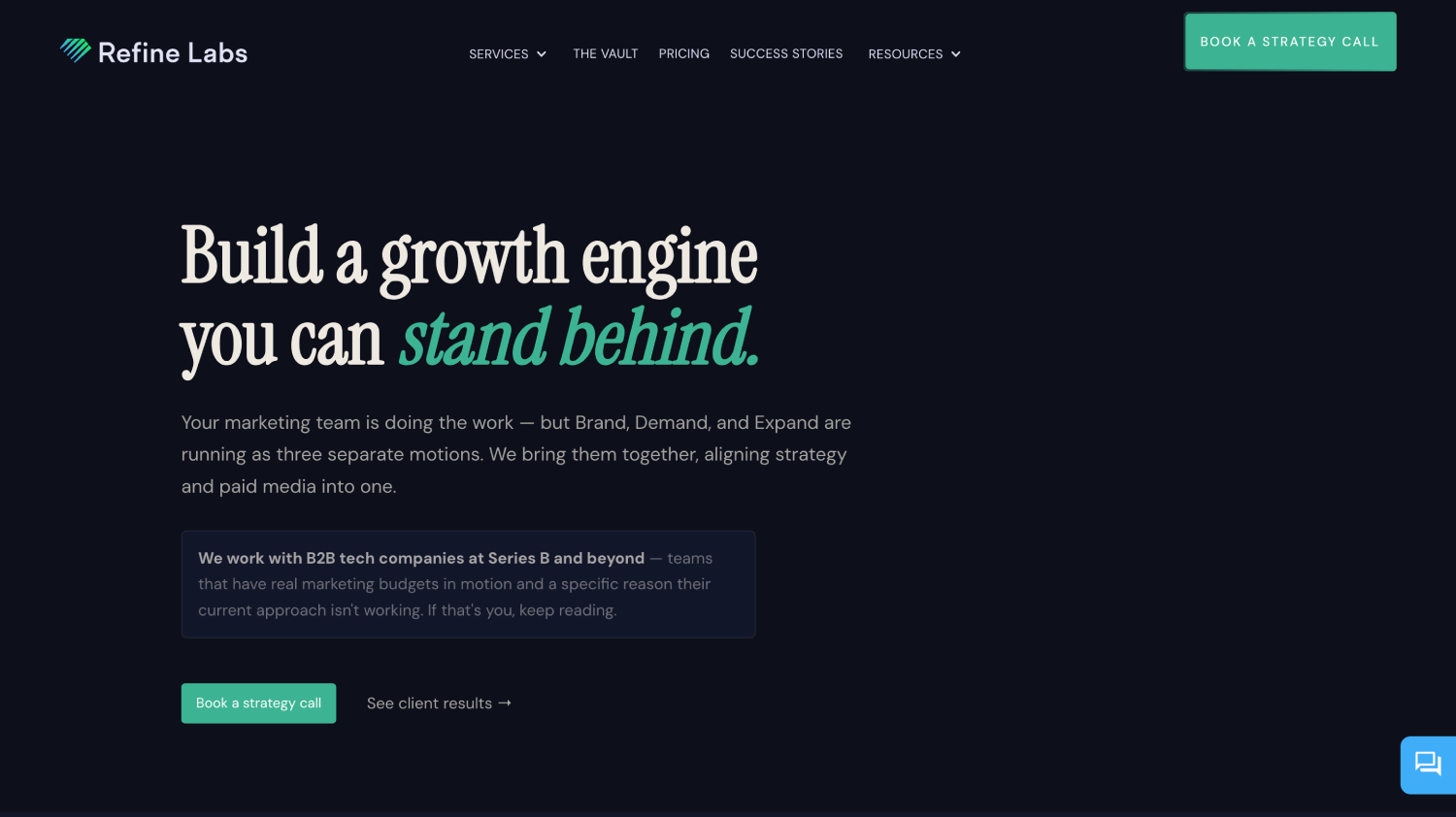
Refine Labs built their reputation on pipeline-led demand generation and challenging the MQL model that most B2B SaaS companies inherited from a previous era of marketing. Their frameworks around demand creation versus demand capture are particularly applicable to HR tech categories where most buyers are not actively searching for a solution but could be convinced to switch given the right positioning and social proof.
HR tech is full of passive buyers. The CHRO who is frustrated with their current HRIS is not typing “best HRIS replacement” every week, but they are reading LinkedIn, attending webinars, and comparing notes with peers. Refine Labs’ dark social and community-driven GTM approach is built for exactly this motion. Their engagement model is selective and pricing reflects their positioning in the premium tier.
6. Metadata.io
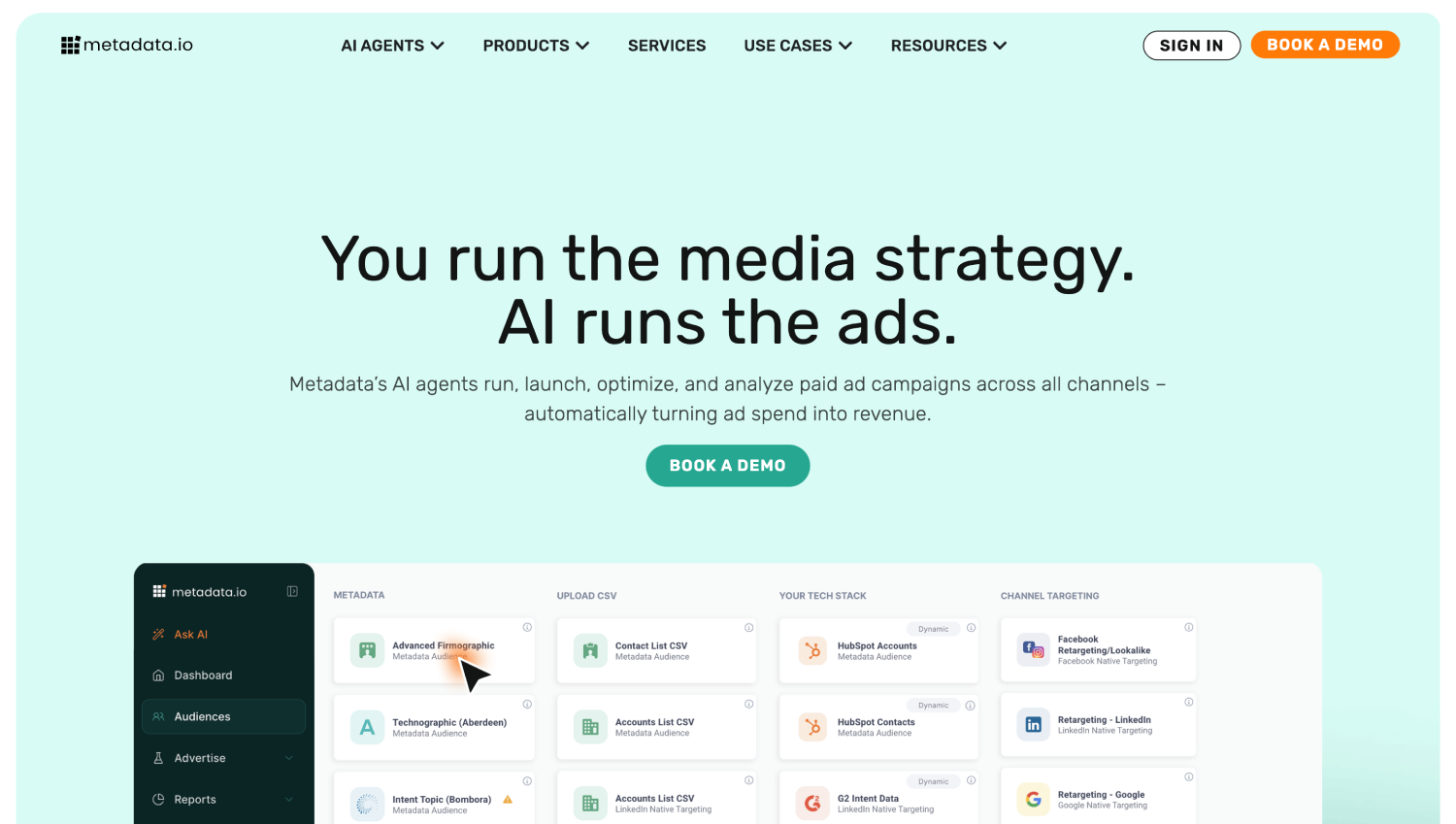
Metadata.io is a B2B demand generation platform with managed services. For HR tech companies running paid acquisition at scale on LinkedIn, Facebook, and Google, Metadata’s autonomous campaign execution and audience matching capabilities compress the manual labor of running multi-channel paid GTM. Their managed service layer means you can engage them as an agency-adjacent partner rather than just buying software.
The distinction here is that Metadata is more platform than pure agency. For companies with in-house marketing teams who need execution support and better paid efficiency, the combination works well. For a founder with no marketing function, you will want an agency relationship with humans managing the strategy layer above the platform.
7. Directive Consulting
Directive Consulting specializes in search-led GTM for B2B SaaS, with a model that connects SEO, paid search, and conversion rate optimization into a unified revenue framework. HR tech companies that have built search demand but cannot convert it will find Directive’s customer generation model more compelling than traditional agency retainers focused on traffic metrics.
Their model is particularly strong for HRtech SaaS companies where buyers are actively searching comparisons and alternatives. If prospects are searching “Workday alternatives for mid-market” or “best ATS for 500 employees” and you are not capturing that demand, Directive’s search GTM approach directly addresses that gap. The full picture of why search intent matters in this category is worth understanding separately; the evaluation frameworks in our demand generation agencies for HRtech SaaS guide provide useful context on how these firms differ.
8. Skaled Consulting
Skaled Consulting focuses on sales motion design, sales enablement, and go-to-market execution from the revenue team side. Most GTM agencies start from marketing. Skaled starts from sales, which makes them a strong fit for HR tech companies that have a working product and inbound interest but lack a repeatable outbound motion or trained sales development process.
For HR tech founders who came from a product or engineering background and built a technically strong product with weak commercial traction, Skaled’s sales-led GTM work addresses the gap that a marketing-first agency cannot. They have worked with SaaS companies across stages and their frameworks for ICP refinement and deal qualification translate directly to HR tech’s complex buying committee dynamics.
9. Gpac Growth
Gpac Growth offers GTM strategy and fractional CMO services, which positions them well for early-stage HR tech companies that need strategic direction without the cost of a full-time marketing executive. Their fractional CMO model gives founders access to senior GTM thinking on a flexible engagement basis, useful during the six to eighteen month window between product-market fit signal and a funded marketing hire.
The fractional model has limits. If you need a full execution team, a fractional CMO alone will not deliver output. Gpac Growth works best when paired with execution resources or when used to build the GTM plan that an internal team then executes against.
10. Winning by Design
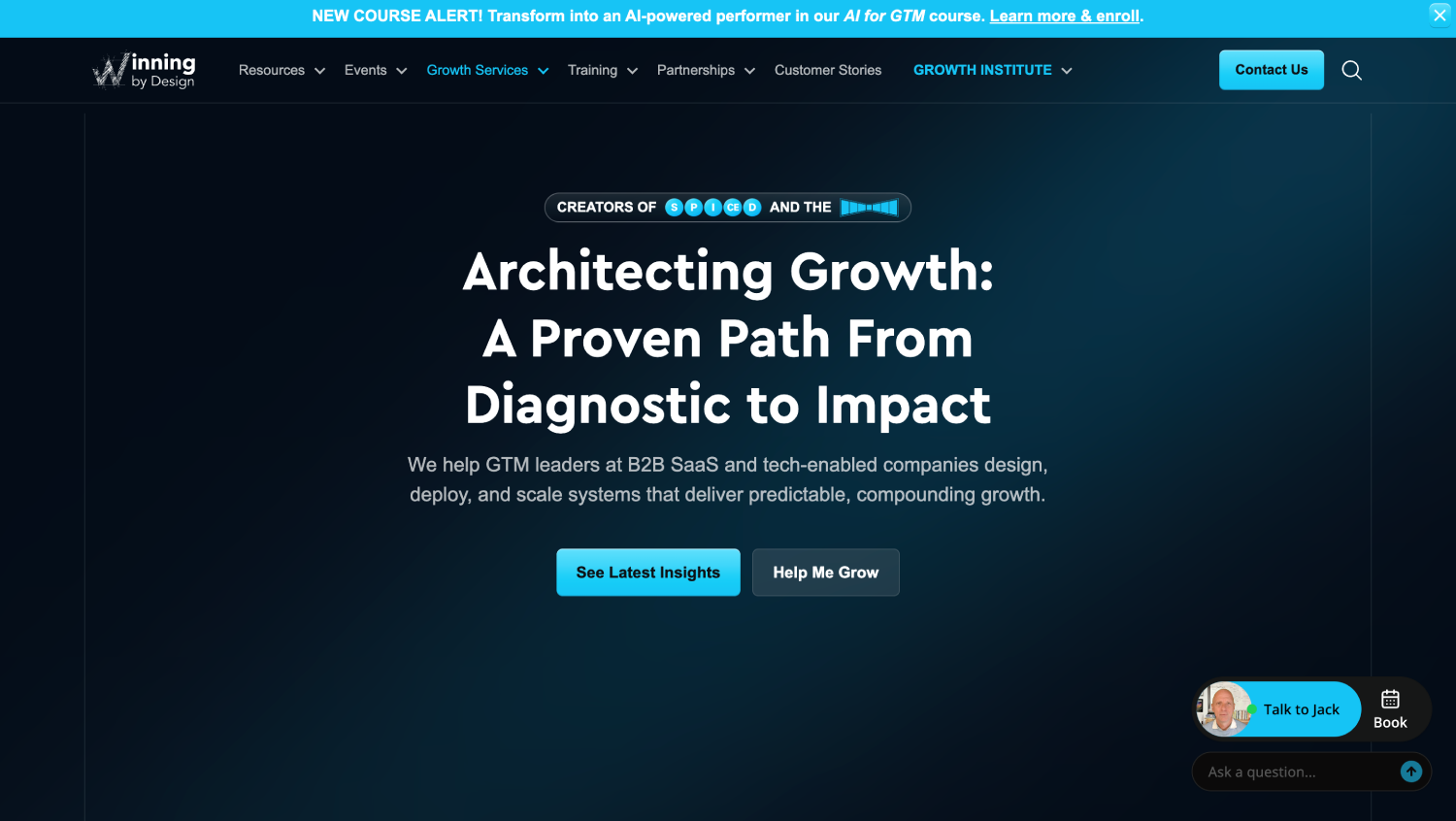
Winning by Design takes a revenue architecture approach to GTM design, with deep frameworks around recurring revenue, expansion motion, and sales process design for SaaS companies. For HRtech SaaS with a product-led growth component or expansion-dependent revenue, their SPICED framework and recurring revenue models are more rigorous than what most marketing agencies offer.
Their approach is more consultative than executional, meaning they are best engaged to design the GTM architecture that your team or other agencies then execute. For Series A or Series B HR tech companies trying to shift from founder-led sales to a scalable revenue model, Winning by Design’s GTM design work fills a gap that neither a marketing agency nor a sales recruiter can address alone.
Which GTM Agency Is Right for Your HR Tech Company’s Stage?
Stage matters more than almost any other variable in agency selection. The GTM needs of a pre-launch HR tech startup are structurally different from those of a Series B company that already has 200 customers and needs to accelerate into enterprise.
| Company Stage | Primary GTM Need | Best-Fit Agency Type | Agencies to Consider |
|---|---|---|---|
| Pre-seed / Seed | ICP definition, positioning, go-to-market narrative | Fractional CMO or GTM strategy consultant | Gpac Growth, Winning by Design |
| Series A | Repeatable outbound, demand capture, sales enablement | Sales-led GTM agency or pipeline-led demand gen | Skaled Consulting, Refine Labs |
| Series B+ | Brand authority, enterprise pipeline, analyst relations | Full-service B2B agency with PR and demand gen | Walker Sands, Directive Consulting |
| Any stage, HubSpot-native | Marketing ops and inbound pipeline | HubSpot-specialist GTM agency | Vonazon |
| Any stage, paid acquisition priority | Paid demand generation at scale | Paid-specialist or platform-led agency | Metadata.io, Directive Consulting |
| HR tech vertical focus | Agency that already understands HR buyers | Category-specialist digital agency | Team 4 Marketing |
What Should You Ask a GTM Agency Before Signing?
The questions that separate a real GTM agency from a rebranded content shop are mostly about accountability. Ask any agency on your shortlist to describe how they define pipeline success, not traffic success. Ask them to walk through a specific HR tech client launch from ICP definition to first closed deal. Ask whether they will own messaging architecture or assume you have already done that work.
Agencies that cannot answer those questions with specifics are selling you a retainer, not a GTM motion. HR tech has too many moving parts in the buyer process for vague promises about “brand awareness” to justify a five-figure monthly fee. Understanding how buyers actually evaluate and purchase HR software is foundational to good GTM; the HR software buying checklist our editorial team developed for buyers also serves as a useful GTM planning input for vendors trying to map their sales motion to how buyers actually make decisions.
Also ask whether the agency has worked with a competitor in your exact sub-category. Many HR tech founders overlook this. An agency that built a GTM playbook for a competing ATS or HRIS has useful category knowledge, but they may also carry conflicts or cognitive lock-in to the previous client’s positioning. It is worth surfacing directly rather than discovering it after onboarding.
How Does GTM Strategy Differ for AI-Native HR Tech?
AI-native HR tech companies face a specific GTM problem that older SaaS playbooks do not address well. Buyers are simultaneously curious and skeptical. CHROs and talent acquisition leaders have board mandates to “do something with AI” but very little framework for evaluating whether an AI-powered HR tool actually works or just markets itself well.
The GTM implication is that social proof and proof of performance have to be front-loaded in the sales motion. Claiming AI-powered anything triggers scrutiny that a workflow automation tool does not face. Agencies working with AI HR tech companies need to understand this buyer psychology and build messaging that demonstrates specificity: what the model actually does, what data it was trained on, what the error rate looks like in production. Vague AI claims accelerate skepticism in HR buyers, not conversion.
This dynamic matters across all the AI HR categories that have seen rapid launch activity: AI sourcing tools, talent intelligence platforms, and AI interview tools all compete in markets where the signal-to-noise ratio for vendor claims is low. GTM agencies that understand how to differentiate a technically credible AI claim from a marketing wrapper will outperform those that treat AI as just another feature bullet.
Some HR tech buyers are also working through compliance questions around AI in hiring, particularly regarding EU AI Act implications and bias audit requirements. A GTM agency advising an AI HR vendor should understand that these objections surface in the sales cycle and that sales enablement materials need to address them proactively. The overlap between GTM strategy and what HR buyers actually ask in evaluations is also covered in our AI HR vendor evaluation checklist, which reads as a map of buyer objections that any credible GTM agency should know cold.
What Is the Realistic Budget for a GTM Agency Engagement in HR Tech?
Most specialist GTM agencies do not publish pricing. The market structure breaks down roughly by engagement type: strategy-only projects are typically fixed-fee, priced on scope and duration; ongoing execution retainers are monthly, priced on deliverable set and team size. Full-service agencies like Walker Sands price at the higher end for integrated engagements that span PR, demand generation, and brand. Fractional CMO or strategy-only engagements through firms like Gpac Growth come in below that. Platform-adjacent services like Metadata.io use a combination of platform access and managed service hours, which produces a different cost structure than a pure agency model.
The right framing for budget is not cost per month but cost per qualified pipeline dollar. An agency generating consistent pipeline for a low average cost per opportunity in an HR tech deal with a $50,000 ACV is a far better investment than a lower-cost content agency generating traffic that never converts. Rates vary enough across firm size and scope that getting three comparable proposals is the only reliable way to calibrate the market for your situation. The same principle applies on the buy side: the hidden costs of HR software guide shows how buyers think about total cost of ownership, and vendors benefit from understanding that framing when building GTM materials around pricing objections.
Frequently Asked Questions
What is a GTM agency for HR tech?
A GTM agency for HR tech is a firm that designs and executes go-to-market strategy for HR software companies. This includes defining the ideal customer profile, building positioning and messaging, selecting and sequencing marketing and sales channels, and producing the sales enablement materials that convert pipeline to closed deals. The distinction from a content or SEO agency is scope: GTM agencies own the full commercial launch motion, not just one channel within it.
How is HRtech GTM different from standard B2B SaaS GTM?
HR tech buyers are committee-driven, risk-averse, and slower to evaluate than most B2B software buyers. CHRO-level decision makers care about organizational trust, compliance risk, and employee experience, not just features and ROI. Sales cycles in HR tech regularly run six to twelve months for enterprise deals. GTM agencies that do not understand these dynamics apply playbooks built for faster-moving verticals and produce messaging that misses how HR buyers actually make decisions.
When should an HR tech company hire a GTM agency?
The right trigger is either a product launch into a new segment, a market expansion beyond the founding customer base, or a plateau in pipeline growth that cannot be explained by product gaps alone. Companies that are generating sales activity through founder relationships but cannot replicate that motion without the founder are the clearest candidates. Hiring a GTM agency before establishing any ICP clarity is premature; the agency will spend the first engagement doing work the founding team should have done first.
What is the difference between a GTM agency and a demand generation agency for HR tech?
Demand generation agencies execute specific channels, typically paid, content, or email, to generate inbound pipeline. GTM agencies design the strategy that demand generation executes against. A demand generation agency without an upstream GTM strategy is running tactics in search of a target. The best HR tech companies use both: a GTM agency to define the target and motion, and a demand generation function or agency to execute within it. Our guide to demand generation agencies for HRtech SaaS covers the execution layer in detail.
Should an AI-powered HR tech company approach GTM differently?
Yes. AI-native HR tech faces a buyer skepticism problem that older SaaS categories do not. HR leaders have been exposed to enough AI marketing claims to apply extra scrutiny to any vendor using the term. GTM strategy for AI HR tools must front-load proof over promise: specific model performance claims, transparent training data disclosures, and references from comparable deployments. Agencies that treat AI as a positioning shorthand rather than a technical claim to be substantiated will produce messaging that accelerates buyer skepticism rather than reducing it.
Do HR tech GTM agencies also handle product positioning?
The better ones do, and it matters. Product positioning is the upstream input to every GTM channel. Without a defensible positioning against Workday, BambooHR, Greenhouse, Rippling, or whoever sits closest to your category, every downstream channel is amplifying an undifferentiated message. GTM agencies that start execution without owning positioning are building on an unstable foundation. When evaluating agencies, ask specifically who does the positioning work and what methodology they use. Agencies that outsource positioning to the client while executing on messaging are structurally set up to produce mediocre results.
How long does a typical HR tech GTM engagement take to show results?
Strategy-only engagements produce outputs in sixty to ninety days. Pipeline results from execution take longer. Inbound demand generation in HR tech, where sales cycles run long and content needs time to rank and build authority, typically shows measurable pipeline contribution at three to six months. Outbound motion design and sales enablement can produce faster results, sometimes within thirty to sixty days, if the ICP is clean and the outreach infrastructure exists. Any agency promising pipeline in the first thirty days of a new engagement is either running paid acquisition on a large budget or overpromising.
What is “hi-tech marketing” in the context of HR software?
In HR tech, “hi-tech marketing” typically refers to applying sophisticated B2B marketing technology , marketing automation, intent data, account-based marketing platforms, AI-driven personalization, and multi-touch attribution , to HR software GTM. The term appears in searches from founders and CMOs wondering whether their marketing operations are keeping pace with how HR buyers research purchases. For most HR tech companies, the answer is that the tooling matters less than the strategy layer above it: the best marketing technology stack in the world will not compensate for weak ICP definition or undifferentiated positioning.
How to Shortlist the Right GTM Agency for Your HR Tech Company
The shortlist decision comes down to three variables: stage alignment, motion fit, and HR category depth. Stage alignment means the agency has worked with companies at your revenue stage, not just companies that are larger or smaller. Motion fit means their primary capability matches your primary constraint: if your constraint is pipeline, you need demand generation execution; if your constraint is sales conversion, you need sales enablement and motion design; if your constraint is positioning, you need a strategy-first firm. HR category depth means they understand the specific buying behavior, competitive dynamics, and compliance anxiety that defines HR software purchases.
No single agency on this list is the right choice for every HR tech company. Walker Sands is the right answer for an enterprise-targeting Series B company that needs brand credibility and PR alongside pipeline. Skaled is the right answer for a founder who needs a sales motion before spending another dollar on marketing. Refine Labs is the right answer for a company that has been running MQL-focused demand gen and getting pipeline that never closes.
The mistake most HR tech founders and CMOs make is treating GTM as a single category and hiring the most credible-sounding agency on the market. GTM is a system. The question to answer first is which part of your system is broken. Once you know that, the agency decision becomes straightforward. For the full picture of what HR buyers see on the other side of your GTM motion, the evaluation frameworks buyers use are worth understanding directly: the HR software RFP template shows exactly how buyers structure vendor comparisons, which is the best available map of what your GTM needs to address.