
HR Tech SaaS may earn a commission when you buy through links on this page. Our recommendations are editorial and never paid for.
- Most HRtech demand generation agency programs fail not because of budget, but because they treat CHRO, CFO, IT, and legal as one audience instead of four separate buying jobs.
- The agencies that consistently move HRtech pipeline treat content, paid, and outbound as a single system, not three separate line items.
- HRtech sales cycles for mid-market and enterprise deals stretch across quarters, sometimes well beyond a year, requiring agencies with patience for late-stage nurture rather than a focus on top-of-funnel impressions alone.
- The best HRtech demand gen agencies know the category: they understand compliance anxiety, integration complexity, and why buyers stall at legal review.
- Shortlisting an agency on price alone will cost you two or three quarters of wasted pipeline before you correct course.
The strongest HRtech demand generation agencies combine category expertise with multi-stakeholder content programs that move CHRO, CFO, IT, legal, and talent acquisition buyers through long sales cycles simultaneously. Generic B2B demand gen agencies can run ads and send emails. What separates the best from the rest is whether they can build educational content that earns trust across a buying committee where each member has a different veto trigger.
Why Does HRtech Demand Generation Require a Different Playbook?
Selling HR software is not like selling marketing automation or analytics. The buyer is not one person. A typical mid-market HRtech deal involves a CHRO or VP of People who owns the initiative, a CFO who controls the budget, an IT leader who owns the security review, legal or compliance who will stall the contract, and often a talent acquisition leader or operations lead who will actually use the product daily. Each of these stakeholders reads different content, attends different events, and responds to different proof points.
Generic demand gen agencies run LinkedIn ads, gate a white paper, and call it pipeline. That approach fails in HRtech because the buying committee is fragmented, the sales cycle stretches across quarters, and the competition for CHRO attention includes other HR initiatives, board priorities, and the constant pressure to reduce headcount costs. The agencies on this list understand that structure.
HRtech also carries a compliance dimension that most B2B categories do not. Buyers evaluating AI HR compliance and bias audit tools are worried about the EU AI Act, EEOC liability, and data residency. An agency that cannot write credibly about those concerns will produce content that experienced HR buyers instantly recognize as shallow.
How Should HRtech Companies Evaluate a Demand Generation Agency?
Before reviewing any list, HRtech founders and marketing leaders need a scoring framework. The following criteria separate agencies that understand HRtech from those that learned your category last quarter.
| Evaluation Criterion | What to Ask the Agency | Red Flag Answer |
|---|---|---|
| HRtech category depth | Name three clients in our HRtech sub-category and describe what worked. | Generic B2B case studies with no HRtech context. |
| Multi-stakeholder content capability | Show me content written for CFOs evaluating HR software vs. CHROs. | One persona, one content type. |
| Pipeline attribution model | How do you connect content programs to sourced or influenced pipeline? | “We track impressions and MQLs.” |
| Sales cycle literacy | What does your program look like at month nine of a twelve-month deal? | No late-stage nurture answer. |
| Paid + organic integration | How does your paid media strategy reinforce organic and outbound? | Paid is a separate team/vendor. |
| Event and community strategy | Which HRtech events and communities do you activate around? | “Whatever events you tell us.” |
| Compliance content literacy | Can you write about GDPR, EU AI Act, or EEOC for an HR audience? | “We can research that.” |
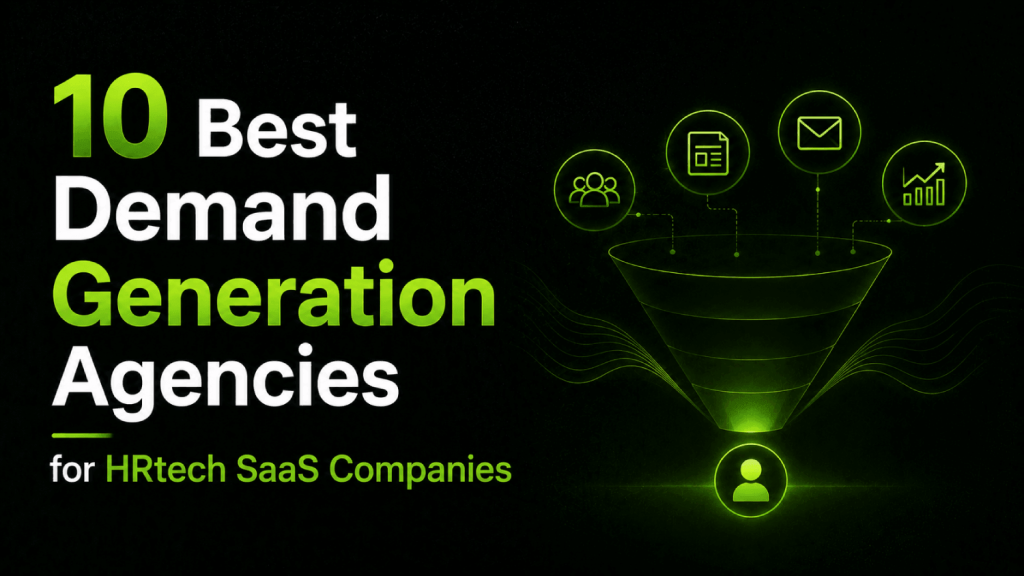
What Are the 10 Best Demand Generation Agencies for HRtech SaaS Companies?
The agencies below were selected based on publicly visible HRtech client work, stated category focus, and the breadth of services they offer across the demand generation funnel. Pricing is quote-based for all of them unless stated otherwise.
1. GrowthMode Marketing
GrowthMode Marketing is the closest thing HRtech has to a category-specialist demand gen firm. The agency focuses exclusively on HR technology companies and builds programs around what it calls “demand creation” rather than lead capture. The distinction matters: instead of gating content to collect form fills, GrowthMode publishes educational content designed to generate category awareness before a buyer is actively in-market.
Their content programs are built to educate buying committees across multiple personas, which is exactly what HRtech sales cycles require. They are a strong fit for mid-market HRtech companies with six-to-twelve-month sales cycles that need to build pipeline twelve months out, not this quarter. Pricing is quote-based.
2. Walker Sands
Walker Sands is a B2B tech marketing agency with a meaningful HRtech client roster and a genuine integrated PR plus demand gen capability. Where most agencies treat PR and demand gen as separate disciplines, Walker Sands builds programs where earned media feeds paid and organic amplification. For HRtech companies that need analyst and media coverage alongside pipeline programs, that integration matters.
They are best suited to HRtech companies at or above Series B that need brand authority in addition to pipeline volume. A startup at Seed or Series A will find the engagement model expensive relative to their immediate needs.
3. Directive Consulting
Directive Consulting is a performance marketing agency built specifically for B2B SaaS. Their methodology centers on Customer Generation, a framework that ties paid media investment to revenue rather than MQL volume. For HRtech companies frustrated by agencies that optimize for click-through rates while pipeline stagnates, Directive’s revenue-first orientation is a genuine differentiator.
Their strength is paid media: LinkedIn, Google, and programmatic. They are less focused on organic content production. HRtech companies that already have a content function and need paid media discipline will get more from Directive than those starting from zero.
4. Red Branch Media
Red Branch Media is one of the few agencies that has worked in HRtech specifically for more than a decade. Their content and thought leadership programs are built around HR buyer personas, and they have production capacity across written content, social, and video. For HRtech companies that need content volume and category fluency without building an in-house team, Red Branch delivers.
Their demand gen integration is less sophisticated than Directive or GrowthMode on the paid and attribution side. They are a better fit for companies that need content to fuel a broader program managed by an internal marketing team.
5. BAO (By Appointment Only)
BAO occupies a specific and valuable niche: outbound pipeline generation for HRtech. As noted on their website, BAO supplements internal teams with experienced Inside Sales Representatives who focus on securing meetings with HR technology decision-makers. This is appointment setting and outbound prospecting done at specialist depth, not a generic BDR outsourcer.
BAO works best when an HRtech company already has a functional inbound program and needs outbound to open new accounts in parallel. They are not a full-stack demand gen agency. Think of them as the outbound arm of a program, not the entire program.
6. TechnologyAdvice
TechnologyAdvice is a media and lead generation platform with broad reach across HR and IT decision-makers who are actively researching solutions. Their model is content syndication and intent-based lead delivery: buyers researching HR software on TechnologyAdvice properties get matched to relevant vendors, who receive contact information. This is closer to demand capture than demand creation, but for HRtech companies that need a steady flow of in-market contacts, it serves a real function.
The risk with TechnologyAdvice is lead quality variation. Contacts delivered are researchers, not necessarily decision-makers with active budget. Treat TechnologyAdvice as a top-of-funnel volume channel that requires a strong nurture program downstream, not a pipeline shortcut.
7. Headley Media
Headley Media is a B2B technology media company that focuses on content syndication and lead generation for technology vendors, with meaningful coverage of HR software buyers. Their network reaches IT and HR decision-makers through sponsored content and research assets. They are most relevant to HRtech companies that have produced strong research reports or benchmark content and need distribution to targeted buyer audiences.
Like TechnologyAdvice, Headley operates at the top of funnel. They generate contacts rather than pipeline directly. HRtech companies that have not yet built out their nurture and sales development motion will underinvest in the leads Headley can generate.
8. Kalungi
Kalungi is a full-service B2B SaaS marketing agency that offers fractional CMO services alongside demand gen execution. For early-stage HRtech companies that do not yet have a VP of Marketing, Kalungi’s model of embedding a fractional marketing leader alongside a delivery team solves a real structural problem. They can build the demand gen strategy and execute it simultaneously.
Kalungi is less HRtech-specific than GrowthMode or Red Branch, but their SaaS marketing depth compensates. They are strongest for HRtech companies at Seed to Series A that need to build a demand gen infrastructure from scratch with limited internal headcount.
9. Refine Labs
Refine Labs built its reputation on the argument that most B2B demand gen programs optimize for vanity metrics rather than revenue. Their demand generation methodology, which they describe openly across their podcast and content, focuses on dark funnel activation: reaching buyers before they raise their hand, through channels like LinkedIn organic, podcasts, and community. For HRtech companies selling to CHROs who are not filling out forms, that matters.
Refine Labs is not HRtech-specific, but their framework applies directly to the category. Their best work happens with HRtech companies that have a strong executive thought leadership angle and want to build community-driven pipeline rather than ad-driven lead volume. They are not the right choice for HRtech companies that need immediate MQL volume to satisfy a board metric.
10. Callbox
Callbox is a multi-channel lead generation firm with a dedicated human resources technology practice. Their model combines outbound calling, email sequencing, LinkedIn outreach, and appointment setting into managed programs. As their published services describe, they offer HR software lead generation as a defined offering, which means their SDR teams have category context rather than reading from a generic script.
Callbox works well for HRtech companies that need outbound pipeline generation in North America or APAC and want to outsource the entire SDR function. They are not a content or brand-building agency. Combine them with a content-led inbound program and the combination is more effective than either in isolation.
How Do These Agencies Compare Across Key Capabilities?
| Agency | HRtech Specialization | Demand Creation vs. Capture | Content Production | Paid Media | Outbound / SDR | Best Fit Stage |
|---|---|---|---|---|---|---|
| GrowthMode Marketing | HRtech-exclusive | Creation | Strong | Moderate | No | Series A to C |
| Walker Sands | B2B Tech / HRtech | Both | Strong | Moderate | No | Series B+ |
| Directive Consulting | B2B SaaS | Capture | Limited | Strong | No | Series A to D |
| Red Branch Media | HRtech-focused | Creation | Strong | Limited | No | Seed to Series B |
| BAO | HRtech-focused | Capture | None | None | Strong | Series A to D |
| TechnologyAdvice | HR + IT buyers | Capture | Syndication | None | No | Any stage |
| Headley Media | B2B Tech | Capture | Syndication | None | No | Any stage |
| Kalungi | B2B SaaS | Both | Strong | Moderate | No | Seed to Series A |
| Refine Labs | B2B SaaS | Creation | Moderate | Moderate | No | Series A to C |
| Callbox | HRtech practice | Capture | None | None | Strong | Any stage |
Which Agency Model Fits Which HRtech GTM Situation?
The right agency depends on where your pipeline problem actually lives. Most HRtech companies misdiagnose this. They hire a content agency when their issue is outbound coverage, or they hire an SDR firm when their issue is that nobody knows who they are. Before hiring anyone, identify the actual gap.
You need demand creation if:
- Your ICP is not actively searching for a solution yet (common for emerging categories like AI internal mobility platforms or talent intelligence).
- Your win/loss data shows buyers chose to “do nothing” more often than they chose a competitor.
- Your category requires educating buyers about a problem before they will consider your solution.
- Sales cycles are consistently longer than nine months with no mid-cycle engagement.
You need demand capture if:
- Your ICP is actively searching for solutions and competitors are capturing that intent while you are not.
- You have inbound leads but they are closing at low rates because they are not the right persona.
- You have a functional content program and need paid media and outbound to accelerate in-market buyers.
You need both if:
- You are entering a new segment or geography where you have no brand presence.
- Your ICP includes both active searchers (mid-market HR directors) and passive buyers (enterprise CHROs who do not Google solutions).
- You have a twelve-to-eighteen-month sales cycle and need to fill the top of the pipeline while nurturing existing opportunities.
What Does a Multi-Stakeholder HRtech Demand Gen Program Actually Look Like?
The most common failure in HRtech demand gen is single-persona content: everything written for the CHRO, nothing for the CFO or IT leader who will block the deal. A well-structured HRtech demand gen program maps content and outreach to each member of the buying committee and connects them at the deal stage.
For a typical mid-market HRtech deal, the buying committee includes five distinct stakeholders with different concerns. The CHRO or VP of People cares about strategic outcomes, employee experience, and time to value. The CFO wants total cost of ownership, ROI models, and payback period. IT wants security architecture, integration specs, and support SLAs. Legal or compliance wants data processing agreements, GDPR or CCPA compliance documentation, and liability language. The talent acquisition leader or daily user wants workflow, adoption, and whether the tool actually works. An agency that cannot produce credible content for all five will leave two or three of those veto points unaddressed.
HRtech companies evaluating complex platform decisions already work through this problem on the buyer side. The AI HR vendor evaluation checklist used by CHROs shows exactly what questions each stakeholder is asking. A demand gen agency that has read and understood that checklist will write better content than one that has not.
What Does HRtech Demand Generation Cost?
All ten agencies on this list operate on custom pricing. None publish standard rate cards for HRtech demand gen programs. The market has recognizable tiers based on scope and agency positioning, but specific retainer figures vary by client size, scope of services, and geographic reach. The table below describes what each agency type typically covers , treat the ranges as rough orientation, not verified pricing, and get scoped proposals before drawing any budget conclusions.
| Agency Type | Indicative Monthly Range (USD) | What You Get |
|---|---|---|
| HRtech specialist (GrowthMode, Red Branch) | Not publicly disclosed , request a scoped proposal | Category-fluent content, persona-based programs, HRtech event activation |
| Full-service B2B SaaS (Walker Sands, Kalungi, Refine Labs) | Not publicly disclosed , request a scoped proposal | Integrated strategy, paid media, content, PR components |
| Paid media specialists (Directive) | Not publicly disclosed , request a scoped proposal; media spend is additional | Paid search, paid social, conversion optimization |
| Outbound / SDR specialists (BAO, Callbox) | Not publicly disclosed , request a scoped proposal | Appointment setting, outbound sequences, meeting volume |
| Media / syndication platforms (TechnologyAdvice, Headley) | CPL or campaign-based pricing , contact each vendor directly | Contact delivery, content distribution, intent signal access |
None of the agencies above publish rate cards. Get scoped proposals from at least three before committing. The scope of what each agency includes in a retainer varies significantly, and the right comparison is cost per pipeline opportunity, not cost per month.
What Are the Most Common Mistakes HRtech Companies Make When Hiring a Demand Gen Agency?
Hiring the wrong agency for HRtech demand gen is expensive in two ways: the direct cost of the retainer and the opportunity cost of six months without pipeline momentum. The most common mistakes follow predictable patterns.
The first is hiring a generalist B2B agency and expecting them to develop category expertise fast enough to matter. HRtech buyers are sophisticated. A CHRO who has evaluated five HRIS platforms in the last three years will immediately recognize content written by someone who does not know the category. That recognition damages your brand.
The second mistake is measuring agencies on MQL volume rather than pipeline contribution. In HRtech, a high MQL count with low pipeline conversion usually means the agency is optimizing for form fills from people who will never buy. HRtech companies selling platforms covered in comparisons like the best HR software platforms for mid-market companies know that buyers are doing serious research before they engage a vendor. The demand gen program needs to earn trust during that research phase, not just capture the lead at the end.
The third mistake is treating demand gen as a single-quarter initiative. HRtech sales cycles are long by structural design. The organizations buying AI people analytics platforms or enterprise HCM systems are not making decisions in thirty days. A demand gen agency needs at least two quarters to demonstrate pipeline influence, and the measurement framework needs to reflect that timeline.
How Should HRtech Companies Structure the Agency Relationship for Long Sales Cycles?
An agency relationship structured for a short sales cycle will fail in HRtech. The program design, reporting cadence, and success metrics all need to account for decision timelines that regularly extend well beyond six months.
Set pipeline influence as a primary metric alongside sourced pipeline. In a long cycle, most deals will be touched by demand gen at multiple points before the opportunity is formally created in CRM. An agency that is only credited for sourced pipeline will appear to underperform even when they are driving significant influence. Build influence tracking into the attribution model from day one.
Require the agency to build persona-specific content calendars quarterly. Content for a CFO audience evaluating HR software is different from content for a CHRO, and neither is relevant to an IT security review. If the agency cannot show you a differentiated content map by stakeholder, they are not building for your actual buying committee.
Insist on a late-stage nurture program. Most demand gen agencies focus on top-of-funnel. HRtech deals stall at legal, procurement, and IT security review. An agency that has not thought about how to support a deal that has been in legal review for sixty days is not built for your category. The best HRtech demand gen programs include content and outreach sequences specifically designed for late-stage deal support, not just pipeline entry.
Frequently Asked Questions
What is the difference between demand generation and lead generation for HRtech companies?
Lead generation focuses on capturing contact information from buyers who are already in-market. Demand generation creates that market awareness before buyers are actively searching. In HRtech, most enterprise buyers do not start their process with a Google search. They are influenced by peer communities, analyst reports, executive thought leadership, and category education months or years before they issue an RFP. Lead generation alone misses that entire pre-market phase, which is where HRtech deals are actually won or lost.
How long does it take to see results from a HRtech demand gen agency?
Expect three to six months before a well-structured program produces meaningful pipeline contribution. Paid media and outbound programs can generate meeting volume faster, sometimes within thirty to sixty days. Content and organic programs typically take six months or more to show pipeline influence. HRtech companies that measure demand gen on a ninety-day timeline and then fire the agency are often terminating just as the program would begin producing. Set twelve-month minimum commitments with quarterly review gates.
Should an HRtech startup hire a specialist HRtech agency or a general B2B SaaS agency?
For companies selling to HR buyers specifically, a specialist agency reduces the category education tax significantly. A general B2B SaaS agency will spend the first two to three months learning the buyer, the compliance concerns, the competitive set, and the vocabulary. An HRtech specialist arrives knowing that vocabulary. At early stages where budget and runway are constrained, that time-to-competence advantage is worth paying for. At growth stage where you need deep paid media or technical SEO capability, a general SaaS agency with a proven B2B methodology may outperform a smaller specialist.
How should HRtech companies measure demand generation ROI?
Pipeline sourced and pipeline influenced are the two primary metrics. Sourced pipeline attributes a deal’s origin to demand gen directly. Influenced pipeline credits demand gen for touching a deal at any point before close. Both matter. Cost per opportunity is more meaningful than cost per lead in HRtech, because MQL volume is a poor proxy for revenue in a category where deals take months and involve multiple stakeholders. Track time-to-close on demand gen sourced deals versus other sources. A program that generates slower-closing but higher-value pipeline is still a strong program.
Do HRtech demand gen agencies also help with sales enablement content?
The best ones do, and in HRtech that distinction matters more than in most categories. Sales enablement content for HRtech includes IT security questionnaire templates, CFO ROI models, compliance documentation summaries, and late-stage objection handling guides. These are not marketing assets in the traditional sense, but they directly influence win rates in deals that stall at the buying committee stage. When evaluating agencies, ask specifically whether they produce late-stage and sales enablement content, not just top-of-funnel awareness assets.
What HRtech events and communities should a demand gen agency know?
Any HRtech-specialist agency should be familiar with HR Tech Conference (Las Vegas), SHRM Annual Conference, Unleash, and WorldatWork events as primary practitioner gatherings. On the digital community side, HR Open Source, People Geek communities, and LinkedIn groups for people operations leaders are relevant activation points. An agency that cannot name the events where your buyers actually gather is not specialist enough to serve you well in HRtech demand generation.
The Decision That Actually Matters
Most HRtech companies hire a demand gen agency and then evaluate it as if it were running a campaign. They look at impressions, MQLs, and monthly lead volume. Those metrics feel like accountability but they are not pipeline accountability. The agencies on this list that produce durable pipeline for HRtech companies do so because they understand that HR software buyers are not just buying software. They are managing organizational risk, justifying headcount to a CFO, satisfying IT governance, and making a decision that affects how thousands of employees experience their workplace. That weight requires content and outreach that treats buyers as intelligent adults with real constraints.
The most important variable in agency selection is not the channel mix or the retainer structure. It is whether the agency has enough category depth to write content that earns trust from a CHRO who has seen every vendor pitch and a CFO who wants a model, not a brochure. That depth takes years to build. The agencies that have built it in HRtech are worth paying for. The ones that claim they can build it while they work for you are asking you to fund their education.
If you are a founder or marketing leader early in the agency evaluation process, the practical next step is a structured RFP with three to five agencies from this list, scored against the evaluation criteria table above. Ask each agency to show you HRtech-specific work, describe their late-stage nurture approach, and explain how they measure pipeline influence across a twelve-month sales cycle. The answers will tell you faster than any case study whether they understand what you are actually buying.
For related context on how HR software buyers evaluate vendors on the other side of the table, see the HR software buying checklist and the best HRtech SEO agencies list, which covers organic search strategy as a complement to demand gen programs.