9 Best Payscale Alternatives for Compensation Benchmarking in 2026
Nine Payscale alternatives compared on data source, coverage, published prices and which Payscale product each replaces, with a switching checklist.
TL;DR
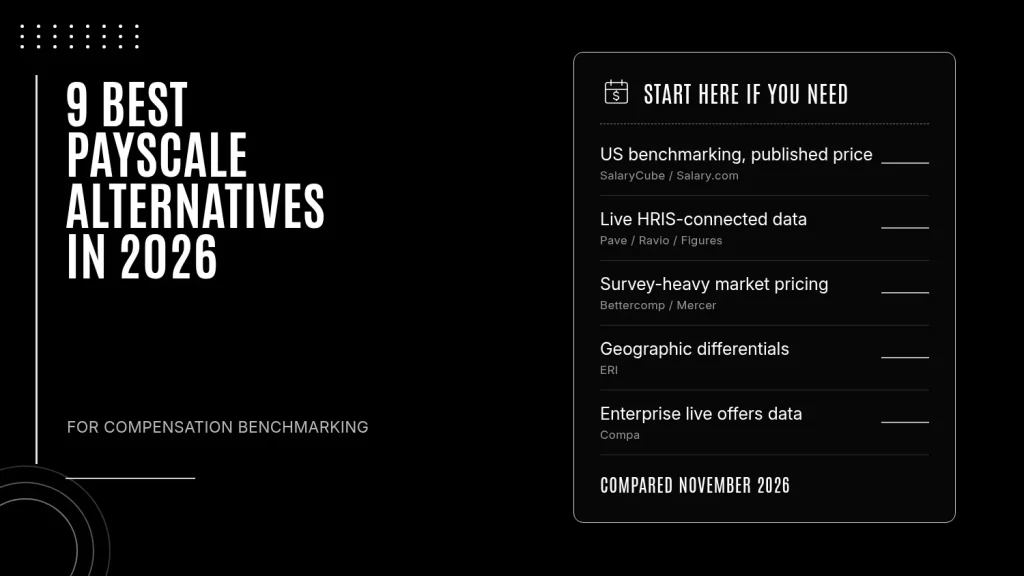
The best Payscale alternatives in 2026 are Salary.com CompAnalyst, SalaryCube, Pave, Ravio, Figures, ERI, the Mercer Benchmark Database, Bettercomp and Compa. Pick by the Payscale job you are replacing: US job pricing with a published price, live HRIS-connected data, multi-survey market pricing, geographic differentials or enterprise offer data.
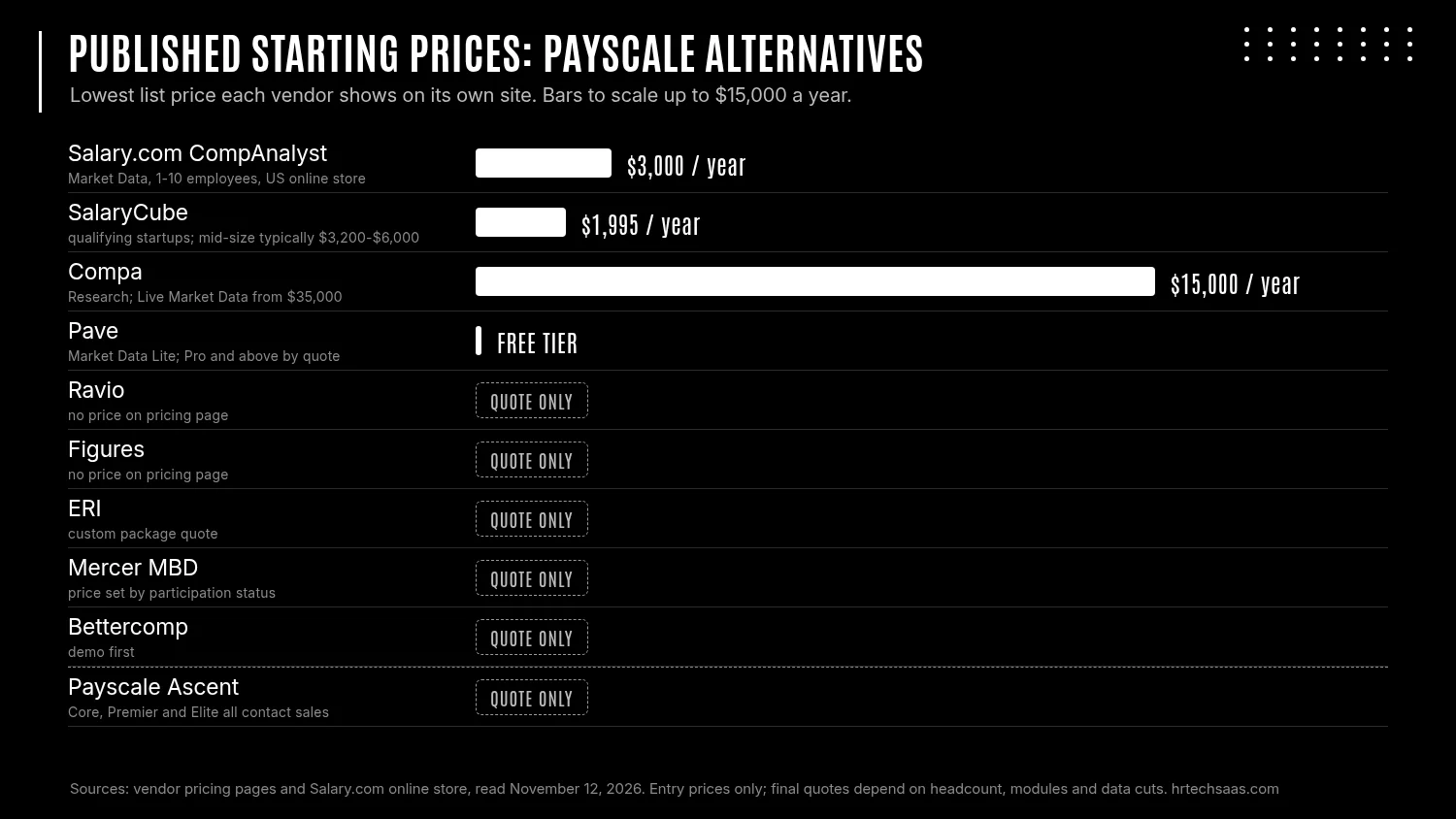
- Lowest published prices: SalaryCube from $1,995 a year for qualifying startups and Salary.com CompAnalyst Market Data from $3,000 a year for 1 to 10 employees.
- Free starting point: Pave Market Data Lite gives free benchmarks for 290+ job families in the US plus one more market.
- International data: Ravio (50+ countries), Figures (110+ countries) and Pave Pro (60+ countries) all use live HRIS-connected data.
- Survey-heavy teams on Payscale Marketpay or Premier: look at Bettercomp for multi-survey pricing and Mercer for survey data.
- Payscale publishes no prices for Core, Premier or Elite, so get a renewal quote before you compare.
Most teams start looking for Payscale alternatives at renewal. The quote arrives, the plan names have changed to Ascent Core, Premier and Elite, and nobody on the team can say which of those the old Payfactors or Marketpay contract maps to. At the same time, newer vendors now sell live salary data pulled straight from HR systems, and a few of them publish prices.
This guide compares nine alternatives on what they actually replace in a Payscale setup, using each vendor’s own pricing and product pages read on November 12, 2026. Where a vendor does not publish a price, we say so instead of guessing.
How we chose these alternatives (last updated November 12, 2026). Written by Olivia Bennett. On November 12, 2026 we read Payscale’s pricing page, its Paycycle page and its Services Documentation (dated August 2026), then each alternative’s homepage, pricing page and product pages. We included vendors that sell their own salary data or a market pricing engine that can replace a Payscale workflow, and we left out compensation planning suites that need data from elsewhere. Prices are list prices shown on vendor sites, with the date we read them. No vendor paid to be listed.
Payscale Alternatives at a Glance
Match the alternative to the part of Payscale you actually use, then compare data source, coverage and published price. Everything in this table comes from the vendors’ own pages, read November 12, 2026.
| Alternative | Replaces this Payscale job | Data source | Coverage (vendor figures) | Published starting price |
|---|---|---|---|---|
| Salary.com CompAnalyst | Ascent job pricing for US-led teams | HR-reported, payroll-backed data | 20,000+ job titles; 25 countries | $3,000 a year (Market Data, 1 to 10 employees) |
| SalaryCube | Ascent Core benchmarking and ranges, US only | Job postings, public filings, client data, updated daily | 35,000+ US roles | $1,995 a year (qualifying startups); $3,200 to $6,000 typical mid-size |
| Pave | Peer data plus Paycycle-style planning | Live HRIS, ATS and equity system feeds | 9,000+ companies; Pro covers 60+ countries | Free (Market Data Lite); paid tiers by quote |
| Ravio | Peer Global for international teams | Live HR system data, human checked | 50+ countries; 300+ roles | Not published |
| Figures | Benchmarks, bands and reviews for Europe-led teams | HRIS-connected market data | 550K data points; 110+ countries | Not published |
| ERI | Geographic and cost-of-labor pricing | Salary survey database and assessors | Global; geographic differentials | Custom quote |
| Mercer Benchmark Database | Traditional survey data in Payscale survey loads | Employer-reported survey | 7,232 positions; 3,423 organizations (US, Aug 2026) | Priced per order; participant discount |
| Bettercomp | Marketpay or Premier multi-survey pricing | Your licensed surveys plus HRIS data | Depends on surveys you own | Not published |
| Compa | Elite-level enterprise market data | Live employee, offer and stock data from its customer network | 9M+ observations; 50+ countries | $15,000 a year (Research); $35,000 (Live Market Data) |
Why Do Teams Look for Payscale Alternatives in 2026?
Usually for one of three reasons: price opacity at renewal, a need for live international data, or a mismatch between the plan tier and the workflow the team actually runs.
- No public prices. Payscale’s pricing page shows three Ascent plans, Core, Premier and Elite, and every one ends in a contact-sales button. Paycycle, its merit and pay review product, is quoted on employee count and configuration and can be bought with Ascent or on its own.
- Features split across tiers. Price at Scale, which bulk-prices hundreds of jobs, is listed for Premier only. Elite gets on-demand Price a Job, unlimited survey loads and two-way HRIS sync, but Peer Global and Peer Enhanced data are add-ons on Elite while they are included in Core and Premier. Survey participation management starts at Premier, which includes 20 survey loads.
- Real-time data from rivals. Pave, Ravio, Figures and Compa all build benchmarks from live HR system data rather than once-a-year surveys, which matters for fast-moving roles.
- Legacy names. Payscale’s Services Documentation still describes Payfactors editions and Marketpay alongside Ascent, so older contracts may not map cleanly onto the new plans.
If you are new to the category rather than switching, start with our main guide to compensation benchmarking tools, which covers how the data sources differ.
The 9 Best Payscale Alternatives for Compensation Benchmarking
The order reflects how much of a typical Payscale setup each vendor can replace, how transparent its pricing is, and how clearly it documents its data. Each entry covers what the vendor publishes, who it suits and what to ask.
1. Salary.com CompAnalyst: Best All-Round Replacement With a Published Price
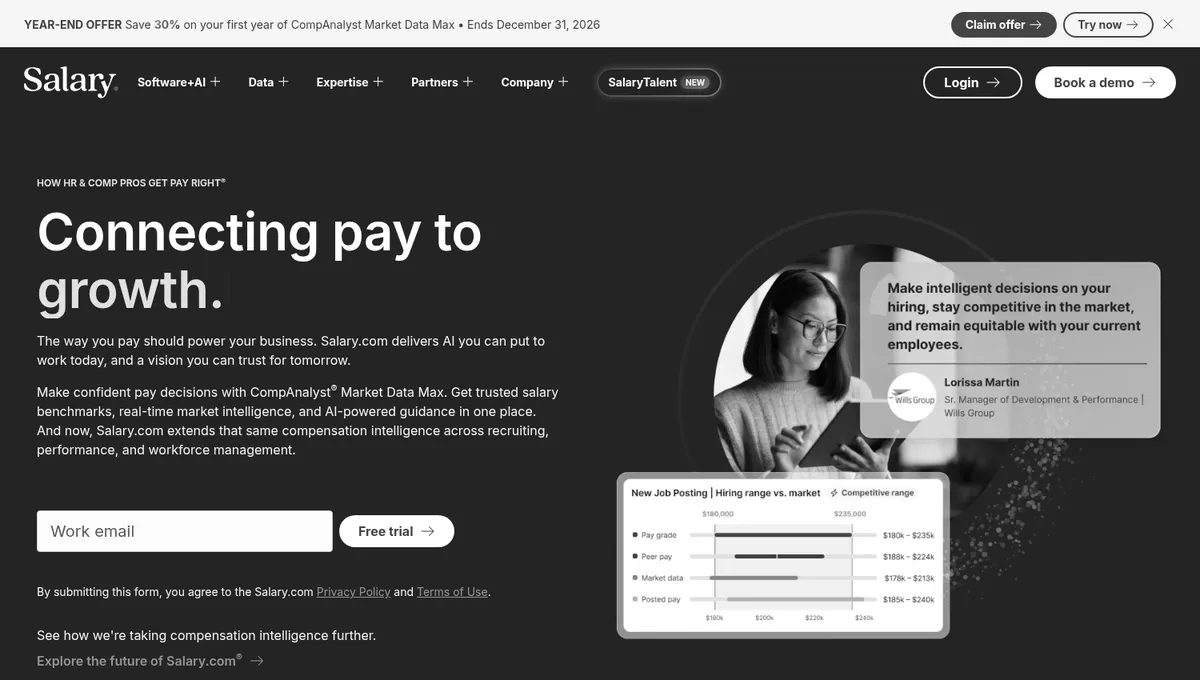
CompAnalyst is the closest like-for-like replacement for Payscale’s job pricing, and it is one of the few in this category you can buy online. The Salary.com online store lists CompAnalyst Market Data annual licenses from $3,000 a year for 1 to 10 employees, with unlimited users, a 30-day refund, 20,000+ job titles, more than 10 billion data points, AI job matching and data for 25 countries. Salary.com says the data is 100% HR-reported and payroll-backed.
For larger teams, Salary.com lists CompAnalyst Enterprise Max on AWS Marketplace at $30,000 a year under 250 employees, $35,000 for 250 to 500, $40,000 for 500 to 1,000 and $70,000 above 1,000, covering market pricing, salary structures and reporting.
Its homepage was running a 30% first-year discount on Market Data Max until December 31, 2026 when we checked. Salary.com has also launched SalaryTalent recruiting and performance products, which we cover in our SalaryTalent explainer.
- Best for: US-led mid-market and enterprise teams that want a survey-grade database and a price they can see before a demo.
- Ask before you sign: Ask which countries are in your license, whether you can load third-party surveys you already own, and what the renewal increase cap is.
2. SalaryCube: Best Low-Cost Option for US-Only Employers
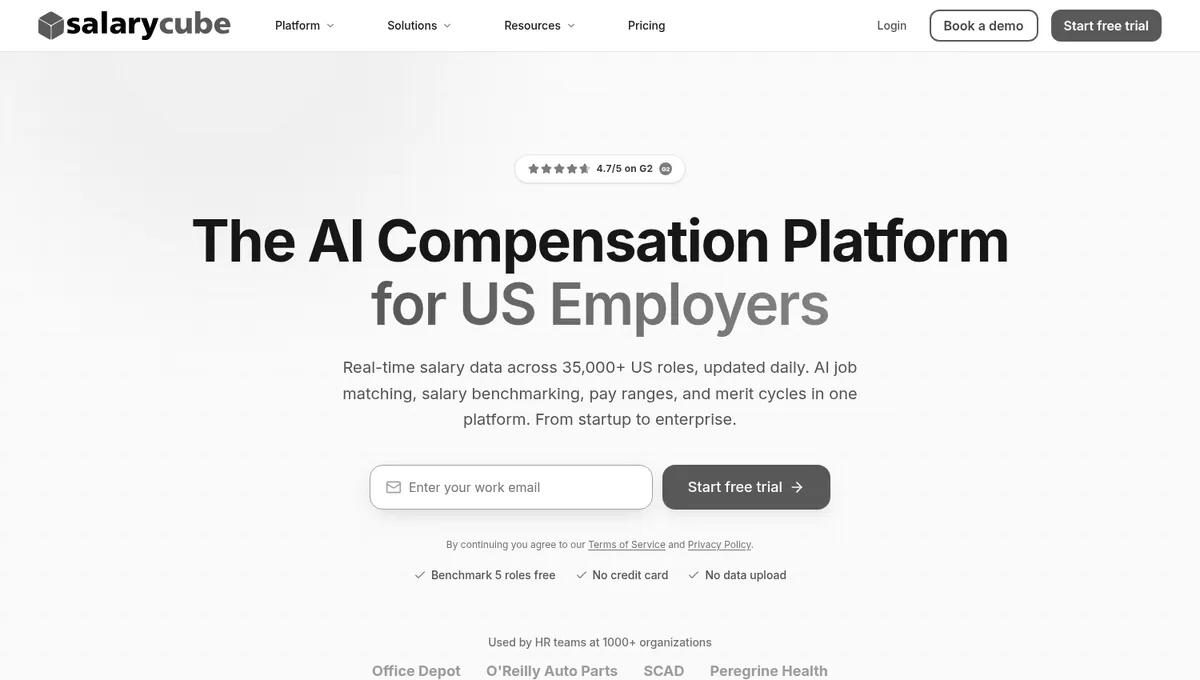
SalaryCube publishes the lowest entry price in this list and is built only for US pay. Its pricing page says qualifying startups and small businesses start at $1,995 a year, most mid-size companies pay $3,200 to $6,000 a year, and larger organizations are quoted on scope. Every quote includes salary benchmarking, range building, AI job matching and FLSA analysis; Comp Planning is a separate add-on.
The homepage says its Bigfoot Live engine covers 35,000+ US job titles with more than 800 million data points from job postings, public filings and client participation, updated daily, and that no survey participation is required.
A free trial gives 5 role credits and 2 live market searches without a credit card. The trade-off is scope: there is no international data, so it does not replace Peer Global.
- Best for: US-only companies of 200 to 5,000 employees that mostly use Payscale for job pricing and ranges.
- Ask before you sign: Ask how job-posting data is weighted against employer data for senior roles, and what Comp Planning adds to the quote.
3. Pave: Best for Live Peer Data and Equity-Heavy Pay
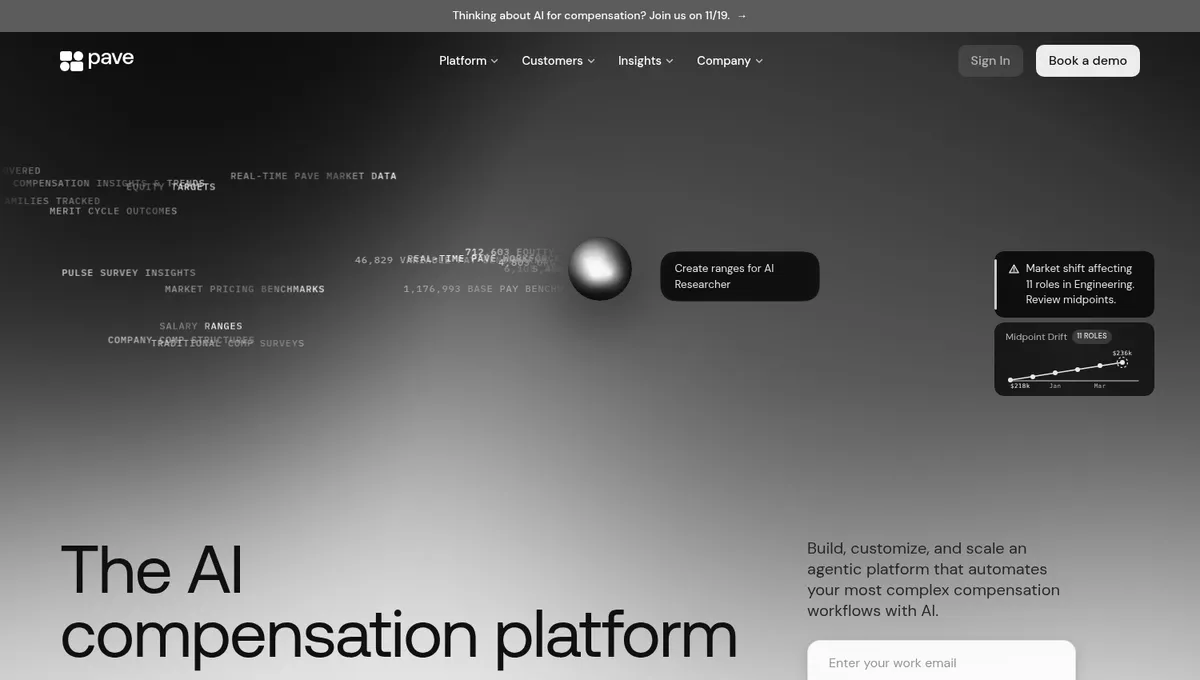
Pave replaces Payscale’s peer data with benchmarks from more than 9,000 companies whose HR systems feed Pave directly, and it is the only vendor here with a free tier. Its pricing page says Market Data Lite is free and covers 290+ job families in two locations, the US overall and one other market. Market Data Pro adds custom peer groups, benchmarks and geo differentials in 60+ countries and 90+ metros, a recent-hire filter and advanced equity data.
Paid tiers go beyond data: Pave sells market pricing that blends your traditional surveys with its own data, and a compensation planning module, so it can cover both Ascent and Paycycle jobs. Higher tiers are quoted.
Because the data comes from connected clients, coverage is strongest where its customers are, which skews toward technology companies. Our Pave vs Ravio vs Figures comparison goes deeper on the data models.
- Best for: Venture-backed and technology companies that grant equity and want live data plus planning in one tool.
- Ask before you sign: Ask for sample depth in your non-tech roles and locations, and what Market Data Pro costs at your headcount.
4. Ravio: Best Replacement for Peer Global in Europe and Beyond
Ravio is the strongest swap for Payscale’s international peer data if your people are mostly in Europe. Its pricing page lists total reward data covering base, equity, variable pay and benefits in 50+ countries and 300+ roles, filters for location, funding stage and headcount, and 60+ HRIS integrations that keep data synced. Ravio maps your roles and levels to its benchmarks for you to review.
Its homepage says benchmarks come from live HR system data, are modelled by data scientists and checked by a person before release.
Beyond benchmarking, Ravio sells salary bands and automated pay equity analysis with reporting for the EU Pay Transparency Directive. It does not publish prices on its pricing page, so you will need a quote.
- Best for: European and international technology scale-ups replacing Peer Global and spreadsheets for bands.
- Ask before you sign: Ask for sample sizes in your smallest countries and whether pay equity reporting is included or an extension.
5. Figures: Best for Europe-Led Teams Facing the Pay Transparency Directive
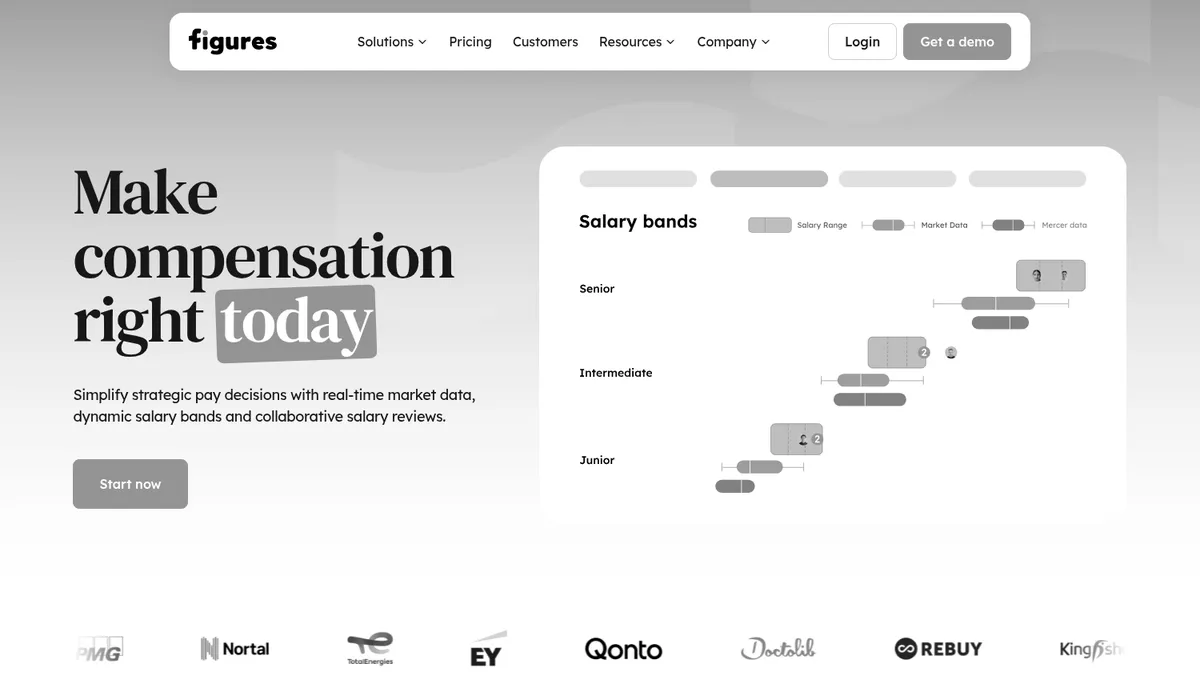
Figures bundles market data, salary bands and pay reviews in one product built in Europe. Its pricing page lists three plans, Structure (benchmark, bands, analytics), Companion (adds annual and off-cycle reviews with manager approvals) and Pay Transparency, sold standalone or as an add-on. Market data covers base, variable and benefits across 550K data points in 110+ countries, with 30+ HRIS integrations and unlimited user seats.
Figures stores data in European cloud storage and says it holds SOC 2 Type 2 and ISO 27001 certifications.
Its pay transparency module covers legal reports by category of worker, adjusted pay gap analysis and employee request letters, which overlaps with dedicated tools in our pay transparency software list. Figures does not publish prices on its pricing page.
- Best for: Mid-market companies headquartered in Europe that want benchmarking, bands, reviews and directive reporting from one vendor.
- Ask before you sign: Ask how many data points sit behind your specific roles and countries, and whether the Pay Transparency module is priced per employee.
6. ERI: Best for Geographic Pay Differentials and Cost of Labor
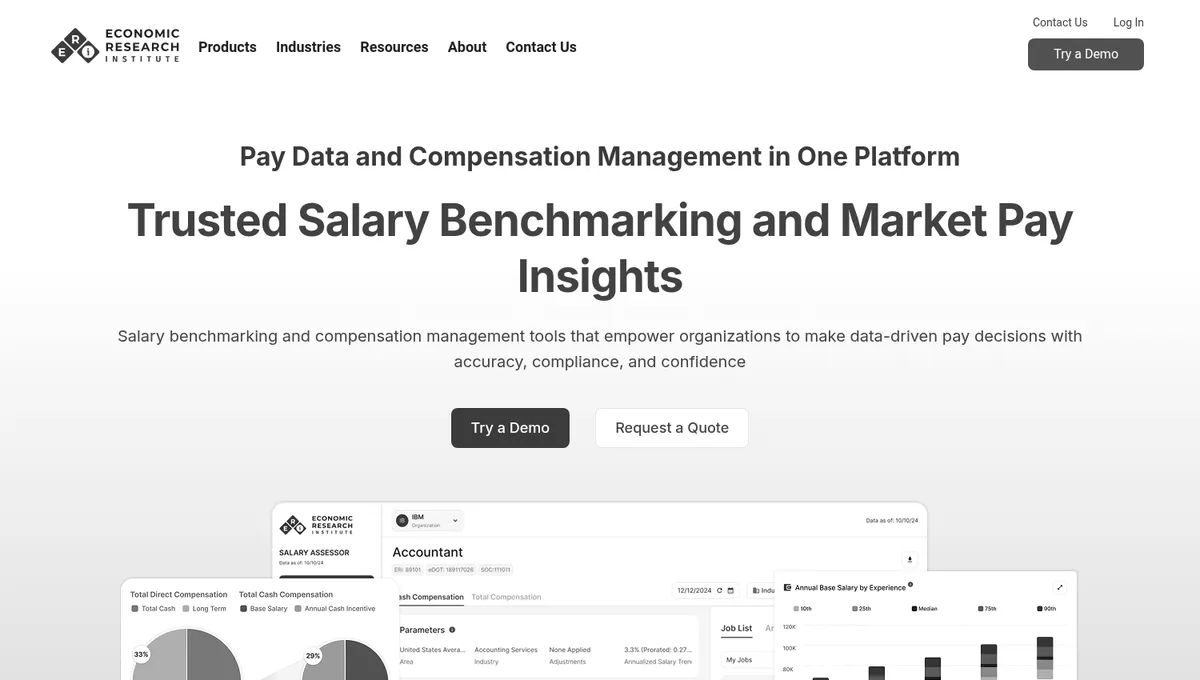
ERI is the specialist pick when location-based pay is the hard part of your program. Its homepage describes a revamped Salary Assessor for benchmarks, pay grades and planning, a Geographic Assessor for cost-of-living and cost-of-labor differentials worldwide, HRIS sync to match job titles, US and Canada benefits data, and an FLSA status suggestion tool. ERI says organizations have used it for more than 35 years.
ERI’s pricing page offers custom packages only, from a handful of job titles to thousands of employees, so there is no list price to compare. It is a good fit for remote and relocation pay policies, and less of a full planning platform than Pave or Salary.com.
- Best for: Employers with many locations, remote pay policies or relocation programs that need defensible geographic differentials.
- Ask before you sign: Ask which assessors are in the package, how often geographic data is updated, and how the HRIS sync handles job title mapping.
7. Mercer Benchmark Database: Best Traditional Survey for Formal Job Architecture
If your Payscale setup leans on survey loads, Mercer is the survey many teams load. The US Mercer Benchmark Database page lists an August 2026 edition with 7,232 positions, 3,423 organizations and 8,141,346 observations, organized into nine functional modules, and each order includes access for 3 users to the Mercer WIN reporting tool. Price depends on whether you took part in the survey; participation for this edition ran from March 2 to May 4, 2026.
Mercer’s site now carries Marsh branding, and says its US data spans 31,000+ reportable jobs and 20 million+ employees across its surveys, plus a Geographic Salary Differential Tool and a global compensation planning report covering 140+ countries. Mercer is a data source, not a pricing engine, so pair it with a tool such as Bettercomp or Salary.com if you are leaving Payscale’s software.
- Best for: Companies with formal job architecture and a comp team comfortable matching jobs to survey benchmarks once a year.
- Ask before you sign: Ask what the participant discount is worth for your modules and when the next participation window opens.
8. Bettercomp: Best for Teams Leaving Marketpay or Premier Survey Workflows
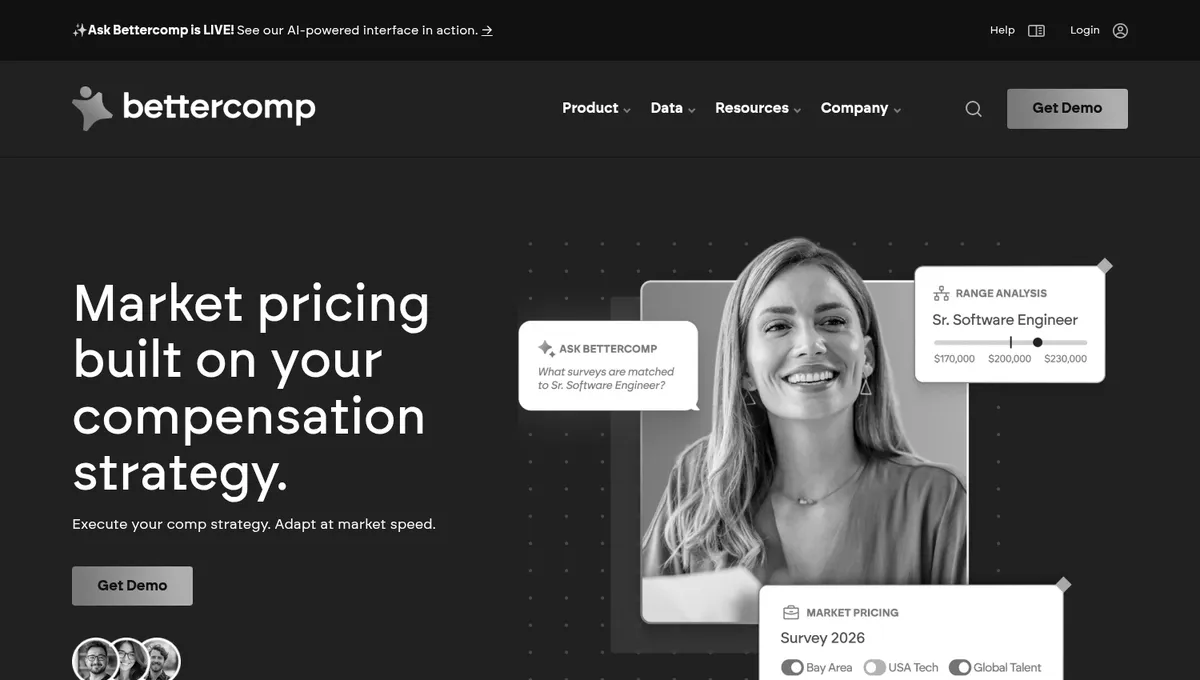
Bettercomp is market pricing software for teams that already license several salary surveys and want a faster engine around them. Its homepage describes pricing entire job families in three clicks with AI-assisted matching and one-click mass changes, automated survey cut selection, structure modeling with unlimited scenarios, 60+ reports and dashboards, and a plain-language Ask Bettercomp assistant.
That maps directly to what Payscale sells in Premier (Price at Scale and survey participation) and Elite (unlimited survey load).
Bettercomp has also announced a partnership with WTW. It does not include its own salary dataset or published prices, so budget for the surveys you load into it.
- Best for: Survey-heavy comp teams pricing many jobs and locations who want to keep Mercer, WTW or other surveys and drop Marketpay.
- Ask before you sign: Ask which survey publishers it already ingests, how matches are reviewed and saved, and how HRIS sync works.
9. Compa: Best for Enterprise Teams Who Want Live Offer Data
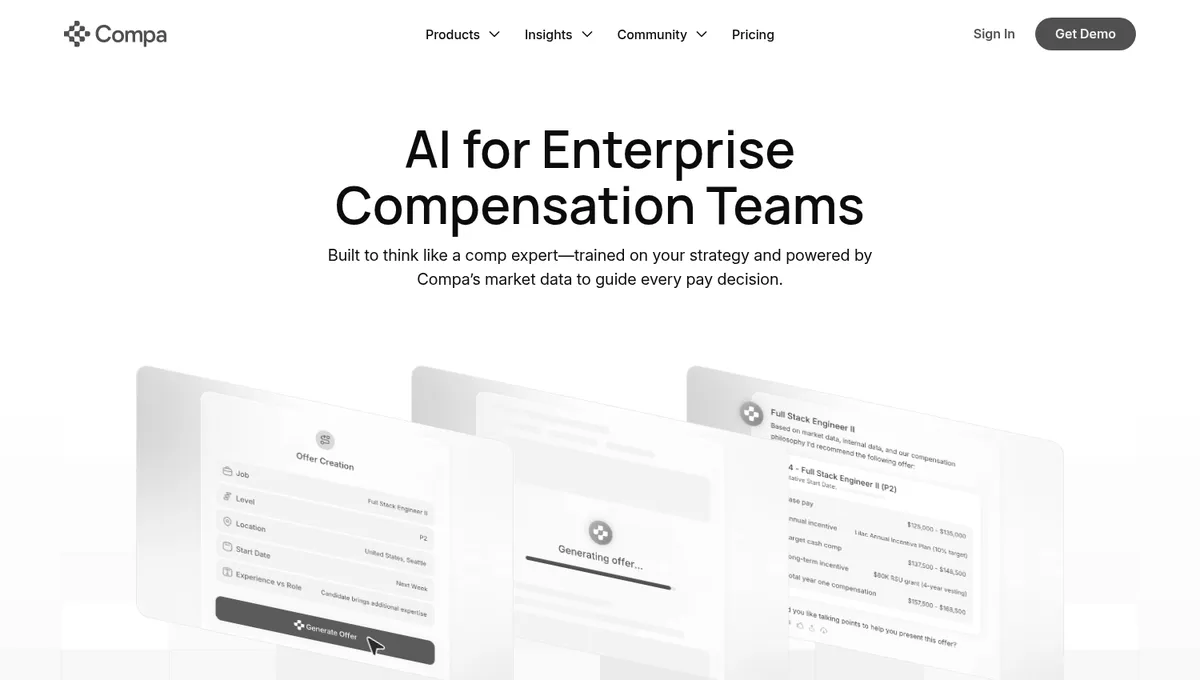
Compa sells live market data from its enterprise customer network, including offers and grant-level stock data, at published prices. Its pricing page lists Research from $15,000 a year and Live Market Data from $35,000 a year, with add-ons for stock, hourly frontline pay mapped by zip code and skills-based jobs. Multi-year and pilot pricing are offered on request.
Compa’s homepage says its data covers more than 9 million observations in 50+ countries across technology, health, retail, finance, professional services and manufacturing, that it is SOC 2 Type II certified, and that it integrates with Workday, Oracle, Greenhouse, Carta and E*TRADE. Its Analyst Agent and Partner Agent bring that data to comp teams and recruiters.
- Best for: Large enterprises with a comp team that wants offer-level market signals alongside its surveys.
- Ask before you sign: Ask which data you must contribute to the network to get access, and how offer data is leveled against your job architecture.
Which Alternative Replaces Which Payscale Product?
Most teams use only one or two parts of Payscale, so replace those parts instead of shopping for a full clone. Here is how Payscale’s own product names map to the alternatives.
| If you use this from Payscale | What it does (per Payscale) | Look at |
|---|---|---|
| Ascent Core | Smart Price, Explore, structures, standard reports, one-way HRIS integration | SalaryCube (US), Salary.com CompAnalyst, Pave |
| Ascent Premier or Marketpay | Price at Scale bulk pricing, 20 survey loads, participation management | Bettercomp plus your surveys, Pave Market Pricing |
| Ascent Elite | Price a Job on demand, unlimited survey load, two-way HRIS sync | Bettercomp, Compa, Salary.com Enterprise Max |
| Peer Global | International peer benchmarks across 50+ countries | Ravio, Figures, Pave Market Data Pro |
| Paycycle | Merit and pay review cycles with budgets and guardrails | Pave Compensation Planning, Figures Companion; see also our compensation management guide |
If pay reviews are the main reason you are leaving, compare dedicated planning tools in our compensation management software guide and our beqom alternatives review, which covers Payscale’s own planning product against enterprise rivals.
What Should You Check Before Leaving Payscale?
Check your data rights, survey loads and structures before you sign anything new, because those are what make a switch slow.
- Peer Global participation. Payscale’s Services Documentation says companies that contribute to Peer Global have their names listed as participants and may remain selectable in Peer Global for a period of time after termination. Ask how long, and whether you can opt out.
- Survey loads you own. List every third-party survey loaded into Payscale and confirm each publisher’s license lets you load it into the new tool.
- Job matches and structures. Export job matches, pay structures, grades and pricing history. Rebuilding matches is the slowest part of any move.
- HRIS sync direction. Payscale lists one-way sync for Core and Premier and two-way sFTP sync for Elite. Make sure the new tool supports the direction you rely on.
- Timing against your review cycle. Switch after a merit cycle closes, not during one. Our compensation cycle readiness audit helps you plan the next cycle.
- Renewal notice period. Find the notice clause in your order form so you do not auto-renew while you evaluate.
How Much Do Payscale Alternatives Cost?
Published entry prices run from free (Pave Market Data Lite) to $3,000 a year (Salary.com CompAnalyst Market Data for 1 to 10 employees) for small teams, with enterprise data starting at $15,000 to $35,000 a year (Compa). Ravio, Figures, ERI, Bettercomp and Payscale itself do not publish prices.
| Vendor | Lowest published price | What sets the final price |
|---|---|---|
| SalaryCube | $1,995 a year (qualifying startups); $3,200 to $6,000 typical mid-size | Company size, scope, Comp Planning add-on |
| Salary.com CompAnalyst | $3,000 a year for 1 to 10 employees (Market Data); $30,000 to $70,000 a year for Enterprise Max by headcount | Employee count, product tier |
| Pave | Free (Market Data Lite) | Tier, headcount, planning modules |
| Compa | $15,000 a year (Research); $35,000 a year (Live Market Data) | Add-ons such as stock, frontline and skills data |
| Mercer Benchmark Database | Shown in cart per order | Modules, participant status, extra WIN users |
| Ravio, Figures, ERI, Bettercomp | Not published | Headcount, countries, modules |
| Payscale Ascent and Paycycle | Not published | Plan tier, add-ons, employees in scope |
Remember to add the cost of any third-party surveys you load, and one-off implementation where the vendor charges for it.
Quick Pick: Which Payscale Alternative Fits Your Team?
| Your situation | Shortlist | Why |
|---|---|---|
| US-only, under 1,000 employees, tight budget | SalaryCube, Salary.com CompAnalyst | Published prices from $1,995 and $3,000 a year |
| Venture-backed tech company with equity | Pave | Free Lite tier, live peer data, equity benchmarks |
| Most staff in Europe | Ravio, Figures | Live European data and EU pay transparency reporting |
| Many US locations or remote pay policy | ERI | Geographic Assessor for cost-of-labor differentials |
| Comp team loading many surveys | Bettercomp plus Mercer | Multi-survey pricing engine plus survey data |
| Large enterprise wanting live offer data | Compa | Offer and stock data from its customer network |
If you need help designing pay structures rather than just data, our list of compensation consulting firms covers advisers who build job architecture, and our pay equity audit software guide covers the analysis side.
Frequently Asked Questions
What is the best alternative to Payscale?
There is no single best one. Salary.com CompAnalyst is the closest like-for-like replacement and publishes a price from $3,000 a year. SalaryCube is cheaper for US-only teams, Pave and Ravio suit companies that want live HRIS-connected data, and Bettercomp suits teams that price jobs from several salary surveys.
How much does Payscale cost in 2026?
Payscale does not publish prices. Its pricing page shows Ascent Core, Premier and Elite plans with contact-sales buttons only, and Paycycle is quoted on employee count and configuration. Ask for a written quote that names the plan, survey loads, Peer data add-ons and implementation fees before comparing alternatives.
Is there a free alternative to Payscale?
Pave offers Market Data Lite free, with benchmarks for 290+ job families in the US and one additional market, according to its pricing page. SalaryCube offers a free trial with 5 role credits and 2 live market searches. Free tiers are useful for spot checks but rarely cover a full job catalog.
Which Payscale alternative has the best international data?
For live international data, Figures lists 550K data points across 110+ countries, Ravio covers 50+ countries and Pave Market Data Pro covers 60+ countries and 90+ metros. Salary.com CompAnalyst Market Data covers 25 countries. Check sample sizes for your smallest countries before choosing.
Can I keep my Mercer or WTW surveys if I leave Payscale?
Usually yes, because survey licenses belong to you, not Payscale, but confirm each publisher’s terms. Bettercomp is built around the surveys you license, and Pave’s market pricing lets you upload traditional surveys and blend them with its own data. Export your job matches from Payscale first so you do not have to rebuild them.
What happens to my data in Payscale Peer Global after I cancel?
Payscale’s Services Documentation says Peer Global participants have their names listed and may remain selectable in Peer Global for a period of time after termination. Ask Payscale how long that period is in your contract and whether you can request removal when you give notice.
The Bottom Line: Replace the Payscale Job You Actually Use
The right Payscale alternative is the one that replaces the specific job you use Payscale for, at a price you can see.
Choose Salary.com CompAnalyst for a close all-round replacement, SalaryCube for low-cost US pricing, Pave or Ravio for live peer data, Figures for Europe and pay transparency, ERI for geographic pay, Mercer plus Bettercomp for survey-heavy teams, and Compa for enterprise offer data. Get Payscale’s renewal quote in writing, export your matches and structures, and check the Peer Global terms before you give notice. For the wider market, see our full list of compensation benchmarking tools.