EOR and HRIS Integration in 2026: Prebuilt Connectors vs Middleware for Deel, Remote, Rippling and Oyster
EOR HRIS integration compared: how Deel, Remote, Rippling and Oyster sync with Workday, BambooHR and HiBob, when you need middleware, and published prices.
TL;DR
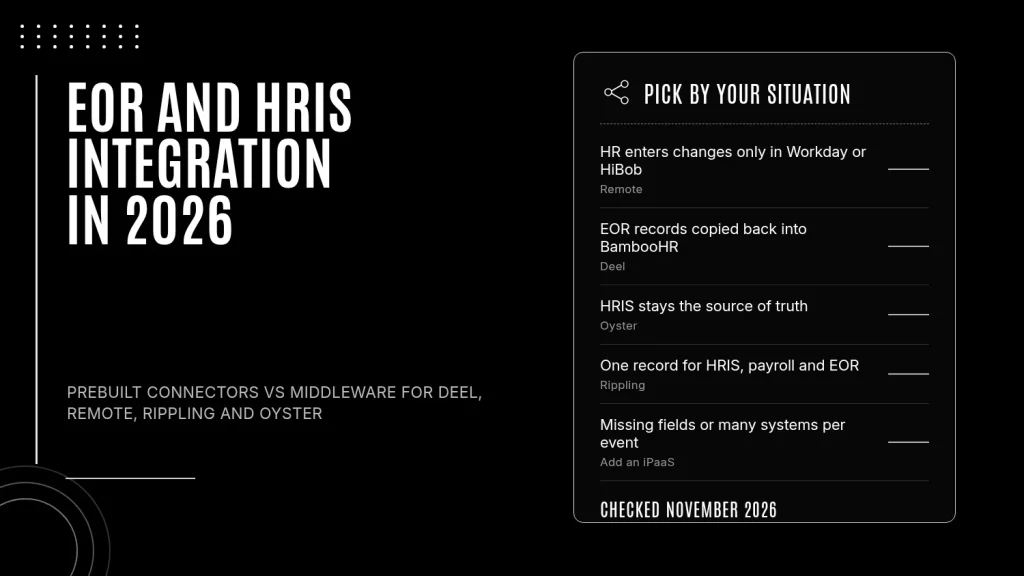
Most teams do not need middleware to connect an EOR to Workday, BambooHR or HiBob, because Deel, Remote and Oyster all document prebuilt connectors for them and Rippling runs EOR on its own HRIS record. The catch is that each connector moves different fields, in a different direction, on a different schedule.
- Remote’s Workday sync is one way, from Workday to Remote, refreshes every few hours and is free for customers of both. Remote became a Workday Certified Integration on August 26, 2026.
- Deel’s BambooHR connector for EOR pushes Deel contract data into BambooHR every 12 hours and cannot create EOR profiles from BambooHR. Its HiBob EOR connector syncs time off only, once a day at 12:00 GMT.
- Oyster treats your HRIS as the source of truth: it pulls BambooHR updates into Oyster and the connector is free for all Oyster customers. With HiBob time off switched on, every leave request has to start in HiBob.
- Rippling EOR sits on the same employee record as Rippling HRIS and payroll, so there is no HRIS sync to break. If your HRIS is something else, you are working with Rippling’s REST API.
- Add middleware (an iPaaS such as Workato, Boomi or Zapier) only for fields the native connector skips, for a homegrown HRIS, or for multi-system workflows. Published EOR list prices: Rippling from $499, Deel and Remote from $599, Oyster USD 699 per employee per month.
Last updated November 17, 2026. Deel, Remote, Oyster and BambooHR help-center and pricing pages, Rippling’s product, blog and developer pages, Workday’s newsroom, and Merge and Finch pricing pages were read on this date.
EOR and HRIS integration is the link that keeps an employee hired through an employer of record visible in the HR system you already run. Your HRIS stays the record for everyone, and the EOR stays the legal employer that runs local contracts, payroll and statutory filings. The integration decides how much retyping sits between the two, and how often the records quietly drift apart.
This guide answers a narrower question than most EOR roundups: when you run Workday, BambooHR or HiBob, do the prebuilt connectors from Deel, Remote, Rippling and Oyster cover what you need, or do you need middleware? If you are still choosing a provider, start with our ranking of EOR platforms for US companies hiring abroad. For integration architecture beyond EOR, our guide to buying an iPaaS, hiring a consultant or building in-house covers the general decision.
How We Researched EOR and HRIS Integrations
We read each vendor’s own setup documentation rather than marketing pages, because that is where sync direction, schedule and field lists are written down. Olivia Bennett reviewed the Deel, Remote and Oyster help centers, the BambooHR marketplace listing and EOR page, Rippling’s EOR page, blog and HRIS API guide, Workday’s November 19, 2025 Workday GO release, and the four providers’ pricing pages on November 17, 2026.
We did not run hands-on integrations in a live tenant, and we did not repeat third-party claims about implementation timelines or integration counts. Where a vendor does not state a price or a sync schedule, we say so. Connectors change often, so confirm the current field list with your provider before you sign.
Do You Need Middleware to Connect an EOR to Your HRIS?
Usually not, if your HRIS is Workday, BambooHR or HiBob and you only need core employee data and approved time off to line up. All three standalone EORs in this guide document native connectors for those systems, and Rippling avoids the connector entirely when Rippling is also your HRIS.
Middleware earns its cost in four situations:
- The field you need is not in the connector. Examples from the vendors’ own docs: Deel’s BambooHR EOR connector does not sync custom person-profile fields, and Remote’s HiBob sync cannot read custom fields built as tables.
- You need data to flow the other way. Remote’s Workday sync runs only from Workday to Remote. If you want EOR payroll results or cost data back in another system, that is a separate flow.
- Your HRIS is not on the provider’s list, or it is a homegrown system. Then the choice is the EOR’s API, an iPaaS, or both.
- One event has to update several systems at once, such as an EOR hire that should also trigger IT provisioning, an ATS status change and a finance cost-center update.
If none of those apply, a native connector plus a written field-ownership map (covered below) is the lower-maintenance setup. The general case for and against an integration layer is in our explainer on how HR systems integrate.
EOR HRIS Integration at a Glance: Deel vs Remote vs Rippling vs Oyster
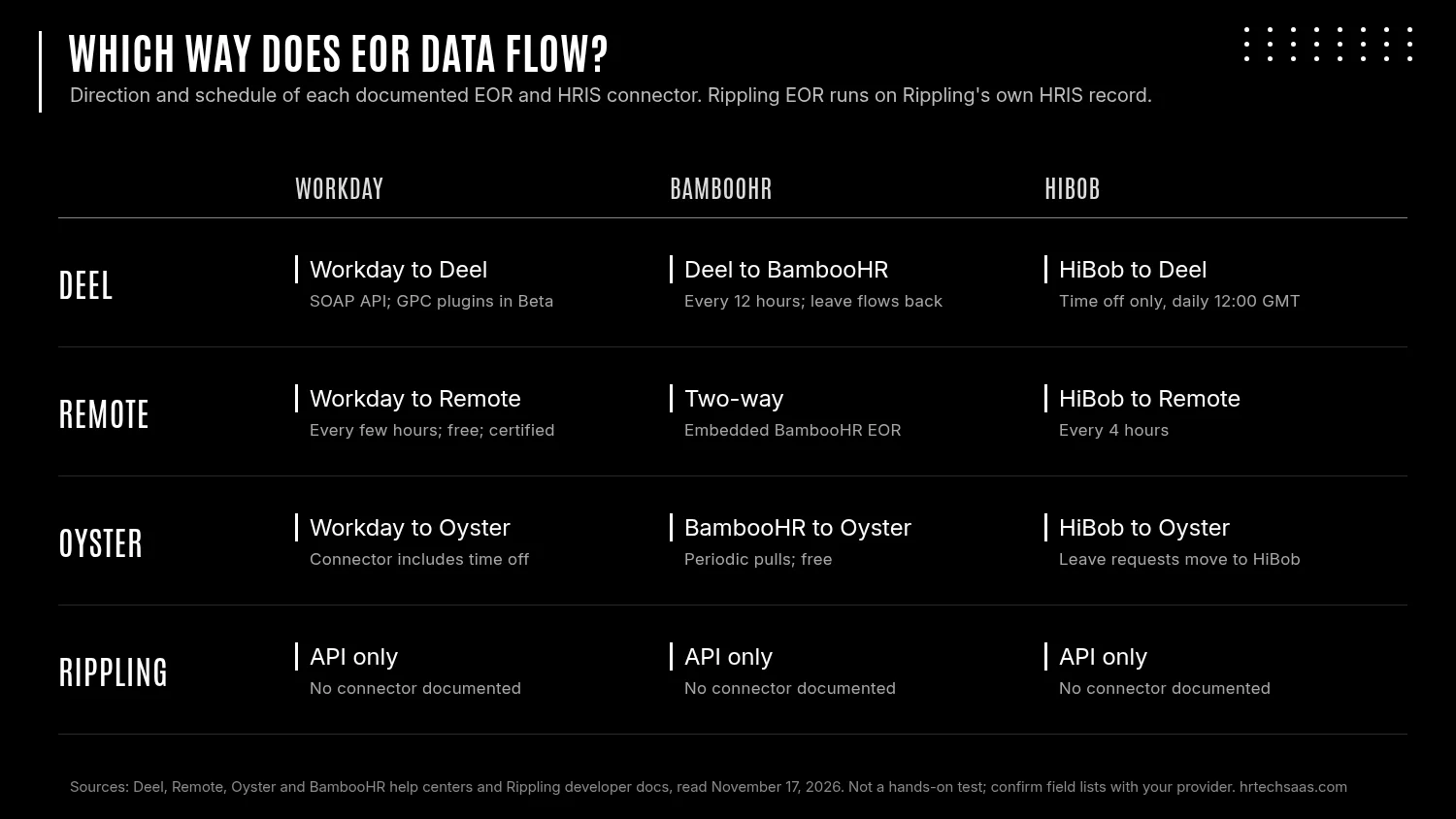
The table summarizes what each provider documents for the three most common mid-market HRIS platforms. Read the direction column first: it tells you which system has to hold the change before the other one sees it.
| Deel | Remote | Rippling | Oyster | |
|---|---|---|---|---|
| Integration model | Native connectors from an app store, plus API and Workday Global Payroll Connect (GPC) plugins | Native connectors, embedded EOR inside BambooHR, and a separate GPC payroll path through Workday GO | EOR runs on the same employee record as Rippling HRIS and payroll | Native HRIS connectors, Zapier and an API |
| Workday | EOR data synced from Workday over the SOAP API; one-time payments, compensation amendments, external payroll documents and time off are Beta plugins (Deel help) | One way, Workday to Remote, every few hours; free; Workday Certified since August 26, 2026 (Remote help) | No Workday connector documented; build against the Rippling REST API | Connect with Workday and OAuth credentials; also enables time off (Oyster help) |
| BambooHR | Deel to BambooHR every 12 hours; EOR profiles cannot be created from BambooHR; time off flows BambooHR to Deel (Deel help) | Sold inside BambooHR as “BambooHR Employer of Record, powered by Remote” with two-way sync (BambooHR) | Not applicable if Rippling is your HRIS | BambooHR to Oyster, periodic pulls; free for all Oyster customers (Oyster help) |
| HiBob | EOR: time off only, HiBob to Deel, daily at 12:00 GMT (Deel help) | HiBob to Remote every 4 hours; salary changes create EOR contract amendments (Remote help) | Not applicable if Rippling is your HRIS | Time-off requests pulled from HiBob; HiBob becomes the only place to request leave (Oyster help) |
| Integration price stated | Not stated on the pages we read | Workday sync stated as free; pricing page says the Remote Platform is included with no base fee | No connector needed for Rippling HRIS | BambooHR connector stated as free |
| Published EOR list price | From $599 per EOR employee per month (Deel pricing) | From $599 per employee per month on annual contracts (Remote pricing) | “Starts at $499/month” in Rippling’s September 14, 2026 EOR guide (Rippling blog) | USD 699 per employee per month, annual discounts available (Oyster pricing) |
What Are the Ways to Connect an EOR and an HRIS?
There are four patterns, and most companies end up with a native connector plus a small amount of API or iPaaS work for the gaps. The right one depends on which system you want to own each field and how much engineering time you can give it.
1. Prebuilt connectors
The EOR builds and maintains the connection to a named HRIS. You authenticate, map a few values such as time-off types or a “sync to EOR” field, and the provider runs the schedule. This is the cheapest path to keep running, but you get the provider’s field list and direction, not yours. Every connector in this guide also has documented preconditions, such as matching email addresses or employee IDs, that cause most sync failures.
2. EOR embedded in the HRIS or on the same record
Here the integration question mostly disappears. Rippling’s EOR shares one employee record with its HRIS and payroll. BambooHR sells EOR powered by Remote inside its own product, and Workday GO Global Payroll, which Workday announced on November 19, 2025 (Workday newsroom), is a Workday-branded payroll service powered by Remote. One caution: Workday GO Global Payroll is payroll for countries where you have an entity, not EOR. Remote’s help center says EOR worker data still moves through Remote’s separate API-based Workday integration (Remote help).
3. Middleware (iPaaS)
An integration platform such as Workato, Boomi, MuleSoft or Zapier sits between systems and runs your own recipes. It is the right tool when you need a transformation the connector does not offer, or an event that fans out to several systems. It adds a second contract, a second place for errors to surface, and someone who has to own the recipes. Oyster lists a Zapier integration covering 5,000+ apps (Oyster integrations). Our list of HR integration platforms that connect HRIS, payroll, ATS and finance compares the main options.
4. Custom API build
All four providers expose APIs. Rippling’s HRIS API, for example, covers workers, users, compensation and bulk draft hires (Rippling developer docs). A custom build gives you full control of mapping and direction, but you also own the monitoring, error handling and every change the vendor makes. If you do not have that capacity in-house, an HR systems integration consultant can build and hand it over.
Deel: Broad App Store, but Check Which Way Each Connector Flows
Deel has a broad app store, but its EOR connectors for BambooHR and HiBob are narrower than the logo list suggests. Integrations are installed from Deel’s app store under Apps and Automation, and its marketplace features a Workday GPC app alongside HR, accounting and SSO connectors (Deel marketplace).
Deel and Workday
Deel’s help center says EOR workflows use the Workday SOAP API to sync employee data from Workday. Four EOR plugins are listed, all marked Beta: one-time payment sync, compensation amendments, external payroll documents and paid time-off sync. The time-off plugin sits behind a feature flag that your Deel contact has to request. The payment, amendment and document plugins need the Workday GPC setup with Data Changes on Demand (DCoD); the time-off plugin uses the standard Workday connection with OAuth 2.0 (Setting up EOR with Workday).
Two documented limitations matter for planning. A Workday pay group can be assigned to only one external payroll vendor, so a pay group already linked to another payroll provider has to be moved first. And fixed-term end dates do not reach Deel unless the “Sync Employment/Contract End Dates” tenant setting is switched off, which affects every fixed-term worker in the tenant.
Deel and BambooHR
For EOR employees, Deel’s BambooHR connector mainly flows from Deel to BambooHR. When a contract is countersigned in Deel, it can create the BambooHR profile, update employment status and add compensation rows (compensation sync is in beta), and push documents such as payslips if the employee has enabled sharing. The integration syncs every 12 hours, at 30 minutes past the hour (Deel BambooHR EOR guide).
The reverse direction is limited. Deel says profiles cannot be synced from BambooHR into Deel for EOR employees, so a hire that starts in BambooHR has to be created manually in Deel. Time off is the exception: EOR employees can log leave in BambooHR and Deel reads it, but only across four categories (Vacation, Sick Leave, Other and Unpaid Leave), and custom person-profile fields do not sync.
Deel and HiBob
Deel’s HiBob guide for EOR employees describes a one-way time-off sync from HiBob to Deel. Employees must be in “hired” status in HiBob and are matched by employee ID. The sync runs daily at 12 noon GMT. Hourly entries are rounded to half or full days, and a wrong leave type cannot be corrected in Deel while the sync is active; it needs a support ticket (Deel HiBob EOR guide).
Price: Deel lists EOR from $599 per employee per month (deel.com/pricing). We did not find a separate integration fee on the pages we read. If you are weighing Deel against other providers, see our Deel alternatives guide.
Remote: One-Way Syncs Into Remote, Plus Embedded Options in Workday and BambooHR
Remote is the strongest fit when your HRIS should stay the single place where HR enters changes. Its Workday and HiBob connectors are built to read from the HRIS and update Remote, and its partnerships put Remote inside both Workday and BambooHR.
Remote and Workday
Remote documents two separate Workday paths. Remote Payroll through Workday GO uses Global Payroll Connect. EOR and contractor data use Remote’s own API-based integration, which sends data one way, from Workday to Remote, syncs automatically every few hours with a manual option, and is free for customers using both products (Remote help). Remote announced on August 26, 2026 that its EOR and Contractor Management integration is live on the Workday Marketplace as a Workday Certified Integration (Remote blog).
For new hires, Remote syncs identity, start date, job title, country, address, department, supervisor and similar fields. After onboarding, a smaller set keeps syncing, including name, job title, address, department, supervisor and compensation. Records match on email, new hires need a future start date, workers must sit in a custom Workday organization named “Remote EOR”, and approved time off syncs one way into Remote. Renaming default Workday sections can break the integration (Remote Workday sync guide).
Remote and BambooHR
BambooHR now sells “BambooHR Employer of Record, powered by Remote” inside its own product, with automatic two-way sync between BambooHR and Remote (BambooHR EOR page). Remote’s help center says existing Remote customers will get access to the embedded version later (Remote help). The standard listing in BambooHR’s marketplace describes a two-way integration over webhooks and API that syncs once per hour (BambooHR marketplace).
Remote and HiBob
Remote’s HiBob connector syncs every 4 hours and creates a “Sync to Remote” field in HiBob to choose who syncs as an EOR employee, contractor or payroll employee. Salary changes for EOR employees create contract amendment requests that Remote reviews, so a raise in HiBob is not instant in payroll. Custom fields built as tables cannot be synced, and Remote warns that updates to active EOR employees are more restricted because of its employment checks (Remote HiBob guide).
Price: Remote lists EOR from $599 per employee per month for annual contracts, with no setup or onboarding fees and the platform included (remote.com/pricing). Our Rippling vs Deel vs Remote comparison covers the wider product differences.
Rippling: EOR on the Same Employee Record
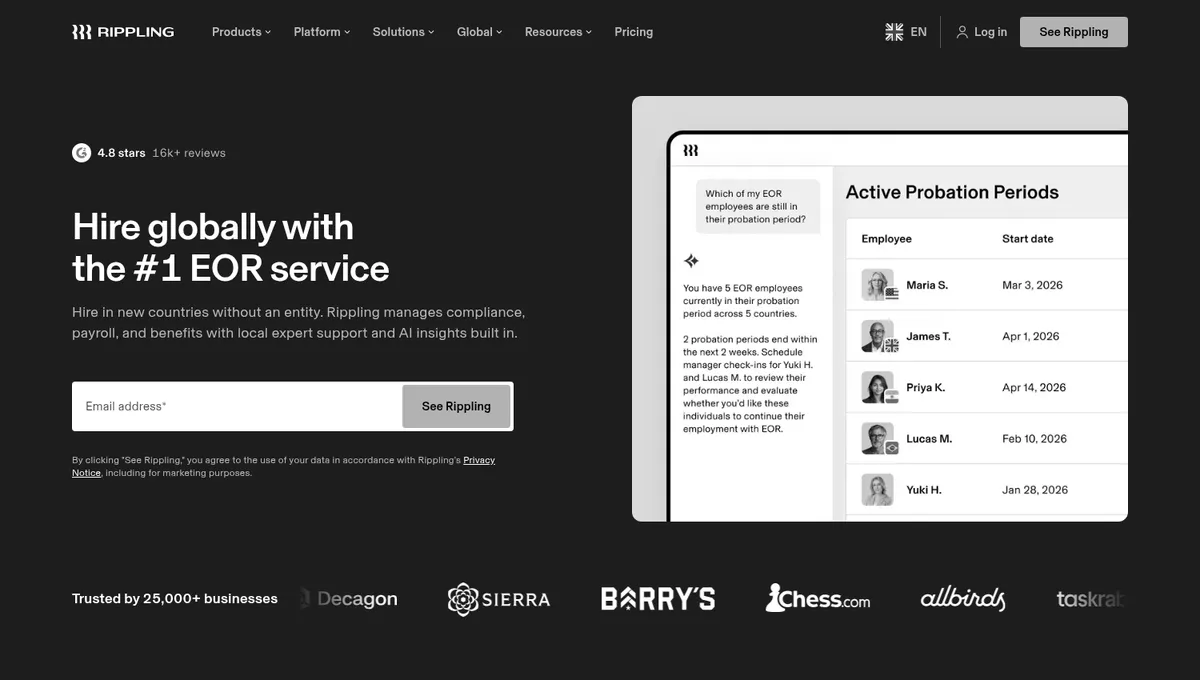
Rippling removes the EOR and HRIS sync when Rippling is your HRIS, because EOR employees live on the same record as everyone else. Rippling describes its EOR as working “with the rest of your workforce” on a built-in HRIS (Rippling EOR), and its October 15, 2026 guide argues that a unified platform leaves “no sync to break” for core HR, payroll and EOR data (Rippling blog).
That advantage reverses if you plan to keep Workday, BambooHR or HiBob. We did not find a documented Rippling EOR connector for another HRIS on the pages we reviewed. Rippling’s REST API reads workers, users and compensation and can create bulk draft hires that an admin completes in Rippling (Rippling HRIS API guide), so a cross-platform setup is an API or iPaaS project. For a full HRIS comparison, see Workday vs Rippling vs BambooHR.
Price: Rippling’s own EOR guide lists Rippling EOR as starting at $499 per month (Rippling, September 14, 2026). Rippling’s pricing page is quote-based, so confirm whether platform modules are billed on top.
Oyster: Your HRIS Stays the Source of Truth
Oyster is built around pulling from your HRIS, so HR keeps entering changes in BambooHR, HiBob or Workday and Oyster follows. That suits teams that do not want admins working in two places, as long as the fields you need are on Oyster’s list.
With BambooHR, you create the team member in BambooHR, Oyster pulls the fields into its hiring form, onboarding is completed in Oyster, and later BambooHR updates are pulled into Oyster periodically. The connector is free for all Oyster customers and covers EOR, payroll and PEO team members (About BambooHR). Existing records match on personal or work email, and once matched, Oyster says BambooHR becomes the primary source of truth (Importing records). An optional add-on turns a termination entered in BambooHR into a draft offboarding request in Oyster, which is deleted if nobody acts on it within 10 days (Termination sync).
With HiBob, the time-off add-on pulls requests and approvals into Oyster and hides Oyster’s own request button, so HiBob becomes the only place to request leave. Unmatched leave types show as “unmapped”, and medical-note attachments still need a manual step (HiBob time off). Workday connects from Oyster’s integrations page with Workday and OAuth credentials, which also turns on the time-off integration (Workday setup).
Price: Oyster lists EOR at USD 699 per employee per month, with annual discounts available (oysterhr.com/pricing). For EU-heavy hiring, see our EOR platforms for hiring in Europe list.
Which System Should Own Each Field?
Decide ownership before you switch on any connector: the HRIS should own who the person is and what you decided about their job, and the EOR should own what local law and payroll require. Rippling’s guide makes the same split, with the HRIS owning job title, manager, compensation and start and end dates, and the EOR owning local tax settings, bank details and statutory deductions (Rippling blog). The table maps that to what the connectors actually do.
| Field or event | Usual owner | How the connectors handle it | Watch out for |
|---|---|---|---|
| New hire profile | HRIS | Remote and Oyster read it from Workday, HiBob or BambooHR; Deel creates BambooHR profiles from Deel instead | Remote needs a future start date; Deel cannot create EOR profiles from BambooHR |
| Job title, department, manager | HRIS | Synced into Remote and Oyster after onboarding | Renamed Workday sections can break Remote’s mapping |
| Salary change | HRIS decision, EOR execution | Remote turns a HiBob salary change into a contract amendment; Deel’s Workday amendment plugin is Beta | Local law can require a signed amendment, so expect a review step |
| Approved time off | HRIS | Time-off syncs into the EOR exist for all three standalone providers | Category limits (Deel and BambooHR: four types) and rounding to half days (Deel and HiBob) |
| Local tax, bank and statutory data | EOR | Kept in the EOR; Remote’s HiBob bank sync is for Global Payroll only | Do not try to master this in the HRIS |
| Payslips and payroll documents | EOR | Deel can push payslips to BambooHR if the employee allows it; Deel’s Workday document plugin is Beta | Check employee consent and data residency rules |
| Termination | HRIS decision, EOR execution | Oyster can create a draft offboarding from a BambooHR termination | The EOR still runs notice and severance under local law |
If you are moving historical records at the same time, plan the cutover with our HR data migration guide.
When Is Middleware Worth It, and Which Kind?
For an employer, “middleware” should mean an iPaaS that you control, not a unified HR API. The two get mixed up in a lot of EOR advice, and they are sold to different buyers.
- iPaaS platforms such as Workato, Boomi, MuleSoft and Zapier let your team build recipes between the EOR API, the HRIS API and other systems. Use one when a connector misses a field or direction you need, or when one event has to update several systems.
- Unified HR APIs such as Merge and Finch are built mainly for software companies that need to read many customers’ HR and payroll systems. Merge’s Launch plan includes 3 production linked accounts free, then $650 per month for up to 10 and $65 per account after that (Merge pricing). Finch’s Starter plan is $65 per connection per month, read-only, for up to 15 connections across 24 providers (Finch pricing). Your EOR may use one behind the scenes, but you rarely need to buy one to connect your own EOR.
Before adding either, check three things in the EOR’s documentation: whether the field you need is readable through its API, whether the API can write the change you want (some EOR changes have to go through a reviewed amendment), and whether there is a webhook or you will be polling on a schedule.
What Breaks Most Often in EOR HRIS Integrations?
Most sync failures come from matching rules and preconditions, not from the connector itself. These are the documented ones:
- Identity matching. Remote and Oyster match on email; Deel’s HiBob EOR connector matches on employee ID. A changed work email or a missing ID breaks the link.
- Lifecycle status. Deel will not sync HiBob employees still in “prehire”. Remote needs a future start date for new EOR hires, so backdated hires have to be created manually.
- Leave-type mapping. Deel’s BambooHR EOR sync supports four categories, Deel rounds HiBob hours to half or full days, and Oyster flags unknown HiBob types as “unmapped”.
- Workday tenant settings. Deel needs pay groups assigned to it as the external payroll vendor and the fixed-term end-date setting switched off; Remote needs a “Remote EOR” custom organization.
- Edits on the wrong side. Deel reverts manual time-off edits on the next HiBob sync, and Remote locks synced Workday fields on the employee record.
- Silent failures. Deel’s HiBob guide for payroll employees warns that syncs may fail silently when worker data is incomplete (Deel help), so someone has to review the sync logs after each run.
Quick Pick: Which EOR Integration Setup Fits Your Stack?
| Your situation | Start with | Why |
|---|---|---|
| Workday is your HRIS and HR should only enter changes there | Remote | Workday Certified, free, one-way sync from Workday into Remote |
| Workday tenant and you want EOR payments and amendments driven from Workday | Deel, with the GPC plugins | One-time payment, compensation amendment and document plugins exist, but are Beta |
| BambooHR shop that wants EOR inside BambooHR | BambooHR EOR, powered by Remote | Embedded hiring flow with two-way sync |
| BambooHR shop that wants EOR records copied back into BambooHR | Deel | Deel creates and updates BambooHR profiles from Deel contracts every 12 hours |
| HiBob shop where HiBob must stay the only leave and HR system | Oyster or Remote | Oyster moves leave requests entirely to HiBob; Remote syncs HiBob data every 4 hours |
| Open to replacing your HRIS with one platform | Rippling | EOR on the same record as HRIS and payroll, so there is no sync to maintain |
| Homegrown HRIS or several systems per event | Any EOR with an API, plus an iPaaS | Native connectors will not cover the workflow |
Questions to Ask Your EOR Before You Sign
- Which way does each field flow, and how often? Ask for the field list in writing for your HRIS.
- Is the connector certified or listed in the HRIS vendor’s marketplace, and who supports it when it fails?
- Is the integration included in the EOR fee, or billed separately?
- Which features are Beta or behind a feature flag?
- How are records matched, and what happens to hires with past start dates?
- Which time-off types are supported, and how are hours rounded?
- Can payroll results, payslips or cost data come back into the HRIS or finance system?
- Is there a webhook, or will an iPaaS have to poll the API?
For a wider vendor checklist, see our HR software buying checklist.
Frequently Asked Questions
Do we need middleware to connect an EOR platform to our HRIS, or do prebuilt connectors cover most cases?
Prebuilt connectors cover most cases when your HRIS is Workday, BambooHR or HiBob and you need core profile data and approved time off to match. Deel, Remote and Oyster all document connectors for those systems. Add an iPaaS only for fields or directions the connector skips, a homegrown HRIS, or one event that must update several systems at once.
Does Remote integrate with Workday for EOR employees?
Yes. Remote’s API-based integration sends EOR and contractor data one way, from Workday to Remote, every few hours, and is free for customers of both. Remote says it became a Workday Certified Integration on August 26, 2026. Workday GO Global Payroll, powered by Remote, is a separate payroll service for countries where you already have an entity.
How does Deel sync EOR employees with BambooHR?
Mostly from Deel to BambooHR. Once a contract is countersigned in Deel, the connector can create the BambooHR profile, update employment status and compensation, and push documents, every 12 hours. EOR profiles cannot be created from BambooHR. EOR employees can log time off in BambooHR across four categories, and Deel reads it.
Which EOR works best with HiBob?
It depends on what you want HiBob to own. Remote syncs HiBob employee data every 4 hours and turns EOR salary changes into reviewed contract amendments. Oyster makes HiBob the only place to request leave. Deel’s HiBob connector for EOR employees covers time off only, syncing once a day at 12:00 GMT.
Does Rippling EOR need an HRIS integration?
Not if Rippling is also your HRIS. Rippling EOR employees sit on the same record as direct employees, payroll and IT access, so there is no separate EOR sync to maintain. If you keep Workday, BambooHR or HiBob, we did not find a documented connector, so plan for Rippling’s REST API or an iPaaS.
How much does EOR HRIS integration cost?
The four providers publish EOR list prices: Rippling from $499 per month (on its own blog), Deel and Remote from $599, and Oyster USD 699 per employee per month. Remote says its Workday sync is free, and Oyster says its BambooHR connector is free. Deel does not state an integration fee on its pricing page. Middleware is a separate contract.
Are Merge or Finch the right middleware for connecting our EOR?
Usually not for an employer. Merge and Finch are unified HR and payroll APIs built mainly for software companies that need to connect to many customers’ systems. Finch Starter is $65 per connection per month and Merge Launch is $650 per month for up to 10 accounts. For your own EOR workflows, an iPaaS such as Workato, Boomi or Zapier is the usual choice.
The Bottom Line on EOR and HRIS Integration
EOR and HRIS integration is less about whether a connector exists and more about which way it flows. Pick Remote if Workday or HiBob should stay the only place HR enters changes. Pick Deel if you want EOR contract data copied into BambooHR, or Workday-driven payments and amendments and can live with Beta plugins. Pick Oyster if you want your HRIS to be the source of truth with a free BambooHR connector. Pick Rippling if you are willing to make it your HRIS too.
Add middleware only for the specific fields or events the connector skips. Then write down who owns each field before go-live, and give one person the job of reading the sync logs. To compare providers on cost and coverage as well as integration, go back to our main list of EOR platforms for US companies.