Oyster vs Remote vs Velocity Global (Pebl): Which EOR Handles EU Labor Law and Works Councils Best?
Oyster vs Remote vs Velocity Global (now Pebl) for EU hiring: who employs your hire, German AÜG rules, works councils, pay transparency and published prices.
TL;DR
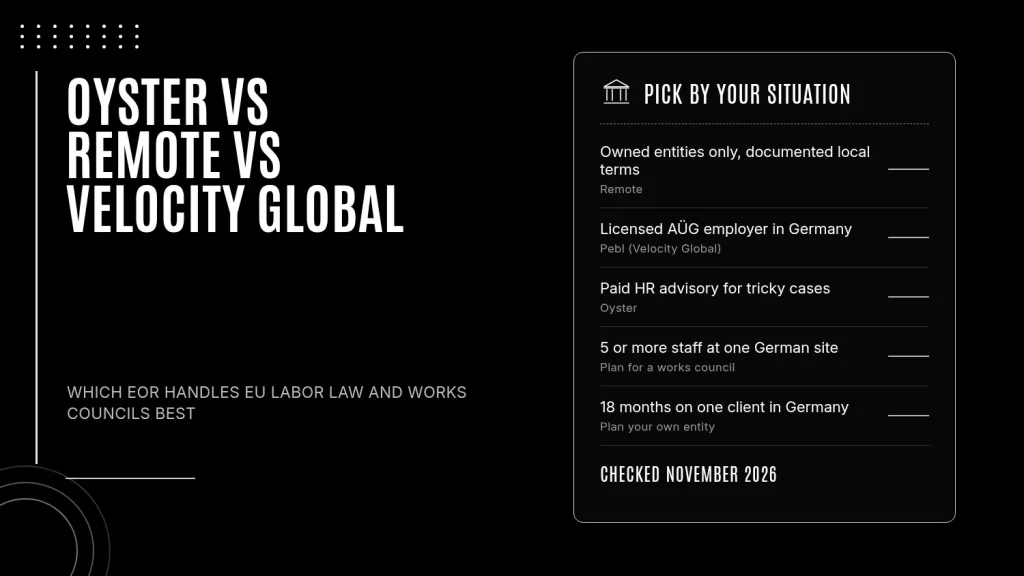
Remote is the safest default for EU hiring if you want one accountable employer, because it says it uses only owned entities and publishes country-by-country legal terms. Pebl, the new name for Velocity Global, is the stronger pick for Germany-heavy plans and harder employment cases. Oyster fits small teams that value guided support, but ask who employs your hire in each country.
- Under an EOR, the provider’s local company is the legal employer, so any works council or CSE attaches to that company, not to you. In Germany, leased workers stay members of the EOR’s establishment under AÜG §14.
- Germany treats EOR as labour leasing: the provider needs a Federal Employment Agency permit, and one worker can normally be placed with the same client for 18 consecutive months. Pebl says it holds the licence; Remote’s terms name the “AUG model”; Oyster has not published its German setup.
- Remote’s Local Terms show the legal model per country, including a payroll employment contract in the Netherlands and agency models in Hungary, Latvia and Lithuania. No other provider here publishes that level of detail.
- Published EOR prices, read November 18, 2026: Pebl $399 per employee per month (quote required), Remote from $599 on annual contracts, Oyster USD 699 with a refundable deposit.
- The EU Pay Transparency Directive had to be in national law by June 7, 2026. Ask each provider how it will publish pay ranges for job ads and answer pay-gap reporting as the legal employer.
Last updated November 18, 2026. Remote, Oyster and Pebl pricing, product, legal-terms and help-center pages, German federal law (AÜG, BetrVG), the French Labour Code, the Dutch Works Councils Act and four EU directives on EUR-Lex were read on this date. This is a buyer’s comparison, not legal advice.
Oyster, Remote and Velocity Global all let you hire in Europe without opening a local company, but they differ in who actually employs your hire, how much of their legal setup they publish, and how much help they give when a works council or a dismissal is on the table. Those three differences matter more in Germany, France and the Netherlands than anywhere else, because European labour law follows the legal employer, and under an employer of record (EOR) that employer is the provider.
One naming note before we start: Velocity Global rebranded as Pebl on September 9, 2025 (Pebl press release), and velocityglobal.com now redirects to Pebl’s site. We use “Pebl (Velocity Global)” throughout. If you are still building a wider shortlist that includes Boundless, WorkMotion and Lano, start with our ranking of EOR platforms for hiring in Europe. This Oyster vs Remote vs Velocity Global comparison goes deeper on these three names only.
How We Compared Oyster, Remote and Pebl
Emma Carter read each provider’s own pricing page, EOR product page, legal or help-center documentation and Germany guidance on November 18, 2026, and checked every legal threshold against the statute itself: the German Temporary Employment Act (AÜG) and Works Constitution Act (BetrVG) on gesetze-im-internet.de, the French Labour Code, the Dutch Works Councils Act, and the EU directives on information and consultation, European Works Councils, temporary agency work and pay transparency.
We did not run test hires, and we did not repeat review-site scores or third-party claims about onboarding speed. Where a provider does not publish something, such as which countries use a partner, we say so and turn it into a question for your sales call. Employment law and vendor terms change, so confirm the details in your own contract and with local counsel.
Oyster vs Remote vs Pebl at a Glance
Read the “legal employer” and “Germany” rows first. They decide who carries the works council relationship and whether a German hire can stay on the same arrangement past 18 months.
| Remote | Pebl (Velocity Global) | Oyster | |
|---|---|---|---|
| Legal employer model | “100% owned entities, no third parties”; 100+ entities owned and operated (Remote EOR page) | “90% of employees supported through Pebl-owned entities” (Pebl homepage); 65 owned entities at the 2025 rebrand (press release) | “Employed either by Oyster directly or by our expert local employment partners”; split not published (Oyster help) |
| Country-level legal terms published | Yes, Local Terms per country, naming the employing company and model (Remote Local Terms) | Country guides; no per-country contract terms found | Country guides; no per-country contract terms found |
| Germany | Employees onboarded “under the AUG model” via Remote Technology GmbH, Frankfurt; optional project-based Solutions model (Local Terms) | Says it is “a valid holder of the AUG license” (Pebl Germany guide) | 2022 library article says employment “by a consulting company such as Oyster” can avoid the 18-month limit (Oyster library) |
| Help for hard cases | In-house payroll, benefits, legal and HR support (Remote EOR page) | Compliance guidance “vetted by Baker McKenzie” (Pebl pricing) | People Partner Services, USD 300 per hour (Oyster pricing) |
| EOR country coverage | 90+ countries | 185+ countries | 120+ countries |
| Published EOR price | From $599 per employee per month, annual contracts; platform included (Remote pricing) | $399 per employee per month; “get a quote” (Pebl pricing) | USD 699 per employee per month; annual discounts; refundable deposit (Oyster pricing) |
Why Does EU Labour Law Change the EOR Decision?
Because European employee rights attach to the legal employer, and under an EOR the legal employer is the provider’s local company. That shifts three things you would normally control yourself: who the works council talks to, which collective agreement and equal-treatment rules apply, and how a dismissal has to be run.
Germany shows the mechanics most clearly. The AÜG says a business that places its employees with another company, where they are integrated into that company’s organisation and follow its instructions, needs a permit (AÜG §1). That describes a typical EOR hire: the provider employs the person, and you direct the work. The Federal Employment Agency says the permit must exist before the placement starts, is first issued for one year, and can become unlimited after three consecutive years (Bundesagentur für Arbeit).
The same section caps placements: the same worker may not be placed with the same client for more than 18 consecutive months, and earlier placements count in full if the gaps between them were three months or less, even through a different provider (AÜG §1(1b)). A sector collective agreement can set a different limit. Section 8 adds an equal-treatment rule, under which a collective agreement can only depart from equal pay for the first nine months of a placement (AÜG §8). At EU level, the Temporary Agency Work Directive sets the same equal-treatment principle (Directive 2008/104/EC, Art. 5).
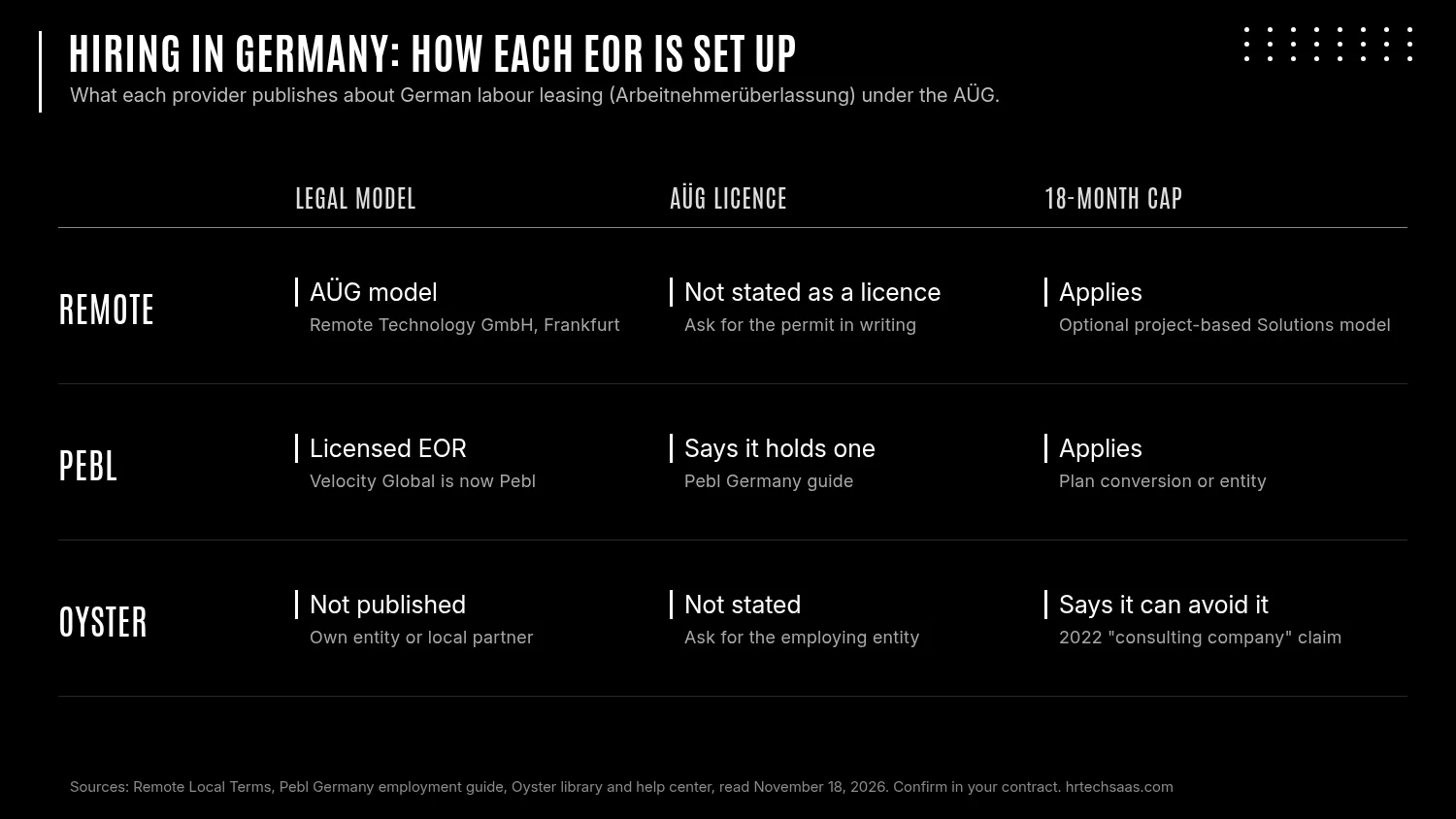
For a buyer, that means three practical questions for any provider in Germany: which German company employs my hire, does it hold an AÜG permit, and what happens at month 18. The answers differ sharply across these three providers, as the sections below show.
How Do Works Councils Work When You Hire Through an EOR?
The works council relationship runs with the EOR’s local company, because your hire is that company’s employee. German law says it directly: leased workers remain members of the lender’s establishment while they work for the client (AÜG §14(1)). If enough people work for the provider at one German site, they can elect a council there, and the provider has to deal with it.
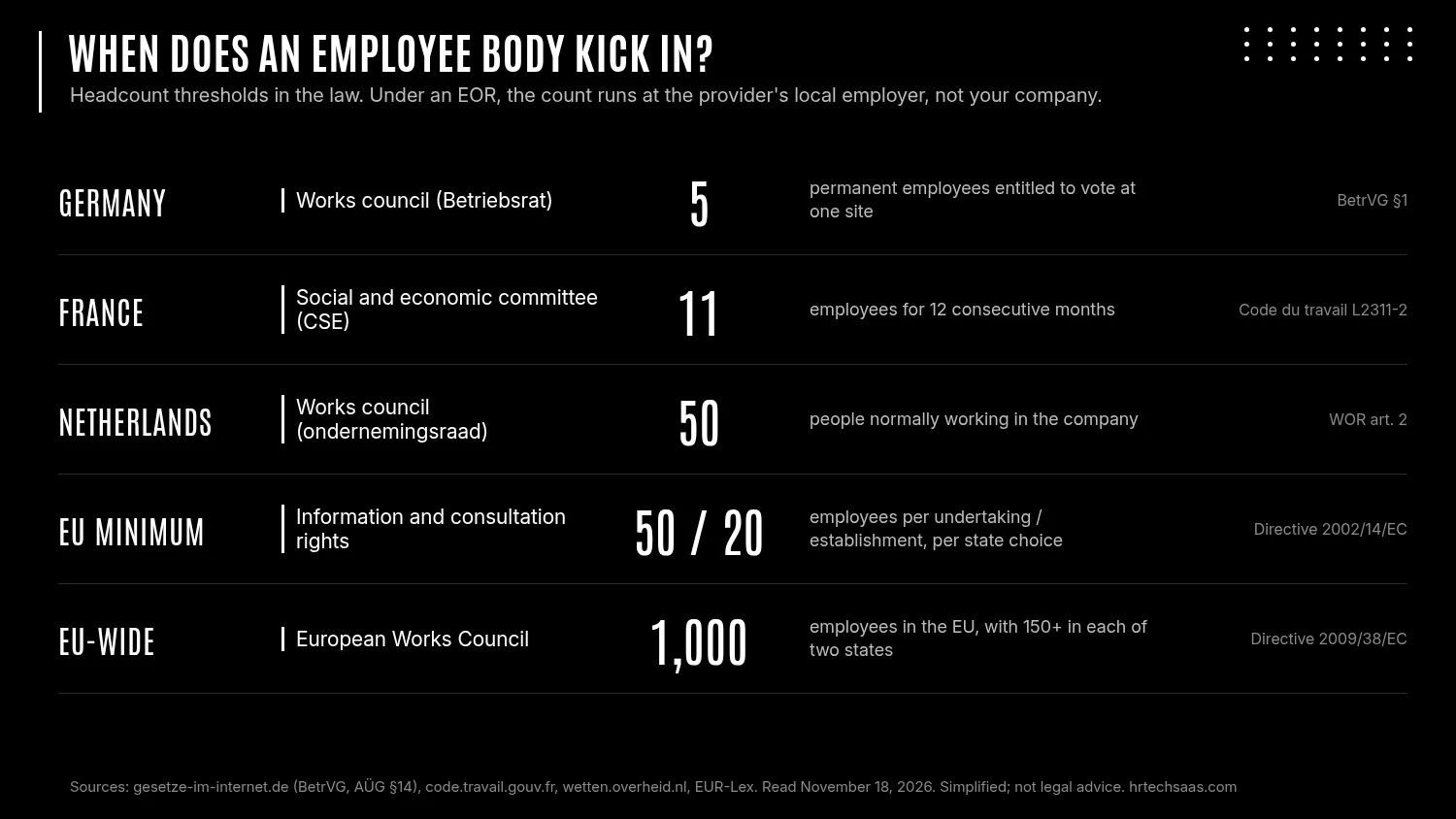
The thresholds are low in some countries and high in others:
| Country or level | Body | Threshold in the law | Source |
|---|---|---|---|
| Germany | Works council (Betriebsrat) | Establishments with normally at least 5 permanent employees entitled to vote, 3 of them eligible to stand | BetrVG §1 |
| France | Social and economic committee (CSE) | At least 11 employees, mandatory once reached for 12 consecutive months | Code du travail L2311-2 |
| Netherlands | Works council (ondernemingsraad) | Companies where normally at least 50 people work | WOR art. 2 |
| EU minimum | Information and consultation rights | Undertakings with at least 50 employees or establishments with at least 20, depending on the member state’s choice | Directive 2002/14/EC |
| EU-wide | European Works Council | At least 1,000 employees in the member states and at least 150 in each of two member states | Directive 2009/38/EC |
Once a German council exists, its rights bite on everyday HR. In companies with more than 20 employees entitled to vote, the employer must inform the council before every hire, regrading or transfer and ask for its consent (BetrVG §99). The council must be heard before every dismissal, and a dismissal made without that hearing is invalid (BetrVG §102). Under an EOR, the provider is the “employer” in both sentences, so its process quality becomes your risk.
One exception catches companies that already have a German site: before a client takes on a leased worker, the client’s own works council has to be involved under §99 (AÜG §14(3)). If you run a German subsidiary with a council and add EOR hires next to it, involve that council first.
Remote: Owned Entities and the Most Published Legal Detail
Remote is the easiest of the three to audit before you sign, because it says every EOR employee sits on a Remote-owned entity and it publishes the legal terms it uses in each country. Its EOR page claims “100% owned entities, no third parties”, more than 100 entities owned and operated, in-house payroll, benefits, legal and HR support, and a three-day average onboarding time (Remote EOR page). Its Germany page repeats that Remote owns its own legal entity there (Remote Germany).
Remote in Germany
Remote’s Local Terms say German employees are onboarded “under the AUG model”, under a Master Services Agreement with Remote Technology GmbH in Frankfurt (trade registry HRB 119900). The same clause adds that before a termination, Remote will review whether the customer had alternative roles available for the employee (Remote Local Terms). That is a useful signal that Remote runs German dismissals with local law in mind, though it also means you should expect questions before any exit.
Remote also offers a separate “Solutions model” through Remote Solutions Germany GmbH, by written agreement only. It is project-based consulting, explicitly not employee leasing, and it requires that you do not direct, supervise or integrate the personnel into your organisation. Ending it carries a three-month notice period and an administrative fee equal to four months’ average fees. Treat it as an option for genuine project work, not as a way around the 18-month cap for someone who works like an employee. On the pages we read, Remote does not quote an AÜG permit number, so ask for a copy.
Remote in the Netherlands and Other EU Countries
The Local Terms show that Remote does not use one model everywhere. In the Netherlands, Remote B.V. signs a payroll employment agreement under Section 7:692 of the Dutch Civil Code and assigns the employee to work under your direction. In Hungary, Latvia and Lithuania, Remote’s companies act as temporary work agencies. In Bulgaria and the Czech Republic, it uses a consultancy model that excludes employee leasing. In Belgium, the terms reference the Belgian Act of 24 July 1987 on temporary work. In France, employees are onboarded under Remote Technology Services France or Remote SAS.
That level of detail is rare. It lets your legal team check, country by country, whether the model fits the role before you make an offer.
Price: Remote lists EOR from $599 per employee per month on annual contracts, with the Remote Platform included and no base fee (remote.com/pricing). For how Remote compares with Deel and Rippling on HR and payroll beyond EOR, see our Rippling vs Deel vs Remote comparison.
Watch-outs: EOR covers 90+ countries, the smallest footprint of the three, so check every country on your plan. Our Europe ranking also notes that Remote’s dedicated works council and collective-agreement processes are less mature than specialist European providers’.
Pebl (Velocity Global): Licensed in Germany, Built for Harder Cases
Pebl is the only provider of the three that states in writing that it holds a German AÜG licence, and it pairs the widest coverage with the lowest published starting price. In its Germany employment guide, Pebl describes itself as “a trusted EOR partner in Germany and a valid holder of the AUG license” that acts as legal employer while you run day-to-day work (Pebl Germany guide). The guide also covers works council agreements and co-determination.
At the rebrand, the company said it had expanded to 185 countries with 65 owned entities and more than 1,500 customers (Pebl press release, September 9, 2025). Today its homepage says 90% of employees are supported through Pebl-owned entities (Pebl homepage) so roughly one in ten does not. Ask which of your target countries fall in that group.
Pebl’s pricing page says its compliance guidance is “vetted by Baker McKenzie”, and its homepage points to specialists across global employment, HR, payroll, benefits and immigration (Pebl homepage). That matters when a German or French termination, a restructuring or a council consultation is likely in your first two years.
Price: Pebl shows $399 per employee per month with a “get a quote” button, so expect the final rate to vary by country (hellopebl.com/eor-pricing). Our list of EOR platforms for US companies covers Velocity Global’s wider product set.
Watch-outs: Pebl does not publish per-country contract terms the way Remote does, and the partner share is not broken down by country. Get the German employing entity’s name and a copy of the AÜG permit before you sign.
Oyster: Guided Support, but Confirm the Employer in Each Country
Oyster suits small and mid-sized teams that want human help through onboarding and HR questions, but it publishes the least about who employs your hire in each European country. Its help center says team members are “employed either by Oyster directly or by our expert local employment partners”, with the same experience either way (Oyster help). It does not publish which countries use a partner.
Oyster is moving some countries in-house. It told Mexico team members that it opened its own legal entity there and that their employment would move from a local partner to Oyster Mexico from January 1, 2026 (Oyster help center). That is good for accountability in Mexico, and a reminder to ask about each European country rather than assume.
Oyster in Germany
Oyster’s Germany hiring page flags works councils from five employees, termination protection after six months, and works council consultation as areas that need local expertise (Oyster Germany). Its older library article, dated September 5, 2022, says AÜG limits EOR contracts to 18 months, but that people can have an unlimited contract length if they are “employed by a consulting company such as Oyster” (Oyster library).
Be careful with that claim. The AÜG defines labour leasing by how the work is done, not by the label: a worker who is integrated into your organisation and follows your instructions is being leased (AÜG §1(1)). Ask Oyster in writing which German company employs your hire, whether it holds an AÜG permit, and how the arrangement avoids being treated as leasing if your manager directs the work day to day.
Price: Oyster lists EOR at USD 699 per employee per month, with annual seat-based discounts and a refundable deposit for each EOR team member. People Partner Services for HR advice cost USD 300 per hour (oysterhr.com/pricing). Our Deel alternatives guide compares Oyster with other mid-market EORs.
Watch-outs: Highest published list price of the three, mixed entity model, and no published German licence statement.
Which EOR Is Best for Hiring in Germany?
Pebl, then Remote, for most German hires; Oyster only after it answers the entity and licence questions in writing. Pebl states a licence and offers law-firm-backed guidance. Remote documents its German entity, model and pre-termination review. Oyster has not published the equivalent.
| Germany check | Remote | Pebl (Velocity Global) | Oyster |
|---|---|---|---|
| German employing company named publicly | Yes: Remote Technology GmbH, Frankfurt, HRB 119900 | Not on the pages we read | Not on the pages we read |
| AÜG licence stated | Names the “AUG model”; no permit quoted | Yes, “valid holder of the AUG license” | No; relies on a “consulting company” claim from 2022 |
| 18-month cap handling | Applies to the AÜG model; separate Solutions model for genuine projects | Not described; plan your own entity or a conversion | Claims the cap can be avoided; verify |
| Dismissal process signal | Reviews whether you had alternative roles before a termination | Guide covers works council hearings; Baker McKenzie-vetted guidance | Paid People Partner advice at USD 300 per hour |
Whichever you choose, put a date in the calendar for month 15 of each German placement. That leaves time to open a GmbH, move the person to your own payroll, or restructure the role before the 18-month cap in AÜG §1(1b) is reached.
How Does the EU Pay Transparency Directive Affect EOR Hires?
It puts new duties on the employer, which for an EOR hire is the provider, so you need to agree in advance who prepares pay ranges and pay data. Member states had to bring the directive into national law by June 7, 2026 (Directive (EU) 2023/970, Art. 34); check the status in each country where you hire.
- Before employment, applicants have the right to the initial pay or its range for the role, and employers may not ask about pay history (Art. 5).
- Pay-gap reporting starts by June 7, 2027 for employers with 250 or more workers (annually) and 150 to 249 workers (every three years), and by June 7, 2031 for 100 to 149 workers (Art. 9).
- Where reporting shows an unexplained gender pay gap of at least 5% in a category of workers that is not fixed within six months, a joint pay assessment with workers’ representatives follows (Art. 10).
For an EOR, the open question is whose headcount and whose job categories count, since the provider employs people for many clients in the same country. None of the three providers explains this on the pages we read. Ask before you post a European job ad, and see our pay transparency compliance checklist for the internal side.
Which of These EORs Have Entities Across Europe and the Americas?
All three hire across Europe and the Americas, but only Remote says every country runs on its own entity. Remote states 100% owned entities in 90+ countries. Pebl says 90% of its employees sit on Pebl-owned entities across 185+ countries. Oyster uses its own entities in some countries and vetted partners in others, and it moved Mexico onto its own entity from January 2026 (Oyster help center).
None of the three publishes a full country-by-country list of owned versus partner entities. If you are hiring in, for example, Germany, Spain, Mexico and Brazil, send each provider that exact list and ask them to name the employing company in each one.
Questions to Ask Before You Sign an EU EOR Contract
- Which company will employ my hire in each country, and is it your own entity or a partner?
- In Germany, does that company hold an AÜG permit? Please send a copy.
- How do you track the 18-month placement cap, and what do you recommend at month 15?
- Is there a works council, CSE or ondernemingsraad at your local entity today? Who handles consultations and dismissal hearings?
- Which collective agreement will apply to this role, and how do you apply equal treatment?
- Who prepares the pay range for my job ad and the pay-gap data under the EU Pay Transparency Directive?
- What notice, deposit and exit fees apply if I convert the hire to my own entity?
For a deeper list of compliance questions across European countries, including CBA identification and GDPR data transfers, see the evaluation framework in our Europe EOR guide.
Quick Pick: Oyster, Remote or Pebl?
| Your situation | Pick | Why |
|---|---|---|
| First one or two hires in several EU countries; legal wants to see the contract model per country | Remote | Owned entities only and published Local Terms by country |
| Germany is the main market, or several German hires are planned | Pebl (Velocity Global) | States an AÜG licence and offers Baker McKenzie-vetted guidance |
| A dismissal, restructuring or council consultation is likely within two years | Pebl, then Remote | Law-firm-backed guidance; Remote documents its pre-termination review |
| Small team that wants hands-on onboarding and pays for HR advice as needed | Oyster | Guided support and People Partner Services, after entity checks |
| Lowest published starting price | Pebl | $399 per employee per month, quote required |
| Need the widest country list in one contract | Pebl | 185+ countries |
Frequently Asked Questions
Which EOR is best for navigating EU labor law and works councils?
For most companies, Remote or Pebl (formerly Velocity Global). Remote uses only owned entities and publishes its legal model per country, including the AÜG model in Germany. Pebl states it holds a German AÜG licence and offers Baker McKenzie-vetted guidance for harder cases. Oyster can work for small teams, but confirm the employing entity first.
Is Velocity Global the same company as Pebl?
Yes. Velocity Global rebranded as Pebl on September 9, 2025, and velocityglobal.com now redirects to hellopebl.com. At the rebrand, the company reported 185 countries, 65 owned entities and more than 1,500 customers. Its EOR pricing page now shows $399 per employee per month, with a quote required for each country.
Who deals with the works council when I hire through an EOR?
The EOR’s local company, because it is the legal employer. In Germany, leased workers stay members of the provider’s establishment under AÜG §14. If a council exists there, the provider must inform it before hires and hear it before dismissals. If you also run your own German site with a council, involve it before taking on EOR workers.
Can an EOR employee in Germany stay longer than 18 months?
Not on the same leasing arrangement with the same client, unless a sector collective agreement sets a different limit. Earlier placements count if the gaps were three months or less, even through another provider. Plan to move the person to your own entity, or restructure the role, before month 18. Remote also offers a separate project-based Solutions model.
Is Remote cheaper than Oyster and Pebl?
It is cheaper than Oyster but not Pebl on list price. Remote starts at $599 per employee per month on annual contracts, Oyster lists USD 699 with a refundable deposit, and Pebl shows $399 with a quote required. Salary, employer social contributions and benefits come on top of all three fees.
Does Oyster own its entities in Europe?
Oyster says team members are employed either by Oyster directly or by vetted local employment partners, and it does not publish which countries use which. It has been moving some countries in-house, such as Mexico from January 2026. Ask Oyster to name the employing company for every European country on your hiring plan.
Does the EU Pay Transparency Directive apply to EOR employees?
Yes, because they are employees of the EOR’s local company. The directive had to be transposed by June 7, 2026. Applicants can ask for the pay range before employment, and pay-gap reporting starts in 2027 for larger employers. Agree with your provider who prepares job-ad ranges and reporting data.
The Bottom Line on Oyster vs Remote vs Velocity Global
For EU hiring, the deciding factor is not the platform but the legal employer behind it. Choose Remote if you want one owned entity per country and contract terms your lawyers can read before you hire. Choose Pebl (Velocity Global) if Germany is central to your plan or you expect difficult employment cases. Choose Oyster if you value guided support and it can name, in writing, the employer and licence for each European country you need.
Whichever you pick, track the 18-month cap for German hires, ask who handles works council hearings, and settle pay transparency duties before your first European job ad. To compare these three with European specialists such as Boundless and WorkMotion, go back to our guide to EOR platforms for hiring in Europe.