
HR Tech SaaS may earn a commission when you buy through links on this page. Our recommendations are editorial and never paid for.
- Most HR integrations fail not because of missing APIs, but because of data mapping errors, permission mismatches, and untested edge cases that surface in production.
- The right integration consultant specializes in your specific stack; a Workday-to-ADP connector is a different problem from a Greenhouse-to-BambooHR connector.
- Payroll and benefits integrations carry the highest risk: a broken sync can delay paychecks, miscalculate deductions, or create SOC 2 audit failures.
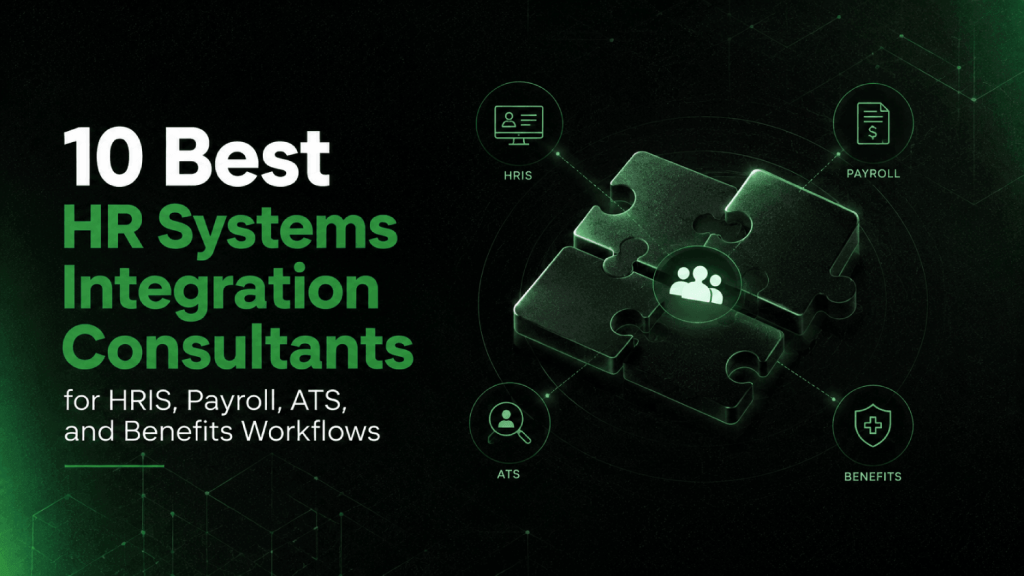
- The ten firms below cover the full range from pure iPaaS specialists to HR-domain consultants who do integration as part of broader HRIS implementations.
- If you are mid-evaluation on your HR software stack, read the HR software buying checklist first, integration scope should be defined before you hire a consultant.
The best HR systems integration consultants specialize in connecting HRIS, payroll, ATS, and benefits platforms so employee data moves accurately across systems without manual intervention. Firms like Surety Systems, Beacon Hill Technology, and Mercer handle different segments of this work. The right choice depends on your HR stack, your internal IT capacity, and whether you need ongoing managed integration support or a one-time build.
Why HR Integrations Fail More Often Than IT Teams Expect
The assumption that HR integrations are simple because most tools have APIs is wrong in a specific way. APIs define what data can move. They do not define what data should move, when, in what format, or what happens when a field is blank on the source side.
Payroll integration is the clearest example. Connecting an HRIS like Workday or BambooHR to a payroll processor like ADP or Gusto involves mapping employee IDs, pay group codes, deduction categories, cost centers, and effective dates. One misaligned field can cause an employee to land in the wrong pay group. That does not show up until payroll runs.
Benefits integrations carry similar exposure. An EDI file sent to a benefits carrier like Anthem or Cigna that omits a dependent enrollment or misclassifies a plan code can result in coverage gaps employees do not discover until they try to use their insurance. ATS-to-HRIS integrations break most often around offer letter data, start dates, and role codes that do not match between systems. Identity provisioning integrations, connecting your HRIS to Okta or Azure AD, carry access control risk: a terminated employee who retains system access because the offboarding trigger misfired is a security event, not just an HR problem.
Integration consultants earn their fees by knowing exactly where each of these failure points lives in your specific stack.
What Does an HR Systems Integration Consultant Actually Do?
An HR systems integration consultant maps data flows between platforms, builds or configures connectors, writes transformation logic, and tests edge cases before go-live. That is the core work. Good consultants also document the integration architecture so your internal team can maintain it after they leave.
The scope varies by engagement type. Some firms do point-to-point integrations between two specific tools. Others build middleware orchestration using platforms like MuleSoft, Workato, or Boomi. Enterprise HR shops running SAP SuccessFactors or Workday alongside half a dozen downstream systems often need the middleware approach, because point-to-point integrations multiply into an unmaintainable web as the stack grows.
HRIS Consultant, HR Systems Analyst, or Integration Specialist: Which One Are You Hiring?
These three titles are used interchangeably in job postings and they should not be. An HRIS consultant configures and optimises a single platform, so the work is security roles, business processes, reporting, and calculated fields inside Workday or SuccessFactors or Dayforce. An HR systems analyst is usually an internal role that owns the platform day to day and handles the queue of change requests. An integration specialist works between platforms and is measured on whether data arrives complete and on time.
The distinction matters at the point of hiring because the sourcing route is different. Configuration and analyst work is commonly filled as a contract role through a staffing firm, at a day rate, for a defined number of weeks. Integration work is more often bought as a scoped project, because the deliverable is a working connector plus documentation rather than a set of hours.
If you are unsure which you need, describe the outcome rather than the title when you brief a firm. “Employee changes in Workday must appear in ADP before the Wednesday payroll cutoff, including mid-cycle transfers” tells a firm exactly which specialist to put forward. “We need an HRIS consultant” does not.
Integration work and HRIS implementation are sold together often enough that the boundary is worth stating plainly: an implementation partner owns the platform going live, while an integration consultant owns the data moving correctly between platforms that are already live. If you are also selecting or deploying a new platform, reviewing the top HRIS implementation partners for mid-market companies before narrowing to integration-only firms makes sense. The two skill sets overlap but are not identical.
Do You Need a Consultant, an Integration Platform, or an In-House Build?
Hire a consultant when the hard part is deciding what should move between your systems. Buy an integration platform when the hard part is maintaining many connections over years. Build in-house only if you have a data engineer who will still be in the role in two years and a payroll calendar that can absorb a learning curve.
Most mid-market HR teams get this wrong in one direction: they buy a platform to solve a mapping problem. The platform will move data reliably once someone has decided that pay group code 04 in the HRIS corresponds to earnings group B in payroll, and that decision is consulting work, not software. The reverse mistake is hiring a consultant for a problem that is really about maintenance volume, in which case you pay project rates every time a carrier changes an EDI spec.
The full comparison, including cost profiles and the point at which each approach stops making sense, is set out in our breakdown of HR data integration: iPaaS versus consultant versus building in-house. If you have already decided you want tooling rather than people, the HR integration platforms comparison covers the vendors.
How to Evaluate HR Tech Integration Consultants Before You Sign
Four criteria matter more than everything else on a vendor’s website.
- Stack-specific certification or documented delivery history. Ask for references on your exact platform combination, not just “HR integrations.” A firm that has delivered ten Greenhouse-to-Workday integrations knows the specific field mapping traps. A generalist iPaaS shop may not. Platform certifications are verifiable, so check them rather than accepting them: Workday, SAP SuccessFactors, and Oracle each maintain partner directories, and a firm that claims certification but does not appear in the vendor’s own listing is describing experience rather than accreditation.
- Data mapping methodology. Ask to see a sample data dictionary or mapping document from a prior engagement. Firms that cannot produce one are doing ad hoc work that will break when either platform updates its schema.
- Testing protocols. Ask how they handle negative testing, what happens when a field is null, when an employee is mid-transfer, or when a benefits election is changed the same day payroll runs. Firms with no answer to this are skipping the work that matters.
- Ongoing support model. Platform APIs change. Payroll processors update their file formats. Benefits carriers change EDI specifications. A consultant who delivers and disappears leaves you with a brittle integration and no one to call when it breaks at 4pm on a payroll processing day.
Pricing is quote-only for almost every firm on this list. The few that publish hourly ranges do so on job boards, not on their own sites. Treat any firm that quotes a flat fee for an integration before doing a scoping call with skepticism, the scope of HR integrations is determined by your specific systems, data volume, and edge cases, none of which a firm can know without asking.
If you have not yet chosen the software itself, that is a different engagement and a different shortlist: HR technology consulting firms that run vendor selection are evaluated on evaluation methodology, not on integration delivery.
The 10 Best HR Systems Integration Consultants
| Firm | Best For | Primary Platforms | Integration Approach | Pricing Model |
|---|---|---|---|---|
| Surety Systems | Mid-market HRIS integration | Workday, Oracle, SAP, Ceridian | Point-to-point, middleware | Quote-based |
| Beacon Hill Technology | Staff augmentation + integration builds | Platform-agnostic | Staff aug + project delivery | Time-and-materials |
| Mercer | Enterprise HR transformation with integration | Workday, SAP, Oracle | End-to-end program delivery | Quote-based |
| Alight Solutions | Benefits and payroll integration at scale | Workday, SAP, ADP, carriers | Managed integration + BPO | Quote-based |
| Boomi Professional Services | iPaaS-native HR integration | Any platform via Boomi | iPaaS orchestration | Subscription + services |
| Cognizant HR Technology | Large enterprise, multi-system environments | SAP, Workday, Oracle | Enterprise middleware + API management | Quote-based |
| Accenture HR Technology | Global enterprise HCM transformation | Workday, SAP SuccessFactors, Oracle HCM | Program-level delivery + integration | Quote-based |
| Appirio (Wipro) | Cloud HR integration, Salesforce + Workday | Workday, Salesforce, ServiceNow | Cloud-to-cloud integration | Quote-based |
| Flexspring | HR-specific integration builds for mid-market | Platform-agnostic across HRIS and payroll | HR-specific iPaaS plus done-for-you connectors | Quote-based |
| Alpha Apex Group | HRIS consulting for SMB and mid-market | Platform-agnostic | HRIS consulting + integration scoping | Quote-based |
1. Surety Systems
Surety Systems focuses on HRIS consulting and integration for mid-market companies running Workday, Oracle HCM, SAP SuccessFactors, and Ceridian Dayforce. Their consultants are platform-certified and available for both project-based integration builds and staff augmentation when you need an integration specialist inside your team temporarily.
What distinguishes Surety from generalist IT staffing firms is HR domain knowledge. Their consultants understand payroll cycles, benefits enrollment windows, and the specific ways HRIS platforms expose data through APIs or file-based exports. That matters when you are mapping compensation data to a 401(k) provider or syncing headcount to a workforce planning tool.
According to Surety’s own documentation, their HRIS consultants handle system configuration, data migration, and integration work. Pricing is quote-based and varies by engagement scope and platform.
2. Beacon Hill Technology
Beacon Hill Technology takes a staffing-led approach to HR tech integration. Rather than delivering integrations as a fixed-scope project, they place integration specialists into your team for the duration of the build. This model works well when you have internal IT project management capacity but lack the platform-specific integration expertise to execute.
Their HRIS and HR technology consulting practice covers integration scoping, data mapping, and technical delivery across a range of platforms. The staff augmentation model means you get a specialist who sits inside your organization, understands your internal systems, and builds documentation your team can own after the engagement ends.
The tradeoff: Beacon Hill works best when you can manage the integration project internally. If you need end-to-end project ownership, a firm with a fixed-scope delivery model is a better fit.
3. Mercer
Mercer operates at the enterprise end of HR transformation. Their technology consulting practice handles Workday, SAP SuccessFactors, and Oracle HCM implementations and integrations as part of larger HR operating model redesigns. Integration is rarely the only thing Mercer does for a client, it is typically one workstream inside a broader program.
For HR leaders whose integration challenges are tied to a system migration, M&A integration, or a global HR modernization program, Mercer’s combination of HR strategy and technology delivery is genuinely useful. For a company that just needs to connect its ATS to its HRIS, Mercer is overscoped and priced accordingly.
4. Alight Solutions
Alight Solutions is one of the few firms that combines benefits administration BPO with HR technology integration. Their integration capabilities center on connecting benefits carrier feeds, payroll processors, and HRIS platforms, the exact three-way relationship that causes the most data integrity problems in HR operations.
If your primary integration challenge is EDI file management to benefits carriers, Alight is worth a direct conversation. They manage carrier connections at scale across large enterprise clients, which means their EDI mapping experience is deeper than most boutique consultancies. Their managed services model also means they monitor and maintain integrations over time, not just at go-live.
5. Boomi Professional Services
Boomi Professional Services is the vendor-aligned consulting arm of Boomi, one of the dominant iPaaS platforms used in HR tech integration. If your organization has already standardized on Boomi as your integration platform, working with their professional services team gives you direct access to platform engineers who know the product’s limits and workarounds better than any third-party integrator will.
Boomi’s platform is widely used to connect Workday, SAP, ADP, and Salesforce in HR contexts. The professional services team can accelerate an integration project that would otherwise require a third party to learn the platform first. Pricing combines the Boomi platform subscription with services fees; both are quote-based.
6. Cognizant HR Technology Practice
Cognizant brings large-scale IT delivery capacity to HR technology integration. Their HR technology practice covers SAP SuccessFactors, Workday, and Oracle HCM, with integration work typically scoped as part of larger enterprise technology programs. For companies running HR as one of many enterprise systems that need to connect into a common data layer, Cognizant’s enterprise architecture experience is relevant.
Cognizant is not the right call for a 300-person company that needs to connect Greenhouse to BambooHR. Their minimum engagement size and pricing structure reflects their enterprise client base. For HR tech teams inside large organizations managing integrations across multiple ERPs, identity systems, and analytics platforms, their delivery model fits.
7. Accenture HR Technology
Accenture is the largest HR technology consulting firm by revenue and headcount. Their HR technology practice delivers Workday, SAP SuccessFactors, and Oracle HCM at global scale, with integration as a core capability on every engagement.
Accenture is appropriate when your HR integration challenge is global in scope, involves multiple ERP systems, or is part of a multi-year technology transformation. For buyers evaluating enterprise HCM platforms, reviewing the comparison of Workday AI versus SAP Joule versus Oracle AI alongside Accenture’s platform-specific delivery track record is a useful exercise before scoping an engagement. Outside of enterprise transformation programs, Accenture’s overhead structure makes them expensive for focused integration work.
8. Appirio (Wipro)
Appirio, now part of Wipro, specializes in cloud-to-cloud integration with a strong track record connecting Workday, Salesforce, and ServiceNow. For HR teams whose integration challenge sits at the intersection of HR, CRM, and IT service management, common in tech companies where recruiting, onboarding, and IT provisioning need to connect, Appirio’s combined Workday and Salesforce expertise is relevant.
Their integration methodology is built around a cloud services model rather than traditional on-premise middleware. This works well in modern cloud-native environments but is less suited to companies still running legacy payroll or HR systems that require file-based integration.
9. Flexspring
Flexspring is an integration specialist built only for HR data, which makes it a different proposition from the generalist iPaaS vendors on this list. The company offers both turnkey connectors for standard field sets and custom connectors that handle nonstandard fields and client-specific business rules, running on its own HR-specific integration platform.
Flexspring states that integrations which previously took six months now typically complete in two to six weeks, a claim worth testing against references on your own platform pair rather than accepting at face value.
For a mid-market HR team that needs one payroll or benefits feed built correctly and maintained, without buying an enterprise iPaaS licence or engaging a global systems integrator, Flexspring occupies the middle ground the rest of this list leaves open.
10. Alpha Apex Group
Alpha Apex Group positions itself as an HRIS consulting firm for SMB and mid-market companies. According to their HRIS consulting page, their services include system selection, configuration, and integration scoping across a range of platforms. Their model is more advisory than technical delivery, they help you define and plan your integration architecture, then either execute or hand off to a technical team.
Alpha Apex is a practical choice for companies in the 100-500 employee range that need someone to make sense of their HR tech stack before committing to a build. They are not the right choice if you need a firm to own the technical delivery of a complex multi-system integration.
Which Type of HR Integration Consultant Do You Actually Need?
There are three distinct consultant types in this space, and they are not interchangeable.
Domain specialists understand HR deeply, payroll rules, benefits enrollment logic, ATS data models, but may rely on an iPaaS platform or a technical subcontractor for the actual integration build. Surety Systems and Alpha Apex lean this way. They are best when the hard problem is understanding HR data, not engineering the connection.
Technical integrators are strong on middleware, API management, and data transformation, but may need your HR team to own the business logic. Boomi Professional Services fits this category. They are best when the platform complexity is the hard part, and your HR team can define the data requirements clearly.
Program delivery firms run integration as one workstream inside a larger transformation. Accenture, Mercer, Cognizant, and Alight operate this way. They are best when integration is part of a system migration, M&A event, or global rollout, not when it is a standalone project.
Mismatching consultant type to problem is one of the main reasons integration projects run over budget. A program delivery firm brought in to connect two mid-market SaaS tools will add governance overhead you do not need. A domain specialist brought in to run a global SAP-to-Workday migration will hit a technical ceiling.
Which Consultants Handle HR System Consolidation After an Acquisition?
Post-acquisition HR system consolidation is a program delivery engagement, not an integration build, which is why the firms best suited to it are Mercer, Accenture, Cognizant, and Alight rather than the specialists further up this list. The reason is not technical difficulty. It is that the integration cannot be designed until someone decides which HRIS becomes the system of record, and that decision sits with a firm that can hold an HR operating model conversation at the same time as a data mapping conversation.
A boutique integration shop can build every connector correctly and still leave you stuck, because it has no mandate to resolve the question of whose process wins.
Three conditions set the scope of the work, and they are worth establishing before you brief anyone:
- Whether both entities keep running separate payroll systems through the first plan year. If they do, you need a consolidated reporting layer over two payrolls before the payrolls themselves merge, because finance will ask for combined headcount and labour cost long before the systems are one.
- Employee ID collision. Two workforces with overlapping ID ranges need a remapping strategy agreed before any record moves, and the mapping has to survive in historical reporting or you lose year-over-year comparability at the exact moment the board wants it.
- Benefits plan year alignment. If the acquired entity’s plan year ends in a different month, you carry two sets of carrier EDI feeds until open enrolment brings them together, which means the integration has a defined temporary state rather than a single go-live.
When you take references, ask who owned the system-of-record decision on that engagement. If the answer is that the client owned it entirely, the firm was doing build work under someone else’s program, which is useful information but a different service from the one you are buying.
What Does an ATS Integration with an HRIS Actually Involve?
ATS-to-HRIS integration is one of the most common integration requests and one of the most frequently underscoped. The visible part is straightforward: when a candidate is moved to “hired” status in your ATS, whether that is Greenhouse, Lever, Ashby, or iCIMS, their data should flow into your HRIS as a new employee record. The integration should eliminate the re-keying of offer data and reduce day-one errors in employee records.
The parts that break are more specific. Job codes in your ATS rarely match cost center codes in your HRIS. Start dates can be entered in different formats. Custom fields added to your ATS over time may have no mapping target in the HRIS. Role levels defined as free text in Greenhouse (“Senior Engineer, L5”) need to map to structured compensation bands in Workday or Rippling. And when an offer is rescinded or a start date changes, the integration needs to handle the update, not just the initial hire event.
An integration consultant’s job is to document every one of these edge cases before writing a line of configuration. The firms that skip this step produce integrations that work for 90% of hires and fail silently for the 10% that have any complexity.
If you are evaluating ATS platforms alongside integration work, the comparison of AI sourcing tools and recruiting platforms covers the ATS-adjacent tooling your integration will need to account for.
How Much Do HR Integration Consultants Charge?
No firm on this list publishes flat rates for integration projects, and for good reason: scope varies too much. A single point-to-point integration between two well-documented SaaS platforms with clean APIs might take a specialist a few days. A Workday-to-ADP payroll integration with custom pay groups, multi-state tax handling, and a benefits EDI layer alongside it can take months.
Three things drive the number more than anything else. The first is whether the engagement is time-and-materials or fixed-scope, and almost all integration work is time-and-materials for the reason above. The second is platform certification: a certified Workday integration specialist bills at a premium to a generalist iPaaS developer, because the certification is a supply constraint rather than a marketing claim. The third is who owns testing. An engagement priced without negative testing, parallel payroll runs, and a documented mapping deliverable will quote lower and cost more, because the work reappears as change requests after go-live.
Ask for the quote broken into four lines: discovery and mapping, build, testing, and post-go-live support with a defined response time. Firms that will not separate those lines are usually pricing the build and treating the other three as goodwill, which is exactly the pattern that produces an integration nobody can maintain.
The right framing is not “how much does an integration cost” but “what is the cost of a broken integration.” A misfired payroll sync, a benefits enrollment error caught at a claims submission, or a security audit finding tied to a misconfigured identity integration will cost far more than the consultant who would have caught it during testing.
What Are the Highest-Risk HR Integrations to Get Wrong?
Payroll integrations carry the most immediate consequence. A broken sync between your HRIS and payroll processor on the day payroll runs affects employees directly and creates legal exposure in jurisdictions with wage payment laws. This is not a theoretical risk, it is the most common escalation HR ops teams face after a system migration.
Benefits carrier EDI integrations are high-risk because errors surface slowly. A dependent dropped from coverage in an EDI file may not be discovered until that dependent tries to use their insurance weeks later. The correction process with carriers is manual and slow.
Identity provisioning integrations, HRIS to Okta, Azure AD, or Google Workspace, carry security risk. Lifecycle events like terminations, role changes, and department transfers need to propagate to identity systems in near-real-time. Delays or failures create access control gaps that SOC 2 auditors will find.
A joiner-mover-leaver engagement usually covers four things, and it is worth confirming all four are in scope before signing:
- The trigger map, which defines which HRIS events fire which identity actions and how fast;
- The attribute map from HRIS fields to directory groups and application entitlements;
- The deprovisioning path, including what happens to mailbox data and licence reclamation on termination; and
- The reconciliation job that catches records the event stream missed, which is the control a SOC 2 auditor will ask to see.
People analytics integrations are lower urgency but still high-stakes for strategy. If your workforce data flowing into tools like Visier or other AI people analytics platforms is stale, duplicated, or missing headcount from acquired entities, the workforce planning decisions built on top of it will be wrong.
Frequently Asked Questions About HR Systems Integration Consultants
What is an integrated HR system, and what does an HRIS integration consultant do?
An integrated HR system is a collection of HR software platforms, typically HRIS, payroll, ATS, benefits, and identity tools, connected so that data flows automatically between them without manual re-entry. A new hire record created in your ATS appears in your HRIS, which then triggers payroll enrollment, benefits eligibility, and IT access provisioning. An HRIS integration consultant maps those data flows, builds or configures the technical connectors, writes transformation logic to handle field mismatches and format differences, and tests edge cases before go-live. Good consultants also document the integration architecture so your internal team can maintain it. Some specialize in specific platforms like Workday or SAP SuccessFactors; others are platform-agnostic and work through middleware tools like Boomi or MuleSoft.
What is an HRIS integration?
An HRIS integration is a technical connection between your HRIS platform and another system, payroll, ATS, benefits carrier, identity provider, or analytics tool, that moves data automatically based on defined triggers and rules. For example, a Workday-to-ADP payroll integration sends updated employee compensation, hours, and deduction data to ADP before each payroll run. HRIS integrations use APIs, file-based transfers (like EDI or SFTP), or middleware platforms to move data.
What is an ATS integration?
An ATS integration connects your applicant tracking system to other tools in your HR stack. The most common is an ATS-to-HRIS integration that converts a hired candidate record in the ATS into a new employee record in the HRIS. Other ATS integrations include background check providers, assessment platforms, job boards, and communication tools like Slack or Microsoft Teams. Each integration requires field mapping, trigger configuration, and testing for edge cases like rescinded offers or amended start dates.
How much do payroll integration consultants charge?
Payroll integration consultants do not publish standard rates publicly. Time-and-materials engagements vary based on platform complexity, the number of pay groups, state or country configurations, and whether benefits and deductions are included in scope. Workday-certified payroll integration specialists typically command higher rates than generalist developers. The cost of a broken payroll integration, delayed paychecks, wage payment law exposure, manual correction work, almost always exceeds the consulting fee for doing it correctly the first time.
When should I hire an integration consultant instead of using a vendor’s native connector?
Use a vendor’s native connector when both platforms officially support it, the connector covers your required data fields, and the connector is actively maintained by the vendor. Hire a consultant when your required data mapping falls outside what the native connector supports, when you have custom fields or nonstandard configurations, when you need multi-system orchestration rather than a single point-to-point connection, or when the integration involves payroll or benefits data where an error has direct financial or compliance consequences.
Is it possible to manage HR integrations without a consultant?
Yes, for simple integrations between two modern SaaS tools with well-documented APIs and active native connectors. A technically capable HR ops or IT generalist can configure a Greenhouse-to-BambooHR integration or a Slack new-hire notification without outside help. Complex integrations, multi-system payroll environments, benefits EDI to multiple carriers, identity lifecycle management tied to an HRIS require platform-specific expertise that most internal teams do not have and cannot cost-effectively maintain.
What should I ask an HR integration consultant before signing?
Ask for references on your specific platform combination, not just general HR integrations. Ask to see a sample data mapping document from a prior engagement. Ask how they handle negative testing, null fields, mid-cycle changes, duplicate records. Ask what happens when a platform updates its API and breaks the integration after go-live. Ask whether they provide documentation your team can use to maintain the integration independently. A consultant who cannot answer these questions clearly is not ready for production payroll or benefits work.
The Real Risk Is Not the Integration Build. It Is What You Skip.
Most HR integration projects fail in testing, not in production, but only if someone does the testing. The firms that skip negative test cases, documentation, and edge case validation deliver integrations that look functional on day one and break quietly over the following months as data accumulates, configurations drift, and platform updates change field behavior. By the time the problem surfaces, the consultant is long gone and the internal team is left diagnosing a system they never fully understood.
The consultants worth hiring are the ones who make the problem harder before they make it easier. They will ask for more time to map data before writing configuration. They will push back on an aggressive go-live date because a payroll integration needs more test cycles. They will insist on documentation that nobody inside the buying organization is excited to pay for. Those are the signals of a firm that has seen what happens when this work is rushed.
If you are still in the vendor selection phase of an HR tech project, the HRIS implementation partner comparison and the detailed HR software buying checklist with 75 evaluation questions are the two most useful resources to work through before you scope an integration engagement. The integration requirements you define during vendor selection will determine whether the consultants on this list can help you, or whether you will need a specialist who is not yet on it.