
Best Workforce Intelligence Platforms for CHROs, CFOs, and People Strategy Teams

HR Tech SaaS may earn a commission when you buy through links on this page. Our recommendations are editorial and never paid for.
- Workforce intelligence is not people analytics with better branding. It sits above analytics, connecting headcount data, skills gaps, finance, productivity signals, and scenario planning into decisions executives can actually act on.
- The platforms CHROs and CFOs need most are those that translate workforce data into business outcomes, not just HR dashboards.
- The strongest players in this space are Visier, Orgvue, Anaplan, Workday (with its Prism Analytics layer), One Model, Lightcast, HCMI, and Revelio Labs, each with distinct strengths and real weaknesses.
- Buyer mistake: treating this purchase as an analytics upgrade. It is a strategic finance and people planning investment. The CFO should be in the room.
- Avoid platforms that lead with activity tracking or headcount dashboards. Real workforce intelligence surfaces which workforce decisions will change business outcomes, and by how much.
The best workforce intelligence platforms connect headcount, skills, costs, retention risk, and productivity signals to business outcomes in a single decision layer used by CHROs, CFOs, and board-level strategy teams. Leading options include Visier, Orgvue, Anaplan, Workday Prism Analytics, One Model, Lightcast, HCMI, and Revelio Labs. Each handles the CHRO-CFO connection differently, and the right choice depends on whether your priority is financial modeling, skills intelligence, or scenario planning.
Why Workforce Intelligence Is Not the Same as People Analytics
People analytics answers HR questions. Workforce intelligence answers business questions using workforce data. That distinction sounds subtle. In practice, it changes which tools you buy, who owns them, and what decisions they support.
A people analytics platform tells you that voluntary attrition in sales rose from 14% to 19% last quarter. A workforce intelligence platform tells you what that attrition costs in lost revenue, how long it will take to rebuild pipeline coverage, whether internal mobility can cover the gap faster than external hiring, and what the scenario looks like if you do nothing for six months. One is a report. The other is a decision.
Most of what vendors currently market as “workforce intelligence” falls short of that bar. Productivity monitoring tools, headcount dashboards, and employee engagement platforms are not workforce intelligence platforms. They generate data. Workforce intelligence synthesizes data from multiple systems, models it against business drivers, and produces something a CFO or CHRO can use to make a call worth millions of dollars.
If you want to understand where people analytics ends and workforce intelligence begins, the distinction is covered in depth in our comparison of people analytics, workforce analytics, and talent intelligence.
What Should a Workforce Intelligence Platform Actually Do?
Before evaluating vendors, align on what the platform needs to produce. These are the six capabilities that separate genuine workforce intelligence from analytics theater.
Financial workforce modeling
The platform must connect headcount plans to cost. Not just total payroll, but loaded cost per role, cost of vacancy, cost of turnover, and cost of skills gaps. CHROs who cannot speak this language to their CFO will not keep the budget. The platform should let finance and HR model the same scenarios in the same system.
Skills gap analysis tied to business plans
A skills inventory is not workforce intelligence. Skills intelligence becomes workforce intelligence when it is mapped against where the business is going. If you are launching a new product line in 18 months, which roles do you not have the skills to staff from within, and what does that cost in hiring versus upskilling? That is a workforce intelligence question.
Retention risk and flight risk modeling
Retention risk models that live only in HR are a missed opportunity. Real workforce intelligence surfaces flight risk by role, manager, location, and business unit, and attaches revenue or productivity impact so business leaders understand the stakes, not just the percentages.
Scenario and headcount planning
Headcount planning in spreadsheets is still common. A workforce intelligence platform replaces those spreadsheets with a shared modeling layer that connects HR, finance, and business unit leaders. Scenario modeling should handle hiring freezes, reorgs, M&A, and growth plans without requiring a data scientist to rebuild the model each time.
External labor market data
Internal data alone is not enough. Workforce intelligence platforms worth buying pull in external labor market signals: talent supply by geography, compensation benchmarks, competitor hiring patterns, and skills demand trends. Platforms like Lightcast and Revelio Labs have built their core value proposition entirely on this external data layer.
Executive-grade outputs
Board-ready workforce metrics, CFO-ready cost models, CHRO-ready talent risk summaries. If the platform produces HR dashboards but not executive decision briefs, it has not crossed the workforce intelligence threshold.
The Eight Best Workforce Intelligence Platforms for CHROs and CFOs
These eight platforms represent the current market. Each has a genuine strength and a real limitation. The table below gives you the fast comparison; the detail sections below it explain who each platform actually fits.
| Platform | Primary Strength | Best For | Key Limitation | Pricing |
|---|---|---|---|---|
| Visier | Workforce analytics depth and financial modeling | Mid-market and enterprise CHROs who need CHRO-CFO alignment | High implementation complexity; expensive for smaller teams | Quote-based |
| Orgvue | Org design and strategic workforce planning | Large enterprises doing structural redesigns or M&A | Weaker on real-time retention and flight risk signals | Quote-based |
| Anaplan | Connected financial and workforce planning | CFO-led planning cycles; companies where finance owns workforce planning | HR-native features are thin; requires heavy configuration | Quote-based |
| Workday Prism Analytics | Native HRIS integration; no data extraction layer needed | Existing Workday customers who want to avoid a second vendor | Only as good as your Workday data quality; limited external data | Sold as Workday add-on; quote-based |
| One Model | Data warehouse flexibility; builds on your existing stack | Analytics-mature HR teams with dedicated people analytics function | Not a self-service tool; needs an analyst to run it well | Quote-based |
| Lightcast | External labor market intelligence; skills demand data | Strategic talent acquisition planning; skills-based workforce strategy | Not a full workforce planning or financial modeling suite | Quote-based |
| HCMI | Human capital financial reporting and ROI measurement | CHROs who need to prove workforce ROI to a board or CFO | Niche focus; not a full planning platform | Quote-based |
| Revelio Labs | Workforce data derived from public sources; competitive intelligence | Strategy and M&A teams; people analytics teams doing market research | Less useful for internal workforce planning; limited HRIS integration | Quote-based |
Visier: The Strongest All-Around Workforce Intelligence Platform

Visier is the closest thing the market has to a purpose-built workforce intelligence platform at scale. It connects data from your HRIS, ATS, payroll, and engagement tools, then runs analysis against financial and business performance data. The output is not more dashboards. The output is workforce cost models, attrition cost breakdowns, and scenario plans that a CFO can engage with directly.
Visier’s strength is depth. The platform comes pre-loaded with hundreds of workforce metrics, which matters because most HR teams do not have the data science capacity to build those from scratch. The trade-off is implementation weight. Getting Visier live requires data integration work, and the configuration to make it speak your company’s language takes months, not weeks.
Visier works best for companies with more than 1,000 employees that have already cleared basic data quality problems, have a dedicated people analytics function or are building one, and need the CHRO to align with the CFO on workforce costs and talent risk. If you are still cleaning your HRIS data, Visier will expose that problem rather than solve it.
Our guide on how to choose a people analytics platform without buying another dashboard nobody uses walks through the data readiness questions you should answer before any platform purchase at this tier.
Orgvue: Best for Org Design and Structural Workforce Planning

Orgvue occupies a specific but important part of the workforce intelligence market: organizational design at enterprise scale. Where Visier focuses on analytics and financial modeling, Orgvue focuses on what your organization should look like, and how to get from the current state to the target state while managing cost and capability.
Orgvue is built for CHROs and strategy teams running reorgs, operating model changes, or post-merger integrations. It lets teams model span of control, layer counts, role architecture, and workforce cost simultaneously. The visualization capabilities are genuinely strong. Executives can see proposed structures, compare scenarios, and model headcount cost implications before a single position is moved.
Where Orgvue falls short is on the analytics side. It does not have Visier’s depth on retention modeling, engagement signals, or workforce productivity analysis. Its value is front-loaded to the design and planning phase. After the reorg lands, you will likely need a separate tool to monitor whether it is working. Orgvue is the right choice for large enterprises, particularly those in regulated industries or going through significant structural change, but it is not a standalone workforce intelligence solution.
Anaplan: Best When the CFO Is Leading the Workforce Planning Process
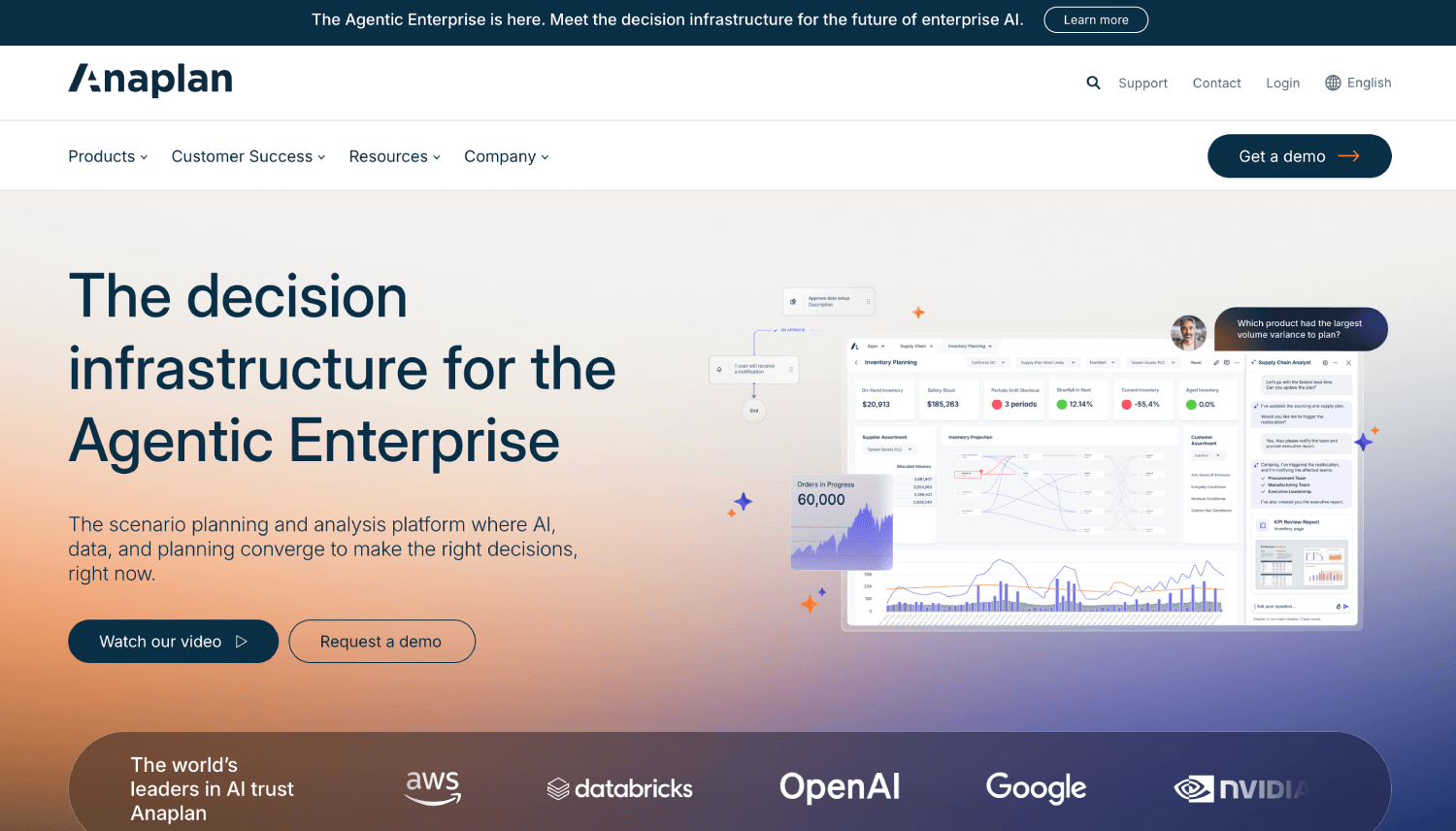
Anaplan comes from financial planning, not HR, and that lineage shapes both its strengths and its limits. As a workforce intelligence platform, Anaplan is strongest when the primary question is financial: what does our workforce cost under different headcount scenarios, and how does that connect to the rest of our operating plan?
Anaplan’s connected planning model means that headcount plans built in HR can tie directly to the revenue model in finance, the capacity plan in operations, and the compensation model in total rewards. No other platform in this category does that integration as natively. For companies where FP&A effectively owns the headcount planning process, and HR is a data provider rather than the driver, Anaplan is the right call.
The limitation is everything else. Anaplan does not have built-in HR-specific analytics, skills modeling, or retention risk capabilities. You configure those, which means a significant professional services investment. Anaplan is a powerful platform, but it is not a product you buy and use out of the box for HR-specific workforce intelligence. Budget accordingly.
Workday Prism Analytics: Best for Existing Workday Customers

If your company is on Workday, Prism Analytics is the path of least resistance to workforce intelligence. The integration is native, the data model is shared, and you avoid the extraction and normalization work that every other platform requires. The question is whether Workday’s analytics layer is strong enough to meet your needs, or whether you need a best-of-breed platform alongside it.
Workday Prism allows you to blend Workday HR data with external data sources, which is meaningful. You can pull in financial data, survey data, and third-party feeds. The outputs are more capable than standard Workday reporting, though they still fall short of Visier’s depth or Orgvue’s design capabilities. Workday Prism works well for teams that want to move beyond static reports without the complexity of a separate data platform.
The honest limitation: Workday Prism is only as powerful as your Workday data quality, and most Workday customers have at least some data quality problems. Our breakdown of Workday AI versus SAP Joule versus Oracle AI for HR covers how each enterprise HCM handles the analytics layer, which is directly relevant if you are trying to decide whether to go deeper with Workday or buy a best-of-breed analytics platform.
One Model: Best for Analytics-Mature HR Teams That Want Full Control

One Model is the platform for HR teams that know exactly what they want to build and have the data science capacity to build it. Rather than a pre-built analytics product, One Model is a people analytics data platform: it ingests data from every HR system, normalizes it, and makes it available for custom analytics, reporting, and machine learning workflows.
The payoff for that flexibility is real. Teams using One Model can build workforce intelligence models that precisely match their business context, rather than adapting their questions to fit a vendor’s pre-built metric library. The cost is that someone has to do that work. One Model requires a dedicated analytics capability, either in-house or through a partner. It is not a product a generalist HR team can self-serve.
One Model is the right choice for large enterprises with mature people analytics functions, complex multi-system environments, and specific modeling needs that off-the-shelf platforms cannot meet. It should not appear on a shortlist for teams that are just getting started with workforce intelligence.
Lightcast: Best for External Labor Market Intelligence

Lightcast (formerly Emsi Burning Glass) does something none of the other platforms on this list do as well: it tells you what is happening in the external labor market with specificity that is useful for workforce strategy. Skills demand trends by geography and industry, talent supply by role and location, compensation benchmarks derived from real job postings. That external intelligence layer is what separates strategic workforce planning from internal headcount management.
CHROs and strategy teams use Lightcast to answer questions like: where should we open our next engineering hub given talent supply and cost? Which skills are becoming scarce in our sector? Are we overinvesting in roles that the market is automating? These are genuinely strategic questions, and Lightcast has the data to answer them.
The limitation is clear: Lightcast is a data and intelligence product, not a full workforce planning or financial modeling platform. Most organizations use it alongside a planning tool like Orgvue or Anaplan, or as a research layer feeding their people analytics platform. Buying Lightcast as a standalone workforce intelligence solution will leave gaps in scenario modeling, financial integration, and internal people data analysis. It also connects closely to skills-based planning, which is explored in our coverage of skills intelligence software for workforce planning.
HCMI: Best for Proving Workforce ROI to Boards and CFOs
HCMI (Human Capital Management Institute) holds a specific position in this market. Its core product, SOLVE, is built around a specific problem: translating workforce investments into financial metrics that boards and CFOs understand. Human capital ROI, workforce productivity ratios, cost-of-workforce benchmarking against industry peers. HCMI calls this human capital financial reporting, and for CHROs who need to defend people program spending in a board deck, it does that job well.
The platform includes benchmarking data across industries, which is valuable for CHROs who need external context, not just internal trends. If your CFO is asking “is our cost per productive employee reasonable for our industry and stage,” HCMI can answer that question with data rather than opinion.
HCMI is narrow by design. It is not a headcount planning tool, a retention prediction tool, or an org design tool. Organizations that need full-spectrum workforce intelligence will use HCMI as a component, not as a primary platform. At enterprise companies where the CHRO regularly presents to the board on human capital performance, that niche is worth the investment.
Revelio Labs: Best for Competitive Workforce Intelligence

Revelio Labs turns publicly available workforce data (LinkedIn profiles, job postings, company filings) into structured workforce analytics. The core use case is competitive intelligence: tracking competitor hiring patterns, workforce composition, skill mix changes, and attrition signals before those companies report anything officially.
Strategy teams, M&A functions, and sophisticated people analytics groups use Revelio to answer questions that internal data cannot: how is our largest competitor reshaping their engineering organization? Which skills is our main rival hiring aggressively right now? Where are they pulling talent from? These are questions that matter in a competitive talent market, and Revelio has answers that are not available anywhere else at this resolution.
For internal workforce intelligence, Revelio’s value is more limited. It does not connect to your HRIS, it does not model your headcount scenarios, and it does not help you plan your talent supply chain. Buy Revelio when you need external competitive workforce intelligence. Do not buy it as a primary workforce intelligence platform.
How CHROs and CFOs Should Divide the Buying Decision
Most workforce intelligence purchases fail or underperform because HR buys them and finance never engages. The platforms that deliver business value are the ones where the CFO and CHRO align on the questions the platform needs to answer before the vendor demos begin.
The CHRO’s primary questions are about people risk: where are we exposed on retention, skills, succession, and org design? The CFO’s primary questions are about cost and productivity: what does our workforce cost us relative to revenue, and what happens to that ratio under different growth scenarios? A genuine workforce intelligence platform answers both sets of questions in the same system. If a vendor can only answer one, you have a people analytics tool or a financial planning tool, not workforce decision intelligence.
CHROs evaluating vendors should bring the CFO or a finance BP into at least two demos. The questions a finance leader asks in a demo will expose gaps that HR buyers miss. Our guide on what CFOs should ask before buying an AI-powered HR analytics vendor gives the specific questions worth asking before any contract is signed.
What Workforce Intelligence Platforms Cost in Practice
Every platform on this list is quote-based. None publish per-seat or per-employee pricing publicly. That said, the cost structure is predictable enough to plan for.
Enterprise workforce intelligence platforms typically price on a combination of employee count, number of data integrations, and module scope. Expect a significant professional services component on top of software licensing, particularly for platforms like Anaplan, One Model, and Orgvue, which require substantial configuration work. Implementation timelines for full deployment commonly run three to nine months depending on data complexity.
The hidden cost most buyers underestimate is data readiness. Getting data from five or six HR systems, normalizing it, and building the integration layer to a workforce intelligence platform is not free or fast. If your HRIS data quality is poor, that problem must be solved before, not during, the workforce intelligence implementation. Our breakdown of tools for cleaning and connecting workforce data is useful reading before you engage any of these vendors.
Budget across the full implementation, including professional services, data integration, training, and 12 months of internal analyst time, before approving the investment. Teams that budget only for software licensing routinely find that the total first-year cost is two to three times what they planned.
Workforce Intelligence vs Talent Intelligence: What Is the Difference?
Talent intelligence focuses on the supply and demand of people: who is available in the market, what skills they have, how to find and assess them. Workforce intelligence focuses on the organization itself: how the current workforce is deployed, what it costs, where the gaps are, and what strategic decisions would improve business performance.
Platforms like Eightfold, Beamery, and Phenom do talent intelligence well. They help you acquire and develop talent more effectively. They do not replace a workforce intelligence platform, which is the decision layer sitting above talent acquisition and connecting to finance, strategy, and operations. Our comparison of the best talent intelligence platforms covers that category in detail, including Eightfold, Gloat, Beamery, and Findem.
A well-constructed HR tech stack often includes both: a talent intelligence platform to identify, source, and develop people, and a workforce intelligence platform to model costs, plan headcount, and connect people decisions to business outcomes. They serve different decision cycles and different buyers within the same organization.
Which Workforce Intelligence Platform Is Right for Your Situation?
No single platform fits every organization. The clearest decision paths are these:
- If you are an existing Workday customer and your workforce intelligence needs are moderate, extend Workday with Prism Analytics before adding a second platform.
- If your primary need is CHRO-CFO alignment on workforce cost and talent risk, Visier is the market leader and worth the implementation investment.
- If you are running a major reorg, operating model change, or M&A integration, Orgvue is built for that specific problem.
- If finance leads your planning process and you need headcount connected to your operating model, Anaplan is the right platform even though it requires more HR configuration work.
- If you have a mature people analytics function and need full modeling flexibility, One Model gives you a data foundation that you can build on over time.
- If your primary need is external labor market intelligence for skills strategy or competitive talent analysis, Lightcast and Revelio Labs solve that problem. Neither replaces a full workforce intelligence platform.
- If you need to prove workforce ROI to a board or CFO with financial benchmarking, HCMI does that specific job better than anyone else in the market.
Red Flags to Watch for in Vendor Demos
The workforce intelligence category attracts vendors whose products are significantly thinner than their marketing suggests. Watch for these patterns in demos.
A vendor that leads with dashboards rather than decisions is selling people analytics, not workforce intelligence. Ask them to show you a scenario where a CHRO changed a headcount or talent investment decision based on their platform’s output. If they cannot produce a concrete example, the tool is a reporting product.
A vendor that cannot demonstrate native financial data integration is not a workforce intelligence platform. Workforce cost modeling requires payroll data, total rewards data, and connection to the financial plan. If the platform only reads HRIS data, it is missing half the picture that the CFO needs.
A vendor that emphasizes employee monitoring features as part of workforce intelligence is conflating two different categories. Productivity monitoring and workforce intelligence serve different purposes and carry different privacy and legal risks. Our coverage of the line between employee monitoring and workforce analytics explains that distinction clearly and is worth reviewing before any vendor conversation that touches productivity data.
Finally, ask every vendor for customer references where the platform is being used by both HR and finance in a joint planning process. If the reference list is entirely CHRO and People Analytics buyers, the platform has not crossed into genuine workforce decision intelligence territory.
Frequently Asked Questions
What is a workforce intelligence platform?
A workforce intelligence platform is software that connects data from HR, finance, and operations systems to support workforce decisions at the executive level. It goes beyond people analytics by modeling business outcomes alongside workforce data, connecting headcount costs to financial plans, surfacing skills gaps tied to business strategy, and enabling scenario planning for hiring, restructuring, or investment decisions. The primary users are CHROs, CFOs, and strategy teams, not HR generalists or recruiters.
How is workforce intelligence different from people analytics?
People analytics surfaces patterns and trends in HR data, typically for an HR audience. Workforce intelligence synthesizes HR data, financial data, and external labor market data to support business decisions made by executives. A people analytics platform answers “what is happening with our workforce?” A workforce intelligence platform answers “what should we do about it, and what will it cost us if we do not?” The buyer, the use case, and the required data integrations are all different.
Which workforce intelligence platform is best for CFOs?
Anaplan is the strongest fit when finance leads the planning process, because it connects workforce cost modeling directly to the operating plan and revenue forecast. Visier is the best choice when the CHRO and CFO need to align on workforce cost and talent risk in a shared platform. HCMI works well when the specific need is human capital financial reporting and board-level ROI metrics. Most CFOs benefit from a combination of two of these rather than a single platform.
Do workforce intelligence platforms replace HRIS?
No. Workforce intelligence platforms sit on top of your HRIS, not in place of it. They read data from your HRIS, payroll system, ATS, and engagement tools, normalize it, and build decision models on top of it. Your HRIS remains the system of record for employee data. The workforce intelligence platform is the analysis and planning layer. Removing your HRIS would remove the data foundation the intelligence platform depends on.
What data do workforce intelligence platforms require?
At minimum, they need HRIS data (headcount, roles, tenure, compensation), payroll and total rewards data, and some form of business performance data (revenue, productivity metrics, or operational KPIs). More capable deployments also integrate ATS data, engagement survey data, skills assessments, and external labor market feeds. The more data sources connected, the more useful the intelligence. Data quality problems in source systems surface immediately and must be resolved before the platform delivers accurate outputs.
How long does it take to implement a workforce intelligence platform?
Implementation timelines vary significantly by platform and data complexity. Workday Prism Analytics for existing Workday customers can reach initial deployment in one to three months. Purpose-built platforms like Visier, Orgvue, and Anaplan typically require three to nine months for full deployment, including data integration, model configuration, and user training. One Model deployments for complex multi-system environments can run longer. The data integration and quality work before go-live is consistently the longest part of any implementation.
Is Visier the best workforce intelligence platform?
Visier is the most complete workforce intelligence platform for most enterprise buyers, with strong coverage across financial modeling, retention analytics, and scenario planning. It is not the best choice for every situation. Organizations doing major org design work need Orgvue. CFO-led planning environments fit better with Anaplan. Teams that need external labor market intelligence will use Lightcast alongside whichever internal platform they choose. Visier earns the top ranking for breadth, but the right platform depends on which decisions you are trying to support.
What is workforce decision intelligence?
Workforce decision intelligence refers to the use of integrated workforce, financial, and market data to support specific executive decisions about talent, headcount, and people investments. The term describes an outcome rather than a product category. A workforce intelligence platform delivers workforce decision intelligence when it produces outputs that directly change how executives allocate headcount, manage workforce costs, or invest in talent. Platforms that produce dashboards without influencing decisions have not reached that threshold.
The Honest Reality About This Market
Most companies that buy workforce intelligence platforms end up using a fraction of their capability because they did not solve the data problem first. A workforce intelligence platform is only as good as the data flowing into it. If your HRIS has duplicate records, inconsistent job codes, and compensation data that nobody trusts, your workforce intelligence output will reflect those problems at executive scale.
The organizations that get the most from platforms like Visier, Orgvue, and Anaplan are the ones where HR and finance have already agreed on what questions matter most, cleaned the data upstream, and staffed the analytical capability to interpret and act on outputs. The platform is the last mile of a process that starts with data governance and ends with executives making better decisions.
If your organization is genuinely ready for this investment, the platforms in this list represent the serious options in the market. Evaluate them against the specific decisions you need to support, bring finance into the buying process from the beginning, and build a realistic picture of total implementation cost before you sign anything. When workforce intelligence is done well, the result is a people function that speaks the language of the business and earns its seat at the strategy table.


