8 Best Retail Workforce Management Software for Scheduling and Labor Forecasting
Compare 8 retail workforce management platforms, from UKG, Legion and Quinyx to Deputy: labor forecasting, fair workweek compliance and published prices.
TL;DR
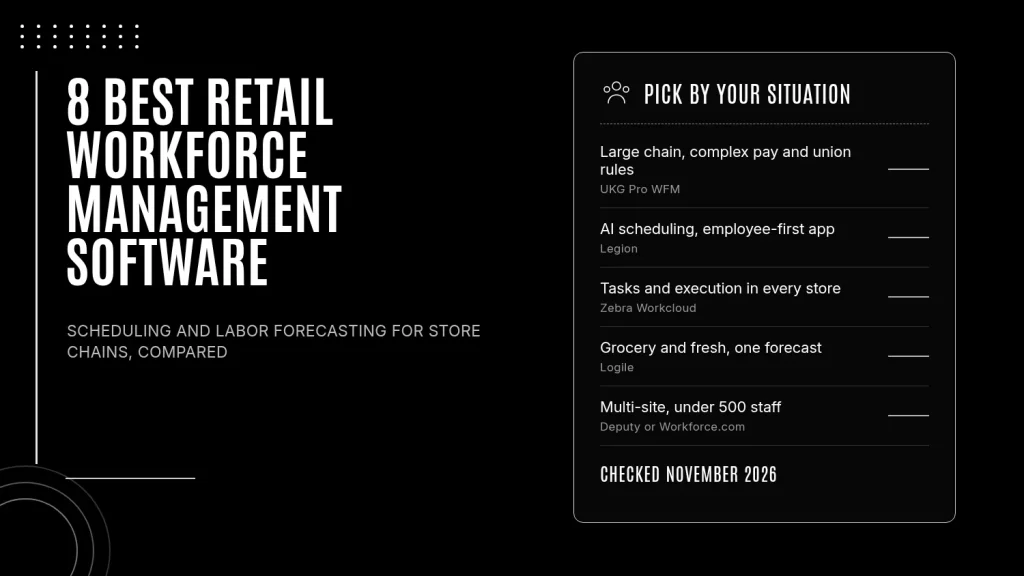
The best retail workforce management software for most store chains is UKG Pro Workforce Management for large, rules-heavy estates, Legion for AI-automated scheduling with a strong employee app, and Quinyx for multi-country compliance. Grocers should look hard at Logile, task-heavy chains at Zebra Workcloud, and smaller multi-site retailers at Deputy or Workforce.com.
- Retail WFM is more than a schedule builder: it forecasts labor from sales, traffic and promotions, turns that into compliant schedules, and tracks time against budget. If you only need shift swaps and a time clock, a scheduling app is cheaper.
- In the 2026 Gartner Magic Quadrant for WFM Technology (September 14, 2026), UKG and Quinyx say they were named Leaders, and Legion says it was named a Visionary.
- Only Deputy publishes prices: $5, $6.50 and $9 per user per month on annual billing, with demand forecasting from the $6.50 Core plan. Every enterprise vendor here is quote-only.
- Seattle, Oregon and Chicago require schedules 14 days ahead for covered retailers; New York City requires 72 hours. Your WFM should block or price late changes automatically.
- Ask every vendor to backtest its forecast on your own store data before you sign. Accuracy figures on vendor sites, such as Legion’s 87% to 96% in a Forrester study, are not your stores.
Last updated November 19, 2026. Vendor product, pricing and press pages, the ISG 2026 Retail Workforce Management Buyers Guide summary, and the Seattle, New York City, Chicago and Oregon scheduling law pages were read on this date. This is a buyer’s guide, not legal advice.
Retail workforce management software forecasts how many people each store needs, hour by hour, then builds schedules that hit that demand, stay inside the labor budget and follow local scheduling laws. For a chain with dozens or hundreds of stores, that forecast-to-schedule loop is where labor cost is won or lost, which is why the tools below are built around it rather than around a calendar.
This list is narrower than our guide to HR software for multi-location retail, which compares core HR and payroll suites. Here we compare the workforce management layer only: labor forecasting, demand-based scheduling, time and attendance, store tasks and fair workweek compliance. If your teams are spread across warehouses, clinics and field sites rather than stores, our list of deskless workforce management platforms is the better starting point.
What Does Retail Workforce Management Software Do That a Scheduling App Does Not?
A scheduling app helps a manager fill a rota; retail WFM decides how many hours each store should have in the first place. The difference shows up in four places:
- Labor forecasting. Demand is predicted from POS sales, transactions, foot traffic, promotions, holidays and local events, usually in 15-minute or hourly intervals per store and department.
- Labor standards and budgets. The forecast is converted into required hours using standards (for example, minutes per transaction or per case of freight), then checked against the store’s wage budget.
- Rules-based auto-scheduling. Schedules are generated against skills, availability, minor-labor rules, union terms and fair workweek notice periods, then published to a mobile app.
- Execution and compliance. Time and attendance, break attestation, task management and premium-pay calculation for late changes close the loop to payroll.
If you have fewer than ten stores and no predictive scheduling law to follow, start with our shortlist of employee scheduling software for shift-based teams. Retail WFM earns its cost when forecasting errors and compliance penalties are bigger than the licence.
How We Chose These Retail WFM Platforms
Jane Miller reviewed each vendor’s own product, industry and pricing pages, plus its 2026 analyst announcements, on November 19, 2026. A platform made the list only if it publishes labor forecasting and demand-based scheduling for retail on its own site. We gave extra weight to retail-specific depth (store tasks, fresh and grocery, POS integration), documented compliance features, and transparency about pricing and results.
We did not run test deployments, and we do not assign star ratings. Where we quote a result, such as a forecasting accuracy figure, we name who measured it. For a neutral analyst view, ISG’s 2026 Retail Workforce Management Buyers Guide evaluated 18 providers and named Oracle, UKG and ADP the top three overall; it rated Blue Yonder and Zebra as “Merit”.
Retail Workforce Management Software Compared at a Glance
Read the “Best for” and “Pricing” columns first. Most chains can cut this list to three names using those two columns alone.
| Platform | Best for | Forecasting (as published) | 2026 recognition | Pricing |
|---|---|---|---|---|
| UKG Pro WFM | Large chains with complex pay, union and multi-country rules | Demand forecasting and strategic workforce planning | Gartner MQ Leader (UKG) | Quote only |
| Legion | Automated, AI-driven scheduling with high employee app adoption | Automated demand forecasting from historical and future drivers | Gartner Visionary (Legion); Nucleus Leader | Quote only |
| Quinyx | Retailers operating across Europe and North America | Sales, transactions, footfall, promotions; model blending | Gartner MQ Leader (Quinyx) | Quote only |
| Zebra Workcloud | Chains that want scheduling and store task execution together | Labor budgeting, forecasting and scheduling | Nucleus Value Matrix Leader, 8th year (Zebra) | Quote only |
| Logile | Grocery and fresh retailers | One forecast for labor, fresh and inventory; reforecast every 15 minutes | Nucleus Value Matrix profile | Quote only |
| Blue Yonder WFM | Retailers already on Blue Yonder supply chain software | AI forecasting tied to store and replenishment activity | Nucleus Leader 2025 (Blue Yonder) | Quote only |
| Workforce.com | US multi-site retailers that want WFM and payroll in one | Labor forecasting in the Scheduling plan | 10,000+ businesses (vendor) | Quote only |
| Deputy | Small to mid-size chains that want published prices | Demand forecasting from POS data on Core and Pro | 390,000+ workplaces (vendor) | $5 to $9 per user per month (annual) |
The 8 Best Retail Workforce Management Software Platforms
The order reflects retail depth, forecasting capability and how well each platform fits a typical multi-store chain, not a single score. Each entry covers who it suits, what the vendor publishes, and what to check before you sign.
1. UKG Pro Workforce Management: Best for Large Chains With Complex Rules
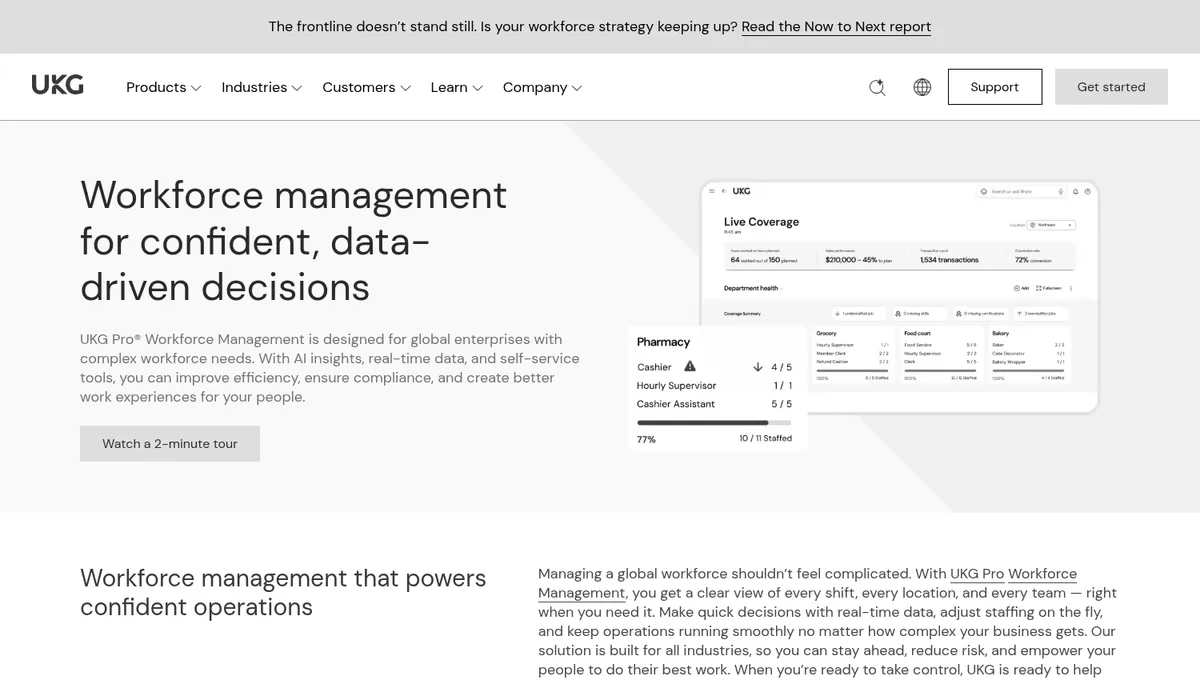
Best for: large retail estates with complex pay rules, unions or several countries.
UKG Pro Workforce Management is UKG’s suite for “global enterprises with complex workforce needs”. It covers time and attendance, AI scheduling that balances business needs with employee preferences, compliance tools for changing labor laws, analytics, communication, and strategic workforce planning to “forecast demand” and project labor costs. UKG Bryte AI adds recommendations on top.
UKG says it was named a Leader in the 2026 Gartner Magic Quadrant for Workforce Management Technology, and ISG ranked it among its top three retail WFM providers in 2026. For smaller retailers, UKG also sells UKG Ready, an all-in-one HR and payroll product that includes time and scheduling.
- Watch out for: implementation effort. UKG Pro WFM is a large configuration project, so budget for a partner. Our guide to UKG implementation partners covers who does this work.
- Pricing: not published; quote only.
2. Legion: Best for AI-Automated Scheduling and Employee Adoption
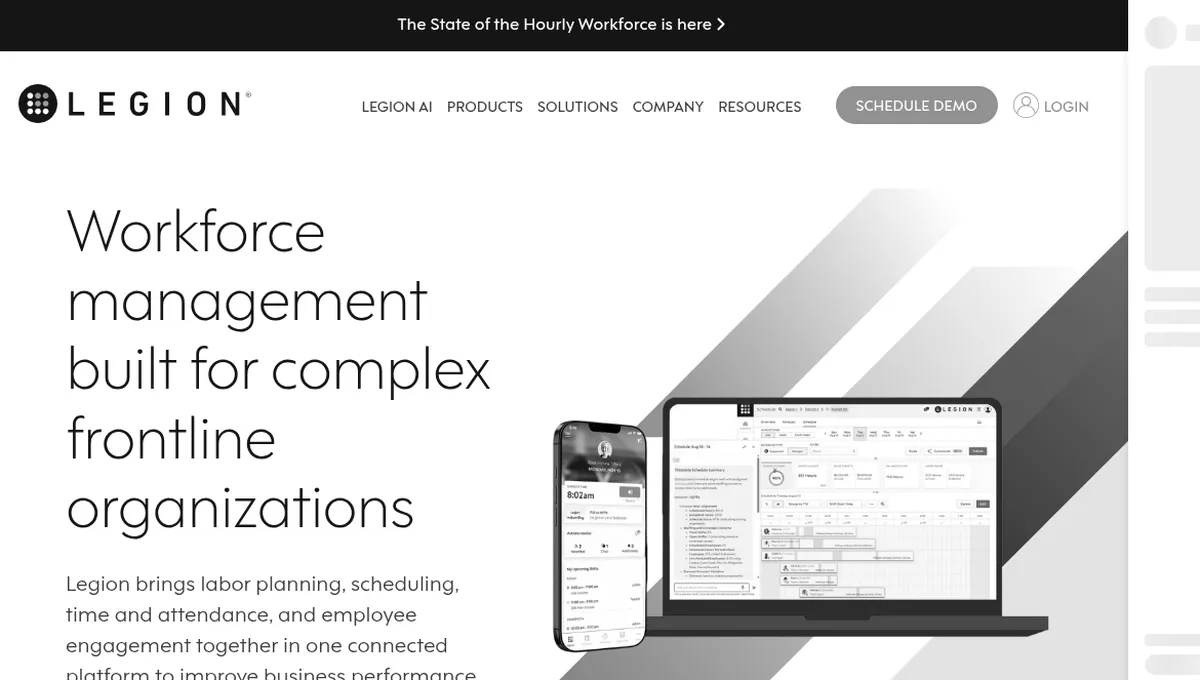
Best for: chains that want schedules generated automatically and an app associates actually use.
Legion sells AI-native WFM for hourly workforces, with a retail edition built around demand forecasting that “automatically incorporates historical and ongoing demand drivers and future events”. Associates get shift swaps, open shifts, work preferences, on-demand pay and chat in one mobile app, which Legion rates at 4.9 stars.
A Forrester Total Economic Impact study commissioned by Legion (July 2026, four retail and hospitality customers, composite organization) reported forecasting accuracy rising from 87% to 96%, about seven hours a week saved per manager, a 20% cut in overtime hours, and go-lives in four to six months. One retailer in the study said it generates schedules for 21,000 stores in about two hours. Legion says Gartner named it a Visionary in its 2026 WFM research.
- Watch out for: the study is vendor-commissioned and based on a composite, so ask for references at your scale. Plan the payroll and HR integration early.
- Pricing: not published; quote only.
3. Quinyx: Best for Multi-Country Retail Compliance
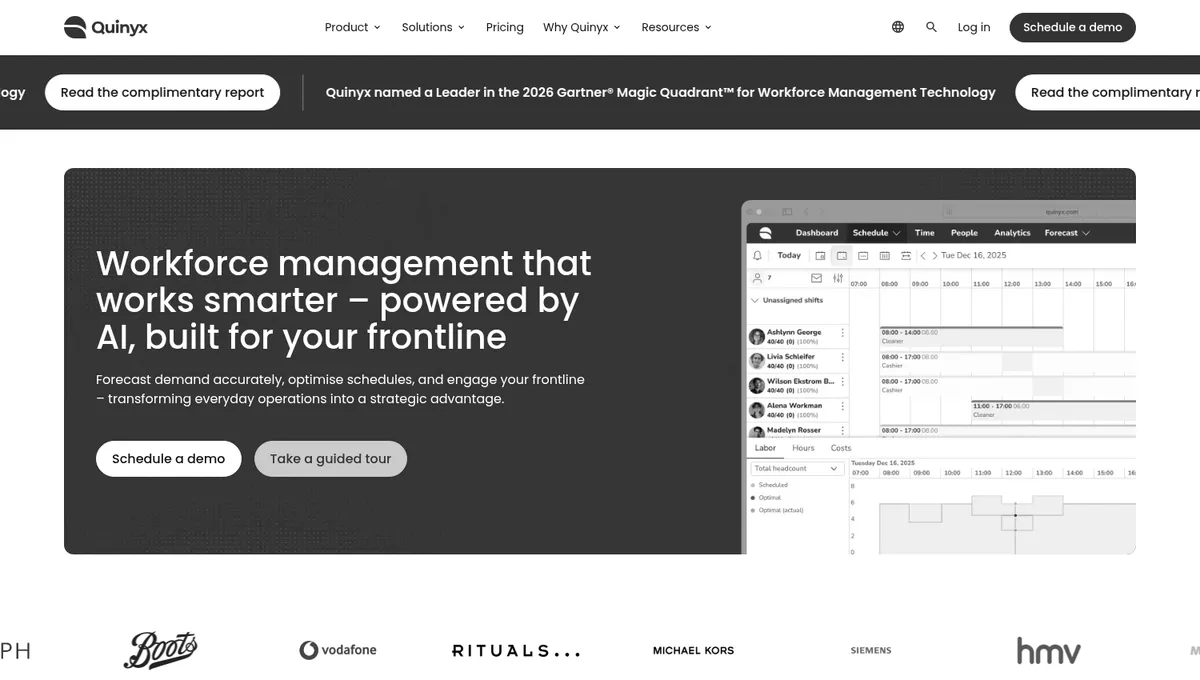
Best for: retailers with stores in several European countries, or in Europe and North America.
Quinyx is a dedicated WFM specialist. Its forecasting module predicts labor demand across stores, departments and regions from sales, transactions, foot traffic, promotions and seasonal peaks, and “automatically selects or blends the best-performing models” for each environment. Schedules, time tracking, task management, a mobile app and labor-law checks sit on the same platform.
Quinyx says it was named a Leader in the 2026 Gartner Magic Quadrant for WFM Technology, noting that most other Leaders sell WFM inside a broader HCM or ERP suite. It also cites a Leader position in the 2025 to 2026 IDC MarketScape for EMEA AI-enabled WFM and compliance.
- Watch out for: if most of your stores are in the US and you want payroll in the same system, a suite vendor may be simpler.
- Pricing: tailored; you request a quote by module.
4. Zebra Workcloud: Best for Scheduling Plus Store Task Execution
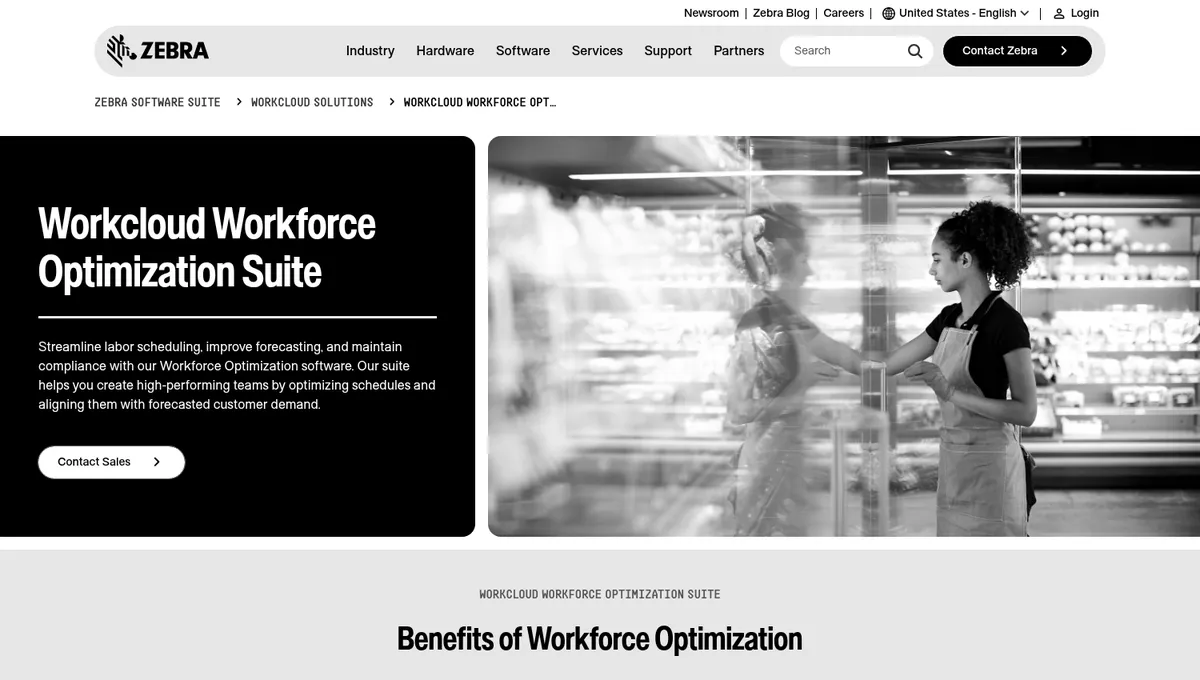
Best for: chains where the problem is getting work done in store, not only staffing it.
Zebra Workcloud Workforce Optimization covers labor budgeting, forecasting, scheduling and time and attendance, and the wider Workcloud suite adds task management, communication and inventory visibility, engineered to work with Zebra devices. Zebra claims “up to 50% improvement in scheduling effectiveness” and says it is trusted by more than 275 global leaders.
Zebra says it was named a Leader in the Nucleus Research 2026 WFM Technology Value Matrix for an eighth straight year. On its own case study, Vera Bradley raised on-time completion of corporate-generated store tasks from 40% to 95% with Workcloud.
- Watch out for: the value is highest if you also use Zebra devices and task management. ISG rated Zebra “Merit” rather than “Exemplary” in 2026.
- Pricing: not published; quote only.
5. Logile: Best for Grocery and Fresh Retailers
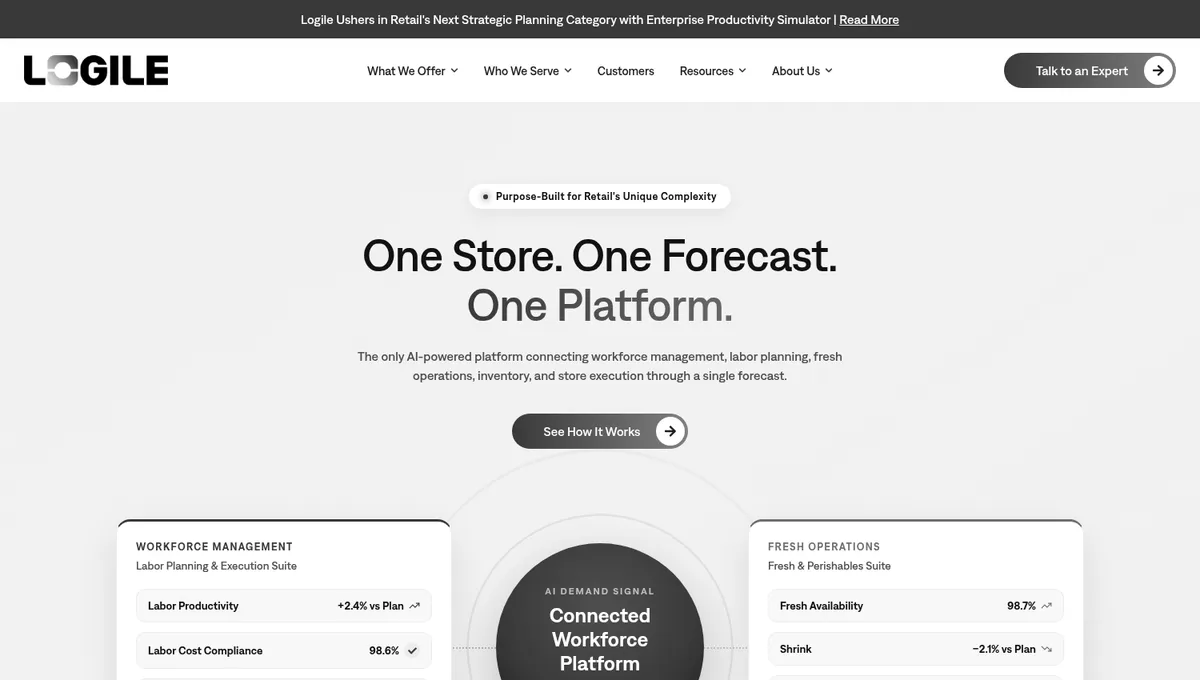
Best for: grocers and fresh-food retailers that want labor, fresh production and inventory on one forecast.
Logile is built only for retail. It runs workforce management, labor planning, fresh operations, inventory and store execution from a single AI demand signal, with “continuous reforecasting at 15-minute intervals” and a jurisdiction-aware rule engine for predictive scheduling, breaks and food safety logs. Logile says it supports 70,000+ locations in 11 countries and is SOC 2 Type II.
Customers named on its site include Northgate (44 stores), Schnucks, Vallarta and Heinen’s. Logile claims about 97% forecast accuracy; treat that as a vendor figure and ask for a backtest on your own data.
- Watch out for: it is a retail operations platform, not an HRIS, so plan the payroll and HR integration early.
- Pricing: not published; quote only.
6. Blue Yonder Workforce Management: Best for Blue Yonder Supply Chain Customers
Best for: retailers that already run Blue Yonder for planning, replenishment or warehouse management.
Blue Yonder Workforce Management combines AI forecasting, intelligent scheduling and a mobile workforce app on the Blue Yonder Platform, and aims to “sync labor with inventory flow, replenishment cycles, and store/service activity”. It lists automated compliance with labor laws, union rules and internal policies, and Blue Yonder says it was a Leader in the Nucleus Research WFM Value Matrix 2025.
The main reason to choose it is the shared data: if your demand and replenishment plans already live in Blue Yonder, labor plans can use the same signals instead of a separate forecast.
- Watch out for: much of the published material is about warehouse labor. Ask for store-level retail references, and note ISG rated Blue Yonder “Merit” in 2026.
- Pricing: not published; quote only.
7. Workforce.com: Best for US Multi-Site Retailers Wanting WFM and Payroll Together
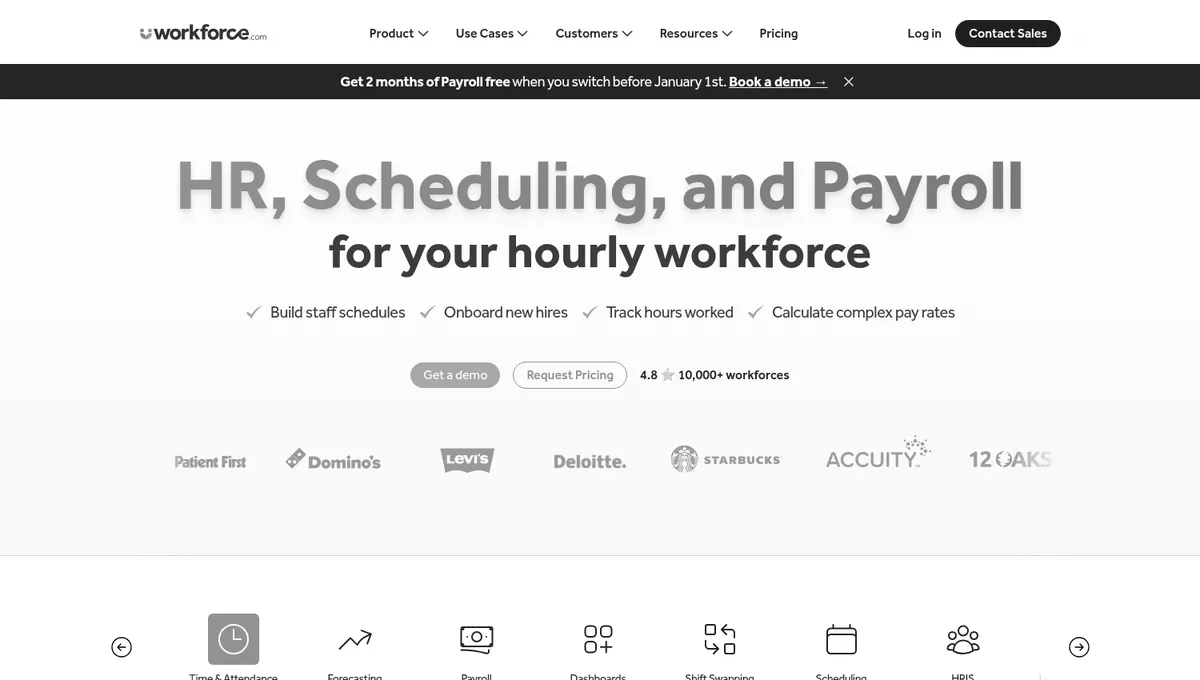
Best for: US retailers with roughly tens of sites that want scheduling, time, HR and payroll in one login.
Workforce.com is built for hourly businesses. Its Scheduling plan includes employee scheduling, labor forecasting, shift management, communications and the employee app, and the All-in-One plan adds full-service payroll, wage and hour automation, tax filing and HR. It says more than 10,000 businesses use it.
It is a good fit when payroll errors from complex pay rates are as big a problem as scheduling. Note that Workforce.com states it is not affiliated with WorkForce Software, which is a different company.
- Watch out for: it is lighter than UKG, Legion or Zebra on enterprise labor standards and store task management.
- Pricing: every plan says “Request Pricing”.
8. Deputy: Best for Small and Mid-Size Chains That Want Published Prices
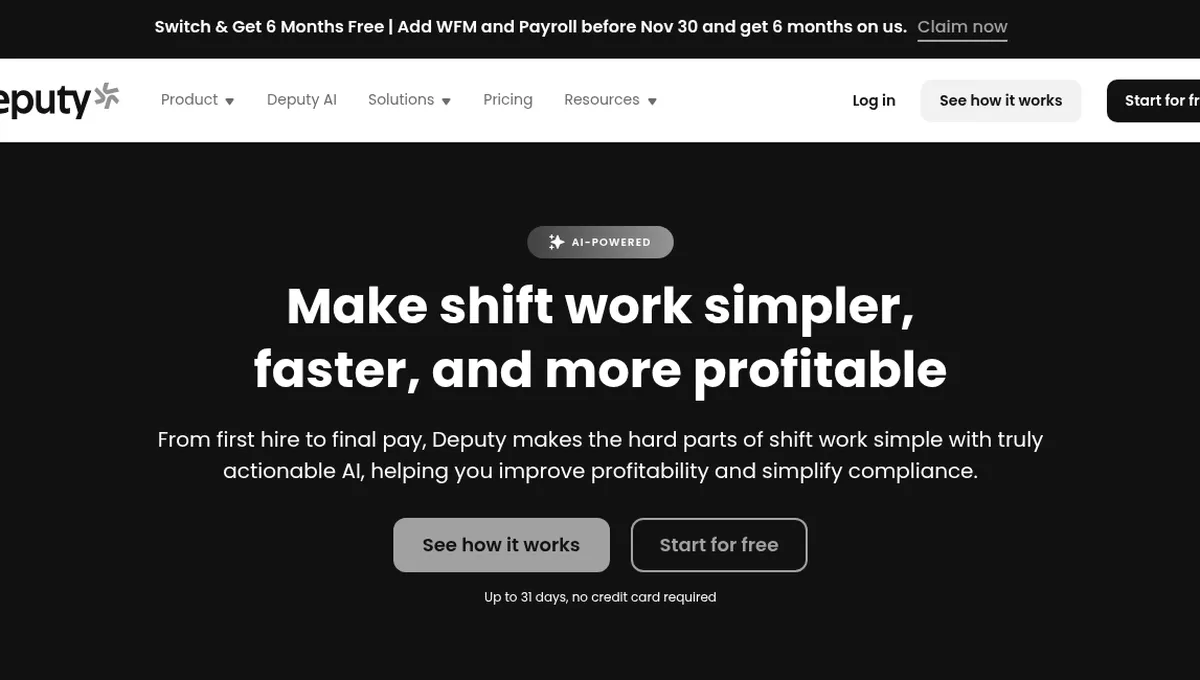
Best for: retailers with a handful to a few dozen stores that want to start quickly and see the price upfront.
Deputy covers scheduling, timesheets, time clocking, labor-law compliance (including Fair Workweek), HR and messaging. Its demand forecasting pulls sales from your POS, compares forecasts to actuals and auto-scales schedules against hour and wage budgets. Deputy says it is used by 390,000+ workplaces.
It is the only platform here with published pricing: Lite $5, Core $6.50 and Pro $9 per user per month on annual billing ($5.50, $7.25 and $10 billed monthly). Demand forecasting, auto-scheduling, labor optimization and wage budgets start on Core; location hierarchies, SSO and a sandbox are in Pro.
- Watch out for: forecasting is simpler than the enterprise tools, with no labor standards engine for freight or fresh production.
- Pricing: $5 to $9 per user per month billed annually, read November 19, 2026.
Which Fair Workweek Rules Must Retail WFM Enforce?
If you have covered stores in Seattle, New York City, Chicago or Oregon, your WFM must publish schedules on time, flag late changes and calculate premium pay automatically. These are the core rules for retail, read on each government site on November 19, 2026. Other cities and states have their own versions, so check every location on your store list.
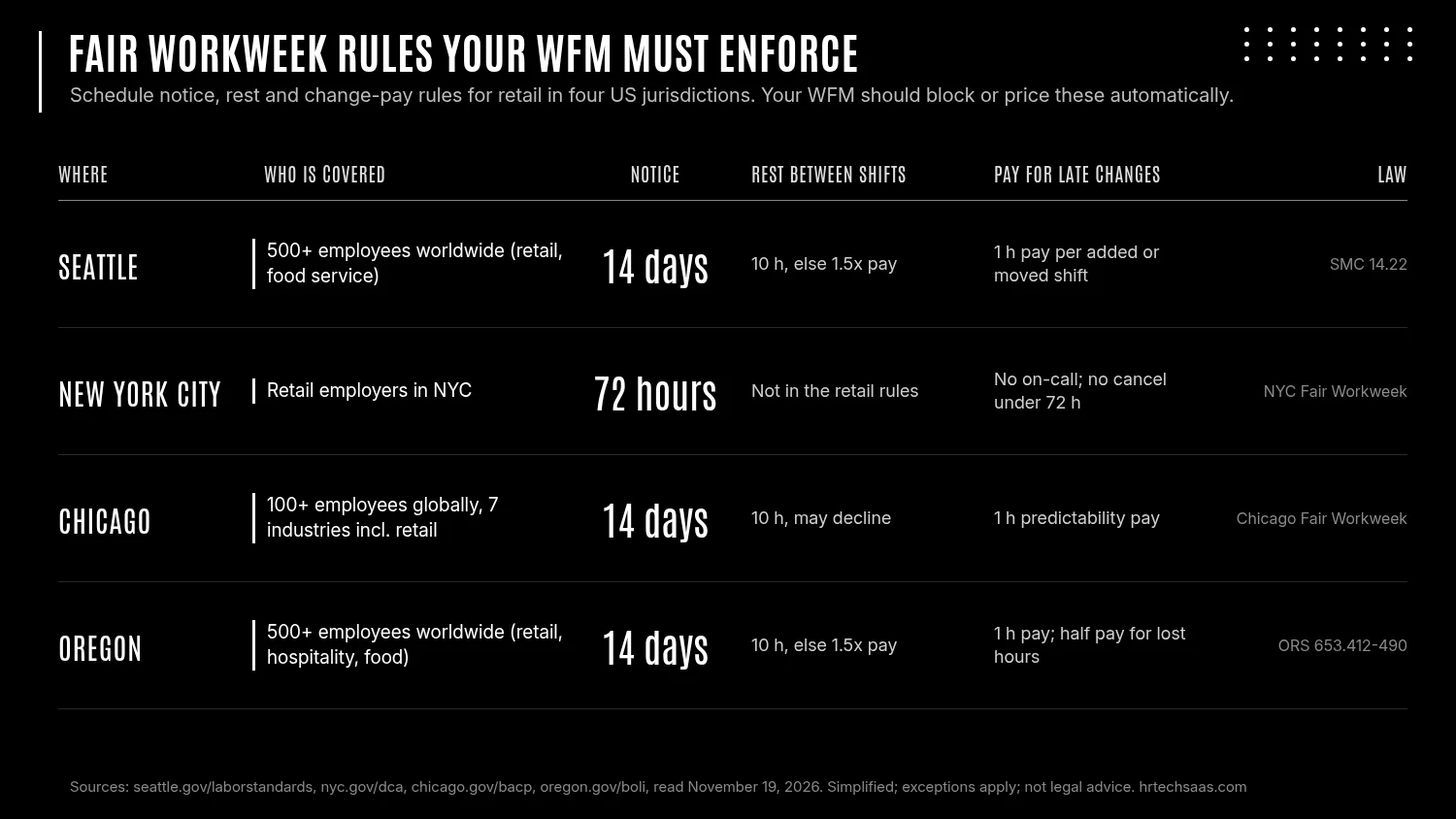
| Jurisdiction | Who is covered (retail) | Schedule notice | Rest between shifts | Pay for employer changes |
|---|---|---|---|---|
| Seattle Secure Scheduling (SMC 14.22) | Hourly staff at retail and food service employers with 500+ employees worldwide | 14 days | Time-and-a-half for shifts less than 10 hours apart | 1 hour of pay for added or moved hours; half of hours lost when sent home early |
| NYC Fair Workweek (retail) | Retail employers in NYC | 72 hours before the first shift | Not in the retail rules | No on-call shifts; no cancellations or added work under 72 hours without consent |
| Chicago Fair Workweek | Covered industries incl. retail; employers with 100+ employees globally; pay at or under $33.85/hour | 14 days (predictability pay window) | May decline hours less than 10 hours after the previous day’s shift | 1 hour of predictability pay for changes within 14 days |
| Oregon predictive scheduling (ORS 653.412 to 653.490) | Retail, hospitality and food service employers with 500+ employees worldwide | 14 calendar days | Time-and-a-half within 10 hours unless the employee agrees | 1 hour of pay for added time or moved shifts; half pay for each hour cut or cancelled |
In practice, ask each vendor to show you three things live: a warning when a manager edits a published schedule inside the notice window, the premium-pay line that change creates in the timesheet, and the good-faith estimate or schedule records you would hand to an investigator. Records matter too: Seattle requires employers to keep them for three years.
How Do You Test Labor Forecasting Accuracy Before You Buy?
Give every finalist the same 12 to 24 months of store data and ask for a backtest against weeks they have not seen. Vendor accuracy claims are measured on other retailers, at other granularities, and are not comparable with each other.
- Pick test stores. Choose five to ten stores that include a high-volume store, a seasonal or tourist location, and a store with a recent remodel or new competitor.
- Share the same inputs. POS transactions or sales by 15-minute interval, foot traffic if you have it, promotion calendars and store hours.
- Hold out recent weeks. Keep the last eight to twelve weeks, including a holiday or promotion, out of the training data.
- Compare at the level you schedule. Ask for error by store, by day and by hour, not just a weekly chain total, which always looks better.
- Convert to hours and dollars. Ask how the forecast turns into required hours using your labor standards, and what that does to the labor budget.
- Check the reforecast. Ask how often the forecast updates during the week and how managers see it. Logile, for example, says it reforecasts every 15 minutes.
Forecast quality is wasted if the hours never reach associates’ phones on time. Pair the backtest with a hands-on look at the employee app, and see our roundup of frontline workforce communication apps if store messaging is a separate gap.
How Much Does Retail Workforce Management Software Cost?
Only Deputy publishes retail WFM prices, at $5 to $9 per user per month on annual billing; UKG, Legion, Quinyx, Zebra, Logile, Blue Yonder and Workforce.com all quote by deal. Enterprise quotes usually depend on employee count, modules (forecasting, scheduling, time, tasks, communications), countries and the implementation scope.
One public data point on total cost: in the Forrester study Legion commissioned, the composite organization’s three-year, risk-adjusted cost was $3.5 million, including $3.2 million in platform fees and $346,000 for implementation, training and ongoing management. That composite was built from large retail and hospitality customers, so use it as an order of magnitude for an enterprise rollout, not a price list.
Time and attendance is often licensed separately in suites. If hourly pay accuracy is the bigger problem, compare our list of time and attendance software with payroll for hourly teams before you add a full WFM layer.
Already on an HCM Suite? When Its WFM Module Is Enough
If your HCM vendor’s WFM module scored well in 2026 and your stores do not need labor standards or store tasks, using it can save an integration. Gartner’s first Magic Quadrant for WFM Technology, published September 14, 2026, put several suites among the Leaders.
- Workday: says it was named a Leader for time tracking, absence, scheduling and labor optimization inside Workday HCM, with demand forecasting for retail and grocery. Our analysis of what Workday’s WFM Leader position means covers the agent claims.
- UKG: if you already run UKG Pro HCM, UKG Pro WFM is the natural pick and is listed first above.
- Dayforce, Oracle and SAP: each was rated “Exemplary” in the ISG 2026 retail WFM guide, so test their scheduling modules before buying a separate tool. Our guide to HR software for multi-location retail compares Dayforce and other suites on core HR and payroll.
Choose a specialist like Legion, Quinyx, Zebra or Logile when forecasting accuracy, store task execution or fresh production planning drives your labor cost more than HR data does.
Quick Pick: Which Retail WFM Should You Shortlist?
| Your situation | Shortlist | Why |
|---|---|---|
| Hundreds of stores, unions or several pay jurisdictions | UKG Pro WFM, Legion | Deep rules engines; both rated highly in 2026 analyst research |
| Stores across several European countries | Quinyx | Specialist with multi-country compliance and Gartner Leader position |
| Store execution and task completion is the main problem | Zebra Workcloud | Scheduling plus tasks, built for Zebra devices |
| Grocery with fresh departments | Logile | One forecast for labor, fresh and inventory |
| Planning and replenishment already in Blue Yonder | Blue Yonder WFM | Labor plans use the same demand signals |
| US multi-site retailer wanting payroll in the same system | Workforce.com | Scheduling, time, HR and payroll in one login |
| Under about 30 stores and want to see the price | Deputy | Published plans from $5 per user per month |
| Already on Workday, Dayforce, Oracle or SAP | Your suite’s WFM module first | Avoids an integration if it meets your forecasting needs |
Frequently Asked Questions
What is the best workforce management software for retail?
For large chains, UKG Pro Workforce Management and Legion are the strongest all-round picks, with Quinyx leading for multi-country estates. Grocers should evaluate Logile, and task-heavy chains Zebra Workcloud. Smaller multi-site retailers get most of the value from Deputy or Workforce.com at a lower cost and faster setup.
What is the difference between retail WFM and employee scheduling software?
Scheduling software helps managers build and share a rota. Retail workforce management software also forecasts labor demand from sales and traffic, applies labor standards and budgets, auto-generates compliant schedules and tracks time against them. If you do not need forecasting or predictive scheduling compliance, a scheduling app is usually enough.
How does retail labor forecasting work?
The software learns demand patterns from POS sales or transactions, foot traffic, promotions, holidays and events, usually in 15-minute intervals per store. It converts expected demand into required hours using labor standards, then builds schedules to match. Good systems reforecast during the week and let managers see forecast versus actual.
Which retail WFM vendors were Leaders in the 2026 Gartner Magic Quadrant?
Gartner published its first Magic Quadrant for Workforce Management Technology on September 14, 2026. Among the vendors in this guide, UKG and Quinyx say they were named Leaders and Legion says it was named a Visionary. Workday also says it was a Leader. Read the report itself before relying on placements.
How much does retail workforce management software cost?
Deputy is the only vendor here that publishes prices: $5, $6.50 and $9 per user per month on annual billing, with demand forecasting from the $6.50 Core plan. Enterprise platforms such as UKG, Legion, Quinyx, Zebra, Logile and Blue Yonder are quote-only and priced by employees, modules and implementation scope.
Does retail WFM software handle fair workweek laws?
All eight list labor-law compliance features; Logile names predictive scheduling rules and Deputy names Fair Workweek on their sites. Confirm the rules for each city you operate in: for example, Seattle, Chicago and Oregon require 14 days’ notice for covered retailers, while New York City requires 72 hours.
How long does a retail WFM implementation take?
It depends on store count, integrations and rules. In the Forrester study Legion commissioned, most customers went live in four to six months. Deputy is self-serve with a free trial of up to 31 days, while suite-wide UKG or Blue Yonder programs usually involve partner-led payroll and HR integration.
The Bottom Line on Retail Workforce Management Software
Pick the platform whose forecast you trust on your own stores, then check that it enforces the scheduling laws where you operate. UKG Pro WFM and Legion lead for large chains, Quinyx for multi-country retail, Zebra for in-store execution, Logile for grocery, Blue Yonder for its own supply chain customers, and Workforce.com or Deputy for smaller multi-site retailers.
Whatever you choose, run a backtest, price the premium-pay rules, and plan the payroll integration before you sign. For the HR and payroll suite that sits underneath your WFM, go back to our guide to the best HR software for multi-location retail.