Rippling LMS vs Docebo vs Cornerstone: Which Learning Platform Fits a Growing Company?
Rippling LMS vs Docebo vs Cornerstone for growing companies: product shape, fit by company size, content standards, pricing models, AI features and 2026 changes, verified November 2026.
TL;DR
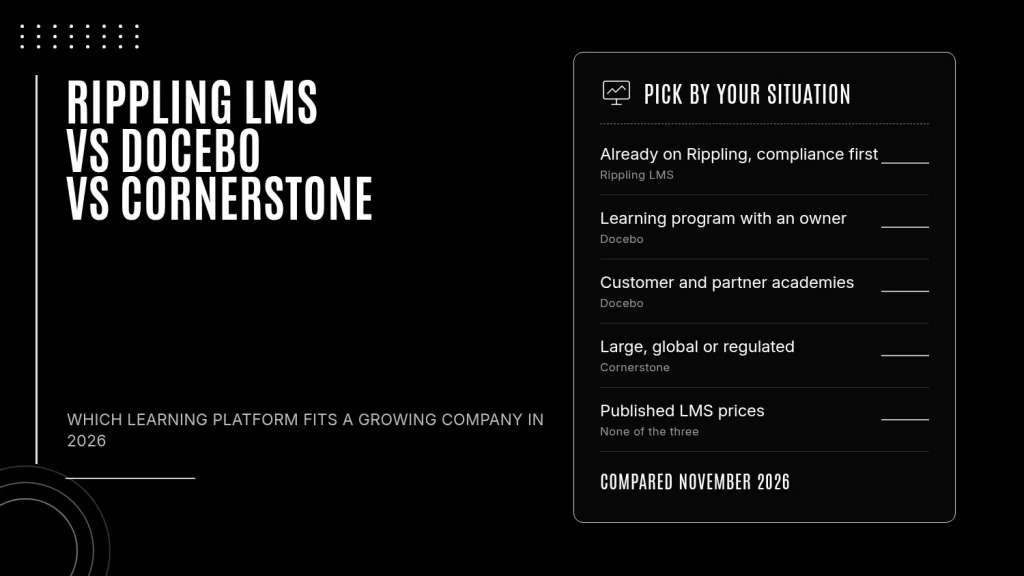
Choose Rippling LMS if you already run Rippling and mainly need automated onboarding and compliance training, Docebo if learning is a real program that also has to reach customers or partners, and Cornerstone if you are a large or regulated employer that wants learning tied to skills, performance and workforce planning.
- None of the three lists an LMS price. Rippling says its plans start at $8 per employee per month plus a monthly base fee; Docebo prices by plan tier and active users; Cornerstone has no pricing page at all.
- Rippling Learning Management is a module, not a standalone product: you buy it on top of the Rippling platform, and it assigns courses from the same employee record as payroll.
- Docebo bills on active learners (monthly, yearly or registered active user models) and counts integrations against a plan allowance, so model both before you sign.
- Cornerstone says about 7,000 organizations and 140 million users in 186 countries use its platform, in 50 languages, with SCORM, AICC and xAPI content support.
- 2026 changed the field: Docebo bought 365Talents for skills intelligence, and Cornerstone launched Workforce AI and Workforce Planning.
If you are comparing Rippling LMS vs Docebo vs Cornerstone, you are probably at the point where spreadsheets and a shared drive no longer cut it for training. New hires need onboarding courses on day one, managers need harassment training by state, and someone in leadership wants to know whether learning is actually building skills.
These three products answer that need in very different ways. Rippling sells a learning module inside an HR, IT and payroll platform. Docebo sells a dedicated learning platform. Cornerstone sells a talent suite where learning sits next to skills, performance and workforce planning. This guide compares them on what a growing company should check: product shape, fit by company size, content and standards, pricing mechanics, AI features, implementation and what changed in 2026.
How we compared them (last updated November 14, 2026). Written by Emma Carter. We read each vendor’s product and pricing pages, Rippling’s pricing FAQ and LMS blog posts, Docebo’s pricing FAQ and third-quarter 2026 results, and Cornerstone’s learning pages and 2026 press releases. Where a vendor does not publish a number, we say so instead of repeating third-party estimates. We have not run hands-on trials, and no vendor paid to be included.
Rippling LMS vs Docebo vs Cornerstone at a Glance
Rippling LMS is the simplest choice for Rippling customers, Docebo is the most flexible dedicated LMS, and Cornerstone is the broadest talent platform of the three. The table shows how each one is built and sold, using only what the vendors publish.
| What you are comparing | Rippling LMS | Docebo | Cornerstone |
|---|---|---|---|
| Product shape | Learning module on the Rippling HR, IT and payroll platform | Dedicated learning platform (Learning Management plus Skills Intelligence) | Talent suite; learning sits beside skills, performance and planning |
| Can you buy the LMS alone? | No, it needs the Rippling platform | Yes | Learning is sold as part of the Cornerstone platform |
| Published LMS price | None; platform from $8 per employee per month plus base fee | None; tier plus active users | None; no pricing page |
| Billing unit | Mostly per employee per month, per product | Monthly, yearly or registered active users | Quoted by Cornerstone |
| Course content | US and global course catalogs, plus 80,000+ Go1 courses to buy | Content Marketplace, AI content creation | Subscriptions from 200+ providers; LinkedIn Learning, Coursera and others connect |
| Your own content | Course builder and SCORM upload | SCORM 1.2, SCORM 2004 3rd Edition and xAPI, plus AI authoring | SCORM, AICC and xAPI |
| Training customers and partners | Not offered | Extended enterprise (up to 10 domains on Enterprise) | Offered, but not the core pitch |
| Languages | 15+ | Instant AI translations | 50 |
| Best fit | Rippling customers of any size | Learning teams, often 250+ learners and external audiences | Large, global or regulated employers |
Quick Pick: Which Learning Platform Fits Your Company?
- You run Rippling and training is mostly onboarding and compliance: start with Rippling LMS. Courses assign themselves from role, department, location or length of service, with no second system to sync.
- You have an L&D lead and want a real learning program: shortlist Docebo. It is built for learning first, with AI authoring, learning paths and reporting a learning team can live in.
- You also train customers, partners or dealers: Docebo. Its Enterprise plan lists extended enterprise across up to 10 domains and a branded mobile app.
- You have thousands of employees, several countries or regulators to satisfy: Cornerstone. It pairs learning with certification, skills, performance and workforce planning in one suite.
- You are not on Rippling and have under 100 learners: none of the three may be the cheapest route; see the lighter options in our corporate LMS guide.
Key Numbers Snapshot (Verified November 2026)
| Fact | Rippling LMS | Docebo | Cornerstone |
|---|---|---|---|
| Scale the vendor reports | 650+ app integrations on the platform | ARR $261.5 million at September 30, 2026, up 11.0% | About 7,000 organizations, 140 million users, 186 countries |
| Published starting price | $8 per employee per month plus monthly base fee (whole platform) | Not published | Not published |
| Vendor price clue | Rippling’s own LMS roundup lists $12 PEPM for HR system plus LMS | Average contract value $77.9 thousand (all customers, Q3 2026) | None |
| Course library | 80,000+ Go1 courses (purchased separately) | Content Marketplace | 200+ content providers |
| Content standards named | SCORM upload | SCORM 1.2 and 2004 3rd Edition, xAPI | SCORM, AICC, xAPI |
| 2026 headline | Course builder, AI course search | 365Talents acquired January 20, 2026 | Workforce AI launched May 20, 2026 |
Sources: Rippling pricing FAQ, Rippling Learning Management page, Docebo pricing page, Docebo Q3 2026 results, Cornerstone Learning page, all read November 14, 2026. Average contract value is Docebo’s figure across its whole customer base, not a price list.
How Are Rippling LMS, Docebo and Cornerstone Different?
The real difference is product shape: a module that rides on your HR record, a learning platform that stands on its own, and a suite that treats learning as one input into talent decisions.
Rippling’s pitch is data. Because the LMS reads the same employee record as payroll, benefits and device management, a new sales manager hired in California can be enrolled in the right onboarding and state harassment courses the day the record is created. The trade-off is that you cannot buy it without the platform, and it is not designed to train people outside your company.
Docebo’s pitch is depth and reach. Learning is the whole product, so it goes further on authoring, personalization, multi-audience portals and analytics. Its pricing page groups everything into two tiers, Elevate and Enterprise, and adds AI products such as Docebo Agents, Docebo Knowledge and Roleplay on top. You will need an HRIS connection to feed it people data.
Cornerstone’s pitch is breadth. Its learning page describes LMS and learning experience platform features in one product, with certification and recertification, assessments, skill and role based paths and agentic features for compliance monitoring and content curation. The value grows when you also use its skills, performance and planning tools; the cost is more configuration and administration.
Rippling LMS, Docebo and Cornerstone Compared One by One
Rippling Learning Management
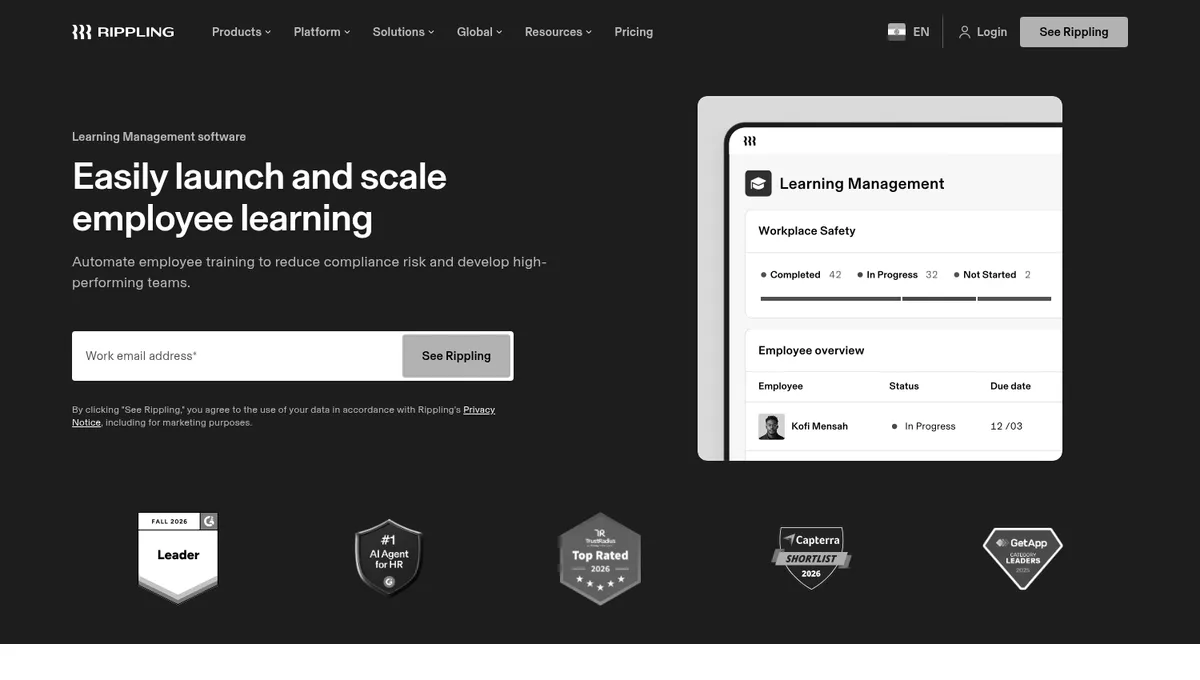
Rippling LMS suits companies that already run Rippling and want training handled by the same rules engine as everything else. Its product page lists automated course assignment by attributes such as role, department or length of service, location-based enrollment for US and global compliance bundles, a course builder for videos, quizzes and case studies, mobile access, support for 15+ languages, self-enrollment and real-time completion reporting.
Content comes from three places. Rippling’s custom courses announcement says you can pick from a prebuilt US course catalog or a global catalog (both cost an additional fee), upload SCORM packages you already own, buy courses from partner Go1, or build your own. Go1 is described as a library of over 80,000 courses, and Rippling added AI-powered search to find them.
- Strengths: no integration to build or maintain; compliance enrollment follows location changes automatically; one login and one vendor; easy to add to an existing Rippling contract.
- Watch-outs: not sold alone; no extended enterprise for customers or partners; per-employee pricing means you may pay for staff who never open a course; the product page does not describe skills intelligence or advanced learning analytics.
- Price: Rippling’s pricing FAQ says plans start at $8 per employee per month with a monthly base fee, and most products are priced per employee per month. Its own LMS roundup lists $12 PEPM for the HR system plus LMS as a starting point. Ask for the LMS on its own quote line.
Docebo
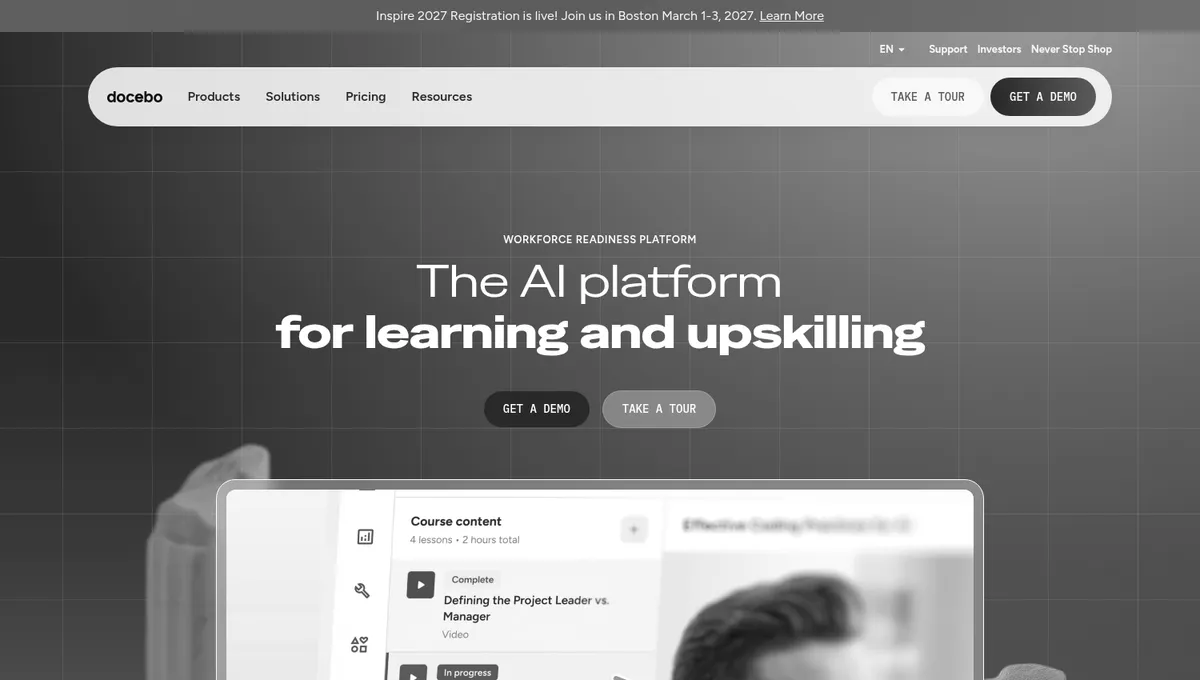
Docebo suits companies where learning is a program with an owner, especially if the audience includes customers, partners or members. Its pricing page lists two Learning Management tiers. Elevate covers personalization and multi-audience support, white-label design, certification and compliance tracking, AI content creation, instant translations, workflow automation, an AI assistant and search, reporting, and live, on-demand, mobile and social learning.
Enterprise adds advanced analytics, extended enterprise across up to 10 domains, two sandbox environments, a branded mobile app, upgraded API access at 100 calls per minute, a dedicated database, elite support and a named account manager, customer success manager and solution engineer. A Docebo Federal edition is FedRAMP authorized for US government work.
The AI layer is priced separately. Docebo Knowledge is included for all customers with 50GB of connected, indexed data; Docebo Agents draw on AI credits; Roleplay is priced by annual simulation volume. In January 2026 Docebo acquired 365Talents to add skills intelligence and internal mobility, and that product now appears next to Learning Management on the pricing page.
- Strengths: learning-first depth; multi-audience portals; 400+ integrations across HR, CRM, identity and content; flexible active-user models; public-company reporting gives some visibility into the business.
- Watch-outs: plans include a defined integration allowance, and embedded experiences or extra integrations can need an add-on or services; usage-based AI operations consume credits; you need a separate HRIS feed.
- Price: not published. The pricing FAQ says pricing is based on active learner usage, with monthly active, yearly active or registered active user models, and an AI Credit Pool or per-seat option for AI.
Cornerstone
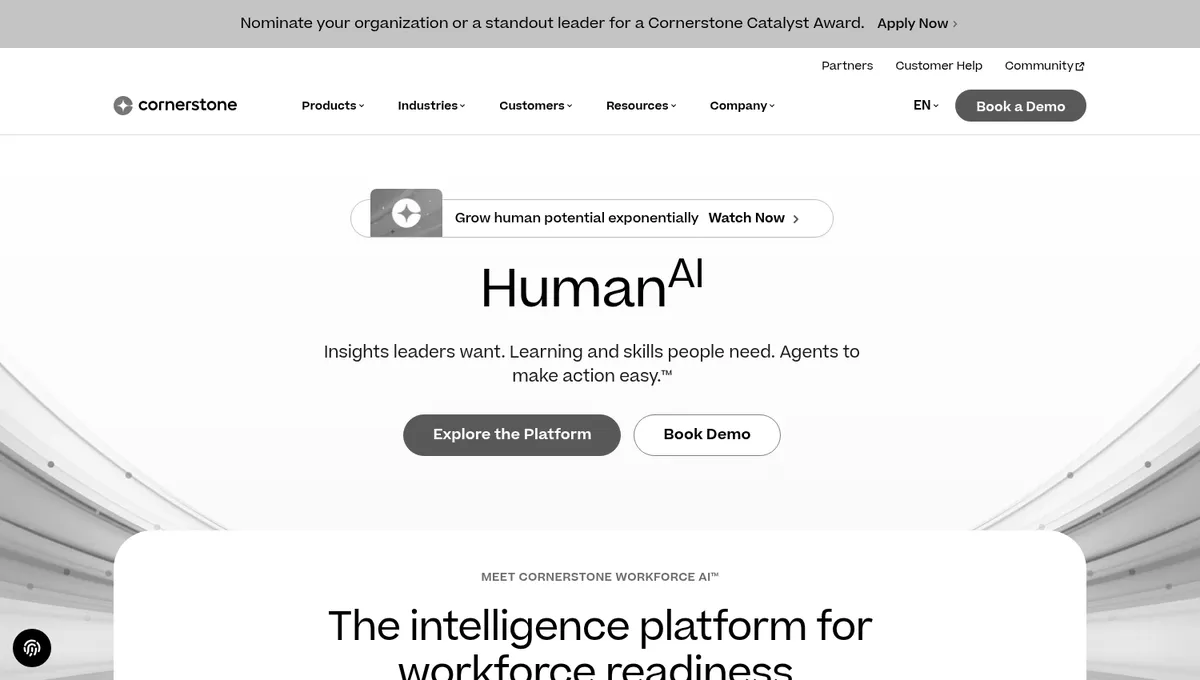
Cornerstone suits large, global or regulated employers that want learning, skills and talent processes in one system. Its Cornerstone Learning page says the product combines LMS and learning experience platform features: learning and content management, certification and recertification, assessments, social learning, gamification, skill and role based paths, communities and analytics, plus agentic features for learning prioritization, compliance monitoring and ILT management.
Content is a strength. Cornerstone supports your own SCORM, AICC and xAPI courses, sells curated content subscriptions from over 200 providers, and connects third-party libraries including LinkedIn Learning, Coursera, OpenSesame, Skillsoft and Udacity. It runs in 50 languages, and learners can use mobile apps offline or learn inside Salesforce Agentforce and Microsoft 365.
- Strengths: breadth across learning, skills, performance and planning; strong compliance and certification depth; very large content ecosystem; global language coverage.
- Watch-outs: more configuration and administration than the other two; many capabilities are separate products, so scope creep is easy; no published prices at all.
- Price: Cornerstone has no pricing page; its /pricing/ address redirects to the LMS product page. Expect a custom quote based on users and modules.
Which One Fits a Growing Company at Each Stage?
Under about 250 employees, Rippling LMS usually wins on effort if you are already on Rippling; from roughly 250 to 1,000, Docebo becomes the stronger learning tool; past 1,000 or across many countries, Cornerstone earns its complexity. These bands are our judgment, not vendor rules.
| Company stage | Typical training need | Best fit of the three | Why |
|---|---|---|---|
| Up to about 250 employees, on Rippling | Onboarding, compliance, a few role courses | Rippling LMS | No new vendor, no integration, auto-enrollment by location |
| Up to about 250, not on Rippling | Same as above | Often none of the three | Rippling needs its platform; Docebo and Cornerstone may be more than you need |
| About 250 to 1,000 | Learning paths, manager training, some customer training | Docebo | Learning-first features and extended enterprise without suite overhead |
| 1,000+ or multi-country | Certifications, skills data, succession and planning | Cornerstone (or Docebo plus HR suite) | Suite breadth, 50 languages, regulated-industry depth |
| Any size with external learners | Customer, partner or dealer academies | Docebo | Up to 10 domains and branded app on Enterprise |
If you are still choosing your HR platform as well, read our Workday vs Rippling vs BambooHR comparison and the best Rippling alternatives before you commit, because the LMS decision often follows the HRIS decision.
What Each Platform Includes
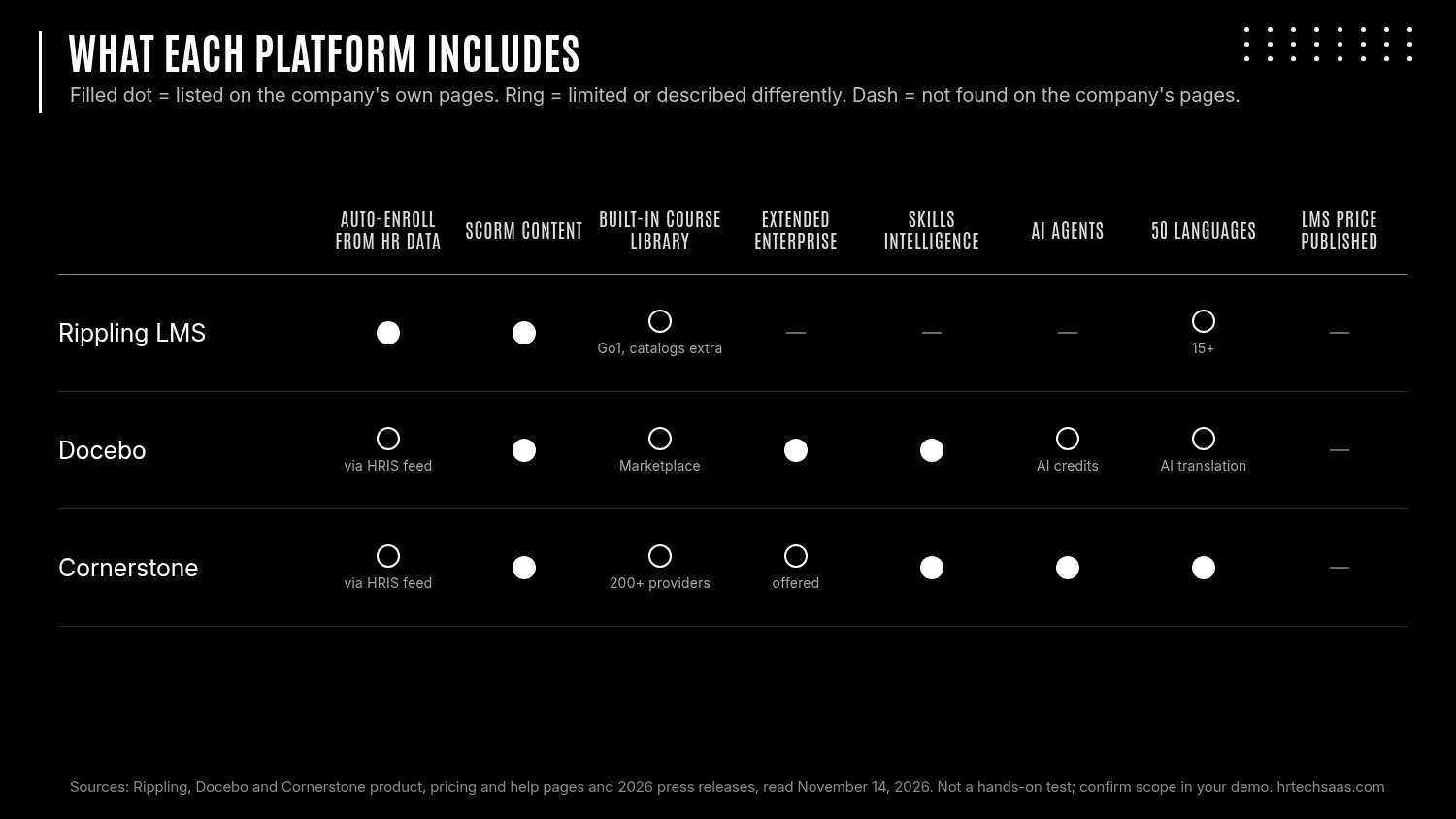
The chart summarizes which capabilities each vendor lists on its own pages. A ring means the feature exists in a narrower form or costs extra.
How Much Do Rippling LMS, Docebo and Cornerstone Cost?
No vendor publishes an LMS price, so compare billing units instead of guessing at list prices. Third-party sites circulate per-user estimates for all three; we could not trace any of them to the vendors, so we do not repeat them.
- Rippling says plans start at $8 per employee per month with a monthly base fee, and that most products are priced per employee per month (pricing FAQ). A Rippling blog roundup lists $12 PEPM as a starting figure for the HR system plus LMS. Course catalogs can add cost: buying both the US and global catalogs costs an additional fee, and Go1 courses are purchased.
- Docebo prices on your tier (Elevate or Enterprise) and active learners. You can choose monthly active, yearly active or registered active user models, admins are accounted for in the model, integrations count against an allowance, and AI usage runs on a shared credit pool or per seat (pricing FAQ).
- Cornerstone does not publish pricing and has no pricing page. Budget for users, each module you add, content subscriptions and implementation services.
How to make quotes comparable: ask each vendor to price the same scenario, for example 400 employees of whom 250 take training in a year, plus 2,000 external learners if that applies. Ask Rippling for the LMS as a separate line, Docebo for both monthly and yearly active user pricing, and Cornerstone for learning only versus learning plus skills.
Docebo vs Cornerstone: Which Is Better?
Docebo is better when learning is the main job and some of your learners sit outside the company; Cornerstone is better when learning has to connect to skills, performance and planning across a large workforce.
| Question | Docebo | Cornerstone |
|---|---|---|
| Core identity | Learning platform with skills intelligence added (365Talents) | Talent suite with learning at its center |
| External audiences | Extended enterprise up to 10 domains (Enterprise) | Supported, less central to the pitch |
| Content | Content Marketplace and AI authoring | 200+ content providers plus third-party libraries |
| Standards | SCORM 1.2, SCORM 2004 3rd Edition (no sequencing), xAPI; 400+ integrations | SCORM, AICC and xAPI |
| 2026 AI | Docebo Agents, Knowledge, Roleplay; AI credits | Adaptive Learning Agent, Course Assistant, Workforce AI, Agent Ready |
| Pricing model shown | Tier plus active users; AI credits | Custom quote only |
For a wider view of Docebo against learning experience platforms, see Degreed vs Docebo vs 360Learning, and for Cornerstone in a skills and mobility context, see Cornerstone vs Degreed vs Gloat.
When Is Rippling Learning Management Enough?
Rippling LMS is enough when training is mostly assigned, tracked and repeated, not designed and measured. That covers most onboarding, annual compliance and policy acknowledgement programs at small and mid-sized companies.
- You already pay for Rippling HRIS and want one vendor.
- Your courses are mostly off-the-shelf compliance plus a handful of internal videos or SCORM files.
- You do not need to train customers, partners or franchisees.
- Nobody on your team owns a learning strategy, skills framework or learning analytics.
Move up to Docebo or Cornerstone when one of those stops being true. For compliance-heavy programs specifically, compare our best compliance training platforms; for shift workers, see the best frontline training platforms.
What Does Implementation Look Like?
Rippling is the lightest lift because the people data is already there; Docebo and Cornerstone are separate systems that need HRIS, single sign-on and content set up. None of the three publishes a fixed implementation timeline, so ask for one in writing.
- Rippling: switch on the module, choose catalogs, set assignment rules by role, department, location or tenure, and upload SCORM or build courses. Check how rules behave when people move teams or states.
- Docebo: its pricing FAQ says every package includes a defined onboarding and support experience, with professional services for complex implementations, migration and custom integrations. Confirm which HRIS and SSO connections are inside your integration allowance.
- Cornerstone: plan for connectors or APIs to your HRIS, video and content providers, plus configuration of certifications, paths and reporting. Scope learning first and add skills or planning later if budget is tight.
Our HR system integration guide covers the data mapping questions to settle before any LMS rollout.
What Changed at Each Company in 2026?
| Date | Company | What happened |
|---|---|---|
| January 6, 2026 | Cornerstone | ISO/IEC 42001 certification for responsible AI management |
| January 20, 2026 | Docebo | Acquired 365Talents (skills intelligence and internal mobility) |
| March 16, 2026 | Cornerstone | Spring 2026 release: AI-Powered Course Assistant and Adaptive Learning Agent |
| May 20, 2026 | Cornerstone | Cornerstone Workforce AI with the People Graph and a Skills Engine covering 55,000+ skills |
| October 19, 2026 | Cornerstone | Workforce Planning and Agent Ready launched at HR Tech 2026 |
| November 6, 2026 | Docebo | Q3 2026 results: ARR $261.5 million (up 11.0%), average contract value $77.9 thousand |
Rippling did not issue a learning-specific 2026 announcement we could find; its product page now highlights AI-powered course search and the 80,000+ Go1 library.
Questions to Ask in Every Demo
- Price my exact scenario: total employees, expected active learners, and any external learners. What happens when we exceed it?
- Which catalogs, content libraries and AI features are included, and which are add-ons or credit-based?
- Show a new hire in a new state being enrolled automatically, and show what happens when they change role.
- Which HRIS, SSO and video integrations are included in our plan, and which cost extra?
- Can we import our existing SCORM and xAPI courses with completion history?
- What does reporting look like for a manager, an HR admin and an auditor?
- What is the contract length, renewal uplift and price protection?
Alternatives Worth a Look
If none of the three fits, our 12 best corporate LMS platforms covers lighter and cheaper options. To decide whether you need an LMS, an LXP or a skills platform at all, read LMS vs skills intelligence platform and our overview of corporate learning technology. If skills data is the real goal, start with our guide to skills intelligence software.
Frequently Asked Questions
Is Rippling LMS better than Docebo?
For Rippling customers whose training is mostly onboarding and compliance, Rippling LMS is usually the easier choice because it assigns courses from the HR record with no integration. Docebo is better when learning is a full program, needs deeper authoring and analytics, or must reach customers and partners.
Can you buy Rippling LMS on its own?
No. Rippling Learning Management is a product on the Rippling platform. Rippling says plans start at $8 per employee per month with a monthly base fee, and the total depends on the products you choose, so you need the core platform to use the LMS.
How much does Docebo cost?
Docebo does not publish prices. Its pricing page says cost depends on your plan tier, Elevate or Enterprise, and active learner usage, with monthly active, yearly active or registered active user models. AI usage runs on a shared credit pool or a per-seat option.
Does Cornerstone publish pricing?
No. Cornerstone has no pricing page; its pricing address redirects to the LMS product page. Pricing is quoted based on users, modules, content subscriptions and services.
Which is best for training customers and partners?
Docebo. Its Enterprise plan lists extended enterprise across up to 10 domains and a branded mobile app. Rippling LMS is built for employees, and Cornerstone supports external audiences but focuses on workforce learning and talent.
Do these platforms support SCORM?
Yes. Rippling lets you upload SCORM packages, Cornerstone names SCORM, AICC and xAPI support, and the Docebo help center lists SCORM 1.2, SCORM 2004 3rd Edition (without sequencing) and xAPI. Confirm completion data migrates if you switch systems.
Docebo vs Cornerstone: which is better for a large enterprise?
Cornerstone fits large or regulated enterprises that want learning tied to skills, performance and workforce planning in one suite. Docebo fits large companies that want a learning-first platform, external academies and flexible active-user pricing alongside a separate HR suite.
The Bottom Line: Match the Platform to Your Training Program
Pick Rippling LMS to automate onboarding and compliance on the platform you already run, Docebo to build a learning program for employees and external audiences, and Cornerstone to tie learning to skills and talent decisions at scale.
Whichever way your Rippling LMS vs Docebo vs Cornerstone shortlist leans, price the same learner scenario with each, ask what is add-on versus included, and test enrollment as a new hire would. For the wider market, see our full guide to the best corporate LMS platforms.