
- Most acquirers treat HR due diligence as a legal checklist item. It is not. People liabilities, benefits gaps, and retention risk are deal-value issues that surface after close, when fixing them costs three to five times more than catching them in diligence.
- Outside counsel reviews contracts. HR due diligence consultants review workforce economics, leadership dependency, culture fit, and day one readiness. Both are necessary. They are not the same job.
- The best HR M&A advisory firms combine people-side financial modeling with operational playbooks for day one, benefits harmonisation, and TSA exit. Generalist management consultants rarely have all three.
- Firm selection depends on deal size, complexity, and whether you need carve-out advisory, integration management, or both. This list covers six firms that specialize in exactly this work.
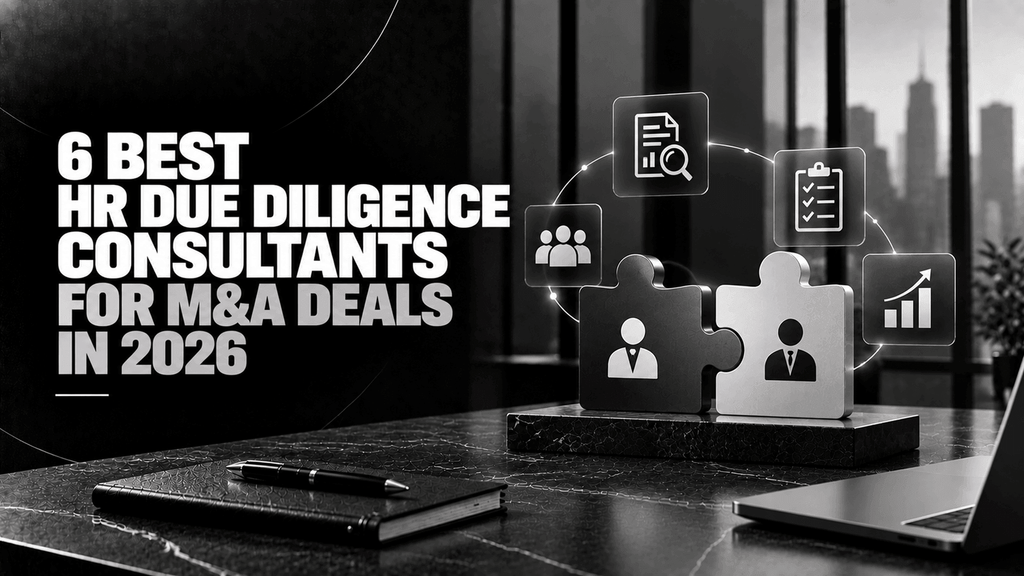
The best HR due diligence consultants for M&A include Mercer, Willis Towers Watson, Aon, Gallagher HR Consulting, Conduent HR Transformation, and Deloitte Human Capital. Each handles people diligence differently, with varying depth across benefits liability, workforce analytics, culture assessment, and day one operational readiness. The right choice depends on deal size, geographic scope, and how much integration management you need beyond the diligence report itself.
Why HR Due Diligence Is Not the Same as Legal Review
Corporate development teams and outside counsel are trained to find contractual exposure. Change-in-control provisions, severance obligations, WARN Act triggers, non-competes: these are legal documents and lawyers handle them well. What they do not model is the people cost of integration.
Consider what a law firm review will miss. Benefits harmonisation costs when a target’s workforce is on richer medical plans than the acquirer’s. Retention liability when three key revenue leaders hold unvested equity that accelerates on a sale. Culture misalignment that drives voluntary attrition among the engineers you paid a premium to acquire. These are financial exposures disguised as HR topics.
A specialist HR due diligence firm quantifies those exposures before the purchase price is set. That is the core argument for bringing them in early, not after signing. If you are evaluating your broader HR technology stack alongside a transaction, the best HRIS implementation partners for mid-market companies covers firms that handle post-close system consolidation, which is a related but separate problem.
What Should an HR Due Diligence Engagement Actually Cover?
Before evaluating firms, you need a clear scope of what people diligence looks like when done properly. A credible engagement covers six workstreams.
- Employee liability review: headcount reconciliation, employment contract terms, pending or threatened litigation, worker classification risks, and WARN Act exposure.
- Benefits benchmarking and harmonisation: side-by-side comparison of medical, dental, vision, retirement, and perquisites. Quantifies the cost delta and identifies any benefits that must be maintained contractually post-close.
- Compensation analysis: base, bonus, and equity structures across both organizations. Identifies compression issues, above-market outliers, and the cost of bringing the target workforce into the acquirer’s bands.
- Retention risk assessment: identifies key-person dependencies, flight risks, and whether retention agreements are needed and at what cost.
- Culture assessment: leadership style analysis, engagement data review, and an honest comparison of operating norms. Firms that skip this and call it “soft” consistently underperform on post-close retention.
- Day one readiness and TSA planning: what HR processes, systems, and support structures must be operational on close day, and which can run under a transition services agreement until full integration completes.
Firms that offer all six, with dedicated practitioners for each, are worth the premium over generalist advisors who handle people diligence as an add-on to financial or operational work.
Which Firms Specialize in HR M&A Integration Consulting?
A note on scope: this list deliberately omits Alvarez and Marsal and FTI Consulting. Both are credible in the restructuring and transaction advisory space and have people-side practices. Neither was included here because their HR M&A capabilities are harder to assess on a standalone basis from public information. If either firm wants to make the case for inclusion, the editorial process is straightforward.
| Firm | Best For | Diligence Depth | Integration Execution | Carve-Out Advisory |
|---|---|---|---|---|
| Mercer | Large-cap and cross-border deals | Very deep | Strong | Strong |
| Willis Towers Watson | Benefits-heavy diligence | Deep on benefits/actuarial | Moderate | Moderate |
| Aon | Total rewards and risk quantification | Deep on comp/equity | Moderate | Moderate |
| Gallagher HR Consulting | Mid-market and PE-backed deals | Solid across all six workstreams | Strong | Growing |
| Conduent HR Transformation | Large-enterprise TSA and HR ops carve-outs | Moderate | Very strong (process/tech) | Very strong |
| Deloitte Human Capital | Complex integrations with HRIS consolidation | Strong | Very strong | Strong |
Mercer: The Default for Cross-Border and Large-Cap Deals
Mercer is the most recognized name in HR M&A advisory for a reason: global reach, deep actuarial bench, and decades of experience across benefits, compensation, and workforce strategy. For transactions that span multiple countries, Mercer’s local presence in over 130 markets means country-specific employment law and benefits analysis is done by practitioners who know those markets, not by generalists reading a desk guide.
Their M&A practice covers the full diligence lifecycle. Pre-letter-of-intent workforce strategy, data room review, culture assessment, and post-close integration management are all in scope. The firm publishes research on M&A people risk that its own practitioners use as a baseline, which means the methodology is documented and auditable rather than ad hoc.
The trade-off is cost and process weight. Mercer engagements at the large-cap level are not light-touch. For a mid-market deal under $200M, the overhead can feel mismatched. Smaller buyers should have an honest scope conversation before signing an engagement letter.
Willis Towers Watson: Best When Benefits Liability Is the Biggest Unknown

Willis Towers Watson (now WTW) brings the strongest actuarial depth of any firm on this list for defined benefit pension plans, post-retirement medical liabilities, and self-insured health plan exposure. If the target company carries a legacy defined benefit plan, an under-funded retiree medical obligation, or a complex captive insurance structure, WTW is the right first call.
Their benefits harmonisation work is quantitative and specific. They will model the total cost delta between the two companies’ benefit plans, project it over a three-year integration horizon, and flag which provisions carry contractual or collective bargaining constraints. That level of specificity is rare.
Where WTW is thinner is on the cultural and organizational design side. The firm has strong compensation and benefits capability and adequate workforce strategy support. Buyers who need deep culture diagnostics or leadership assessment alongside benefits work typically pair WTW with a behavioral science or OD firm for the qualitative components.
Aon: Strongest on Executive Compensation and Equity Diligence
Aon’s human capital practice leads with compensation benchmarking, equity plan analysis, and executive pay diligence. In PE-backed transactions and public-to-private deals, where deal-contingent bonuses, management incentive plans, and rolled equity are structurally complex, Aon’s team has the experience to model payout scenarios and quantify total deal consideration allocated to management.
Aon also runs a strong transaction risk practice that bridges the gap between HR diligence and rep and warranty insurance. If your deal structure involves R&W coverage, Aon’s ability to provide underwriters with actuarial and compensation analysis from the same engagement reduces friction and rework.
Like WTW, Aon is weaker on integration execution than on diligence and analysis. The firm delivers a credible diligence report and cost model. Integration project management and day one readiness programs are possible but not Aon’s core strength at the field-execution level.
Gallagher HR Consulting: The Mid-Market Specialist Worth Calling First
Arthur J. Gallagher’s HR consulting practice is the most underrated firm on this list for mid-market and PE-backed deals in the $50M to $500M range. The firm covers all six diligence workstreams with a leaner team structure than Mercer or WTW, which typically means faster turnaround and closer senior-level involvement on smaller mandates.
Gallagher’s HR M&A work integrates directly with their benefits brokerage and administration business. For buyers who intend to migrate acquired employees onto their existing benefits programs, Gallagher can simultaneously advise on the diligence findings and own the subsequent open enrollment and plan migration. That continuity eliminates a common handoff problem where diligence findings never inform the integration team.
PE sponsors running multiple portfolio company add-on acquisitions in a year should evaluate Gallagher seriously. The firm can establish a repeatable diligence framework across the portfolio rather than scoping each deal from scratch. On carve-out advisory for divestitures, Gallagher’s capabilities are still maturing relative to Mercer or Deloitte, so for a complex multi-country carve-out, other options may warrant priority consideration.
Conduent HR Transformation: The Right Call for TSA-Heavy Carve-Outs
Conduent approaches HR M&A from the operations side rather than the advisory side. The firm’s HR transformation practice specializes in carve-out execution: standing up HR shared services, payroll processing, and HR technology operations for a divested entity that needs to function independently on day one.
When a carve-out target has been deeply embedded in the parent company’s shared services center, getting to operational independence requires more than a report. It requires someone who can actually build and run the replacement functions under a transition services agreement while the permanent model is constructed. Conduent does this work at scale.
Their diligence depth on compensation and benefits analysis is more moderate than Mercer or WTW. Conduent is not the right choice when the primary question is “what is this workforce worth.” They are the right choice when the primary question is “how do we make this workforce operational independently by close date.” For companies who need post-close systems support beyond the TSA period, the best Workday consulting firms covers implementation and optimization partners that handle HRIS consolidation after the carve-out structure is settled.
Deloitte Human Capital: Best for Complex Integrations That Include HRIS Consolidation
Deloitte’s Human Capital practice is the strongest choice when the transaction involves a major HR technology consolidation alongside the people diligence work. The firm combines M&A advisory capability with deep Workday, SAP SuccessFactors, and Oracle HCM implementation experience. A buyer planning to migrate the acquired company onto their own HRIS within 18 months will benefit from a firm that can design that migration path during diligence rather than treating it as a separate project after close.
Deloitte’s scale also means access to organizational design, change management, and culture integration practitioners within the same engagement. For transformational acquisitions where the combined company will look materially different from either predecessor, that breadth matters. The culture assessment methodology Deloitte deploys draws on proprietary research from their Human Capital Institute, which gives the qualitative components more structure than a typical leadership interview series.
Cost is the honest caveat. Deloitte is one of the more expensive options on this list, and their model tends toward larger teams. Buyers who want a senior practitioner-led engagement with minimal junior staff should negotiate team composition explicitly in the scope of work. For context on what a post-close HRIS implementation project typically involves separately, the HR software implementation checklist covers data migration, integrations, and rollout planning in detail.
How to Evaluate HR Due Diligence Consultants Before You Engage
The procurement process for HR M&A advisory should move faster than a typical consulting RFP because deal timelines do not wait. Three questions separate the right firm from a capable but mismatched one.
- Who will actually be in the data room? Firm-level credentials are less relevant than the specific team assigned to your deal. Ask for the lead partner’s deal sheet and the names of the next two people on the team. A senior partner with eight transactions in your industry beats a firm brand every time.
- Can they quantify the people liabilities, or just describe them? Ask for a sample output from a completed engagement. A good HR diligence report includes a financial model showing benefits harmonisation costs, retention agreement estimates, and headcount restructuring exposure. A report that only identifies issues without quantifying them is not diligence, it is a risk memo.
- What happens after the report? Many firms exit at report delivery. If you need integration project management, day one readiness support, or TSA oversight, confirm the firm can provide continuity of the same team through those phases. Starting over with a new firm at close is a predictable failure mode.
Buyers evaluating a broader set of HR technology and service decisions alongside an acquisition should also review the best people operations consultants for scaling companies, which covers ongoing HR advisory firms that support the integration period after the transaction closes.
What Does HR Due Diligence Cost?
All six firms on this list are quote-based. Pricing depends on deal size, target complexity, geographic footprint, and scope of work. None of these firms publish standard rates, and any figure quoted elsewhere without sourcing to a specific engagement should be treated skeptically.
What can be said qualitatively: diligence-only engagements for a single-country mid-market deal will cost less than multi-country carve-out advisory with integration project management. Large-cap transactions with actuarial work, executive compensation modeling, and full integration management will carry fees that reflect that complexity. Buyers should request a detailed scope of work and fee structure broken down by workstream, not just a total project estimate. That breakdown shows you where the budget is concentrated and where you can reduce scope if needed.
The firms most likely to be price-competitive on mid-market deals are Gallagher and Conduent. Mercer, WTW, Aon, and Deloitte tend to carry higher minimums, particularly when actuarial or technology practices are engaged alongside the HR advisory team.
Frequently Asked Questions About HR Due Diligence in M&A
What is people due diligence in an acquisition?
People due diligence is the structured review of a target company’s workforce economics, employment liabilities, benefits obligations, compensation structures, culture, and HR operational readiness. Unlike legal review, which focuses on contracts and compliance documents, people diligence quantifies the financial impact of workforce-related risks and identifies what needs to change on day one for the combined organization to function. It covers headcount, comp, benefits, retention risk, and HR systems. Done properly, it informs the purchase price and integration budget.
When should HR due diligence consultants be engaged in a deal process?
Before the letter of intent is signed if possible, and no later than when the data room opens. Engaging HR diligence consultants after signing limits your ability to negotiate price adjustments or restructuring representations based on what they find. The findings from a people diligence review often affect the purchase price, the structure of reps and warranties, and the size of escrow. Late engagement means findings become integration problems rather than deal terms.
What is the difference between HR carve-out advisory and HR M&A integration consulting?
Carve-out advisory focuses on divestitures, specifically on separating a business unit or subsidiary from its parent company and making it operationally independent. This involves standing up new HR processes, payroll, benefits administration, and systems from scratch under a transition services agreement. Integration consulting, by contrast, is about combining two existing organizations into one. The skills overlap but the orientation differs: carve-out work is about independence, integration work is about convergence. Some firms, like Conduent and Deloitte, handle both well. Others specialize in one.
What is a transition services agreement (TSA) in an HR context?
A transition services agreement is a contract between buyer and seller under which the seller continues to provide HR services to the acquired or divested entity for a defined period after close. This typically covers payroll processing, benefits administration, HRIS access, and HR help desk support. TSAs are common in carve-outs where the acquired entity cannot stand up independent HR operations by day one. The goal is to exit the TSA as quickly as possible, because TSA costs erode deal economics and the acquirer loses control of HR operations until it exits.
How is benefits harmonisation handled post-close?
Benefits harmonisation is the process of aligning the target company’s employee benefit plans with the acquirer’s plans. This includes medical, dental, vision, life insurance, disability, and retirement plans. The process starts during diligence when both plan designs are compared and cost deltas are modeled. Post-close, harmonisation typically happens at the next open enrollment cycle unless immediate alignment is required by the transaction documents. Employees on richer plans will almost always view harmonisation negatively, so communication strategy and any temporary hold-harmless commitments are part of the planning work.
Do I need a separate HR consultant if I already have an investment bank and law firm on the deal?
Yes. Investment banks model financial performance and market position. Law firms review contracts and regulatory compliance. Neither profession is trained to quantify benefits liabilities, model retention agreements, assess culture risk, or design day one HR operations. The people cost of an acquisition, when it surprises a buyer post-close, typically shows up in retention attrition, benefits cost overruns, and integration delays. These are preventable if the right advisor is engaged during diligence. Legal and banking fees do not substitute for specialist HR M&A advisory.
What is day one readiness in an HR M&A context?
Day one readiness means that on the closing date, every employee of the acquired company receives their paycheck correctly, can access their benefits, knows who their manager is, and has access to the tools they need to do their job. For HR teams, this means payroll files are loaded, benefit carrier connections are live, employee records are transferred to the acquirer’s HRIS, and a communication plan has been executed. Failures on day one create immediate employee relations problems that undermine retention. HR due diligence consultants who include day one planning in their scope prevent the most visible and damaging integration failures.
The Case for Treating HR Diligence as Deal Infrastructure
The framing that HR due diligence is a support function during a transaction, handled by whoever has bandwidth on the corporate development team, produces predictable outcomes. Benefits liabilities get missed. Key person dependencies get underpriced. Integration costs exceed the model. Attrition in the acquired workforce erodes the synergies the deal was built to capture.
Buyers who engage specialist HR M&A consultants before signing treat people risk the same way they treat financial risk: systematically, with a professional who has seen the same problems across dozens of transactions. The six firms on this list have that experience. The right one for your deal depends on size, complexity, and whether diligence alone or end-to-end integration management is what you need. The HRIS implementation partners hub covers the technology side of the post-close equation for teams that need to consolidate HR systems as part of integration.
The most consistent mistake in mid-market M&A is assuming that a strong HR team on the acquirer’s side can absorb people diligence as an internal workstream. Internal HR teams know their own company. They do not have the cross-deal benchmarks, the actuarial models, or the TSA design experience that specialist advisors carry. Bring them in early, scope them correctly, and the engagement pays for itself before close.