
HR Tech SaaS may earn a commission when you buy through links on this page. Our recommendations are editorial and never paid for.
- Microsoft Viva Insights is adequate when you need basic collaboration and wellbeing nudges inside the Microsoft 365 environment, but it was not designed for strategic workforce analytics.
- Standalone alternatives give you deeper attrition modeling, org network analysis, headcount planning, and cross-system data connections that Viva cannot reach.
- The best alternative depends on whether your priority is collaboration patterns, employee sentiment, headcount forecasting, or all three combined.
- Most listed tools are quote-based for enterprise; a few publish transparent per-seat pricing that makes budgeting easier.
- Privacy architecture matters as much as feature depth. The right tool should aggregate and anonymize at the team level, not expose individual behavior.
The best Microsoft Viva Insights alternatives for workforce and employee experience analytics are Worklytics, Visier, Qualtrics XM, Culture Amp, Peakon (Workday), Glint (LinkedIn), Lattice, Orgvibe, Humanyze, and Erudit. Each goes deeper than Viva in at least one critical dimension, whether that is people analytics, sentiment measurement, or collaboration science.
Viva Insights launched as a productivity and wellbeing tool built on Microsoft Graph data. It shows focus time, meeting load, and some manager-team connection metrics. For teams already paying for Microsoft 365, it feels free. The problem is that it was never designed to answer the questions boards and CFOs are actually asking: why is attrition spiking in this function, which managers predict voluntary exits six months out, and how does headcount mix drive margin? Those answers require sources beyond Outlook and Teams, and they require analytical depth Viva does not have. If your people strategy depends on Viva as your primary analytics source, you are working with one hand tied behind your back.
What Does Microsoft Viva Insights Actually Do, and Where Does It Fall Short?
Viva Insights pulls from Microsoft 365 signals: email, calendar, Teams messages, and meeting metadata. It surfaces individual wellbeing nudges, manager effectiveness signals, and some organizational-level collaboration patterns. The personal dashboard helps individual contributors reflect on their own work habits. The manager and leader dashboards show aggregated team-level patterns.
The gaps are structural, not cosmetic. Viva Insights cannot ingest HRIS data from non-Microsoft systems to build attrition risk models. It does not do headcount scenario planning or skills gap analysis. Sentiment measurement is absent unless you layer in Viva Glint, which is a separate product with separate licensing. And because the data model is built entirely on Microsoft Graph, any organization running Slack, Zoom, or Google Workspace for core communication gets a blind spot by design.
Microsoft retired Viva Goals in late 2024, collapsing several Viva modules and creating real uncertainty about the product’s direction. Teams evaluating Viva as a long-term people analytics foundation should take that product history seriously before deepening the investment.
How to Evaluate Viva Insights Competitors Before You Shortlist
Before comparing tools, decide which analytical problem you are actually trying to solve. Workforce analytics tools cluster into three distinct categories that are often confused with each other.
Collaboration analytics platforms (Worklytics, Humanyze, Orgvibe) measure how work actually happens across communication tools. They answer questions about meeting overload, cross-team connectivity, and manager span of control.
People analytics platforms (Visier, One Model, Orgnostic) connect HRIS, ATS, payroll, and performance data to model attrition, DEI trends, compensation equity, and workforce cost. This is where the strategic workforce planning lives.
Employee listening platforms (Culture Amp, Glint, Qualtrics XM, Peakon) measure sentiment through surveys and correlate it with operational outcomes. Some now layer passive signal analysis on top of survey data.
Viva Insights sits awkwardly between collaboration analytics and a thin version of employee listening. Most companies replacing it need to pick a lane, or deliberately combine tools. For a fuller picture of how these categories differ, the breakdown on people analytics vs workforce analytics vs talent intelligence is worth reading before you shortlist.
The 10 Best Microsoft Viva Insights Alternatives
1. Worklytics
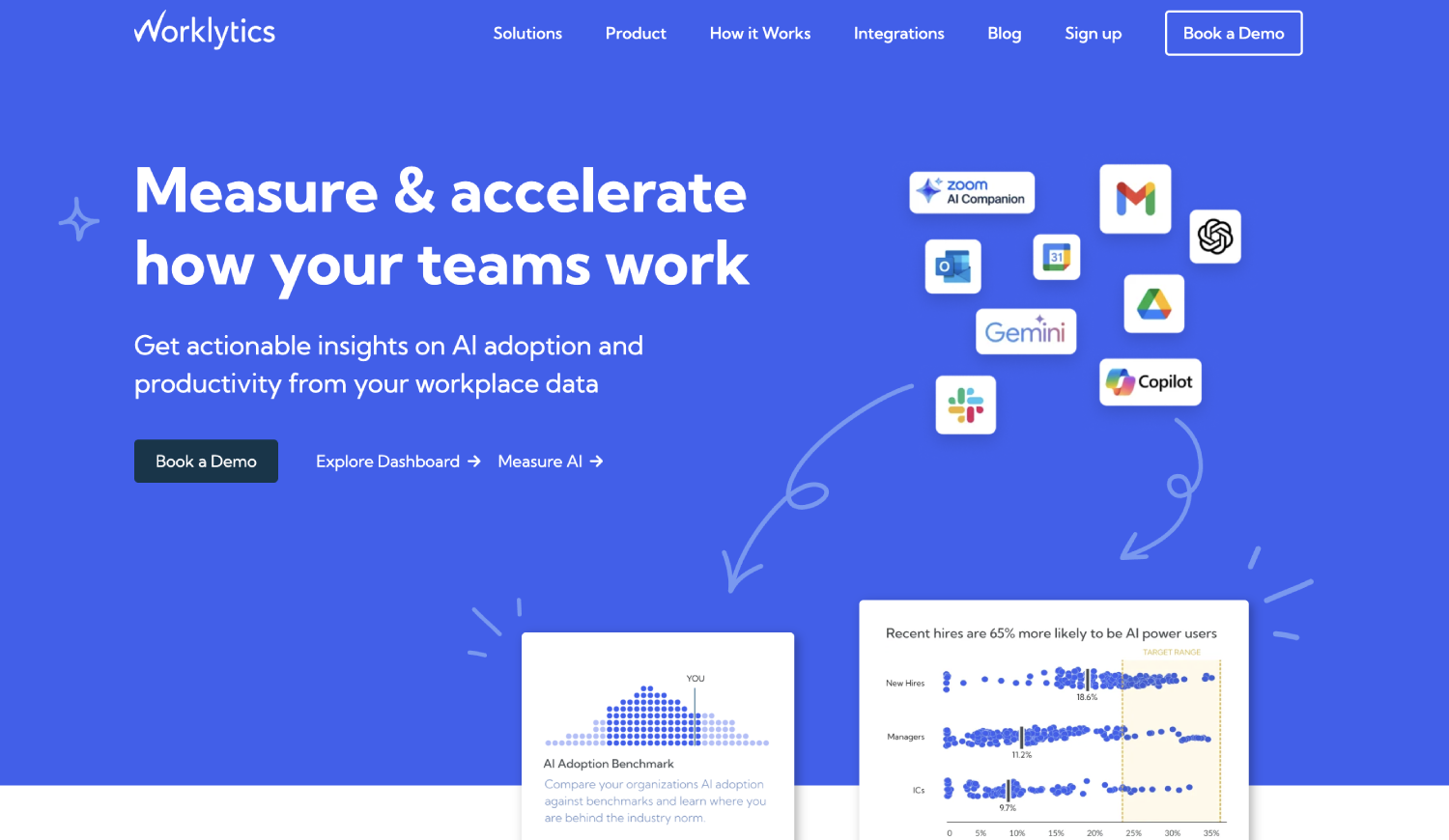
Worklytics is the most direct substitute for Viva Insights’ collaboration analytics layer. It connects to Google Workspace, Microsoft 365, Slack, Zoom, Jira, and GitHub, so it is not limited to Microsoft Graph data. That cross-tool view is its primary structural advantage over Viva.
The platform is built on a privacy-first model: it aggregates data at the team level and does not expose individual-level behavioral logs to managers or HR. Hashed pseudonymization happens at the source before any data reaches Worklytics’ servers. For organizations with European employees or strong privacy sensitivities, this architecture matters. Pricing is quote-based.
Best for: organizations running mixed communication stacks (Office 365 plus Slack or Google Workspace) that want collaboration analytics without the Microsoft lock-in.
2. Visier
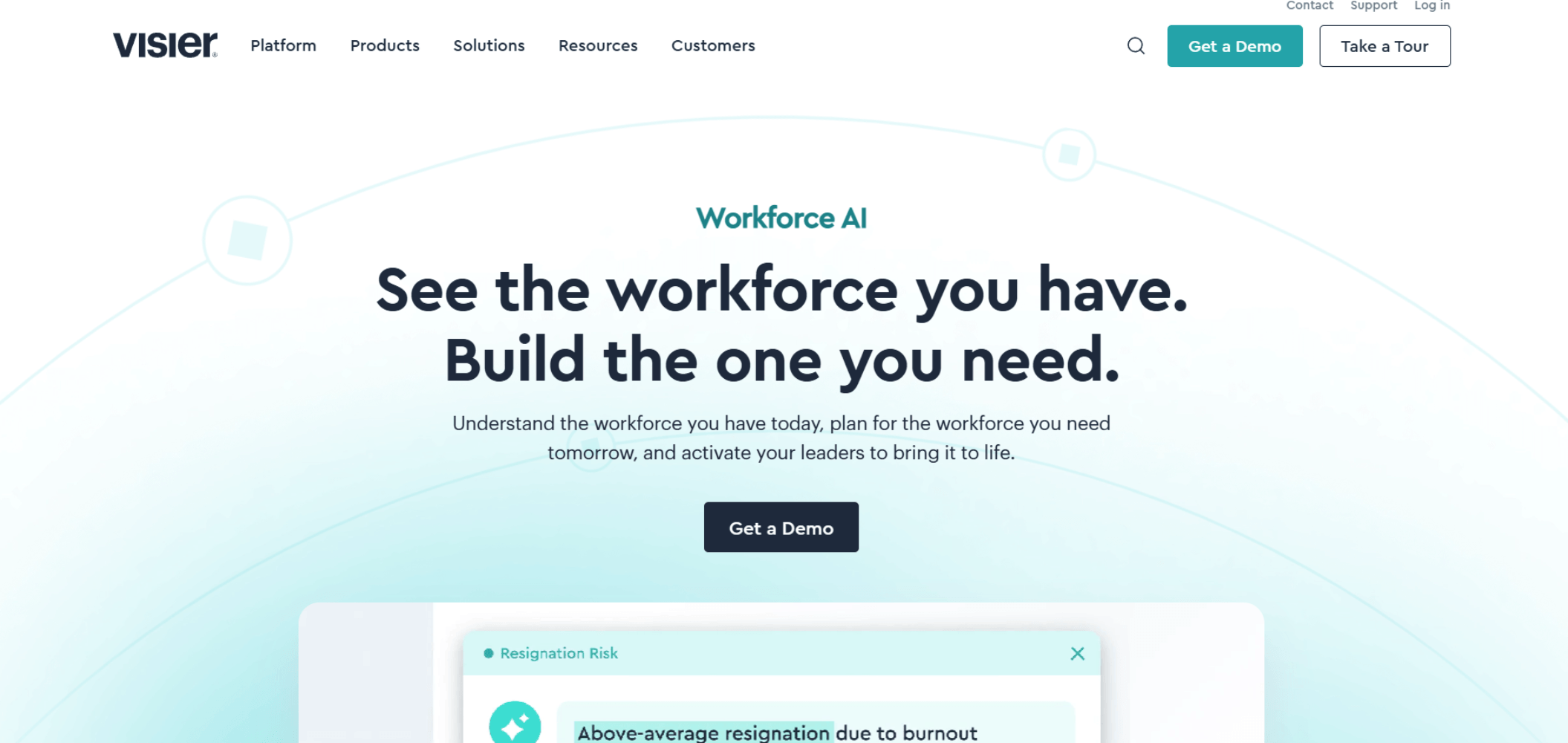
Visier is the category leader for people analytics platforms. It connects to virtually every major HRIS, ATS, and payroll system and builds a unified workforce data model that Viva cannot approach. Attrition prediction, headcount planning, compensation equity analysis, and DEI dashboards are all native.
The platform is designed for HR leaders presenting to boards and CFOs, not just people ops teams running reports. Visier’s benchmarking database, built across its customer network, lets you compare your attrition rate or manager span against industry peers. Pricing is quote-based and scales with headcount, typically deployed at companies with over 1,000 employees. For companies evaluating this category seriously, our guide to the best AI people analytics platforms covers Visier alongside its closest competitors.
Best for: mid-market and enterprise HR teams that need strategic workforce planning, not just collaboration signals.
3. Qualtrics XM for Employee Experience
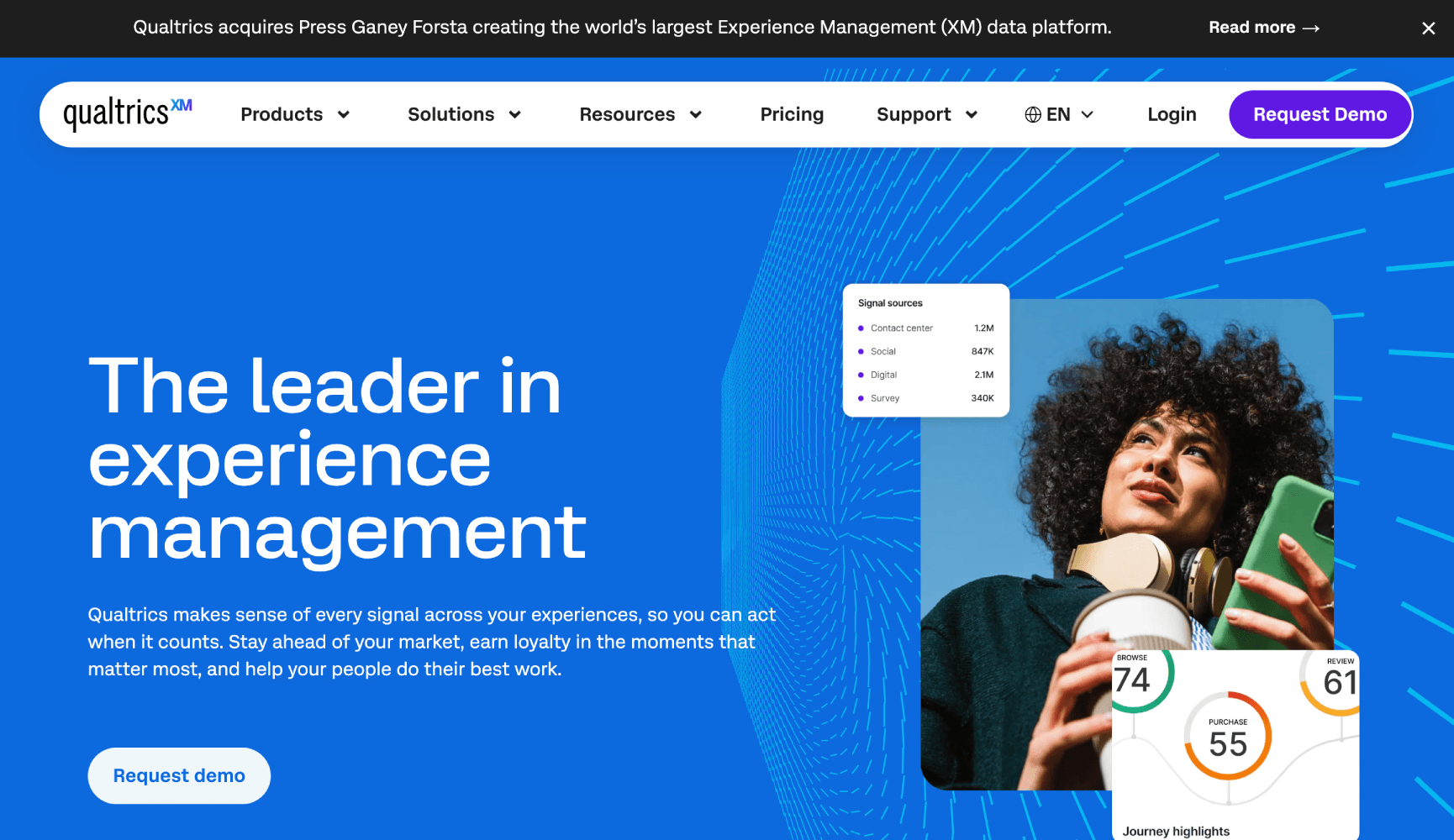
Qualtrics XM takes the listening approach and adds predictive analytics on top. Its iQ engine runs sentiment analysis and topic clustering on open-text survey responses, surfacing themes HR leaders would otherwise miss in manual review. It connects engagement data to operational outcomes like turnover and productivity through the EmployeeXM dashboard.
Qualtrics’ breadth is its strength and its complexity. Implementation takes time. The platform is built for organizations that take employee listening seriously as a strategic function, not as an annual survey checkbox. Pricing is quote-based.
Best for: enterprise teams with dedicated people analytics or HR insights functions that want survey science at the highest depth combined with predictive modeling.
4. Culture Amp
Culture Amp is the mid-market-friendly alternative to Qualtrics in the employee listening space. It covers engagement surveys, onboarding surveys, exit surveys, and 360-degree feedback within one platform. The analytics layer correlates engagement scores with attrition risk, giving HR teams a leading indicator rather than a lagging report.
Culture Amp’s benchmarking database spans a large network of companies, making peer comparisons meaningful. It integrates with most major HRIS platforms including BambooHR, Workday, and HiBob. Pricing is quote-based and typically accessible for companies between 200 and 2,000 employees. Culture Amp also surfaces to our people analytics add-ons for Lattice, BambooHR, and HiBob for teams building a layered analytics stack.
Best for: mid-market HR teams that want a strong employee listening foundation with enough analytics depth to drive real decisions.
5. Glint (LinkedIn)
Glint, now part of LinkedIn, focuses on continuous employee listening with real-time feedback loops. Its manager experience layer is particularly strong: it gives frontline managers team-level insights and suggested actions, which is where Viva Insights claims to operate but rarely delivers meaningful guidance.
The Microsoft ownership creates an interesting dynamic. Glint integrates naturally with Microsoft 365 and Viva, so some organizations run both. But as a standalone replacement for Viva Insights’ employee experience layer, Glint’s survey science and action planning framework is materially stronger. Pricing is quote-based.
Best for: organizations already invested in LinkedIn Talent Solutions or the Microsoft stack that want deeper employee listening than Viva Insights provides natively.
6. Peakon (Workday Peakon Employee Voice)
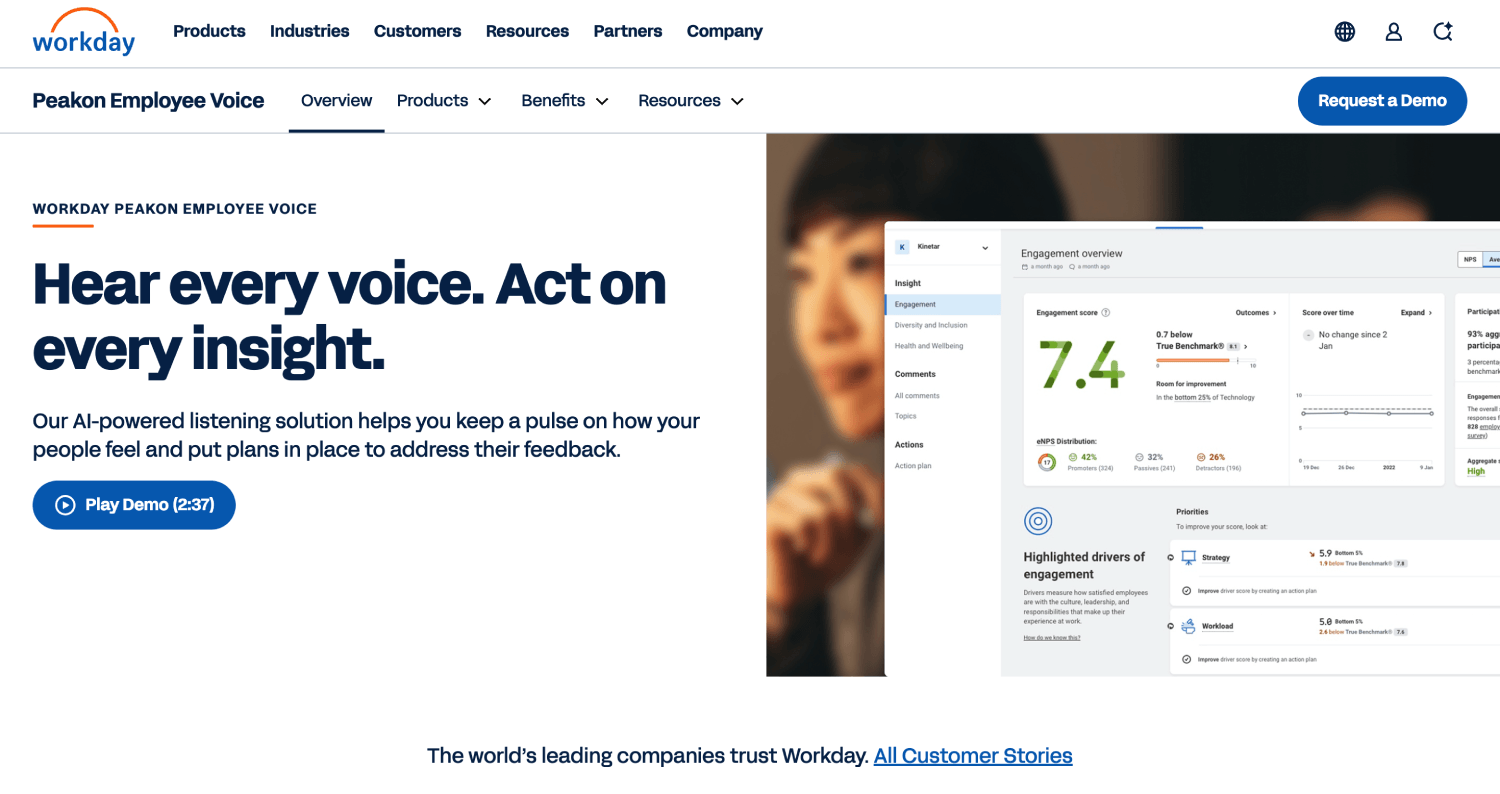
Workday Peakon Employee Voice runs continuous listening through frequent short-pulse surveys and uses machine learning to predict attrition risk at the individual and team level before it shows up in exit data. The attrition prediction model is one of the more validated in this space.
For organizations already running Workday HCM, Peakon integrates natively and shares a data model, which eliminates the connector overhead that plagues standalone tools. For non-Workday shops, it still operates independently. Pricing is quote-based.
Best for: Workday HCM customers who want continuous listening and attrition prediction without adding another system integration project.
7. Lattice
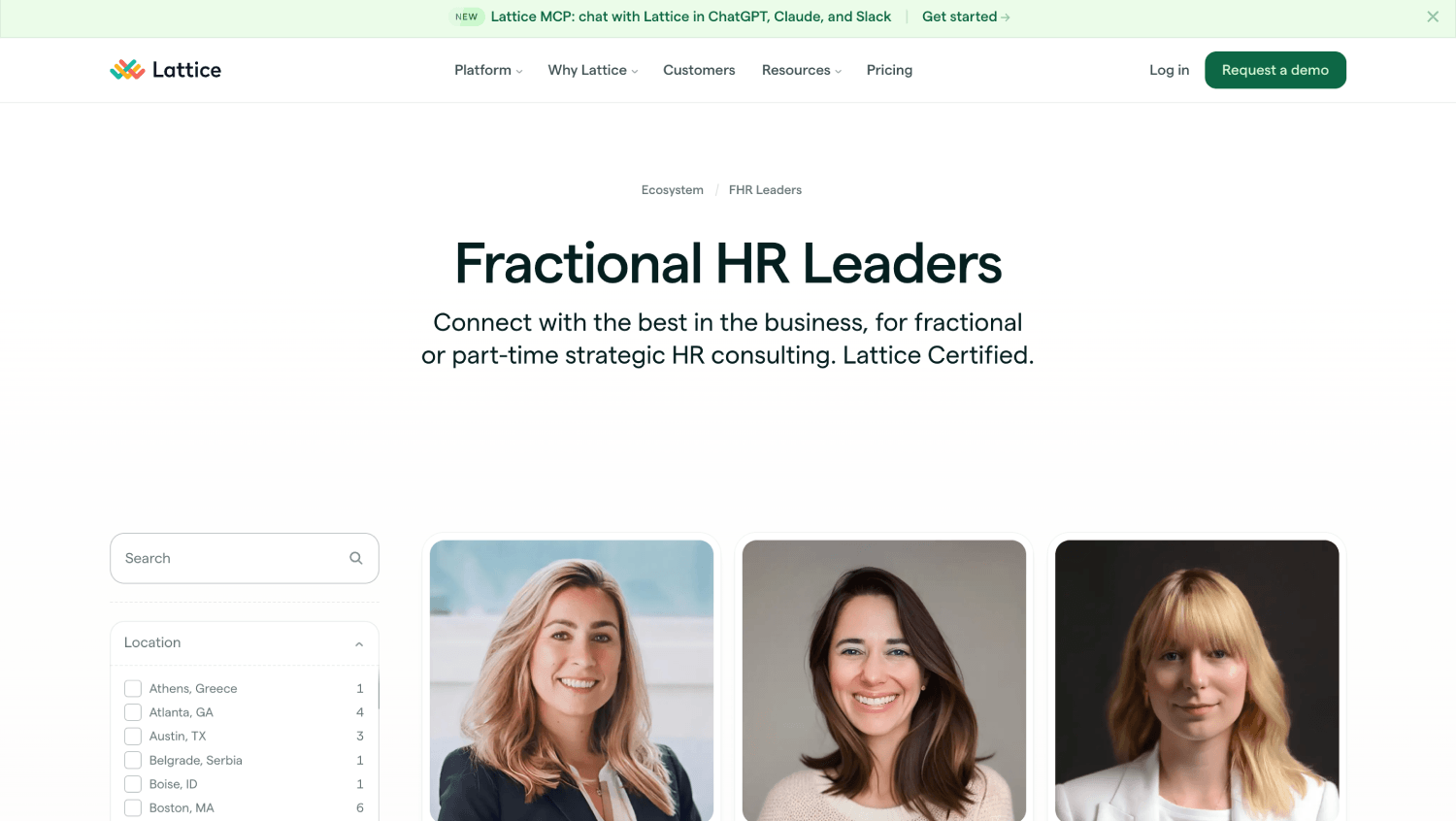
Lattice covers performance management, engagement surveys, career development, and a growing analytics layer within one platform. Its analytics are not as deep as Visier for workforce planning, but for companies that want performance data, engagement data, and goal tracking in one place, Lattice removes the integration overhead of combining separate tools.
According to Lattice’s public pricing page, plans start at $11 per person per month for performance management, with engagement surveys available as an add-on module. That transparent pricing makes budget conversations easier than with most enterprise analytics tools. For teams considering other options in this tier, the best Lattice alternatives for mid-market HR teams covers the competitive set.
Best for: mid-market companies (200 to 1,000 employees) that want performance and engagement in one system without enterprise analytics complexity.
8. Orgvibe
Orgvibe focuses on organizational network analysis (ONA) and team-level collaboration analytics. It maps informal influence networks, identifies collaboration bottlenecks, and surfaces which teams are over-indexed on meetings versus deep work. The visualization layer makes it genuinely useful for executives who want to understand how work actually flows across the organization.
Orgvibe connects to Microsoft 365, Google Workspace, and Slack. It positions itself as privacy-safe, working with aggregated team data rather than individual surveillance. Pricing is quote-based.
Best for: CHROs and organizational design teams that want to understand org network dynamics and reduce structural meeting overhead.
9. Humanyze
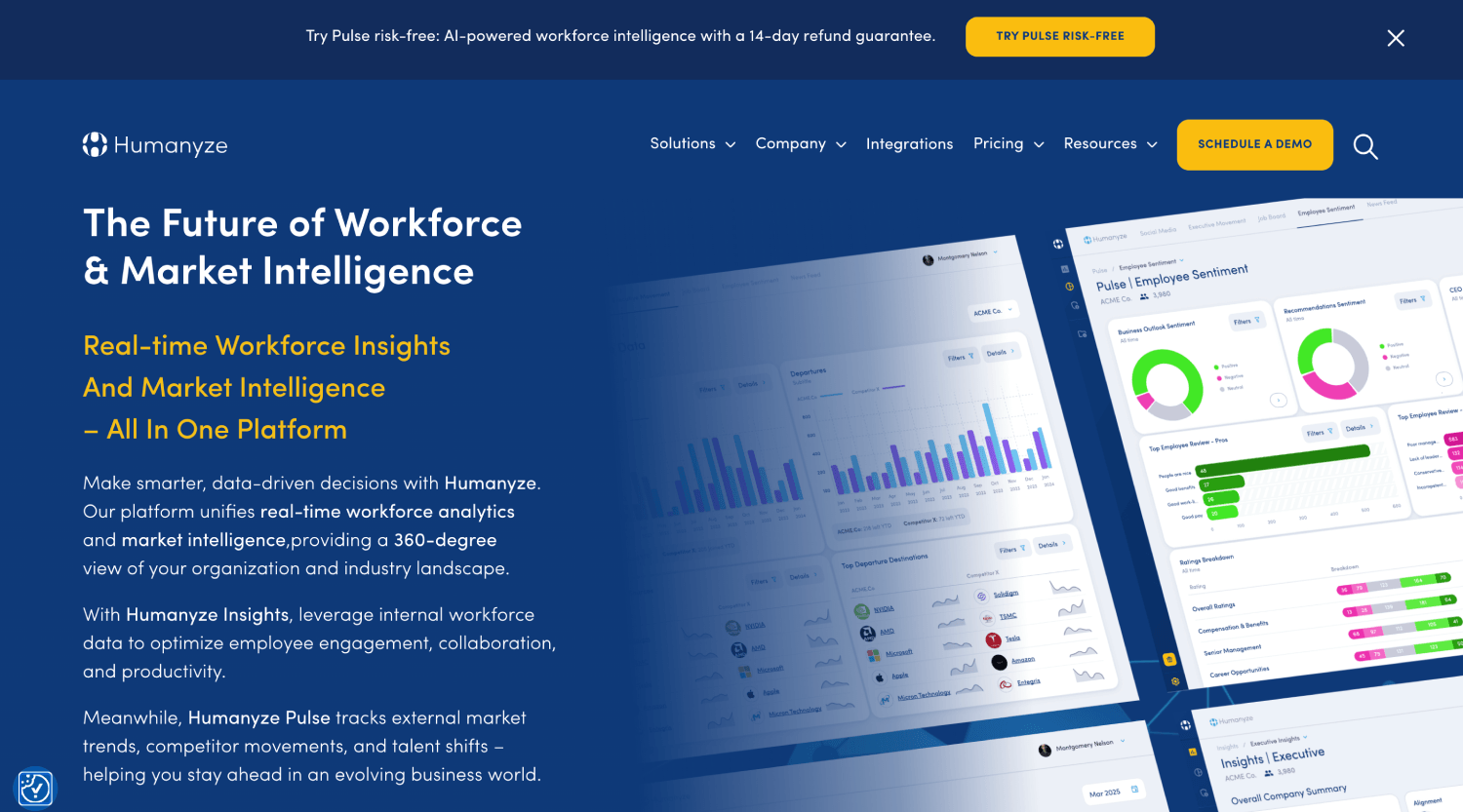
Humanyze sits at the intersection of collaboration analytics and organizational design. It started with sensor-based workplace analytics and evolved into a platform that models org health by correlating communication patterns with productivity and retention outcomes. Its Organizational Business Intelligence layer connects digital collaboration data to business metrics.
Humanyze is more sophisticated and more expensive than most collaboration analytics tools. It is best suited for companies running significant change management programs (mergers, reorgs, hybrid work transitions) where understanding communication pattern shifts matters. Pricing is quote-based.
Best for: enterprise teams managing large-scale organizational change who need evidence about whether the new structure is actually working.
10. Erudit
Erudit takes a different approach: it uses passive NLP analysis of communication data (with employee consent) to surface burnout risk, engagement trends, and turnover likelihood without survey fatigue. Rather than asking employees how they feel, it infers signals from the tone and patterns in their communications.
The consent and privacy model is critical here. Erudit is explicit about working on aggregated, anonymized data and positions the tool as an early warning system rather than individual monitoring. For privacy-skeptical organizations, the distinction between monitoring and analytics is worth scrutinizing in any vendor conversation. The broader question of where that line sits is covered in our article on employee monitoring vs workforce analytics.
Best for: teams that want continuous passive listening without increasing survey frequency, particularly in high-burnout industries like healthcare or financial services.
Side-by-Side Comparison: Viva Insights vs the Top Alternatives
| Platform | Primary Use Case | Data Sources Beyond M365 | Attrition Prediction | Survey / Listening | Pricing Model |
|---|---|---|---|---|---|
| Microsoft Viva Insights | Collaboration wellbeing | No (M365 only) | No | Via Glint add-on | Included with M365 plans |
| Worklytics | Collaboration analytics | Yes (Slack, Zoom, Google, Jira) | No | No | Quote-based |
| Visier | People analytics / workforce planning | Yes (HRIS, ATS, payroll) | Yes | Limited | Quote-based |
| Qualtrics XM | Employee experience / listening | Yes (HRIS integrations) | Yes (via iQ) | Yes (advanced) | Quote-based |
| Culture Amp | Engagement / performance | Yes (HRIS integrations) | Partial | Yes | Quote-based |
| Glint (LinkedIn) | Continuous listening | Yes (M365, HRIS) | Partial | Yes | Quote-based |
| Peakon (Workday) | Continuous listening / attrition | Yes (Workday native + others) | Yes | Yes | Quote-based |
| Lattice | Performance + engagement | Yes (HRIS integrations) | Partial | Yes | From $11/person/mo |
| Orgvibe | Org network analysis | Yes (Slack, Google, M365) | No | No | Quote-based |
| Humanyze | Org design / change management | Yes (multi-channel) | Partial | No | Quote-based |
| Erudit | Passive listening / burnout | Yes (comms data) | Yes | Passive (NLP) | Quote-based |
Which Viva Insights Alternative Should You Choose?
If you are running a mixed communication stack and want collaboration analytics specifically, Worklytics is the right starting point. It is the most direct replacement for the part of Viva Insights that actually works, and it does it without the Microsoft dependency.
If your goal is attrition modeling and strategic workforce planning, Visier is the clearest choice. No other tool in this list gives you the same depth of workforce data modeling. The trade-off is implementation complexity and enterprise-level pricing.
For employee listening at the mid-market level, Culture Amp offers the best balance of analytical depth and implementation speed. Qualtrics XM is stronger for enterprises with dedicated analytics teams and the budget and patience to configure it properly. Peakon makes the most sense if Workday is already your system of record for HR data.
Lattice is the right call when you want to collapse performance management, engagement, and basic analytics into one system and you do not want to manage three separate vendor relationships. It is not the deepest analytics tool, but it covers enough ground for most companies under 1,000 employees.
Before signing any contract, running through a structured vendor evaluation pays off. The AI HR vendor evaluation checklist covers the questions that separate tools with real analytical capability from those with polished demos.
What Privacy Guardrails Should You Demand From Any Viva Alternative?
Workforce analytics tools sit on sensitive behavioral data. Any vendor that cannot clearly answer the following questions should not make your shortlist.
- At what level is data aggregated before HR or managers see it? Individual, team, or department?
- Is individual-level data ever stored on the vendor’s servers, or only processed locally?
- How is employee consent collected in jurisdictions with strong data protection laws (EU, UK, Germany, Netherlands)?
- What happens to the data if you terminate the contract?
- Does the vendor sell aggregated data to third parties?
These are not hypothetical concerns. GDPR enforcement in the EU has specifically targeted employee monitoring tools, and teams with German or Netherlands-based employees face works council approval requirements before deploying behavioral analytics tools. Privacy-first architecture is not a nice-to-have in those geographies. The distinction between what counts as monitoring versus analytics is worth understanding before you brief legal. Our piece on privacy-safe team-level workforce analytics platforms covers vendor-by-vendor privacy architecture in more detail.
Frequently Asked Questions
Is Microsoft Viva Insights being discontinued?
Microsoft Viva Insights itself has not been discontinued, but Microsoft retired Viva Goals in late 2024 and has consolidated several Viva modules. The product roadmap has shifted, and the pace of development has slowed relative to standalone competitors. Teams that need deep people analytics should not rely on Viva’s roadmap catching up. Evaluate standalone tools on current capability, not anticipated Microsoft investment.
Is Microsoft Viva Insights free?
A personal dashboard version of Viva Insights is included in most Microsoft 365 commercial subscriptions at no additional cost. The advanced analytics features, including the organizational analytics layer and manager dashboards, require Microsoft 365 E1, E3, or E5 licensing tiers or specific Viva add-on purchases. Check your current licensing agreement before assuming full access.
What is the difference between Microsoft Viva Insights and a people analytics platform like Visier?
Viva Insights measures collaboration patterns from Microsoft 365 data: meeting load, focus time, and communication frequency. Visier connects HRIS, ATS, payroll, and performance data to model workforce outcomes like attrition risk, pay equity, and headcount trends. They operate on different data sources and answer fundamentally different questions. Viva tells you how your team spends its time in Microsoft tools. Visier tells you why people leave, who is at risk, and what your workforce will cost in 18 months.
Can these alternatives integrate with Microsoft 365?
Most can. Worklytics, Glint, Orgvibe, and Lattice all connect to Microsoft 365. Visier and Culture Amp pull HRIS data from Workday, SAP, UKG, and BambooHR, among others, but can also ingest Microsoft Entra (formerly Azure AD) data for organizational hierarchy. The more important question is whether the tool can connect to all your data sources, not just Microsoft’s.
Do I need a dedicated people analytics team to run these tools?
It depends on the platform. Culture Amp and Lattice are self-service enough for an HR generalist or a small HR team to run without a data analyst. Visier and Qualtrics XM benefit significantly from a dedicated analyst or a people analytics team to configure models and interpret outputs. Worklytics sits in the middle. If you are at a company under 500 employees with a lean HR team, start with tools designed for self-service and add analytical depth as your team grows. Our guide on how to choose a people analytics platform helps calibrate the right complexity level for your organization.
What should I ask vendors about AI in their analytics products?
Ask what the AI model actually predicts, what data it was trained on, how often the model is retrained, and whether you can see the feature weights driving any given prediction. Attrition prediction models that cannot explain why a specific team shows elevated risk are not analytically trustworthy, regardless of how confident the vendor sounds in the demo. Demand a pilot on your own data before committing.
What will replace Microsoft Viva Goals?
Microsoft retired Viva Goals in late 2024. For OKR and goal-tracking functionality, the market has moved toward standalone OKR tools like Lattice Goals, Leapsome, and Betterworks, or integrated modules within broader performance management platforms. None of these are direct Viva replacements across all modules, because Viva was never a coherent single product. Replacing it means identifying which specific capability you are trying to replace and picking the best standalone tool for that job.
The Bottom Line on Choosing a Viva Insights Alternative
Viva Insights is genuinely useful for what it was designed to do: surface collaboration patterns for Microsoft 365 users and nudge individuals toward better work habits. The problem is that most HR leaders buying or evaluating it expect it to be a people analytics platform, and it is not. The data model is too narrow, the analytical depth is too shallow, and the product history is too uncertain for it to be the foundation of a workforce intelligence strategy.
Standalone alternatives exist across every dimension where Viva falls short. Collaboration analytics, sentiment measurement, attrition prediction, headcount planning, and org network analysis are all available at higher quality from vendors who built their entire product around that specific problem. The integration overhead of adding one of these tools is real, but it is a one-time project cost. The cost of making workforce decisions on incomplete data compounds every quarter.
Pick the category that solves your most pressing problem first. If managers are making decisions blind, start with collaboration analytics or employee listening. If your CFO is asking why headcount costs keep rising without productivity evidence, start with people analytics. Get one system working well before adding complexity. The companies that struggle with people analytics are almost always the ones that tried to solve every problem at once.