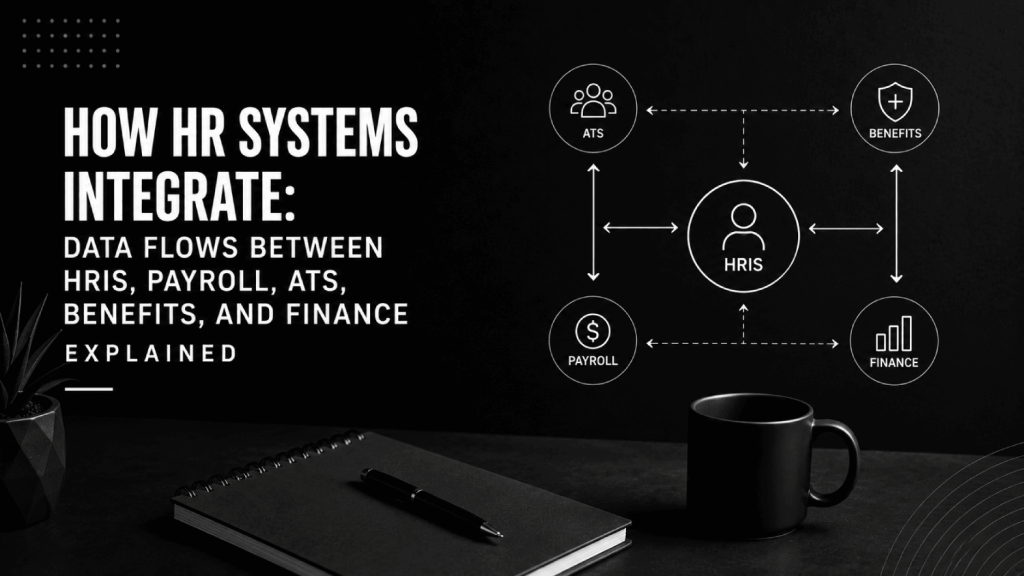

- Most HR data problems are not software problems. They are integration problems , the wrong data arriving in the wrong system at the wrong time, or not arriving at all.
- Five systems generate the majority of HR data flows: HRIS, payroll, ATS, benefits administration, and finance. Each needs specific data from the others to function correctly.
- There are three ways to connect HR systems: native integrations (built by the vendor), APIs (custom-built connections), and iPaaS platforms (middleware like Workato, Boomi, or Mulesoft). Each has a different cost, maintenance burden, and failure profile.
- Before buying any HR software, you should be able to describe exactly what data must move between systems, how often, and in which direction. If you cannot, you will underscope implementation and overbuy on features.
- Integration is not an IT problem handed off after contract signature. It is a scoping decision that changes which vendor you should buy from in the first place.
HR system integration is the process of connecting separate HR software platforms so they automatically share employee data without manual entry or file uploads. A properly integrated HR stack keeps a single employee record synchronized across HRIS, payroll, benefits, ATS, and finance systems in real time or on a defined schedule. When integration breaks down, payroll runs on stale headcount data, benefits enroll employees who have already left, and finance reports do not match what HR sees.
Why Do HR Systems Need Integration at All?
No single HR platform does everything well. Workday is strong on HRIS and workforce planning but expensive for companies under 500 employees. Greenhouse or Lever handle recruiting well but are not built to manage post-hire employee data. ADP or Paychex handle payroll compliance in depth but their talent modules are weak. So most companies run three to six separate HR systems, and each one holds a different piece of the same employee’s record.
The integration problem appears the moment a candidate becomes an employee. The ATS holds the offer details, start date, and job title. Payroll needs the salary, tax elections, and bank account. Benefits needs the enrollment window trigger. IT needs a provisioning request. Finance needs a headcount update. Without integration, someone on your HR team manually re-enters that data four times. With integration, it moves automatically.
Manual data entry is not just slow. It introduces errors that compound. A transposed salary figure in payroll produces a wrong paycheck. A missed department code in the HRIS produces a wrong report six months later when a CFO asks for headcount by cost center. The case for integration is not convenience , it is data integrity.
What Data Actually Flows Between HR Systems?
Before scoping any integration project, map the data objects. The table below covers the most common flows in a mid-market HR stack.
| Data Object | Origin System | Destination System(s) | Trigger |
|---|---|---|---|
| New hire record (name, start date, job title, salary) | ATS | HRIS, Payroll, Benefits, IT provisioning | Offer accepted / hire status set |
| Pay rate change | HRIS | Payroll | Compensation event |
| Termination date and type | HRIS | Payroll (final check), Benefits (COBRA trigger), IT (deprovisioning), Finance (headcount) | Termination event |
| Benefits elections | Benefits admin | Payroll (deduction amounts), Finance (accruals) | Open enrollment or qualifying life event |
| Time and attendance data | Time tracking | Payroll | Pay period close |
| Headcount and FTE data | HRIS | Finance / ERP (e.g. NetSuite, SAP, Workday Financials) | Scheduled sync or real-time |
| Performance ratings | Performance management | Compensation management, HRIS | Review cycle close |
| Job requisition status | ATS | Finance (open headcount cost), HRIS (position management) | Requisition open / filled / cancelled |
| Learning completion records | LMS | HRIS (compliance tracking), Performance management | Course completion event |
Each row in that table represents a place where, if integration fails, an HR team member manually reconciles a spreadsheet. Companies running disconnected systems typically reconcile several of these flows every pay period. That cost compounds across quarters, and it shows up in audit findings and payroll errors, not just HR team overtime.
What Are the Three Methods for Connecting HR Systems?
Vendors describe integration in ways that make it sound uniform. It is not. There are three distinct approaches, each with different cost profiles and maintenance requirements.
Native Integrations
A native integration is pre-built by one or both vendors. Rippling, for example, markets its platform around native integrations between its own HRIS, payroll, and IT modules , because all three are built on the same data model. When a new hire is added in Rippling HR, the payroll and device provisioning records update automatically with no middleware required. BambooHR has pre-built integrations with dozens of ATS and benefits platforms. These work out of the box and carry no additional per-connection cost, but they exist only for the partner pairings the vendor has chosen to build.
API Integrations
An API (Application Programming Interface) connection is a custom-built integration between two systems using their published APIs. If your ATS is Greenhouse and your HRIS is HiBob, your developers or an implementation consultant write code that calls Greenhouse’s API when a candidate is hired and pushes that data to HiBob’s API. API integrations are flexible and precise , you define exactly which fields move and when. The downside is maintenance. Every time either vendor updates their API, your integration may break, and someone has to fix it.
iPaaS Platforms
iPaaS (Integration Platform as a Service) tools sit in the middle. Platforms like Workato, Boomi, MuleSoft, and Zapier (for simpler use cases) provide a layer of pre-built connectors and a workflow builder that lets you configure integrations without writing raw code for each one. You still need someone who understands data mapping and workflow logic, but you do not need a developer for every new connection. iPaaS platforms charge by connection, task volume, or seat, which adds a line to your software budget that most buyers do not anticipate when they are comparing HRIS platforms.
For a practical budget comparison, see the hidden costs breakdown in our guide to hidden costs of HR software , integration fees are consistently one of the most underestimated line items at implementation.
What Does HRIS Integration Actually Require?
The HRIS is the system of record for employee data in most organizations. Every other system either sends data to it or pulls data from it. That makes HRIS integration the most consequential connection in your stack, and the one where data quality problems have the widest blast radius.
When evaluating an HRIS, the integration questions worth asking before contract signature are: Does this platform expose a full REST API with documented endpoints for all major objects (employees, positions, departments, compensation, terminations)? What is the rate limit on API calls? Does the vendor maintain a dedicated integration marketplace with certified connectors for your payroll and benefits providers? And critically , when the vendor releases a new API version, how long is the previous version supported?
Workday, for instance, has a well-documented integration framework and a large partner network, but its integrations are often configured through Workday Studio or third-party iPaaS tools rather than simple plug-and-play connectors. Smaller HRIS platforms like HiBob, BambooHR, and Rippling have invested heavily in native marketplaces that reduce the configuration burden. For a broader view of mid-market options, the best HR software platforms for mid-market companies covers which systems have the strongest out-of-box integration depth.
How Does Payroll Integration Work, and What Breaks It?
Payroll integration is the highest-stakes data flow in any HR stack. An error in a candidate record is annoying. An error in payroll is a legal and reputational event. Payroll systems need five data types from upstream systems: employee identity (SSN, tax ID), compensation details (salary, pay rate, pay schedule), tax withholding elections (W-4 data), deductions (benefits, retirement, garnishments), and hours worked (from time and attendance).
The most common integration failure point is compensation change lag. An HRIS records a merit increase effective on the 1st of the month. If the payroll integration runs on a nightly batch rather than in real time, and the payroll calculation happens before the batch, the employee receives the old rate. This is not a hypothetical. It is one of the most frequent complaints in payroll implementation post-mortems.
Real-time payroll integration , where a compensation event in the HRIS immediately triggers an update in payroll , is a meaningful differentiator between platforms. Rippling and Paychex Flex handle this differently from how a disconnected HRIS-plus-ADP setup does. Before comparing payroll platforms, it helps to understand which vendors require an iPaaS layer to connect to your HRIS and which have native payroll-HRIS parity. Our comparison of best payroll software for multi-state US companies flags integration architecture as a key evaluation criterion.
How Do ATS-to-HRIS Data Flows Work During Onboarding?
The ATS-to-HRIS handoff at hire is where integration either saves the most time or creates the most confusion. The moment a candidate’s status changes to “hired” in an ATS like Greenhouse, Lever, or Ashby, the following data should flow to the HRIS without human intervention: legal name, personal email, start date, job title, department, manager, office location, and offer salary.
What usually does not flow cleanly: custom fields specific to your company (cost center codes, team names, contract type), data collected in background check platforms, and any offer letter amendments that happened outside the ATS workflow. These gaps require either manual reconciliation or custom field mapping at integration setup, which takes time and requires someone who understands both the ATS and HRIS data models.
The onboarding downstream is equally important. Once the HRIS receives the new hire record, it should trigger benefits enrollment (in a platform like Benefitfocus or PlanSource), IT provisioning (email, laptop, access), and payroll setup. Well-implemented onboarding software handles this trigger chain. Our review of best employee onboarding software platforms evaluates which tools manage the full downstream integration, not just the new-hire paperwork experience.
How Do HR and Finance Systems Exchange Data?
The HR-finance integration is frequently an afterthought in HR software buying decisions and consistently a frustration in CFO budget conversations. Finance teams run on ERPs: NetSuite, SAP, Oracle Financials, QuickBooks Enterprise, or Microsoft Dynamics. HR systems and ERPs do not share a common data model, and the translation layer between them requires deliberate design.
Finance needs three things from HR in most organizations. First, headcount and FTE data by cost center, synced often enough to keep budget vs. actual variance reports accurate. Second, payroll journal entries , the aggregated cost of each pay run broken out by department and GL code , so that payroll costs hit the income statement correctly without someone manually entering them. Third, open requisition data so finance can accrue against approved but unfilled positions.
Most mid-market HR platforms handle the payroll journal entry export reasonably well. The headcount-to-finance sync is more variable. Platforms like Workday that span both HCM and financials have an obvious structural advantage , the data model is unified. For companies on separate HRIS and ERP platforms, the integration typically requires a scheduled data export or iPaaS workflow, and the accuracy of finance’s headcount view depends entirely on how quickly and completely HR processes changes in the source system.
If workforce cost analysis is a priority for your CFO, the people analytics perspective in people analytics for CFOs explains which data connections are necessary to produce workforce cost, retention, and productivity reporting that finance actually trusts.
API vs. iPaaS: Which Integration Approach Should You Choose?
The practical decision comes down to three variables: how many systems you are connecting, whether you have internal developer capacity, and how often integration logic is likely to change.
| Factor | Custom API | iPaaS (Workato, Boomi, Mulesoft) | Native Integration |
|---|---|---|---|
| Upfront cost | High (developer time) | Medium (platform fee + config) | Low to zero |
| Ongoing maintenance | High (breaks on API updates) | Medium (vendor handles connector updates) | Low (vendor-maintained) |
| Flexibility | Maximum | High | Low (fixed field mapping) |
| Speed to deploy | Slowest | Medium | Fastest |
| Best for | Complex, specialized logic; engineering-resourced teams | Multi-system mid-market stacks; no dev team | Common vendor pairings on the same platform |
For most companies between 50 and 500 employees without a dedicated IT integration team, native integrations for common vendor pairs and an iPaaS platform for the exceptions is the right model. Custom APIs belong in stacks with unusual requirements or where the business logic genuinely cannot be configured in a middleware tool.
One practical note: iPaaS platforms are not free. Workato’s per-task pricing, Boomi’s connector fees, and MuleSoft’s licensing costs add up quickly when you are running dozens of HR workflows. Budget this explicitly before you commit to a vendor stack that requires middleware to function.
How Should You Scope Integration Before Buying HR Software?
Integration scoping belongs in the vendor evaluation process, not in the implementation kickoff. By the time you have signed a contract, you have lost negotiating position on integration support, and your IT or implementation team inherits whatever you committed to without knowing the details.
A practical pre-buy integration checklist covers four things. First, map every data object that must move between your systems using a table like the one above. Second, ask each vendor shortlist candidate to document which of those flows they support natively and which require a third-party connector. Third, ask specifically about field-level mapping flexibility , can you map your custom department codes, or are you locked into the vendor’s taxonomy? Fourth, ask for the name of the integration partner they most commonly work with for your stack, and get a rough cost estimate from that partner before you sign.
If your current HR stack already has integration debt , systems that technically connect but routinely produce mismatched data , see our HR software implementation checklist for a structured approach to data migration and integration design before any new system goes live.
Frequently Asked Questions
What is an integrated HR system?
An integrated HR system is a set of HR software platforms configured to automatically share employee data with one another, either through native connections, APIs, or middleware. The goal is a single accurate employee record that updates across payroll, benefits, time tracking, and finance without manual re-entry. “Integrated HR system” sometimes also refers to an all-in-one platform like Rippling or Workday that handles multiple HR functions in a single product on a unified data model.
What does HR integration mean in practice?
In practice, HR integration means that when something changes in one system, the relevant downstream systems update automatically. A new hire added in your ATS appears in payroll and benefits without HR manually creating a duplicate record. A termination in the HRIS triggers a final paycheck calculation in payroll and a deprovisioning request in IT. The absence of that automatic update is the definition of an integration gap, and those gaps are where HR teams spend hours per pay period reconciling data.
What is the difference between API integration and iPaaS for HR?
An API integration is a custom-coded connection between two specific systems, built and maintained by your developers. An iPaaS (Integration Platform as a Service) platform like Workato, Boomi, or MuleSoft sits between systems and provides pre-built connectors and a workflow configuration layer that does not require raw code for each connection. APIs offer more flexibility; iPaaS reduces maintenance burden and is more practical for HR teams without internal engineering capacity.
How often should HR systems sync data?
It depends on the data type. Payroll data needs to sync at minimum before each pay run, ideally in real time for compensation changes. Headcount data for finance can typically sync daily or weekly without causing operational problems. Benefits deduction data should sync before payroll closes for the period. The more time-sensitive the downstream decision, the more frequently the sync should run. Batch integrations that run once per night introduce a lag window that can cause payroll errors if a change is made after the batch has already run.
What are the most common HR system integration failures?
The five most common failure points are: compensation changes that miss a payroll batch window and run at the old rate; terminated employees who remain active in benefits systems due to a missed status sync; new hires missing from payroll because the ATS-to-HRIS handoff required a manual step that someone skipped; department or cost center codes that do not match between HRIS and finance, breaking GL mapping; and benefits deductions that do not update in payroll after open enrollment, producing incorrect take-home pay for the first pay period after enrollment closes.
Do I need a consultant to set up HR system integrations?
For simple stacks with native integrations between two or three common platforms, you may not need one. For anything involving a custom API build, an iPaaS configuration with complex conditional logic, or a migration from legacy systems with messy data, an integration-experienced implementation partner will save you more time than their fee costs. The risk of underscoping integration is not a delayed go-live , it is payroll errors and compliance gaps that show up months after launch. Our guide to the best HRIS implementation partners for mid-market companies covers firms that specialize in integration architecture, not just platform configuration.
How do HR systems integrate with ERP and finance tools?
HR-to-ERP integration typically covers three flows: payroll journal entries exported to the general ledger, headcount and FTE data synced to finance for budget vs. actual reporting, and open requisition data shared so finance can accrue against approved headcount. Most HR platforms offer a payroll export in a format compatible with major ERPs like NetSuite, SAP, or Oracle. Real-time headcount sync usually requires an iPaaS layer or custom API unless both the HCM and ERP are from the same vendor, as with Workday.
What Integration Architecture Signals Should You Read Before Buying?
Vendor marketing uses the word “integration” to mean everything from a full bidirectional real-time data sync to a CSV export you run manually once a week. Ask for specifics. A vendor that cannot tell you whether their payroll sync is event-driven or batch-based, or cannot give you a documented list of which HRIS fields map to which payroll fields, is signaling that their integration layer was bolted on rather than designed. That distinction matters more than the feature list on the product demo.
The practical signal to look for: does the vendor have a dedicated integration or platform partner program with published documentation? Do their implementation case studies mention integration architecture, or just UI features? Are there public API docs you can review before signing? Platforms like Rippling, Workday, and BambooHR publish their integration marketplaces openly. A vendor who makes you request API documentation under NDA is telling you something about their integration maturity.
Integration is ultimately a forcing function for honest evaluation. A stack that looks affordable based on per-seat pricing can become expensive when you add the iPaaS subscription, the implementation consulting fees, and the ongoing IT maintenance of three custom API connections. That total cost calculation , not the per-seat sticker , is what you are actually buying. Scoping it before negotiation gives you a real number to compare across vendors, and it changes the decision more often than buyers expect.