
TLDR
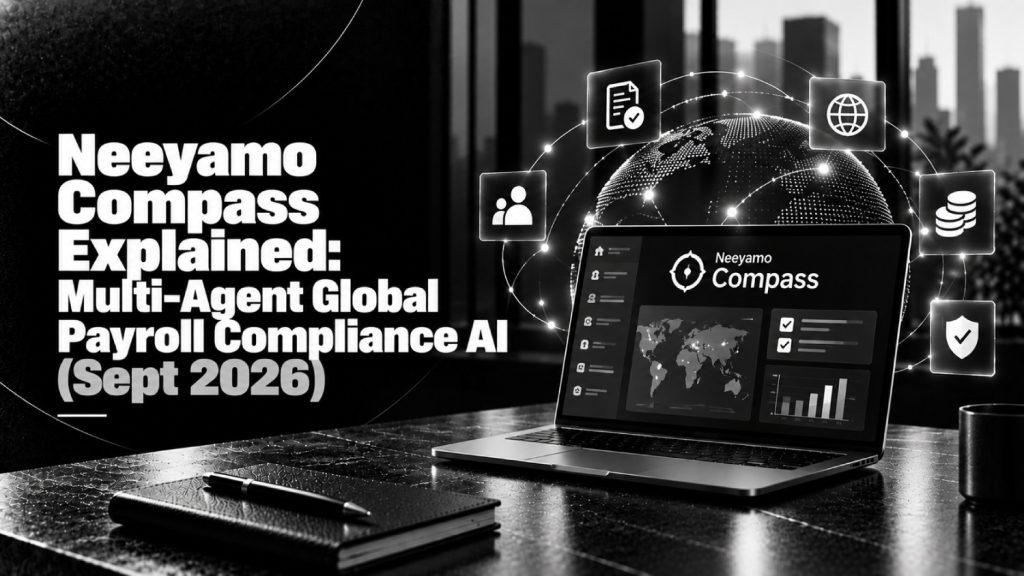
- On Sept. 29, 2026, Neeyamo unveiled Compass, a multi-agent AI system that now powers compliance across every Neeyamo payroll run in 160+ countries.
- Primary source: Neeyamo’s PR Newswire release. Compass reads regulatory change as it is published, maps it to affected payrolls, and produces configuration Neeyamo Payroll can apply. Customers do not log into Compass; they experience it as payroll that stays correct when the rule changes.
- Architecture claimed: monitoring, interpretation, configuration, and validation agents, plus a council of large language models that interpret independently. When models disagree, a payroll professional decides. Autonomy is granted rule by rule after a scored human track record.
- Vendor metrics since 2024 AI work began: 11,000+ regulatory developments monitored, publication-to-recommendation time cut from three weeks to 48 hours, and interpretations accepted unchanged 94% of the time (Neeyamo figures).
- For buyers: this is global payroll compliance configuration, not a chatbot and not the Workday Payroll by Neeyamo India packaging story. Ask how rule-level autonomy is earned, what validation looks like before a live run, and how liability is shared when an AI-configured change is wrong.
Sept. 29, 2026 added a concrete payroll-AI story that is about acting on regulatory change, not answering policy questions in Teams.
Neeyamo, the global payroll and Employer of Record provider, said Compass is the third generation of its compliance AI: first detect change, then monitor it, now produce payroll-ready configuration. That is a different buyer question from recruiting agents, HCM copilots, or AI-native people-ops Routines that move money and access.
This draft sticks to the Sept. 29 launch facts, the agent design Neeyamo described, and the evaluation questions global payroll buyers should ask. It is not a rewrite of Workday Payroll by Neeyamo, the CloudPay vs Papaya Global vs Neeyamo comparison, or Warp Agent.
What Neeyamo announced
Per the Sept. 29 PR Newswire release:
- Compass now powers compliance across every Neeyamo payroll run in 160+ countries.
- The system reads regulatory change as it is published, determines what it means for each affected payroll, and produces the configuration Neeyamo Payroll needs to apply it.
- Customers never log in to Compass. The experience is framed as payroll that is right when the rule changes.
- Neeyamo says it was among the first payroll providers to run generative AI in production, deploying regulatory change detection in 2024 while much of the industry was still evaluating chat assistants.
- Compass is positioned as generation three: detect, then monitor, then act by outputting configuration-ready specifications rather than memos for humans to reinterpret.
Shakil Gour, SVP and Head of Payroll Product and Integrations, said: “In 2024 we proved AI could tell us a rule had changed. The harder problem was what to do about it – which countries, which pay elements, with what evidence.”
He continued: “Compass understands Neeyamo Payroll the way our engineers do, so its output is a change we can apply, not a memo to interpret. Every recommendation is approved by a payroll professional and scored against what they would have done; autonomy is granted rule by rule, only where that record earns it. That is how AI should be allowed to touch pay.”
Treat the autonomy language as the product thesis. Your RFP still has to prove where that rule-by-rule gate is real in your footprint.
How Compass is supposed to work
Neeyamo describes specialised agents, not a single chat interface:
- Monitoring agents scan gazettes, tax authorities, labour ministries, and collective bargaining sources.
- Interpretation agents deconstruct each country’s payroll and compliance architecture into a structured blueprint.
- Configuration agents, grounded in Neeyamo Payroll’s own architecture, produce configuration-ready specifications rather than summaries.
- Validation agents audit pay registers and reconcile parallel runs before release.
- A council of large language models generates every interpretation independently. When they disagree, a payroll professional decides.
The release also says Compass designs new-country implementations and trains associates before a live cycle. That matters if you are expanding into long-tail markets where Neeyamo already competes on coverage depth, a theme we cover in CloudPay vs Papaya Global vs Neeyamo and best global managed payroll providers.
Metrics buyers should treat as vendor claims
Neeyamo published operating numbers for its AI compliance work since 2024:
| Claim | Figure (Neeyamo) | Buyer use |
|---|---|---|
| Regulatory developments monitored | 11,000+ | Ask for sample feed quality in your top 10 countries |
| Publication-to-recommendation time | 3 weeks to 48 hours | Ask for median and p90, not only best case |
| Interpretations accepted unchanged by reviewers | 94% | Ask how acceptance is scored and whether it holds for complex collective-bargaining changes |
| Country coverage for payroll runs using Compass | 160+ | Separate native-engine depth from partner markets in your matrix |
| Customer login to Compass | None (invisible layer) | Ask what audit artifacts you can export even if there is no UI |
These are vendor-reported results. Put them next to your own SLA language for statutory updates, parallel-run evidence, and who carries late-filing risk.
Why this is different from chat assistants and people-ops agents
Most HR AI news in September 2026 still clusters around assistants that answer questions, recruiting agents that source and schedule, or people-ops agents that provision accounts and escalate exceptions. Compass sits in a narrower, higher-stakes lane: regulatory change to payroll configuration to validated run.
That matters because wrong pay is hard to reverse cleanly across jurisdictions. Neeyamo’s own framing leans into that: autonomy is earned rule by rule, every recommendation starts with professional approval, and disagreeing models escalate to a human. For category context on agents vs copilots, see HR copilots vs HR agents and AI agents for HR service delivery. For AI-native people-ops execution with different write-path risks, compare the questions in Warp Agent and ADP’s AWS Assist agents path.
How this differs from other hub drafts and site pages
HrTechSaas already covers nearby Neeyamo and payroll-AI stories:
- Workday Payroll by Neeyamo (India payroll sold through a Workday contract via Global Payroll Connect)
- CloudPay vs Papaya Global vs Neeyamo (coverage and delivery-model comparison)
- Best global managed payroll providers
- Global employment platform models
- Nearby agent news: Warp Agent, ADP AWS Assist agents, evergreen AI HR agents explained
This draft is different:
- Same-week Compass product news (Sept. 29, 2026)
- Focus on multi-agent regulatory compliance configuration inside Neeyamo’s global payroll engine
- Not the India-plus-Workday packaging story and not a three-vendor comparison listicle
Do not merge this into the Workday India URL. Different announcement, different buyer question, different workflow surface.
Who should care, and what to ask
Prioritize a read-out if you:
- Run multi-country payroll where statutory change volume, not chat deflection, is the bottleneck
- Are evaluating Neeyamo against CloudPay, Papaya Global, ADP Global, Safeguard, or Strada for long-tail country depth
- Already buy or shortlist Neeyamo as a native engine under Workday, SAP, or another HCM stack and need to understand the AI compliance layer behind the scenes
- Are writing AI governance language for systems that can change pay configuration
Ask Neeyamo (and your counsel / payroll ops) before treating Compass as set and forget:
- For your top 15 countries, which rule types already have earned autonomy, and which still require human approval every time?
- Show a case where the LLM council disagreed: what artifact did the payroll professional see, and what entered the audit trail?
- What does a validation agent parallel run look like before release, and can you export the reconciliation evidence for your auditors?
- How is publication-to-recommendation measured (median vs best case), and what happens when a gazette or ministry source is delayed or ambiguous?
- Who carries financial and regulatory liability if an AI-produced configuration is applied and later found wrong?
- How does Compass treat collective bargaining changes versus statutory tax or social security updates?
- If customers never log into Compass, what customer-visible change log, exception queue, and rollback path exist inside Neeyamo Payroll?
- How does Compass interact with HCM integrations (for example Workday Global Payroll Connect) when HR data and local pay elements both need to move?
The take: configuration agents need rule-level proof, not a demo chat
Neeyamo’s Sept. 29 story is coherent for the global payroll category. The hard problem was never only detecting that a rule changed. It was translating that change into the right countries, pay elements, and evidence before a live cycle.
Your job is narrower. Treat Compass as an invisible compliance factory whose outputs still have to survive your parallel-run standards. Ask for rule-level autonomy maps, disagreeing-model examples, and exportable validation evidence. Keep human approval on high-impact rule classes until the scored track record matches what your team would have done. Use coverage comparisons like CloudPay vs Papaya Global vs Neeyamo for footprint fit, and use this Compass news for the separate question of how AI is allowed to touch pay configuration.
FAQ
What is Neeyamo Compass?
Compass is Neeyamo’s multi-agent AI system, announced Sept. 29, 2026, that monitors regulatory change, interprets it against country payroll blueprints, produces Neeyamo Payroll configuration, and validates runs before release.
Do customers log into Compass?
No. Neeyamo says customers experience Compass as correct payroll when rules change, not as a separate product UI.
How is this different from Workday Payroll by Neeyamo?
The Workday India offer is a packaging and GPC integration story for India payroll sold through Workday. Compass is Neeyamo’s internal multi-agent compliance layer across 160+ country runs.
What governance model does Neeyamo claim?
Every recommendation starts with payroll-professional approval and is scored against what that professional would have done. Autonomy is granted rule by rule. An LLM council interprets independently and escalates on disagreement.
Which metrics did Neeyamo publish?
11,000+ regulatory developments monitored since 2024, publication-to-recommendation time cut from three weeks to 48 hours, and 94% of interpretations accepted unchanged by reviewers. Treat these as vendor claims pending your own verification.
Who should evaluate Compass this week?
Global payroll and HCM buyers already on or shortlisting Neeyamo, especially programs with long-tail country complexity where statutory change latency is an operational risk.
What should buyers do next?
Request a country-by-country autonomy map, a disagreeing-model case study, sample validation/parallel-run exports, and clear liability language for AI-configured payroll changes.