
- A spreadsheet can show you a raw pay gap. It cannot tell you whether that gap is statistically significant, legally defensible, or driven by a compensable factor you forgot to control for.
- Defensible pay equity analysis requires multiple regression, attorney-client privilege protection, and a documented methodology for defining similarly situated employee groups.
- The platforms in this list vary sharply on cohort definition flexibility, remediation modeling, and multi-country compliance coverage.
- Syndio and Trusaic lead on legal defensibility. PayAnalytics leads on accessibility and price. Coda and CompensationXL sit at the bottom of this category.
- If your only goal is UK gender pay gap reporting, you need different criteria than a company preparing for OFCCP audit or EU Pay Transparency Directive compliance.
The best pay equity audit software for most mid-market and enterprise employers is Syndio, Trusaic, or PayAnalytics, depending on whether your priority is legal defensibility, remediation workflow, or global coverage. All three run proper multiple regression, support attorney-client privilege on analysis outputs, and handle similarly situated employee group definitions at scale. Smaller employers with simpler needs can get reasonable results from Payscale or beqom.
Why Your Spreadsheet Pay Equity Analysis Will Not Hold Up
Most compensation teams run a pay gap analysis by exporting HRIS data into Excel, filtering by gender or race, and comparing average salaries. That produces a raw or unadjusted pay gap. It tells you what exists. It does not tell you whether it is statistically meaningful, what drives it, or whether it would survive a plaintiff attorney’s expert witness.
A defensible pay equity audit requires multiple regression analysis that controls for legitimate compensable factors: job level, tenure, performance rating, geography, and business unit. The residual after controlling for those factors is the unexplained pay gap. That number is what regulators, plaintiffs, and government auditors care about.
Three other things a spreadsheet cannot do: define similarly situated employee groups with documented, reproducible logic; flag when a cohort is too small to produce statistically significant results; and generate remediation cost modeling under privilege. Those gaps are why purpose-built pay equity software exists.
Pay equity is also increasingly a reporting obligation, not just a voluntary exercise. The EU Pay Transparency Directive requires employers with 100 or more employees to report pay gaps by category. Illinois, Colorado, and New York have pay data reporting requirements. OFCCP-covered federal contractors face compensation analysis in every compliance review. If you are running your analysis in Excel, you are one audit request away from a problem.
For context on how pay equity software fits into your broader compensation technology stack, see our coverage of the best compensation management software that connects to performance.
How to Evaluate Pay Equity Audit Software Before You Buy
Before comparing vendors, get clear on what you actually need the software to do. The evaluation criteria split into four buckets.
Statistical methodology. Does the platform use ordinary least squares (OLS) regression, or something more sophisticated? Can you control for your specific compensable factors, or is the model fixed? Can you see the model outputs and confidence intervals, or just a summary dashboard?
Cohort definition and similarly situated employee groups. This is where most platforms differ most significantly. Some let you define groups by job family, grade, and function. Others use algorithmic grouping that may or may not match how your organization is actually structured. If the cohort logic does not match your job architecture, the analysis is wrong before it starts.
Privilege protection. Analysis conducted under attorney-client privilege is shielded from discovery in litigation. Several platforms offer a structured privilege workflow, where legal counsel formally engages the vendor and retains analysis outputs. This is not a checkbox feature. It is a fundamental risk management decision.
Remediation modeling. Identifying a gap is only half the work. The platform should model what it costs to close the gap, allow scenario testing across different remediation approaches, and feed recommendations into your compensation planning cycle.
| Platform | Regression methodology | Privilege protection | Remediation modeling | Multi-country | Pricing |
|---|---|---|---|---|---|
| Syndio | OLS + advanced controls | Yes | Yes | Yes | Quote-only |
| Trusaic | OLS regression | Yes | Yes | Yes | Quote-only |
| PayAnalytics | OLS regression | Yes | Yes | Yes | Quote-only |
| Payscale | Basic regression | No | Limited | Limited | Quote-only |
| beqom | Configurable | Depends on config | Yes | Yes | Quote-only |
| Mercer Pay Equity | OLS regression | Through Mercer legal | Yes | Yes | Project-based |
| Brightmine (XpertHR) | Gap analysis | No | No | UK/EU focus | Subscription |
| CompAnalyst (Radford) | Survey-linked gap | No | Limited | Limited | Quote-only |
Which Pay Equity Platforms Produce Analysis That Survives Legal Scrutiny?
Three platforms consistently appear in the context of OFCCP reviews, litigation defense, and EU Pay Transparency Directive compliance: Syndio, Trusaic, and PayAnalytics. All three share a common set of characteristics that separate them from market-data tools with a pay equity tab bolted on.
Syndio

Syndio is the most widely deployed purpose-built pay equity platform in the US enterprise market. Its core analytical engine runs OLS multiple regression with configurable compensable factors. You can define similarly situated employee groups by job family, grade, function, location, or any combination your job architecture supports. The platform tracks statistical significance at the cohort level and flags groups where sample size is too small to draw defensible conclusions.
The privilege workflow is structured: Syndio engages directly under retainer with your outside counsel, which means analysis outputs can be shielded from discovery. This matters enormously if you are a federal contractor, operating in a heavily regulated industry, or simply want to conduct proactive analysis without creating a document you cannot control later.
Remediation modeling in Syndio lets you test what it costs to close identified gaps under different budget constraints and methodological choices. You can model by cohort, set remediation thresholds, and export budget-ready outputs that feed into your comp cycle. Syndio also covers multi-country reporting requirements, including the EU Pay Transparency Directive and UK gender pay gap reporting.
Pricing is quote-only. Syndio does not publish rates publicly. Contracts are typically annual and scale with employee count. For a deeper comparison of Syndio against its closest competitors, see our Syndio vs Trusaic vs PayAnalytics head-to-head.
Best for: US enterprise employers, federal contractors, and multinational companies that need legally defensible analysis and privilege protection.
Trusaic
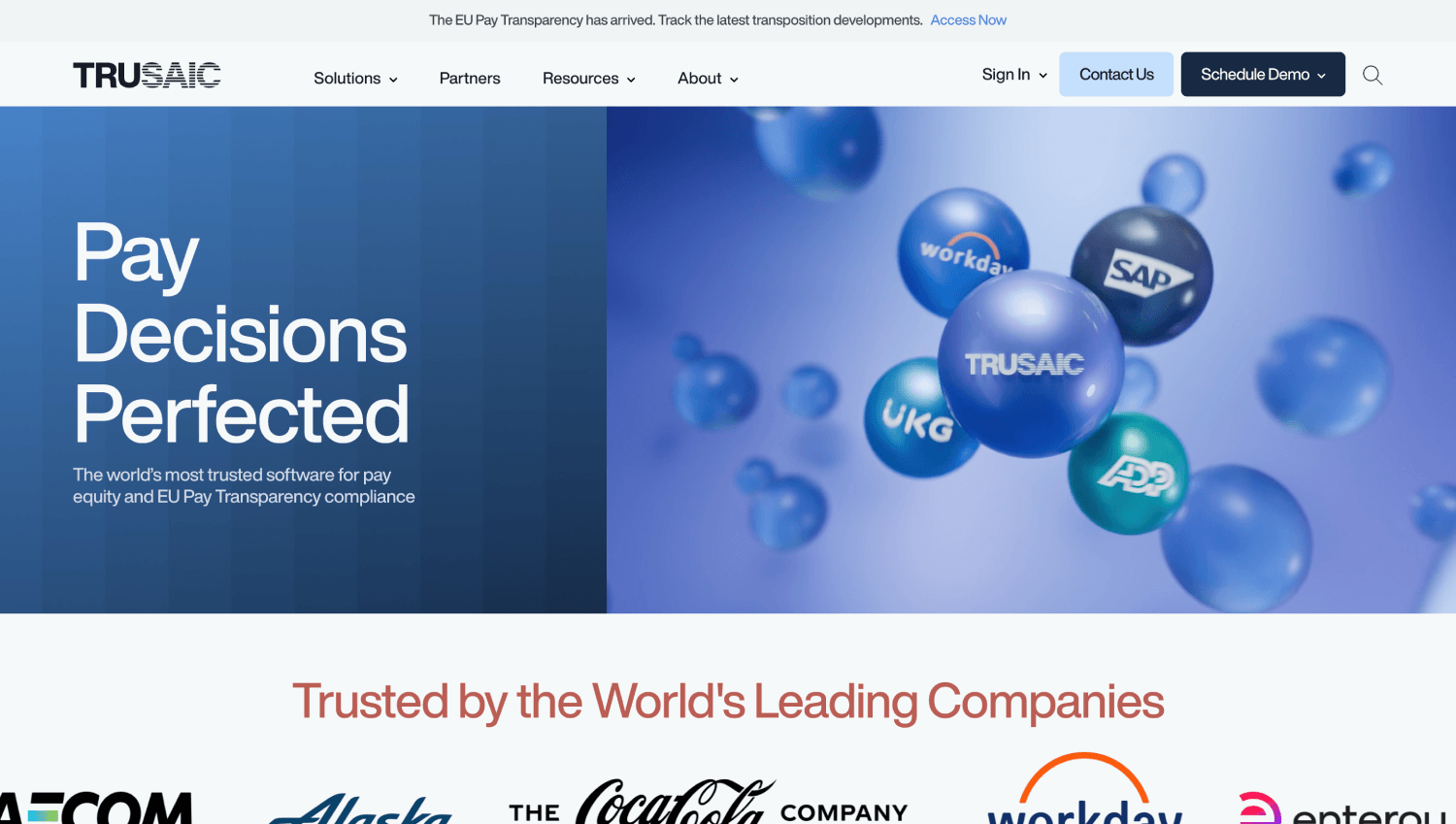
Trusaic is the other platform that consistently shows up in serious compliance conversations. Its pay equity platform is built explicitly around the requirements that appear in OFCCP compensation reviews and pay data reporting statutes. The regression methodology is OLS with controls for tenure, grade, job function, and other compensable factors you configure.
Where Trusaic differentiates is in its compliance workflow orientation. The platform maps directly to specific reporting requirements by jurisdiction: California pay data reporting, Illinois pay transparency, and EU directive requirements. If your primary driver is regulatory compliance rather than proactive equity work, Trusaic’s pre-built compliance templates reduce setup time materially.
Privilege protection is available through Trusaic’s legal partnership structure. Remediation modeling exists and integrates with comp cycle planning. Trusaic also offers managed services, where their team runs the analysis on your behalf, which some compliance teams prefer when internal statistical expertise is limited.
Best for: Multi-state US employers and federal contractors where specific regulatory compliance is the primary buying trigger.
PayAnalytics
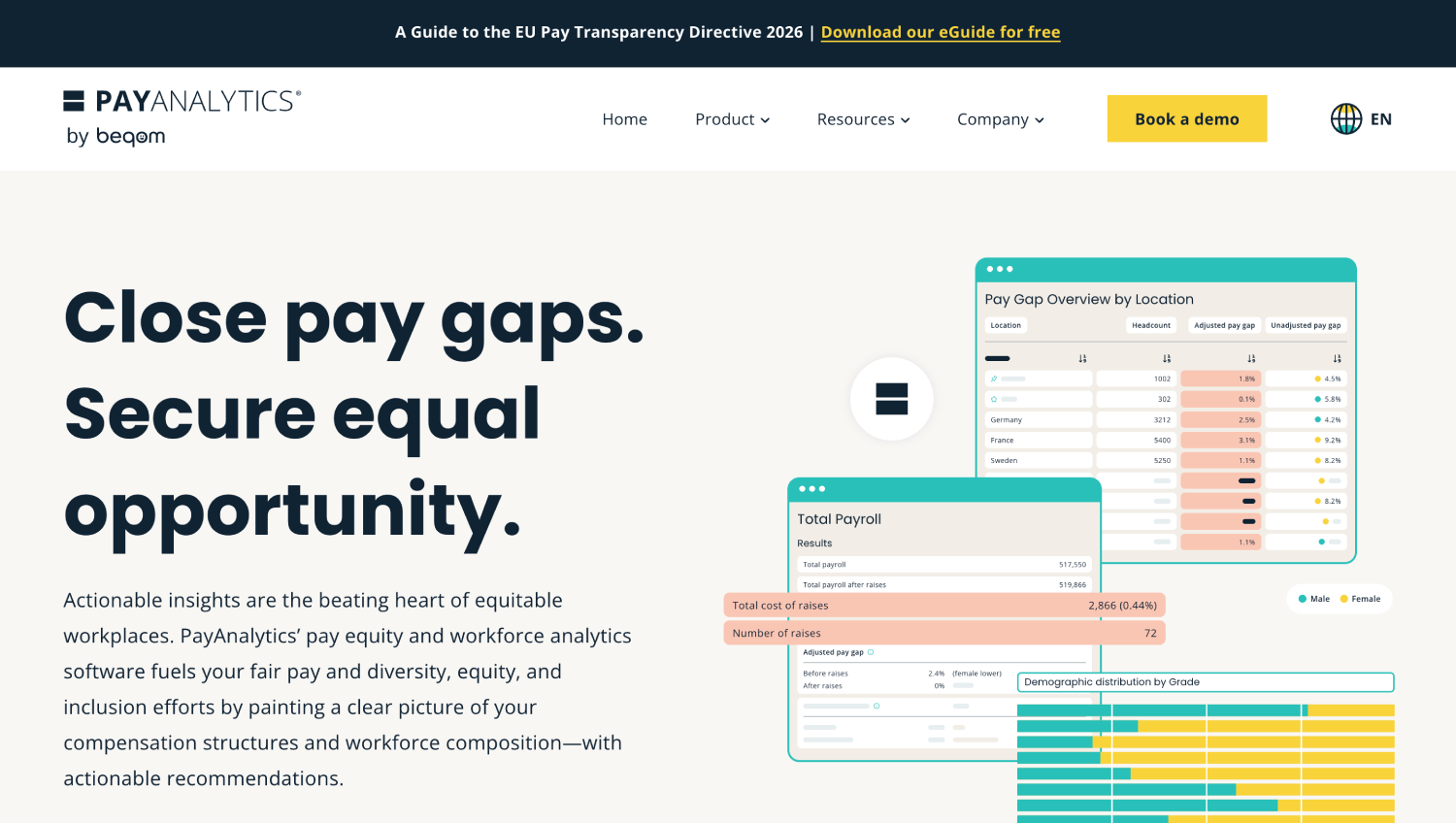
PayAnalytics, founded in Iceland and now deployed across Europe, the US, and beyond, is the strongest option for multi-country workforces. Its regression engine handles multiple currencies, multiple legal frameworks, and country-specific reporting formats in a single platform. This matters for companies hiring across the EU, UK, and US simultaneously.
The platform is more self-serve than Syndio or Trusaic, which cuts both ways. Implementation is faster and pricing is typically more accessible. The trade-off is that cohort definition requires more internal statistical literacy. PayAnalytics assumes you understand what a compensable factor is and why your choice of controls matters. Teams without a compensation analyst or people analytics function may struggle to configure the analysis correctly.
Privilege protection is available. Remediation outputs are strong, particularly for EU reporting contexts where the directive specifies what remediation documentation must include.
Best for: Multinational employers with a competent internal analytics function and a need for multi-country compliance coverage.
Payscale
Payscale is primarily a compensation benchmarking and market data platform. Its pay equity module exists, but it is not where Payscale competes. The regression capability is more limited than dedicated equity platforms, privilege protection is not a core feature, and remediation modeling is basic. Teams that already use Payscale for benchmarking sometimes run a rough equity check inside the same interface, which is convenient but analytically thin.
If you are deciding between Payscale for equity analysis and a purpose-built tool, the choice depends on your risk exposure. Low-risk environments with no regulatory triggers can get adequate directional analysis from Payscale. Any employer with OFCCP exposure, active litigation risk, or EU operations should not rely on it as their primary equity tool. For a comparison of compensation benchmarking tools more broadly, our compensation benchmarking platform review covers where Payscale fits in that market.
Best for: Mid-market employers that want equity analysis adjacent to their benchmarking workflow and have no significant regulatory exposure.
beqom
beqom is an enterprise total compensation management platform that includes pay equity analysis as a module within its broader comp cycle and incentive management product. For companies that have already deployed beqom for compensation planning, adding the equity module makes integration straightforward because the underlying employee and compensation data is already in the system.
The analytical depth depends heavily on how your beqom environment is configured. The regression capability is present but requires setup. Privilege protection varies. The real advantage is that remediation recommendations feed directly into beqom’s compensation planning workflow without a data export step, which is a meaningful operational benefit for teams running complex comp cycles.
beqom is overkill if you are buying it purely for pay equity. The platform’s value accrues to enterprises that need the full compensation management suite.
Best for: Existing beqom customers who want equity analysis integrated into their compensation planning cycle.
Mercer Pay Equity

Mercer Pay Equity is a consulting-led offering rather than a pure SaaS platform. Mercer’s compensation consulting team runs the analysis using their proprietary methodology, with access to Mercer’s survey data to contextualize findings. The outputs are typically delivered as a report with remediation recommendations rather than a persistent platform you log into quarterly.
The advantage is that Mercer’s consultants can structure the engagement under legal privilege from the outset, and their expert witness credentials are well established. The disadvantage is that it is expensive, not self-serve, and does not give your team an internal capability they can run independently. Annual re-analysis requires re-engagement.
For large enterprises that want a one-time defensible audit with expert witness backing, Mercer is worth evaluating. For organizations that want to run equity analysis as a continuous internal process, purpose-built SaaS is the better investment.
Best for: Employers that want a consulting-backed audit with expert witness support for a specific litigation or regulatory response scenario.
Brightmine (XpertHR)
Brightmine, formerly XpertHR, includes a gender pay gap reporting tool oriented specifically at UK statutory requirements. It produces the mean and median hourly pay gap calculations required under UK gender pay gap reporting regulations, along with the quartile band breakdowns.
What it does not do: multiple regression analysis, similarly situated employee group analysis, or meaningful remediation modeling. It is a reporting compliance tool, not a pay equity analysis platform. For UK employers whose only requirement is the annual gender pay gap report, it gets the job done within a broader HR compliance subscription. For anyone wanting to understand what drives their gap and how to close it, Brightmine is not the answer.
Best for: UK employers that need statutory gender pay gap reporting and are already Brightmine subscribers.
CompAnalyst (Aon / Radford)
Aon’s CompAnalyst (built on the Radford survey platform) includes pay equity analytics alongside its primary compensation benchmarking function. Like Payscale, it is primarily a market data tool. The pay equity analysis capability exists and is improving, but it is not the platform’s core value proposition.
Teams that use Radford surveys for technology and life sciences compensation sometimes find it convenient to run a gap analysis inside the same platform. The results are directionally useful but lack the statistical controls and privilege workflow of purpose-built tools. If your equity analysis feeds into regulatory filings or could be subpoenaed, this platform is not adequate as a standalone solution.
Best for: Technology and life sciences companies already using Radford survey data that want directional equity analysis alongside benchmarking.
How Do Pay Equity Platforms Define Similarly Situated Employee Groups?
This is the methodological question that separates competent from defensible analysis. A similarly situated employee group (SSEG) is a cluster of employees who are comparable enough in job content, level, and function that any pay difference should be explainable by legitimate compensable factors. Define the groups too broadly and you mask real gaps. Define them too narrowly and cohorts are too small to produce statistically significant results.
Syndio uses a structured configurator that maps to your existing job architecture. You define groups based on combinations of job family, function, grade, and geography. The platform then tests whether each resulting cohort is statistically large enough to support a regression. Groups below threshold are flagged, not suppressed, which is the correct approach because suppression hides risk.
Trusaic uses a similar approach but with pre-built OFCCP-aligned grouping logic that you can customize. PayAnalytics gives you the most flexibility, allowing fully custom group definitions, which is powerful but requires analytical skill to do correctly.
Platforms like Payscale and CompAnalyst tend to use broader, less configurable grouping that may not match your actual job architecture. That misalignment is the most common source of incorrect equity analysis in the market.
What Does Pay Equity Software Cost?
Every platform in this category is quote-only. None of them publish public pricing. Costs scale with employee count, number of countries, and whether you need managed services alongside the software.
Based on publicly reported information and market observation, purpose-built platforms like Syndio and Trusaic typically start at annual contracts in the low-to-mid five figures for smaller employers and scale into six figures for large enterprises with multi-country requirements. PayAnalytics tends to come in at a lower price point for comparable employee counts, which reflects its more self-serve model. Mercer’s consulting-led approach is priced per project and is typically more expensive than any SaaS option for comparable scope.
The question of cost should be framed against the cost of a defensible error. A single OFCCP investigation, EU regulatory inquiry, or equal pay claim will cost more in legal fees alone than most annual SaaS contracts. The right frame is not “what does the software cost” but “what does a bad analysis cost.”
For anyone evaluating the broader cost picture of HR technology procurement, our guide to hidden costs of HR software covers what implementation, integrations, and ongoing fees typically add to the sticker price.
Pay Equity Software for Multi-Country Workforces
If you operate in the EU, the EU Pay Transparency Directive is the defining compliance requirement. It mandates pay gap reporting for employers with 100 or more workers, requires employers to provide pay information to employees on request, and creates a right to remedy when unexplained gaps exceed specified thresholds. Member state implementation varies, but the core obligations are consistent.
PayAnalytics was built for this environment and covers EU country-specific reporting formats natively. Syndio has extended its product significantly to cover EU requirements and handles multi-currency, multi-country analysis within a single client environment. Trusaic covers EU requirements but with a US-primary design philosophy that shows in the interface.
UK gender pay gap reporting and US multi-state pay data reporting (California, Illinois) are supported across all three leading platforms. If you are running a truly global workforce and need a single analytical environment for all jurisdictions, PayAnalytics or Syndio are the realistic options. Mercer can cover global scope through consulting engagement but at correspondingly higher cost.
For companies building out the broader compliance technology stack, our review of AI HR compliance and bias audit tools covers adjacent tools that intersect with pay equity in regulatory contexts.
How to Connect Pay Equity Analysis to Your Compensation Planning Cycle
Pay equity analysis that does not connect to remediation is an academic exercise. Remediation that does not connect to your compensation cycle is a recommendation nobody acts on. The goal is a closed loop: identify the gap, model the cost to close it, build the remediation budget into the comp cycle, and re-run the analysis after the cycle closes to verify the gap moved.
Syndio and Trusaic both offer remediation workflow that integrates with HRIS systems and can export into compensation planning tools. beqom closes the loop most tightly for existing customers because the analysis and the comp cycle live in the same platform. Mercer delivers a remediation recommendation report, but implementation is manual.
One underappreciated consideration: your HRIS data quality determines the accuracy of every regression you run. If job codes are inconsistent, tenure is missing, or performance ratings are stored differently across business units, your compensable factor controls are wrong. Every platform in this list will give you a cleaner analysis if your underlying HRIS data is clean. If your HR data is fragmented or inconsistent, address that before expecting pay equity software to produce reliable outputs.
For a useful framing of how HR data quality affects analytics across the board, see our piece on the best AI people analytics platforms, which covers the data infrastructure requirements that underpin analytics programs including equity analysis.
Frequently Asked Questions
What is the difference between a raw pay gap and an adjusted pay gap?
A raw pay gap is the difference in average pay between two groups (typically by gender or race) without controlling for any other factors. An adjusted pay gap controls for legitimate compensable factors like job level, tenure, performance, and geography. The adjusted gap is what remains after those factors are accounted for and is the number that matters in legal and regulatory contexts. Purpose-built pay equity software produces adjusted gaps using multiple regression. Excel produces raw gaps.
What does attorney-client privilege protection mean in pay equity software?
When a pay equity analysis is conducted under attorney-client privilege, the analysis outputs, findings, and internal communications about them are shielded from discovery in civil litigation. To establish privilege, legal counsel must formally engage the software vendor, typically under a separate retainer. Syndio, Trusaic, and PayAnalytics all offer structured privilege workflows. Platforms that do not offer this create documents that could be subpoenaed in equal pay claims or regulatory investigations.
How do pay equity platforms define similarly situated employee groups?
Similarly situated employee groups are clusters of employees comparable enough in job content, level, and function that pay differences should be explainable by legitimate compensable factors. Platforms define these groups either by mapping to your existing job architecture (job family, grade, function, location) or through algorithmic clustering. The critical requirement is that groups are large enough to produce statistically significant regression results. Groups below threshold should be flagged, not suppressed. The definition methodology is a primary differentiator between platforms.
Does pay equity software work for small companies?
Statistical significance requires minimum cohort sizes. Most regression-based analyses require at least 30 employees in a similarly situated group to produce defensible results, and many platforms recommend larger cohorts. For companies with fewer than 150 to 200 total employees, sample size constraints often limit the analysis to broad job families rather than detailed grade-level comparisons. Small companies are better served by a consulting-led approach than a platform subscription, unless multi-country regulatory reporting is a separate driver.
What is the EU Pay Transparency Directive and which platforms support it?
The EU Pay Transparency Directive requires employers with 100 or more employees in the EU to report pay gaps by category, give workers pay information on request, and remedy unexplained gaps above specified thresholds. Member states are implementing it on varying timelines. PayAnalytics and Syndio offer the most complete native support for EU country-specific reporting formats. Trusaic covers EU requirements but with US-primary design. UK gender pay gap reporting (a separate statutory obligation) is covered by all three leading platforms and by Brightmine for UK-only needs.
Can pay equity software integrate with Workday or SAP?
Yes. Syndio, Trusaic, and PayAnalytics all support integration with major HRIS platforms including Workday, SAP SuccessFactors, Oracle HCM, and others via API or SFTP data transfer. Integration depth varies. Some platforms pull employee data automatically on a scheduled basis. Others require periodic manual exports. Confirm the integration method and data refresh frequency before signing. Stale data produces stale analysis, which can misrepresent your equity position at the time of reporting.
What is a remediation budget model in pay equity software?
A remediation budget model calculates the cost of closing identified pay gaps by raising pay for under-compensated employees to close the unexplained gap. Good platforms let you set budget constraints, test different remediation thresholds (close 100% of the gap versus close the gap to statistical insignificance), and model the cost by cohort, business unit, or geography. The output is a dollar figure and employee list that can be fed directly into your compensation planning cycle. Syndio and Trusaic offer the most complete remediation modeling in this category.
The Right Framework for Choosing a Pay Equity Platform
Two variables determine which platform is right for you: your regulatory risk profile and your internal analytical capability. If you are a federal contractor, an EU employer subject to the Pay Transparency Directive, or a company with active litigation exposure, you need Syndio or Trusaic. The privilege protection and regression methodology are not optional features at that risk level. If you are a multi-country employer with a strong internal people analytics function and a preference for a more self-serve model, PayAnalytics is worth serious evaluation, particularly if EU coverage is the primary driver.
Teams with no statistical expertise and no immediate regulatory trigger can get directional value from Payscale or, if they already use it, beqom. But be honest with yourself about what “directional value” means: it means you can see whether a gap exists, not whether it is legally significant or what is causing it. For a 15-minute exercise that helps you assess whether your broader compensation process is ready to support a proper equity analysis, the compensation cycle readiness audit is a useful starting point before you call vendors.
The spreadsheet answer gets you to awareness. The software answer gets you to defensibility. Those are not the same thing, and in a regulatory environment that is tightening across the US and EU simultaneously, the gap between them is closing fast.