Physical Address
304 North Cardinal St.
Dorchester Center, MA 02124
Physical Address
304 North Cardinal St.
Dorchester Center, MA 02124

HR Tech SaaS may earn a commission when you buy through links on this page. Our recommendations are editorial and never paid for.
Rippling vs Deel vs Remote is one of the most common platform comparisons in global HR today , and one of the most frequently oversimplified. Rippling, Deel, and Remote all let you hire internationally, pay contractors, and handle EOR arrangements. The similarity ends there. Rippling is primarily an HRIS and IT platform that added global payroll; Deel is a contractor and EOR platform that added HRIS features; Remote is an EOR-first platform built on owned legal entities. Which one you should choose depends on your hiring model, entity situation, domestic payroll complexity, and whether you need one system for everything or a purpose-built EOR solution specifically.
Most teams enter this evaluation asking “which platform is cheapest for EOR?” That is the wrong starting question. EOR is a commodity service at this point. All three platforms can hire an employee in Germany or Singapore on your behalf. The real differentiation is what happens around the EOR: how the platform handles your domestic workforce, what the HRIS can actually do, whether entities are owned or subcontracted, and how much operational complexity you are willing to carry long-term.
A 60-person startup with 10 international contractors and 50 US employees has completely different needs from a 300-person company expanding into five new markets this year. Pricing alone will not answer that question. Platform architecture will.
One more thing worth flagging: Rippling and Deel have been involved in high-profile litigation. In early 2025, Rippling filed a lawsuit against Deel alleging corporate espionage and RICO Act violations. Reuters reported on the filing, and the case received wide coverage across major outlets. Deel has disputed the allegations. This is worth factoring into vendor risk assessments, though it should not be the sole deciding factor for most buyers.
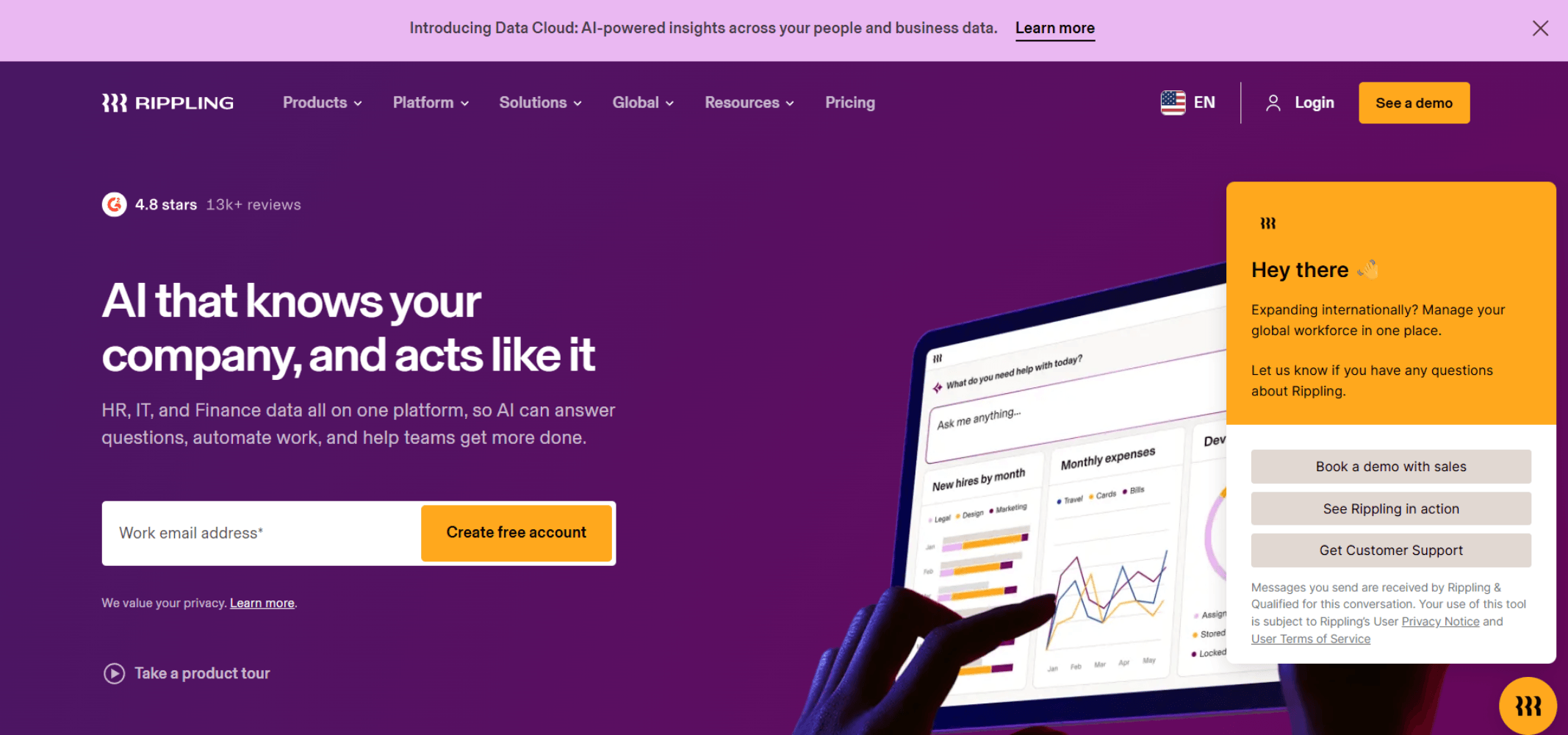
Rippling was built from the start as a unified workforce platform covering HR, IT, and Finance. It added global capabilities on top of an existing HRIS spine. That architecture means Rippling can do things the other two cannot: order and configure laptops, manage software access and permissions, run US domestic payroll with benefits administration, and handle multi-state compliance. It genuinely extends beyond HR into IT management in a way that Deel and Remote do not.
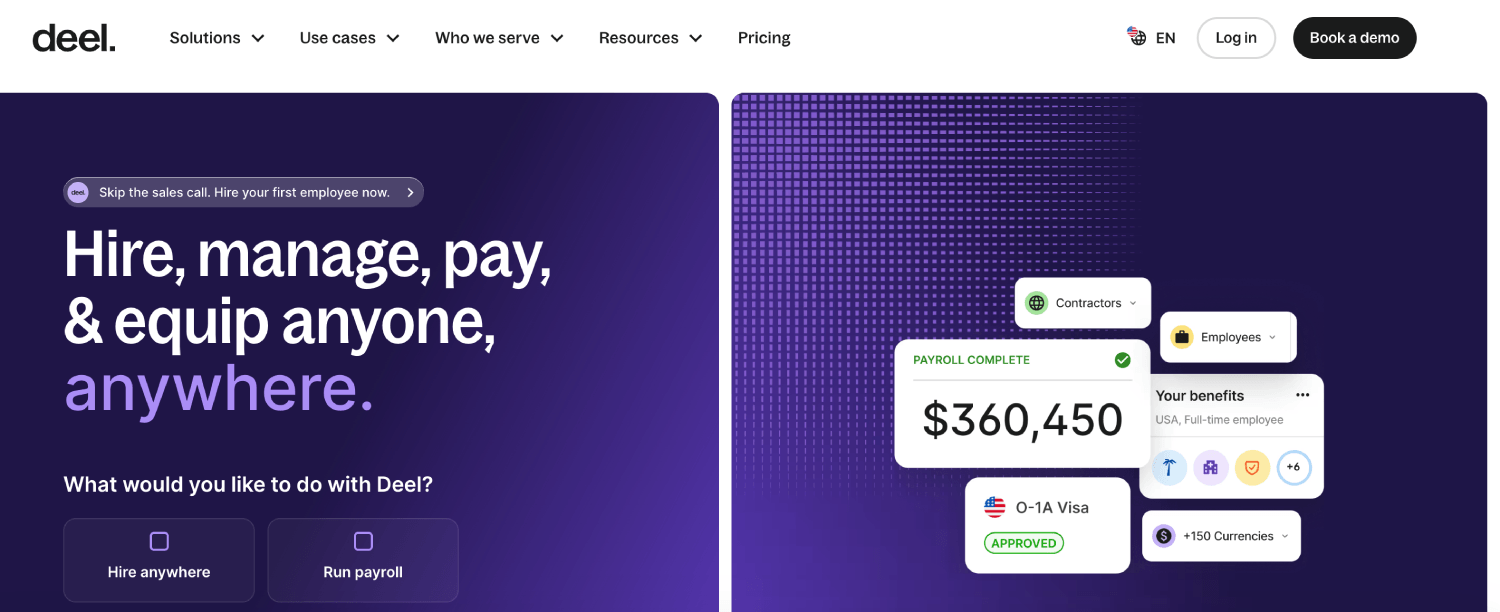
Deel was built around the contractor and EOR use case first. Its core strength is speed: onboarding a contractor or EOR employee in a new country quickly, with built-in compliance for local labor law. Deel has added HRIS modules, but those modules sit on top of a payroll and compliance infrastructure rather than a true HR system of record. The platform also offers Deel HR, a free HRIS for companies using Deel for payroll.
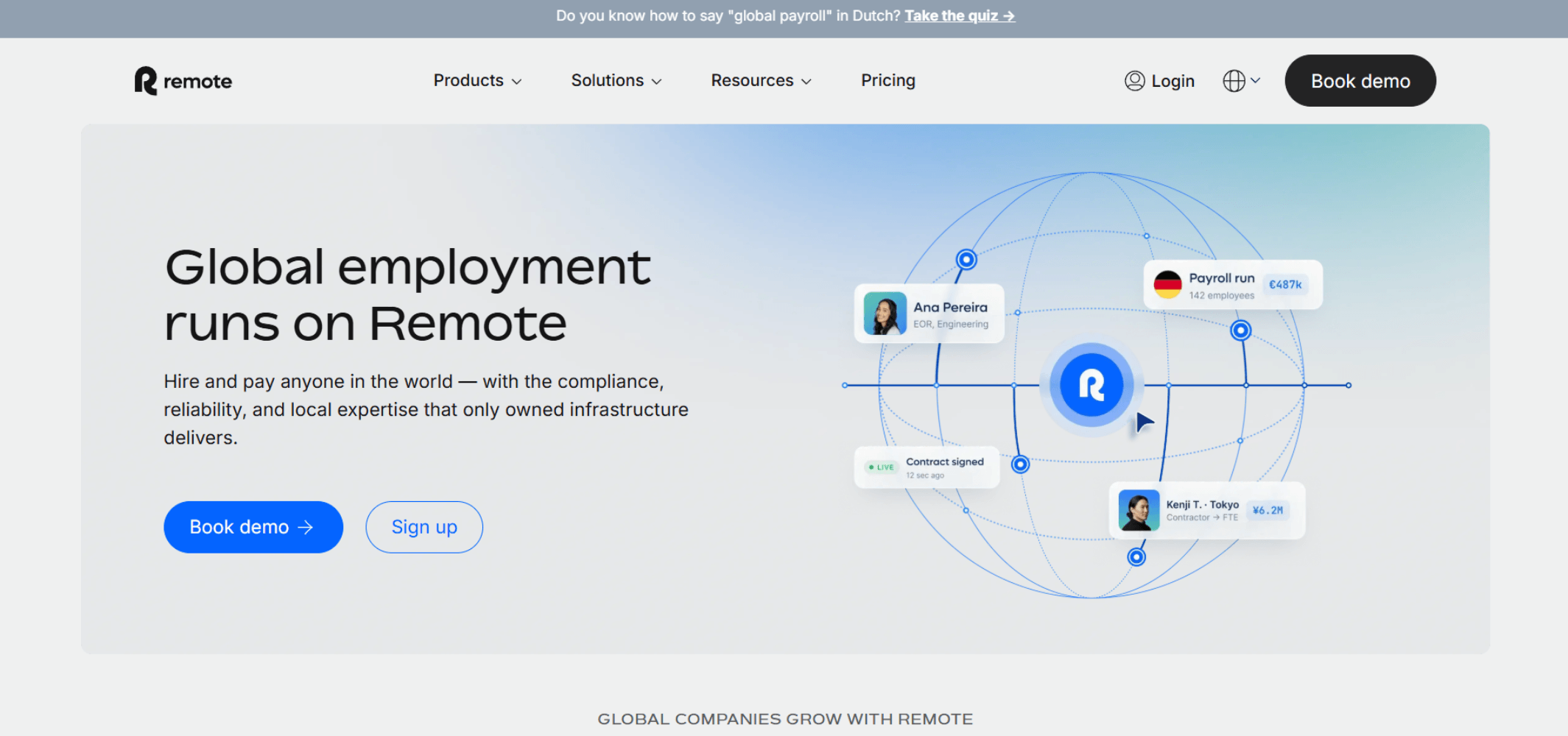
Remote made a deliberate architectural bet: own the legal entities in every country where it offers EOR, rather than subcontracting to local partners. That choice has direct implications for liability, consistency of service, and IP protection. Remote does not offer the HRIS breadth of Rippling or the contractor volume tools of Deel, but its owned-entity model is a genuine differentiator for companies with strong compliance requirements.
All three platforms offer EOR services, but the delivery model varies in ways that matter.
| EOR Dimension | Rippling | Deel | Remote |
|---|---|---|---|
| Entity ownership model | Mix of owned entities and local partners | Mix of owned entities and local partners | Primarily owned entities |
| Country coverage | Per Rippling’s global payroll page | Per Deel’s pricing page | Per Remote’s pricing page |
| EOR pricing transparency | Quote-based | Listed publicly on pricing page | Listed publicly on pricing page |
| IP and equity protection | Standard | Standard | Explicit IP protection built into contracts |
| Contractor management | Yes, through Rippling Global | Core product strength | Yes, included |
| Domestic US payroll | Full-featured | Available | Limited |
Remote’s owned-entity approach means the company is the direct employer in most countries, not a local partner. For companies worried about inconsistent service quality across markets or about IP ownership when hiring engineers abroad, that distinction is real. Deel’s geographic coverage is the widest of the three , verify current country counts on each vendor’s pricing page, as these figures change frequently. Rippling’s EOR offering is solid but priced on a quote basis, which makes apples-to-apples cost comparison harder at the evaluation stage.
Pricing transparency is one area where the three platforms diverge significantly.
According to Deel’s public pricing page, EOR services are priced at $599 per employee per month. Contractor management starts at $49 per contractor per month. Deel HR (the standalone HRIS) is available at no cost for companies using Deel for payroll. Global payroll for employees in entities you own starts at $29 per person per month.
According to Remote’s public pricing page, EOR pricing starts at $599 per employee per month, with contractor management available at $29 per contractor per month. Global payroll for owned-entity employees is also available at a per-seat price.
Rippling’s pricing is not publicly listed in the same way. According to Rippling’s pricing page, plans are quote-based, and pricing depends on the modules selected. Rippling is modular by design, meaning you pay for HR, IT, and Finance workloads separately, which can produce a much higher total bill than a point solution but also more capability per dollar if you are replacing multiple tools.
The honest framing: Deel and Remote are cheaper if you need EOR only. Rippling costs more in total but replaces more tools. The comparison is not fair at the module level because the platforms are not competing on the same scope.
Rippling is the clear answer here, and it is not close. Rippling’s HRIS includes onboarding workflows, org chart management, document storage, time and attendance, PTO policies, benefits administration for US employees, compensation management, and reporting. It is a genuine system of record for people data. Teams that want to run all of US HR, plus international payroll, through one platform will find Rippling’s HRIS the most complete of the three.
Deel’s HRIS modules cover the basics: employee profiles, document management, time off, org charts, and reporting. Deel HR is a reasonable free HRIS for companies already using Deel for payroll, but it is not a replacement for a full HRIS at the 200-plus employee range. Performance management, compensation benchmarking, and advanced analytics are thinner than on Rippling.
Remote’s people management features are the most limited of the three. Remote is not trying to be your system of record for all HR data. If you are using Remote, you will likely still need a separate HRIS like one of the mid-market HR platforms for your core people operations. Remote works best as a layered EOR and global payroll solution on top of an existing HR stack, not as a replacement for one.
Contractor management is Deel’s home turf. The platform was built on it, and it shows. Bulk contractor onboarding, localized contracts across a wide range of countries, automated invoice approval workflows, and multi-currency payments are all strong. Companies managing large contractor networks across many countries will find Deel’s tooling more purpose-built than the alternatives.
Remote handles contractor payments competently and at a lower per-contractor price than Deel, according to their respective public pricing pages. Remote’s contractor offering is simpler but covers the core use case well. For companies with a small contractor footprint who mainly need EOR, Remote’s contractor pricing is attractive.
Rippling’s contractor management exists but is not the platform’s differentiator. Where Rippling stands out on the global payroll side is in consolidating international payroll with US domestic payroll in a single run. That matters a great deal for ops and finance teams tired of reconciling payroll across multiple systems. If your payroll team runs domestic and international payroll today and wants one place to do both, Rippling is the most coherent answer.
For most HR platforms, the answer to IT management is “we integrate with your IT tools.” Rippling’s answer is “we are your IT tool.” Rippling can manage devices, configure software access, enforce security policies, and deprovision accounts when employees leave, all from the same dashboard where you run payroll and onboarding. This is a genuine differentiator that Deel and Remote do not match.
Whether this matters depends entirely on your company’s size and IT maturity. A 40-person startup without a dedicated IT function will find Rippling’s unified approach genuinely useful. A 500-person company with an established IT team using Jamf, Okta, and a proper MDM solution probably does not need Rippling’s IT features and should evaluate it on HR and payroll merits alone.
Deel and Remote do not offer device management. They integrate with identity providers and HRIS platforms but are not competing in the IT management space.
Every EOR platform presents compliance as a core value proposition, but the underlying mechanics differ. When an EOR uses third-party partners in a given country, your employee is technically employed by a local entity that the EOR has contracted with. Service quality, response time, and liability can vary by market. When an EOR owns its entities, the platform has more direct control over the employment relationship and the compliance infrastructure.
Remote’s owned-entity model is its clearest differentiator on compliance. For companies hiring in regulated industries, companies with significant IP risk from international engineering hires, or companies that have had bad experiences with EOR partner quality inconsistency, Remote’s approach addresses a real problem. Remote also includes explicit IP protection and non-disclosure language in its standard employment agreements, which is not a universal practice across EOR providers.
Deel’s compliance infrastructure is broad given its wide country footprint, but some of that coverage relies on local partners. Deel’s legal team and compliance documentation are substantial, and the platform has built-in misclassification risk assessment tools. For companies whose primary concern is speed of hiring with reasonable compliance coverage, Deel’s model is defensible.
Rippling’s compliance posture is strong for US domestic employment, with multi-state payroll compliance built in. On the international EOR side, Rippling’s compliance approach is comparable to Deel’s. For companies with heavy US compliance complexity (multi-state payroll, benefits compliance, FLSA considerations), Rippling’s domestic-first architecture is a real advantage over the other two. If compliance concerns are top of mind for your buying committee, the AI-assisted HR compliance tools that layer on top of any of these platforms are worth evaluating separately.
The right answer depends on three variables: your hiring model, your US payroll complexity, and how many tools you want in your stack.
| Company Profile | Best Fit | Why |
|---|---|---|
| US-HQ company scaling internationally, wants one platform for everything | Rippling | Full HRIS plus domestic plus global payroll in one system; IT management included |
| Startup with large contractor network in many countries | Deel | Best contractor tooling, widest country coverage, transparent pricing, fast onboarding |
| Company hiring full-time employees in regulated or high-IP-risk markets | Remote | Owned entities, built-in IP protection, consistent compliance standards |
| Company expanding into 10+ countries with diverse hiring types | Deel | Largest country footprint, handles EOR, contractors, and global payroll at scale |
| Series B/C company with complex US benefits and multi-state payroll | Rippling | US payroll depth + benefits administration + HRIS in one platform |
| Company using an existing HRIS, needs EOR only | Remote | Clean EOR layer, owned entities, straightforward pricing, does not force HRIS replacement |
Deel is the fastest to implement of the three. Its onboarding process for new EOR hires and contractors is designed for speed, with guided workflows and 24/7 support via chat, email, and phone , a setup reflected consistently across Deel’s own product documentation and user reviews on G2 and Capterra. For a company that needs to hire someone in a new country within two weeks, Deel’s implementation timeline is a real advantage.
Rippling’s implementation is more complex because the platform scope is larger. Implementing Rippling fully means migrating payroll data, configuring HR modules, connecting IT systems, and training HR, finance, and IT teams. That is a meaningful project. The payoff is a more complete system, but buyers should plan for a longer rollout. If you are switching from a legacy payroll provider, the complexity of a payroll migration should factor into your timeline planning. The right payroll migration consultant can reduce that risk substantially.
Remote’s implementation sits between the two. It is not as fast as Deel for bulk contractor onboarding, but also not as complex as Rippling’s full platform rollout. Companies adding Remote as a dedicated EOR layer on top of an existing HRIS can typically get up and running relatively quickly.
Rippling’s integration catalog is one of its strongest selling points. The platform offers hundreds of integrations across HRIS, payroll, IT, identity management, benefits, and finance tools. If you are building a connected HR and IT stack, Rippling’s integration depth is hard to match. It also offers an open API for custom integrations.
Deel integrates with major HRIS platforms (including BambooHR, Workday, and HiBob), accounting tools, and equity management platforms. Deel’s integration layer is solid for a payroll and EOR platform but less comprehensive than Rippling’s across IT and operations tools.
Remote offers a narrower integration set focused on core HRIS and accounting connections. If you are running Workday, HiBob, or a similar platform as your system of record, Remote integrates without requiring you to replace your HR stack. That is consistent with Remote’s positioning as an EOR layer rather than a full HR platform.
Comparing total cost of ownership across these three platforms requires being honest about scope. Comparing Deel’s EOR price to Rippling’s EOR price without accounting for the HRIS, IT management, and domestic payroll functionality that Rippling includes in its platform will produce a misleading number.
A more honest comparison: if you are currently paying for a standalone HRIS, a domestic payroll platform, and an EOR service separately, Rippling’s total cost may be competitive or even lower despite higher per-module pricing. If you only need EOR and contractor payments and already have an HRIS you like, Deel or Remote at their published rates is almost certainly cheaper.
For companies evaluating the broader HR software market, the HR software buying checklist covering 75 evaluation questions is a useful framework for mapping total cost of ownership before signing any contract.
In early 2025, Rippling filed a lawsuit against Deel alleging corporate espionage and violations of the RICO Act, claiming a Deel-directed spy had infiltrated Rippling and was sending confidential data to Deel. Reuters covered the filing at the time, and it received wide coverage across major business and technology outlets. Deel has disputed the allegations. The litigation is ongoing as of publication.
This is worth acknowledging because it has appeared prominently in search results and because buyers have raised it in vendor evaluations. At the same time, lawsuits between competitors are not unusual in competitive technology markets. Neither platform has been found liable at the time of writing.
What matters for a buyer is whether the litigation introduces meaningful business risk. Both platforms continue to operate, process payroll, and sign new customers. The practical risk for most buyers is reputational rather than operational. That said, enterprise buyers with legal teams should monitor the case and include standard vendor viability language in their contracts.
Deel is better for companies with large contractor populations, fast international hiring needs, and wide country coverage requirements. Remote is better for companies prioritizing owned legal entities, IP protection in employment contracts, and consistent compliance standards across markets. Deel has broader coverage; Remote has deeper entity ownership. If you are hiring full-time employees in high-risk IP markets, Remote’s owned-entity model justifies the narrower country list. If you are paying contractors across 30-plus countries, Deel’s tooling and coverage wins.
Deel is better than Rippling for international-first global payroll, especially for contractor-heavy teams or companies expanding into many countries quickly. Rippling is better for companies that need global payroll integrated with US domestic payroll and a full HRIS. According to Rippling’s own positioning, it was built to support both domestic and international workforces in one system, whereas Deel was built for international workforces primarily. Your geography mix and domestic complexity drive this decision more than feature parity.
Rippling filed a lawsuit against Deel in early 2025 alleging corporate espionage, claiming a Deel-directed spy had infiltrated Rippling and was sending confidential data to Deel. Rippling’s lawsuit accused Deel of violating the RICO Act and alleged the scheme was directed by Deel’s leadership. Reuters reported on the case when it was filed. Deel disputed the allegations. The case is ongoing. Neither company has been found liable. Buyers should track the outcome but should not base a platform decision solely on unresolved litigation.
Yes. Remote and Deel are direct competitors on EOR and contractor management. Both offer employer of record services, contractor payments, and global payroll. The key difference is entity ownership: Remote primarily uses its own legal entities in the countries it covers, while Deel uses a mix of owned entities and local partners. Remote covers fewer countries than Deel but offers more consistent compliance quality in the markets it does serve. For straightforward EOR, they are comparable; for wide coverage, Deel has the advantage.
For most mid-market companies up to 500 employees, yes. Rippling covers the core HRIS use cases: employee records, onboarding, org management, time and attendance, PTO, benefits administration, and reporting. It is not a replacement for enterprise HCM platforms like Workday or SAP SuccessFactors at the high end. For companies comparing HRIS options by stage, the best HRIS platforms for 500-employee companies provides a broader comparison set including Rippling alongside other mid-market options.
Deel is the fastest to implement for international contractor and EOR use cases. Remote is straightforward as an EOR layer on top of an existing HR stack. Rippling has the longest implementation timeline because it covers more functional scope: HR, IT, and payroll. The implementation complexity is proportional to the breadth. Companies replacing multiple systems with Rippling should plan for a multi-week implementation and consider working with an HRIS implementation partner to manage the rollout.
Deel has equity management features built into its platform, covering equity grants and vesting schedules for international employees. Rippling integrates with equity management tools but does not have native equity management at the depth Deel offers. Remote supports equity by including standard equity and stock option language in its employment agreements, though dedicated equity management requires a separate tool like Carta or Capdesk. For companies hiring internationally with complex equity structures, Deel has the most native equity tooling of the three.
Deel is the most practical starting point for a 50-person startup adding its first international hires. The pricing is transparent, setup is fast, and Deel HR provides a basic HRIS at no additional cost for companies using Deel for payroll. Rippling is worth evaluating if the startup also needs to manage devices and software access centrally. Remote is the right choice if the startup’s international hires are full-time employees in markets where IP protection and entity quality matter, such as Germany, the UK, or the Netherlands.
Start with your hiring model, not the pricing page. If your next 12 months involve US growth with scattered international EOR hires, Rippling gives you the most complete domestic-plus-global platform without forcing you to integrate multiple systems. If your next 12 months involve aggressive international expansion with contractors and EOR employees across many countries, Deel’s coverage and contractor tooling will serve you better. If your primary concern is full-time employee quality and compliance in a smaller set of key markets, Remote’s owned-entity model is worth the narrower country coverage.
The companies that regret their platform choice are usually the ones that bought on EOR price alone and later found they had outgrown the HRIS, or bought a full platform like Rippling before they actually had the workforce complexity to justify it. Honest self-assessment of where you are in 12 months, not just today, is the best input to this decision.
All three platforms are legitimate. None of them is obviously bad. The question is architectural fit, and that is a question only your team can answer once you are honest about what problem you are actually solving. If you are still mapping out your broader HR stack, the HR software implementation checklist is a practical next step before committing to any vendor.