
HR Tech SaaS may earn a commission when you buy through links on this page. Our recommendations are editorial and never paid for.
- Phenom vs Beamery vs Eightfold: three platforms that look similar from a distance but solve different primary problems , Phenom owns the candidate experience layer, Beamery owns workforce intelligence and planning, and Eightfold owns deep AI matching across the full talent lifecycle.
- Choosing the wrong one is not a features problem. It is a use-case alignment problem. Most buyers pick based on demo quality rather than architectural fit.
- All three are enterprise-grade and quote-only on pricing. None are appropriate for companies under roughly 1,000 employees unless you have a very specific problem to solve and budget to match.
- Internal mobility is the sharpest differentiator. Eightfold leads on AI-driven skill inference, Beamery leads on strategic workforce planning, and Phenom leads on employee-facing career pathing UX.
- If none of the three fit, 365Talents and Gloat are the most credible alternatives depending on whether your gap is skills intelligence or talent marketplace.
Phenom, Beamery, and Eightfold are three of the most capable talent platforms on the market and three of the most frequently confused. All three use AI for matching, all three cover both external recruiting and internal mobility, and all three sell into enterprise TA and HR leaders with similar language. A buyer who watches three demos in the same week will likely walk away feeling like they saw the same product three times. They did not.
What Do Phenom, Beamery, and Eightfold Actually Do?
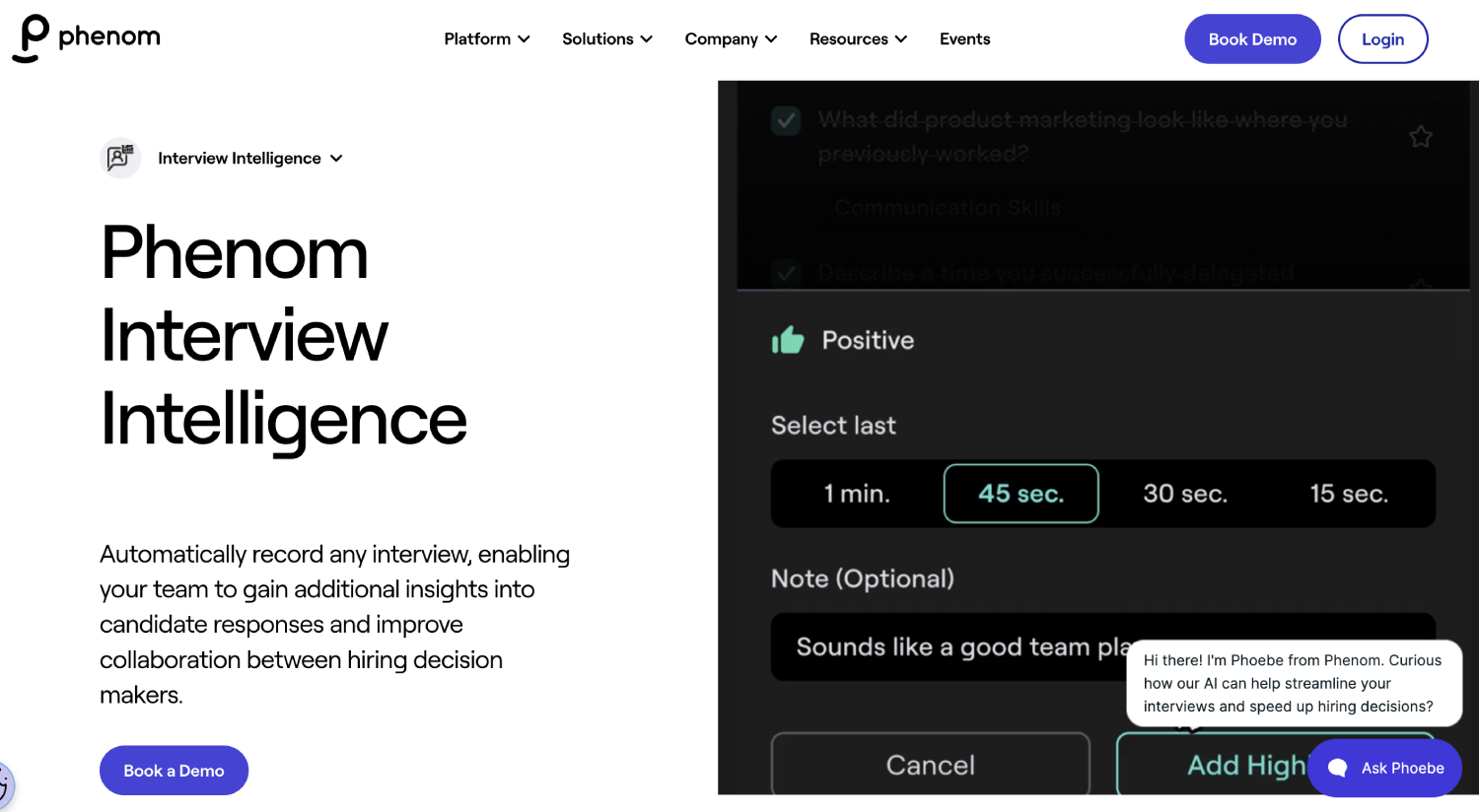
Phenom is a talent experience platform built around the candidate and employee experience. Its core product is a career site, CRM, and AI recruiting assistant layer that sits on top of existing ATS infrastructure. Phenom does not replace your ATS. It wraps around it to improve candidate experience, recruiter productivity, and internal career visibility.
Beamery starts from workforce intelligence. Its foundation is a talent graph that maps skills across your workforce, labor market data, and a CRM that feeds both external pipeline and internal mobility. Beamery acquired TalentEd in 2022 and has pushed harder into skills-based workforce planning than any of the three vendors here.
Eightfold AI is built around a deep-learning model trained on hundreds of millions of career trajectories. Its differentiator is the underlying AI: it infers skills from unstructured resume data, predicts career potential rather than just matching job descriptions, and applies that model across sourcing, internal mobility, and workforce planning from a single data layer.
The architectural difference matters because it determines where each platform is strong and where it needs help from adjacent tools.
How Does Each Platform Handle Talent CRM?
Phenom’s talent CRM is its most mature capability. The platform was built CRM-first, and it shows. Recruiters get campaign tools, talent pool segmentation, automated nurture sequences, and pipeline analytics that rival dedicated CRM vendors like Avature. For teams with a large passive pipeline or high-volume hiring needs, Phenom’s CRM is the most recruiter-friendly of the three.
Beamery’s CRM is differentiated by its skills graph. Rather than just segmenting candidates by source or status, Beamery can segment by inferred skills, map external talent pools to internal workforce gaps, and connect CRM activity directly to workforce planning scenarios. The trade-off is that the recruiter-facing UX requires more configuration to get to Phenom’s level of day-to-day usability.
Eightfold’s CRM is the least standalone of the three. It exists as part of a broader talent intelligence layer rather than as a purpose-built recruiter tool. Sourcing is strong because the AI model surfaces non-obvious candidates from your ADB and external sources. But campaign management, nurture automation, and pipeline reporting are more limited than what Phenom ships out of the box.
| Capability | Phenom | Beamery | Eightfold |
|---|---|---|---|
| Talent CRM depth | Strong (built CRM-first) | Strong (skills-graph layer adds strategy) | Moderate (AI-led, less campaign tooling) |
| Candidate nurture automation | Strong | Moderate | Moderate |
| Pipeline analytics | Strong | Strong | Moderate |
| Skills-based segmentation | Moderate | Strong | Strong |
| External + internal CRM unification | Moderate | Strong | Strong |
Which Platform Has the Best Internal Mobility Module?
Internal mobility is where the three platforms diverge most sharply, and it is the most important question for any enterprise buyer whose mandate includes retention and skills-based workforce strategy.
Eightfold’s internal mobility product is the strongest on AI inference. It maps employee skills from résumés, performance data, and project history, then surfaces opportunity matches the employee would not find by browsing a job board. The model identifies potential for roles employees have never held, not just roles that match their current title. This is genuinely differentiated and reflects the depth of the underlying model. Based on SERP analysis of Eightfold’s positioning and alternatives coverage, Eightfold consistently appears as the primary shortlist candidate for companies above roughly 3,000 employees building a skills-based talent marketplace from scratch.
Beamery’s internal mobility sits within a broader workforce planning context. Rather than employee-facing career browsing, Beamery’s strength is helping HR and TA leadership model where skills gaps exist, identify internal candidates before external searches open, and connect mobility to succession. The employee experience layer is less polished than Eightfold’s, but the strategic planning tools are stronger.
Phenom’s internal mobility is the most employee-facing of the three. Employees get personalized career path recommendations, mentoring connections, and a gig/project marketplace. The UX is clean and the adoption tends to be higher because employees actually use it. For HR teams whose internal mobility problem is “employees don’t know what opportunities exist here,” Phenom solves that problem more directly than either of its competitors. For a deeper look at how these platforms stack up against dedicated internal talent marketplace tools, the best AI internal mobility platforms for enterprise talent teams covers the full category.
How Deep Is the AI in Each Platform?
All three vendors say AI. The meaningful question is: AI doing what, trained on what data, and applied where in the workflow?
Eightfold’s AI model is the most architecturally distinct. It is trained on a large corpus of career data and uses deep learning to infer skills from unstructured text, predict career trajectories, and match candidates to roles based on potential rather than keyword proximity. The skills inference works even when candidates have non-linear careers or job titles that do not map cleanly to role taxonomies. This is where Eightfold genuinely differentiates from the other two, and it is why enterprise buyers with complex skills environments consistently put it on the shortlist.
Beamery’s AI sits in the skills ontology and workforce planning layer. Its TalentGPT product (announced in 2023) applies generative AI to skills-based tasks like job description generation, career path modeling, and workforce scenario building. Beamery’s AI is strongest when you are trying to answer strategic questions about your workforce, not when you are trying to speed up recruiter workflows at the top of funnel.
Phenom’s AI operates across the candidate experience layer. It powers chatbot conversations, personalized job recommendations, interview scheduling, and recruiter-facing candidate scoring. Phenom’s AI is broad rather than deep. It does many things adequately across the talent lifecycle, but the underlying model is less sophisticated than Eightfold’s when it comes to skills inference and career potential prediction.
For HR leaders evaluating AI depth across this category, the best talent intelligence platforms comparison covers Eightfold, Beamery, and adjacent vendors including Findem and Gloat in a broader context.
What Are the ATS and HRIS Integration Requirements?
None of these platforms replace your ATS. Understanding how each integrates with your existing stack is not optional, it is a buying prerequisite.
Phenom has the broadest and deepest set of pre-built ATS integrations. It connects to Workday Recruiting, SAP SuccessFactors, Taleo, iCIMS, Greenhouse, Lever, and others. The integrations are bidirectional, meaning candidate activity in Phenom flows back into the ATS and ATS requisitions pull into Phenom. For teams already on Workday or SAP, Phenom has invested heavily in certified integrations and co-sell relationships with both.
Beamery’s integrations are strong at the HRIS level, particularly with Workday and SAP SuccessFactors, which is consistent with its workforce planning positioning. ATS integrations exist but are less of a selling point because Beamery’s value is upstream of individual requisition workflow. Teams using Beamery for workforce planning may run it alongside an ATS without expecting deep bidirectional sync.
Eightfold integrates with major ATS and HRIS platforms but operates more as a parallel intelligence layer. The integrations pull data in to build the talent graph and push recommendations back, but the actual hiring workflow typically still lives in the ATS. For Workday shops specifically, the Workday AI vs Eightfold vs Gloat comparison covers how these platforms coexist with native Workday talent features.
Who Is Each Platform Actually Built For?
Phenom fits best at enterprise companies in the roughly 1,000 to 10,000 employee range where the primary pain is candidate experience, recruiter productivity, and employee retention through internal career visibility. (The lower bound reflects Phenom’s own positioning toward mid-to-large enterprise, where career site and CRM investment makes economic sense.) Retail, healthcare, and financial services companies with high-volume hiring programs and complex career sites are a natural fit. Phenom also works well alongside a strong ATS that handles requisition workflow while Phenom handles the candidate-facing experience layer.
Beamery fits best at companies where workforce planning and skills strategy are board-level priorities. Think global enterprises undergoing workforce transformation, organizations moving toward skills-based hiring, or HR leadership teams that need to connect talent pipeline data to headcount planning. Beamery skews toward larger enterprises , its deal sizes and implementation scope are consistent with a buyer in the 5,000-and-above range, though the vendor does not publicly disclose a firm minimum. Beamery’s ideal buyer has a CHRO or CPO mandate on skills strategy, not just a TA team trying to fill requisitions faster.
Eightfold fits best at companies with high complexity on the skills side: technology companies, defense contractors, healthcare systems, or any organization where roles require non-obvious skill combinations or where internal talent redeployment is economically significant. Eightfold also leads for companies building a global skills taxonomy from scratch, because the AI model does the heavy lifting of skills inference rather than requiring the HR team to build and maintain a manual ontology. Based on SERP analysis of Eightfold alternatives coverage, companies in the 3,000 to 10,000 employee range should treat Eightfold as a primary shortlist candidate, while companies in the 200 to 3,000 range have more options to consider, including Phenom and 365Talents.
| Factor | Phenom | Beamery | Eightfold |
|---|---|---|---|
| Best company size (employees) | 1,000 to 10,000+ | 5,000 to 50,000+ | 3,000 to 50,000+ |
| Primary buyer | TA leader, CHRO | CHRO, VP People Strategy | CHRO, VP TA, CTO-adjacent |
| Primary use case | Candidate experience, recruiter efficiency | Workforce intelligence, skills planning | Deep AI matching, skills inference |
| Internal mobility strength | Employee-facing UX | Strategic planning layer | AI skill inference and matching |
| Implementation complexity | Moderate | High | High |
| Pricing model | Quote-only | Quote-only | Quote-only |
How Do the Platforms Handle Bias, Compliance, and AI Governance?
All three vendors operate in regulated territory. AI-driven candidate matching and skills inference are subject to increasing scrutiny under the EU AI Act, New York City Local Law 144, and equivalent rules in California and Illinois. Any buyer evaluating these platforms needs answers to specific governance questions before signing.
Eightfold has published more on responsible AI than the other two, likely because its AI model is more central to its product and therefore receives more external scrutiny. The vendor offers explainability tools that show why a candidate was matched or ranked. Buyers should still demand independent bias audit documentation and model monitoring commitments in the contract. Our AI HR compliance and bias audit tools guide covers the third-party auditing category that should sit alongside any of these platforms.
Beamery and Phenom both have published materials on responsible AI, but the documentation is less technically detailed than Eightfold’s. For EU-based buyers, all three vendors are operating in an environment where the EU AI Act classifies certain AI hiring systems as high-risk, which triggers conformity assessment requirements. Demand specific documentation on training data, model versioning, and audit rights from any vendor before purchase.
The practical question for a buying team is not just whether the vendor has an ethical AI statement. It is whether you can get contractual model monitoring, bias audit results, and explainability for individual decisions. Use the AI HR vendor evaluation checklist as a starting framework for these conversations.
What Are the Realistic Alternatives to These Three?
If you research “Eightfold AI alternative” or “365Talents vs Eightfold,” you are likely running into a genuine fit problem with one of these three platforms. Here is where the credible alternatives land:
365Talents is the strongest alternative if your primary need is skills intelligence and internal mobility in the 1,000 to 5,000 employee range. It is less expensive than Eightfold and more focused than Beamery. The AI is genuinely skills-centric rather than a keyword matching layer dressed up with AI branding. For European buyers, 365Talents has strong GDPR handling and is gaining traction in financial services and professional services firms across France, the UK, and the Netherlands.
Gloat is the strongest alternative if your primary need is an employee-facing internal talent marketplace rather than recruiter-facing sourcing intelligence. Gloat competes directly with Eightfold on internal mobility but positions as a talent marketplace rather than an intelligence platform. The Gloat vs Fuel50 vs Eightfold comparison covers this trade-off in detail.
Avature is the strongest alternative if your primary need is talent CRM and you want deep configurability. Avature does not have Phenom’s AI depth, but it is extremely configurable and has a loyal enterprise customer base. If Phenom’s approach to the candidate experience layer does not fit your workflow, Avature is worth a serious look.
SeekOut and Findem are strong alternatives if your primary gap is external sourcing and talent intelligence rather than internal mobility or workforce planning. Both compete more directly with LinkedIn Recruiter than with the full platforms compared here. The best AI sourcing tools and LinkedIn Recruiter alternatives covers this segment.
Frequently Asked Questions
Is Phenom an ATS replacement or an ATS add-on?
Phenom is an ATS add-on, not a replacement. It wraps around existing ATS infrastructure to improve candidate experience, career site performance, recruiter workflow, and internal mobility. Phenom integrates with Workday Recruiting, iCIMS, SAP SuccessFactors, Greenhouse, and others. If you need a new ATS, Phenom does not solve that problem. If you have an ATS that manages requisitions but delivers a poor candidate experience and limited recruiter intelligence, Phenom addresses that gap directly.
Can Beamery replace a workforce planning tool like Visier or Workday Planning?
Beamery is not a direct replacement for dedicated workforce planning platforms like Visier or Workday Workforce Planning. Where Beamery adds something those platforms do not is external talent intelligence: connecting internal workforce skills gaps to external pipeline data and labor market signals. Beamery works best alongside an HRIS with workforce planning features, not instead of one. Think of Beamery as the skills and talent layer on top of existing workforce analytics infrastructure.
Does Eightfold work without a separate ATS?
Eightfold has an ATS module, so technically yes, it can operate as a standalone recruiting workflow system. In practice, most large enterprise buyers use Eightfold’s intelligence layer on top of Workday Recruiting or another established ATS, because migration risk and compliance requirements make replacing a mature ATS a large project on its own. Eightfold’s ATS is a real product but it is not the primary reason enterprise buyers choose the platform.
How long does implementation take for these platforms?
All three are enterprise software implementations. Phenom implementations typically run three to six months for a standard career site, CRM, and ATS integration scope. Beamery and Eightfold implementations are often longer because data quality requirements for skills mapping and AI training are more demanding. Budget for six to twelve months to reach full adoption across use cases. Implementation complexity is consistently underestimated on enterprise talent platform projects, and clean, structured HRIS data significantly accelerates the process.
How does Phenom compare to Paradox for AI recruiting?
Phenom and Paradox solve different problems. Paradox is a conversational AI platform known for screening automation and high-volume hiring workflows , the vendor has publicly emphasized its strength in hourly, retail, and service-sector hiring, though it also serves enterprise clients across other industries. Phenom is a broader talent experience platform that includes CRM, career site, internal mobility, and analytics alongside conversational AI. Companies choosing between them are usually solving different primary problems. The Paradox vs Phenom vs Humanly comparison covers this split in detail.
Is 365Talents a credible alternative to Eightfold for European buyers?
Yes, particularly for companies in the 1,000 to 5,000 employee range. 365Talents is purpose-built for skills intelligence and internal mobility, with strong GDPR compliance and a client base concentrated in European financial services and professional services. It lacks Eightfold’s depth of external sourcing intelligence and the breadth of its AI model, but for buyers whose primary problem is internal skills mapping and career pathing rather than external sourcing, 365Talents is a realistic shortlist candidate at lower cost and complexity than Eightfold.
What should I ask each vendor about their AI model before buying?
Ask four specific questions: First, what training data was used and how was bias tested in it? Second, can you provide explainability at the individual candidate or employee level, not just aggregate fairness statistics? Third, what is the model update cadence and how will changes to the model be disclosed? Fourth, what contractual audit rights do we have? Any vendor that deflects on these questions with marketing language about “responsible AI” rather than technical documentation is a risk. A vendor evaluation framework built for exactly these questions is available in the AI HR vendor evaluation checklist for CHROs.
The Decision Framework
The confusion between these three platforms comes from treating them as feature lists rather than architectural bets. Phenom is a bet on candidate experience and recruiter workflow. Beamery is a bet on skills-based workforce strategy. Eightfold is a bet on AI model quality as the primary differentiator. These are different bets, and the right one depends on what problem you are actually trying to solve.
If your TA team is losing candidates to a poor career site experience, losing productivity to manual outreach, and cannot tell which internal employees are ready for open roles, Phenom is the most direct solution. If your CHRO is being asked by the board to show how workforce skills align to strategic direction and where critical skill gaps will emerge over the next two years, Beamery is the better fit. If you are operating in a complex skills environment where the value is in finding non-obvious candidates and redeploying existing talent based on inferred potential rather than job title history, Eightfold is worth the implementation complexity.
All three are expensive, all three require significant implementation investment, and all three will deliver poor results if your underlying HRIS data is incomplete or your ATS integrations are poorly maintained. The platform you choose matters less than how well you can actually execute the implementation and adoption program behind it.